Showing posts with label white supremacy. Show all posts

Tuesday, May 08, 2018

National Memorial for Peace & Justice + Legacy Museum Now Open


National Memorial for Peace and Justice
Despite the fact that the US has a well documented history of nearly two and a half centuries of legalized enslavement (1640-1865/66), enshrined in the US  Constitution; nearly another century of legalized apartheid known as Jim Crow (1876-1960-1980s?) and multiple de facto forms of explicitly racialized and class segregation (continuing today); and centuries of racist terror and enforced white supremacist terror, policing, brutality, and violence against peoples of African descent (as well as Native Americans and other non-white peoples), there have been relatively few national or regional museums or monuments recognizing this terrible history.

The aftermath of a lynching
Across the US there (rightly) museums calling attention to the horrific Nazi Holocaust against Jewish people that occurred in Germany and across much of Europe from the 1930s through 1945. There are specific museums and commemoration cites honoring specific African American figures, regional events, and particular moments, like Civil Rights history. Yet until very recently, there were only a few general museums specifically recognizing African American history and culture, and almost none calling attention to the horrendous legacy of slavery, segregation and racialized terror, all of which have contributed in numerous ways to shaping the society in which all Americans live today.
A sculpture commemorating
the brutal history of chattel slavery
Thankfully, Americans and people from all over the globe are flocking to the architecturally stunning National Museum of African American History and Culture (NMAAHC) in Washington, which provides an exceptionally thorough overview and celebration of the richness of African American and Black life in the United States and North America. (I wrote about visiting the NMAAHC last February.) To the NMAAHC, as of a week ago you can also now visit a museum that acknowledges the legacy of lynching, one of the most horrific manifestations of racialized terror in American history, as well as chattel slavery and its many afterlives, which include the carceral state. The Legacy Museum: From Enslavement to Mass Incarceration, and the National Memorial for Peace and Justice, both projects of the Equal Justice Initiative (EJI), opened in Montgomery, Alabama 2 weeks ago on April 26, 2018. According to its website,
The Legacy Museum: From Enslavement to Mass Incarceration is situated on a site in Montgomery where enslaved people were once warehoused. A block from one of the most prominent slave auction spaces in America, the Legacy Museum is steps away from an Alabama dock and rail station where tens of thousands of black people were trafficked during the 19th century....

The 11,000-square-foot museum is built on the site of a former warehouse where enslaved black people were imprisoned, and is located midway between an historic slave market and the main river dock and train station where tens of thousands of enslaved people were trafficked during the height of the domestic slave trade. Montgomery's proximity to the fertile Black Belt region, where slave-owners amassed large enslaved populations to work the rich soil, elevated Montgomery's prominence in domestic trafficking, and by 1860, Montgomery was the capital of the domestic slave trade in Alabama, one of the two largest slave-owning states in America.

and
The National Memorial for Peace and Justice, which opened to the public on April 26, 2018, is the nation’s first memorial dedicated to the legacy of enslaved black people, people terrorized by lynching, African Americans humiliated by racial segregation and Jim Crow, and people of color burdened with contemporary presumptions of guilt and police violence.

Work on the memorial began in 2010 when EJI staff began investigating thousands of racial terror lynchings in the American South, many of which had never been documented. EJI was interested not only in lynching incidents, but in understanding the terror and trauma this sanctioned violence against the black community created. Six million black people fled the South as refugees and exiles as a result of these "racial terror lynchings."

This research ultimately produced Lynching in America: Confronting the Legacy of Racial Terror in 2015 which documented thousands of racial terror lynchings in twelve states. Since the report’s release, EJI has supplemented its original research by documenting racial terror lynchings in states outside the Deep South. EJI staff have also embarked on a project to memorialize this history by visiting hundreds of lynching sites, collecting soil, and erecting public markers, in an effort to reshape the cultural landscape with monuments and memorials that more truthfully and accurately reflect our history.

African Americans re-enslaved
through convict leasing
The Equal Justice Initiative (EJI), established by public interest lawyer, author and MacArthur Foundation "genius" award-winner Bryan Stevenson in 1989, was long known for its impressive work providing legal aid to innocent death row prisoners and successfully exonerating a number of them, as well as its manifold efforts on behalf of economically and socially marginalized communities across the US. As Stevenson looked at the history of the US prison-industrial complex, the school-to-prison pipeline and unequal applications of justice that African Americans faced, and the larger, profoundly skewed narrative about race in the US, he realized that one component of maintaining the structures and systems that allowed this narrative to take root was the absence of public recognition of the history that had helped to create it and the structures of oppression now in place, and one key element was the occluded history of US lynching, which usually went unpunished by federal or state authorities--and in the case of the latter, often had their complicity or tacit acquiescence--and which helped to support and further white supremacy and inequality.

Newly freed African Americans
in the post-Civil War era
Moreover, the absence of public museums and venues commemorating this history have helped in allowing narratives of white and national innocence to take hold; what the public doesn't know cannot exist, right? Out of site, out of mind. It only happened down there or far away, etc. Slavery ended and that was the end of it, right? Furthering this, the absence and silencing of the names of the more than 4,000 lynched, of their stories and voices, their families' and communities' traumas, except in specific works of art (films, photographic exhibits, works of fiction and nonfiction, etc.), has allowed the horror to become abstracted and thus, to a certain degree, ignored and dismissed. And yet, it waters the very soil and sand on which every American treads, much as the dispossession, forced removals and slaughter of Native Americans, to name but another frequently obscured component of US history does as well.

Stevenson and a group of fellow lawyers spent years delving into this history, combing through archives to notate names and stories of lynchings across the South, and documented roughly 4,400 across the South (though there were lynchings all over the US, including in the North and West), from 1877 to 1950, which are featured at the Memorial site. As a result, the National Memorial for Peace and Justice redresses this long silencing and invisibility; its architecturally striking building housing the tribute to those who were lynched and the site on which it sits have drawn considerable praise. The latter venue was inspired by the unforgettably powerful Holocaust Memorial in Berlin, and by the Apartheid Museum in Johannesburg. To quote The New York Times's Campbell Robertson

At the center is a grim cloister, a walkway with 800 weathered steel columns, all hanging from a roof. Etched on each column is the name of an American county and the people who were lynched there, most listed by name, many simply as “unknown.” The columns meet you first at eye level, like the headstones that lynching victims were rarely given. But as you walk, the floor steadily descends; by the end, the columns are all dangling above, leaving you in the position of the callous spectators in old photographs of public lynchings.

The magnitude of the killing is harrowing, all the more so when paired with the circumstances of individual lynchings, some described in brief summaries along the walk: Parks Banks, lynched in Mississippi in 1922 for carrying a photograph of a white woman; Caleb Gadly, hanged in Kentucky in 1894 for “walking behind the wife of his white employer”; Mary Turner, who after denouncing her husband’s lynching by a rampaging white mob, was hung upside down, burned and then sliced open so that her unborn child fell to the ground.
At the second site, the Legacy Museum makes the connection between the slavery and apartheid past and the present prison system, showing how the past evolved into a system that continues to wreak havoc on countless Black and brown lives. As the Times article notes, the Museum guides the visitor through the compelling argument that Stevenson have made for how this system is still operating, ending on the hopeful note encouraging voter registration and political activism. Like the NMAAHC, where I witnessed groups of students eagerly queuing up to visit, the Legacy Museum and National Memorial for Peace and Justice should be obligatory sites for American school children to spend time and study. Given the current state of our politics and society, the US can only benefit as a result.


The Guardian interviews museum founder Bryan Stevenson:

Friday, January 22, 2016

Oscars Whiteout (Again)

Who really cares about the Oscars? Clearly some of us care about the Oscars. Should we care about the Oscars? Should we care about the fact that the #Oscars(Are)SoWhite--again?

For the second year in a row, the Academy of Motion Picture Arts and Sciences, the organization that awards out the annual gold-plated Oscar statuettes, considered the pinnacle of the multibillion-dollar American film industry's honors, have nominated an all-white slate of actors in the Best and Supporting categories. Ten slots, ten white women and men, and even in two films, Creed and Straight Outta Compton, with black leading actors, only a white supporting actor and the white scriptwriters respectively received nominations. No leading actors of other races or ethnicities were nominated, nor were any films in which they played the leading roles.

While this might not have drawn much notice fifty years ago in 1966 (which in fact did have an all white roster of nominees) or, in 1936 (unsurprisingly), closer to the Oscars' establishment in 1929, it does stick out in 2016, at a time when the United States is growing increasingly more diverse in racial, ethnic, religious, and other ways, and when industry figures themselves note that 46% of Hollywood movie ticket buyers in 2013 alone were people of color (designated as black, Latinx and "other" in the marketing study linked above), and Latinxs in particular are the most enthusiastic moviegoers. And the Academy has a black woman, Cheryl Boone Isaacs, as its president.

2013 in fact was supposed to be "turning-point year" for black filmmakers. In his The Dissolve article "New study puts numbers to the lack of minority representation in film," Vadim Rizov quotes producer Harvey Weinstein uttering a quintessentially post-racial (and deeply deluded) paean to America's changing political and thus social terrain, noting that the micro-burst of black directed and starred films "signals, with President Obama, a renaissance. He’s erasing racial lines. It is the Obama effect." How wrong he was and is. Hollywood cinematic representations lag behind those on TV, which has certainly improved since the heyday of the 1970s, and those "racial lines" Weinstein spoke of are as present today as they were in 2013 or before.

As it turns out, 2013 was more of a mirage than anything else. The USC Annenberg School for Communications and Journalism study that Rizov cites makes clear, diverse racial and ethnic representation in Hollywood cinema is still a problem:

Examining 500 top-grossing films released in the U.S. from 2007 to 2012, the study considers some 20,000 characters and finds diversity is sorely lacking. “Across 100 top-grossing films of 2012, only 10.8 percent of speaking characters are Black, 4.2 percent are Hispanic, 5 percent are Asian, and 3.6 percent are from other (or mixed race) ethnicities,” the paper notes at the outset. “Just over three-quarters of all speaking characters are White (76.3 percent). These trends are relatively stable, as little deviation is observed across the five-year sample.”

I observe this not only when I catch previews during my increasingly rare visits to see movies in theatrical release but on TV, where film after film appears to reflect a very narrow, usually white, upper-middle-class, coastal perspective. Innumerable stories not just from the present but the past remain offscreen, at least those screens commandeered by Hollywood studios. Non-traditional casting has improved somewhat, but people of color are still relegated to secondary or subsidiary, and often stereotypical roles, and even though blackface performance thankfully is rare to nonexistent in Hollywood these days, whitewashing source characters happens regularly, and yellowface characterizations crop up. Far more frequent, though, are stereotypes.  Quoting Rizov again:

Among the other conclusions reached: “Hispanic females are more likely to be depicted in sexy attire and partially naked than Black or White females. Asian females are far less likely to be sexualized.” While women got assigned the same kind of domestic status regardless of their race or ethnicity, “Hispanic males are more likely to be depicted as fathers and relational partners than males in all other racial/ethnic groups. Black males, on the other hand, are the least likely to be depicted in these roles.”

Some actors of color, like Kevin Hart--who has become the current go-to black sidekick-enabler in comedies--continue to make careers out of this situation. What exacerbates the problem is the lack of diversity behind the camera, with the ratio of white directors dwarfing directors from any other racial background. Thinking intersectionally, given the sexist and ageist challenges women in Hollywood still face (articulated without intersectionality last year by Patricia Arquette and again this year by media darling Jennifer Lawrence), things are even worse for women of color.

Meanwhile certain plotlines, including "white men battling adversity"; an older white man paired with a younger white woman; younger upper-middle-class white people facing relationships hurdles; and all or mostly white historical scenarios characterize a great many of the plots of Hollywood films. Yes, pace Vladimir Propp, there are a limited number of plots out there, but still a far greater array of narrative configurations, inflected by cultural difference, which is to say stories and experiences, in the US and across the globe, that rarely if ever make it through Hollywood's system.

Sylvester Stallone and Michael B. Jordan
in Creed (moviepilot.com)
This imaginative narrowness, which I would only partially chalk up to racism, only magnifies the inequities the Academy members' racial and gender makeup (94% white and 77% male) and voting patterns produce. Fewer and less culturally and narratively diverse film opportunities mean fewer roles in which actors of color appear on screen, whatever their acting skill level. I should also note that most of the black actors who have won Oscars in recent years have usually been honored for performances involving strong elements of abjection and spectacle, which also points to Academy voting biases.

Ultimately it comes back to gatekeepers at all levels of the movie industry who fail to approve and advance scripts and films that might offer a richer portrait of the society, or who tend to view issue of race and ethnicity, religious difference, and so on, through a narrow lens, are one major source of the problem. The revelations emerging from the Sony hack made this very clear. Moviegoers who support the status quo are another, but while it is conceivable that Americans could boycott Hollywood standard offerings (and excuses), films are a global business, circulating from Canada to Argentina, the UK to South Africa, Russia to New Zealand--and China is the largest single market of all. Hollywood's representations are not just a domestic problem.

Actress Jada Pinkett Smith, supported by her husband actor and musician Will Smith, who starred in the film Concussion (which I did not see) and did not garner a nomination this year, has called for a boycott of the Oscars ceremony, as has director Spike Lee. Actor and comedian Chris Rock, the event MC, may be considering boycotting the proceedings as well, though it appears he will show up and, I hope, skewer the debacle. Other actors, including 2013 Academy Award winner Lupita Nyong'o and actor Idris Elba have called out the movie and TV industry's failings, and in the Briton Elba's case, the UK's parallel problems with cinematic and TV racial representations.

April Reign, creator of the #OscarsSoWhite hashtag, has challenged one of the default excuses behind the film industry's ongoing whiteout, male domination and this and the previous year's nominations: "Don't tell me that people of color, women can't fill seats." But Hollywood, which pays attention to the bottom line, apparently isn't as concerned about who fills those seats as it is with endlessly replicating its tiny store of self-regarding visual narratives. It's not about the money, but rather systemic and structural problems that need to be dismantled completely. Perhaps beginning with a boycott of the Oscars this year, and from now on all movies with retrograde casting approaches and stories.

As important, filmmakers, actors and movie audiences must proactively devise ways to build systems to enable domestic filmmakers of color to create, distribute and screen not just more, but better films, and perhaps if people desire an awards system, as in the case in the literary world and other artistic areas, create that as well. The technology is increasingly there, as are the rival film bases Bollywood and Nollywood (whose films I increasingly watch). Given that Hollywood's earnings have taken a dip in recent years, the studios will change--or they'll realize too late that they could have but did not.

Tuesday, January 05, 2016

Quote: Alexander G. Weheliye

"I emphasize the family ties between political violence and suffering not because they are nobler or more worthy than other forms of suffering, but because they usher us away form the liberal notion of wounding that that is at the core of modern western politics and culture. Given the prominence of political violence within the histories of colonialism, indigenous genocide, racial slavery, internment, de jure segregation, and so on, black studies and other incarnations of racialized minority discourse offer pathways to distinctive understandings of suffering that serve as the speculative blueprint for new forms of humanity, which are defined above all by overdetermined conjurings of freedom. Overall, I am asking whether there exists freedom (not necessarily as a commonsensically positive category, but as a way to think what it makes possible) in this pain that most definitely cannot be reduced to mere recognition based on the alleviation of injury or redressed by the laws of the liberal state, and if said freedom might lead to other forms of emancipation, which can be imagined but not (yet) described."
- Alexander G. Weheliye, Habeas Viscus: Racializing Assemblages, Biopolitics, and Black Feminist Theories of the Human, Durham: Duke University Press, 2014, pp. 14-15.

Friday, June 19, 2015

Racism, American Culture and the Massacre at Emanuel AME Church in Charleston

No sanctuary in this society, it seems, none. Not in our homes, not in the streets, not behind the wheel, not in a store, not in public swimming pools, not even in our churches. Nowhere in this country, it seems, can black people not live and breathe and simply be without fear of being hunted down, beaten, brutalized, killed.

Emanuel A.M.E. Church
On Wednesday the nation and world witnessed another example of this fact when a 21-year-old white terrorist massacred nine black people in the historic Mother Emanuel African Methodist Episcopal Church in Charleston, South Carolina. The Rev. Clementa Pinckney, 41, a South Carolina state senator, who had welcomed the murderer into the church to participate in a Bible study session, was among the slain, as were Rev. Sharonda Coleman-Singleton, 45, a mother of three and a high school track coach; Cynthia Hurd, 54, a librarian at St. Andrews Regional Library of the Charleston County Public Library; Tywanza Sanders, 26, a recent graduate of Allen University and barber, who had attempted to shield his 87-year old aunt, Susie Jackson; Myra Thompson, 59, the wife of the vicar of the Holy Trinity Reformed Episcopal Church; Ethel Lee Lance, 70, a cousin of Susie Jackson and a longtime member of the church; Rev. Daniel L. Simmons, 74, a ministerial staff member at the church; and Rev. DePayne Middleton Doctor, 49, a minister, member of the church choir, and mother of four. Tywanza Sanders' mother and a 5-year-old child played dead to survive

The terrorist, Dylann Storm Roof, of Columbia, South Carolina, fled the scene and was on the loose before being taken into custody in Shelby, North Carolina, after a florist spotted his car and called authorities.

While it is unknown why Roof chose the Emanuel AME Church, the oldest AME congregation in the South, founded in 1816, the church does have a long and visible civil rights history dating back to the 19th century, and Roof specifically asked for Rev. Pinckney and sat next to him. Among its early members, who included enslaved and free blacks, was Denmark Vesey, who attempted a slave revolt in 1822 before being betrayed, after which the church was burnt to the ground, its rites thereafter being conducted in secret until after the US Civil War. Over the years the Reverend Dr. Martin Luther King Jr. had visited the church, which played an important role in civil rights organizing the city and state, to champion black South Carolinians' right to vote, and his widow, Coretta Scott King, addressed and then led participants in a march for hospital workers' rights. Its leader, Rev. Pinckney, had pushed for body cameras for police officers in the wake of the shooting of Walter Scott in North Charleston earlier this year. Before the shooting, Rev. Pinckney and the other Bible study participates openly welcomed Roof into their session, where he allegedly sat for an hour, disagreeing with the readings of Scripture, before opening fire and killing nearly everyone there in cold blood. According to a survivor, he also reportedly told those he massacred that, "I have to do it. You're raping our women and taking over the country. You have to go." Once apprehended, he confessed to the murders
Historical marker
(National Park Service)
After his arrest, journalists and online commentators pieced together clues showing the terrorist clearly had expressed anti-black racist, white supremacist sympathies and behavior. Roof's Facebook profile, which suggests he had a number of black "friends," shows him in one photo wearing a jacket with the flags of apartheid-era South Africa and Rhodesia, both of which are considered racist symbols, while in another he perches over an ornamental license plate featuring the Confederate flag. Friends of Roof, including former classmates, a childhood friend, and his roommate, have since told authorities that he was known to make racist comments in high school, was ranting about Trayvon Martin and Freddie Gray, believed black people "were taking over the world" and sought racial segregation, was involved with "racist groups," wanted to launch a "race war," and yelled a racial epithet at and threatened to kill a black woman on the street. Despite all of this, no one felt the need to alert authorities. His friend Joseph Meek Jr. even removed Roof's gun, but returned it at his girlfriend's suggestion because he, Meek, was on probation.

Most appallingly from the standpoint of lack of prevention, Roof's white roommate Dalton Tyler said that Roof had been planning a slaughter for "six months," and Christon Scriven, who is black and the resident of a trailer park that Roof regularly visited, said that Roof outlined his murderous plot last week. "He flat out told us he was going to do this stuff...he was looking to kill a bunch of people." Scriven thought Roof was just being "weird" and joking, a miscalculation with mortal consequences. Roof apparently had never finished high school and was unemployed. Reports also say that his parents gave him the money for a gun as a birthday gift, and he has said that he bought it. His prior run-ins with the law include an arrest at a Columbia mall for possession of an unprescribed controlled substance, the drug pain drug Suboxone, and a month later for trespassing at that same mall. According to several news articles, he had been partially raised and recently living with his sister in Lexington, South Carolina.

As church members and people across the country were mourning the slain churchgoers, leading Republicans, including South Carolina governor Nikki Haley, unsurprisingly sought to deflect the discussion away from the obvious causes of the slaughter, as did some conservative news sites, making a mockery of the horror, the facts, and of Christianity itself. Presidential candidate Hillary Clinton, who had just come from Charleston on a fundraising trip, stated that the country needed to face "hard truths about race, violence, guns, and division," though the issue in this case, as with the relentless state violence against black and brown Americans, the expanding carceral state, government-enabled inequality, US imperial action against nonwhite people all over the globe, and so much more, has been the system and structures of racism and white supremacy that pervade every aspect of American life

It is not "race" or "racial issues," but RACISM, particularly anti-black racism, black disposability, and white supremacy, that are the problem. It is exhausting to have to keep experiencing and witnessing the effects of racism much as it is to have to keep pointing this out, but it seems that far too many people would rather not deal with this reality and connect the dots, since doing so may implicate them and expose their own  privilege. President Barack Obama was, for his part, somewhat better, calling out American gun culture and our distinctive contemporary problem with mass murders, and historicizing attacks on black churches and people, though he also danced around invoking outright the beast of racism and racial domination, whose visible symbol, the Confederate flag, is still flying at full staff at the state capitol while the US and South Carolina flags were lowered in tribute to the dead. (And its continued presence at the capitol is, I should note, the result of a compromise with its promoters.) 

Rev. Sen. Clemente Carlos Pinckney
(1973-2015, Emanuel
A.M.E. Church)
Yet it is not just the South's blood-drenched standard, but the silences that stand in for the act of naming, decrying and dismantling this poison that has continued to course through the nation's veins since before the country's founding, and which renders the statements with which I started this blog post, of no sanctuary, anywhere, reality for millions. The Justice Department, under Attorney General Loretta Lynch, has announced a hate crime investigation into the attack. Yet the reality of living under the regime of racism and white supremacy in this country will not change, no matter how many federal hate crime investigations occur, unless we make a conscious effort to change things. Nor will we reduce the plague of gun-related murder, including mass murders, until we reform our gun laws and make it harder to get our hands on guns than than to acquire tickets to the Mayweather-Pacquiao fight. We have an immense standing military, funded to the tune of billions of dollars; we no longer need a "well regulated Militia" to maintain "the security of a free State." We must change this society for the better. We must. 

Despite their devastation and in the depths of their grief, many of the family members of the slain churchgoers have already expressed love and forgiveness. One tangible way you show your sympathies is to sign ColorofChange's sympathy card. You also can help out Emanuel AME Church is by going to its website and offering a donation here.

Monday, May 18, 2015

On Vanessa Place, Gone With the Wind, and the Limit Point of Certain Conceptual Aesthetics

When it appeared in 1937, Margaret Mitchell's sole novel, Gone With the Wind, was a publishing sensation, selling one million copies in its first six months and winning its author that year's Pulitzer Prize for the Novel, as the fiction category was then known. The book would sell even more copies after the movie version, starring Vivien Leigh and Clark Gable, appeared in 1939 and won its own spate of highest honors, among them Academy Awards for Leigh as Best Actress for her portrayal of Southern belle Scarlett O'Hara; for Victor Fleming as Best Director; and for Selznick International Pictures and Metro-Goldwyn Mayer as the Best Film of the Year. The Academy also broke new ground by nominating, for the first time, and awarding the Oscar to an African American, actress Hattie McDaniel, who reprised Mitchell's novel's "Mammy," who was not just a character in the novel and film but a social archetype and offensive stereotype, with deep roots in the white Southern and broader American racist imaginary. That stereotype, it cannot be emphasized enough, still resonates today.

The film remains an icon of American cinema, its characters, its quotations, and its portrayal of the Civil War and its aftermath seared into the national--and international--consciousness, much like its ideological predecessor, D. W. Griffith's 1915 film, Birth of a Nation, based on white supremacist and arch-segregationist Thomas Dixon's novels, had done with the Reconstruction period in the South. It is not going too far to say that Gone With the Wind's images, its themes, and its revisionist master narrative, like other forms of racist ideas, and visual and material culture, including Blackface minstrelsy, have suffused American popular culture, and exist just beneath the surface of a good portion of what we still see today onscreen and in books. Both Mitchell's novel and the film Gone With the Wind are racist and revisionist in ideological terms, infused with a "Lost Cause," anti-Unionist perspective that can be traced directly back to its author's and the larger Southern society's belief in and justifications for the Confederacy. As that seditionist state's former Vice President, Alexander Stephens, underlined in his Cornerstone Speech of May 1861 in Savannah, Georgia, "[the Confederacy's] foundations are laid, its cornerstone rests, upon the great truth that the negro is not equal to the white man; that slavery, subordination to the superior race, is his natural and normal condition." There you have it, white supremacy and anti-black racism in distilled form, from the viper's mouth itself.

Gone With the Wind, in its cinematic version, retains many aspects of the novel, down to direct quotations of the text, but it is one thing to watch Scarlett, Rhett, Melanie, Ashley, Mammy, and Prissy, among others, cavorting on screen, often beguiling, sometimes cringe-inducing as the entire spectacle, especially the latter characters' scripted, stereotypical and caricatured actions may be, and it is another to read Mitchell's written text, which brims over with her historical revisionism, grotesque depictions of the enslaved African Americans, and her flawed renditions of black speech, including liberal use of the n-word. In 1937, such characterizations and language would have provoked few to no negative responses from white or many black readers, as the book trafficked in white American literary and cultural conventions; today, in a novel or story collection, they would, I trust, spark criticism from critics of all races. That is, unless they were part of an ongoing "conceptual" project that mostly flies under the public radar, with some versions appearing in literary journals, and others in extended, durational form on social media platforms, in which case until someone noticed and paid attention to them, little if any criticism or critique might arise. Then all hell would break lose.

***

Conceptual art, or more accurately, conceptual artistic practices, have a long provenance that one might date back to various antecedents; from the perspective of Euro-American art, one could point back to Plato's ideal forms, or Kantian formalism, or various experiments in music, the plastic arts, or Medieval and Early Modern forms of group and appropriative writing, or to performances by Modernist and post-Modernist figures on multiple shores of the Atlantic, with the various iterations of Yves Klein, Happenings, Fluxus, socially engaged projects in the US, South America, Europe, and elsewhere, and more formal dematerialization practices and performances of the late 1960s through the 1970s marking "conceptual art" as an established category. In its many guises, conceptual art underlines one of Plato's central aesthetic insights, which is that art gains its power in part because it can be a vehicle for ideas and practices, which is to say, that ideas themselves can be incredibly powerful, and, as Plato warned, dangerous. 

However you chart the genealogy, conceptual practice remains a valuable path in contemporary imaginative culture. Not every conceptual project or action succeeds, however, and none exists outside a given framework or frameworks that do not automatically endow and invest it with value and meaning. Content, form, style, and the project's originators and practitioners (if there are any) matter as much as the contextual frame of the conceptual piece. For example, a conceptual project that plays on the idea of unspeakable but publicly objectionable ideas has a different meaning in a society in which types of speech are banned or criminalized by possible imprisonment or death than it does in a society in which all types of speech are possible, though liable to social sanction. To put it another, self-evident way, no conceptual project is value-free, and all are political in some manner or fashion.

In the case of Kenneth Goldsmith's March 16, 2015 Brown University performance, in which he "remixed" and "read" Michael Brown's autopsy report, the very fact that he, as a wealthy, socially privileged cis-gender straight white male, chose to appropriate and perform the remixed report, within (and despite) the broader and longstanding social and political context of the crisis of police harassment, the prison-industrial context and the New Jim Crow, and the state-sanctioned murder of black people, especially black men, made it an overtly political act. That he remixed it, ending with a riff on the murdered black man's genitalia, to entertain a mostly white audience at one of the nation's most elite universities, underlined the political valence of the performance. The dismemberment and display of black bodies before white audiences has an ugly history in the US, such that one might view Goldsmith's performance as a form of symbolic lynching. Here the appropriate practice was neither "uncreative" nor apolitical; in its commodifying and reifying action-as-spectacle, it reinscribed the violence of Brown's (and other black people's) tragic death and its aftermath, and the erasure of his humanity, in an effort at ironic, clever entertainment. It was thus an act of oppression-as-art that fits well with the logic of white supremacy as it has long functioned in American society. It also broaches the question, beyond this specific conceptual act, of what is the formal manifestation of the sociopolitical philosophy and ethic/aesthetic modus operandi of anti-black racism and white supremacy, and aren't there many such manifestations? Don't we see them all the time?

To perform such an act is Kenneth Goldsmith's right, as an artist and person. He and anyone else should be able to and ought to do whatever they feels brave enough to do. I do not know him, but I would imagine that he even if he did not realize that his actions would brook harsh criticism, once the critiques began he recognized that they weren't going to end, especially if the videotaped version of his performance aired, which is perhaps why he asked that it not be. Perhaps he even has considered the implications of his performance, and asked himself why he did it, why he felt it was necessary, and what he believes it contributed, to the Brown community, to the larger body of art in the US and the world, to his own oeuvre. Meanwhile, since Michael Brown's murder last year and Goldsmith's performance, at least several dozen black people, including Walter Scott in North Charleston, South Carolina, Tony Robinson in Madison, Eric Harris in Tulsa, and Freddie Gray in Baltimore, have been killed by police, and the system that makes such murders possible has not changed, though concerted protests all over the country strive to effect the changes--as opposed the sloganeered "Change"--we badly need and are literally dying for. Perhaps Kenneth Goldsmith has thought about this as well, as have his supporters, who defended this work or remained silent in the face of it, which is, of course, their right.

Every artist takes such risks if she or he dares to do something truly transgressive, but certain forms of transgression are easier and less fraught than others. Given the racist and white supremacist history of the United States, and the ongoing systemic and structural forms of racism that still exist in what some commentators have been pushing to label a post-racial--if not post-racist--society, especially since the first election of Barack Obama in 2008. So it is with attorney, author and artist Vanessa Place's apparently ongoing conceptual project--and I am characterizing it as such, though she may view it differently--involving variations on Margaret Mitchell's novel and the subsequent film version of Gone With the Wind. Although I have contributed reviews to and periodically read Drunken Boat, I had missed her 2006 (?) work of "fiction" in the journal, "Gone with the Wind,". A trip to Germany and encounters with the "multifarious reminders of Nazism" sparked this fiction. In her own words, 
This piece—the gleaning of all passages in Gone With the Wind in which “nigger” features prominently (omitted are other racial epithets or denigrating enactments), then set in a block of text, a slave block—aims to remind white folks of their goings-on and ongoings. Self included, for there is personal guilt there as well, given my family is not just Caucasian American, but Southern, Virginian, as they say, “by the grace of God.” And God’s grace carries with it a certain responsibility for the error of blind loyalty (see, Abraham & Isaac). Too, GWTW is still a very much beloved bit of Americana (Molly Haskell recently published a book on Scarlett O’Hara as feminist icon, and last year’s Best Actress Oscar was announced to the soaring strains of “Tara’s Theme”), with very little attention paid to its blackface, or that its blackface is blackface. Or that, in such texts, characters are to people as people may be to property. So I have stolen Margaret Mitchell’s “niggers” and claim them as my own. In a funny way, I am replicating Huck Finn's dilemma/conversion: to understand that keeping (not turning in runaway) Nigger Jim is stealing, for which one may well go to hell, and to do it anyway.    
There is so much to criticize here, from the idea that this text will remind "white folks of their goings-on and ongoings"--really? did this text have this effect on any of its white readers?--to the personal guilt which elides the larger social and historical guilt, violence and trauma not only of chattel slavery, but of Civil War and post-bellum violence, forms of debt peonage and forced imprisonment, Jim Crowism and de facto and de jure segregation, redlining, and on and on. The elision of the societal and social in favor of the personal is a common liberal gesture, and it fits with a perspective that can call out individual racist moments or events (which is a good thing), but maintains naieveté and innocence before the systems and structures of racism and white supremacy that make white (skin) privilege and power possible, and does not seek to dismantle them.

Moreover, who must be elided or erased for GWTW to be a "much beloved bit of Americana"? Whose graves and bodies must be trampled on, without a second thought? And, as I need not say, not only is it deeply disturbing to hear a queer white woman talking about stealing Mitchell's "'niggers'" and claiming them as her own--in the process commodifying and reifying them--but placing herself in the affective space of the naïf Huck, with his partial "innocence" of the fact that, at one level, as Jane Smiley has pointed out, he was taking his "friend" into ever greater danger, made literal when Jim was re-re-enslaved in Arkansas. In other words, she was reproducing the very power relations she allegedly aimed to be critiquing.

Another version of this project appeared in the July/August issue of Poetry, in which "Miss Scarlett" appears. I will not quote the piece here, but I will reprint the note beneath the poem, which reads as follows:
NOTES: Taken from Prissy’s famous scene in the movie version of Gone with the Wind, Place phonetically transcribes the “unreliable” slave’s words, which are then set in Miltonic couplets. Through the simple act of transcription, Place inverts our relationship to Margaret Mitchell’s best-selling and beloved American epic by prioritizing the formal aspects of language over Mitchell’s famous narrative. With this deconstructive move, Place illuminates the many subtexts embedded in the text concerning plays of power, gender, race, and authorship. By ventriloquizing the slave’s voice as well as Mitchell’s, Place also sets into motion a nexus of questions regarding authorship, leading one to wonder: who is pulling whose strings?
Again, so many issues. A conceptual, which is to say formalist white-gaze gesture, involving the screenplay version (whose authors included the white screenwriters Sidney Howard, Oliver Garrett, Ben Hecht, Jo Swerling, and John Van Druten) of racist author Margaret Mitchell's rendering of purported black speech, is supposed to represent a "deconstrutive move" that reveals subtexts in the text concerning power, gender, race, and authorship. As if those are not already legible in the very fact of who wrote the novel and the screenplay, and who directed the film, let alone the life experiences of any black American person living in the United States in the era in which the film was set, or was made! Quite a few people reading Mitchell's novel, or watching the film, or reading Place's poem, realize quite clearly "who is pulling whose strings." The question is, who doesn't? Or who isn't even being considered--who is being elided and effaced?--in the conceptualization Place's poem engages and enacts?

Which brings me to the most recent manifestation, in my viewing, of this project, Place's durational tweeting of Mitchell's novel's text. As part of this effort, Place replaced her Twitter avatar with an image of Hattie McDaniel as Mammy, and featured an image of a minstrel "Mammy" featured on the cover of the sheet music for Martin Saxx's 1899 song "Jemima's Wedding Day," visible on Brown University's online library depository.


I do not follow Place on Twitter, so I had missed it until I noticed that the Mongrel Coalition Against Gringpo not only had rightly called attention to it (and has forcefully critiqued the entire Gringpo biz, as have others in academic and non-academic forums), but was seeking to get the Associated Writing Programs to rethink Place's role as an official arbiter of the panels at next year's annual AWP conference in Los Angeles. Many others joined in the effort, on Twitter, Facebook, and elsewhere. (This effort, and a Change.org petition initiated by Tom Volpert, appears to have succeeded.)

As I noted on Twitter, I believe Place, like Goldsmith, has the right to post such things, and if she feels compelled to continue doing so, she should. Their supporters should continue to support them, and make arguments on their behalf as they see fit. I do not believe in censorship, and she or anyone else ought to say whatever she likes, however offensive to one or many groups, with an awareness of what the effects of such behavior are, as well as the potential consequences might be. In the case of the tweets and the petition, it struck me as valid to call AWP's attention to the fact in that someone engaging in repeatedly replicating racist speech, whether singly or in multiple forms, whatever the vehicle, might not be the right person to make judgements about the panel submissions of people targeted by or whose panel topics, ideas and themes were the targets of the racist speech, but that was a decision for AWP and any organization to make.

Most importantly, though, I think it is crucial to call racist speech what it is and not dance around it. and as I stated at the Thinking Its Presence conference at the University of Montana in Missoula, it is especially incumbent upon white people, especially progressive white people and allies in the anti-racist cause, to publicly call out not just personal instances of racism, but to actively critique white supremacy and its effects. Even at the cost of the privileges and power it conveys. While it might be theoretical or conceptual to some people, I and many millions of other people have to deal with the reality of racism and white supremacy as part of our daily life experiences. An onslaught or even single instance of racist speech--or homophobic, or sexist and misogynistic, or ableist speech, to give other examples--whether spewed by a human being standing before you or appearing daily in a Twitter feed, on a news website, on blogs, or wherever, is quite different for people who are the targets and objects of such invective.

***

What is the limit point of conceptual practice of this sort? Does such conceptual acts really and truly represent a counterstatement or argument to the implicit ideological violence and trauma of the source idea--and text, in the case of the projects--when it reinscribes and commodifies that violence and trauma? How does it undermine or deconstruct the social, political and economic relations that make such violence and trauma possible? Let me ask again: what is the formal manifestation of the sociopolitical philosophy and ethic/aesthetic modus operandi of anti-black racism and white supremacy? Are not the multiple forms of literary and cultural apartheid today, among other tangible artifacts, so frequently and casually deployed and allegedly unintentional, not part of the larger American ideological matrix whose corollary was the Nazism Place rightly noted to be still evident, in various ways, in Germany? What is the terminus in terms of extremity? These are not questions with easy answers, but if we are exploring the possibility of conceptual aesthetics, we should be asking them.

They come down once again, I would argue, to the factors I enumerated above, chief among them to the social, political and cultural contexts in which the concept act or project is enacted. Under what contexts would reading Michael Brown's autopsy report have been acceptable, or the reinscription been acceptable? And to whom? You could say that if a member of Michael Brown's family, or protesters speaking against his murder, made the decision to perform a verbal re-autopsy, you might have a case that would stand up. That is not what happened in the case of Goldsmith. What about retweeting Gone With the Wind? Place, in her book Tragodia 1: Statement of Facts, for example, presented horrifying accounts, drawn from real court transcripts, of sex crimes cases. Did this text go too far? Or did the justifications of Place's aims for this material and project suffice?

I also was wondering whether another artist's next step, after Place has exhausted the storehouse of Gone With the Wind, would be another text from the vast trove of racist Americana, with black Americans or black people in general, as its target, which would be in keeping, as I said above in relation to Goldsmith's text, with this society's white supremacist and anti-black racist social and political logic. Would it even be ironic in the face of the revealed phantasm--how many more black people have to be shot dead by cops? How many attempts at striking down voting laws need to be pushed and passed by state legislatures, and ratified by the US Supreme Court? how much resegregation, disinvestment and displacement through gentrification needs to occur?--of post-raciality (if not post-racism). Indeed, since Place sought to call attention to racism by enacting it in her Drunken Boat poem, if she or someone else wanted to continue along this trajectory, would not another anti-black racist text be appropriate? Why not go to one of the American fonts, like Thomas Dixon, or William Pierce themselves?

Or could the textual target be other racial or ethnic minorities in the US? Would it be mixed race people, who have long been a hobbyhorse of white supremacists? Would it be Asian Americans, or Arab Americans or Indigenous peoples, all of whose bodies have been historically subject to state violence, repression and oppression in the US? What about other socially or politically targeted or marginal people in the US, like LGBTIQs, or undocumented people, or differently abled people, especially people of color intersectionally embodying more than one of these categories? Would it be a text that parodied or singled out religious minorities, like Muslims? Would not any of these targets, if not as easy as going after black people, nevertheless be expected?

Would any of the conceptualists dare engage in the very anti-Semitism whose "formal manifestation" as sociopolitical philosophy and ethical/aesthetic modus operandi, as Place pointed out in her Drunken Boat "Artist's Statement," was Nazism? Why would anyone feel the compulsion to do this, and how would she explain it? Would a conceptualist dare tweet or make "fictions" or poems from Mein Kampf, or the extreme racist text The Protocols of the Elders of Zion? Would this represent a limit point, and how would not just the artist, but supporters and friend react to the certain criticism to follow? Would any mainstream national or international institution hesitate, even for a second, to respond to such a provocation? Would that close the book on this strain of conceptual practice temporarily, or for good? 

Tuesday, April 07, 2015

The Murder of Walter Scott

Here we go again.

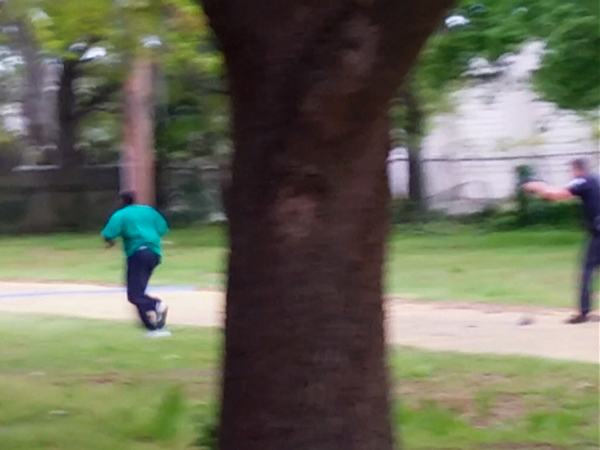
In this April 4, 2015, frame from video provided by Attorney L. Chris Stewart representing the family of Walter Lamer Scott, Scott appears to be running away from City Patrolman Michael Thomas Slager, right, in North Charleston, S.C. Slager was charged with murder Tuesday, hours after law enforcement officials viewed the dramatic video that appears to show Slager shooting a fleeing Scott several times in the back. (AP Photo/Courtesy of L. Chris Stewart)

Walter Lamar Scott was murdered in North Charleston, South Carolina, by white cop Michael T. Slager. Slager had pulled Scott over for a traffic violation, a broken tail-light, and when Scott fled, Slager initially tried to Taser him.

When that failed, Slager shot Scott dead, in cold blood, in the back, eight times. 

For a traffic stop. A traffic stop. A traffic stop.

Scott was not armed. Scott was not armed. Walter Scott. Was. Not. Armed.

Slager then apparently handcuffed the corpse of the man he had just killed and attempted to plant his Taser on him, with the apparent assistance of a fellow cop, a black man. Despite his attempted cover-up, a now-surfaced video belies it.

Unlike many cops in his position, he has been fired, and is being charged--though whether he will be prosecuted and convicted remains to be seen--with murder.

Again and again and again this keeps happening, because even though we repeat that "Black Lives Matter," in reality in this country, in this society, on this globe, what we see is that they do not.

As Jason Parham notes on Gawker, last month alone, 36 black people were killed by police, or roughly one every 21 hours. This approximates a slow and almost shameless form of genocide.

More Black Americans were killed by cops in 2014 than the total number of black people who died in the 9/11 attacks.

Like Parham I want to write something more thoughtful, more insightful, something illuminating, but I am exhausted. I really am. I have lived this reality all of my life, now approach 50 years. The foreground changes but the backdrop of racism, white supremacy, black disposability and social death, and state violence allied to elite social and economic interests are the same. Yes, things have improved, always as a result of sustained struggle, since I was a child, and they continue to improve, but we still have a long way to go.

These state murders are occurring as this country warehouses vast numbers of black and brown people in prisons, many of them privatized and providing cheap labor for corporations and earning dividends for investors. Countless black and brown people--children, adolescents, women, men--cycle through the failed penal system and its prison industrial complex annex, sometimes as a prelude to be murdered, at some point in their lives and usually with impunity, by the state, which does everything to protect elite interests, global corporations, and the billionaires who are destroying this country piece by piece.

It has to end. It MUST END.

No amount of telling black people how to behave, whether around officers or otherwise, no amount of "diversity training," no amount of explaining away the disparate ways that black americans (and brown americans who are treated like black americans by this system) are treated by the law and its officers, no amount of appeals to "black on black violence," divorced from the larger social context or not, no rationalizing away or ignoring all the ways in which black people in this society pay extensive social, political and economic taxes just for being black, is going to do it.

What has to happen is that cops have to stop killing unarmed black americans, and when they do they have to be prosecuted to the fullest extent of the law. Cops have to stop serving as the shock troops of white supremacy, neo-colonialism, the plutonomy and global capitalism. THEY MUST STOP KILLING US. What has to happen is that the entire foundation and edifice upon which this society has been built and developed has to be addressed, rethought, and remade. This is not an interpersonal issue. It is a systemic and structural problem. And it has to be addressed and redressed.

NOW.

Wednesday, February 11, 2015

Justice Carlton Reeves on the Death of James Craig Anderson

James Craig Anderson
(Justice for James Craig
Anderson via Facebook)
At her Hullabaloo blogsite, Digby posted the remarks Justice Carlton Reeves, the second African American to serve on the federal bench in Mississippi when he was appointed by President Barack Obama in 2010, delivered when he passed down sentences against three young white men who were part of a larger group that brutally beat and ran over a black man, James Craig Anderson, in Jackson, Misssissippi, in 2011. Justice Reeves gives an excellent overview of the racially motivated hatred that still plagues the US, so following Digby's lead, I am reproducing a sizable chunk of his commentary from the bench. I recommend reading the whole thing.
One of my former history professors, Dennis Mitchell, recently released a history book entitled, A New History of Mississippi. “Mississippi,” he says, “is a place and a state of mind. The name evokes strong reactions from those who live here and from those who do not, but who think they know something about its people and their past.” Because of its past, as described by Anthony Walton in his book, Mississippi: An American Journey, Mississippi “can be considered one of the most prominent scars on the map” of these United States. Walton goes on to explain that “there is something different about Mississippi; something almost unspeakably primal and vicious; something savage unleashed there that has yet to come to rest.” To prove his point, he notes that, “[o]f the 40 martyrs whose names are inscribed in the national Civil Rights Memorial in Montgomery, AL, 19 were killed in Mississippi.” “How was it,” Walton asks, “that half who died did so in one state?” — My Mississippi, Your Mississippi and Our Mississippi.
Mississippi has expressed its savagery in a number of ways throughout its history — slavery being the cruelest example, but a close second being Mississippi’s infatuation with lynchings. Lynchings were prevalent, prominent and participatory. A lynching was a public ritual — even carnival-like — within many states in our great nation. While other States engaged in these atrocities, those in the deep south took a leadership role, especially that scar on the map of America — those 82 counties between the Tennessee line and the Gulf of Mexico and bordered by Louisiana, Arkansas and Alabama.
Vivid accounts of brutal and terrifying lynchings in Mississippi are chronicled in various sources: Ralph Ginzburg’s 100 Years of Lynching and Without Sanctuary: Lynching Photography in America, just to name two. But I note that today, the Equal Justice Initiative released Lynching in America: Confronting the Terror of of Racial Terror; apparently, it too is a must-read. 
In Without Sanctuary, historian Leon Litwack writes that between 1882 and 1968 an estimated 4,742 Blacks met their deaths at the hands of lynch mobs.1 The impact this campaign of terror had on black families is impossible to explain so many years later. That number contrasts with the 1,401 prisoners who have been executed legally in the United States since 1976.2 In modern terms, that number represents more than those killed in Operation Iraqi Freedom3 and more than twice the number of American casualties in Operation Enduring Freedom4 — the Afghanistan conflict. Turning to home, this number also represents 1,700 more than who were killed on 9/11.5 Those who died at the hands of mobs, Litwack notes, some were the victims of “legal” lynchings — having been accused of a crime, subjected to a “speedy” trial and even speedier execution. Some were victims of private white violence and some were merely the victims of “Nigger hunts” — murdered by a variety of means in isolated rural sections and dumped into rivers and creeks. “Back in those days,” according to black Mississippians describing the violence of the 1930’s, “to kill a Negro wasn’t nothing. It was like killing a chicken or killing a snake. The whites would say, ‘Niggers jest supposed to die, ain’t no damn good anyway — so jest go an’ kill ’em.’ . . . They had to have a license to kill anything but a Nigger. We was always in season.”6 Said one white Mississippian, “A white man ain’t a-going to be able to live in this country if we let niggers start getting biggity.”7 And, even when lynchings had decreased in and around Oxford, one white resident told a visitor of the reaffirming quality of lynchings: “It’s about time to have another [one],” he explained, “[w]hen the niggers get so that they are afraid of being lynched, it is time to put the fear in them.”8 
How could hate, fear or whatever it was that transformed genteel, God-fearing, God-loving Mississippians into mindless murderers and sadistic torturers? I ask that same question about the events which bring us together on this day. Those crimes of the past as well as these have so damaged the psyche and reputation of this great State.

Mississippi soil has been stained with the blood of folk whose names have become synonymous with the Civil Rights Movement like Emmett Till, Willie McGee, James Cheney, Andrew Goodman, Michael Schwerner, Vernon Dahmer, George W. Lee, Medgar Evers and Mack Charles Parker. But the blood of the lesser-known people like Luther Holbert and his wife,9 Elmo Curl,10 Lloyd Clay,11 John Hartfield,12 Nelse Patton,13 Lamar Smith,14 Clinton Melton,15 Ben Chester White, Wharlest Jackson and countless others, saturates these 48,434 square miles of Mississippi soil. On June 26, 2011, four days short of his 49th birthday, the blood of James Anderson was added to Mississippi’s soil. 
The common denominator of the deaths of these individuals was not their race. It was not that they all were engaged in freedom fighting. It was not that they had been engaged in criminal activity, trumped up or otherwise. No, the common denominator was that the last thing that each of these individuals saw was the inhumanity of racism. The last thing that each felt was the audacity and agony of hate; senseless hate: crippling, maiming them and finally taking away their lives. 
Mississippi has a tortured past, and it has struggled mightily to reinvent itself and become a New Mississippi. New generations have attempted to pull Mississippi from the abyss of moral depravity in which it once so proudly floundered in. Despite much progress and the efforts of the new generations, these three defendants are before me today: Deryl Paul Dedmon, Dylan Wade Butler and John Aaron Rice. They and their coconspirators ripped off the scab of the healing scars of Mississippi . . . causing her (our Mississippi) to bleed again. 
Hate comes in all shapes, sizes, colors, and from this case, we know it comes in different sexes and ages. A toxic mix of alcohol, foolishness and unadulterated hatred caused these young people to resurrect the nightmarish specter of lynchings and lynch mobs from the Mississippi we long to forget. Like the marauders of ages past, these young folk conspired, planned, and coordinated a plan of attack on certain neighborhoods in the City of Jackson for the sole purpose of harassing, terrorizing, physically assaulting and causing bodily injury to black folk. They punched and kicked them about their bodies — their heads, their faces. They prowled. They came ready to hurt. They used dangerous weapons; they targeted the weak; they recruited and encouraged others to join in the coordinated chaos; and they boasted about their shameful activity. This was a 2011 version of the Nigger hunts. 
Though the media and the public attention of these crimes have been focused almost exclusively on the early morning hours of June 26, 2011, the defendants’ terror campaign is not limited to this one incident. There were many scenes and many actors in this sordid tale which played out over days, weeks, and months. There are unknown victims like the John Doe at the golf course who begged for his life and the John Doe at the service station. Like a lynching, for these young folk going out to “Jafrica” was like a carnival outing. It was funny to them – – an excursion which culminated in the death of innocent, African-American James Craig Anderson. On June 26, 2011, the fun ended.
But even after Anderson’s murder, the conspiracy continued . . . And, only because of a video, which told a different story from that which had been concocted by these defendants, and the investigation of law enforcement — state and federal law enforcement working together — was the truth uncovered. 
What is so disturbing . . . so shocking . . . so numbing . . . is that these Nigger hunts were perpetrated by our children . . . students who live among us . . . educated in our public schools . . . in our private academies . . . students who played football lined up on the same side of scrimmage line with black teammates . . . average students and honor students. Kids who worked during school and in the summers; kids who now had full-time jobs and some of whom were even unemployed. Some were pursuing higher education and the Court believes they each had dreams to pursue. These children were from two-parent homes and some of whom were the children of divorced parents, and yes some even raised by a single parent. No doubt, they all had loving parents and loving families. 
In letters received on his behalf, Dylan Butler, whose outing on the night of June 26 was not his first, has been described as “a fine young man,” “a caring person,” “a well mannered man” who is truly remorseful and wants to move on with his life . . . a very respectful . . . a good man . . . a good person . . . a loveable, kind-hearted teddy bear who stands in front of bullies . . . and who is now ashamed of what he did. Butler’s family is a mixed-race family: for the last 15 years, it has consisted of an African-American step-father and step-sister plus his mother and two sisters. The family, according to the step-father, understandably is “saddened and heart broken.” 
These were everyday students like John Aaron Rice, who got out of his truck, struck James Anderson in the face and kept him occupied until others arrived . . . . Rice was involved in multiple excursions to so-called “Jafrica”, but he, for some time, according to him and his mother, and an African-American friend shared his home address.
And, sadly, Deryl Dedmon, who straddled James Anderson and struck him repeatedly in the face and head with his closed fists. He too was a “normal” young man indistinguishable in so many ways from his peers. Not completely satisfied with the punishment to which he subjected James Anderson, he “deliberately used his vehicle to run over James Anderson – – killing him.” Dedmon now acknowledges he was filled with anger. 
I asked the question earlier, but what could transform these young adults into the violent creatures their victims saw? It was nothing the victims did . . . they were not championing any cause . . . political . . . social . . . economic . . . nothing they did . . . not a wolf whistle . . . not a supposed crime . . . nothing they did. There is absolutely no doubt that in the view of the Court the victims were targeted because of their race.
The simple fact is that what turned these children into criminal defendants was their joint decision to act on racial hatred. In the eyes of these defendants (and their coconspirators) the victims were doomed at birth . . . their genetic make-up made them targets.
In the name of White Power, these young folk went to “Jafrica” to “fuck with some niggers!” – – Echos of Mississippi’s past. White Power! Nigger! According to the Fifth Circuit Court of Appeals, that word Nigger is the “universally recognized opprobrium, stigmatizing African-Americans because of their race.”16 It’s the nuclear bomb of racial epithets – – as Farai Chideya has described the term. With their words, with their actions – – “I just ran that Nigger over” – – there is no doubt that these crimes were motivated by the race of the victims. And from his own pen, Dedmon, sadly and regretfully wrote that he did it out of “hatred and bigotry.” 
The Court must respond to one letter it received from one identified as a youth leader in Dylan Butler’s church, a mentor, he says and who describes Dylan as “a good person.” The point that “[t]here are plenty of criminals that deserve to be incarcerated,” is well taken. Your point that Dylan is not one of them — not a criminal . . . is belied by the facts and the law. Dylan was an active participant in this activity, and he deserves to be incarcerated under the law. What these defendants did was ugly . . . it was painful . . . it is sad . . . and it is indeed criminal. 
In the Mississippi we have tried to bury, when there was a jury verdict for those who perpetrated crimes and committed lynchings in the name of WHITE POWER . . . that verdict typically said that the victim died at the hands of persons unknown. The legal and criminal justice system operated with ruthless efficiency in upholding what these defendants would call WHITE POWER. 
Today, though, the criminal justice system (state and federal) has proceeded methodically, patiently and deliberately seeking justice. Today we learned the identities of the persons unknown . . . they stand here publicly today. The sadness of this day also has an element of irony to it: each defendant was escorted into court by agents of an African-American United States Marshal; having been prosecuted by a team of lawyers which includes an African-American AUSA from an office headed by an African-American U.S. Attorney — all under the direction of an African-American Attorney General, for sentencing before a judge who is African-American, whose final act will be to turn over the care and custody of these individuals to the BOP — an agency headed by an African-American. 
Today we take another step away from Mississippi’s tortured past . . . we move farther away from the abyss. Indeed, Mississippi is a place and a state of mind. And those who think they know about her people and her past will also understand that her story has not been completely written. Mississippi has a present and a future. That present and future has promise. As demonstrated by the work of the officers within these state and federal agencies — black and white; male and female, in this Mississippi, they work together to advance the rule of law. Having learned from Mississippi’s inglorious past, these officials know that in advancing the rule of law, the criminal justice system must operate without regard to race, creed or color. This is the strongest way Mississippi can reject those notions — those ideas which brought us here today. 
At their guilty plea hearings, Deryl Paul Dedmon, Dylan Wade Butler and John Aaron Rice told the world exactly what their roles were . . . it is ugly . . . it is painful . . . it is sad . . . it is criminal. 
The Court now sentences the defendants as follows: [The specific sentences are not part of the judge’s prepared remarks.] 
The Court has considered the advisory guidelines computations and the sentencing factors under 18 U.S.C. § 3553(a). The Court has considered the defendants’ history and characteristics. The Court has also considered unusual circumstances — the extraordinary circumstances — and the peculiar seriousness and gravity of those offenses. I have paid special attention to the plea agreements and the recommendations of the United States. I have read the letters received on behalf of the defendants. I believe these sentences provide just punishment to each of these defendants and equally important, I believe they serve as adequate deterrence to others and I hope that these sentences will discourage others from heading down a similar life-altering path. I have considered the Sentencing Guidelines and the policy statements and the law. These sentences are the result of much thought and deliberation. 
These sentences will not bring back James Craig Anderson nor will they restore the lives they enjoyed prior to 2011. The Court knows that James Anderson’s mother, who is now 89 years old, lived through the horrors of the Old Mississippi, and the Court hopes that she and her family can find peace in knowing that with these sentences, in the New Mississippi, Justice is truly blind. Justice, however, will not be complete unless these defendants use the remainder of their lives to learn from this experience and fully commit to making a positive difference in the New Mississippi. And, finally, the Court wishes that the defendants also can find peace.

Friday, August 15, 2014

On Michael Brown, St. Louis & Ferguson, & Black Disposability

On Saturday, August 9, 2014, in Ferguson, a predominantly black, inner-ring suburb in Saint Louis County, Missouri, under circumstances that remain murky but for which there are non-police witnesses who have spoken on the record, Michael Brown, an unarmed 18-year-old recent high school graduate who was heading to Vatterott College, was gunned down by a policeman. The Ferguson police force, which is predominantly white (50 of 53 officers), have alleged that Brown was shot repeatedly after a struggle with a white officer, whose name the police force initially would not release (It since has: Darren Wilson).

According to the Saint Louis County police chief, Joe Belmar, around noon on Saturday, after an alleged tussle in and beside Darren Wilson's police cruiser, during which Brown supposedly attempted to grab the policeman's gun, Brown was shot, several of the shots occurring over three feet from the police car. Several witnesses, including one, Dorian Johnson, who was with Brown right before the shooting, have disputed the police's account, however, attesting that Brown had his hands up when he was initially shot. After he was killed, Brown lay in the street for hours, as shocked local residents watched and photographed it, until his body was finally collected and taken to the morgue, where an autopsy on Sunday showed that he died from multiple gunshot wounds.

Brown's grieving parents retained attorney Benjamin Crump, who represented the parents of Trayvon Martin, the Florida teenager who was shot to death on February 26, 2012 by George Zimmerman after a scuffle in the gated community where Martin's parents lived. Brown's killing would been horrible enough, but following his death, which has both followed and preceded other widely reported killings by police forces of unarmed black people in the US, including Staten Islander Eric Garner's death by stranglehold on July 17, 2014, Ferguson residents and others in the St. Louis metropolitan area decided to hold a candlelight vigil.  The Sunday evening event then turned violent when some people, who may not even have been vigil participants, began attacking and looting local stores in Ferguson and a neighboring suburb, which resulted in over 30 arrests and injuries to two officers. For a number of US media outlets this turn of events became the focus, and not the tragic, unexplained murder of Brown, the fumbling response of the Ferguson police, or the specific and larger contexts in which Brown's death occurred.

On Monday protesters showed up outside the Ferguson police department to demand a full investigation of Brown's death, and shortly thereafter at a press conference Brown's parents, mother Lesley McSpadden and stepfather Louis Head, publicly called for an end to the violence, while also imploring local officials for justice for their deceased son; alongside the Ferguson police department's efforts the FBI announced that it would launch a parallel investigation to that of the St. Louis County Police Department. Monday evening the NAACP held a prayer meeting that brought together local leaders and residents. Afterwards, in a turn of events that caught the attention of a global audience, a subsequent peaceful vigil on West Florissant Avenue, one of the main strips through Ferguson, was met by the terrifying response of the militarized Saint Louis County police force, supplementing Ferguson's officers. The county forces, like an occupying army, used tear gas to disperse local residents, shooting canisters into front yards, and included snipers, officers on tanks, and machine guns that matched or exceeded the sophistication of weaponry used in the US's wars in Iraq and Afghanistan. Vigil participants were captured in photo after photo holding up both hands, as Brown was said to have done before being shot, with the police forces training their war-ready weapons upon them.

On Tuesday, justice seekers rallied in front of the Saint Louis County Police Department, in the county seat of Clayton (where Washington University is located), and the Rev. Al Sharpton arrived in Ferguson to meet with Brown's family and spark further national attention for the tragedy. It was also on Tuesday that President Barack Obama offered public comments on Brown's death, that the US Department of Justice announced it would launch a federal civil rights investigation, and that Missouri's Democratic governor, Jay Nixon, met with St. Louis City mayor Tom Slay and other local leaders to discuss the ongoing crisis. Yet the evening standoffs between the protesters and the hyper-armed police force continued. Because of these, on Wednesday morning Ferguson called for an end to evening vigils; when people sought to remember Brown's death peacefully at the end of the day, the police again responded violently, shooting rubber bullets and wooden plugs into the crowd, firing tear gas at them as well as reporters from Al-Jazeera covering the event, and going so far as to arrest a St. Louis City alderman, Antonio French, and two reporters, one from the Washington Post, Wesley Lowery, another from the Huffington Post, Ryan Reilly, after rousting them from a local McDonald's restaurant.

Finally, yesterday evening, Missouri's Democratic governor, Jay Nixon, having previously called for calm but without taking any concrete steps to ensure it, had the Missouri State Highway Patrol take over the policing of Ferguson's protests.  The person now in charge, Highway Patrol Captain Ron Johnson, a Ferguson native and resident of nearby Florissant, not only de-escalated the police response, but marched with protesters. One wonders what would have happened had this been the response five or even two days earlier. President Obama also delivered a public address on the crisis in Ferguson from his vacation redoubt, though he added little to the discourse beyond calling for the local police to be "open and transparent" in their investigation. Across the US and globe, silent rallies and marches, beginning at 7 pm and organized under the social media hashtag #NOMS1, took place; in New York, vigil participants filled Union Square and marched through Times Square.

Today, the Ferguson police released information that Brown had participated in the theft of cigars from a local convenience store; Dorian Johnson's attorney has acknowledged that Johnson was with Brown in the commission of this crime. If this is true, Johnson should and will be prosecuted, as Brown should have been; Missouri is not now nor has ever been known for letting black people alleged of criminal behavior, however light the crimes, off the hook. But even with this new information, the fact remains that Brown, like Garner, like Ramarley Graham in the Bronx, like Rekia Boyd in Chicago, like far too many black people, whether accused of a crime or not, did not deserve to be summarily shot dead. There is a structure, a system, and multiple well-defined processes for adjudicating alleged criminal behavior; vigilante state murder by "peace officers" is none of these.

***

As is probably well known to anyone who has read my work, let alone who knows me, I was born in the city of Saint Louis and spent roughly half my life up through the age of 18 in St. Louis County, in the suburb of Webster Groves. (It is the same suburb that Jonathan Franzen grew up in, and the home of two institutions of higher education, the Protestant Eden Theological Seminary and Roman Catholic Webster University). Webster Groves, like Ferguson and many Saint Louis suburbs, was and is divided geographically by race; north Webster, where we lived, was predominantly black, while south Webster was predominantly white (and much wealthier). In fact, one can draw a line through the middle of fan-shaped St. Louis City and the collar-like county, and quite reliably predict the race of who lives where. North of the city line is black; south is white, and the same holds true for the suburbs: north are the formerly white and integrated suburbs, some of which, like Ferguson, white flight has transformed into predominantly black suburban towns, and south are the mostly white suburbs, which are less wealthy. Fanning out westward are the wealthier suburbs, with larger non-white populations closer to the city, and smaller ones the further west you go. To put it simply, it is the case that over the last four decades as black people have moved from St. Louis City into its suburbs, white people have moved--fled?--further and further west, or south, or north, taking jobs and wealth with them, and have only recently returned to a revitalizing, gentrifying downtown area of the once-hollowed out core city.

One can find mirrors of this process all over the US (in Chicago, Detroit, Boston, Atlanta, Los Angeles, etc.), as well as analogues to the internal racial and spatial divisions. In St. Louis County as in suburban New York or New Jersey or Boston or Birmingham, or in many parts of the county, one can usually point not just to which suburbs are more or less white, but where in a given suburban area, as in the core cities, the races live. As has widely been reported, Ferguson's demographics have changed, but its power structure, the mayor, the city council, the police chief and department, and so forth, remain mostly white. Perhaps this reality predicted that at some point Ferguson would blow up, but I would imagine that if you asked most St. Louis-area residents where in the region what we have all witnessed over the last week would take place, Ferguson would not be high on the list. The City of St. Louis might be readily named, because St. Louis City has seen its share of violence over its 250-year-history, though it was spared the uprisings of the late 1960s (its sibling in Illinois, East St. Louis, was not so lucky, then or before). Perhaps you might hear people name some of the poorer suburban towns in North County, or some of the towns in the south suburbs where overt racism is not unknown. But, despite the problematic indicators, not Ferguson.

Our larger public discourse and visual culture still too seldom reflect the diversity, or the demographic shifts and attendant sociopolitical shifts, which have transformed American suburbs over the last four decades. Indeed, the images of Ferguson before and after Brown's murder belie the visual narratives we usually encounter; American suburbs have increasingly browned since the 1970s. My own family participated in this demographic shift, as have millions of African Americans and other people of color. In some places the John Cheever-John Updike-Richard Yates-A.M. Homes suburban world may still exist, but there are now many more Fergusons out there, as the last US Census made clear, than our news media or Hollywood ever deign to depict.

This conceptual blindness and indifference is particularly dangerous not only because it promotes ignorance about the reality of American life, but also because it helps to increase the possibility that what happened in Ferguson could happen all over the US; police beatings and killings of black Americans have sparked uprisings repeatedly through US history, as has been the case with numerous riots (1969, 1983, 1984, 1989, 1992!) in Miami, or the Los Angeles Uprisings after the videotaped beating of Rodney King in 1992, but suburbs could as easily become flashpoints as the urban areas that are now under economic and political contestation as gentrification and economic and social displacement work the perverse counter-magic of racial and ethnic partitioning and cleansing. Our political and social fabric in cities and suburbs across the US, well into the second term of President Obama, remains tinder for enraged responses by people who are still treated as second-class, not-fully-human, semi-citizens; who are viewed as superfluous, whose lives we still see daily are thought to have less value and importance; who have long been denied full participation in American, full access to humanity, in this society; who must move through their daily lives with the added tax and burden of racism and white supremacy underpinning every aspect of the world around them; who are not viewed as integral to what the country has ever claimed to mean by the word "Americans"; who are viewed, to invoke Keguro Macharia, and other theorists, as completely and utterly disposable.

***

You do not shoot someone in the back and let his body lie in the summer sun, no matter what he has done, unless you view him, and others like him, as disposable. You do not choke a person to death, when he is crying out that he cannot breathe, unless you view him as disposable. You do not empty your handgun's magazine twice, issuing more than thirty shots, into three men who are not armed. You do not mis-or-undereducate millions of people; you do not disinvest in and thereby eliminate opportunities for gainful employment from millions of people, starving them through incalculable, invisible legerdemains of austerity and greed; you do not provide zero or sub-standard health care to millions of people, and use their poor health to impoverish them further; you do not poison and destroy the environment in which millions of people live and work, again using this as a tool to extract every thing you can out of them; you do not perform a false pantomime of justice and equality, in courts of law, in places of employment, in stores, in the pews, everywhere, before millions of people for whom you do not want real justice and quality ever to be possible; you do not warehouse millions of people, whom you view as nothing more than commodities to provide jobs for others in whom you have disinvested, and mere bodies for cheap labor to enrich the bottom lines of privatized prison corporations, unless you view them as disposable.

You do not demonize and dehumanize an entire race people, through language and images, persistently and consistently for hundreds of years, changing the surface code and semantics as needed to maintain your power, and then appeal to your innocence and pretend that you have not. Indeed, you cannot appeal to any category of the human or human rights because you have systemically denied the humanity of the people all around you. You do not arm a police force as if it is an occupying army ready to slaughter everyone in its crosshairs, and train it on people living in your midst (or on other people across the globe, for that matter). Much of what I describe here applies not only to black people in this country, but to anyone who is not (considered fully) white, and to white people as well, especially poor ones. But the fact since before this country's founding is that black people bear the brunt of this logic of disposability, we are the ne plus ultra on which this logic, concomitant with anti-black racism and white supremacy, was established and perfected, and until this logic is completely overturned and dispelled,  so long as we remain here, and we will remain here, we will remain the most disposable of all.

This is the world Michael Brown and others like him, live in. This is the world that I, who have several degrees and teach at a university and have published and translated books, live in. This is the world that our President, the leader of the "free world," lives in. Until the economic, political, social, and juridical foundations on which this society has built its entire edifice truly and fully change, until we extirpate the structural and systemic racism and white supremacy that underpins everything, the kind of murder and the crazed response by state forces that we witnessed in Ferguson very well will continue to occur.

It was horrifying, but hardly a surprise.

It was a tragedy, but not unforeseen.

It will inspire some brilliant activism in a multiplicity of forms, as similar tragedies have; some introspection and soul-searching, among people who want things to change; some changes in the law, as we now see with Congressional efforts to demilitarize the police, and perhaps a prosecution or two;

But very likely almost nothing, beyond rhetoric and shadowplay, will transpire among those with real power, who have a vested interest in keeping things as they are.

We should feel disgust and horror at what has occurred in Ferguson, and Staten Island, and Beavercreek, Ohio, and Los Angeles, and Harlem, and everywhere a scenario like this unfolds.  But that is not enough. What must also occur, in as many ways as are possible, is to change the structures of this society so that the groundwork for what we have witnessed and continue to witness is not already laid, that this tragedy is not again foreordained. We cannot change our past, but we can reshape our future. NONE OF US is disposable. I know this will not be the last time I write about a tragedy of this sort, and I certainly will not forget Michael Brown, or Eric Garner, or John Crawford, or Ezell Ford, or Dante Parker, or Rekia Boyd, or Tarika Wilson, or Gabriella Nevarez, or Tyisha Miller, or Yvette Smith, or Ramarley Graham, or Oscar Grant, or Sean Bell, or Ousmane Zongo, or Amadou Diallo, or Eleanor Bumpurs...or Trayvon Martin. But what I do hope happens this time, as with every prior time, is we make even firmer our commitment, at every level, but especially as a society, to ensure that we will not have to relive a version of this story, with only the particulars changed, once again.