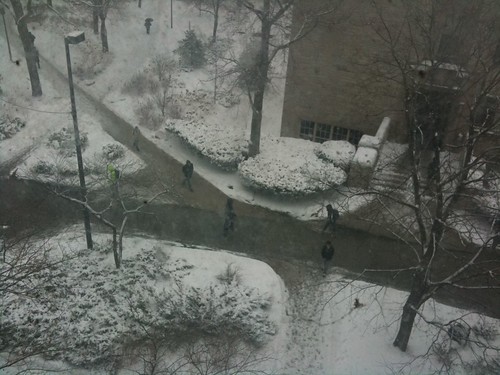
 Snow, snow, everywhere snow. Or at least it feels like I'm trailing or it's trailing me here in Chicago. It wasn't snowing in Los Angeles, which I just returned from a few days ago, but it was chilly, though I can't complain because a little chill in the air is better than sliding across icy roadways as snow pour down from an infinite white sky. That was my experience this morning on the way to my first class. But I got there, and am now hoping that the snow here decides to trail off, soon.
***
I am not going to try to diagnose Jared Lee Loughner or offer some overarching rationale for why this past Saturday this 22-year-old evidently disturbed man attempted to assassinate US Representative (D-AZ) Gabrielle Giffords, who is now in critical care and still fighting for her life, though it increasingly appears as though she will make a strong recovery. In his attempt to kill her he went on a rampage, murdering her aide, Gabe Zimmerman, 30; Federal judge John Roll, 63; Christina Taylor Green, a 9-year-old girl born on September 11, 200l, who was deeply interested in governmental affairs; Dorothy Murray, 76; Dorwin Stoddard, 76; and Phyllis Scheck, 79. He also wounded a number of other bystanders, making January 8th one of the most tragic days in 2011 America.
One thing that made this crime possible is the easily availability of semiautomatic weapons, such as the Glock that Loughner apparently was able to acquire without any problems. Another, that many across the Net have pointed, is the extremist rhetoric that is now so common, though I would suggest that pointing to this backdrop does not mean that I am drawing a direct link and, as I've seen some do, I'd add that not forget such rhetoric isn't new in American history and that as recently as the 1990s not only was such rhetoric in wide circulation, but there was surge in private militias, attacks targeting racial, ethnic, sexual and religious minorities, and spectacularly horrific acts like the Oklahoma City Bombing, which killed over 100 people, occurred in 1995.
Let me make two micro points about rhetoric and discourse. First, rhetoric, one of the oldest aspects of verbal exchange (it precedes written language), is meant to have psychophysical effects. The way that one speaks can shape the way others act. This is why orators going back thousands of years were trained in the art of rhetoric. To speak of "rhetoric," even in its degraded contemporary form, then, is to speak of language with the potential make people think and act. We remember the best rhetoric: "Four score and seven years...," "Ask not what your country can do for you, but what you can do for your country," "I have a dream..." Second, anyone who has passed through or even near a lit crit class in the last 35 years has learned a little bit about "discourse," primarily via Foucault and his adepts. One lesson anyone who has paid attention learns (and I'm simplifying radically here) is that society, and people in society, change and are changed not simply by individual acts, history, material culture, etc., but also by the discourse that circulates--the language, the ideas, the memes, etc.--throughout an era in any given time. It shapes what people say, think, do, create, and so on. Foucault took the idea in very important and sometimes controversial directions, but it is now pretty much a given, at least in contemporary humanities scholarship, that discursive production, is something always to consider.
I thus do believe this extremist rhetoric and its discursive effects, aided and abetted by fanatics employing the media new and old, have increased, as has the failure of many in the corporate media, or in the upper reaches of the political left even to make any effort to counter it. I also believe that the "eliminationist rhetoric" in particular, which New York Times columnist Paul Krugman wrote about on Monday, from politicians no less, is perhaps more prominent. Yet let me make clear that I am not saying there is a direct causational link between the crazy ranting and the crazy acts. One of the tricks I've noticed online over the past few days is people on the right citing President Obama's "if they bring a knife, we bring a gun" remark as a counterweight, missing the point that this is an old saw, composed of two metonyms and defensive in its meaning, as opposed to a direct offensive call for violence against opponents, or for revolutionary violence (Sharron Angle's "Second Amendment" solutions), etc.