Showing posts with label surrealism. Show all posts

Thursday, April 12, 2018

Poem: Shuzo Takiguchi

Shuzo Takiguchi
(Mirador. Blog de Joan Miró,
Cultural y Arte, por
Antonio Boix.)
Keeping with the theme of ekphrasis and with the principle that an ekphrastic poem or poem about art need not describe a specific artwork, as Monica Youn's poem yesterday demonstrated, today I'm sharing yet another approach: you could write a poem about a specific artist, an homage/femmage/themage, with references however overt or subtle, to their oeuvre. Such is the case with Shuzo Takiguchi (1903-1973), the Japanese Modernist poet, painter and critic, who was associated with various movements in Japan, including Surrealism and Dada. I happened upon Takiguchi's tribute below, and two others--to fellow Surrealist artists Yves Tanguy and Joan Miró--on the Poetry site (the three translated poems appeared in the October 2014 print issue of Poetry Magazine), and was intrigued.

"René Magritte," once you read it, is an open tribute to the great, popular Belgian Surrealist, who lived from 1898 to 1967, and who produced some of the most iconic art work of the Surrealist movement--though he broke with André Breton over his decision to stay in Brussels instead of returning to Paris before the war. Allusions to various recurring Magrittean images, such as silhouettes, water, mountains, and hats appear, but it is not just the imagery, but the incantatory repetition of phrases, privileging sound and juxtaposition over clarity and immediacy of meaning, the unmooring of realist logic, that also underpins Takiguchi's own Surrealist poetic practice, and the way he translates his understanding of Magritte into poetry. His translation is not literal, but imaginative and contextual.  Additionally, the end words, when read aloud, almost make the two stanzas feel like the opening or ending to a sestina, though it clearly isn't one.

So was there a particular Magritte painting or were there paintings that Takiguchi had in mind? He mentions "silhouettes / flow incessantly like water," as well as "a mirror trick, / like a human echo / burns a silk hat endlessly." Given these references, two Magritte paintings, "La Belle Société" (1962) and "Décalcomania" (1966) come to mind.  In both there are human silhouettes that open up, like windows, onto beach landscapes with water flowing in the distance. As it turns out, Takiguchi created his own set of decalcomanic artworks, keeping the media as the title. The final stanza seems to refer to the two paintings above as well as to another famous Magritte image, "The Masterpiece Or the Mysteries of the Horizon," featuring three men, angled in various ways away from the viewer, and three crescent moons that could also be eclipses. (The poem could also be titled "Giorgio de Chirico" given the landscapes Takiguchi describes and paints.)

Yet what I want to argue is that even if Takiguchi had these two paintings, or just the latter one, in mind, his poem's language and imagery capture the spirit of Magritte such that any painting could stand in. His approach stands against literalness in favor of something more elusive and strange, not unlike Magritte's often very beautiful and bizarre paintings. Here I quote from Mary Jo Bang's and Yuki Tanaka's "Translators' Note," which shares a bit more information about what Takiguchi was after:

With Takiguchi, the surrealist estrangement has to be maintained in today’s poetic world where defamiliarization is not as surprising as it once was. To that end, we have had to be careful not to normalize the poems or alter their dialogic relationship to French surrealism. Takiguchi was actively involved in that literary movement. He corresponded with André Breton and translated his 1928 Surrealism and Painting into Japanese two years after it was published in France. An Abridged Dictionary of Surrealism, compiled by Breton and Paul Éluard for the International Surrealism Exhibition in 1938, recognized Takiguchi as a “poète et écrivain surréaliste.” The present poems were first published in 1936 in L’échange surréaliste, a collection of writings and drawings by European Surrealists in Japanese translation, designed to foster international exchange. Takiguchi also helped revive the avant-garde scene in postwar Japan by spearheading an interdisciplinary art group called Jikken Kobo (Experimental Workshop), which was active from 1951 to 1957. The experimental fervor of French surrealism can be felt in the radical texture of Takiguchi’s poems and his decision to call them “poetic experiments.”

You can find more about Takiguchi here. There's also his archives, where you can view some of his drawings.

And now, the poem.

***

RENÉ MAGRITTE


by Shuzo Takiguchi


Translated by Mary Jo Bang and Yuki Tanaka

Released silhouettes
flow incessantly like water,
flow between mountains
swiftly like a kaleidoscope.
The solitude of  the North Pole
bustles with human silhouettes.
Endless transmission of  ABC.

On the shredded shore
a silk hat burns
like a mirror trick,
like a human echo
burns a silk hat endlessly.
Then the flames
were received like ABC.

On the night of a beautiful lunar eclipse
the silhouettes smiled.

                     
                 Translated from the Japanese

Translators’ Note: Three Poems by Shuzo Takiguchi

Here are the three paintings by René Magritte, followed by one of Takiguchi's "Decalcomania" series:

René Magritte, The Beautiful Society,
oil on canvas, 1962.

René Magritte, Decalcomania, oil
on canvas, 1966.

René Magritte, The Masterpiece or Mysteries of the Horizon,
oil on canvas, 1955, private collection.

Shuzo Takiguchi, Spirit of Matthias
Grunewald
, decalcomanic painting on paper,
1962.

Monday, April 29, 2013

Proust/Degas/Surrealist Drawing @ the Morgan Library

Over the last few months the J. P. Morgan Library in New York mounted three shows, each of which was worth the price of admission. Rather than a long disquisition I'll offer some brief thoughts on each, along with pictures, to give a sense of why I was glad to have caught them.

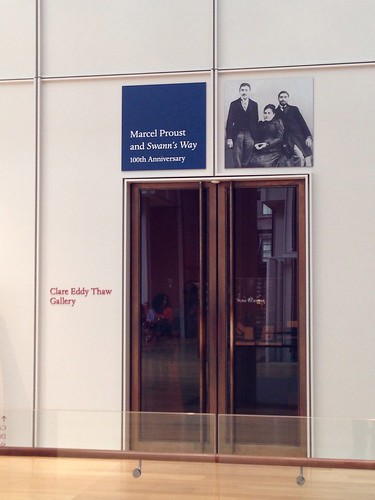
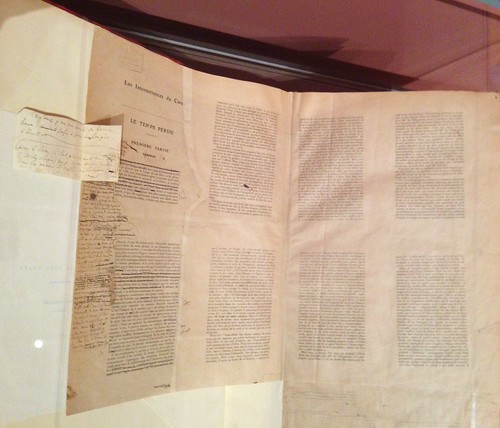
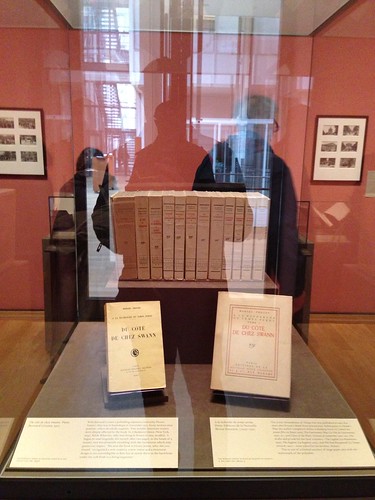
The Marcel Proust exhibit at the Morgan LibraryFirst, the Library memorialized the 100th anniversary of the publication of Marcel Proust's (1871-1922) Du côté de chez Swann (1913), better known in English as Swann's Way, the first volume in what would be come one of the masterworks of the 20th century, and of all literature, À la recherche du temps perdu (In Search of Lost Time), with an exhibit on the background of the novel, Proust, and a trove of manuscripts, including letters he wrote to his beloved mother, the notebooks in which he took down thoughts towards Swann's Way, the handwritten manuscript drafts, and the bound, marked-up galley pages.

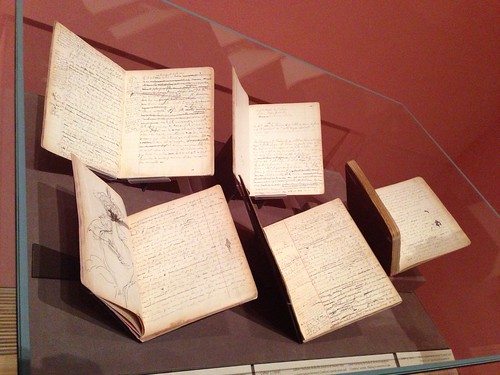
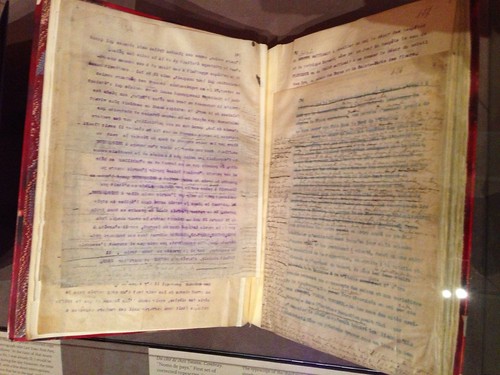
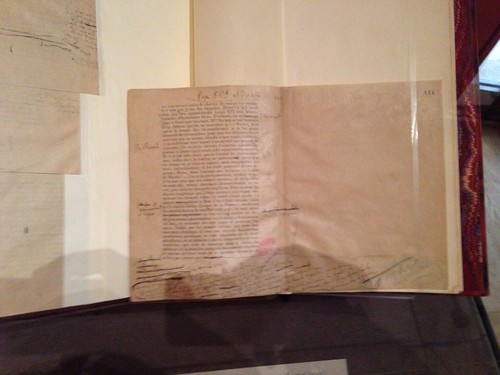
Though I was quite familiar with Proust's life and story, it was something altogether new to be able to view his handwriting, to note how he was unfolding his ideas on the page, and to study how he edited the opening of Swann's Way, crossing out a large swath of meandering prose and inserting in its place that unforgettable opening, "Longtemps je me suis couché de bonne heure." (For a long time I would go to bed early"), which in its rhythmic propulsion, idiomatic playfulness and grace, and narrative foreshadowing portends not just the rest of the first section but the entire giant work. The musical title itself, something I'd always wondered about, turns out to have been a bit of slang Proust was playing with; it literally means "Alongside Swann's home," which sounds awful for an English title, and was also controversial among French grammarians. What the exhibit also shows is that Swann's Way, initially rejected by nearly all the major Parisian publishing houses, was so long that the ultimate publisher, Grasset, who required Proust to subsidize its production (yes, this began as a vanity project!), demanded that the author lop off a sizable chunk from the novel's end, and, because Proust wanted the book to appear, he complied. The second volume, À l'ombre des jeunes filles en fleurs (In the Shadow of Young Girls In Flower, a/k/a In a Budding Grove) did not appear until the end of the First World War, in 1919. Despite the rejection Proust encountered at first, the estimation by many in Paris's literary world that he was a wealthy dilettante and socialite, and Grasset's own rather harsh editorial treatment of his work, there were admirers who immediately grasped his brilliance; the exhibit names two American literary masters who read him upon the book's publication in the original French: Edith Wharton, who knew she was in the hands of one of the all-time greats, and Henry James, to whom she sent Swann's Way, who also perceptively lauded Proust's genius. The seeds of that genius, cultivated and nurtured, are visible in this show.

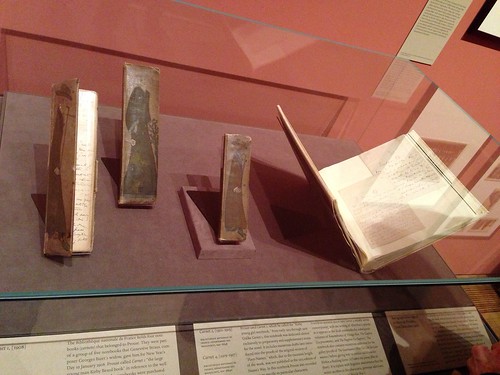
Proust's notebooks
Proust's notebooks (note the illustrations on the covers
of these narrow, pocket-perfect volumes)
Proust's notebooks
Proust's notebooks containing notes and
drafts of what would become Swann's Way
Proust's corrections to the typed early version of Swann's Way
The typescript version of Swann's Way
with Proust's annotations and changes
Proust's Swann's way, 3rd galley version
The third galley (incomplete) of Swann's Way
on which Proust has inserted, on a piece of paper,
his famous opening line, "Longtemps je me
suis couché de bonne heure...."
Proust's galley for Swann's Way
Proust's galley, with the truncation
Grasset required, concluding Swann's Way
First editions of Proust's masterpiece, À la recherche du temps perdu
In Search of Lost Time (the complete,
multivolume text)
***

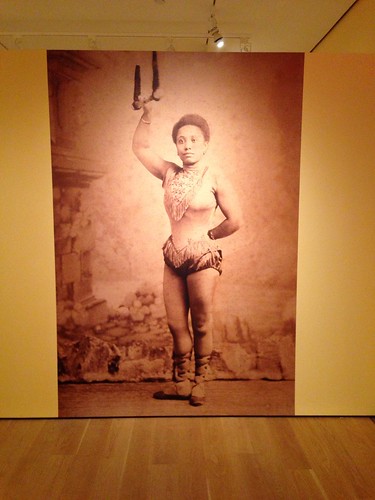
Miss La La (Anna Olga Albertina Brown, b. 1858-?), the amazing acrobat, 19th c. Europe
Miss La La (Anna "Olga" Brown)
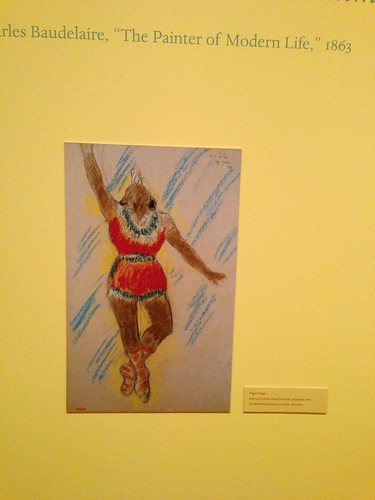
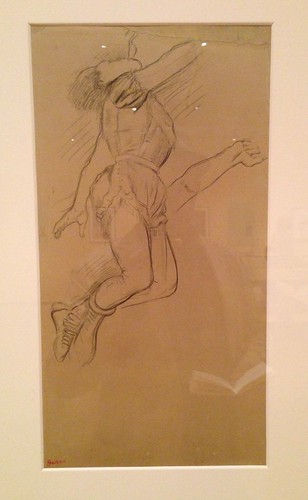
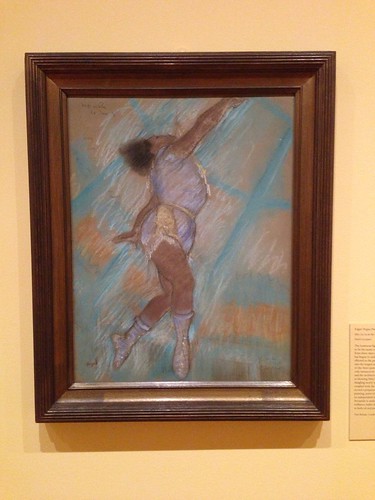
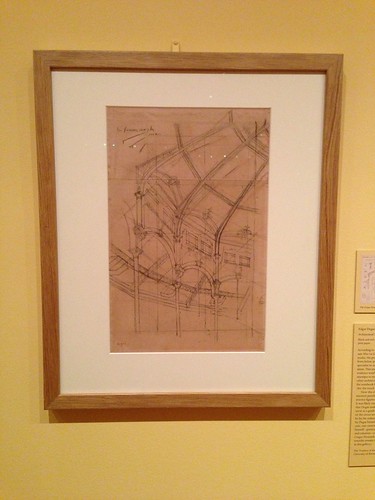
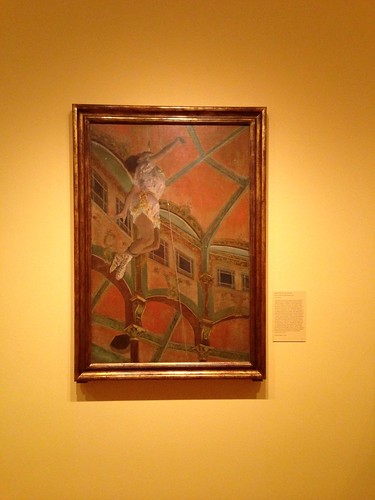
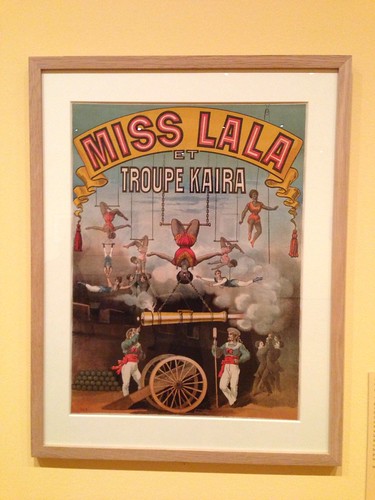
There also was an enthralling exhibit focusing on French artist Edgar Degas's (1834-1917) drawings and eventual 1879 painting of the famous 19th century black aerialist, Miss La La (Anna Olga Albertina Brown) (b. 1858-1919?), at the Cirque Fernando, one of the popular mass entertainment venues in mid-century Paris. Yes, you read that right; Miss La La was an acrobat, born to a black father and a white Prussian mother, who performed with the Troupe Kaira and regularly transfixed Paris and other cities in Europe. Degas's painting, considered one of his masterpieces, required his usual intense preparation, but with even greater concentration, for while he was able to render Miss La La, suspended high above the circus floor by dint of her bite on a suspended from a rope, fairly easily, he struggled to capture the geometry of the circus building's ceiling and rafters.

According to the exhibit, Degas may even have had some help with the drafting of the arches and planes, though it is known that he studied the architectural plans quite carefully.  The preparatory drawings, pastels, and paintings of Miss La La on display all offered their own considerable beauty, and it was thrilling to move along the wall and note how Degas was working up towards the extraordinary painting, "Miss La La at the Cirque Fernando" (oil on canvas, 1879, National Gallery, UK), that resulted, though interestingly, Miss La La's racial identity is less evident in the final work than in the preparatory ones. What one notices in that final image is her floating form, inspired in part by religious iconography Degas was quite familiar with, as well as other circus images by peers, and that almost glowing, orange vault of ceiling and the arches and pillars holding them up, as carefully poised as the aerialist herself.

The exhibit did not say what happened to her, though Reggie H. sent a link with more information on her (can't find it on Wikipedia!), including that she was born in Stettin, formerly in the Prussian Empire and now part of Poland (Szczecin), and that was known various as Olga Kaira, Olga Kaire, la Venus Noire, “Olga the Mulatto”, “Olga the Negress”, “The Venus of the Tropics”, “The Cannon Woman” and “The African Princess.” According the Circus Girl blogsite, she continued performing up to the late 1880s, married an American contortionist named Emmanuel (Manuel) Woodson, and had a daughter named Rose Eddie Woodson, who was born in London in 1894, before giving birth to two more daughters who together became an act known as the "Three Keziahs." Apparently the last known recorded year of Olga's life was 1919, when she was listed on a US passport application. Had I the time I'd spend a bit of it trying to learn what happened to her. Degas, who had mixed-raced relatives on his mother's side, not only painted one of his greatest works when capturing her, but immortalized this extraordinary figure.

Drawing of Miss La La, Edgar Degas
A reproduction of a Degas pastel
Degas' preparatory sketch
A preparatory sketch (charcoal on brown paper), 1879
Pastel preparatory drawing, Miss La La at the Cirque Fernando
A preparatory pastel, on brown paper
(one of the most "Impressionistic" of
all his versions here)
Preparatory sketch for Miss La La at the Cirque Fernando
Degas' draft of the architecture
in the Cirque Fernando's ceiling
Edgar Degas, Miss La La at the Cirque Fernando
(oil on canvas, 1879)
Poster from *Degas's Miss La La at the Cirque Fernando* exhibit, Morgan Library
A poster featuring the Troupe Kaira
and highlighting Miss La La
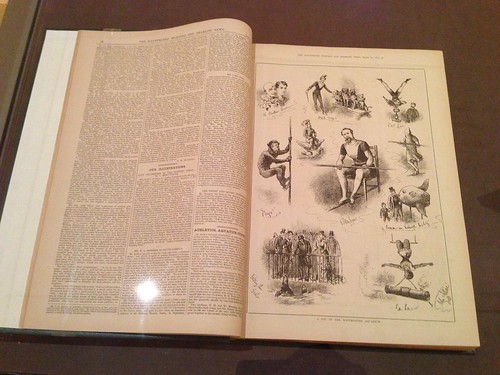
Book detail from *Degas's Miss La La at the Cirque Fernando* exhibit, Morgan Library
An illustrated magazine, featuring
images of circus participants,
including Miss La La on the lower right
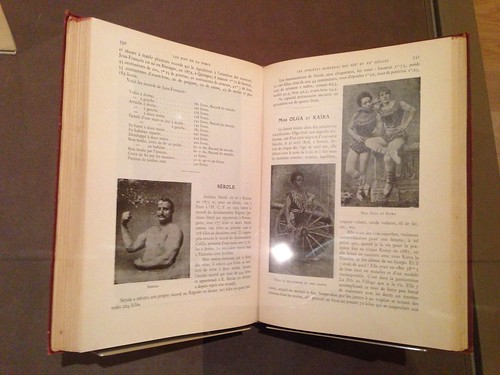
Book detail from *Degas's Miss La La at the Cirque Fernando* exhibit, Morgan Library
A book that includes a discussion
of Olga (Miss La La) and her acrobatic
partner, Kaira la Blanche (Theophila Szterker)
***

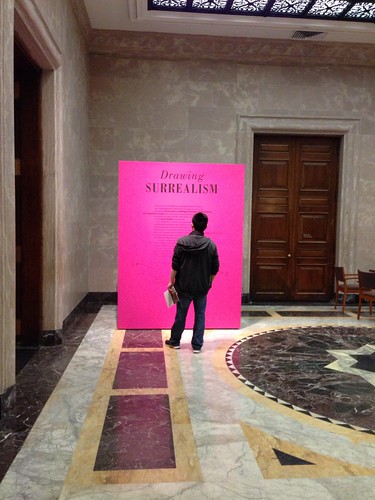
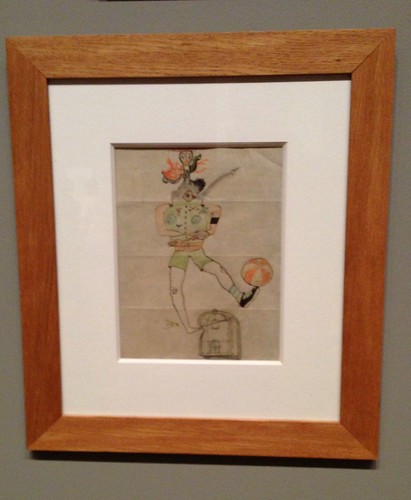
At the Surrealist Drawing Exhibit, Morgan LibraryThese two exhibits would have been enough for any museum visit, but there was also the Drawing Surrealism show to explore. A surfeit of energizing, deranging riches, filling two large galleries. Ego yes, but so much id! In fact it contained 165 works by 70 artists from 15 countries on paper, including many of the most famous Surrealist stars, like René Magritte, Giorgio DiChirico, Salvador Dalí, and Jean Arp, as well as some I did not expect, like Georges Bataille. Artists preceding or following the Surrealists, like Frida Kahlo also make appearances, and throughout the show gently guides you along the pathways of affiliation and influence. One highlight and delight was a painting by Wilfredo Lam, Surrealism's man in Cuba. There also were more recent non-Euro-American artists working in that tradition, which was a refreshing addition.

The show unfolds by emphasizing Surrealist techniques, including collage, automatic drawing, decalcomania, frottage, and some of the most striking imagery of all produced through the exquisite corpse method. Viewing this group of images made me want to gather up a group of friends, have a few drinks, and produce a few exquisite corpse drawings and texts for fun. (I just might have to do that.) A number of the works had this effect, though, which in a sense is in keeping with the Surrealist ethos. Unfortunately this show ended on April 21, so if you pass through New York you can still catch the Proust and Degas exhibits, but these Surrealist renderings won't be departing my memory anytime soon. Should someone mount a future show featuring these artists and works, perhaps pairing a bit of the poetic and prose works, music, and other artistic forms that also constituted Surrealism would make for quite a event. A participatory exquisite corpse dramatic or performance work wouldn't be a bad idea either.

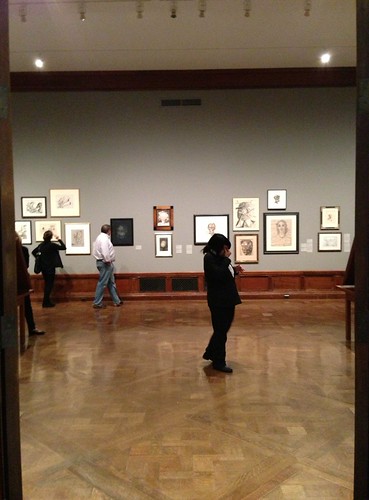
At the Surrealist Drawing Exhibit, Morgan Library
One of the Drawing Surrealism exhibit rooms
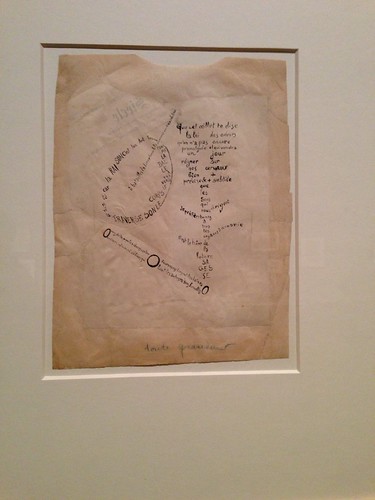
Guillaume Apollinaire, La mandoline, l'oeillet et la bambeau, 1915-1917
Guillaume Apollinaire, "La mandoline,
l'oeillet et la bambeau" (1915-1917) 
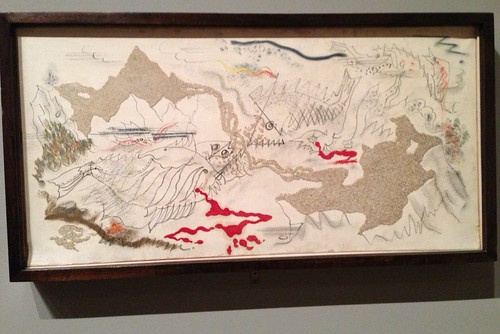
André Masson, Battle of Fishes, 1926
André Masson, Battle of Fishes (1926)
(he uses sand on the painting, as you can see)

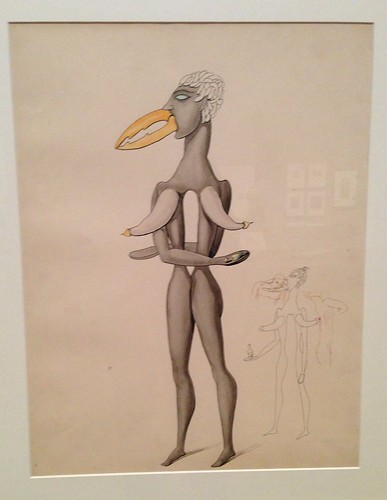
Wilfredo Lam, Woman and Bird, 1942
Wilfredo Lam, "Woman and Bird" (1942)
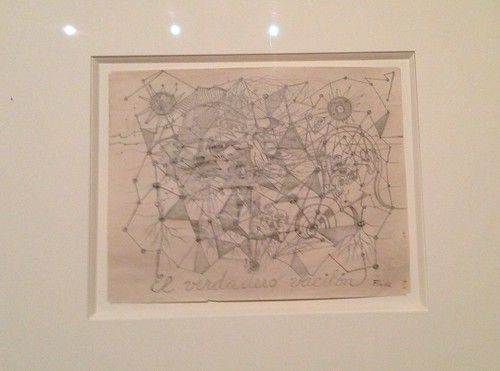
Frida Kahlo, El verdadero vacilón, 1946-47
Frida Kahlo, "El verdadero vacilón" (1946-47)
Victor Brauner, Anatomie du désir, 1913
Victor Brauner, "L'Anatomie du désir" (1933)
Exquisite corpse drawing (Breton/Duhamel/Morise/Tanguy), 1928
Exquisite corpse drawing (collaboratively
created by André Breton, Marcel Duhamel,
Max Morise, and Yves Tanguy, 1928)
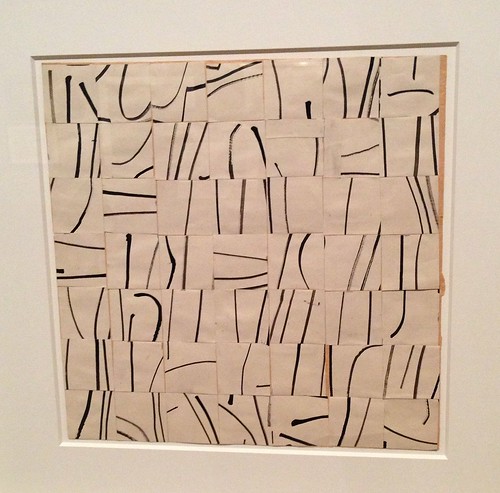
Ellsworth Kelly, Brushstrokes Cut Into 44 Squares and Arranged by Chance, 1951
Ellsworth Kelly, "Brushstrokes Cut into 44 Squares
and Arranged by Chance," 1951

Sunday, February 10, 2013

Black Surrealism Conference @ NYU

Left: Journal cover of Légitime Défense (Self-Defense) (1932).
Right: Adam Pendleton (American, b. 1984) with Jaan Evart (Estonian, born 1981),
Marc Hollenstein (Swiss, b. 1980). Black Dada (Ian Berry, couple dancing, independence
celebration Congo, 1960) (2008/2012).  Courtesy the artist, Pace Gallery,
and Shane Campbell Gallery.
Blizzard Nemo struck, but it wasn't a knockout blow, so I bundled up and hopped on the trains to make my way to NYU on Saturday so as not to miss a Performa conference with one of the longest titles I've ever seen, GET READY FOR THE MARVELOUS: BLACK SURREALISM IN DAKAR, FORT-DE-FRANCE, HAVANA, JOHANNESBURG, NEW YORK CITY, PARIS, PORT-AU-PRINCE, 1932-2013, but which could easily go by the title "Marvelous Black Surrealism(s)." Held at NYU's Barney Building, the conference included the standard talks and panel discussions, but also film screenings and several performances. Since I attended the MoMA PS1 Now Dig This! conference on Friday I had to miss the conference's first day, which RoseLee Goldberg, the Founding Director and Curator of Performa introduced, and which included a keynote address by Robin D. G. Kelley, "Blues People and the Poetic Spirit: Recovering Surrealism's Revolutionary Politics; artist Adam Pendleton's "Black Dada" performance honoring playwright Adrienne Kennedy; a panel on "Black Surrealist Beginnings: Dance, Theater, and Visual Art," featuring NYU professor Awam Ampka and Barbara Browning; Lowery Stokes Sims, Curator at the Museum of Art and Design; and RoseLee Goldberg; a screening of Maya Deren's famous film (completed by Cherel Ito and Teiji Ito), Divine Horsemen: The Living Gods of Haiti (1985). Poet Holly Bass, who I saw on the Saturday, told me that the panel was especially good.

Saturday's program began with a screening of the William Greaves' 1967 film The First World Festival of Negro Arts; this was the official documentary film of the 1966 festival held in Dakar, Senegal, attended by over 2,000 artists in all genres from across the African Diaspora, among them Duke Ellington, Langston Hughes, Alvin Ailey, Léopold Sédar Senghor, and Aimé Césaire. Following the Greaves film was Zétwal, a 2008 film by Gilles Elie-dit-Cosaque, which tells the story of "Martinican legend" Robert Saint‐Rose, or Zétwal (Creole for Les Étoiles, or Stars, or "Twinkl," as it was translated in the subtitles), who built a space-ship and attempted to travel to outer space, powered by the poetry of Césaire. As fanciful as this sounds--and bizarre, no less--the film tells an enthralling story about popular beliefs, the credence given the written and spoken word, specifically poetry and more specifically the poetry of Césaire, and how myths shape and become realities. This film repeated in the afternoon when, because of the blizzard, Savannah College of Art and Design chief curator Isolde Brielmaier was unable to make it to New York to deliver her talk on contemporary artist Wangechi Mutu.

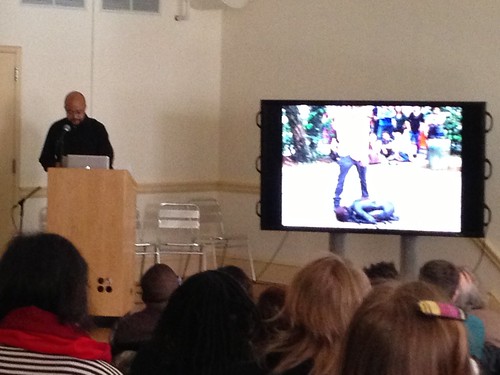
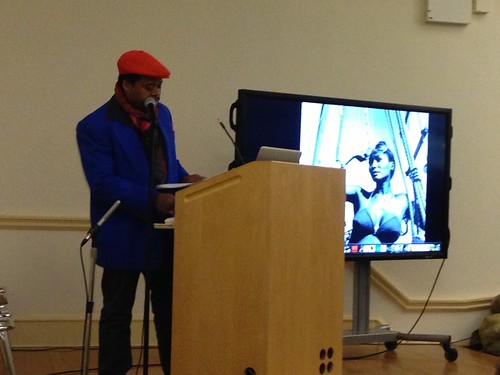
The afternoon session did begin in fulgurant fashion with NYU performance studies guru Tavia Nyong'o delivering a paper entitled "Dream, Collage, Lightning: Dark Future for Surrealism." There were so many bright points in this presentation that I could barely keep up, but I did note a few: the idea of "illuminatory fulguration" in relation to capital, surrealism, and the future; thinking of the "black in black surrealism as the back beat"; the work of the Brazilian artist Washington Silveira; the "ongoing immanence of blackness to European radicalism"; how Jean-Michel Basquiat, in "Cabeza" and other paintings, was drawing upon a notion of "The Line of Flight" from George Jackson and other black radicals, and how this linked to even older trajectories of flight and fugitivity; Lorraine O'Grady--evoked several times during the day--on the feminine body in the West not being a "unitary sign," but rather like a 2-sided coin, which led to thinking about how blackness and racial difference made possible the "sexual differentiation of sexual difference," which is to say that blackness "provides the dark ground on which sexual difference can differentiate itself"; Mutu's art building figures out of the body's palimpsests; blackness as the possibility of all colors or euchromaticity; Fred Moten (also frequently evoked) noting that "we claim all who claim blackness"; and, a revelation for me, the work of Regina José Galindo, notably a body art-performance piece in which she covered herself in multiple layers of blackened cork, curled up like a ball, and then remained impassive as two men, followed a woman, urinated on her. Nyong'o talked about how he withheld identification with her in order to "see" the performance, see her, see more deeply into what meanings it held and offered, and concluded by tying this to the old(er) idea of surrealist "second sight," which might allow us more fully to "see."

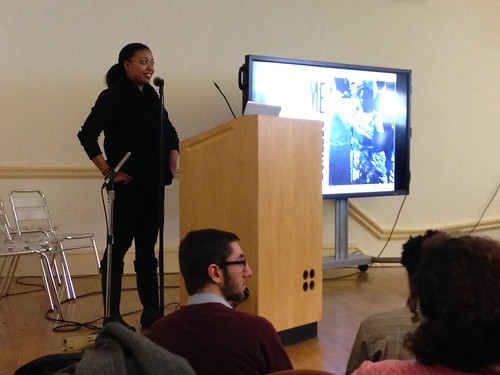
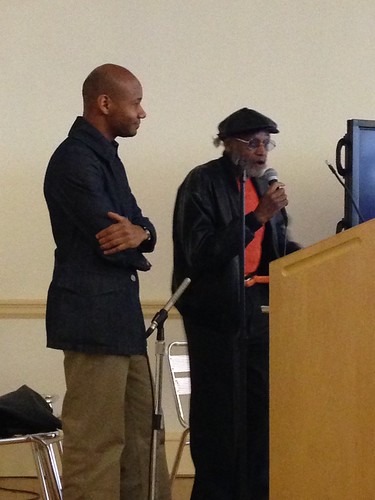
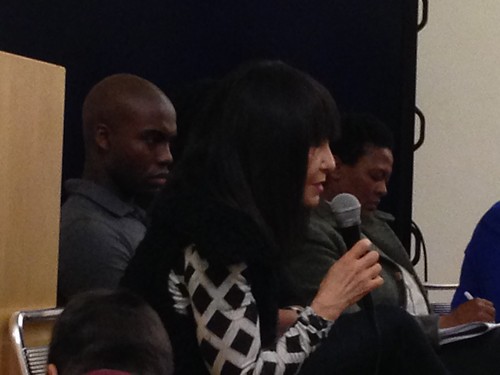
Another highlight of the day was a conversation Paul D. Miller, a/k/a DJ Spooky, held with filmmaker, director, actor and overall savant Melvin Van Peebles. Up there in years but spry as a fox, Van Peebles told stories, recited some poems, and basically served up a bounty of folk wisdom, even sharing the famous "Shine on the Titanic" poem, which I hadn't heard in years. In between anecdotes about how he, a native of the South Side of Chicago, got started initially as a painter before shifting into films, dealing with mainstream studios and the unions, and his role in helping Gordon Parks to get his first directing stint in Hollywood, he expounded on how so much of black life in America and elsewhere has drawn upon a practical surrealism that functions as a means of survival. It was a highlight of the afternoon. Another came when author, musician, cultural critic, and brilliant person Greg Tate concluded the afternoon panel on "Black Surrealism Now," which also included artist Simone Leigh, and Gabi Ngcobo, Curator and Founder of the Center for Historical Reenactments in Johannesburg, with what may have been a work of fiction that also moved critically across a range of themes and tropes dealing with what he variously named "black soul realism" and "Afro-fugitivism." I would be remiss if I didn't mention doctoral student and associate curator at Peforma Institute Adrienne Edwards, who not only organized the entire conference, but offer the warm remarks throughout the day and delivered a stand-in, stand-up presentation on Mutu, casting insightful light on that artist's works. All the events were videotaped, so I hope Performa makes them available free of charge, and soon.

Some photos from the event below:

Tavia Nyong'o @ Black Surrealism conference, NYU
Tavia Nyong'o, with a clip of Regina Galindo
Adrienne Edwards, Black Surrealism Conference @ NYU
Conference organizer and presenter Adrienne Edwards
DJ Spooky & Melvin Van Peebles
DJ Spooky and Melvin Van Peebles
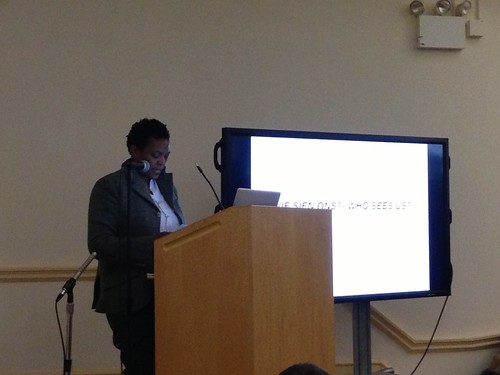
Gabi Ngcobo
Gabi Ngcobo
Greg Tate
Greg Tate
Adam Pendleton, RoseLee Goldberg, Gabi Ngcobo
Final panel (l-r) Adam Pendleton, RoseLee Goldberg, Gabi Ngcobo