 |
| Brazil's new chief justice, Joaquim Barbosa |
Brazil passed a milestone last month when Joaquim Barbosa, Brazil's only black current Supreme Court justice, ascended to the post of Chief Justice on November 17, 2012, becoming the first Afro-Brazilian ever to hold that post. He is the third person of identifiable African ancestry to sit on Brazil's Supreme Court; the other two served in the early 20th century. Barbosa, who attended the University of Brasília and the Université de Paris II, and served as a visiting scholar at several US institutions (Columbia University and University of California-Los Angeles), initally assumed his Supreme Court seat in 2003 after being nominated by former president Inácio Lula da Silva in 2003. Despite the patronage of Lula, Barbosa has electrified the Brazilian populace and press through his role as the leading figure in the prosecution of the potentially worst corruption crisis in the country's history, the Mensalão scandal, which has engulfed a number of prominent members in the administration of former president Inácio Lula da Silva, and has led not only to prosecutions, but perhaps as well to the death of São Paulo State mayor, Celso Daniel of Santo André.
Barbosa's background differs little from a sizable portion of Brazil's Afro-Brazilian communities, which now account for 52% of the country's total population of 192 million people; he was born in the small town of Paracatu in Minas Gerais state and grew up in a working-class household, and after completing his studies served in various capacities for several of Brazil's governmental departments. With the retirement of his colleague Ayres Britto, also appointed in 2003 by Lula, Barbosa automatically became Acting President of the Court, but he already had been chosen to hold the seat, for a two year period, by his fellow justices in October, as part of a tradition in which the oldest justice who had not already assumed the post would do so. According to the Latin American Herald Tribune, in addition to inviting Brazil's first woman president, Dilma Rousseff, Barbosa also made a point of inviting notable Afro-Brazilians to his installation. Roberto Gurgel, Brazil's attorney general noted that "“In a society like ours with a large presence of blacks, it speaks very
well of our country, of our democracy, that for the first time a black
man becomes chief justice of the Supreme Court." Time indeed.
***
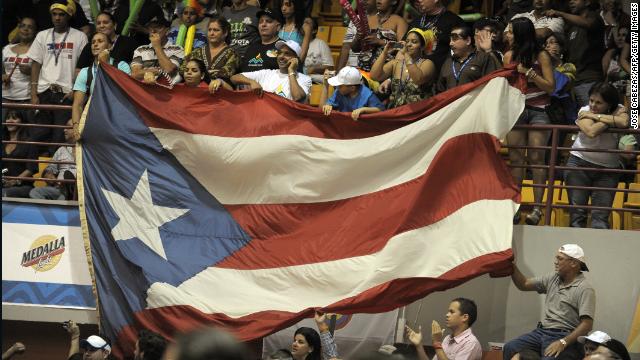 |
| Puerto Ricans holding up their flag (File photo) |
I think I've missed the commentary on this, but I thought it significant that this past national election day, November 6, 2012, for the first time, a majority of Puerto Rican voters cast ballots in favor not of independence or continued Commonwealth status, but for statehood. So the dream of Dr. José Celso Barbosa (1857-1921), the (Afro-Rican) father of Puerto Rican statehood, has moved from background to the foreground. The plebescite involved two votes. In the first, by 54% to 46%, Puerto Rican voters rejected Commonwealth status, and in the second, 61% of voters called for statehood versus 33% for "sovereign free association" and 6% for full independence. About one-third of all the ballots, however, were left blank. Despite the vote, Congress must follow the US Constitution's provisions under Article 4 to take the steps it has for every state that has entered the Union since Vermont in 1791, and which it last did in 1959, when Hawai'i became the 50th state. There is no guarantee that the current Congress will do so.
 |
| Dr. José Celso Barbosa (Wikipedia) |
In CNN.com's article on the vote, Puerto Rico's Secretary of State Kenneth McClintock stated that the motivations behind the pro-statehood vote included the Commonwealth's ongoing economic crisis and its falling population. As of this year, 58% of Puerto Ricans live on the mainland instead of Puerto Rico's islands. With statehood, McClintock appears to suggest, might come greater economic integration and certainty for residents and businesses. Additionally, the 4 million Puerto Ricans living in Puerto Rico would be able to vote in national and federal elections just as the 5 million who live in the US mainland can now do. But is this what Puerto Rican voters really want? Another approach was not on the ballot, Jorge Benítez, a scholar at the University of Puerto Rico-Río Piedras, noted, citing those blank ballots and pointing out that many voters would rather that authorities review an Obama administration report that offers possible non-colonial options, an approach favored by the party that will assume the governorship.
Just a few days ago, on December 11, 2012, the Legislative Assembly of Puerto Rico enacted a concurrent resolution asking the Congress and President Barack Obama to respond swiftly and seriously in response to Puerto Rico's voters, thereby ending once and for all its territorial status and, like Alaska and Hawai'i, incorporating it fully into the United States and making it the 51st state. Last year President Obama became the first sitting president in 50 years to visit Puerto Rico, and he received overwhelming support from Puerto Ricans living in the 50 states, so he very well might press Congress to consider getting the process leading to statehood underway. Whether that squares with the wishes of Puerto Ricans in Puerto Rico is another matter. There is also the question of a possible 52nd state which would provide numerical, if not ideological balance: The District of Columbia. It too should be given full consideration by the Congress. One problem, however, would be that between the two entities, there might not be a balancing of Democratic and Republican Congressional votes, though Puerto Rico has repeatedly elected conservatives to its governorship, including the last before this most recent election. Post-colony or independent? El estado nuevo or lo mismo de siempre?