This past Sunday brought the sort of event that too seldom occurs: two of the leading African American writers and cultural avatars--two of the leading
American writers and cultural avatars--in a conversation guided by the third, in an intimate, welcoming non-academic setting. Or perhaps this does occur frequently but I have not been around to catch it. As soon as a friend alerted me that
Toni Morrison (1931-) and
Ishmael Reed (1938-) would participate in a conversation, led by
Quincy Troupe (1939-) in
Harlem no less, at the home of Quincy and
Margaret Porter Troupe, as part of the
Harlem Arts Salon, which has been presenting amazing programs for years now, I let friends know and got a ticket so as not to miss them. I have seen (and drawn) Toni Morrison a number of times, I studied with Ishmael Reed as an undergraduate, and I have heard Quincy Troupe read his work and was fortunate to have him select one of the first poems I ever had published in a mass circulation publication years ago, but I had never seen them all together chatting publicly. And it goes without saying that they did not disappoint.
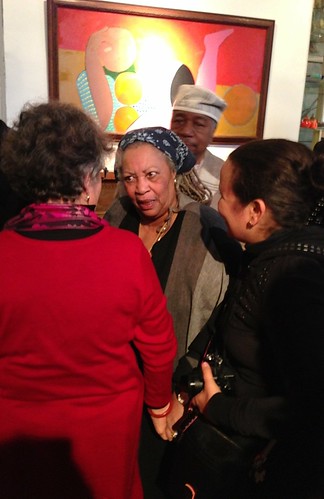 |
| Toni Morrison, after the talk (Eugene Redmond behind her) |
Before I provide a few highlights of their conversation, let me first note that a number of other wonderful writers and literary folks (and I will certainly accidentally miss some people, so forgive me) were present, among them
John Edgar Wideman, Marilyn Nelson, Eugene Redmond, Steve Cannon, Elizabeth Nunez, Keith Gilyard, Kate Rushin, Tyehimba Jess, Tonya Foster, Randall Horton, Farah Jasmine Griffin, Lorelei Williams, Brenda Greene, and
Charles Ruas, just to name a few. That was just (part of) the audience, which poured into some three or four rooms of Margaret and Quincy Troupe's beautiful home. So packed was the gathering that I sat in a side room, with many others, and watched the luminaries on a screen, though I could hear them clearly just a room away. Acclaimed Bay Area artist
Mildred Howard prepared a range of delicious, healthy meals, as well as some of the softest, most scrumptious but not too sweet sugar cookies I've eaten in years. Also, the
San Francisco Museum of Modern Art's Open Space blog featured a streaming livecast of the event, and you can watch the entire conversation
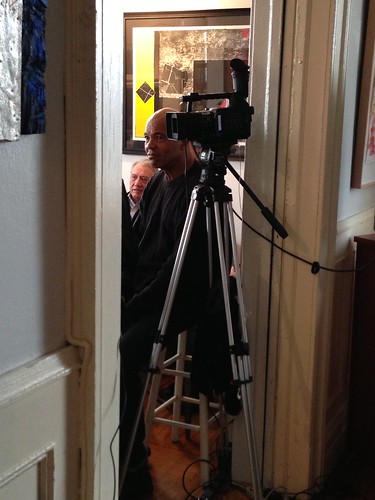
here. (A head's up: I'm briefly visible behind the video technician.) Lastly, poet
Rich Villar, co-curator and one of the main forces behind the
Acentos Foundation, which nurtures and promotes Latino/a writers and literature, delivered a spirited introduction to the event and for all three writers that did him and them proud.
Morrison and Reed have known each other for many years, going back to the period when both were living in New York and beginning their careers, and both have known Troupe as well since the late 1960s; Morrison and Troupe met at the loft that late, great writer
Toni Cade Bambara had once maintained in Harlem. Rich Villar even read biographical notes for each from the mid 1970s, when they were already quite accomplished and yet still early in their careers. The conversation proceeded with Troupe asking open-ended questions about several topics, ranging from teachers who had an influence, to literary and cultural models, to the importance of geography, to how each writer wrote on a daily basis, to their thoughts on contemporary literature, and each spoke at length, with Reed (one of the best teachers I have ever had, and the first person to publish me in my adult life) often divagating into topics he wanted to discuss, and Morrison mostly sticking to the question but providing delectable anecdotes and motes of wisdom as she did so.
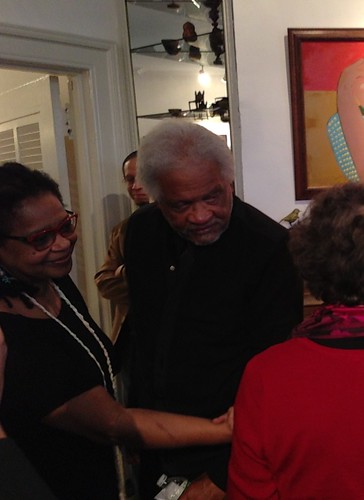 |
| Margaret Porter Troupe and Ishmael Reed |
Some of my favorite Morrison comments were when she was describing how, as an undergraduate at Howard, she had wanted to write on blacks in Shakespeare, but her professor felt this was outlandish and denigrated her. (She would have been ahead of her time on this topic, as subsequent scholarship has made quite clear.) She mentioned this anecdote as a way of distinguishing such professors from the ones who were more open, nurturing and forward-thinking, among them
Sterling Brown, the great poet, and
Alain Locke, the philosopher, whose "personal idiosyncrasies," such as using a handkerchief to touch doorknobs and folding a napkin on the desk onto which he placed his thereafter unmoving hands she found even more compelling than his difficult philosophizing. With regard to influences, she mentioned how important
James Baldwin's essays were, particularly his evocative and effective use of language, and she also praised
Chinua Achebe and
Wole Soyinka for not "writing under the [white] gaze", something she has always striven not to do. One powerful aspect of Achebe's work she noted was a moment in which a male character is about to depart his home, and loving runs his hands through the thick hair of his wife. This small loving gesture towards hair that is so often reviled (even in Africa) was something many readers might overlook, but she found it telling about Achebe's mindset and larger aesthetic and social outlook, and worth thinking about in relation to her own writing.
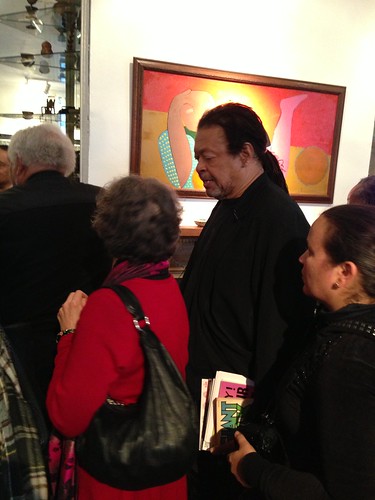 |
| Quincy Troupe |
Morrison also talked about being a radio story-telling child, and how, growing up in her family, people would tell stories and then retell them over and over, often changing and transforming them, and expect the children to do the same. (I grew up in a similar environment; stories were retold, and changed, though certain elements were invariant.) Growing up in
Lorain,
Ohio, she recalled there were no "black neighborhoods" and that her world was integrated, though her
home was a different sort of place, and that the segregation she encountered in
Washington while at
Howard University, which she chose to attend so that she could be around black intellectuals, black thinkers, her professors and fellow students, became "theater" for her. As she noted, the care and detail, and money, that went into maintaining segregation and segregated facilities was noteworthy--and, I often think, a sign of an societal-wide psychosis, but that's for another time. About her writing routine, she noted that she woke up early, when she was sure she could still be smart on the page, and she provide a bit of insight into her method of characterization, noting that she usually does not describe every attribute of a character, instead writing in such a way that the reader will draw her in our heads, but also know her when we see her in the world. She described this is as "call and response," perhaps the first time I've heard that term used in this regard, and it struck me as deeply insightful and apt.
 |
| Toni Morrison signing a book |
Ishmael Reed was his usual volcanic self; the years have turned hair almost titanium, but he has lost none of the fire I've always admired. He told the audience that one of his models was the Modernist satirist
Nathanaël West, particularly West's non-linear, collage method, which one can see in not only in Reed's earliest fiction but in his most recent novel,
Juice (Dalkey, 2011). He also mentioned
J. A. Rodgers, the famous autodidactic historian whose work re-educated several generations of black readers, and his peers in the
Umbra Group, one of the New York-based early 1960s predecessors to what became the
Black Arts Movement and the other innovative artistic movements of that era and ones that followed. Freestyling and riffing off Troupe's questions, Reed moved from "geography" and "region" to a discussion of 19th century Black poets--one of the second moments he appeared in intellectual sync with the work of my former colleague
Ivy Wilson--and discussed the courage of some of them in terms of their overt critiques, with so much more at stake, of
President Andrew Johnson and other powerful, white figures. He offered some choice quotes, among them that "A good writer is a rival state" (he was quoting ), and "We don't get to tell our stories," meaning that the pipeline remains a narrow one, we often write to the expectations of publishers and certain groups and readers, and so on. (This is far more true in other genres than fiction and poetry, though.) He ended this electric slide of commentary by saying that he wanted to be "like Mike Tyson" in his literature. I think he's achieved that many times over.
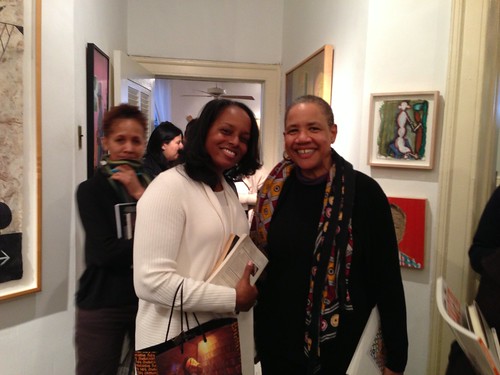 |
| Lorelei Williams and Kate Rushin |
Responding to the question of how he wrote, Reed discussed waking up and reading the papers every day, and getting angry. (Among his prodigious literary production was a blog he maintained for a while at the
San Francisco Chronicle, which I had linked to on this blog. I particularly enjoyed his editorial cartoons, which can acidly funny.) He was angry on Sunday too, noting how
Law and Order (I think he said) was planning an episode based on
Chris Brown's domestic abuse of
Rihanna, only in the episode the Brown-like character was killed. The exploitation and spectacularity of it are the kinds of things Reed has long pointed out, and he was no less acute in his comments. He went on to say, anticipating what Morrison would say, that he was always writing and urged people in the room never to stop writing, but also to write in a variety of genres, undertake a "full-court press." He even spoke about a program for low income students he and his daughter had developed that got them reading and writing, and described it as a "Midnight Basketball During the Day," or Midday Basketball program. The participants, mostly black and latino, told him when he asked why they'd gone off track that they had no idea where they came from, and addressing this problem had long been an aim of his work.
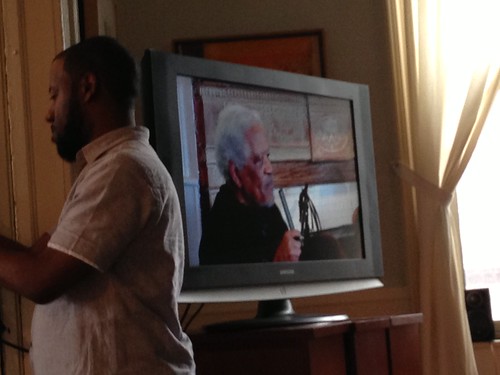 |
| Ishmael Reed on the monitor |
A few other points he made involved him talking about learning
Yoruba, the language and literature,
as a way of studying the roots of African American culture and of another tradition of storytelling. He also talked about his study of
Japanese, and how after
Reckless Eyeballing, which deeply enraged white feminists and their allies across the country, he became "literary roadkill," though he noted Morrison supported both him and that book, but also that after that he'd followed
Langston Hughes's example of going to Japan (and this connection with Japan in particular, I must note editorially, has a history in black innovative art practice; it came up at the
Now Dig This! conference as well), where his book
Japanese By Spring, as well as his other works, were praised and he was feted. Among his final thoughts were praise for contemporary American writer, in part because of the changing technological landscape, with e-books and print-on-demand possibilities unavailable to earlier generations, and "more players" out there, as opposed to the gatekeepers and literary elites of the past. He did admit to addiction to Facebook, an enthusiasm I'm thankful I've been able to avoid but which many writer friends have not, but Reed flipped it by noting that for him it was also a "platform" of the kind he is so fond of, and so even on Facebook, he is being none other than Ishmael Reed, writing and fighting.
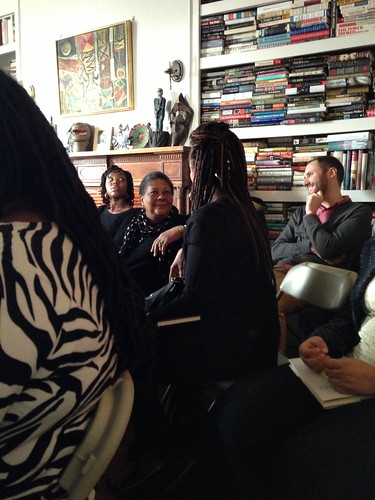 |
| Marilyn Nelson |
It was an amazing event, and whetted my desire to catch any and every future Harlem Arts Salon event. It was also a perfect way to spend a Sunday afternoon in New York during Black History Month!
 |
| John Edgar Wideman |