Showing posts with label austerity. Show all posts

Monday, November 26, 2012

Fiscal Cliff/Austerity Bomb/Phantom Crisis


There have been many excellent reports online about the alleged "fiscal cliff," which is not a cliff at all but more of a "slope," and which really merits a far better metaphor of the kind that Paul Krugman and others have devised, the "austerity" bomb. A while ago, I wrote about what was behind the push for austerity, and I urge J's Theater readers who have not already read Krugman's column today, "Fighting Fiscal Phantoms" to review it, because he not only names the chief player behind the "fiscal cliff"/"deficit scold" testeria, but summarizes why it is hardly what we're being told it is, including by the White House, with the complicity of one of Krugman's employers, the New York Times. His column crystallized for me what I've long thought about why we keep running into this crisis around taxes, the social safety net (i.e., "entitlements"), the government's role, and the establishment media's unwillingness to spell out what's really at stake (or its willingness participate in manufacturing consent by playing up the crisis). When you have multimillionaires like Goldman Sachs's chief, Lloyd Blankfein, hopping aboard Trojan horses like "Fix the Debt" despite the fact that his company has gorged at the government's troughs, the game and fix are clear enough to me. Here are my thoughts, adapted from an email I sent to some friends and broken down into numbered points, about what's really behind the current fiscal cliff crisis.

The GOP and conservative Democrats, agents of the plutocracy (or the 1%, or oligarchy, or billionocracy, whatever designation you like), seek to:

1) slash the social safety net now so that there will be less need later to keep marginal and capital gains tax rates, especially for the 1% and corporations, at even the current historically low levels--making it likely that any future necessary tax increases will disparately impact the middle and working classes and the poor;

2) under the rubric of "tax reform," steadily ratchet down marginal rates on the 1%, lower corporate rates, zero out capital gains taxes, eliminate estate taxes, cut all loopholes that do not benefit plutocrats, and allow various territorial tax schemes that allow the 1% and corporations to avoid US taxes and play other federal, regional or territorial tax regimes against each other;

3) lock in spending for the military and any programs (like Fed Reserve spending) that benefit the top 1%, Wall St., military-industrial complex beneficiaries, and if it takes a war or three to guarantee it, so be it; 

4) privatize as much of the remaining government as possible, so that those with the access and assets can feed off all the new revenue streams and what remains of a severely weakened, defunded governmental system;

5) rhetorically demonize government, via the corporate media (which has a stake in picking the bones of the government dry) to blame it for its failure to address the needs of the 99% (or 47%), while destroying and sucking every last dollar out of it.

Speaker John Boehner, President Barack Obama meet
to discuss the "fiscal cliff," November 16, 2012
(Carolyn Kaster/AP, csmonitor.com)

But it doesn't have to be this way at all. There was a Budget of the Congressional Progressive Caucus that progressives in Congress have seemed incapable of championing, and the result is that the GOP, neoliberals and the establishment media see fit not merely to sneer but to bury it altogether. Even short of the Progressive Budget, though, the default of returning to the Clinton-era tax rates, which involve much more than the federal marginal income tax rates (the top being a relatively low 39.5%; top economists Emmanuel Saez and Thomas Piketty recommend a much higher rate of around 70%), but also capital gains taxes, the estate tax, the alternative minimum tax, and payroll taxes, just to name a few, is a better option that the austerity push with safety net cuts we have before us. De jure austerity has been a complete failure in Europe, and de facto austerity here, in the form of government cuts over the last 3 years, has kept the US economy from growing as robustly as it could. Furthermore, there are fairly simple fixes for Social Security that do no involve raising eligibility or reindexing it, while Medicare's and Medicaid's problems, more difficult to resolve, need not entail raising or restricting eligibility; a single payer system or Medicare-for-all would do more to lower health care costs and ensure Medicare's future than the fixes the GOP and Democrats are proposing.

Krugman states very clearly what I learned in introductory macroeconomics. We are not anywhere close to the Federal Reserve's inflation target for full employment. Price stability is not its only mandate, and the people and corporations sitting on cash will put it to better use as we approach the 4% target. Additionally we will not go bankrupt or encounter the problems of Greece or any of the other European peripheral countries because we have our own central bank and control our own monetary policy and currency. US monetary policy over the last five years has had a beneficial effect on the economy, and the libertarian Republican Ben Bernanke is hardly about to turn into Andrew Mellon or Paul Greenspan. We will not encounter the problems South Korea did in its debt crisis because most of the debt is in our own currency, and primarily owed to the US or American creditors. The cries about a weaker dollar overlook the fact that even in a weakened global economy weak dollars help the US with exports, providing a necessary jumpstart for the economy, and improving our balance of trade.

One thing that Krugman has been begging the President and Congress to consider is the basic Keynesian principle of borrowing now, with borrowing costs at near historic lows, to underwrite a massive jobs and infrastructure bill. We can more than make up the costs by increased revenues from higher tax rates and increased employment, and we will set ourselves up for even greater economic prosperity in the future with an improved and expanded infrastructure, a better educated populace, and an economy that is powering forward. Lastly, cram down legislation, which the banks and Wall Street have fought, and which their agent Timothy Geithner has worked hard to prevent, would be the best plan for the housing crisis. It's unlikely to happen, but that coupled with all the other strategies above, and a vibrant safety net that protects vulnerable Americans, would really help the economy in ways all the tax cuts in the world to billionaires never could.

Tuesday, March 06, 2012

Whom Does Economic Austerity Benefit?

French President Nicolas Sarkozy
and German Chancellor Angela Merkel
(Philippe Wojazer, AFP/Getty Images)
Why do so many European leaders, both within the Eurozone and outside it keep pushing economic austerity despite its apparent failures historically (under Hoover, FDR in 1937, Latin America in the late 1980s and early 1990s, etc.), and, as a host of current economic indicators show, in real time, in Greece, Ireland, Spain, Portugal, Italy, Latvia, and now even France and Germany? Why is so hard for the political opposition in the United Kingdom to make an argument for the failure of that country's coalition government's policies, which have proved a disaster, stalling economic growth and creating social havoc? In fact, were the UK following an equally tight monetary policy, like the European Common Bank under Jean-Claude Trichet and now Mario Draghi, instead of the expansionary approach the Bank of England head Mervyn King has adopted, its jobless rate and slowdown might be as severe as Spain's, which tops out the European Community.  Even here in the USA, after the country experienced the most severe economic shock since the Great Global Depression of the 1930s and early 1940s, and in the face of an inadequate but still necessary stimulus bill and the Federal Reserve's successful monetary policies, the call for austerity, budget-cutting, and fiscal retraction remains strong. In fact, it is already underway at the state and local level, and may be one of the major causes of the slow and tenuous growth rate the country is now experiencing.

I'm aware that Naomi Klein and many others have written entire books about why economic and political leaders would and continue to push such policies; Klein's arguments concerning "disaster capitalism's" effects, via "shock doctrine" policies, praised but with caveats by the likes of Nobel laureate economist Joseph Stiglitz and Indian MP and former United Nations Under-Secretary Shashi Tharoor, are incredibly persuasive and resonate with critiques articulated by generations of people on the political Left as they do with many participating in the Occupy movement.  Moreover, as Michael Moore's Capitalism: A Love Story (2009), Charles Ferguson's Inside Job (2010), and the documentary film version of Klein's book, to give but three examples also illustrated, the "disaster capitalism complex" is just that, complex series of interlocking systems, institutions, discourses, attributable to no single person, firm (though Goldman Sachs's name would pop up in amost every account), conspiracy or aim, though the goal of funneling economic and political capital into the hands of a very few (the upper reaches of the 1%).

So, knowing all of this, why would I ask "What is Economic Austerity For?" or, to put it another way, why do political leaders and their plutocratic backers and friends keep pushing economic austerity? Why do brilliant economists like Paul Krugman bemoan the depredations of austerity, as he regularly does, predicting its destructiveness and calling out its agents, but always with the query of why the people behind it are doing it? Surely he knows better. Why do online commentators resort to a form of near-Manicheanism when discussing austerity, labeling those behind it "evil,"or suggesting that they are sadists--and perhaps some are, who knows--rather than trying to divine who benefits from such policies? As I said, we know who benefits, but when I consider the public discourse about austerity, whether in the US or beyond our shores, particularly in the mainstream media, I note that no one begins to put the various strands together. So here's an attempt, using a simple list format, to note who benefits from such policies.
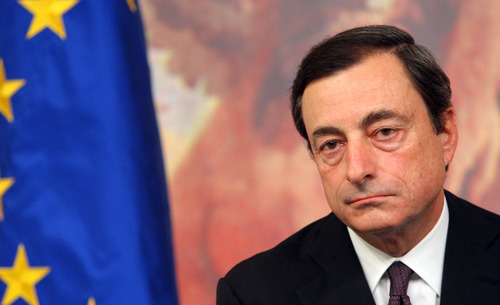
European Common Bank President Mario Draghi
(Macrobusiness.com.au)


This is what I see:

In the EUROZONE countries

1) for the creditor nations and the global banks, austerity coupled with bailouts of the creditors (but not the governments themselves through the purchase of sovereign debt) represents the chief alternate to default because because under a default the creditor nations could incur massive losses and the banks, both in terms of debt obligations and in terms of bond holdings, could lose everything. Thus creditors benefit by imposing austerity and dragging this out as long as possible, with feints, false promises, anything, because with each bailout the creditors are getting something, as opposed to nothing, which also benefits the private bond market, while the austerity policies place the sovereign entities in an even more weakened position;

2) for the sovereign governments in severe fiscal crisis with no monetary policy options, agreeing to austerity policies appears to be a good option in lieu of default because they fear the inability to borrow money at a reasonable cost, which is already happening, so their governments, whether run by people ostensibly on the left, right, or technocratically "centrist," go along with the creditors' program, though, as many have argued, in Greece's case, where the country to default, though it would cause a severe temporary shock, Greece would again have control its currency, devalue it to make itself radically more competitive, thus lowering its cost of living,  increasing exports, and making itself more attractive to tourists. It probably would not be able to borrow money anytime soon, however, so political and economic restructuring would have to occur, but that is already happening without any of the benefits of having its own currency.

MOREOVER:

3) the global banks and shadow banks, which caused the economic collapse, as well as private creditors, have placed bets on rising European debt and are benefitting as austerity drives these bets up;

AND, THE FOLLOWING APPLIES TO NON-EUROZONE ECONOMIES LIKE THE UK AND THE US:

4) austerity allows political policymakers, abetting global corporations, banks, and the very wealthy to drive down public sector wages, dismantle unions or force radical cuts in any agreements they've made, hack away large numbers of government employees and any agreements public sector unions have made, making it more difficult to reenact those agreements at a later date;

5) austerity allows political policymakers, abetting global corporations, banks, and the very wealthy to drive down private sector wages because of increased competition and wage and salary deflation; dismantle private sector unions or force radical cuts in any agreements they've made, and thus drive up corporate profits, which accrue to corporate executives and shareholders;

6) once these policymakers and actors have effected such cuts, they then can also reduce or eliminate direct government services, through privatization, benefiting private corporations and often wealthy individuals; reduce government subsidies for particular private services that benefit middle-class and poor people, unless these subsidized private services directly benefit political and economic patrons, or undermine direct government programs; and to the extent possible, they seek to destroy or severely undermine safety nets, turning them both into privatized systems that the banks and wealthy can then plunder on the one hand, and into social welfare programs that are politically weakened and eventually be eliminated on the other.  One major discursive effect of such an approach is to underline the narrative that "government" doesn't work and that the safety net comprises entitlements as opposed to benefits people pay into and support, and which benefit the entire society; the attack on government power reinforces these empowered government and private political and economic actors' capital and power;

7) with austerity in place, the decreased public sector costs and social services mean that federal, state and capital gains taxes on the wealthy can remain low or, if raised (as in the UK, for example) can be pegged to floating economic targets upon which they can be returned to lower levels; the wealthy, imagining they will need only minimal government support of any kind, can afford to pay for private services, including higher municipal taxes benefitting the places they live; or they imagine they can move to secure enclaves protected from social unrest;

8) with austerity policies in place, the increased economic stress makes private and public sector workers more fearful of joining unions, challenging management, of speaking out, of requesting raises, of striking (this has not stopped either Europeans or Americans from doing so, yet), or of aiding fellow workers and organizing;

9) with austerity policies in place, the increased economic stress breeds social, economic and thus emotional and psychological strife and makes it easier to pit those under stress against each other, and in the absence of a strong Left party or parties, or a class-based or group-based consciousness grounded in theories of resistance and opposition, including the historical trends (Marxism-Leninism, Socialism, Progressivism, etc.) it opens the way for right-leaning parties to come to the fore, to write into law and then justify through adjudication the new state of affairs;

10) austerity policies in place also advantage the wealthy in multiple other ways, not least in elminating competition in corporate terms, while increasing access to political, social and economic actors and systems; augments their buying power (cf. real estate, retail, etc.) as well as their social and political power; affords their children less competition in terms of education, social and political access, etc.;

11) and finally, with austerity policies in place and the social, political and economic transformations these create, it makes it considerably more difficult to enact policies to turn things around, in the absence of revolution or another economic collapse, both because of the increased concentration of power and wealth in the hands of a few and because economically and psychologically stressed civic actors are less able if not less likely to participate, organize or challenge the increased power of the elites, allowing those possessing it to control whoever or whatever entities are "democratically" elected or, in the absence even of the figment of democracy, they can control through authoritarian means, thus extending social and economic inequality and the policymakers' power and control.

Now every element of this list, and especially numbers 4-11, do really represent "shock doctrine" policies in action to varying degrees, which is to say, neoliberal capitalism in conjuction with laissez-faire and libertarian economics.  They also do suggest a conspiracy, if not linkable to one source then to particular ideologies, actors, institutions and systems. Again, whereas some might label this behavior evil, and others, like economist Duncan Black (Atrios) have on more than one occasion pondered whether the people with and in power are just stupid, it's clear that there are numerous benefits, at least to a very few, of austerity policies in the face of the sorts of economic downturns we're seeing nowadays.

Now, how can we get some of this information across to more people?  The Occupy movement, blogs and other online social media, and certainly many grassroots organizations and institutions, as well as some political parties across the globe, have begun to do so, but I do think that one of the best way to get such information across to people is via media that touch them affectively, as well as intellectually, that entertain while also educating and enlightening. How, without resorting to propaganda and eluding the censors, can we do this? That is the major challenge.