Showing posts with label archive. Show all posts

Thursday, April 18, 2013

Digital Public Library of America Launches Today

Digital Public Library of America homepage
Utopian and pragmatic: these are the two poles that Robert Darnton, the eminent historian, Pforzheimer University professor and director of the Harvard University Libraries, identifies as guiding the process he and others dreamt up years ago, then began collaboratively developing two years ago in 2011, and which will come to fruition, when the Digital Public Library of America launches today.

"Háw-che-ke-súg-ga, He Who Kills
the Osages, Chief of the Tribe" (1832)
oil on canvas
George Catlin (1796-1872)
From the Smithsonian Institution
What is the Digital Public Library of America? It will be an online site that will make available to everyone with Internet access large portions of the already-digitized collections of many major American private and public libraries, archives and museums. While Google initially seemed the likely repository for the sorts of materials the DPLA will be hosting, its attempts--unsurprisingly, as a private corporation--to monetize access to the vast array of materials it has scanned in, and court rulings limiting full access to some of these materials, both have come to mean that Google may be a participant down the road, but the organizers of the DPLA have instead found private foundations to underwrite the project, and private and public institutions with extensive, already digitized archives, that they are willing to make available to anyone interested in exploring them.

Is the DPLA only open to people in the USA? Based on Darnton's comments in the New York Review of Books article linked above and what he has previously stated, the portal will be open to everyone able to access US websites. In addition, an immense storehouse of materials from Europe will be available via interconnection with Europeana, a super-aggregator of materials from 27 countries within and sponsored by the European Union. Darnton predicts that within a generation (or two, depending), a much vaster array of the world's materials will be available via the site. I immediately thought of the manuscripts stored in northern Mali that were thought to have been badly damaged when the northern part of that country fell under the sway of radicals who declared it an autonomous country, though it turns out they were not harmed as much as previously conjectured. A digital archive might be one way, alongside better material efforts, to preserve them for humankind.

Darnton appears to see only upsides to this effort, and I agree that it suggests to potentially extraordinary possibilities for knowledge preservation and production. I sincerely hope, however, that it also does not become an excuse, or the excuse, for financially strapped private and public institutions, organizations and governments of all kinds to eliminate or continue to gut physical libraries.  DPLA should be a complement and supplement, not a substitute or replacement, for the libraries we have, which deserve our fullest public and private support.

Now please excuse me while I go check out the DPLA.

Friday, January 25, 2013

"Lunch Hour NYC" Exhibit @ NYPL

photo
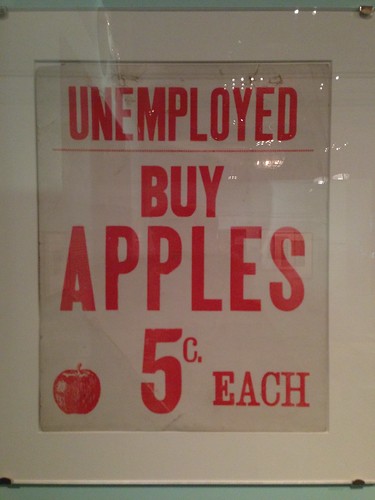
Depression era sign, Lunch Hour NYC (NYPL.org)
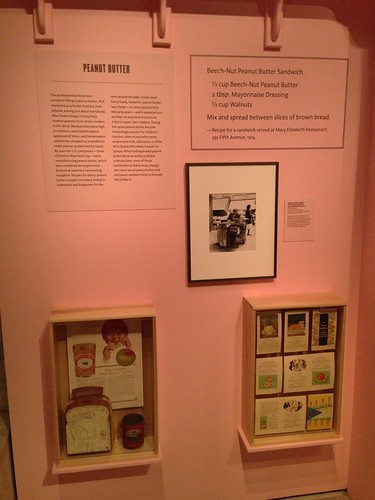
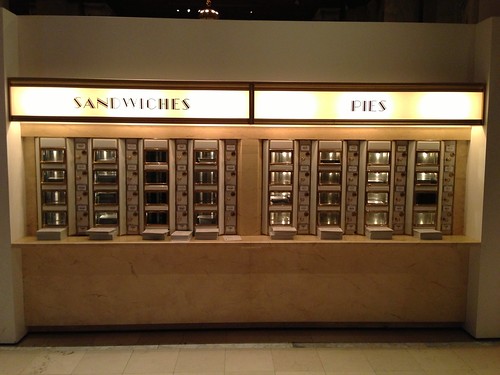
I spend at least one or two days of almost every week at the New York Public Library's Research Branch (the Schwarzman Building, soon to undergo a monstrous transformation), but so narrow and routine are my tracks there that it took a post on Jeremiah's Vanishing New York to draw me to the "Lunch Hour NYC" exhibit on the library's first floor. It is a delight, and if you're in Manhattan and anywhere near 42nd St. and Bryant Park, devote a half hour to seeing it. The gist of the exhibit is that in many ways New York City differs from the rest of the country, but in terms of lunch, a word whose definition the exhibit accords its own display, New York has often been very distinctive, as well as a pacesetter for the rest of the USA. From oyster carts and pretzel venders, to bagel-brimming delicatessens, to the Horn and Hardart automats that gladdened not only numerous city dwellers' stomachs but Hollywood screenwriters' imaginations as they dreamt up scenarios and settings, to that American culinary staple, peanut butter, as a lunchtime nutritional staple, to sumptuous power lunches where the city's (and often the country's and globe's) most important people made sure to be seen, the exhibit casts a wide net and offers many pearls.

photo
All about peanut butter for lunch (NYPL.org)
photo
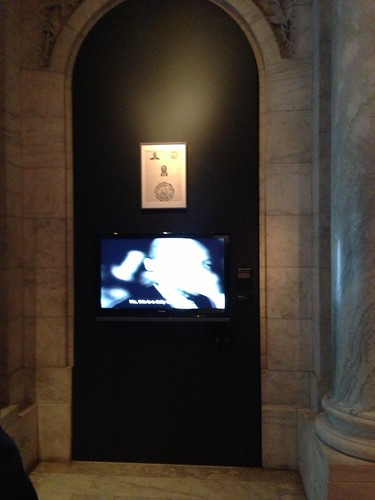
Fr. Divine, immortalized by Ralph Ellison (NYPL.org)
Lunch, it turns out, first appears in 16th century English as a rendering of the Spanish lonja, meaning a slice of ham (from the Oxford English Dictionary: R. Percyvall Bibliotheca Hispanica Dict. at Lonja de tocino,  A lunch of bacon, frustum, lardi.), while its supposed derivative, luncheon, appeared a decade or more before, with the same meaning. As the meal following breakfast, lunch, the more popular term, was considered "a vulgarism or a fashionable affectation," in the early 19th century (from the Oxford English DictionaryH. D. Best Personal & Lit. Mem. 307
The word lunch is adopted in that ‘glass of fashion’, Almacks, and luncheon is avoided as unsuitable to the polished society there exhibited), and still in its salad days if salads hardly made any menus but those of the penniless, but by the end of the century it had gained currency and become the name of the midday meal all English-speakers know today.

photo
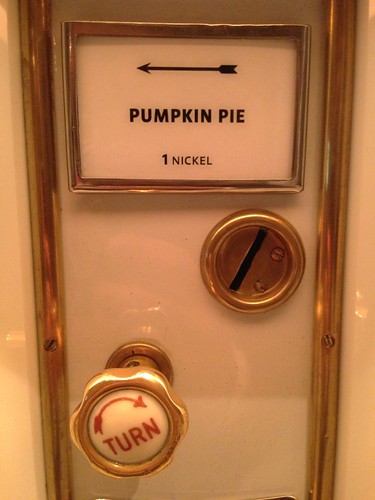
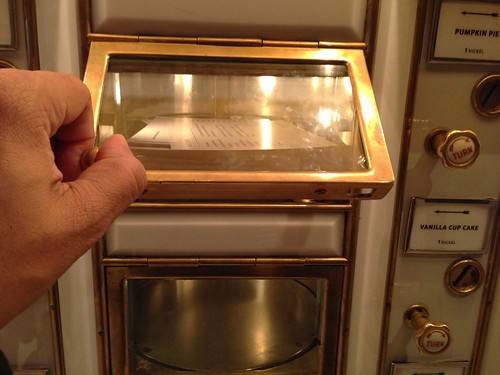
The automat case handle (NYPL.org)
photo
The automat case (NYPL.org)
photo
Opening one of the doors, with free
recipes inside (NYPL.org)
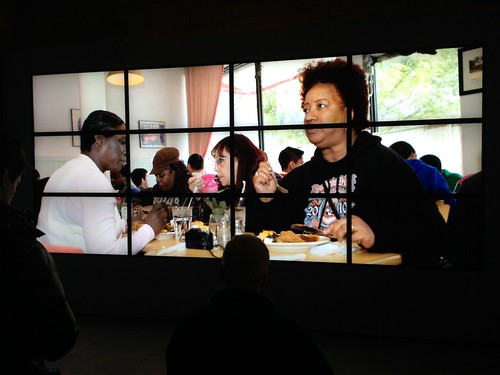
There's a little section devoted to the Algonquin Hotel and its legendary "round table," with drawings and photographs of notable attendees, including Alexander Woollacott and Dorothy Parker. There is a section devoted to African American lunchers, with an immense reproduction of a cafeteria packed with black diners. I grew up hearing "Why don't you go sell an apple?" as a snide remark, and the exhibit includes materials, like the poster above, detailing how this was for the most destitute of the destitute in the city (and others), at least temporarily, an employment option. Another wall features archival material and historical documents on dieting, which gained in popularity in the post-World War II era. Not only New York-based magazines, especially those geared towards women, but some restaurants attempted to capitalize on the growing interest in growing thinner and more svelte. At the exhibit's end perch artists' books, which show how great a subject lunch food can be in the right creative hands. Across from it, a multi-screen wall flashes images recent lunch-takers in the city, capturing and underlining the diversity and commonalities that have marked New York mid-day dining habits for nearly two centuries. The exhibit is one of the few free (visual, tactile, intellectual) lunches you can get in New York, and you won't gain a pound enjoying it.

photo
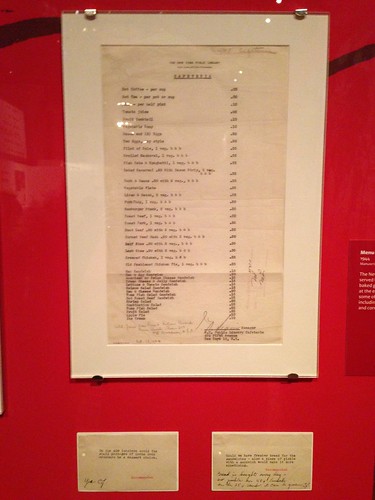
A menu from 1954, I believe (NYPL.org)
photo
Ladies who lunch, in 2012 (NYPL.org)

Wednesday, August 29, 2012

Ives House Spared + Zweig Brazilian Home Now Museum

The Charles Ives House in Redding, Connecticut
Danbury, Connecticut native Charles Ives (1874-1954) was one of the most original composers the US has produced, a genius to the ears of Arnold Schoenberg, another genius and his exact contemporary, and to those of many others, including Gustav Mahler, Leonard Bernstein, Leopold Stokowski, and José Serebrier. Like his soundworld, with its competing and often clashing layers of melody and harmony, rhythms and tonalities, Ives's composing career was idiosyncratic; he spent most of his daily working life as an insurance company executive in New York, and allegedly did not compose anything for the last 17 years of his life. Up till that point, however, he produce a slew of works that challenged the conventions of his era, and even today many of them strike the listener with their strange, otherworldly qualities. Ives's final home outside New York was in Redding, Connecticut, and as of last year, Charles Ives Tyler, Ives's grandson, had placed it on the market, and so it was in danger of being leveled, given the value of the land beneath it, its ramshackle state, and the presence of and desire for much larger homes nearby.

In early August Norman Lebrecht's Slipped Disc music blog posted about cellist and performance artist Zoe Martlew's attempts to alert the public's attention to the house's fate; her efforts and others' quickly stirred supporters, including the Charles Ives Society, based at the University of Illinois, into finding some means of preserving the residence, which still holds some valuable relics of Ives' life there, as Martlew saw when she visited the house with composer and conductor Oliver Knussen. It was here that Ives composed some of his finest and most original music, including the "Concord Sonata" and his radical, almost unperformable Fourth Symphony, which wasn't premiered until over a decade after his death.

Pictures (c) Zoe Martlew/Lebrecht Music & Arts
Among the proposed actions to rescue the house was a petition to President Barack Obama (but why not, I wondered, Connecticut governor Dannel Malloy, or, as someone on Lebrecht's blog suggested, the US Representative for that area, James Himes (D-CT) ?). Robert Eschbach, a music professor at the University of New Hampshire, established a Save the Ives House Facebook page. More practicable, it turns out, was finding some Ives fan or fans, or a coalition of them, to buy Ives's house. Now, according to WQXR Radio, it appears that that is happening, with the Charles Ives Society taking the lead in trying to raise the $1.5 million to purchase the house, an 18+-acre estate that also includes a cottage and barn, from Tyler, and Nikola Ragusa also setting up a fundraising page on Indiegogo to raise money as well. 

Kevin Hagen for The Wall Street Journal 
Kevin Hagen for The Wall Street Journal
This is only the first step, though; even if taken off the market and transformed into an artists' retreat, there are further unresolved issues, as WQXR points out, including zoning and related real estate issues; tax status; further funding for renovations and making the house accessible to visitors; the endowment of the "housing complex," as it were; the estate's location on a residential street, and so on. The institution running Ives' birthplace museum in Danbury faced such severe financial problems it had to furlough its tiny staff. The ongoing economic crisis has poses perils for arts institutions of all kinds, and the Ives House in Redding, even if saved from purchase-to-demolition, will still not be out of the woodpile without much, much more support.

***

@ CSZ Arquivo
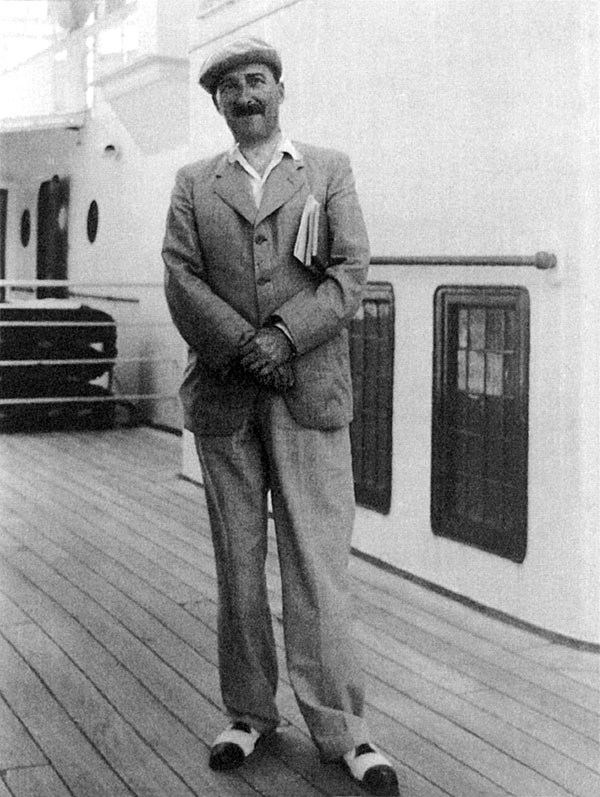
Stefan Zweig (@ CSZ Arquivo)

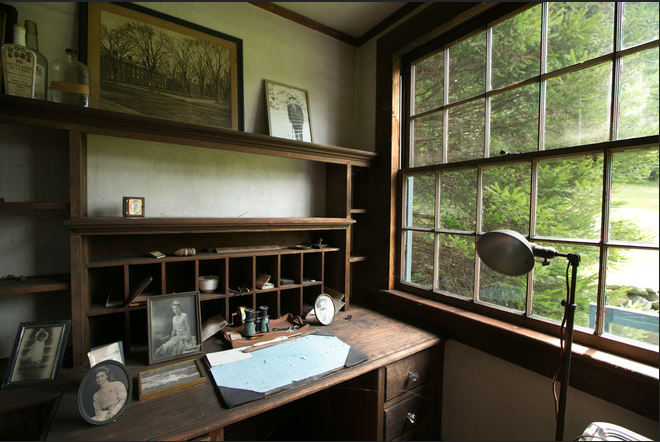
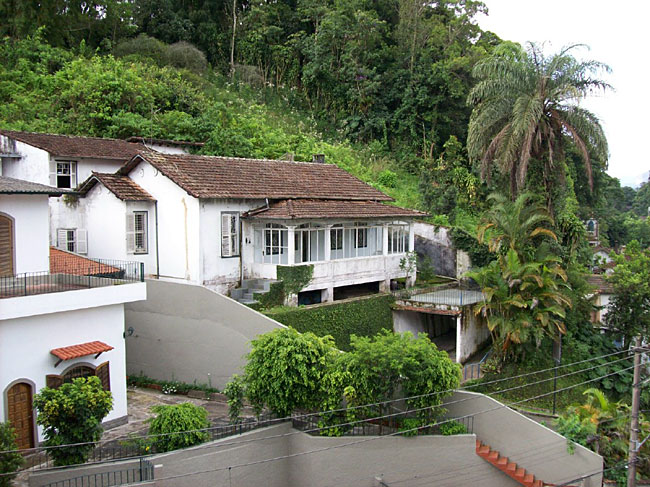
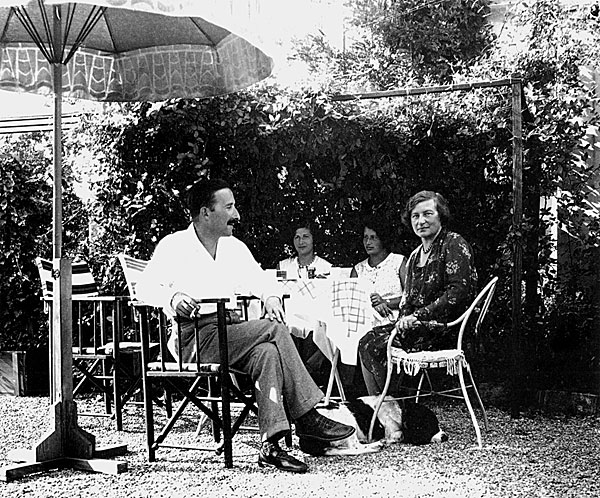
Halfway around the world, on the other side of the Equator, a famous artist's residence, brief though it was, has been preserved. North of Rio de Janeiro, in Petrópolis, the former summer resort city of Brazil's imperial family, the final home of the prodigious Austrian writer and librettist Stefan Zweig (1882-1942) and his second wife Lotte Altmann. It was in this home that Zweig and his wife, in flight from the Nazi regime dominating large swaths of Europe and thus cut off from the world they had known, and despairing for the future, lived for five months, with Zweig finishing his memoir The World of Yesterday; one of his finest works of fiction, The Chess Novella; and his perceptive survey of the country to which he had only just moved, Brazil, Country of the Future, before committing joint suicide. Thus did he terminate what had been one of the major literary careers of the era.  

The Casa Stefan Zweig (CSZ - Stefan Zweig House) received its earliest support shortly after Zweig died, when Brazilian author Raúl Azevedo proposed that the house be turned into a museum to honor the stateless refugee. His own heirs subsequently offered Brazil the contents of his dwelling in London, where he had lived before departing first for New York, and then to Brazil. It was not until over half a century later, however, that fans of Zweig were able to purchase the house and transform it into a museum. The house opened as a Zweig museum and archive, and as a cultural center, on July 29, and is open Fridays through Sundays, 11 am - 6 pm, with free admission. Among the artifacts available for view are 560 volumes, works in the original German, other manuscripts including annotated ones for future works, personal objects, autographed photos from close friends such as Richard Strauss and Sigmund Freud, and some of his extraordinary collection of original musical scores.

The Casa Stefan Zweig © Manfred Grietens
© arquivo

Rather bizarrrely, English Heritage turned down the application to honor Zweig with a plaque on the London house where he lived for five years. In addition to claiming that Zweig's status in Britain was not as high as elsewhere, it also stated that "it was felt that a critical consensus does not appear to exist at the moment regarding Zweig's reputation as a writer and that, as a consequence, it was not possible to be certain of his lasting contribution." During his lifetime up through his flight from the Nazis, his fiction, poetry, plays, histories, belles-lettres, and journalism received both acclaim and a large readership, in Europe, the United States, and South America, to the extent of being turned into major Hollywood films in several cases, and after the death of Strauss's longtime collaborator Hugo von Hoffmannsthal, Zweig wrote two libretti for Strauss's operas, having to do so secretly towards the end because of the proscription against his work laid down by the Nazis. Yet to the British preservationists, Zweig does not rank. Or not highly enough. So be it. A trip to Petrópolis sounds like a far more inviting option anyways.

Thursday, September 15, 2011

Via the Wayback Machine

c. 1997
When I first started blogging in 2005 I had no idea who my blog visitors were outside of very rough statistics or posts in my comment section.  I still don't know exactly, apart from commenters or people who tell me in person, but it's quite easy now to view the weekly, monthly or yearly stats and get an idea. To give an example, this week my top 5 most visited posts have been 2007 Rugby World Cup (always high on the list since it first appeared, and I have a strong idea why), Poem: Julia de Burgos's "To Julia de Burgos" (also usually quite high, and it makes me especially proud that my blogpost about one of Puerto Rico's most important poets, an Afrolatina, tends to be regularly sought out), Poem/Translation: Claudia Roquette-Pinto (my translation of one of her many exquisite poems), Review: Homme au bain (Man at Bath) (my review of Christophe Honoré's film, which features a discussion of M. François Sagat, whose name I suppose generates the searches), and The High Line (my 2009 photos from a visit to one of New York City's contemporary treasures).

This week the top referring sites are all Google (US, UK, Canada, New Zealand, Australia, South Africa, India), no surprise there, but the top key searchwords bringing people to the site are a surprise: "a julia de burgos translation," "homme au bain," "roberto bolano," "mamuka gorgodze" [მამუკა გორგოძე] (? - yes, I had to look him up; he's a star of Georgia's 2011 Rugby World Cup team), "a julia de burgos," and "martin puryear."  Again, how wonderful that people are searching out films, writers and visual artists and coming across this site. J's Theater readers are overwhelmingly from the US, but the next highest groups of page viewers this week come from the UK, France, Canada, Australia, Germany, New Zealand, and Brazil. Hello to all of you! Most viewers (40%) are using Internet Explorer on Microsoft Windows (66%), but Firefox (23%) and Safari (17%), once in the single digits, have crept up, as have the number of Macintosh (25%) and Linux (4%) viewers. iPhone, Android and iPad readers together make up about 3% of readers, which is 3% more than existed a few years ago.

My old web page banner
Before the blog, which I began in 2005, I did have an earlier Web presence, and the main way I knew who visited--beyond the Stat counter --was through the emails I would receive from time to time letting me know that a reader had taken interest in some aspect of my site.  I wantonly gave that out, and never received a single nastly post. Instead, I heard from people who shared my interests in architecture, who wondered what it was like to peer down through the glass floor in Toronto's CN Tower, and who wanted to offer thoughts on who'd win the Cy Young Award in each league. Via the Wayback Machine, the Internet archive, I came across my old page, which I started in 1997 while still in school, and which is archived, with selected posts and updates in 23 "captures," from 1998 through 2001.  Alma mater NYU's servers hosted it, and after I departed their urban groves they shut it down, though by that point it had already been preserved in Net amber. Interestingly enough, one of the first students I taught at the university knew about me and my work via that old website. She mentioned one my animated gifs, a poem I'd created in that format (another remains), and I was amazed that she'd come across it. This was pre-Google, so it might have been Yahoo! or one of the older search engines that summoned it up.

In my personal preamble, I included the following:

One truly scary sign is when one company owns a publishing house, newspapers, a movie studio, TV and radio stations, and on and on! And several companies (Rupert Murdoch's behemoth empire, Sony, Time Warner, etc.) now fit this description. We have to be vigilant as consu mers, as citizens, and one small step is keeping informed through organs such as Media Watchdog, reading everything you can, and resisting the increasing industrialization of our consciousness(es). So PLEASE READ a good book, magazines, newspapers, and buy them if you can from your local INDEPENDENT BOOKSTORE, and articles and pieces on the Web. Whatever you do, don't surrender without a fight! RESIST! 
I'm proud to say I was calling out media consolidation and Rupert Murdoch quo ante. I admit to having not visited Media Watchdog (update: which no longer exists) in many years, though. In subsequent updates I removed most of the polemics and offered readers a less combative welcome. The final accessible main page is from 2001, just before I headed to the university for the first time. From it as from the earlier pages, you could reach my distinct pages set aside for books, sports, art (fascinating to me that some of the drawings have vanished, but one of Charles Bernstein remains), and poetry. Hmm, doesn't this all sound familiar?  Also, because I'd finally figured out how to create frames and tables (remember when those were the hot new thing?) in Html, I'd set up an "Notable African Americans" page, with those frames. This was pre-Wikipedia, so such pages weren't so easy to come by. I did update it a few times. Most of the links appear to have disappeared. Checking Wikipedia today, I note that there are pages for all the people I wrote entries for, including fairly obscure folks like composer Robert Nathaniel Dett, whose music my friend Byron M. turned me onto.

One of the drawings from my MIT days, c. 1989
Many of the files stored on NYU's server(s) are no longer accessible, so my 5 pages of photos from my first trip to Brazil (we went to Salvador da Bahia and Rio de Janeiro in 2000, and ran into Sonia Sanchez and her son twice, once in each city!), are mere ghost traces. Though the captions remain I had to think for a minute about what they may have looked like, though in no time I recalled one of them featuring some of the enthrallingly grotesque statuary in Salvador da Bahia's Ordem Terceira de São Francisco, the monastery just off the Terreiro de Jesus, in Salvador's upper city.  Think ropes--velvet--of blood emanating from Jesus Christ's hands, stigmated palms, horror-film grimaces on the faces of Saint Francis and his life-size peers lining the room, and you start to get the picture.  C couldn't bear to spend more than a few minutes anywhere near these marvelously horrible creations, nor in the ossuary downstairs, but having grown up Roman Catholic and had more than a little exposure to the gory tales of numerous saints' martyrdoms, I found these fascinating. Other photos featured capoeristas, Rio tourist sites (the Rio page is riddled with grammatical and factual errors--Oscar Niemeyer did not design the city's new cathedral, though our guide told us this), and at some point I will have to scour my desk in NJ for the original prints--since I think this might have been just before I got ahold of a digital camera--to find them and scan them in. They also feature my dreadlocks, now a year gone, at their earliest stages. The memories!

One of the old poems, "Super Matrix," that appeared on old website, c. 1998
As Wayback Machine searches make clear, there's more of our earlier web presence than we might imagine, and things persist on the Net perhaps not eternally, but for a much longer time than they once did when they appeared only in print form or when they were passed along in the form of spoken or whispered tales and gossip. I do miss the informality, freedom and directness of that earlier pre-Google, pre-social networking site world, though. I also wonder what has happened to some of the people I used to correspond with, that is, the ones I wasn't fortunate enough to befriend and stay in contact with, no matter how far away they physically were.