Showing posts with label acting. Show all posts

Friday, January 22, 2016

Oscars Whiteout (Again)

Who really cares about the Oscars? Clearly some of us care about the Oscars. Should we care about the Oscars? Should we care about the fact that the #Oscars(Are)SoWhite--again?

For the second year in a row, the Academy of Motion Picture Arts and Sciences, the organization that awards out the annual gold-plated Oscar statuettes, considered the pinnacle of the multibillion-dollar American film industry's honors, have nominated an all-white slate of actors in the Best and Supporting categories. Ten slots, ten white women and men, and even in two films, Creed and Straight Outta Compton, with black leading actors, only a white supporting actor and the white scriptwriters respectively received nominations. No leading actors of other races or ethnicities were nominated, nor were any films in which they played the leading roles.

While this might not have drawn much notice fifty years ago in 1966 (which in fact did have an all white roster of nominees) or, in 1936 (unsurprisingly), closer to the Oscars' establishment in 1929, it does stick out in 2016, at a time when the United States is growing increasingly more diverse in racial, ethnic, religious, and other ways, and when industry figures themselves note that 46% of Hollywood movie ticket buyers in 2013 alone were people of color (designated as black, Latinx and "other" in the marketing study linked above), and Latinxs in particular are the most enthusiastic moviegoers. And the Academy has a black woman, Cheryl Boone Isaacs, as its president.

2013 in fact was supposed to be "turning-point year" for black filmmakers. In his The Dissolve article "New study puts numbers to the lack of minority representation in film," Vadim Rizov quotes producer Harvey Weinstein uttering a quintessentially post-racial (and deeply deluded) paean to America's changing political and thus social terrain, noting that the micro-burst of black directed and starred films "signals, with President Obama, a renaissance. He’s erasing racial lines. It is the Obama effect." How wrong he was and is. Hollywood cinematic representations lag behind those on TV, which has certainly improved since the heyday of the 1970s, and those "racial lines" Weinstein spoke of are as present today as they were in 2013 or before.

As it turns out, 2013 was more of a mirage than anything else. The USC Annenberg School for Communications and Journalism study that Rizov cites makes clear, diverse racial and ethnic representation in Hollywood cinema is still a problem:

Examining 500 top-grossing films released in the U.S. from 2007 to 2012, the study considers some 20,000 characters and finds diversity is sorely lacking. “Across 100 top-grossing films of 2012, only 10.8 percent of speaking characters are Black, 4.2 percent are Hispanic, 5 percent are Asian, and 3.6 percent are from other (or mixed race) ethnicities,” the paper notes at the outset. “Just over three-quarters of all speaking characters are White (76.3 percent). These trends are relatively stable, as little deviation is observed across the five-year sample.”

I observe this not only when I catch previews during my increasingly rare visits to see movies in theatrical release but on TV, where film after film appears to reflect a very narrow, usually white, upper-middle-class, coastal perspective. Innumerable stories not just from the present but the past remain offscreen, at least those screens commandeered by Hollywood studios. Non-traditional casting has improved somewhat, but people of color are still relegated to secondary or subsidiary, and often stereotypical roles, and even though blackface performance thankfully is rare to nonexistent in Hollywood these days, whitewashing source characters happens regularly, and yellowface characterizations crop up. Far more frequent, though, are stereotypes.  Quoting Rizov again:

Among the other conclusions reached: “Hispanic females are more likely to be depicted in sexy attire and partially naked than Black or White females. Asian females are far less likely to be sexualized.” While women got assigned the same kind of domestic status regardless of their race or ethnicity, “Hispanic males are more likely to be depicted as fathers and relational partners than males in all other racial/ethnic groups. Black males, on the other hand, are the least likely to be depicted in these roles.”

Some actors of color, like Kevin Hart--who has become the current go-to black sidekick-enabler in comedies--continue to make careers out of this situation. What exacerbates the problem is the lack of diversity behind the camera, with the ratio of white directors dwarfing directors from any other racial background. Thinking intersectionally, given the sexist and ageist challenges women in Hollywood still face (articulated without intersectionality last year by Patricia Arquette and again this year by media darling Jennifer Lawrence), things are even worse for women of color.

Meanwhile certain plotlines, including "white men battling adversity"; an older white man paired with a younger white woman; younger upper-middle-class white people facing relationships hurdles; and all or mostly white historical scenarios characterize a great many of the plots of Hollywood films. Yes, pace Vladimir Propp, there are a limited number of plots out there, but still a far greater array of narrative configurations, inflected by cultural difference, which is to say stories and experiences, in the US and across the globe, that rarely if ever make it through Hollywood's system.

Sylvester Stallone and Michael B. Jordan
in Creed (moviepilot.com)
This imaginative narrowness, which I would only partially chalk up to racism, only magnifies the inequities the Academy members' racial and gender makeup (94% white and 77% male) and voting patterns produce. Fewer and less culturally and narratively diverse film opportunities mean fewer roles in which actors of color appear on screen, whatever their acting skill level. I should also note that most of the black actors who have won Oscars in recent years have usually been honored for performances involving strong elements of abjection and spectacle, which also points to Academy voting biases.

Ultimately it comes back to gatekeepers at all levels of the movie industry who fail to approve and advance scripts and films that might offer a richer portrait of the society, or who tend to view issue of race and ethnicity, religious difference, and so on, through a narrow lens, are one major source of the problem. The revelations emerging from the Sony hack made this very clear. Moviegoers who support the status quo are another, but while it is conceivable that Americans could boycott Hollywood standard offerings (and excuses), films are a global business, circulating from Canada to Argentina, the UK to South Africa, Russia to New Zealand--and China is the largest single market of all. Hollywood's representations are not just a domestic problem.

Actress Jada Pinkett Smith, supported by her husband actor and musician Will Smith, who starred in the film Concussion (which I did not see) and did not garner a nomination this year, has called for a boycott of the Oscars ceremony, as has director Spike Lee. Actor and comedian Chris Rock, the event MC, may be considering boycotting the proceedings as well, though it appears he will show up and, I hope, skewer the debacle. Other actors, including 2013 Academy Award winner Lupita Nyong'o and actor Idris Elba have called out the movie and TV industry's failings, and in the Briton Elba's case, the UK's parallel problems with cinematic and TV racial representations.

April Reign, creator of the #OscarsSoWhite hashtag, has challenged one of the default excuses behind the film industry's ongoing whiteout, male domination and this and the previous year's nominations: "Don't tell me that people of color, women can't fill seats." But Hollywood, which pays attention to the bottom line, apparently isn't as concerned about who fills those seats as it is with endlessly replicating its tiny store of self-regarding visual narratives. It's not about the money, but rather systemic and structural problems that need to be dismantled completely. Perhaps beginning with a boycott of the Oscars this year, and from now on all movies with retrograde casting approaches and stories.

As important, filmmakers, actors and movie audiences must proactively devise ways to build systems to enable domestic filmmakers of color to create, distribute and screen not just more, but better films, and perhaps if people desire an awards system, as in the case in the literary world and other artistic areas, create that as well. The technology is increasingly there, as are the rival film bases Bollywood and Nollywood (whose films I increasingly watch). Given that Hollywood's earnings have taken a dip in recent years, the studios will change--or they'll realize too late that they could have but did not.

Wednesday, October 30, 2013

Street Stories with Gbenga Akinnagbe @ Rutgers-Newark

Gbenga Akinnagbe

Two wonderful colleagues of mine, my English department chair Professor Frances Bartkowski, and Senior Associate Dean of Faculty and Associate Professor of Sociology Sherri-Ann Butterfield, decided last year to co-teach an undergraduate course revolving around the former HBO series The Wire. The five-season series was one of my favorite TV shows of the last decade and one I blogged about a few times in the past. But nothing I have written about the series could compare to the fastidious, thoroughly engaging interdisciplinary approach Fran and Sherri-Ann are taking in introducing this richly provocative program to Rutgers undergraduates.

As part of their class, they invited to campus actor, activist and entrepreneur Gbenga Akinnagbe, who played one of The Wire's profound villains, Chris Partlow, to speak not just to their class, but to the larger Rutgers and Newark communities.  Rutgers-Newark's College of Arts and Science Departments of English and Sociology and the Paul Robeson Campus Center: Office of Service Learning and Student Development sponsored the Washington, DC-native's visit.

Akinnagbe spoke about his upbringing as a Nigerian American, some of the struggles he had encountered over the years and how wrestling helped him in multiple ways, including gaining a scholarship to Bucknell University, his career as an activist, and how he has gone on to participate in civil and social activism, both in the USA, where he has been active in opposing the New York Police Department's racist "stop and frisk" policy, and overseas, including with Occupy Nigeria. He also talked a bit about current projects, including his recent work as a producer of multiple films in 2013, among them the documentary Children of the Wind, and the feature film Newlyweeds (2013), has received a lot of industry buzz.

Akinnagbe patiently answered questions, many of them about his preparation for and the effects of playing Chris Partlow, whom he deemed a "sociopath," as well as his roles in programs like Graceland, for over an hour, never flagging and frequently and smoothly shifting from seriousness to humor, all while providing a richer picture of who he is and many of the things he's been up to. I asked him about balancing acting and activism, and he responded that he was still trying to figure out how to do so, but he is not giving up on lending his voice, time and platform to causes he believes in. Afterwards I expressed my wish that he and some of the other members of The Wire reconvene on another project that would allow them--like Seth Rogen's film repertory--to display their talents on screen, and he said that some of the actors do appear in Newlyweeds, but that he would love to do more projects bringing them all together. I hope it happens soon! Many thanks to Fran, Sherri-Ann, Mr. Akinnagbe, and everyone else who made his visit possible.

Fran Bartkowski and Sherri-Ann Butterfield
Sherri-Ann with Gbenga Akinnagbe

Gbenga Akinnagbe
One of the Rutgers-Newark
students with Akinnagbe
after his talk

Monday, December 17, 2012

Black Diaspora in Hollywood 2.0

Watching Sunday night's Homeland finale, which brutally and ironically dispatched one of my favorite characters from the show, CIA Counterintelligence Chief David Estes, superbly embodied by British actor David Harewood (see below), I recalled that during Black History Month in 2006 I wrote a blog post pointing out the sizable number of black actors from across the African Diaspora now in Hollywood, and featured stars including Idris Elba, Marianne Jean-Baptiste, Adewale Akinnoye-Agbaje, Thandie Newton, Chiwetel Edjiofor, Garcelle Beauvais, and Boris Kodjoe. I noted then that I hadn't seen any discussion at all of this reality in the mainstream media, though the black film and TV communities in the US appeared to be acknowledging the diversity of their talent pool, and, like the larger black communities across the country, reflected the truth that the US black population has always comprised people from all over the world. As far as cinema and TV go, you need only cite iconic non-US-born black actors from the past such as Sidney Poitier, Harry Belafonte, Juano Hernández, Frank Silvera, Austin Stoker, Percy Rodriguez, and Zakes Mokae to bear this out.

As of 2012, the trend continues; just as with white actors in Hollywood, a number of high-profile black stars of film and TV shows are originally from overseas, but have found roles and homes (even if temporarily) here. The list below suggests that black actors from several different parts of the globe are making their names and careers in the US. Some, like Mel B, play themselves; some, like Dania Ramirez, are able to get roles crossing ethnicities; others like, Harewood and Oyelowo, quite effortlessly slip into African American/unspecified black roles without much problem. The British actors have gained considerable attention, and it remains the case that in the UK, roles for talented black actors are scarce.  In Hollywood, there are many more roles, but few leading ones, outside biopics, for actors of the caliber of many of these folks or their African American colleagues. As the country darkens, though, one can hope.... Here are a few of the most notable contemporary black diaspora actors gracing US TV screens:

David Harewood (UK)
Homeland, Blood Diamond
Ashley Madekwe (UK)
Revenge, Drop Dead Gorgeous
David Oyelowo (UK)
Red Tails, Last King of Scotland, Lincoln, The Help
Naomie Harris (UK)
Skyfall, Miami Vice, 28 Days Later
Benjamin Charles Watson (Jamaica/Canada)
L. A. Complex
Gloria Reuben (Canada)
ER, Feast of All Saints, Lincoln 
Dayo Ade (Nigeria/Canada)
L. A. Complex, Lost, Let Go, Degrassi High
Dania Ramírez (Dominican Republic)
Entourage, Heroes, Fat Albert, She Hate Me
Dayo Akeniyi (Nigeria)
The Hunger Games
Mel B (Melanie Brown/Scary Spice) (UK)
X Factor, Mel B: It's a Scary World
Dwain Murphy (Canada)
Saving Hope, The Mentalist, How She Move 
Enuka Okuma (Canada)
Rookie Blue, 24, Andromeda 
Lyriq Bent (Canada)
Rookie Blue, Saw III, Saw IV, Four Brothers
Marsha Thomason (UK) 
2 Broke Girls, General Hospital, Lost
Peter Mensah (Ghana/Canada)
Avatar, True Blood, Spartacus
Lorraine Toussaint (Trinidad & Tobago)
Scandal, Friday Night Lights, Saving Grace, Ugly Betty
Rocsi (Díaz) (Honduras)
106 & Park, Brothers, Soul Ties

Aml Ameen (UK)
Harry's Law, Red Tails, CSI Miami
Harriet Lenabe (South Africa) [shown with Don Cheadle)
The No. 1 Ladies' Detective Agency, Hotel Rwanda
Nonso Anozie (UK)
Game of Thrones, The Grey
Kandyse McClure (South Africa)
Battlestar Galactica, Persons Unknown

Wednesday, February 22, 2006

African Diaspora in Hollywood + New Orleans Libraries Need Books


Perhaps another blogger has already covered this topic, but since it's Black History Month and when I was watching the Lars von Trier film Manderlay, it struck me that recent studies on the shifting ethnic and national origin cast of Black America (as Schomburg Center for Research in Black Culture's Black Migrations site and similar studies on this topic have made clear) are being reflected in some of the brown faces on screen in Hollywood these days. Each of the following actors was born in another country, or grew up there, and several have at some point played not only played foreign roles (as Africans, as Black characters of indeterminate national origin, etc.), but African-American ones. In fact, I remember that some fans of the excellent HBO series "The Wire" were very surprised to learn that the gorgeous Idris Elba was British and had a pronounced accent (when not in his role as "Stringer Bell"). Marianne Jean-Baptiste, who first came to wider US notice through her superb performance in the British film Secrets and Lies, now plays Vivian Johnson on the US TV show Without a Trace (which I believe also stars Australian Anthony LaPaglia as an American).

Idris Elba

Marianne Jean-Baptiste

Adewale Akinnuoye-Agbaje

Maurice Dean Wint

Clockwise, from left: Idris Elba [UK], Marianne Jean-Baptiste [UK], Maurice Dean Wint [UK/Canada], Adewale Akinnuoye-Agbaje [UK]

Thandie Newton

Djimon Hounsou

Richard Chevolleau

Sophie Okonedo

Clockwise, from left: Thandie Newton [Zambia], Djimon Hounsou [Benin], Sophie Okonedo [UK], Richard Chevolleau [Jamaica/Canada]


Boris Kodjoe

Zoe Saldaña

Razzaq Adoti

Adrian Lester

Clockwise, from left: Boris Kodjoe [Austria], Zoe Saldaña [US/PR/Dominican Republic], Adrian Lester [UK], Razaaq Adoti [UK]


Isaach de Bankolé

Garcelle Beauvais

Rae-Dawn Chong

Chiwetel Ejiofor

Isaach de Bankolé [Côte d'Ivoire], Garcelle Beauvais [Haiti], Chiwetel Ejiofor [Nigeria/UK], Rae-Dawn Chong [Canada]

I was trying to think of others who might fit this category; any suggestions?

Roles for Black actors from any background in Hollywood still far too often fall into stereotypes and are nowhere near as numerous as for White actors, but over the last 30 years, things have improved, in terms of there being more films directed (and produced) by Black people, more TV roles, especially on cable, and more race-blind casting opportunities, which benefits not only African Americans and other Blacks living in the US, but other non-American Black actors, especially from Britain and Canada (Rae-Dawn Chong's father Tommy Chong is Canadian, but several of her siblings, like hottie brother Marcus Chong, were born in the US.)

I wonder if there have been any discussions among American-born Black actors about the presence of foreign-born Black actors in Hollywood, and what sorts of conversations have occurred between and among the two groups. Is their presence even on the radar screen? (I know some Black writers and directors have written non-US roles into their work, and for many years African-American actors have played non-US Black characters.) I also wonder if the majority of African-Americans, especially outside the Eastern seaboard and larger cities, realize how great the immigration of Blacks from Africa, Latin America and Europe has been over the last 10-15, and if folks are even aware that these actors are not US-born, though I'd argue that at some level, people may be aware, since there are foreign-born Blacks (and not only just people from the Anglophone Caribbean) living in predominantly Black and non-Black communities across the US. Whether the presence and representation in film and televisual media of non-US born Black actors may be reshaping perceptions is another question, though it's one I think that could and should be posed.

±±±

From an email I received from the wonderful Carolyn Micklem of Cave Canem:

Seeking Book Donations
The New Orleans Public Library
(New Orleans LA)

The New Orleans Public Library is asking for any and all hardcover and paperback books for people of all ages in an effort to restock the shelves after Katrina. The staff will assess which titles will be designated for its collections. The rest will be distributed to destitute families or sold for library fundraising. Please send your books to:

Rica A. Trigs, Public Relations
New Orleans Public Library
219 Loyola Avenue
New Orleans, LA 70112

If you tell the post office that they are for the library in New Orleans, they will give you the library rate which is slightly less than the book rate.

Saturday, October 29, 2005

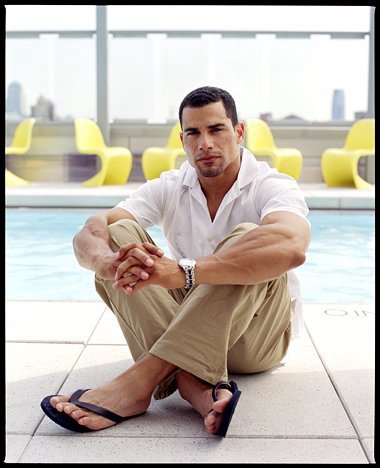
Franky G

Reggie H. sent me and Ryan this photo today (it originally was posted on MostProper, a blog that features lots of "phyne sights" in Reggie's words), letting us know that Franky G. (pictured at left) will be in Saw 2, which I gather is the sequel to Saw. I had to write back to let Reggie and Ryan know how out of it I must be, since I'd never heard of the initial film, which according to IMdB (the online encyclopedia of film information), appeared in 2004. A horror movie directed by James Wan (¿quién es él?), starring Danny Glover, Cary Elwes, and quite a few actors I've never heard of, it concerns a serial killer whose calling card is a circular saw, or something like that. The general viewer rating for Saw is 7.5 stars out of 10, which ranks higher than Hitchcock's superb Suspicion or Cassavetes's standard-setting Gloria. Yeah, right.

But anyways, who cares about Saw or Saw II, really? At my age I'm able to recognize quite clearly there's enough horror going on in the world around me that I don't wish for or need cinematic treatments of it anymore--the important issue is the man above. I know I'm not alone in thinking that the New York native Puerto Rican-American Franky G (for Gonzalez) is one of the more beautiful men in film and TV, am I? And the man is the same age as me, 40 years old! Sadly and unsurprisingly, Hollywood doesn't know what to do with this kind of (male) beauty, which has always fallen and continues to fall outside its "mainstream." In my alternative universe, Franky G, who does have some acting talent (though he's no Denzel Washington or Robert DeNiro, and that's OK!), would have regular roles, both in movies and on TV. And he'd have material suited to his talent and looks, not the sort of dreck that characterized Johnny Z, his late show on Fox, which brings me to another point.

As I stated in my second post on Noah's Arc, I intend to keep watching that show, despite how bad it is. Thinking of Johnny Z, I realized that in fact lack of quality is no bar to my watching a TV show, if it has other things going for it (humor, attractive stars, some catchy element). For much of my life I eagerly watched bad or retrograde TV (F Troop, My Three Sons, One Day at a Time, Good Times, Dallas, Eight Is Enough, Family, Fantasy Island, The Love Boat, Three Is Company, The Dukes of Hazzard, The Greatest American Hero, Cybill, Melrose Place, Beverly Hills 90210, Sister Sister, The Parkers, etc.) for a variety of reasons other than quality (which I think was and is one key element of, for example, Batman, The Adventures of Rocky and Bullwinkle, Schoolhouse Rock, Zoom, The Electric Company, Speed Racer, The Patty Duke Show, Get Smart, Monty Python, Maude, The Golden Girls, Frank's Place, The Cosby Show, Seinfeld, SCTV, The Kids in the Hall, Mr. Show Show, certain seasons of SNL, The Wire, The Sopranos, Six Feet Under, The Comeback, etc.). 

As I age, though, I can't really take too much bad or retrograde TV anymore, especially shows that depict a world set anywhere but Iceland or Finland (or Wyoming, let's say) that's focused excessively on the very young and rich or economically privileged and devoid of any people of color. Just no. No. NO. My tolerance for minstrelsy also has shrunk to nil. I don't want to waste my time what's essentially a repurposed lost script for Amos n' Andy. Nevertheless, friend David M. and I caught the first episode of Franky G's Johnny Z and faithfully watched the really awful--dreadful, cringe-inducing, appallingly badly written--subsequent ones every week, until, mercifully, it was pulled. If you never saw the show, you missed little--except, of course, for Franky G.

He was the ONLY reason to watch it. The entire scenario--a Latino late-30s-something, with a kid and ex-wife, gets out of jail, is on parole in NYC, has to keep clean yet cannot help getting involved with criminals, etc.--started out with a mild stench. So much of it was utterly implausible: a British gangster in NYC...wait, let me repeat that. A British gangster--in New York City! Okay, there may be British gangsters in New York (New York has all kinds of people, and there certainly are quite a few in London, Manchester, Liverpool, Birmingham, etc.) but seriously, and at the risk of political incorrectness, while I appreciate the writers' attempts at being...inventive?...wouldn't a Black or Latino or Italian or Irish or Russian or Albanian or Greek or Chinese crime boss be more believable...well, you get my drift. We're talking about New York City. Any student in an introductory fiction class would find every mention of this character in a story based on the initial premise of Johnny Z surrounded by circles and question marks. 

Then there was his sidekick, this endlessly babbling, unspeakably annoying, wannabe comic White nerdy guy who looked like a plucked chicken, and they shared a huge apartment...in New York City...I kept wondering, why on earth wasn't this waste of space and dialogue shed during the development phase? David and I both concurred, of course, that the network probably thought that the show wouldn't succeed without a central White character. So why not instead give us a real New York type, a White tough, say from Queens or Brooklyn or Staten Island, or if you need to ramp up the comedy, New Jersey, who, far more conceivably, might have met Johnny Z on the inside and then caught up with him when they both got out? Instead, the quasi-Jerry Lewis-esque buffoon the show selected didn't work at all. And then they added an Australian bail bondswoman, who just happened to be a busty blonde bruiser, which satisfied some other show runner's or writer's fantasies, and...well, the show was off the airwaves not long thereafter.

So there is no chance anymore to watch horrible TV just to see Franky G every week. I doubt I'll go see Saw 2, so I'll have to miss Franky G's newest star turn. Which is a shame, because I relish any opportunities to see Franky G. onscreen. And not only Franky G, but any number of other actors that whose beauty lights up the screen, but whom Hollywood and the major networks in New York don't know what to do with. (Mekhi Phifer has kept his job on ER and there's the two guys, Eva Longoria's husband and Alfre Woodard's son on Desperate Housewives, a show I don't watch, but that's about it now that Taye Diggs, Keith Hamilton Cobb, Matthew St. Patrick, etc. are no longer on regularly airing shows.) But then things may change, as they already have in my lifetime, though slowly, slowly.... So cable TV stations, just so you know, Franky G could still be a contender....