Showing posts with label US Civil War. Show all posts

Friday, May 15, 2015

"Rivers" in VICE + "The Lions" (& Interview) in The Offing

Brazos (de) Santiago, Texas, where
the final battle of the US Civil War occurred
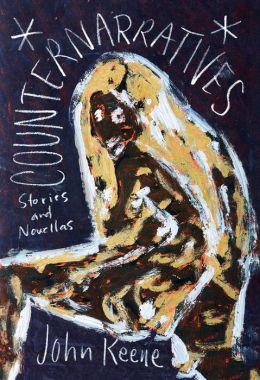
One of the stories in Counternarratives, "Rivers," is also one of the riskiest. Not because of its form or style, but because it takes up the thread of--and takes on, it's fair to say--one of the greatest writers and books in American literature, Mark Twain's 1885 novel The Adventures of Huckleberry Finn. Or, more precisely, it revisits one of that novel's central characters, the enslaved man Jim, without whose presence the novel could not exist, but whose perspective throughout it remains mostly on the periphery, except in rare glimpses that are played for comedy.

My goal with the story was not so much to revise Twain's novel, whose main story stays mostly offstage in "Rivers," but rather to imagine Jim's life, particularly after freedom, his freedom, both the convenient legal version given by Twain and whatever subsequent freedom(s) Jim earned himself. Before the novel appears next week, thanks to VICE magazine and its editors, and New Directions, you can read "Rivers" in The VICE Reader and see where the character of Jim, as well as Huckleberry, led me, discover the significance of the story's title, and find out what it was like to participate in the final battle of the U.S. Civil War. Accompanying the story are photographer Alec Magnum's stunning, stirring photos from his series "Sleeping by the Mississippi."

***

In another fascinating coincidence, another story in Counternarratives, "The Lions," appeared this week in The Offing, the new literary publication of the Los Angeles Review of Books. About "The Lions" I'll say only that it is the last story in the collection and deeply disturbing. There are many inspirations for each of the characters, which is one reason neither is named, and you can take your pick about who seems to fit which role. (It is set in contemporary Africa, but could take place, with some adjustments, all over the globe.) Many thanks to the editors at The Offing and at New Directions.

Accompanying the story is a brief online interview, "No Whitewash," on The Offing's Tumblr that Bix Gabriel conducted with me, about the new collection and this collection, so please do check it out. (Thank you, Bix!)

A snippet:

Other stories or aspects of the book you’d like to readers to know about?
Spirituality and religion, in their multiple manifestations, flow throughout many of the stories, and some, like “A Letter on the Trials of the Counterreformation in New Lisbon,” turn in part on the clash between spiritual systems, which are also systems of knowledge. What does it mean to know, and can knowledge lead to freedom? Liberty and fugitivity are throughlines in the text. How might freedom be lived, embodied? Also, queerness in the many senses of that term is another current throughout all of these stories. Lastly, I hope it’s clear that I had a lot of fun creating and then following the stories of many of these characters.

Thursday, January 24, 2013

Spring Semester Classes Begin


This post is of zero interest to anyone beyond my students and me, I know, but Spring 2013 semester classes began today, first thing this morning to be exact, and I'm excited about both of them, but especially about my undergraduate literature class, which incorporates some material I've taught before but many new texts as well. That class is officially an English and African American Studies class on The Black Arts Movement, satisfying two distinct registrations (and I thus have two Blackboard sites, which is a little disorienting), and covers not only aspects of the movement itself, but several antecedent moments (The Harlem Renaissance, Négritude, Black American poetry of the 1950s) and successors (a Spike Lee film, Public Enemy's music, and Kia Corthron's play Force Continuum). At the core of the course we'll be delving into a great deal of Amiri BarakI've included a good deal of  scholarly, critical and theoretical material (by figures from Alain Locke and W. E. B. DuBois to more recent scholars and authors like Cheryl Clarke, Howard Rambsy II, Cherise Pollard, and Lorrie Smith, as well as primary), including some primary documents by Larry Neal, Amiri Baraka and others. It's a decent-sized class (anywhere from 18-26 students, depending upon how many stay enrolled, and smaller is always better for the students and their professor) and thus manageable. The second course is one all members of the African American and African Studies teach in rotation, Introduction to African American Studies (Part II), which spans the period from Reconstruction through today, and which draws a pretty sizable enrollment. Right now I have about 45-50 students, but one asked about the amount of reading (up to 200 pages a week, from an array of texts, including historical and critical studies in a range of fields, primary documents by the likes of Marcus Garvey, Malcolm X, and Rev. Dr. Martin Luther King Jr., and creative works), so perhaps the numbers will slim down by next week. As with my fall classes my students come from a range of backgrounds, though the majority are black (African American, African, Caribbean, mixed race, etc.), latino (many Afro-Latino), and Asian-American (South Asian and East Asian), which I learned quickly lent a very different cast to the conversations we had about the course material. I expect no less this semester. We begin with Booker T. Washington's Up From Slavery, a book I haven't read in many years, and rereading it in preparation for the class has reminded me why I enjoyed it so years ago, and how rich and complex our history--black history, American history--truly is.

Tuesday, January 01, 2013

Emancipation Proclamation Turns 150 + Fiscal Leap Averted

Emancipation
Proclamation, p. 1
Happy New Year!

150 years ago President Abraham Lincoln signed the Emancipation Proclamation, a largely symbolic document that accelerated, in word if not in deed, the process of ending chattel slavery in the United States of America. By 1863 nearly all the formerly slave-holding northern states, save those on the border with the Confederacy (Missouri, Kentucky, Maryland, and Delaware), had ended slavery by statute, and though slaveholders had attempted to implant the seeds of their infernal system in the West, bringing enslaved people to what is now Utah, Nevada, Arizona, and other territories, it was on the wane, throughout the Western Hemisphere (Haiti had extinguished slavery in 1804) and in rapidly industrializing and culturally diversifying America.

The Proclamation affected only those "states" and territories of said states "in rebellion," and none of the border states or northern states like New Jersey, which still had people living in bondage. It would take two more brutal years of war, the Union Army's defeat of the Confederate military, and Republican Congress's passage of the 13th Amendment in December 1865, to stamp out slavery de jure and de facto, but, as I need not tell any J's Theater readers, African Americans' struggle for freedom and social, political and economic equality continues.  Nevertheless one of the Proclamation's tangible effects is our 44th President of the United States, the recent re-elected Barack H. Obama.

Beginning yesterday and continuing through today, the National Archives will display the original 5-page document, written on paper instead of the longer-lasting, conventional parchment and thus extremely fragile, at the National Archives Building in Washington, DC.  If I were in DC I'd be beating a path there, as this document represents and embodies even today, as it did when Lincoln drafted and signed it, an alternative view of what this country, our country, might be, and where we might go. We are not there yet, but we have this document always to remind us that the seeming impossibility of freedom and equality is a possibility if we are willing to engage in the often hard and painful, but also joyful and exhilarating work of making it possible.

***

VP Biden and President Obama announce House passage
of the bill to avert the "fiscal cliff"
Surprise, surprise. The last minute, eleventh-hour scramble by the Congress averted shoving most of the country down the fiscal slope, and setting off the austerity bomb. Or did it? The Senate, by 89-8, passed a bill brokered by the Vice President, sent it to the House, which after a bit of petulant kabuki, passed by a 257 (172 Democrats with 85 Republicans) to 167 vote a concurrence of the Senate resolution, meaning that the bill could go to the President's desk to be signed. The particulars of the deal look decent, at least superficially. Among the bill's details the president's marginal federal income taxation rate threshold of $250,000/year unfortunately rose to $400,000 for single people and $450,000 for couples; there will be slightly higher capital gains, dividends and estate tax rates; it includes an alternative minimum tax fix; it extends unemployment insurance for 2 million people; it addresses the Medicare provider cuts that were to take effect; and, perhaps most beneficial for middle-and-working class families, it continues the 2009 tax credits for five years. The compromise bill avoided any cuts, of any sort, to the earned benefit and social safety net programs. The payroll tax, however, did return to 6.2% of all workers' first $113,700 of income.

It did not address other issues, such as the debt ceiling fight which still looms, or the GOP's likely demands for further spending cuts as part of the sequester. It also was perhaps a less effective bill than the President and Democrats might have gotten had they allowed all the Clinton era rates to return, which would have put the onus on the Republicans to agree to tax cuts for those under to $250,000 in exchange for less burdensome taxes on those above that cutoff, while also agreeing to better terms for nearly everything else this deal brought. Perhaps "the markets" might have freaked out, but we would have gotten past this blip soon enough. The US's finances, despite all the doom and gloom, is quite sound. Instead, we are still zooming towards legislating more austerity, which has proved disastrous in all the other places where it has been implemented (the UK, Spain, Germany, etc.), with the next battle royale to occur around March 1, 2012.

A pyrrhic victory, then? It's better than that, but if the President and Democrats, whose numbers in both the Senate and House will grow, cannot stand strong, we could facing far worse than the usual drang and drama, and the past 4 years offer only tepid confidence. As I always say, though, we shall see. 

Monday, May 30, 2011

Memorial Day's Origins + The 50 States (Stereotypes & More)

What are the origins of Memorial Day, during which we as a nation honor those who've fallen in wars past and current? I always thought I'd known, and would readily have stated it publicly if asked. Yale historian David Blight, however, enlightened me--and thousands of others, perhaps millions--with his article in today's New York Times, "Forgetting Why We Remember," on the holiday's origins and likely earliest celebration. It, as I have repeated several times on here about the Times's Disunion pieces, moved me mightily.

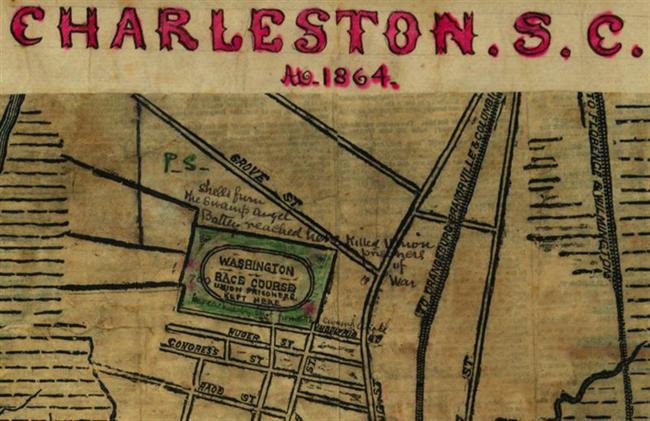
As it turns out, the first Memorial Day celebration probably took place in the South, amidst the ashes of the defeated Confederacy, in Charleston, South Carolina, ironically and poetically, as that was the political and cultural headquarters of the states' plantocracy, who pushed secession from the Union, and the vantage from which soldiers under General P. T. Beauregard first the shots at Fort Sumter, launching the war.  The celebration occurred in, on and around a race track that the Confederates had transformed into a prison and eventual morgue for Union soldiers. Blight writes:

The largest of these events, forgotten until I had some extraordinary luck in an archive at Harvard, took place on May 1, 1865. During the final year of the war, the Confederates had converted the city’s [Charleston's] Washington Race Course and Jockey Club into an outdoor prison. Union captives were kept in horrible conditions in the interior of the track; at least 257 died of disease and were hastily buried in a mass grave behind the grandstand.

After the Confederate evacuation of Charleston black workmen went to the site, reburied the Union dead properly, and built a high fence around the cemetery. They whitewashed the fence and built an archway over an entrance on which they inscribed the words, “Martyrs of the Race Course.”
Note for a second the presence of ritual here--the whitewashing of the fence, and the renaming of the race course, a sports site transformed in a site of horror, and now, a place of remembrance, grieving, and honor. (The 1864 map of the Washington Race Course above comes from the Preservation Society of Charleston's website.)
The symbolic power of this Low Country planter aristocracy’s bastion was not lost on the freedpeople, who then, in cooperation with white missionaries and teachers, staged a parade of 10,000 on the track. A New York Tribune correspondent witnessed the event, describing “a procession of friends and mourners as South Carolina and the United States never saw before.”

The procession was led by 3,000 black schoolchildren carrying armloads of roses and singing the Union marching song “John Brown’s Body.” Several hundred black women followed with baskets of flowers, wreaths and crosses. Then came black men marching in cadence, followed by contingents of Union infantrymen. Within the cemetery enclosure a black children’s choir sang “We’ll Rally Around the Flag,” the “Star-Spangled Banner” and spirituals before a series of black ministers read from the Bible.
Note here more significant elements: the cross-racial union to make the celebration possible, in defiance of the very grounds on which the Confederacy was founded; the presence of teachers, another countersignifier in relation to what African Americans had been subjected to under slavocracy's tenets; children in the forefront of the march, a recognition of their role as the future and vanguard, of the race and nation; the singing and evocation of abolitionist John Brown, a freedom fighter and pre-war martyr whose memory was well known to and not lost on these newly freed people; and then the freedmen followed by, not following, the Union troops, some of them African Americans, as Blight notes. Then come the celebrations of patriotism and, alongside them, religion.

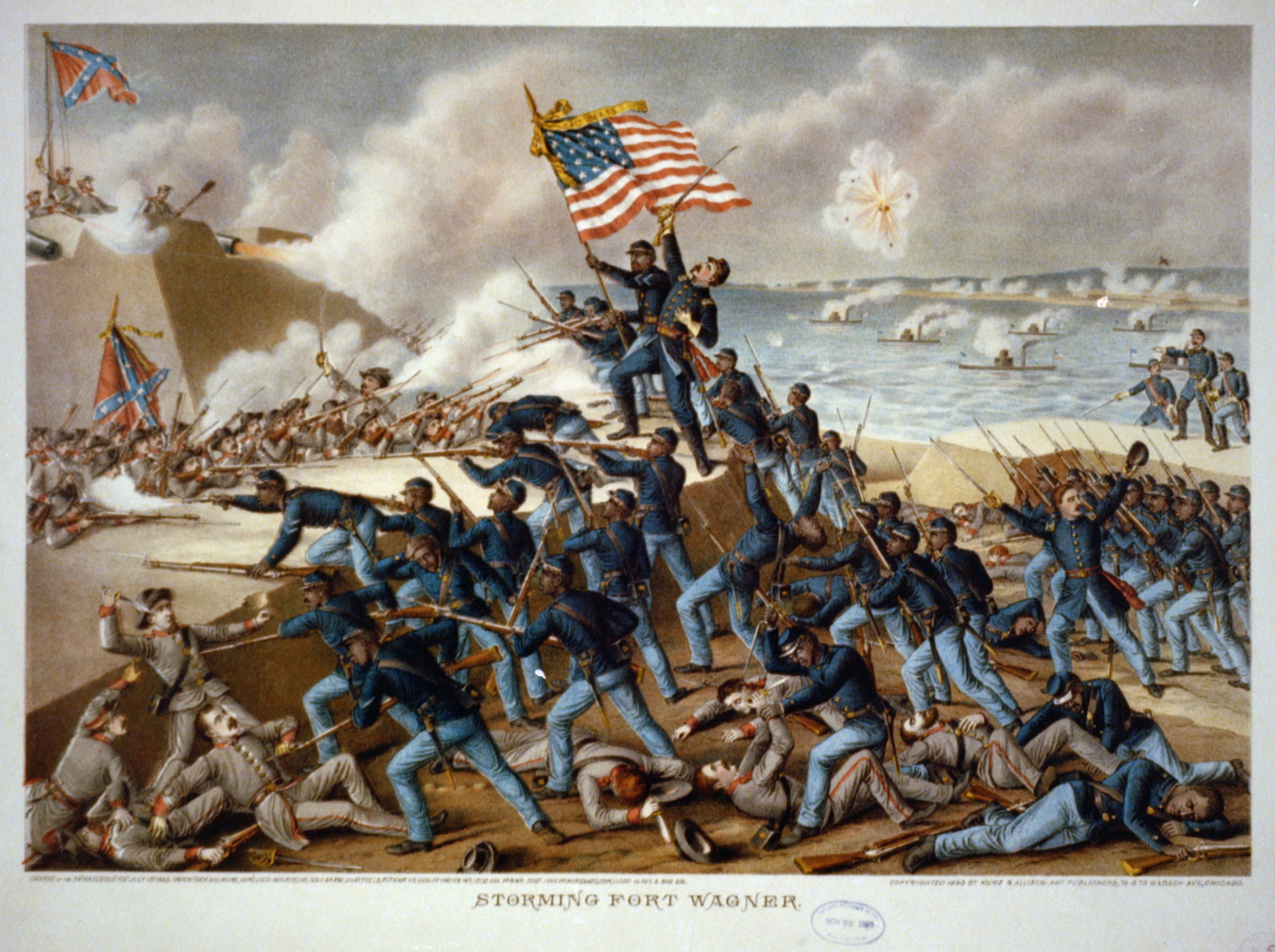
Blight goes on to note that after the processions and tributes, the blacks and whites then began picknicking--sharing food and drink, enjoying each others' companies--and watching military drills by the African-American regiments, including the famous 54th Massachusetts Volunteer Infantry Regiment, one of the first official all-black Union regiment in the war, the subjects of Edward Zwick's 1989, Academy Award-winning film Glory. (At the top of the article is a detail from Augustus Saint-Gaudens' famous Robert Gould Shaw memorial, which sits at a corner of Boston Common, at Park and Beacon Streets, and which Robert Lowell memorialized in his famous poem "For the Union Dead." The second image is an 1890 lithograph by Kurz and Allison of the 1863 storming of Ft. Wagner in South Carolina, the battle at which Shaw died.)

Black Union soldiers, US Civil War, from Civil War Academy
This history somehow got lost to the wider world, though, interestingly enough to me, the Preservation Society of Charleston does mention it, noting it to be the first Memorial Day celebration, on their website at the link above.  Blight does not tarry over the process by which this history has evanesced or its implications, though I would imagine that like so much of our national history, especially anything involving African Americans, cross-racial alliances, and so on, it has suffered both active and passive omission until, voilà, it has been waiting for someone to bring it to wider attention. It is, as I said, on the website above and perhaps on many more too. [I should note that while I have read a great many books of and on American history, I have never heard of this event, though historians very well may have written extensively about it. I have many times heard about the various early Northern and Southern commemorations of the war and those who died in it.] At any rate, as we go about our business today and on every memorial day hereafter, we might keep a kernel of this re-membering of the our polity, led by these brave freed people after the worst war US soil has ever known (and I hope will ever know), fastened to our memories.

+++

On a lighter note regarding the states, I was reading Huffington Post's Comedy page and chuckled at author Chuck Jury's "50 State Stereotypes in 2 Minutes" video, which is a promo for his new book of the same name.  He's tagged some of the states perfectly, though with others it appears he just tossed out whatever he could think, anything he could think of, quickly.  Cf. Indiana. (I also love that he probably filmed the entire 50 entries in California, but chose landscapes that mirrored (or not) those of the states he invokes.


Jury certainly has Illinois down, I'll give him that. (But is he talking about Governor Pat Quinn or Mayor Rahm Emanuel. Hmm.)

With a far different aim, last July I posted an animated tour of the 50 states, primarily for children to learn their years of entry into the United States. Of course I did not advertise it anywhere, so it has gotten about 10 viewers or something, but anyways, after the laughter above, check this out, with your little ones if they haven't already learned this information. It's quite rough, but then I'm no pro at this stuff. But it was fun to do!


Wednesday, April 13, 2011

Poem: Robert Lowell

Yesterday's poem got me thinking about another poem that treats the US Civil War, a poem I had to read in high school and did not fully understand, could not really understand or bear, even, until I returned to it, and its author, in college. I speak of Robert Lowell (1917-1977), who had died only a decade before and whose name and fame were still widely known and accepted. They have both dimmed quite a bit since then, as his peer and friend, Elizabeth Bishop (1911-1917), has seen her star ascend, and many of the poets of his generation (Theodore Roethke, Karl Shapiro, John Ciardi, Randall Jarrell, etc.) are even less invoked. (Another almost exact contemporary, Gwendolyn Brooks (1917-2000), has also become better known and canonical over the last 30 years.)  Lowell's career had many stages, controversies, summits and pits, but when he published the poem below, "For the Union Dead," in the eponymous 1964 volume, he was at the zenith of his fame.

Its title invokes his friend and former teacher Allen Tate's "Ode to the Confederate Dead," while also touching upon many of Lowell's touchstones: Boston, especially the city of his youth; New England and its place in the country; political and social liberalism, and his own conflicts concerning his and the country's difficulties in grappling with race and racism; modernization and the shifts the country was experiencing; his own aging; the power and limits of art to invoke, witness, imagine, commemorate; and so much more. Formally, it shows his shift to the looser, more open style of his mid-career, while still demonstrating his skill as a versifier, his sureness of meter, rhetoric, figure.  His use of the "n" word still jars, but far less; I think it stopped me when I was a teenager, tearing more at the wound that its use in other circumstances--by white classmates, in books like Huckleberry Finn and Wallace Stevens's poetry--had already created. Now I can see why it was necessary, for Lowell, here. The national wound that Shaw and the black soldiers of the 54th Massachusetts Infantry confronted in 1863, reanimated so vividly in the 1989 film Glory (which won Denzel Washington his first Academy Award) still festers to some degree, though their bravery and that of all who fought and won that terrible war has gone a long way--including, at the moment of this poem's writing, during the Civil Rights Movement, which involved those "Negro children" on the TV Lowell cites--towards suturing if not fully healing it.


FOR THE UNION DEAD

"Relinquunt Omnia Servare Rem Publicam."

The old South Boston Aquarium stands
in a Sahara of snow now.  Its broken windows are boarded.
The bronze weathervane cod has lost half its scales.
The airy tanks are dry.

Once my nose crawled like a snail on the glass;
my hand tingled
to burst the bubbles
drifting from the noses of the cowed, compliant fish.

My hand draws back.  I often sigh still
for the dark downward and vegetating kingdom
of the fish and reptile.  One morning last March,
I pressed against the new barbed and galvanized

fence on the Boston Common.  Behind their cage,
yellow dinosaur steamshovels were grunting
as they cropped up tons of mush and grass
to gouge their underworld garage.

Parking spaces luxuriate like civic
sandpiles in the heart of Boston.
A girdle of orange, Puritan-pumpkin colored girders
braces the tingling Statehouse,

shaking over the excavations, as it faces Colonel Shaw
and his bell-cheeked Negro infantry
on St. Gaudens' shaking Civil War relief,
propped by a plank splint against the garage's earthquake.

Two months after marching through Boston,
half the regiment was dead;
at the dedication,
William James could almost hear the bronze Negroes breathe.

Their monument sticks like a fishbone
in the city's throat.
Its Colonel is as lean
as a compass-needle.

He has an angry wrenlike vigilance,
a greyhound's gentle tautness;
he seems to wince at pleasure,
and suffocate for privacy.

He is out of bounds now.  He rejoices in man's lovely,
peculiar power to choose life and die--
when he leads his black soldiers to death,
he cannot bend his back.

On a thousand small town New England greens,
the old white churches hold their air
of sparse, sincere rebellion; frayed flags
quilt the graveyards of the Grand Army of the Republic.

The stone statues of the abstract Union Soldier
grow slimmer and younger each year--
wasp-waisted, they doze over muskets
and muse through their sideburns . . .

Shaw's father wanted no monument
except the ditch,
where his son's body was thrown
and lost with his "niggers."

The ditch is nearer.
There are no statues for the last war here;
on Boylston Street, a commercial photograph
shows Hiroshima boiling

over a Mosler Safe, the "Rock of Ages"
that survived the blast.  Space is nearer.
When I crouch to my television set,
the drained faces of Negro school-children rise like balloons.

Colonel Shaw
is riding on his bubble,
he waits
for the blessèd break.

The Aquarium is gone.  Everywhere,
giant finned cars nose forward like fish;
a savage servility
slides by on grease.


From Life Studies and For the Union Dead by Robert Lowell, published by Noonday Press (a division of Farrar, Straus & Giroux, Inc.). Copyright © 1964 by Robert Lowell. All rights reserved.