Showing posts with label Rutgers University. Show all posts

Friday, May 17, 2013

Semester's/First Year's End + Congratulations to 2013 Graduates


It seems hard to believe, but as of today I have concluded my spring semester and first year teaching at Rutgers-Newark. I've graded the exams, read, reread and assigned grades to the final papers, signed off on MFA theses and an undergraduate honors thesis, and reviewed the work of my independent study student. CONGRATULATIONS TO ALL THE GRADUATING STUDENTS! I now have only to complete an assessment for my department and the undergraduate college, and I believe I will be fully done until this fall, a few administrative tasks notwithstanding.

On Twitter I described the experience as "exhilarating", and it was, though I also feel mentally and physically drained as I do at the end of every term, the spring/summer ones perhaps even more so than the fall ones, since no matter where I have taught, far more occurs from January to June than September to December. I designed and taught four new classes, which is unsurprising considering that this was a new job, but as anyone who teaches regularly will attest, new courses, especially at a new institution, require a tremendous amount of work, and since none of these was a repurposed course from my prior institutions, they entailed even more work and planning than ever before.

I have already written about the fall courses (an undergraduate Afro-Latin literature course, and a graduate course for English and American Studies under the Topics in Post-Modernism rubric on post-humanism and trans-humanism), so I'll say a little about the two spring courses, one a jointly listed course in English and African American and African Studies (AAAS) on the Black Arts Movement, and the second the spring half of the year-long, introductory survey course for AAAS. I enjoyed both, though I must admit I particularly loved the literature class, which took place at 8:30 AM and meant very early Sunday and Wednesday nights for me, as well as arriving in Newark when almost no one was on the street. My first morning I tweeted how shuttered everything was at 7:30 AM, and my colleague Tayari Jones, though on sabbatical, helped guide me via Twitter to a spot where I could grab coffee.

In the literature class I taught more poetry than I have ever taught in a single, non-survey course, as well as more drama (four plays, two by LeRoi Jones/Amiri Baraka, and one each by Ed Bullins and Kia Corthron), a film, and rap music (three different artists, also a first), with a good helping of historical, critical and theoretical material. One of the most powerful moments for me was when I read the students' creative pieces (they wrote 6 short essays, a creative piece, and a final paper), and could see how fully nearly all of them had engaged with the course materials, in aesthetic, theoretical and personal terms. Their final papers represented an extension of this engagement.

The survey course was a huge challenge, as I had not taught such a large class in a few years, and I realized while planning it that I would need to create a narrative for the students to bring the disciplinarily disparate materials together. As an undergraduate I studied history in its various forms (including social history, which became my main approach), and into my historical narrative I tried to weave, to varying degrees of success, works of literature, sociology, political science, and journalism, to present the students with a way of understanding the rich and complex stories of African America from 1865 to the present. Based on the final exams, I think I succeeded, though I also know what to work on to improve the course, and my teaching of it, for future versions.

I want to note in particular how energizing it was to once again read Booker T. Washington's Up From Slavery, which I read as an undergraduate and only recalled in pieces, and W. E. B. DuBois's The Souls of Black Folk, which impressed me no less this time than it had before. I had never finished LeRoi Jones's/Amiri Baraka's The Blues People, but did for this class, nor had I ever read beyond a few chapters in Nelson George's The Death of Rhythm and Blues, which together provide excellent overviews of Black music, and thus by extension, African American culture and society, from the mid-19th century through the end of the 20th. Their narratives provided a second scaffolding for us to follow as we proceeded chronologically from the Emancipation period to the election of Barack Obama. To teach this class in the year marking the 150th anniversary of the Emancipation Proclamation and the 50th anniversary of the March on Washington (both of which we talked about) was also energizing.

I also have even deeper appreciation for the work of so many former colleagues, including Robin D. G. Kelley, Darlene Clark Hine, and Aldon Morris, whose work I taught and from which I, like the students, learned a great deal. Among the exciting moments for me was when I had the chance to discuss with the class Robin Kelley's exploration of working-class and poor African Americans' day-to-day battles in the mid-to-late 1940s, the innumerable acts of resistance, self-protection and self-assertion that constituted "small war zones," in public transportation in Birmingham, Montgomery and other Southern cities, that helped prepared the ground for the Civil Rights movement struggles and victories that would soon come there and elsewhere. The poet and scholar Geoffrey Jacques has noted more than once how badly we in the US could benefit from a careful and thorough study of the history of African Americans, and this course underlined how important and pressing Geoffrey's suggestion continues to be. Most of us--including African Americans--still don't know enough, beyond some significant historical facts and anecdotes, about our past, and how much that past continues to inform our contemporary--which is to say, American, and global--experience.

These courses unfolded as Rutgers itself has faced a significant institutional crisis, which began before I started last fall and which continues to unfold as I type this blog post. In both classes I was able to note how significant the social, political and cultural activism we were studying had proved in the past fortunes of our campus; in 1969, black students occupied Conklin Hall for a week, thus provoking changes that helped to create the vibrant, racially, ethnically, economically, and culturally diverse campus--the most diverse campus in the United States--Rutgers-Newark is today. I also was able to point out to them that one of the sources of the university's current crisis, the forced integration of the University of Medicine and Dentistry of New Jersey (UMDNJ) into Rutgers as the "new" medical school, had an antecedent in the state's rezoning and forced clearance, using eminent domain, of an African American Newark neighborhood in 1967, in order to build a new campus for UMDNJ, and which led to the 1967 Newark Uprising, that profoundly scarred and changed the city. How fitting that these earlier history has been all but buried in the discussions about Rutgers's transformation, but how powerfully it resonates in the threats Rutgers-Newark (and Rutgers-Camden) and the university as a whole face as the changes unfold. I tried my best to let the students know that they could and must be agents of change, as their predecessors were.

I must add that at this point over the last 10 years (with the exception of 2006, when I had a spring leave yet nevertheless had university business to address) I would still be in class, in the final weeks of the spring quarter, so I continue to feel a bit unsettled, as if I am leaving classes full of students hanging in the lurch. I remind myself: the grades are in! It feels good to be done before the end of May, and I imagine that by next year this time, I will feel as if an earlier start to the summer is the way things have always been. Once again, congratulations to all the 2013 graduates!

Thursday, September 06, 2012

A New School, A New School Year

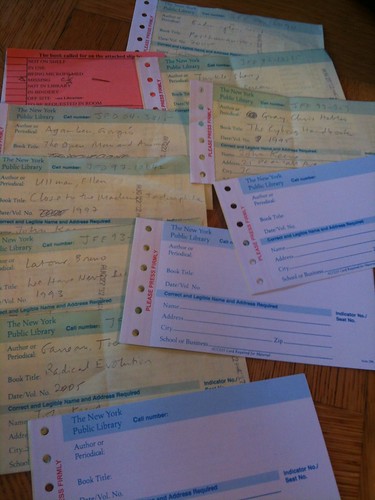
Call slips, NYPL
Call slips at the NYPL
This past two month's post-move's worth of scurrying about searching for books and films at local libraries and bookstores, speed-reading, photocopying and scanning, writing and rewriting and re-rewriting syllabi has come to fruition in the form of my first week, and first undergraduate and graduate classes at my new employer. I'll say more about my classes soon, but I'll note that I am teaching two this fall: one in African American and African Studies, focusing on Afro-Latin literature, and the second a graduate course in English, under the rubric of postmodernism, which explores transhumanism and posthumanism. (I thank my former Northwestern colleague Alex Weheliye for turning me on to Sylvia Wynter and getting me to think more carefully about the latter two concepts.)  The first class yesterday went very well, and I am charged up for the first course meeting of the grad course tonight. (UPDATE: It went very well too.) I'll write more soon, but to all who have returned or are returning the classroom over these next few weeks, as teachers or students or both, at all levels, BEST WISHES FOR A GREAT SCHOOL YEAR!

Wednesday, July 11, 2012

Unpacking My (Office) Library

Blogging grinds to a creak as I am settling back in, but I have begun setting up my new office, while cleaning out my home one (so many receipts one can amass in the span of a year!).  A book cull is underway; if anyone knows of good places to send books (I've gone with libraries, prisons, and overseas schools in the past), please post the links in the comments section.

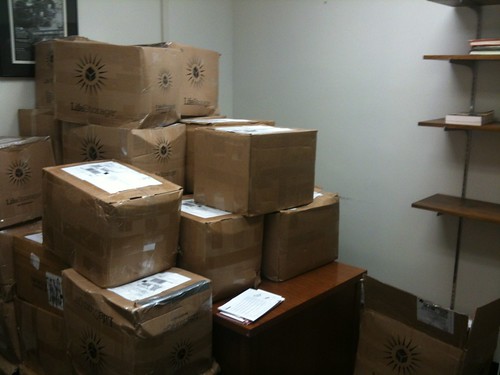
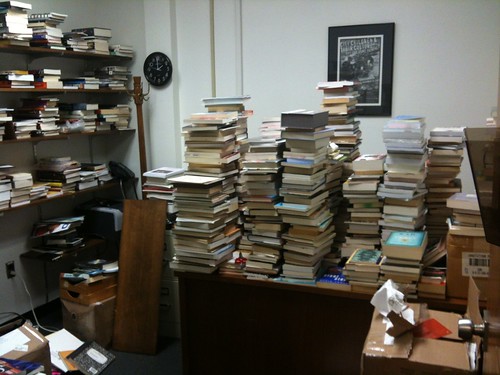
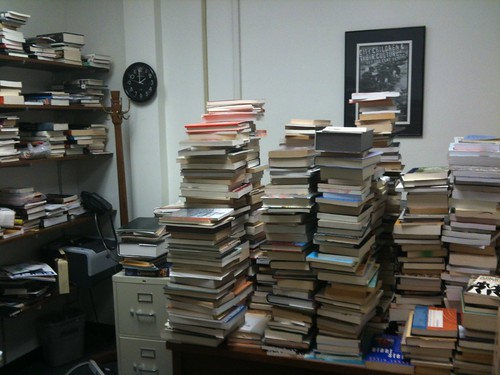
Below is a visual representation of the unpacking, which I unfortunately will describe in prosaic fashion, unlike Walter Benjamin, whose evocative "Unpacking My Library: A Talk About Book Collecting" is one of my favorite essays in Illuminations. Over two days I've emptied 30 of the 32 boxes, many of which arrived in a state not unlike immense grapefruits that someone had pounded with a sledgehammer for two straight weeks--but being amply taped and filled with styrofoam peanuts, neither the books nor the bubblewrapped pictures and other memorabilia were any worse for the journey.

My new bookshelves arrived today, so the tomes will find their new lodgings tomorrow. My plan is, counter to my usual haphazard book organization method, to alphabetically arrange in advance (anthologies of and guides to creative writing, literary journals, etc. notwithstanding) all of my books of imaginative, critical and scholarly literature, so that they begin their stays on these shelves this way and will thus be far easier to find. Thus the stalagmites.

That will, I hope, obviate my usual comments to students that I have X book they should look at, which begins with me scouring my shelves to find it, only to not recall whether it is 1) on my university office shelves; 2) my Chicago apartment shelves; 3) my New Jersey home shelves; or 4) some former home or apartment or carrel in which I had the books, never to see them again. With alphabetical order at least in my university office, the process of elimination should be much easier. I also hope this will prevent my ordering multiple copies of The Harlem Renaissance Reader, for example, as I'm wont to do, good as this can be for the authors or estates of said books.

A new colleague passed by my open door and, after introducing himself, pronounced, "You don't have enough shelves!" We'll see.

(Perhaps it's just my collection, but there are far more books written by authors whose last names begin with M, B, H, S, D and C than the other letters. W, F, G, P, and A are not far behind.  K, it turns out, is somewhere in the middle.)

Almost no books unpacked yet
The boxes, stacked like ripened fruit, waiting to be opened
Very few books unpacked
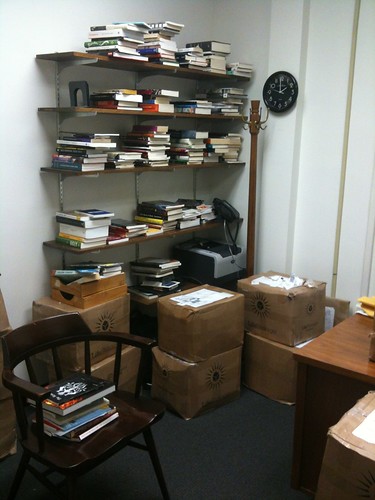
The first few books, on the first few shelves (the clocks batteries are fused in corrosion, so it's right only twice a day, until I replace them)
My office, with only a few books unpacked
More books unpacked (visible, from what I can see: books by Patricia Jabbeh Wesley; the Windrush anthology of Caribbean British literature; TriQuarterly's Prose for Borges, edited by my colleague Mary Kinzie; and a study by Philip Brian Harper, I think)
My office with all the books almost unpacked
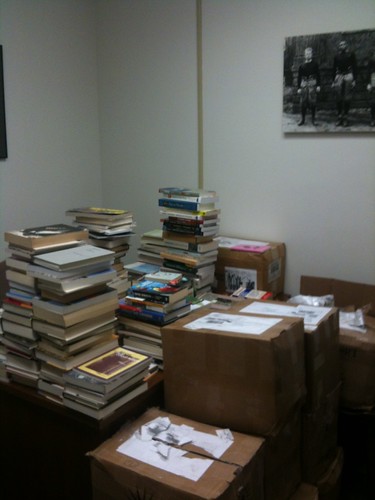
Most of the boxes unpacked; the tallest pillar at the back of the desk is "M"; at the front it's "C" (that's Anne Carson's Nox box perched just so)
My office with all the books, save 1 box, unpacked
All done, save for 1 box: I can see Kodwo Eshun's More Brilliant than the Sun, one of my favorite books ever, a Kevin Young anthology, and Palm-Wine Drinkard (at right, I think)
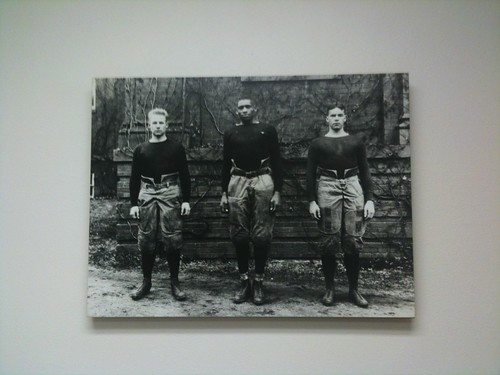
In my office: Paul Robeson
The image awaiting me in the new office: Paul Robeson, with fellow footballers, from his college days

Sunday, May 27, 2012

Valediction Forbidding Mourning, or Farewell to Evanston & Chicago

My office bookshelf
Part of my office bookshelves, soon to be packed up


Since my colleagues and students at both institutions know, and since my family members and most friends know, and since C has asked me more than once when I'm going to do so, I figured that now that the spring quarter is nearly over (yes, it runs until mid-June) and I've already begun packing up, I can share with J's Theater readers who do not already know that, after nearly a decade in Chicago and Evanston, at the university (Northwestern), I will head to a new one this fall, back home in New Jersey (Rutgers-Newark). I shall be teaching similar but slightly different things, in a similar, very amenable configuration, and am now winding down at the former institution and up at the new one.

As even infrequent readers of this blog will know, I have greatly enjoyed many aspects of my time at NU.  I will certainly treasure the relationships and friendships I developed with so many wonderful students, colleagues and staff, and will always consider them invaluable.  I particularly cherish the opportunities to teach a range of courses at the undergraduate and graduate level, in creative writing and literary and cultural studies. Although I previously had taught at the secondary school level, in non-academic settings, as an adjunct, at a superb private university, and as part of public and private university-sponsored writing programs before arriving at NU, I can say without hesitation that it's there that I truly learned how to teach, and how to learn from my students and colleagues. Shortly after arriving I applied and was admitted as a fellow into the university's Center for Teaching Excellence, which aims to improve college-level teaching. My year in that program taught me a great deal. But more important has been my time in the classroom, listening to my students, working to create the conversations that ensure dynamic learning, figuring out how to adapt and change when needed, and observing my students' learning processes to improve my teaching for subsequent classes. Crucial too has been observing colleagues who are excellent teachers. Several years ago one colleague said at her investiture ceremony that to become a better teacher, one of the models she followed was that of one of her teachers, who was always "present in the moment"--and I have striven every day to take that to heart, to make that my practice.

I also learned about many other aspects of university-level teaching, including how to be an administrator, how to serve on multiple committees simultaneously without losing one's mind, how to work with colleagues across different fields and departments, how to be a junior colleague and to advocate for them once I'd moved up the ranks, and how to survive the tenure process. I learned how to advocate for and support students, especially women, students of color, queer, and working-class students, who sometimes do not have the support they need or enough people to advocate on their behalf. I learned that one of the most important things that I could do was to be in the room and speak up. I learned that one can read hundreds of job applications, 54 student short stories, masters and doctoral theses chapters, honors and independent study projects, and a mountain of committee-related material, and still work on (some of) my own writing. I learned that zilch happens without the remarkable support staff who really keep everything running. I learned that laughter is one indispensable element of being a professor, and may have to be deployed more than one ever envisioned. I learned that university administrators can be approachable, and that they can often be allies if you get communicate with them. I feel utterly fortunate to have had wonderful chairs in place during my time at Northwestern; each of them was different, but demonstrated how to lead in their various ways.

I especially learned that it's possible to teach anything at the undergraduate and graduate levels in the inhospitable-to-learning quarter system, and that when I've reached students, the knowledge they acquired and built upon would be there not just for subsequent courses but for years to come.  I will miss these students and the prospect of teaching them, and my many extraordinary colleagues, in a range of fields, who have taught me so much. But I also am deeply excited to my new position at a new and very different institution in a new and very different city, my soon-to-be-colleagues, and my new students, whoever they may be. I'm looking forward to many new challenges (and to forgoing others, like long-distance commuting), all of which this past decade has prepared me for.

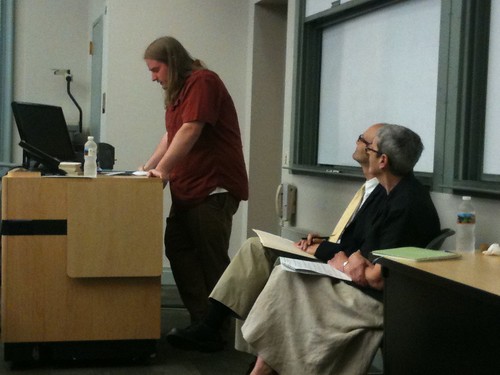
I'll like to end with a photo of one of the last Northwestern students I worked with, my honors advisee this year, Steve Koteff, reading a selection of his superlative novel(la), WalMart, at the annual English department prizes ceremony. Not only did this novella earn Steve departmental honors, but it also received the English Department's 2012 Thesis Prize in Creative Writing, and this dazzlingly gifted young man will be heading to Syracuse University this fall to continue his studies. Congratulations to him and to all my students who are graduating this year, and a million thank yous to all my Northwestern students, colleagues and staff for many wonderful, insightful, amazing years.

My honors undergraduate student, fiction writer extraordinaire Steve Koteff
My final NU undergrad honors student, thesis prize-winner Steve Koteff (c)