Many a major American cultural figure is buried at
Woodlawn Cemetery in the
Bronx;
Countee Cullen (1903-1946) is among them. One of the most important poets of the
Harlem Renaissance, he is perhaps less read than
Langston Hughes or
Claude McKay, though several of his poems have solidified their place in the canon, among them "Incident," "Heritage," "Tableau," and "Yet Do I Marvel." Like McKay and unlike Hughes, Cullen worked almost completely in conventional forms, yet as with both of these poets he explored questions of race, politics and society, and, like them, also touched upon sexuality, including (his) homosexuality, though with considerable discretion.
The award-winning poet
Major Jackson has now edited a brand new gathering of Cullen's work,
Countee Cullen: Collected Poems (Library of America, 2013) and in honor of its publication, Cullen's importance as a New York poet, and his presence in Woodlawn, the
Poetry Society of America, in conjunction with the
Woodlawn Conservancy, presented "Yet Do I Marvel: A Tribute to Countee Cullen," which featured readings of Cullen's work by Major and fellow poets
Robin Coste Lewis and
Rowan Ricardo Phillips, as well as vocal performances of song settings of Cullen's poetry by
Alicia Hall Moran, with
Brandon Ross (of the group
Harriet Tubman). They did so in Woolworth Chapel at Woodlawn, which hosts the gravesites of a number of leading cultural and political figures of the past, ranging from
Miles Davis and
Billie Holiday to
Duke Ellington and
Herman Melville. It's worth visiting on its own, but the Cullen event made the event obligatory (and how perfect too to honor this great black queer poet on
Pride weekend). I ventured up with friend and fellow poet
Patricia Spears Jones, and am very glad I did.
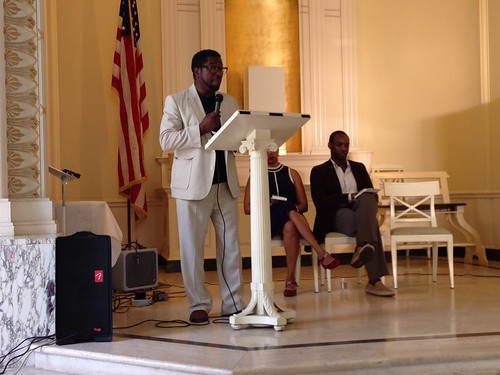 |
| Major Jackson, introducing the program |
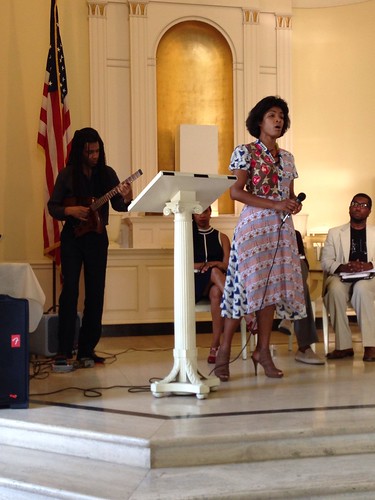 |
| Brandon Ross, at left, and Alicia Hall Moran, at center |
I must praise Alicia Hall Moran's singing and Brandon Ross's musicianship before I type any more words; as wonderful as it was to hear the poets, Hall Moran, whose voice and performances I've seen praised ecstatically before but which I've never heard live, added a completely new layer to Cullen's poems. The three songs she sang, "Deep River," "Two Wings," and "Prepare me one body," all arranged by the great
Roland Hayes, brought out not just the spirituality of the poems, but their grounding in the Spirituals and the Sorrow Songs. Rowan invoked
Longinus's description of "the sublime" and I would concur that Hall Moran certainly took these poems, and singing in general, to another place. I'll add that her enunciation made it possible to hear every word, and though she had a microphone, her projection was so rich and full she didn't need it.
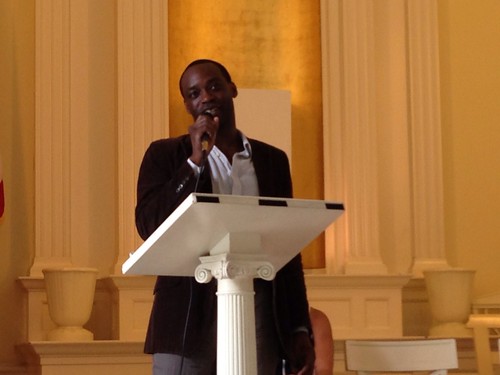 |
| Rowan Ricardo Phillips reading |
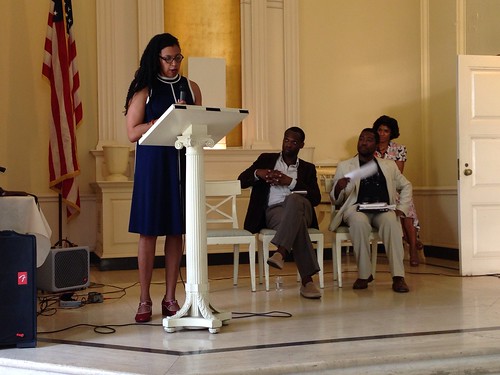 |
| Robin Coste Lewis bringing Cullen's words to life |
The poets too did a fine job in bringing Cullen's words and works to life. Rowan recited "Incident" from memory; through her recital of several of his
Epitaphs Robin showed the humor and wit that often get lost in discussions of Cullen, while also giving voice, through several others, to his queer facets; and Major, after an insightful, rooting introduction, read several unexpected poems, including "Shroud of Color" and "Mad Song," that demonstrated how current Cullen's poetry and politics are. All three poets selected judiciously from the rich store of Cullen's work and helped to give a fuller portrait of him and his art. I took notes on a number of the poems, and when I teach Cullen again I plan to use this volume and to introduce Cullen poems I hadn't considered (or didn't know about before) to my students. But first I plan to read the collection.
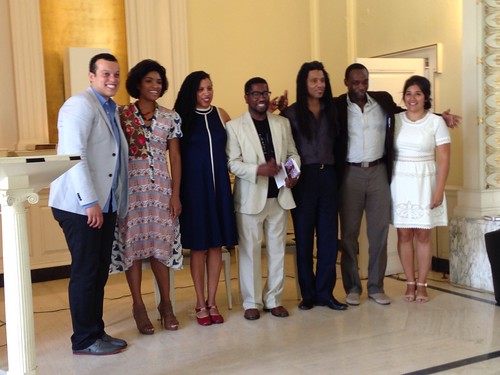 |
Everyone on the event's program: L-r (Charif Shanahan, PSA; Alicia Hall Moran;
Robin Coste Lewis; Major Jackson; Brandon Ross; Rowan Ricardo Phillips;
and Cristiana Peña, Woodlawn Conservancy) |
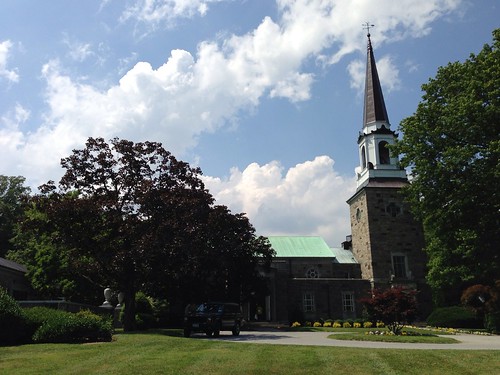 |
| Woolworth Chapel, Woodlawn Cemetery |
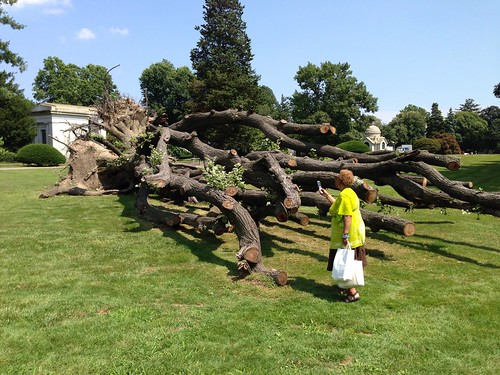 |
Patricia photographing a large, felled tree
at Woodlawn |
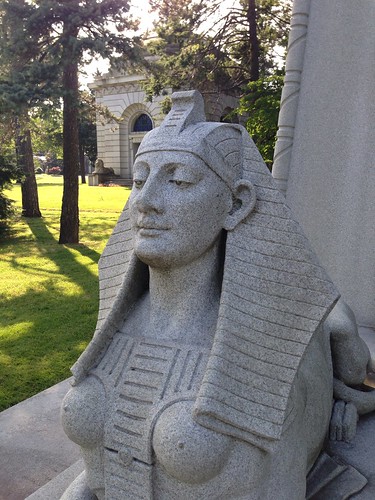 |
A sphinx keeping vigil in front
of the Woolworth crypt |