Showing posts with label New York Yankees. Show all posts

Friday, September 18, 2015

Baseball Season Winding Down

Our youthful obsessions, how hard it is to shed them! For much of my childhood and adolescence, and well into adulthood, I followed Major League Baseball avidly. Many testaments to this enthusiasm fill past pages of this blog, and although I haven't ceased watching professional baseball, my ardor has waned, especially after the revelations several years ago about the extensive use of performance enhancing drugs by a large number of players, including some, like the New York Yankees' superstar third baseball Álex Rodríguez, who had denied ever doping up.

Jason Heyward, St. Louis Cardinals
More than being disgusted at all these athletes, including the ones who repeatedly and consistently misled the public, I was most disgusted with and by Major League Baseball itself, and its handling of the crisis as it erupted over a series of several years. For much of the 1990s into the 2000s the pro teams had benefited from the juiced players and their almost superhuman feats. The Mark McGwire-Sammy Sosa home run battle in 1998, when McGwire hit 73 home runs to Sosa's 66, was the unmistakeable epitome of how PEDs had turned already great players into transhuman freaks, but Major League Baseball, attempting to draw audiences back after a strike and aiming to bank as much money as possible, aided and abetted the timber show, only later to denounce the two "heroes" for what was now clearly a PED-fed spectacle. (I must add that as far as I know, Sammy Sosa, once one of my favorite players, was never caught using PEDs.)

Perhaps even worse, by 2010, Major League Baseball had clear results of positive tests among a wide array of players, but rather than either exposing them and fining them or accepting the fact that supervised cycling could be beneficial for players and the sport, it appeared to hide the results until they later emerged as the result of a lawsuit, rendering the sport as believable as the theatrics on display with World Wrestling Entertainment (WWE). It has taken years for me to surmount my distaste for MLB's debacles, but my support for the St. Louis Cardinals never completely died, nor did my interest in pro baseball in general, which brings me to the current 2015 season, now winding to a close.
Dee Gordon, Los Angeles Dodgers
So what does the coming playoff picture look like? Let's start with the NL. In the NL East, the New York Mets (84-65) have a 6-game lead over the Washington Senators; in the NL Central, the Cardinals (93-56) lead Pittsburgh's Pirates (89-60) by 4 games and the Chicago Cubs (87-62) by 6 games, with 10 the Cards' magic number and the other two teams likely to achieve Wild Card status easily; and in the NL West, the LA Dodgers (85-63) lead their closest competitors by 7.5 games, with 7 the magic number.

Thus far the Cardinals have set the pace with strong starting pitching and a solid position-playing lineup without any stars, unlike in past years, when future Hall of Famer Albert Pujols, and Cy Young Award-winning pitcher Chris Carpenter led them to 2 World Series wins in 5 years (2006 and 2011). All of these teams have real talent, though. The Mets have one of the best starting pitching staffs in the league; the Pirates have excellent young players; the Dodgers play more as individuals than a coherent whole, but have the pitching and hitting to go all the way. I'm rooting for the Cardinals, but whether they can get past all these challengers will be the test.
Chris Archer,
Tampa Bay Rays

In the American League, the East division leaders are the Toronto Blue Jays. Yes, the 85-64 Blue Jays, and not the Yankees. It's almost like a flashback to their 1992-1993 Cito Gaston years. The Yankees are only 2.5 games back, at 82-66, but have looked far less dominant than in recent years. In the AL West, which seems to be the perpetually weakest division, the Texas Rangers (80-69), who've had several continuous years of playoff success without winning the World Series, lead the Houston Astros (79-71) by 1.5 games. It's in the NL Central, though, where you can find the AL's real powerhouse, the Kansas City Royals (87-62). The Royals have a good but not dominant starting pitching staff, bolstered by the excellent Johnny Cueto acquisition from the Cincinnati Reds, but they do possess a punchy ineup and strong pitching relief.

It also has been 30 years (1985) since the Royals and Cardinals faced each other in the (in)famous "Interstate 70" series that involved a terrible umpiring call, the superb pitching of former Royals All Star Bret Saberhagen, and the only World Series appearance of Hall of Famer George Brett. That year the St. Louis Cardinals won 101 games and lost 61; this year they are grinding towards another 100 win season. The last two times they won 100 games, in 2004 and 2005, they lost the World Series to Boston and the National League Championship Series to Houston (now in the AL). In their recent World Series-winning seasons of 2006 and 2011, they had what appeared to be shaky records of 83-78 and 90-72. This is not to say that they cannot win the championship if they break the 100-win mark but I want to note that the last time they won the World Series in a season in which they won 100 games was 1967--and they had one of the greatest pitchers of all time, Bob Gibson, on the mound to defeat Boston in 7 games. However it goes, though, Cards, Royals, Yankees, Mets, or one of the other teams, I'll be watching!

***

Jake Arrieta, Chicago Cubs
The statistical leaders thus far, in a season that has included six no-hitters, by Chris Heston (SF) against the New York Mets; Max Scherzer (WAS) against the Pittsburgh Pirates; Cole Hamels (PHI) against the Chicago Cubs; Hisashi Iwakuma (SEA) against the Baltimore Orioles; Mike Fiers (HOU) against the LA Dodgers; and Jake Arrieta (CHC) against the Dodgers, and Zack Greinke's 45 2/3 innings scoreless streak:

AL Batting Leaders: Miguel Cabrera (DET) .338, Xander Bogaerts (BOS) .322, Michael Brantley (CLE) .315

AL Home Run Leaders: Chris Davis (BAL) 43, Nelson Cruz (SEA) 42, Mike Trout (LAA) 39

AL RBI Leaders: Jason Donaldson (TOR) 120, Chris Davis (BAL) 109, Kendry Morales (KC) 105

AL ERA Leaders: Dave Price (TOR) 2.42, Dallas Keuchel (HOU) 2.56, Sonny Gray (OAK) 2.72

AL Wins Leaders: "King Félix" Hernández (SEA) 18, Collin McHugh (HOU) 17, Dallas Keuchel (HOU) 17

AL Strikeout Leaders: Chris Sale (CWS) 259, Chris Archer (TB) 243, Corey Kluber (CLE) 224

NL Batting Leaders: Bryce Harper (WAS) .343, Dee Gordon (MIA) .332, Buster Posey (SF) .327

NL Home Run Leaders: Bryce Harper (WAS) 41, Nolan Arenado (COL) 39, Carlos González (COL) 37

NL RBI Leaders: Nolan Arenado (COL) 114, Paul Goldschmidt (ARI) 100, Matt Kemp (SD) 98

NL ERA Leaders: Zack Greinke (LAD) 1.65, Jake Arrieta (CHC) 1.96, Clayton Kershaw (LAD) 2.18

NL Wins Leaders: Jake Arrieta (CHC) 19, Zack Greinke (LAD) 18, Madison Bumgarner (SF) 18,

NL Strikeout Leaders: Clayton Kershaw (LAD) 272, Mike Scherzer (WAS) 237, Madison Bumgarner (SF) 219

Tuesday, April 17, 2012

More Pulitzer Fallout + Eagleton Refinds Literature + MLB Baseball 2012

Ann Patchett (www.annpatchett.com)
The fallout from the Pulitzer Foundation's failure to award a fiction prize continues. The New York Times features three articles on it, the first a Media Decoder blog post (whose title is stronger than anything said in it--who's "fuming"?), Julie Bosman's straight news report, the third an Op-Ed by belauded author Ann Patchett (Bel Canto, State of Wonder--which I suggested should have been a Pulitzer fiction consideree). The Daily Beast weighs in with more gossipy Sturm, if not Drang. Reggie H. directed me first to the Publishers Weekly Publishers' Launch site, and then to Laura Miller's Salon piece. Much speculation, none of the three judges are happy, nor are most publishers (or authors, it seems). It appears the board, which does include one truly amazing creative writer (and professor), Junot Díaz, couldn't agree on a choice. It got me thinking, on another note, that a sizable swath of the better-known and most original American fiction writers of the 20th and 21st centuries, have not received the Pulitzer Prize for Fiction for their best works, or at all. This list would include William Faulkner, John dos Passos, Scott Fitzgerald, the major early novels of Ernest Hemingway, Flannery O'Connor, all the Beats (Jack Kerouac in particular), Ray Bradbury, Philip K. Dick, Vladimir Nabokov, Kurt Vonnegut, Jr., William Gaddis, James Baldwin, Thomas Pynchon, Don DeLillo, E. L. Doctorow, Ishmael Reed, Grace Paley, Samuel R. Delany, Donald Barthelme, Ursula LeGuin, Raymond Carver, Joy Williams, Leslie Marmon Silko, Tim O'Brien, Sandra Cisneros, Bobbie Ann Mason,  Gayl Jones, John Edgar Wideman, Jayne Anne Phillips, Julia Álvarez, Lois Ann Yamanaka, Charles Baxter, T. C. Boyle, Mary Gaitskill, Sherman Alexie, David Foster Wallace, or George Saunders, just to name a few.  An august list, by any measure, though many of these folks are still with us and still writing, so....

+++

Today after the Poetry and Poetics Colloquium event featuring Russian prose writer Andrei Levkin (about which I'll blog tomorrow or so), I was chatting with a senior colleague and noting how humorous I found it that Terry Eagleton (1943-), the leading British Marxist literary and cultural critic who loomed over many discussions when I was an undergraduate in the late mid-1980s and who spent a great deal of his early career attempting, with some success (and help from others), to dispel the idea of literary value or literariness itself, has now decided that, in fact, there is such a thing as literary value and literariness and "literature," and that he, Terry Eagleton, is determined to describe and define it. This is not his first volta face; there was After Theory, almost a dozen years ago (2003).  Not that I'm mocking Eagleton, of course; his advocacy of theory, and many of his insights about the relationship between the literary and the aesthetic, interpretation and reading, and capitalist hegemony and empire, the primacy of social construction and the political, and so forth, are still quite valid. We forget them at our peril. Also: No text is completely transparent: this idea blazes as clear as a torch to this reader as day. But it has also always struck me that he and others might have gone too far, as he too has noted, and in The Event of Literature (Yale University Press, 2012), which sounds like he might be toking a good deal of Alain Badiou but isn't, he has taken up the idea, long ago cast away, that there is something called the "literary," or that there is something common to what we might call "literature," that he can subject to an Eagletonian taxonomy. I think many of us could have told him this. Baby, bathwater. According to this Stuart Kelly Guardian piece, Eagleton gets there via a more traditional (and to me reassuring, since I cite this person not infrequently, to bemusement, since I don't think he's considered so valid anymore) route: Ludwig Wittgenstein. The Wittgenstein of the later works, The Philosophical Investigations, Lectures on Aesthetics, Brown and Blue Books, that Wittgenstein, not the one who thought everything could be contained within a logical treatise.  According to Kelly, Eagleton essentially returns to a "common sense" (or pragmatic view) of what literature is, creating five categories--fictional, moral, linguistic, non-pragmatic, and normative--which those things we call "literary" possess at least some combination or all of. I haven't read the book, so I can't assess the argument, but it sounds very interesting, and I think Wittgenstein's concepts of familial resemblances and particular kinds of language games are a way back into a means of linking disparate texts. Kelly's critique is generous and fair. He finds Eagleton's argument "elegant" but "fuzzy," witty and sometimes felicitous in his aphoristic skill, but also thinks facts belie certain his assertions, particularly in the "moral" and "linguistic" categories. Kelly concludes with: "When, as a critic, I call something literature, I mean that it expands the field of what literature can be. David Foster Wallace is literature. Jonathan Franzen just tried to write a literary novel." I'm no great fan of Franzen, but The Corrections certain is literature, and I find a good deal of Wallace--I do like some of his work, let me be clear--trying too hard (and his fans, legion though they be, trying very hard to convince others). I guess this means I'll be reading this book at some point, once it's published (officially, May 12, 2012), as I have many of Eagleton's others, with a trained and skeptical eye...

+++

C. C. Sabathia (AP Photo/Seth Wenig)
It's baseball season, and I admit to not following so closely, because I have too many other things to fixate on right now. But I am still saddened that Albert Pujols now wears the uniform of the Los Angeles Angels of Anaheim (the most unfelicitous team name in history), and will not man first base for the World Series champion Saint Louis Cardinals. He went out in style, though, and now has a 10-year mega-contract to ensure that no matter what happens, his family will be set for life. The Cardinals are relying much more on pitching this year, a mix of veterans (Rafael Furcal, Javier Molina, Matt Holliday) and newbies (Matt Carpenter, free agent Carlos Beltrán), and the return of David Freese's bat. So far they've ascended to the top of the NL Central Division's heap, with an 8-3 record. Can they keep it up? I hope so.

The other currently top 2 NL beyond the Cardinals are the Washington Senators (I'm not joking), and the formerly financially shaky Los Angeles Dodgers. The Senators have some of the league's better young players and pitching sensation Stephen Strasburg, who is back from arm surgery and up through today has struck out 19 batters in 19 innings. He's only one of a very sharp pitching staff. The Dodgers have some of the league's best field players, including almost-MVP and Rihanna ex, coverboy Matt Kemp, as well as André Ethier, and Juan Rivera, and superb pitching, including 2011 Cy Young winner Clayton Kershaw, who went 21-5 last year with a 2.28 ERA. Other teams that look good so far: the New York Mets and the Arizona Diamondbacks. The rest of the league, at least thus far? Meh.

This season's major distraction has been Miami Marlins manager Ozzie Guillen's impromptu praise of Fidel Castro, which led to profuse apologies and a 5-game suspension. He probably could have gotten away with what he said anywhere else, including New York, but he'll be apologizing till the end of the season given the team he's managing, unless the Marlins manage to end up scaling their division. That team has pulled out miracles in the past, but this season, I'm not so sure.

In the AL, last year's World Series runners up, the Texas Rangers, are again setting the pace at 9-2. They have the cast and the tools to go all the way this year. Whether they can achieve their aims is another question. They definitely are playoff caliber. The Detroit Tigers lead the AL Central Division, and have been one of the better teams in this league for the last decade. They possess a reliable, solid fielding core, led by outfield Miguel Cabrera, as well as hefty slugger Prince Fielder, and they have the league's best pitcher in Justin Verlander, who won last year's Cy Young Award.

In the AL East, the New York Yankees are middling at 6-5; it is only April, and pitching star C. C. Sabathia just won his first game tonight. But the team in general looks long in the tooth; a number of its veteran players--Derek Jeter, Alex Rodríguez, Raul Ibanez, are approaching the end of their careers and only Jeter isn't playing as if this is the case--and the youngsters--Mark Teixeira, Robinson Cañó, Nick Swisher--haven't yet hit their stride this season. Senescent or not, they're never a team to count out.

The other AL East teams are keeping pace with the Yankees. The Baltimore Orioles, a team accustomed to bottom-dwelling these last few years, leads the division. Reviewing their stats leaders and lineup, I hardly recognize even a single name, save Wilson Betemit. Maybe they have the chops for a run. We'll see. What we can see now is that the Boston Red Sox are in last place, a bit of a surprise after their amazing run in the early 2000s. Stepping to the plate every day for them are David "Big Papi" Ortiz, Dustin Pedroia, and Adrian González, and their always strong corps of hurlers. The Yankees and everyone else are surely keeping an eye on them. Sleeping serpents. Let's hope they keep slumbering, as opposed to lumbering in the bat department, all the way through October.

In the AL West the Angels have posted more losses, 7, than wins, 4. It's only April, though. Albert Pujols is batting only .268, with no homers. I wish him the best, and hope he resumes his Hall of Famer pace. The Angels have good pitching (Jered Weaver, C. J. Wilson, Danny Haren) and a host of veterans alongside Pujols, so they should return to form soon enough. It's going to take everything to catch those Rangers. They really look great, again.  Rangers and Cardinals? I'm not betting on it, at least not yet, it the rematch would be sweet.

Wednesday, September 28, 2011

Baseball Update (Cards, Rays in Playoffs!)

Albert Pujols, at potentially his
final game at Busch Stadium
in St. Louis, September 25, 2011
(Ed Szczepanski/Getty)


I'll keep this simple, but let me first note that although I'm not a superstitious person (yet grew up around quite a few such folks), I did fear that if I blogged at all about the amazing late-season comeback of the St. Louis Cardinals, who'd some St. Louis-area media and fans by early August had considered failures, I would somehow jinx their surge. I know, it's utterly ridiculous, but I decided not to post until things had sorted themselves out, and now, here we are, on the final day of the regular season and what a remarkable turn of events has occurred. Yesterday the Cardinals, had made up the 10.5-game deficit they had on August 26 to tie Atlanta, the National League Wild Card slot leaders, and today St. Louis defeated the Astros today 8-0 behind a complete game shutout by former Cy Young Award-winner Chris Carpenter, while Atlanta lost in 13 innings to the Philadelphia Phillies, the NL East Division winners, to fall out of contention. The Cardinals will now face the Phillies starting on Saturday in a best-of-five series to see who heads to the NL League championship series. In the other NL playoff game, the Milwaukee Brewers, the surprise NL Central Division leaders, will face the NL West Division leaders, the Arizona Diamondbacks.

Pujols with Philly and former Cardinal
Plácido Polanco at Citizens Bank
Park, Philadelphia, September 25, 2011
(Jim Redkoles/Getty)
As astonishing was the American League's parallel, in which the Tampa Bay Rays experienced a late-season surge and ended up tying the Boston Red Sox for the AL Wild Card slot. Today would determine either a winner or a playoff for the slot, and as Tampa Bay was poised to lose to the New York Yankees after being down 7-0, the Rays came back and won it in the 12-inning, defeating the Yankees 8-7. The Red Sox, a mainstream media favorite, had a 9-game lead over Tampa Bay on September 4, but thereafter stumbled, yet still had a chance at least to vie for a one-game playoff to make it into the post-season, yet their star reliever, Jonathan Papelbon, could not hold a 3-2 lead against the Baltimore Orioles, and lost the game 4-3. The Rays now face the AL West-leading Texas Rangers, a team rarely seen in the post-season, while the other matchup will pit the perennial champion New York Yankees, the AL East Division leaders, against the Detroit Tigers, who won the AL Central Division.

Pujols breaks his bat
against Chicago Cubs at
Busch Stadium, St. Louis
September 25, 2011
(Ed Szczepanski/Getty)
A few other notes: the Cardinals have unfortunately not yet signed one of the greatest players ever to grace one of their uniforms, Albert Pujols, a sure Hall of Famer, but he has again made a case for them to find the money to keep him. Pujols struggled early on and broke his non-catching hand mid-season, but returned to form by late July, and was trying to continue his career-long streak of at least 30 home runs, a .300 batting average, and 100 runs batted in. He finished the season, his 11th in the major leagues, with 37 home runs, a .299 average, and 99 runs batted in, just points below his empyrean standard. Thus far he has amassed a .329 lifetime batting average and a .617 slugging average, 445 home runs, 1329 runs batted in, and 975 walks. He is only 31. Since he joined the team in 2001 he has played a key role in every Cardinals post-season, including their World Series victory in 2006. They--the Cardinals, the wealthy DeWitt family that owns the team, their partners--must sign him if they want to remain competitive. Without him they'll be hard-pressed to keep up even with the middling teams in their division, let alone better teams across the league.

NY Mets shortstop José Reyes (r)
escorted back onto the Citi Field
lawn by teammate Willie Harris
Flushing, New York,
September 28, 2011 (Jim McIsaac/Getty)


A pitching rarity seems set to occur. Both the American League and the National League will have pitchers who will qualify for the pitching Triple Crown, which  comprising posting the highest win total, most strikeouts, and lowest earned run average. In the AL, Detroit's Justin Verlander posted 1970s-style numbers, going 24-5, the first pitcher to win so many games in decades, while striking out 250 (in 251 innings) and posting a 2.40 ERA. He allowed 0.92 walks and hits per inning pitched. Opposing batters hit only .091 against him. The next closest AL pitcher in wins was the Yankees' C. C. Sabathia, with 19. In the NL, the Los Angeles Dodgers' Clayton Kershaw, only 4 years in the majors, went 21-5, tying Arizona Diamondbacks starter Ian Kennedy (21-4) for the highest win total, yet bested him by striking out 248 batters in 233.1 innings, with a 2.28 ERA. Kershaw allowed only 0.98 walks and hits per innings pitched, and opposing batters only hit .207 off him. Seldom to pitchers in either league achieve the Triple Crown; the last NL pitcher to achieve it was Jake Peavy, when he pitched for the San Diego Padres in 2007, while the last AL pitcher to do so was Johan Santana when he pitched for the Minnesota Twins in 2006. The last time pitchers in both leagues achieved this pinnacle in the same year was 1924 (!), when Walter Johnson did so for the old Washington Senators in AL, while Dazzy Vance did so for the Brooklyn Robins (Dodgers) in the NL. (The only pitcher to win it more than twice remains Sandy Koufax, who led the NL in all three categories during three of his final four seasons as a Dodger, in 1963, 1965, and 1966.)

Met José Reyes bunts a single in his only at bat against
the Cincinnati Reds at Citi Field, Flushing, NY,
September 28, 2011 (Jim McIsaac/Getty)
Lastly, another player who may leave his longtime hometeam, José Reyes of the New York Mets, won the NL batting title for the first time in his career. The 27-year-old shortstop posted some of the best numbers of his career, hitting .336, scoring 101 runs, and stealing 39 bases. He edged the Minnesota Twin's Ryan Braun, who finished the day 0 for 4, leaving him with a .332 batting average.  Like Pujols Reyes hasn't been signed, and may leave the Mets for more lucrative environs. What a loss his departure would be for his team. In the AL, Detroit's Miguel Cabrera, a regular sparkplug from his days with the Florida Marlins, finished the season at .344, putting him ahead of Boston's Adrian González and Texas's Michael Young, who both finished at .338. In both cases both leagues had new batting title winners for the second straight season. The AL home run king was Toronto Blue Jays outfield José Bautista, who hit 43 this year and had won last year, while the NL saw a new star emerge in the Dodgers' Matt Kemp, who hit 39 and also was vying for the batting Triple Crown. He finished with a .324 average, but also led the league in RBIs, with 126.

Finally, hits marvel Ichiro Suzuki of the Seattle Mariners ended his streak of 10 consecutive 200-hit seasons this year, posting only 184. In 2004 Suzuki broke the single-season record when he gained 262 hits; his final batting average that year was .372. This year he managed only a .272 average, the lowest of his stellar career. His team managed only a 64-95 record, putting them 4th and last in their division, and second-worst in the AL. Only the Twins had a worse record (63-99).

Now let the playoffs begin! GO CARDINALS! GO YANKEES!

Saturday, July 09, 2011

Jeter Hits 3,000 + FIFA Women's Soccer World Cup 2011

Suzy Allman for The New York Times
Only a month ago New York Yankees shortstop, captain and longtime star Derek Jeter was maintaining that 3000 hits were "still too far away." At 37 years of age and in the league since 1995, only a year before the Yankees began their late 1990s string of World Series victories (1996, 1998, 1999, and 2000, before they won another in 2009), in all of which he played a vital role, Jeter has faced criticism over the last few years for his faltering bat, but it has been clear even to any casual observer that though he might be at the end of his storied career, he still was going to reach what would only be a major professional milestone and put him the top rank of legends of one of one of baseball's most legendary teams. And today, at Yankee Stadium, he did it, with a home run, becoming only the 28th player ever to reach 3,000 career hits, the second player ever to do so with a home run (former Yankees Wade Boggs, also mostly a singles hitter, was the other), and the first Yankee (amazingly, at least to me), to reach this mark.

The third-inning homer, off a full-count curveball from Tampa Bay Rays lefthander David Price, one of the better pitchers in the American League, was one of five hits Jeter posted in the game, which the Yankees won 5-4, and his performance in the game exemplified how special and exceptional he has always been, despite playing in the shadow at times of far more heralded teammates like Roger Clemens and Álex Rodríguez, both of whom seemed destined for the Hall of Fame before revelations of steroid use, denied in Clemens and admitted in Rodríguez's, have likely derailed their chances. I tend to cast no blame on these or any other roided players but rather on Major League Baseball itself, since it and its teams made billions off these chemically-enhanced stars and looked away in the process for decades, only to turn on them when the secret got out, but I think it's fair to say that however one judges steroid use, Jeter has never been accused of doing so, and has, from his rookie year on, appeared to make the best use of his skills and talents, not only as a player but as a team leader.

It's difficult to imagine the Yankees' teams, great as many have been over the last 17 years and loaded with stars (from Hall of Famers Randy Johnson and Mariano Rivera to Hideki Matsui, Johnny Damon and C. C. Sabathia) and superb supporting players, without him and his quiet determination and resolve.  The Pequannock, New Jersey native has never been flashy, never been a showboat, never been anything but a cornerstone, to use an old and perhaps inadequate metaphor, around which which the Yankees' success for a decade and a half has risen. His teammates greeting him at home plate recognize this as readily as Yankee and baseball fans across the league have since he started. The 1996 Rookie of the Year has a lifetime .313 batting average, has scored 1727 runs (with more to come) and, despite never being a power hitter, driven in 1159, and has 481 doubles and 4,319 total bases, an .833 OPS, and a .383 on-base percentage, all testimonies to Jeter's excellence.  Now that he's crossed 3,000 hit mark, I hope he realizes that he can exit his playing career at the summit. He proved that yesterday, and has nothing left to answer for; his plaque has already been awaiting him in Cooperstown.

New York Times graphic on Jeter's 3,000 hits, and his 27 predecessors (from Cap Anson to Craig Biggio).

Jeter's 3,000th hit:


+++

The FIFA Women's Soccer World Cup has been underway since June 26, and enters the quarterfinal stage this weekend. 16 teams have played in four groups, with the USA team in Group C, with Sweden, North Korea, and Colombia. The USA women finished their group play with a 2-1-0 record, good enough to make it to the quarterfinal round, and just short of Sweden's 3-0-0 tally. The top teams in the other groups have been Germany 3-0-0 (Group A), England 2-0-1 (Group B), and Brazil 3-0-0 (Group D), and as of this past Wednesday, the quarterfinal matchups will pair England and France (2-1-0 also), Germany and Japan (2-1-0), Australia (2-1-0) and Sweden, and Brazil and the USA.

I would be telling a huge tale if I said I was at all familiar with any of these teams, let alone the USA women, but based on their play it's clear that they're as talented at controlling the field and scoring as some of their World Cup predecessors.  In 3 games they've scored 6 goals so far against 2 allowed, with all six goals coming from different players (Lauren Cheney, Rachel Buehler, Heather O'Reilly, Megan Rapinoe, Carli Lloyd, and Abby Wambach), and outstanding goaltending in Hope Solo.  Brazil is one of the tournament favorites--big surprise!--but the US team has surprised more than once in the lead-up to the tournament, so Sunday's matchup should be a great one. If they do get past Brazil, they still will have their feet busy against at least one of the other championship contenders Germany or Sweden.  Can they win?  I don't know.  Will it be a game to watch? Definitely.

Heather O'Reilly of US team, vs. Colombia, World Cup 2011 (FIFA via Getty Images)

Monday, April 05, 2010

Unemployment Benefits Cut + Baseball's Back + Poems: Shin Yu Pai

I hate to start on a down note, but today 400,000 Americans will lose their unemployment insurance, because members of the Senate GOP--first Kentucky's former baseball player Jim Bunning (see below), and now Oklahoma's gift to the country, Tom Coburn, MD, who reportedly committed Medicaid fraud and also reportedly performed a tubal ligation on a woman against her will--see fit to play games with their lives. Their hobbyhorse, never once raised during the votes for the unfunded Bush tax cuts, which destroyed the surplus President Bill Clinton left and added over $1 trillion to the deficit, or the rush to send troops to raze and occupy Iraq, or blow money on Medicare Advantage, a multibillion-dollar boondoggle, is that any spending must be "paid for."

As anyone who has ever been unemployed and relies on unemployment insurance knows, this little bit of money can be the only thing keeping a roof over your head, food in your stomach, and your lights on. But to Tom Coburn, Jim Bunning, and others in the GOP, the suffering of hundreds of thousands of people, including their children and elderly relatives, who'll also suffer, doesn't matter.

Won't you join me and urge others in calling Tom Coburn to let him know that he is playing games with people's lives, and you don't like it?

Phones:
Washington: Main: 202-224-5754
Tulsa: 918-581-7651
Oklahoma City: 405-231-4941

And if you have a Democratic Senator or two, why not call them and tell them to stop whining and take drastic action to stop the suffering of fellow Americans. They can give tax cuts to the richest people at the drop of a hat, but can only cry and rend their garments and complain about the the terrible GOP when people really need help--and the money that's due them. And you can always call GOP Senators, if they represent you, to urge them to put pressure on Coburn to stop his dangerous, cruel games.

***

Bunning's mention, acrid though it is, provokes another, more pleasant thought: baseball's back. Yes, the national and now an international pastime began last night with the Boston Red Sox--of all teams--defeating the defending World Series Champion New York Yankees 9-7.  Ugh!  I won't read the Red Sox victory as a (bad) omen, especially for the Yankees, who stayed right in the thick of the game, but rather as the stats suggest, as a breakdown by middle-reliever and former starter Chan Ho Park. 161 more games to go, guys, it can only get better.

Tuesday, November 10, 2009

Politics + Yankees Win! + Se Pone Blanco + Kessler Lecture, 11/12 + iPhone Drawings

It's been a week since I dropped in here, and every J's Theater reader knows the political business that's occurred since then, so I won't rage. But the results in Maine, which stripped away equal rights and ended Maine's brief experiment with same-sex, i.e., equal marriage, were very disappointing, even though the pre-election polling showed a close contest, and the Roman Catholic Church, among others, poured a great deal of money and energy into overturning the new law. As the chart below (straight from Matthew Yglesias/Think Progress) shows, marriage equality will eventually be part of the American landscape, but it may still be a ways off for most of the country.

Equal Marriage Support in the USA
(Click on table to enlarge)

˚˚˚

On Saturday, the House of Representatives made history by passing a Health Care Reform bill by a 220-215 margin. Only one Republican, Anh Joseph Cao (R-LA), who represents convicted Democrat Bill Jefferson's former New Orleans-area district, voted for the bill, while 39 Democrats, most Conservadems, a few ultraprogressives (Dennis Kucinich) voted against it. The historic legislation, ushered through by Speaker Nancy Pelosi (D-CA) and her leadership team, does include some great touches, such as removing the tax penalty for same-sex domestic partners on the same plan and a considerably weakened public option. It also will go a long way towards covering the majority of the 40+ million who do not have and cannot afford health care insurance. But doesn't allow for a single-payer system, and includes extremist anti-abortion language that could conceivably be used by insurance companies to deny coverage to women who have miscarriages. It also does little to address one of the major problems of US health care, which is we spend more than twice, and in some cases three times what nearly every other industrialized nation does on health care. That is to say, it does little to remove the profit incentive from health care insurance, or to help drive down the cost of pharmaceuticals, medical devices, or hospital care. President Barack Obama removed himself from the discussion several weeks back, and seems concerned only with having something to sign, as opposed to the best bill possible. Or perhaps it's Rahm Emanuel whose conservative pragmatism is guiding the White House's approach. It's hard to know, because the White House sends out so many conflicting signals and operates in such a frustrating passive-aggressive manner it's hard to know what the President and his administration really stand for. Such are vicissitudes of 11 months of Obamatude. Well, we did get Sonia Sotomayor, didn't we?

Now the bill heads to the graveyard of the popular will, the US Senate. Republicans are mostly united against anything approximating reform. The Democrats probably have 50 votes, now that Al Franken is finally seated and Teddy Kennedy's replacement, Paul Kirk, also is present, but the main issue is a cloture vote, and it's unclear whether nominal Democrats like Ben Nelson and Blanche Lincoln, or tantrum-throwing neocons like Joe Lieberman, will sustain a filibuster and prevent anything viable from coming to the floor. The Democrats have one of the wettest noodles leading them, if one can use the term, Harry Reid, who seems incapable of exerting any real power whatsoever. Dick Durbin of Illinois, second in command, seems to do little more than whine and beg, to little effect. It's beyond pathetic. In fact, Reid has even spoken recently of not getting anything to the floor before the end of the year! Meanwhile, the GOP, which is now witnessing its lowest level of voter identification in decades, makes threats, commands the media, and continues to draw stricter and stricter lines, all to the end of gumming up the legislative process and destroying our Hamlettian head of government and state. I'll say this: if the Democrats fail to push through a Senate bill, and if they leave in Bart Stupak's toxic anti-abortion amendment, they very well may have their "Waterloo," even if the President hangs on to middling popularity by the skin under his nails. They appear to want to fail, and they're doing nothing to prevent it. Meanwhile, as has been repeatedly noted, 45,000 people die each year from lack of health care insurance or inadequate coverage, and as someone who dealt with the health care industry extensively last year, I can say that the US's system is seriously screwed up and needs help, immediately.

˚˚˚

Friday I joined hundreds of thousands (a million?) people who crammed into the narrow streets of lower Manhattan to cheer on the New York Yankees, who won their 27th World Series. Responding to an online query, I predicted that the Yankees would win--against the St. Louis Cardinals, who were out after the first round of the playoffs. The Yankees had everything they needed, on the mound and in the field, including some production from the pulchritudinous but perplexing and scandal-plagued Alex Rodriguez for a change. Last year's champions, the Philadelphia Phillies, just could not crack Andy Pettitte or Mariano Rivera, or keep Hideki Matsui and Derek Jeter off the bases. With the Cardinals out, I followed--and watched, sometimes with C--most of the Yankees' games, and thought they'd pull off a 4-1 series in Philly, but the return to and victory in the Bronx only made the victory sweeter.

The parade was, in my experience, one of those rare times, like last November on Michigan Avenue and in Grant Park in Chicago, when vast throngs of people gather together and, because they're united in a common cause, they behave very well. Just a few days before, I'd told C about a near altercation I witnessed on the 5 train, in which a wacko ranted on about everything nearly bursting his rage-swollen head in support of another nut who ran his bicycle wheel over one woman's foot and into another's leg. On Friday, however, and I don't think it was just the presence of enough New York police officers to form a human bridge to Weehawken, people were acting quite kindly towards each other. I saw this again and again as people were polite when pressing through the dense crowds, and on the subway, there were more "Excuse mes" and "Pardon mes" than I've heard over the last 7 months. One unfortunate thought I had amidst all the good cheer, however, was there might be more people in that narrow corner of Manhattan (and in the tunnels beneath and on the other side of the Hudson trying to get there) than voted last Tuesday. (Michael Bloomberg only won by about 50,000 votes, and only 1.1 million of 4 million or so eligible voters cast ballots; I've so far spoken to at least one who didn't.)

Photos and video below:

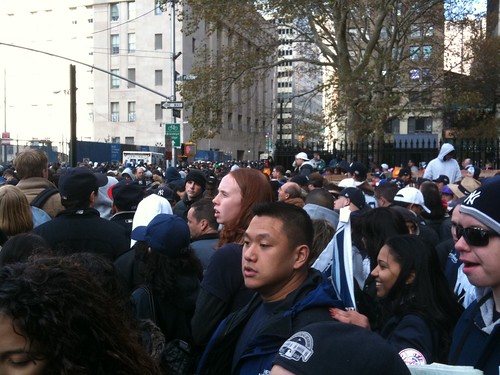
At the Yankees parade
At the parade (it looks like I was far away, but not really--not!)
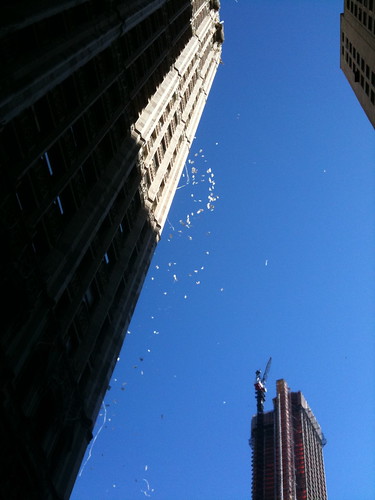
Confetti
The confetti being dumped from the cornices--it turned out that some of the celebratory paper included people's vital records and bank documents. Oops!
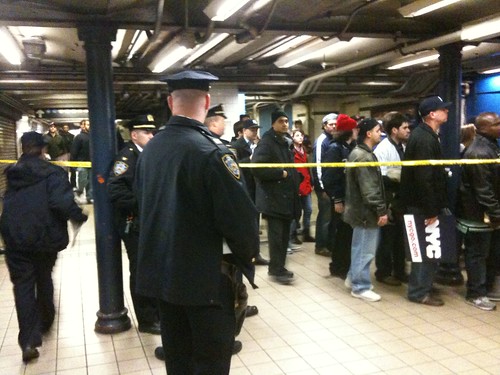
At Broadway Station
New York's finest penning people in like cattle
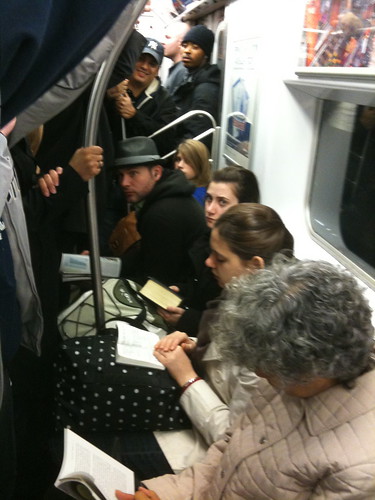
On the horribly crowded 5 train
On a very crowded train--and the young woman in the middle of the photo was diligently reading and speaking her Hebrew text...only in New York!
Yankees fans
Among the many, the proud, the Yankees boosters

˚˚˚
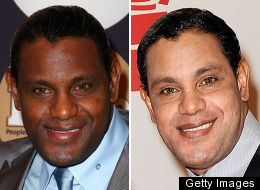
Speaking of baseball, Chicago, blackness, racism, the not-so-proud, and so much more, I'll just present the photos. Ughhh and arrrgghhh. Sad and tragic doesn't barely scratch the surface.

Sammy w/ Mark McGwire
Sammy Whitens Himself

Vitiligo it ain't!

˚˚˚

On Thursday, playwright, novelist and activist Sarah Schulman will deliver the 18th Annual David R. Kessler Lecture. Her talk is entitled "Ties That Bind: Familial Homophobia and Its Consequences."

The event takes place at the CUNY Grad Center, at 34th St. and 5th Avenue, in Manhattan, in the
Proshansky Auditorium. It runs from 6:30 to 8:30.

If you're in New York, don't miss it.

˚˚˚

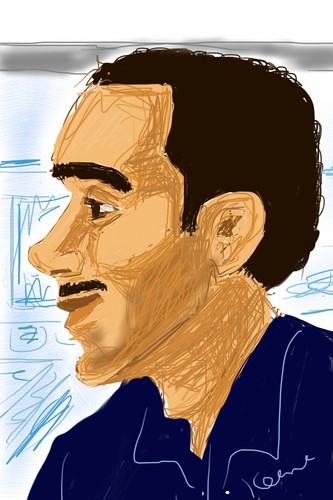
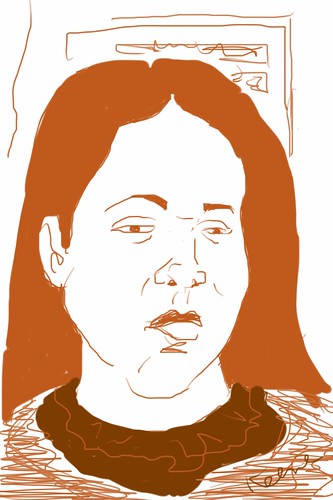
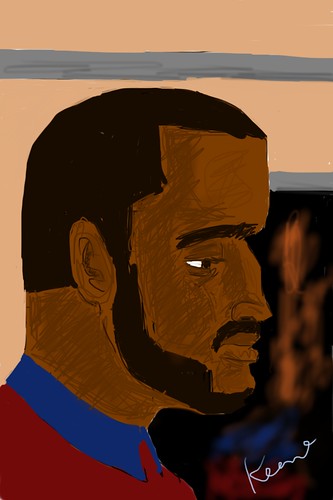
The iPhone drawing continues. I'm addicted. I don't think I've drawn--or thumbed/index-fingered?--this much from life in many years. My new approach is to do as quick a sketch as possible, then fill in the details later. I've also been experimenting with different drawing styles, though I seem to be locked into train portraits these days.

I haven't yet figured out all the intricacies of the very popular Brushes program and have instead been using Autodesk Sketchbook for most of these portraits, which now total 23, or about 1 per day, though some days I do 2-3 in one shot. I do want to learn how to use the layers function in the former app, because I love Jorge Colombo's images.

Now if only AT&T would provide service anywhere near equal to the performance of my iPhone's apps, I'd consider the device essentially miraculous.
iPhone drawing - Young man on train
Man on light rail train
iPhone drawing
Woman on PATH
iPhone drawing - PATH conductor
PATH conductor
iPhone drawing
Man on light rail
iPhone drawing
Man on PATH

Monday, October 26, 2009

Yankees Go to Series vs. Phillies + MR Daniel Music Tomorrow + Glissant at NYU

I haven't posted anything on the baseball playoffs since they began nearly a month ago. In part my silence results from the swift and ignominious departure of the Saint Louis Cardinals, who fell in 3 straight games, marked by minimal hitting and maximal errors, to the Los Angeles Dodgers. So the Cardinals are out. The Philadelphia Phillies, however, took care of the Dodgers after walloping Colorado, and now face the American League's best team, the New York Yankees.

The Boss's businessmen in pinstripes have played with great efficiency and pop since dominating their division, reminding me of their late 1990s run, when they reeled off four World Series wins in five years (1996, and 1998-2000). After a spate of playoff failures against the Boston Red Sox, and the annual post-season disappearance at the plate of A-Rod, the Yankees are again taking the field and games like champions. Their off-season acquisitions have also paid off, in particular the multimillion-dollar contract they offered to CC Sabathia, the 6'7", 290 lb southpaw powerhouse who after a bumpy start in April won 19 games for them with a 3.37 ERA, growing stronger as the months advanced. Sabathia has been dazzling so far in the post-season run, and was name American League Championship Series MVP.

Also working out well has been two other acquisitions: switch-hitting first baseman Mark Teixeira, who hit 39 home runs and drove in 122, tops on the team, and righthander A. J. Burnett, whose 13-9 record helped put the Yankees atop the AL East. While Teixeira has been a factor in playoffs so far, Burnett hasn't. Another factor in the Yankees' run this year has been lefthander Andy Pettitte. One of the Yankees' aces during the late 90s, George Steinbrenner let him go despite a 21-8 season in 2003 and a 16-9 playoff record, and during his absence the Yankees' playoff hopes fizzled. Pettitte returned two years ago, however, and with Sabathia, Burnett, and very young pitchers Joba Chamberlain and Phil Hughes, constituted one of the best starting rotations in the American League. Last night Pettitte pitched another gem, sending the Los Angeles Angels of Anaheim, who also sank themselves with onfield mistakes, back to Orange County, and setting them up for a battle with the Phillies.

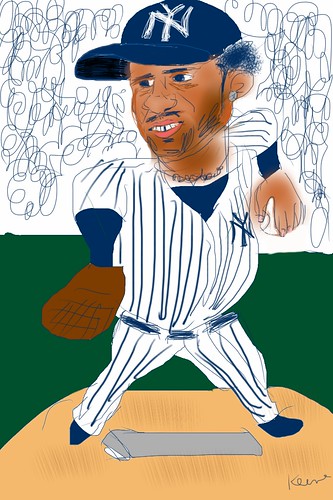
CC Sabathia
My iPhone sketch of CC Sabathia

This matchup could be called the Original US Capital Cities Series, or the Original Major League Baseball Teams Series, or the New Jersey Transit Series, or the New Jersey Turnpike Exit series, or Competing Jersey Media Market Series, or the Two Cities that Dominate New Jersey Series, or the Two Cities Hosting Ivy League Universities Equidistant from Princeton and Rutgers Universities Series, or something else altogether. It's been 59 years since the two teams faced off in the World Series, which the Yankees, in their most glorious era, won 4 games to 0. The 2009 Phillies have very good pitching, especially in starters Cliff Lee and Cole Hamels, and a dangerous lineup, with good contact hitters like Chase Utley, Shane Victorino, and Pedro Feliz and a slugger for the ages in St. Louisan Ryan Howard. They more than match up well with the Yankees. They will also have the edge in the games played in Philadelphia, since the Yankees will lose a bat in their order, though Sabathia's very handy at the plate; neither ballpark is particularly pitcher-friendly.

I'm going to give my nod to the Bronx Bombers. If they can get outstanding pitching performances out of Sabathia and Pettitte, some offense from A-Rod, and close games out effectively under the Chamberlain-Hughes duo before future Hall of Famer Mariano Rivera has to take the mound, they will win. This is asking a tall order, but I think it's possible. I'm looking forward to watching every game if I can. (And if you have free tickets, you know, you can always share!)

***

Tomorrow, composer-critic-brilliant person MR Daniel will be presenting work at Princeton University, at 8 pm, at
Taplin Auditorium, in Fine Hall.

The Celestial Mechanics vocal trio will be performing her new three movement vocal piece, My Father and I Are Playing. She writes of them: "I've known the performers in this ensemble for a couple of years, and I'm really excited by what I've heard of their approach to the piece so far. And they're really excited to be doing the piece--always a good combination!" I can say that I've heard some of her work live (in Chicago, and online), and I'm really excited to hear more.

Daniel be accompanying the vocal trio with a live visuals mix, and is part of the Composers Ensemble program at Princeton University. Celestial Mechanics is also performing work by "members Lainie Fefferman and Anne Hege, along with Michelle Nagai and Jascha Narveson, and piano works by David T. Little."

Here's another wonderful thing: if you can't make it to the actual performance there will be a live video stream with link available through the Princeton University Music Department's website. I also hope the performance is archived, because another event I'll mention below is taking place simultaneously, and also because I hope more people will get to hear MR Daniel's work.

Lastly MR writes, "(If you watch the webcast, please do let me know about your viewing experience--this is a new offering from the department)." Please do so if you can [go to the Princeton University Music Department link for more info].

***

The other event (and of course there are many) occurring simultaneously (well, a little before) with the Princeton Composers Ensemble concert is the first of four panels devoted to the work of critic-author-sage Édouard Glissant, whose Caribbean Discourse and Poetics of Relation are two of the bedrock theoretical texts of contemporary Black Diasporic and global post(-post)-colonial thought and practice. The events, sponsored by New York University's Institute of African American Affairs under the heading One World In Relation, will be taking place on the NYU campus over a series of weeks. I've had at least four different people send reminders, so I will let all J's Theater readers know about them as well. Here's the flyer:

Glissant's One World in Relation

Institute of African American Affairs

at New York University

presents

Édouard Glissant:

One World in Relation

Four Conversations with Édouard Glissant

whose path-breaking work, according to Gilles Deleuze,

“Ties the knot between philosophy and poetry at their deepest and purest level.”

Tuesday, October 27th

Wednesday, November 4th

Wednesday, November 18th

Monday, November 30th

Édouard Glissant is one of the most important thinkers of our time. In the 1980s, his theories of créolization, diversity and difference, as elaborated in the book Le Discours Antillais, were considered seminal texts for the emerging studies of multiculturalism, identity politics and minority literatures. In the 1990s and 2000s, Glissant’s work moved beyond the mere consideration of meanings as circumscribed by the relation of the signifier and the signified and the recognition of otherness. In his recently published book, Philosophie de la Relation, the concept is used to meditate on the new meanings of globalization, chaos, violence, equality and justice. Whereas in France and parts of Europe, Glissant’s work has inspired critics, poets, artists, museum curators, musicians, philosophers and politicians, in North America, much of its scope is still limited to the circle of Francophone literary theorists. It is now time to bring his ideas to a broader audience in the Anglophone world. With Philosophie de la Relation, Glissant points us to a possibility where our differences are no longer considered as proof of an irreconcilable fact, but as part of what relates us, makes us beautiful, complex and creative. These four conversations with Édouard Glissant will bring together philosophers, social scientists, artists and humanists to discuss his ideas across disciplines and for the larger public.

Opacity, Stupidity and the History of Unintelligibility:

The Right to Opacity as a Prerequisite for Politics and Philosophy

Tuesday, October 27th, 2009 @ 6:30 pm

Panelists: Avital Ronell, Francois Noudelmann, Joan Retallack,

Sylvère Lotringer, Tracie Morris, Manthia Diawara and Denis Hollier (Moderators)
Location: Kimmel Center, Rosenthal Pavilion, 10th Floor

60 Washington Square South, 4th Floor, NY, NY

Diversity in the Black Night: Chaos, Créolization and Metissage

Wednesday, November 4th, 2009 @ 6:30 pm

Panelists: Michael Dash, Ulrich Baer, Patricia Williams,

Kendall Thomas, Arjun Appadurai, Manthia Diawara and Judith Miller (Moderators)

Location: Cantor Film Center, 36 East 8th Street, NY, NY

Roots & Imaginary Offshoots: Ecstatic Difference

Wednesday, November 18th, 2009 @ 6:30 pm

Panel: Theory of “Relation and Difference”

Panelists include: Francois Noudelmann, Mary Ann Caws,

Breyten Breytenbach, Fred Moten, Emily Apter,

Manthia Diawara and Avital Ronell (Moderators)

Location: Cantor Film Center, 36 East 8th Street, NY, NY

De-capitalization and the Way of the World: Religion, Secularism and Multiplicity

Monday, November 30th, 2009 @ 6:30 pm

Panelists: Richard Sennett, Avital Ronell, Francois Noudelmann,

Craig Calhoun, Arjun Apadurai,

Manthia Diawara and Avital Ronell (Moderators)
Location: Kimmel Center, Rm. 914-Silver

60 Washington Square South, NY, NY

Free and open to the public

Please RSVP at (212) 998-IAAA (4222)

Presented by Institute of African American Affairs

Supported by: L’Institut du Tout-Monde, The Institute for Public Knowledge,

French Department and Comparative Literature Department

Sunday, September 27, 2009

NY Philharmonic Opening Night + Sports Roundup

A couple weeks ago I did something I haven't done in a while: I watched a live classical music concert on TV. The occasion was the PBS Live from Lincoln Center's broadcast of the New York Philharmonic Orchestra's season opener, which marked the début of its new Music Director, 42-year-old Alan Gilbert. I'd even made a mental note of the broadcast primarily because I saw that it would include Renee Fleming singing songs not by Schubert, or Strauss, or Faure, all likely opening-night and maestro-début and audience friendly choices, but...Olivier Messiaen.

I almost didn't believe my eyes or ears when I heard and saw this after an episode of The Newshour with Jim Lehrer, but then Gilbert, the son of two NY Philharmonic musicians, has from his earliest appearances with the orchestra shown an adventurousness that marks a change from the musty perspectives of his immediate predecessors, both consummate musicians, Kurt Masur and placeholder Lorin Maazel. Gilbert not only chose Messiaen's Poèmes pour Mi (1934), a serious of deeply religious, dramatic connubial songs written by the composer for his first wife, whose nickname was Mi, but also opened with a newly commissioned composition, EXPO, a continuously developing orchestral piece in a tonal idiom by the Philharmonic's composer in residence, Magnus Lindberg, and, after a break, concluded with...not Mozart, not Beethoven, not Brahms, Bruckner, Mahler, or Schumann, but...Berlioz's Symphonie fantastique.

The Lindberg piece, with its echoes of Sibelius and Americana riffs, was pleasant enough to listen to, and Gilbert and the orchestra played it with assurance and verve, as if they were enjoying themselves. This was also the first time in over 45 years that the Philharmonic had included a newly commissioned piece on its opening night program. I'm sorry but that's pretty pathetic, so even more props go to Gilbert. But the Messaien riveted me. Not only did Fleming convey the otherwordliness of the nine song's scores, capturing both their highest and lowest registers and the churning colors between, but Gilbert pushed the orchestra to fully evoke all of Messaien's shadings without ever overshadowing the singer. Perhaps the most striking moment came when Fleming sang the grim "Éprouvante," a wrenching vision of hell that the music did not stint in reflecting. It was also exhilarating to hear work by Messaien, a highly regarded canonical composer whose music nevertheless remains on the other side of the symphonic mainstream, on TV, in prime time. This bodes well, I hope, for future NYPO and other orchestral concert broadcasts, though sometimes tells me they'll still be dominated by the late baroque-to-late Romantic German standards.

As Fleming sang, I intermittently wondered what subscribers and critics thought of Gilbert's choices. As a sign of a new vision, they left no doubt. To people used to a mostly late baroque-to-late Romantic German repertoire with a few outliers (19th century French and Russian, early 20th century European late-Romantic and tonal modernist, a few American composers, and commissioned pieces, never to be played again), was probably upsetting. To end with Berlioz's vast, forward-looking 1830 symphony must have felt like a shockwave. Gilbert and the orchestra showed that they knew the score and in most of its sections, went below the surface to portray the richness of the moods Berlioz was aiming for. I'm no expert on Berlioz's work nor an authority on how other orchestras have played it, but I could hear both Gilbert's and the players' skill and precision, but also passion. It was never mechanical, as Maazel's performances often were.

Anthony Tommasini raved about Gilbert in his New York Times review of the concert the following day. He praised the Lindberg for not writing a "gnarly, intimidating modern piece"--Mr. Tommasini, it's 2009, and there are so many contemporary composers who do not write "intimidating modern" or "post-modern" or "post-post-modern" or whatever pieces that also are not treacly, neo-Romantic, ersatz movie music outtakes--and rained down kudos for Gilbert's choice of the Messiaen and Berlioz, though he was less fulsome when he described Gilbert's conducting of the latter work, saying that some listeners probably liked to hear it conducted with more of a"sumptuous feeling for color or more fantastical freedom" than on display in this concert. He nevertheless lauded Gilbert's assured and effective conducting, which not only brought the symphony to life but worked well with the two prior pieces, both in French idioms, broadly construed. The article's comment section, however, reflected more displeasure than happiness: lots of complaints not about Gilbert's music-making, which seems unimpeachable, but about his program choices.

I've been wondering about this as I've followed Greg Sandow's blog on classical music for several years. Sandow is a composer and professor at Juillard, and is writing a book about the present state of the US classical music world. One persistent element in his blog commenters' responses is a denial that the US classical music world is any trouble; another is that its audience is aging; a third is that the standard repertoire is just fine. Keeping these frequent threads in mind, I wondered to myself how much outrage there would have been had Gilbert gone farther, and in addition to the Lindberg, programmed all new music to launch his tenure. What if instead of Messiaen (whose career spanned the early to late 20th century) and the 19th century Berlioz, he had played two contemporary, living American composers, like John Corigliano and Ellen Taaffe Zwillich? Or two contemporary non-US composers, like Toru Takemitsu and Thomas Adès? Or two 20th century American composers who weren't exactly mainstream any more, like Roy Harris and William Schuman? Or truly avant-garde 20th century, post-Second Viennese school American composers, like Morton Feldman, Terry Riley, and John Cage? Or a composition in a jazz or rock-inflected idiom by the likes of Elvis Costello, or Wynton Marsalis? Would people have walked out of and lustily booed the concert as occurred at the Metropolitan Opera's premiere last week of the warhorse Tosca, based on Luc Bondy's new staging and direction?

Perhaps a better question is, would it ever happen, even under someone as open to the new as Gilbert? (When the extraordinary conductor James Levine, who heads the Met Opera's orchestra, took over the Boston Symphony Orchestra, which long been moribund under his predecessor, he jumpstarted its formerly progressive repertoire under Fritz Reiner by performing a slew of "difficult" 20th century works. I don't think, however, that he touched the likes of Daugherty, say, or Todd Machover, or Tania León.) It remains to be seen. I should note that Gilbert's second concert as Musical Director was conducting Mahler's Third Symphony, about as standard as things can get. This week he conducted Brahms's Violin Concerto, another standard piece, but paired it with Arnold Schoenberg's less frequently heard Pelleas und Melisande, which Tommasini described in his Friday review, typically, as "formidable" and "demanding," despite it's having been superseded by far more formidable and demanding Schoenberg scores (Chamber Symphony? Fantasie? Violin Concerto?), as well as innumerable more complicated soundworlds including many in rock, jazz, ambient, etc. I take the slotting in of even a fairly old-style (for) Schoenberg piece as a good sign, though. And he spoke to the audience about it! Looking through the upcoming concerts--and Gilbert will be taking the Philharmonic on the road to Japan, South Korea, Vietnam, and Singapore for a chunk of October--through December, it appears as though there will be lots of Mozart, Beethoven and Brahms, unsurprisingly, but throughout the 2009-2010 season Gilbert has slated a range of post-Romantic fare into the main concerts, including performances of Ligeti's Le Grand Macabre (semi-staged), Ives's Second Symphony, Anton von Zemlinsky's Lyric Suite, and, as part of the end of 2009 concerts, Webern's Symphony. Additionally, such very up-to-date works as Christopher Rouse's new commission, Zhizn ("life" in Russian), H.K. Gruber's Aerea, and pieces by Nico Muhly, Matthias Pintscher, Lindberg, and others, will be in both the main and Contact: The New Music series concerts.

To me, this programming in Gilbert's first year is a clear sign that the NYPO is moving into both the present and future, much as Baltimore's symphony has done under Marin Alsop, and Los Angeles's will under Gustavo Dudamel. Since I spend a chunk of each year in Chicago, I'm curious to know which directions new Musical Director Riccardo Muti will take the Chicago Symphony Orchestra for the five years of his contract. He is known as a strong conductor of Giuseppi Verdi, late baroque and early Romantic music, and of the standard repertoire, in a lean, recording-friendly idiom, and not so much of anything that new. At least since Mahler's time.

(I am skipping the Lyric Opera of Chicago's offerings this year; they aren't staging a single opera written since 1921--Leos Janacek's Kát'a Kabanová--while the Metropolitan Opera's tiny steps outside its narrow conventional doors are Alban Berg's Lulu, Dmitri Shostakovich's The Nose, and Janacek's From the House of the Dead. The unparalleled season Gérard Mortier had planned for the New York City Opera is now nothing but a phantom, like that opera company itself.)

+++

The Saint Louis Cardinals are now officially in the playoffs, after defeating the Colorado Rockies 6-3 last night. They joined the Los Angeles Dodgers, who have also made the playoffs and currently have the best record in the NL. In the AL, the Yankees are now in the playoffs, having defeated their arch-nemeses, the Boston Red Sox tonight at the new Yankee Stadium 4-2. The Philadelphia Phillies and Los Angeles Angels of Anaheim both seem bound for the playoffs with dwindling magic numbers and the Red Sox are well ahead in the AL Wild Card Race, but the AL Central-leading Detroit Tigers are hanging on for all their lives, and the NL Wild Card race is increasingly a toss up, as Atlanta surges and Colorado falters. I'm just glad the Cardinals and Yankees are in. Now they have to keep winning.
Mark Sanchez
EAST RUTHERFORD, NJ - SEPTEMBER 27: Mark Sanchez #6 of The New York Jets runs upfield after catching a pass against The Tennessee Titans during their game on September 27, 2009 at Giants Stadium in East Rutherford, New Jersey. (Photo by Al Bello/Getty Images)

As of tonight, the New York Jets are 3-0; rookie QB Mark Sanchez's 3 straight wins are a league first, and the defense allowed more than 10 points for the first time this season in today's 24-17 victory over the Tennessee Titans. The Saint Louis Rams, however, are 0-3 after another uninspired, sloppy loss, this time to the Green Bay Packers. With the Detroit Lions' victory over the Washington Snyders, the Rams have the longest losing streak, at 13 games dating back to last season. They look awful enough to make it 29 if they maintain this abysmal level of play. But they're in good--or bad--company so far: Miami, Cleveland, Kansas City, Tennessee, and Tampa Bay have also lost 3 games without a win and Carolina has 2 losses without having won one. Which of this sorry group will turn things around first? I say Tennessee or Tampa Bay, but don't hold me to that.