Showing posts with label Gayatri Spivak. Show all posts

Wednesday, September 18, 2013

Gayatri Spivak & Anne Carson @ NYU

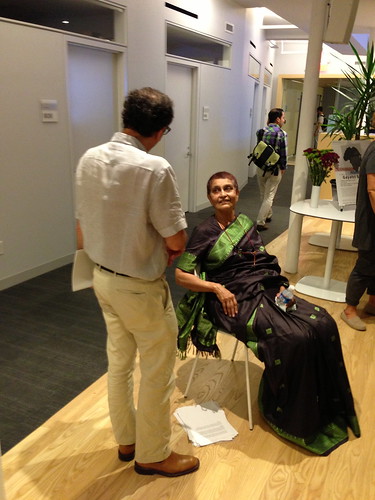
Gayatri Spivak after her talk
This blog post's title suggests that in some strange confluence two eminent contemporary figures, Gayatri Spivak and Anne Carson, perhaps appeared together at New York University. But that was not the case. This past Thursday, both Spivak and Carson spoke at New York University, though they did so at completely different venues. I do wonder what it would be like to bring them together; what might the points of connection and contact be? Where might their thought intersect? Have they read each other? Something tells me that given the prominence of Spivak's theoretical production and Carson's poetry, perhaps they have at least familiarized themselves, however briefly, with each other's work.

Spivak delivered a talk entitled "Democracy and Representation" that Arjun Appadurai introduced and which NYU's Department of Media, Culture, and Communication hosted, with additional funding from the NYU Africana Studies Program, the Comparative Literature Department, and the Anglophone Project in the English Department. Ostensibly her aim was to speak about the problem of political representation in light of structures and practices international democracy, through a discussion of the late Patrice Lumumba, the first democratically-elected leader of a free Congo (now the Democratic Republic of Congo), who Belgian forces, in collusion with the United States, assassinated shortly after he took office. Her talk was then to shift into a discussion of a new "epistemology for engaging the contemporary by working through the inter-animation between postcoloniality and democracy." She in fact did talk about these issues, but she also spoke extensively, sometimes in Bengali, about her projects working with subalterns in India, and she offered informative sallies, often brimming with generosity, of a range of issues, including the relationship between "democracy" and social justice, the role of ancestor worship in Raoul Peck's Lumumba versus Jacques Brassine's deeply flawed colonialist post-colonial documentary Spectres, Belgium's and European colonization's roles in the spread of HIV in Congo, the reality of "sustained underdevelopment," and the Occupy Movement.
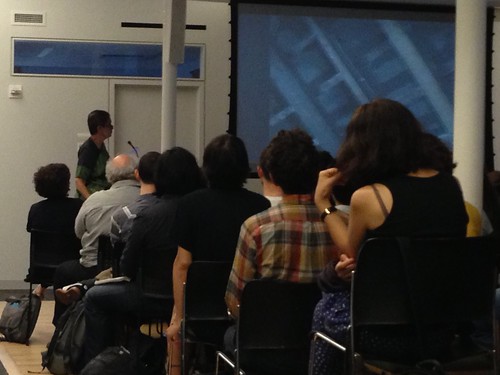
IMG_0749
One aspect of her talk that I found most compelling was her discussion of her efforts toward what she called "supplementing vanguardism," which is to say, helping to create a subaltern intellectual, in terms that Antonio Gramsci articulated a century ago. As she noted, she has aimed for "intellectual labor conversations," viewing her work in part as "using intellectual labor to produce intellectual labor in students," moreso than merely imparting information. This, one might say, is part ofthe knew epistemology she was trying to fashion. She went on to talk about this work as "epistemological performance," and, against the obsession with STEM, talked about the necessity for a "training of the imagination," an "aesthetic imagination," which she correlated with "the humanities at work." She also juxtaposed this with the growing systematization and statistization of human development measurement, urging that it be supplemented by the humanities, that a different approach from that of "capital and colony" be taken into account, that we engage in "imaginative activism." As part of her broader critique, she noted that "underdevelopment" did not begin with capitalist colonization, and that this would be clearer if we moved questions of development away from the statistical development model, but that one way to do this was through this imaginative activism, utilizing the power of the humanities at work, but this must entail going beyond mere "activist writing," which could become self-referential and self-satisfied, but have few direct or practical effects for subalterns engaged in struggle. Moreover, political passion alone cannot suffice either. As she said, and as we know just from US history, organization, coalition building, direct action, and other forms of mobilization beyond immediate demands and protests for action, are necessary; "political passion, even when it is incandescent, cannot lead to permanent political structures." (Gramsci, I believe, thinking about Croce.)

There was one moment toward the end when a questioner asked Spivak to explain an incredibly complex formulation that she had made in her talk, and warned the audience about in terms of its difficulty, and, as I have seen her do now many times of the years (at the University of Virginia, at Northwestern, etc.), she basically diagrammed her formulation such that it was not only comprehensible but almost dizzying once you realized what she was saying. I will only say that it involved a formulation about reproductive heteronormativity and its relation to the autonormativity of ideas. At any rate, she returned several times during the Q&A to her emphasis on the necessity of training the imagination to think what is not there, to resisting the impulse to think only of oneself, to using whatever tools--including our two hands--to produce resistance, and to praising the emergence of structures and entities like the Khan Academy, which she nevertheless said must be supplemented by "imaginative training." There was a brief, powerful quote she uttered that I repeated at the MoCADA event, with attribution to her, about how Gramsci noted that "the subaltern is denied the right to abstraction." A great deal of what she has done and continues to do is to challenge this idea, to show and make possible access, among subaltern peoples, to "abstraction," the tools of social justice and liberation. There is, she noted, good and bad in everything; how to understand the difference, and make use of the better aspects of what's around us, including abstract structures such as democracy, money, the law, particularly in the face of the increasing subalternization of the 99%, remains the challenge. This reminds me of Clay's speech to Lula at the end of Amiri Baraka's Dutchman, in which he tell Lula how dangerous he and other black people could be if they use the Enlightenment tools, chiefly reason, instead of sublimating their oppression and transforming it into art. How to use those tools, without losing sight of that aesthetic dimension, is part of what Spivak spoke so evocatively and persuasively about that night.
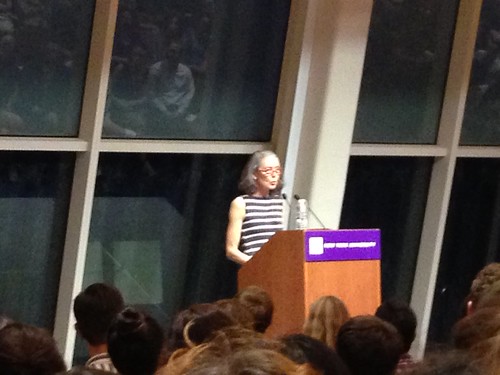
IMG_0754
Having written all of that about Spivak, I must admit that I have less to say about Anne Carson, though she was no less invigorating, in a different way. The MacArthur Foundation Fellow and NYU Distinguished Poet-in-Residence received an affirmative introduction by NYU Creative Writing Program head Joanne Landau, and, it turns out, was reading for the first time in a while at NYU without her husband and frequent collaborator, Robert Currie. She primarily read from her latest work Red Doc> (Knopf, 2013), which takes up the thread of Geryon, the strange, red, unforgettable monster-child from her earlier work, the brilliant novel-in-verse The Autobiography of Red (Knopf, 1998), but she also read assorted older and newer work, including one of the best things I've ever heard from her, one of her dialogues titled "Krapp House," in which she imagines Samuel Beckett's eponymous protagonist from his play Krapp's Last Tape conducting TV interviews various notable historical figures and literary characters. In the "Krapp House" interview she read, Krapp was interviewing Helen of Troy, who made a monstrous choice of her own--captured women vs. her dog; I'll leave J's Theater readers to figure out what Helen did, but let it be said that Carson can treat the profundity of horror, self-absorption, and ethical quandaries, among so many other things, as well as anyone. She ended the event with participatory short talks that were like delicious candies handed out to all who attended. Few writers can bring the house up, then down, then back up again, as deftly as she can. I now will keep my eye ready for announcements about new performances of Red Doc> or anything else she and "Currie," as she called him, are up to.

Sunday, March 09, 2008

The Wire: Finis + Travels & Brain Camp

The Wire: is it really over? What a finale! I know folks who haven't yet seen all the prior four seasons, so I'll keep my thoughts to a minimum, but what a series of climaxes and denouements, with narrative braiding and unexpected twists superior to many a novel out there. Another of the strongest and most appealing aspects of the show for me was the way that David Simon, his writers and producers, and his cast, maintained a consistency and depth of characterization over multiple seasons; the only character whose motivation was least clear to me this season was Kima, which I attribute to the writers' inability to find the right character to take the potentially devastating steps she did. Who else could have done it? The characterizations of the newsroom people, save Gus Johnson, were also shallower than what Simon and company served up in previous seasons, and I attributed this to the lack of narrative space and time to fill them out. 10 shows simply were not enough. I cannot figure out what drove the yuppy reporter to his unethical actions, because even his early statement and demonstration of his ambition rang more than a little hollow--and I can't attribute it solely to bad acting--and yet his behavior, reflecting the many journalistic scandals over the last ten years, was all too plausible.

My favorite final notes tonight included the utterly cynical and predictable take on the newspaper industry, with the racial and gender critiques woven in without being uttered; the ridiculously random yet perfect resolution to the "homeless killer" plotline, with its manifold ramifications for all involved; Marlo Stanfield's return, replete with a bit of streetfighting, to the only thing he truly knows; Daniels' final demonstration of an inner ethical compass, despite the consequences, as a counterstatement to the cynicism filling the air of nearly every other space in the show; and little Michael's figurative and literal reprise of the series' anti-hero, Omar, with a hooded accomplice in tow. (Bernie, Reggie and I had broached a possible reading of this after a domestic scene early this scene.) The show's culmination also represented one of the best multi-season explorations of local and state politics that I can recall. I told C that given how close the show sometimes hewed to reality down there I imagine Maryland's governor, the former Baltimore mayor Martin O'Malley, is probably more relieved than almost anyone else that it's finally ended. Then again, I think the most relieved party may be the Baltimore Sun.

◊◊◊

This past week was like brain camp! I want to go back! (Photos coming soon....)

After getting an opportunity to spend some time at home, on Tuesday evening I participated in a Poets House-sponsored panel, The Harlem Renaissance Revisited, which included the marvelous scholar-poet Evie Shockley, who inimitably brought to light the work of poet Anne Spencer, and the amazing multitalented duo Mendi + Keith Obadike, who spoke about the influence of several Harlem Renaissance-era musicians and poets on their own work. I offered some remarks on a longtime hero, Richard Bruce Nugent, whose life and works, such as "Smoke, Lilies and Jade," like other pathbreaking texts from this period and group I see as being integral, in key ways not only to the subsequent development of Black queer literary and cultural production, but also to Black avant-garde and American avant-garde traditions. Amiri Baraka drawing from the notebooks of Nugent and Hughes, Hurston and Spencer: can you picture it? Before the panel, I met with several Borough of Manhattan Community College classes, and answered their questions on the Harlem Renaissance, which ranged from the paucity of high profile female poets, to why Langston Hughes got so many props, to when exactly the Harlem/New Negro Renaissance ended and why. Great questions, and many thanks to the professors and students, one of whom was analyzing a Langston Hughes poem as we walked to the auditorium--you gotta love it!

I was so glad that friends like Tisa, Patricia Spears Jones, and Kaemanje were present, and it was also a pleasure to see Tom Wirth, who edited the Nugent omnibus volume, Gay Rebel of the Harlem Renaissance (Duke) several years ago, and passed on a copy of Nugent's posthumous roman à clef, Gentleman Jigger, which he edited and I am reading now and cannot put down! Langston Hughes, Zora Neale Hurston, Countee Cullen, Carl Van Vechten, Aaron Douglas, Alain Locke, W.E.B. DuBois, A'Lelia Bundles, and many other high-profile Harlem Renaissancers make their appearances herein, sometimes to shocking effect. Had he published this back when he wrote it, he not only might have provoked Wallace Thurman--a central figure ("Rusty") in the text and the foil of Nugent's alter ego, "James 'Stuartt' Brennan"--whose Infants of the Spring is like a mirror of this text (Nugent calls the Thurman character a "plagiarist" in the book, though Wirth's introduction argues that the matter remains unresolved), to an even earlier death, but he might have found himself exiled from New York permanently. I recommend it, and if I hadn't already crammed my spring course with reading material (how on earth is that going to work?), I'd be adding it to the list. Thanks to Stephen Motika of Poets House, and Alison Meyers of Cave Canem, among many others, for making this event possible.

On Wednesday I flew out to Indiana University to participate in a reading with Evie Shockley; our host was the gentle, brilliant, beautiful poet-scholar Ross Gay, along with poet Cathy Bowman, who heads the Creative Writing Program, and Margo Crawford, one of the smartest people I have met. (Margo's mind moves like subatomic particles, and I'm not kidding.) The reading was lots of fun: I read a new story, and Evie TORE IT UP with her poems! I had never heard her read more than a poet or two from her collection, A Half Red Sea--in fact, I don't think I'd ever heard Evie read outside of a CC reading, incredibly enough--so this opportunity was platinum. She also read newer poems whose concision, subtlety and punch could serve as models for any poet, and three final pieces which closed out the evening perfectly. Along the way she invoked Ella Fitzgerald, Henry Bibb, Gwendolyn Brooks, mathematics, Nappyphilia, and countless other things in utter congruence in that way that only Evie can. If only I could figure out a way to bring her and Ross to the university, at least for a day! I will only add that Ross's introductions set the bar high, and you know you gotta bring it when he sets the standard. Later we all hung out, and I got to chat with Cathy and Margo, and Ross and Evie, and another colleague of theirs, who wrote an award-winning bio of Nella Larsen, and had the sort of conversation I often dream would or could occur regularly in these parts. The next day we met with some of the graduate writing students, and Ross, Margo and they all posed excellent questions, with Evie supplying her customary super brain power, and some of which I didn't think of the answers to until I was on the plane back to O'Hare, but what can you do? I still ran my mouth. Oh--and the "non-objective" was part of the philosophical underpinnings of the Black Arts Movement, referring back to the central African principle of muntu. If only I'd have thought of that definition a few days ago. As I said, what can I do? Nevertheless, I felt like my head had expanded from all I learned and I was in one of the best moods I could imagine in Chicago in a long time, even after I got on the road and nearly destroyed my axle on a pothole the size of Lake Michigan.

Then it was back to grind, but Friday provided a LOT more brain-nourishment when, after meeting with highly accomplished prospective graduate students to the English department, and a very talented young person who's been admitted to the African American Studies program, I went to hear Gayatri Spivak give a talk on "Rethinking Comparativisms." One of the most eminent of my colleagues and her former graduate school classmate at Cornell, Samuel Weber, introduced her, and then he let her do her thing. I have seen Spivak talk before, and I place her in the avatar category, so it was a thrilling ride she took me and everyone else on, not only in the lecture, which was supposed to include clips from Sissoko's film Bamako (Keguro, I thought of you!)--only no one could figure out how to work them in that "smart" lecture hall, which meant that Spivak had to act them out! Just imagine that!--but also in the question and answer period. Afterwards, I was able to attend a dinner with Spivak, whom I didn't get to speak to until the very end, as she was departing, but I did meet some new colleagues in the German and Comparative Literature departments, with whom I gabbed about several figures we were mutually interested in (Yannis Ritsos, Alexander Kluge, Immanuel Kant, Walter Benjamin, etc.), I learned a strange new fact about how many Enlightenment philosophers and mathematicians made their keep, and I got to chat at length with a colleague I rarely see on campus, Jillana Enteen, who had some perceptive and enlightening takes on the talk.

One aspect of the talk that most interested me was Spivak's reading of Pascale Casanova's The World Republic of Letters, a book of the month pic on here years ago and also the subject of a short post; I even taught a little of the book a few years ago, to the bafflement of my students, in part because Casanova's theorization was only tangentially germane, though useful I thought, to the subject matter at hand. But Spivak's breakdown of the terms of Casanova's premise, concerning minor literatures' relations to the hegemonic languages and their literatures, as well as the larger global field of literary production and publishing, caught my attention, I only wished she'd have said more about this, though it was clear that her argument's aims were different: "policy," as she put it. And not policy regarding the question of global literary production, reputation-making and historicization, which are Casanova's, as I read them. For that's for another day, of course; perhaps when Casanova returns to the university to speak, since I unaccountably missed her talk here a month ago.

Then on Saturday evening, I went to see Toni Asante Lightfoot participate in a dance performance at Link's Hall in Boystown: Choreographing Coalitions: Dancing the Other in the Self's first show, which included dances by Darrell Jones, Gesel Mason and David Roussève. I'm nobody's dance critic, so I'll keep it brief: Gesel performed two works, the first a brief, smooth piece "No Less Black" (2000), with a text she'd originally written in 1998 or so, which Toni read in accompaniment. After a video interlude, the second startled me beyond speech: called "Jumping the Broom" (2005), it was one of David Roussève's pieces, and linked the horrors encountered by two enslaved people who dared marry to the battles facing many LGBTQ people who want to marry nowadays. As it was a Roussève piece and given Gesel's performance, which was visceral in the pain and struggles it portrayed (she was bound wrist and ankle, crawled and dragged herself across the floor, and wrenched the text out of her core), the equivalence (the subject of Spivak's critique) came off as fitting. After a short break, during which I wasn't sure where my emotions were, a group of five very fabulous young people, four gorgeous young people (Darrell Jones, Damon Demarcus Greene, JSun Howard, and Awilda Rodriguez Lora, accompanied I'm told by a member of the House of Avant-Garde who was wearing a gas mask and white jumpsuit!) began practicing for their piece, excerpts from third Swan from the end (2007), which was perhaps the blackest, gayest dance performance I've seen that wasn't in a club or at a spot like the old, pre-Giuliani West Side Piers. Evoking all manner of black gay public and private (dance) performance and gesture, from keekeeing to vogueing to strutting to runway walking to bodily reads, all to a House soundtrack, these four dancers turned it out (serve!), and even managed to include a hilarious bit that C and I had witnessed live years ago at the Octagon, a performance of one of Oprah's bits from The Color Purple! (Darrell Jones told me afterwards that he indeed gotten it from there!) Had they included Harmonica Sunbeam/Sheila Noxzema's Spiderman hustle, which C and I also saw live years ago (and which I hope appears in a film somewhere someday), I swear I would have jumped through the roof in astonishment or joined them myself. As it was, it was hard not to stay in my seat. Part of what made it all so much fun was that Krista, Abegunde, Toni (after her performance), and Toni's husband Setondji were there, and did our own keekeeing. Thank you Gesel, thank you Darrell and your crew, and thank you Toni, for always coming up with ways to make Chicago feel like one of the most exciting cities in the world!

Tonight I finished an introduction that has been needling me for weeks, to another author's book, and my brain is tired, which means back to the grindstone!