Showing posts with label CUNY. Show all posts

Saturday, July 15, 2017

Anthurium: A Caribbean Studies Journal Special Issue on Paule Marshall


The vagaries of literary fortune are such that a writer who was quite famous in her time might very well be forgotten a decade later, while a little known and acknowledged wordsmith might find her work resurrected and championed. For a writer like Paule Marshall (1929-), still with us and an author whose long career has included numerous distinctions, she should be part of current literary, critical, theoretical, and cultural conversations, particularly around Black women's, Caribbean, African American, African Diasporic, immigrant, New York, and contemporary US writing.

To that end, Kelly Baker Josephs, Associate Professor of English at York College, CUNY, has edited a new issue of Anthurium: A Caribbean Studies Journal (Vol. 14, No. 1) devoted to Paule Marshall's life and work. The issue comprises a range of essays that offer ways of thinking and reading Marshall's writing, particularly around the theme of Black women--especially Black Caribbean women--and personhood, as Baker Josephs frames it in her introduction. Other contributors include Marlene Clark on Marshall's prescient understanding of "slumming" and gentrification in Brooklyn; Justin Haynes reading Marshall's The Timeless Place, The Chosen People through the lens of the posthuman; and Shirley D. Toland-Dix on Marshall's rereading of The Tempest.

Also in the issue are Janelle Rodriques on Afrofuturistic diaspora in Marshall's Praisesong for the WidowPetal Samuel on "regimes of aural discipline" in Marshall's The Fisher King; Patricia G. Lespinasse on women and jazz in that same novel; Lia Bascomb on mapping Diaspora "through biomythography"; and Jason Hendrickson on speech, resistance, and the ongoing relevance of Marshall's work. I contributed a short piece that began as response to questions posed by Baker Josephs, about having studied with Paule Marshall, which was one of the best classroom experiences I had at NYU.

I'll end by quoting Baker Josephs's insightful introduction, and urge you to check the full issue out:
The very different approaches to Chosen Place included in this issue indicate how fertile it can be for us at this historical moment, in which one has to cull the past to understand the roots of—and to locate resources with which to combat—contemporary traumatic social and political violences. In “Ghosts in the Posthuman Machine: Prostheses and Performance in The Chosen Place, the Timeless People,” Justin Haynes reads the interaction between humans and machines in the novel as the space within which we might examine the limits of resistance and mobility then and now. Haynes’ reading of Vere’s Opel is especially compelling amidst current controversies about autonomous automobiles. More interested in the timeless challenges of human interaction in the novel, Shirley D. Toland-Dix reads the novel as Marshall’s “audacious” reimagining of the Caliban-Prospero dyad via the Merle-Harriet dyad. TolandDix’s careful reading of the interactions between these two complex characters against the larger backdrop of the novel and its concerns argues for the ways in which Marshall articulates and anticipates the later demands of black and third world feminist movements.

In particular, the dynamic Marshall probes between socially (and often financially) privileged white women and less powerful women of color illustrates the implicit “limits of personhood” that plague attempts at intersectionality (when attempts are made at all). The direct link in the novel between Harriet’s choices and the failure of the Bournehills project foregrounds the blind enactment of privilege that we see criticized today in similar “development” projects. Harriet’s consistent alignment with power, even as she professes otherwise, may also evoke for readers comparable contemporary moments in which race and class privilege prevail over the promise of gender and sex equality—think here of the demographic breakdown of results in the 2016 United States presidential election, with 53% of white women voting for Donald Trump while 94% of black women voted for Hillary Clinton. One can easily see parallels between Merle’s insistent (especially about Harriet’s complicity) and Angela Peoples’ iconic 2017 Women’s March photo.

Thursday, April 05, 2012

Excerpt: Frank O'Hara

Kenneth Koch, Patsy Southgate, Frank O'Hara
Here is a snippet from one of the Lost and Found: The CUNY Poetics Document Initiative chapbooks I picked up last weekend, a letter circa Spring 1955, from Frank O'Hara (1926-1966) to Kenneth Koch (1925-2002), during the years when they were consolidating their friendship, and just beginning to publish the poetry that subsequent generations of readers now know as the earliest examples of New York School writing. I like this letter because it gives a clear sense of O'Hara's jaunty and campy sensibility and style, as well as little hints of what he (then toiling at the front desk at the Museum of Modern Art) and Koch (then traveling in Europe with his wife, Janice Elwood Koch) were up to. It mentions one of the famous episodes in American mid-century poetry history, the initial rejection of both O'Hara's and John Ashbery's (1927-) [called "John Ash" and "J A" below] first collections of poetry by the Yale Series of Younger Poets Prize in 1955, a situation that the judge, W. H. Auden (1907-1973), later rectified when he asked that O'Hara and Ashbery send their collections to him directly, and he chose--though not enthusiastically, according both to his then assistant and eventual close friend and associate of O'Hara, Koch and Ashbery, James Schuyler (1923-1991), and to his somewhat disaffected introduction--Ashbery's volume, which was published the next year, in 1956, as Some Trees. The CUNY chapbook includes notes to all the references, but here are some clues if you're not familiar with these names: Larry [Rivers] (1923-2002), Grace [Hartigan] (1922-2008), and [Jean-Paul] Riopelle (1923-2002) were visual and plastic artists; Joe [Brainerd] (1941-1994) was an author, collagist, cartoonist and painter; Wystan is W. H. Auden; and Koch's two versions of "The Circus," the first one praised here, are among his best and most famous single poems). I highly recommend them.

***

May 9, 1955
New York

Dear Kenny,

Not knowing where you are, I'm writing you back in Paris. Doubtless you two have gone to Labrador or Aden, there's no way of guessing.

Have you see the art show we sent to the Orangerie?  and have you seen the Musée d'Art Moderne show, which has a Hartigan in it? Write me your impressions.

I'm sending you my first poem in French. If you find any mistakes please let me know. Otherwise, I hope you'll be able to get it printed in the French Vogue with a suitable decoration by Riopelle. Does it sound French, I wonder?

How is Janice? Would she like to sell me her painting of Joe by Larry I have grown passionately fond of it and would buy it at whatever price (but I know she only paid $25, honey, and ten years have not yet passed), but couldn't afford anything over $50, I don't think unless it were long-range. The money might come in handy, however, as your stay continues so let me know.

John Ash has writen a miraculous new 3 act play which takes place in the Canadian Northwest and is full of Mounties and Indians. It is more or less of an homage à Rin Tin Tin, with Pirandelloesque touches. It is full of something like fresh mountain air and has a simplicity like quicksand. You'll adore it.

We both sent books to Yale with disastrous results. Mine was returned because it arrived too late and then John's was returned because they are so stupid. And now Wystan will not see either of them. That preliminary screening gimmick is a crime--there can't be so many each year. You'd think he'd realize that no lesser person than himself should be allowed to make even the first rejections--what's the sense of his being editor if his choice is limited to the final 15 manuscripts and they are weeded out by a perfectly ordinary commercial publishing system? He was complaining before he left that there were so few interesting ones, and this certainly explains that. Oh well, who cares? But he might have liked John's enough to do it...

Are you too busy traveling to write? or writing to travel? Send me another delicious postcard, a note, some poems (I loved the ones you sent J A, especially Geography and the Circus). As you always do, give me the feeling about your works that "Alps on Alps arise" or whatever that line is.

Love to both,
Frank

From "this pertains to me which mean to you": The Correspondence of Kenneth Koch & Frank O'Hara 1955-1956 PART 1. Josh Schneiderman, editor. New York: Lost and Found: The CUNY Poetics Document Initiative, Series 1, Number 2, Winter 2009.

Saturday, March 31, 2012

Chapbook Festival at CUNY Grad Center

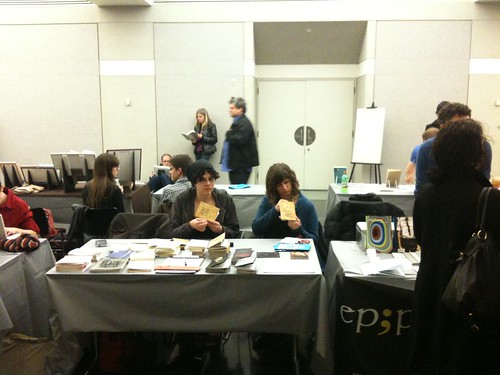
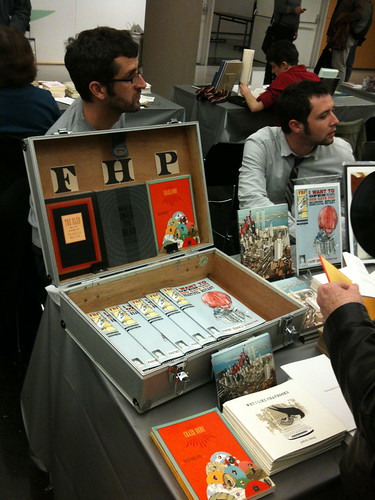
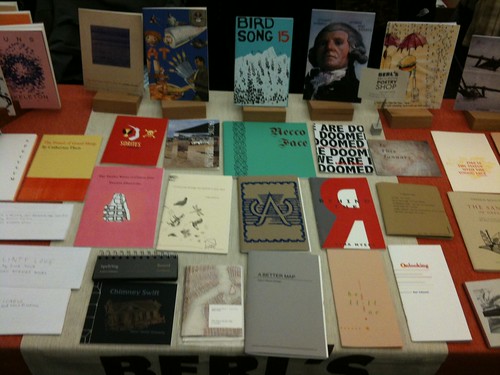
Books! I can never resist them, and chapbooks are a special treat, so after several Friday morning appointments, I headed down to the CUNY Graduate Center to check out the Chapbook Festival, which was sponsored by the City University of New York, CUNY's Center for the Humanities, the Center for the Book Arts, the Poetry Society of America, and Poets House, great organizations all.  The three-day festival (March 28-30) comprised a book fair in the Grad Center's Concourse atrium, readings (with free lunch and coffee), talks, and workshops on how to create chapbooks. There were publishers assembling right there at the book fair, and so many little presses I had to restrain myself from exceeding the very modest budget I'd set.

But I did pick up a neat, bound set of chapbooks, the first of the Lost and Found Series, edited and published by people at CUNY's Center for the Humanities. Each series features various key documents from American literary history produced by original research, in beautifully printed editions. Series I contains:

  • Amiri Baraka & Ed Dorn: Selections from the Collected Letters, 1959-1960, ed. Claudia Moreno Pisano
  • Darwin & The Writers: Muriel Rukeyser, ed. Stefania Helm
  • Philip Whalen's Journals: Selections: 1957-1977 (Parts I and II), ed. Brian Unger
  • The 1963 Vancouver Poetry Conference / Robert Creeley's Contexts of Poetry, with selections from Daphne Marlatt's Journal, ed. Ammiel Alcalay
  • The Correspondences of Kenneth Koch & Frank O'Hara (Parts I & II), ed. Josh Schneiderman

At the table, the first document from Series III, Lorine Neidecker's Homemade Poems, was on sale, with the rest of the volumes to appear soon, so I said I'd wait for it and buy Series II soon. I got to see a number of poet friends, including Tonya Foster, Brian Teare, and Cara Benson, and to meet a number of new folks as well. I arrived between the readings, so I didn't check those out, but saw on Twitter that they went well.

I also had a verklempt moment, when I saw a chapbook by Christy Call (with her brother Ryan Call) for sale, Pocket Finger (Baltimore: Publishing Genius, 2008). I taught Christy as an undergraduate (she took her introductory fiction course with me) and then, years later, when she was finishing up, I served as her thesis advisor for her creative nonfiction thesis. (She's the only student so far I've been lucky enough to teach at the undergraduate and graduate levels.) In this book, she shows her versatility by providing the drawings.  I remember Christy saying the book was forthcoming, but it was so good to see it on display and for sale. I am definitely look forward to next year's event, which I hope to catch a lot more of!

Here are some photos from the event:
Chapbook Festival 2012 @ CUNY Grad Ctr
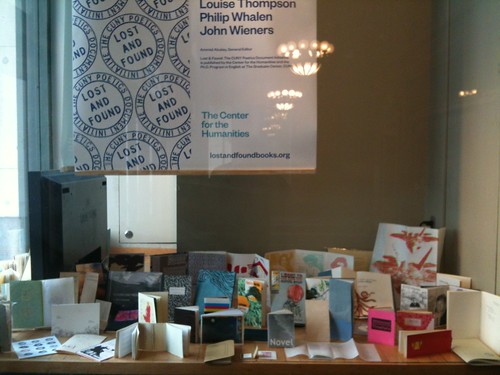
The window display at the CUNY Grad Center

Chapbook Festival 2012 @ CUNY Grad Ctr
The display in the Grad Center alcove

Chapbook Festival 2012 @ CUNY Grad Ctr
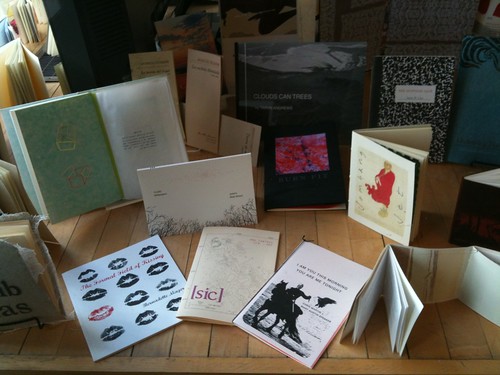
Some of the chapbooks

Chapbook Festival 2012 @ CUNY Grad Ctr
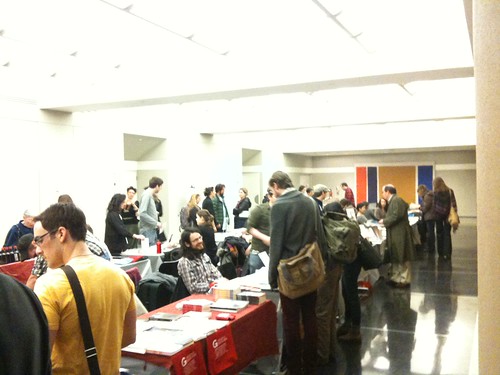
The chapbookfair

Chapbook Festival 2012 @ CUNY Grad Ctr
Some of the vendors, sewing and assembling chapbooks

Table display at Chapbook Festival 2012 @ CUNY Grad Ctr
Books for sale: Christy Call was my undergrad and grad student!

Chapbook Festival 2012 @ CUNY Grad Ctr
More books

Chapbook Festival 2012 @ CUNY Grad Ctr
The fair

Chapbook Festival 2012 @ CUNY Grad Ctr
A particularly fine display

The window display @ CUNY for the Chapbook Festival 2012
Another excellent display

Wednesday, March 28, 2012

Exciting Literary Events in NYC

As always, lots of exciting literary events happening in New York City over the next few days.

They include:

Institute of African American Affairs at NYU presents Critical Voices: Women Writing the World
March 28, 2012 (TONIGHT!)
Honorée Fanonne Jeffers, Martha Southgate, ZZ Packer
moderated by Rich Blint, Ph.D. candidate, NYU, American Studies
Time: 6:30 pm
Location: Institute of African American Affairs, NYU 41 East 11th Street, 7th Floor New York, NY 10003
Free & Open to the Public Limited Space
Please RSVP to (212) 998-IAAA (4222)

March 28-30, 2012
In addition to a book fair, it includes workshops, classes, panels, and readings


The poster:


The 11th National Black Writers' Conference, at Medgar Evers College, CUNY
March 29-April 1, 2012
Honorees: Ishmael Reed, Ngugi wa Thiong'o, Nikki Giovanni, Howard Dodson
The theme: The Impact of Migration, Popular Culture, and the Natural Environment on the Literature of Black Writers


PAINTING AWAY REGRETS: a book launch and benefit, featuring Opal Palmer Adisa & friends
Thursday, March 29th, 2012, 7 pm
Cave Canem, 20 Jay Street, Suite 310-A Brooklyn, NY 11201

Celebrate the launch of Cave Canem fellow Opal Palmer Adisa's latest collection, Painting Away Regrets (Peepal Tree Press), in a rare New York appearance. Alice Walker has described her work as “solid, visceral, important stories written with integrity and love.” Joining her will be Cave Canem fellows R. Erica Doyle and Darrel Alejandro Holnes and special guest, Jacqueline Bishop.  Book signing & reception to follow.

$5-10 suggested donation. Wheelchair accessible.
Hosted by LaTasha N. Nevada Diggs and Metta Sáma


Tuesday, March 27, 2012

Embodiment Exhibition @ CUNY Graduate Center

I haven't seen Corporealities: An Exhibition of Art on Embodiment, at the City University of New York Graduate Center, which went up in February of this year (and may no longer be up; I need to check!), but an artist I worked with over a decade ago, Adrienne Klein, whose artworks explore and synthesize the multiple locations where art and science meet, did have a piece in it, and you can see a snippet of her and other artists in the show talking about their work.

According to the YouTube description, the exhibition was held in conjunction with a seminar, likely still underway, on embodiment, and was sponsored and hosted by the Mellon Foundation Interdisciplinary Committee on Science Studies. The exhibition featured artists whose work deals with "body parts, body modification, beauty, disease, sexuality, and biological processes," which is to say, "corporealities." I hope there's a fuller writeup and more images online soon.

Saturday, September 26, 2009

Adfempo Conference @ CUNY Grad Center + Dangerous Mathematicians Show

What an exciting, energizing two days the Advancing Feminist Poetics and Activism: A Gathering conference was. I must offer my heartiest thanks to Belladonna, the independent bookstore/publisher/collectives, who conceived, organized and executed the event, along with the CUNY Graduate Center’s Center for the Humanities, Center for the Study of Women and Society, PhD Program in English, and Poetics Group. There was such palpable intellectual and creative energy at the event, which explored and emphasized the necessity and possibilities of feminist poetics and activism today. I didn't attend a single uninteresting panel or reading during the event. It was also wonderful to see so many creative people--brilliant, visionary, socially and politically activist women in the poetry world!--I know and admire as well as those I've never met or seen but only read over the years. My only complaint arises from the concurrent scheduling situation; because of the multiple simultaneous panels, it was not possible to audit most of the intriguing discussions, and if you jumped from room to room (there were 4 panels per time slot for most of Friday) you very well might miss the people you were hoping to see. I do understand, however, the economic and logical necessities of fitting the event into two short days, so I'm looking forward to the videos of the panels, when those go online.

I also want to thank poet-scholar-activist Tonya Foster, a member of Belladonna's Collective Committee and the organizer of the panel I was on, which, as the Opening Plenary I panel, inaugurated the event on Thursday afternoon. Our panel had grown out of discussions we'd been having over a series of months, and focused on orality and literacy in relation to African American and Diasporic literature, but also had come to encompass discussions of "the commons," and in particular, the "feminist commons." Other panelists included Meta DuEwa Jones, who spoke about Erica Hunt and Tracie Morris; Evie Shockley, who talked about Sonia Sanchez's Do These Houses Have Lions?; and Julie Patton, who showed slides and discussed her creative, activist work with young people in Cleveland, as well as her mother's artwork. We ended up running short of time, and I went last, so my talk, discussing Kamau Brathwaite's, Jay Wright's and Marilene Felinto's strategies for utilizing orality and feminist-inflected oral and written discourses (historical, mythic, etc.) to subvert conceptions of aesthetic mastery, was smushed into pithiness, but I do feel like I did succeed in getting my points across. And I got to read a translated (though not by me) snippet of Felinto's work, so that was fun too.

Our panel was packed, as were most of the ones I attended, despite their concurrency; at the 12:45pm discussion on the "Body and Discourse," chaired by Kate Eichhorn and featuring Joan Retallack, Trish Salah, Laura Smith, Nathalie Stephens/Nathanaël, and Ronaldo V. Wilson, there wasn't even standing room for most of those present. This panel, like the others I attended, delved into the questions that people had been posing and hashing since our opening presentations, and involved some contention and argumentation, rather than an amen chorus, which was refreshing.

Two of my favorite moments at the conference were the Thursday night keynote talks-performances, and a reading, introduced by scholar-poet Kate Hinton, that Mei-Mei Berssenbruegge and Ann Lauterbach gave on Friday. At the former, Kathleen Fraser talked about her trajectory from newly-minted English major just arriving in a very male-dominated New York poetry world in the early 1960s to her move to California, her years of young motherhood, and her connections with some of the figures who would become so important for developments in feminist poetics and practice/praxis. Amidst this she wove in some unforgettable anecdotes, such as that Barbara Guest was the only female poet whose work she came into contact with in those earliest years, outside of the "modernist women," that Charles Olson was huge, dominating figure and not the sort of person for women to be alone with, and that George Oppen was a serious, but encouraging poet. Fraser concluded her comments by reading a moving pamphlet-long poem, whose title I wrote down as "hi dde violent i dde violet," that she had written for fellow poet Norma Cole. Erica Hunt, a writer and thinker I admire tremendously, followed and in a way only she could do, she managed to weave in a demonstration of her mother blind-folded and boxing to discuss the feminist projects feminist poets had engaged in and needed to continue to pursue, especially in light of the economic, social and political situation we all now find ourselves in, and which has been unfolding since Erica and the other writers in the auditorium began their work. She was sharp, witty, oppositional, elliptical, concise, and offered up a series of grace quotes. "We write what just might escape commodification" is but one of them.

The third speaker, Eileen Myles, gave a talk called "Yoga for Losers" which succeeded not only in reminding everyone that the "academy was a patron" and a fraught place and space for the poet's work, but also called out the Language poets, asking where was the great language poem on AIDS, and wondered whether the model of "schools" of poetry was less apt that "stores," decried the pervasiveness of pornography for girls' and boys' imaginaries, invoked some contemporary women writers doing what she thought was outstanding activist work, and even expressed her exhausting with the term "feminism," ultimately urging that the hard work continue, in a range of new forms. As more and more poets (and writers in general!) appear to view the academy as the route, as opposed to one of many, or even just a byway, to pursuing an avocation as poet, Myles's critiques assume even greater importance.

The Berssenbruegge-Lauterbach reading was also a highlight. I have seen both read a number of times; Berssenbruegge was one of the first of the younger generation "experimental" American poets (not counting some fellow students) I heard read and met in college, and she came to the university a few years ago as part of the Asian American Studies program's 10-year anniversary celebration. I had an account of Lauterbach and John Ashbery reading from the latter's long, double-columned "A Litany" at the Bowery Poetry Club a few years ago. This was the first time I'd seen them read together, and with the focus being on their art-inflected poems, they complemented each other perfectly. Berssenbruegge read from her collected volume I Love Artists (Univ. of California Press, 2008), which really should have received one of the major poetry awards, as well as from some new poems. Her quiet manner and soft voice require the listener's concentration, which the poems thoroughly reward. She also read lines and fragments from others, something poets never really do, in order to convey the spirit of the reading. Some of the fragments of lines I wrote down from the various poems were: "there are three dimensions of gray"..."your waking is a blue brushstroke creating a space"..."this color of being sentient, like seeing Venus in the day"..."where openness is form"..."but I am my contact with green"..."forest is the originary fullness of this presence"..."you turn back my words to stay in that region."

Lauterbach, whose work I believe always benefits from being read aloud, especially by her, traced her poetic development in relation to visual art, which has served as a formal rather than a visual source. She noted the centrality of the visual to most poetry, and her own attraction to resistance against or inquisition of the visual. She also read poems marking her stages of confronting the visual, including the first she'd written, some time ago, in which there was no visual description whatsoever. One of the poems she read, "The French Girl" (from Clamor?) struck like a lightning bolt this time. She finished with the poem "The Scale of Restless Things (Fra Angelica)," written after going to see that exhibit at the Met with a former student, Garrett Kalleberg, and it was a fitting conclusion to a great reading. Afterwards she and Berssenbruegge, along with Hinton, took questions, and Lauterbach provided one of the most succinct and thoughtful responses possible to the question of how to appreciate a poem, particular poems like hers, explaining how a poem is an experience that we ought enter like any other experiences we've never had, and how it negotiates the parallel subjectivities of the reader's I and the lyric/narrative voice's (I/we/multiples). That space of negotiation ought be fruitful and pleasurable, rather than merely a puzzle to be interpreted and solved.
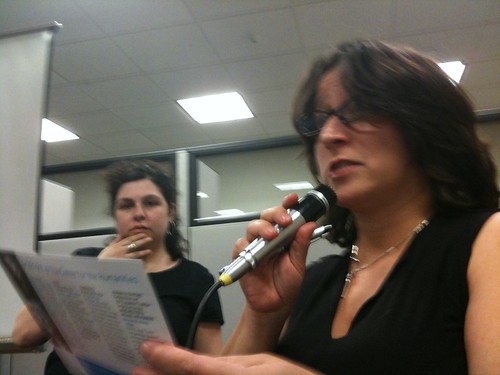
Erica Kaufman and Rachel Levitsky, Adfempo co-organizers
Erica Kaufman and Rachel Levitsky
My panel, post-presentations
L-r: Evie Shockley (back turned), Julie Patton, and Tonya Foster
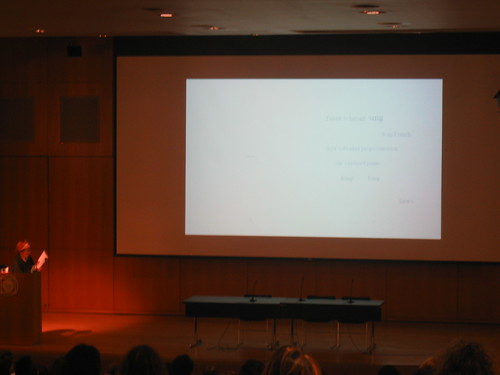
Kathleen Fraser, reading her poem
Kathleen Fraser, reading her poem to Norma Cole
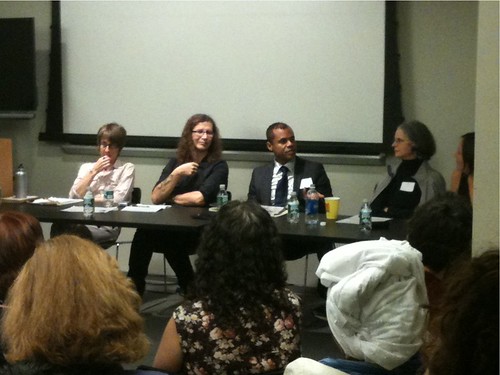
Body as Discourse panel, Adfempo
Ronaldo V. Wilson (in tie), speaking to the panel (l-r): Nathaniel, Trish Salah, Joan Retallack, and Laura Smith (who spoke about Akilah Oliver)

***

After I left my dinner companions on Friday, I took up a friend's invitation to check out a fashion show/performance party, Dangerous Equations 101, at a small shop, Dangerous Mathematicians, on the Lower East Side. Unlike this events at Bryant Park a week ago, this was a low-key, non-industry affair; the shop's owner creates and sells innovative, sexy clothing for women with a geek chic edge. The "models" turned out to be practicing engineers, scientists and mathematicians and the clothing had a S&M-ish edge, which I doubt would probably go over better during the weekend or at clubs than at most workplaces. It appeared to be well-made, and really, the funnest aspect was just listening to the musicians and seeing another slice of New York I seldom see.
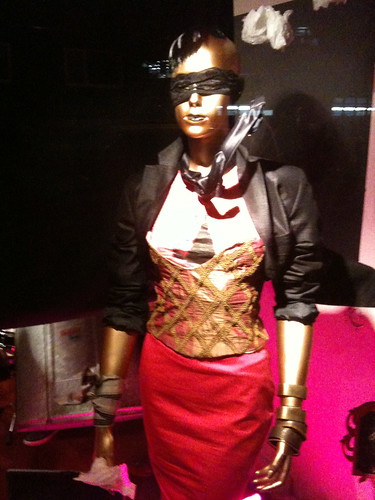
Dangerous Mathematicians store window