Showing posts with label Bruno Carvalho. Show all posts

Monday, June 04, 2018

*Essays On Hilda Hilst* Now Available


Thanks to the dedication of editors Adam Morris and Bruno Carvalho, Essays on Hilda Hilst: Between Brazil and World Literature, the first English-language scholarly volume dedicated to the work of one of Brazil's most singular and path-blazing authors, is now available for purchase. Published by Springer this month, the book opens with an insightful introduction about Hilst (1930-2004) and her relation to the category of "World Literature," by Morris, a gifted translator and scholar who produced an exceptional rendering of Hilst's 1986 novella Com os meus olhos de cão (With My Dog Eyes, Melville House, 2014), as well as works by Jõao Gilberto Noll, Beatriz Bracher, and other major contemporary Portuguese-language writers, and Carvalho, a Princeton professor of Spanish and Portuguese, whose scholarly interests span an array of topics and whose study Porous City: A Cultural History of Rio de Janeiro (2013), received the Brazilian Studies Association Robert Reis Book Award in 2014. Other essays in the volume explore different aspects of the late author's oeuvre, ranging from her plays (Tatiana Franca Rodrigues Zanirato), fiction (David William Foster), poetry (Alva Martinez Teixeiro), and broader theoretical, political and ideological readings (Deneval Siqueira Azevedo Filho, Eliane Robert Morães, Morris, and Nathanaël).

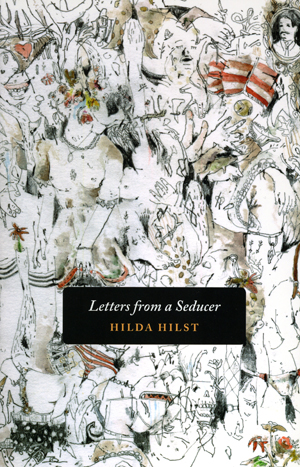
For my part, I contributed a revision of a talk I delivered in at the New York Public Library back in 2014, "Translating Brazil's Marquis de Sade," which explores the complexities of Hilst's Cartas de um Sedutor (Letters from a Seducer), for which Carvalho wrote the introduction, and the challenges I--and anyone--might face bringing it and her work in general into English. (In "Derelict of Duty, "Nathanaël also discusses some challenges faced co-translating Hilst's A obscena Madame D (The Obscene Madame D, Nightboat and A Bolha Editora, 2013). It is especially exciting to see this essay in print and in this volume, which I hope will serve as an enticing overview and introduction that I hope sparks more studies in English about Hilst, and spurs more translations of Hilst's work. I believe a translation of Hilst's Fluxo-Floema is on its way soon, and this year, Hilst's Of DeathMinimal Odes, translated by Laura Cesarco Eglin, will be published by co•im•press.

Please consider getting a copy of this volume, or at least suggesting your nearest library do so. And please, read Hilda Hilst!

Wednesday, September 26, 2012

Catching Up

Catching up here on the blog always feels possible at first thought, but by the time I sit down to begin a post, I realize I have something else to do and the blog goes wanting. I do lament it. Blogging has often been a pleasure and served as a respite for me, but perhaps my new daily and nightly rhythms--and Apple TV, which allows me to stream YouTube music videos and Netflix films from our TV--have so disrupted my previous mindset that it has just become more or too difficult to do. We will see.

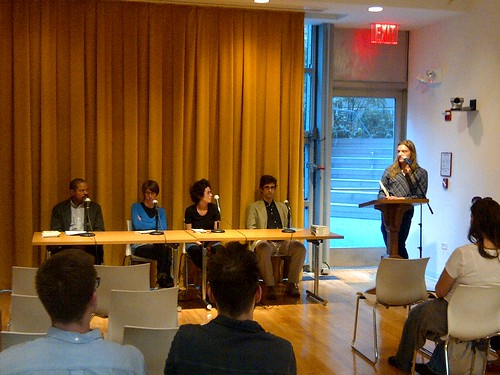
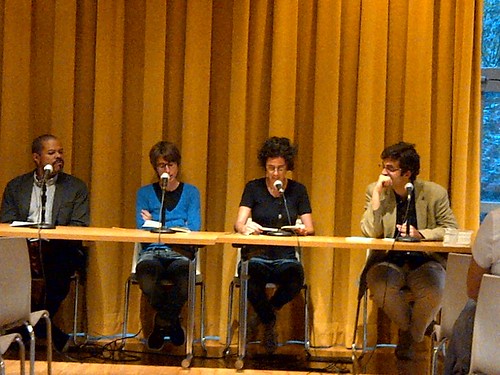
Until that moment comes, here are a few photos from recent events. The first two are of the panel discussion, at Poets House, for the Hilda Hilst book launch, and by Reggie H. (Thank you!) It was a fun panel, the book is now out and looks delectable, and Hilst now resides, at least in the form of one book, The Obscene Madame D (with more to come), in a superb English collaborative translation by Nathanaël and Rachel Gontijo Araújo, a first.

Hilda Hilst book panel
Me; poet and critic Nathanäel and A Bolha Editora publisher and poet Rachel Gontijo Araújo, who collaborated the translation; Princeton professor Bruno Carvalho; and Stephen Motika, poet and publisher of Nightboat Books
Hilda Hilst book panel
Me, Nathanäel, Rachel Gontijo Araújo, reading, and Bruno Carvalho
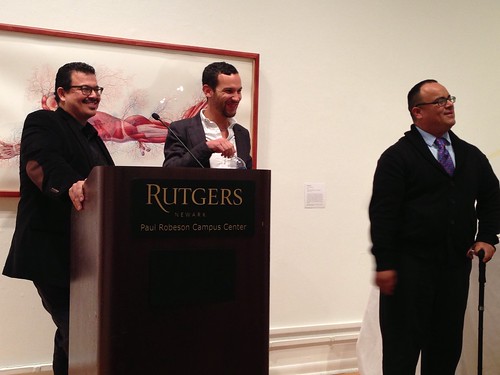
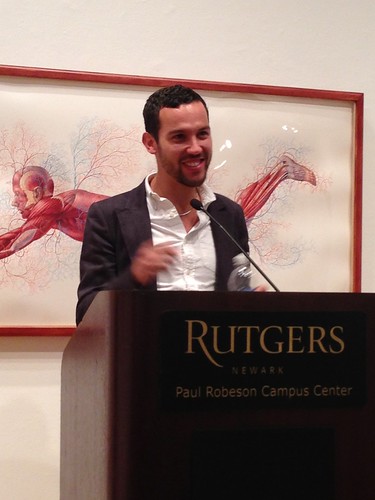
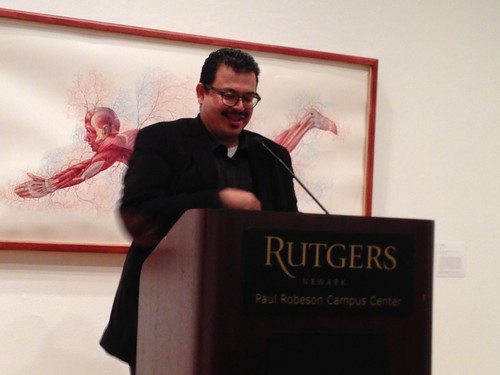
On Tuesday I attended my first MFA Program reading at Rutgers-Newark, and the featured readers were two of today's most acclaimed younger writers, poet Eduardo C. Corral, who was selected by Carl Phillips to receive this year's Yale Series of Younger Poets Prize for his collection Slow Lightning, becoming the first Latino poet to be so honored, and fiction writer Justin Torres, whose stories have been blowing up The New Yorker, and whose first novel, We the Animals, has summoned the highest praise for all quarters. Both read as if they had been doing so, with panache, all their lives. My colleague, the acclaimed poet, nonfiction writer and anthologist Rigoberto González, introduced both writers and moderated a lively Q& A session full of undergraduate and graduate writing students. Both had a good store of bon mots to share, and it was an honor to meet both of them in person.

Eduardo Corral, Justin Torres, Rigoberto Gonzalez
Eduardo C. Corral, Justin Torres, Rigoberto González
Justin Torres
Justin Torres
Eduardo C. Corral
Eduardo C. Corral