Wednesday, November 08, 2006

Celebration Day

Give yourselves a hand or three. A hearty hug. An extra flute of champagne. A big tip. A week at the beach. Because you did it. You did it, you did the do!


(NY Times/Chip Somedevilla/Getty Images)

You went out and voted and helped to clean house. You ensured that at least 29 Democrats replaced Republicans to flip the House of Representatives, and your votes shifted six seats from several of the Senate's most notorious right-wing racists and homophobes to Democrats, so that they now control the Congress's upper house as well. You also ensured that Democratic candidates, some of them true progressives, now control the majority of governorships, and dominate in statehouse legislatures.

You did this, American people, despite the government and media disinformation and misinformation bombardment, the months and weeks and days of harassment and intimidation, the balloting chicanery, the disparity in financial support from big business and the megarich, and even the wrongheadedness of members of the Democratic Party itself, the Republite DLC wing and some of the party's powerbrokers.

You have placed in office progressive legislators like new Senators Sheldon Whitehouse, Bernie Sanders, Amy Klobuchar, Sherrod Brown, and Jon Tester, and new Congresspeople Patrick Murphy, Joe Sestak, Jim Yarmuth, Jerry McNerney, Tim Walz, and many others.

You did this, and you've left the pundits, the prognosticators, and most of all the President and his party dazed and confused. His thuggish politics of fear, deception and demonization finally lost. Not even Diebold machines could rescue him. He stammered and stuttered today like someone who was punch drunk--as he probably was. He even sent one of his most inept and arrogant captains, Donald "Back Off" Rumsfeld, packing (only to replace him with a retread from his father's era, but that's another story).


(Doug Miller/New York Times)

Cutting away dead and rotting flesh is, as I learned years ago from Michael Harper, called "debridement." You wielded the laser, and the result is enough to give all of us some measure of hope.

***

Unfortunately, anti-gay marriage bans passed in 8 states, although in 5 the opposition exceeded 40%. That is a very good sign for the future. Arizona, however, rejected an anti-civil union bill. It's increasingly clear that as the new generation of voters, many of whom do not possess the homophobia and heterosexism of their elders, mature, they will continue to reject anti-gay measures, but for now, the Republicans will continue to use them, along with racist and class-based appeals, whether they work or not.

In Michigan, despite opposition even from the entire Democratic leadership and high-level Republicans like losing gubernatorial candidate and Amway founder Dick DeVos, voters passed an anti-affirmative action ban by a margin of about 58%-42%. The deeply deceitful proposal, spearheaded by racial basketcase Ward Connnerly, mirrors ones in California and Washington State. It's a terrible stain on an otherwise very good day, but I think that down the road it may be possible to overturn it as well. The immediate effects for the University of Michigan, however, may be as dire as they were in other places such bans came into effect.

In South Dakota, voters rejected the extreme anti-abortion bill that the legislature passed and governor signed. Female voters' ballots were decisive. I doubt this will stop some states like Mississippi that have been fiending to pass anti-abortion laws, but with a Democratic Senate Judiciary committee controlled by Vermont's Pat Leahy, there's no way that another Alito or Roberts will skate onto any of the nation's courts. No. Way. It's been interesting to see ultraconservatives lament this loss of power; Pat Buchanan was just the latest to bemoan it tonight on Scarborough Country. Oh well....

***

What we began to challenge head on yesterday 2005 Nobel Laureate in Literature Harold Pinter described in his award lecture last year:

Political language, as used by politicians, does not venture into any of this territory [ambiguity] since the majority of politicians, on the evidence available to us, are interested not in truth but in power and in the maintenance of that power. To maintain that power it is essential that people remain in ignorance, that they live in ignorance of the truth, even the truth of their own lives. What surrounds us therefore is a vast tapestry of lies, upon which we feed.

Having torn down at least part of the tapestry, let's make sure that we feed no longer.

***

And speaking of Pinter's speech, one of its points of incandescence is his discussion of the US's involvement in Nicaragua under Ronald Reagan, which came to be known, as a result of the Congressional investigations and special prosecution, as the Iran-Contra Affair. Here is Pinter, in clarifying prose, on that whole sordid, horrid, criminal escapade:

The tragedy of Nicaragua was a highly significant case. I choose to offer it here as a potent example of America's view of its role in the world, both then and now.

I was present at a meeting at the US embassy in London in the late 1980s.

The United States Congress was about to decide whether to give more money to the Contras in their campaign against the state of Nicaragua. I was a member of a delegation speaking on behalf of Nicaragua but the most important member of this delegation was a Father John Metcalf. The leader of the US body was Raymond Seitz (then number two to the ambassador, later ambassador himself). Father Metcalf said: 'Sir, I am in charge of a parish in the north of Nicaragua. My parishioners built a school, a health centre, a cultural centre. We have lived in peace. A few months ago a Contra force attacked the parish. They destroyed everything: the school, the health centre, the cultural centre. They raped nurses and teachers, slaughtered doctors, in the most brutal manner. They behaved like savages. Please demand that the US government withdraw its support from this shocking terrorist activity.'

Raymond Seitz had a very good reputation as a rational, responsible and highly sophisticated man. He was greatly respected in diplomatic circles. He listened, paused and then spoke with some gravity. 'Father,' he said, 'let me tell you something. In war, innocent people always suffer.' There was a frozen silence. We stared at him. He did not flinch.

Innocent people, indeed, always suffer.

Finally somebody said: 'But in this case "innocent people" were the victims of a gruesome atrocity subsidised by your government, one among many. If Congress allows the Contras more money further atrocities of this kind will take place. Is this not the case? Is your government not therefore guilty of supporting acts of murder and destruction upon the citizens of a sovereign state?'

Seitz was imperturbable. 'I don't agree that the facts as presented support your assertions,' he said.

As we were leaving the Embassy a US aide told me that he enjoyed my plays. I did not reply.

I should remind you that at the time President Reagan made the following statement: 'The Contras are the moral equivalent of our Founding Fathers.'

The United States supported the brutal Somoza dictatorship in Nicaragua for over 40 years. The Nicaraguan people, led by the Sandinistas, overthrew this regime in 1979, a breathtaking popular revolution.

The Sandinistas weren't perfect. They possessed their fair share of arrogance and their political philosophy contained a number of contradictory elements. But they were intelligent, rational and civilised. They set out to establish a stable, decent, pluralistic society. The death penalty was abolished. Hundreds of thousands of poverty-stricken peasants were brought back from the dead. Over 100,000 families were given title to land. Two thousand schools were built. A quite remarkable literacy campaign reduced illiteracy in the country to less than one seventh. Free education was established and a free health service. Infant mortality was reduced by a third. Polio was eradicated.

The United States denounced these achievements as Marxist/Leninist subversion. In the view of the US government, a dangerous example was being set. If Nicaragua was allowed to establish basic norms of social and economic justice, if it was allowed to raise the standards of health care and education and achieve social unity and national self respect, neighbouring countries would ask the same questions and do the same things. There was of course at the time fierce resistance to the status quo in El Salvador.

I spoke earlier about 'a tapestry of lies' which surrounds us. President Reagan commonly described Nicaragua as a 'totalitarian dungeon'. This was taken generally by the media, and certainly by the British government, as accurate and fair comment. But there was in fact no record of death squads under the Sandinista government. There was no record of torture. There was no record of systematic or official military brutality. No priests were ever murdered in Nicaragua. There were in fact three priests in the government, two Jesuits and a Maryknoll missionary. The totalitarian dungeons were actually next door, in El Salvador and Guatemala. The United States had brought down the democratically elected government of Guatemala in 1954 and it is estimated that over 200,000 people had been victims of successive military dictatorships.

Six of the most distinguished Jesuits in the world were viciously murdered at the Central American University in San Salvador in 1989 by a battalion of the Alcatl regiment trained at Fort Benning, Georgia, USA. That extremely brave man Archbishop Romero was assassinated while saying mass. It is estimated that 75,000 people died. Why were they killed? They were killed because they believed a better life was possible and should be achieved. That belief immediately qualified them as communists. They died because they dared to question the status quo, the endless plateau of poverty, disease, degradation and oppression, which had been their birthright.

The United States finally brought down the Sandinista government. It took some years and considerable resistance but relentless economic persecution and 30,000 dead finally undermined the spirit of the Nicaraguan people. They were exhausted and poverty stricken once again. The casinos moved back into the country. Free health and free education were over. Big business returned with a vengeance. 'Democracy' had prevailed.


But democracy has truly prevailed. Daniel Ortega, the candidate of the Sandinista National Liberation Front (FSLN), was elected on Sunday as Nicaragua's new president. Despite the ministrations of the Bush administration, despite convicted felon Oliver North's campaigning with former Contra leaders, despite facing a wealthy, conservative opponent, Ortega prevailed, with strong support from the country's working-class and poor populace. He has promised to work with Washington, as well as Latin America's main leftist leaders, but openly rejected the US Republicans who'd been condemning his possible win. He will face a possible conservative plurality in Nicaragua's Congress, though his own party has retained nearly as many seats, and a coalition is possible.

Tuesday, November 07, 2006

Election Day

Election Day
Now, in many districts around the country, there have been few problems reported. I hope you've already voted or are planning to do so. Turnout supposedly is exceeding expectations in Connecticut and Virginia. At the same time, however, things are going badly in a number of precincts. California, Ohio, Pennsylvania, and Indiana are registering some of the highest complaints about voting problems. According to the Raw Story, Talking Points Memo, Daily Kos, Huffingtonpost.com, and AmericaBlog, here are some of the problems being identified so far:

And these are only some of the problems that have been noted so far.

From the Election Protection site - Voting Report (as of 3:00 pm CST)
Legend: Red=250> reported problems or incidents
Blue= 51-250 reports
Green=10-50 reports
Yellow=1-10 reports

Let's also keep in mind that these problems are occurring in a country whose federal officials have had the gall to criticize the voting in Venezuela, in Nicaragua, in Haiti, and elsewhere. Don't forget this map the next time you hear one of them utter the word "democracy."

BTW, horrible old hanky head, self-hating ______ Ward Connerly has accepted Ku Klux Klan support for his anti-affirmative action ballot measure in Michigan. Yep, that's right. He's got the KKK on his side, and, yes, he's glad about it. To quote from Dave Neiwert's site:

Ward Connerly, the California man leading a ballot measure to end most affirmative action in Michigan, accepts Ku Klux Klan support for his position in a video clip posted this week on the Internet.

Connerly on Friday defended his remark in a statement, saying he accepts support for banning affirmative action wherever he finds it.

He said he does not support hateful activities.

His precise words, defending the Klan support:

"If the Ku Klux Klan thinks that equality is right, God bless them. Thank them for finally reaching the point where logic and reason are being applied instead of hate."

The last polls, in California, Oregon and Washington State, close at 11 pm EST tonight. Let's stay tuned!

UPDATES:

The Democrats have retaken the US House of Representatives by ousting Republicans across the country, from New England to Ohio to the Golden State. Democratic challengers, ranging from the very conservative to very liberal and progressive, defeated a number of scandal-plagued or moderate Republicans, and appear to have gained between 20-30 seats. They only needed 15 to regain control. (Also fascinating, not one Democratic Congressperson has lost so far.) Come January, Nancy Pelosi (D-CA), who has been repeatedly and regular demonized by Republicans and their mainstream media puppets, will the first female Speaker of the House in US history! Among other Democratic victors are the first Muslim to hold office in US history, an African American from Minnesota; a Democratic mathematician in California; and a former alternative news weekly founder and publisher in Tennessee.

The Democrats are on the cusp of retaking the US Senate. Democratic challengers have ousted Republican incumbents in Pennsylvania, Rhode Island, Ohio, and Missouri (!!!), and are leading in Virginia (by about 12,000 votes) and Montana (by about 9,000 votes). Harold Ford Jr., the right-wing Democrat, lost to Republican Bob Corker. Had he won, he would have been the first Black Democrat ever and the first Black person since Reconstruction from a former Confederate State. Corker and the Republicans resorted to the usual tactic of race-baiting, and unfortunately it appeared to work. If the Democrats retain Virginia and Montana, they will hold the Senate outright, 51-48, with two members of their caucus being independents Bernie Sanders of Vermont, and Bush-loving Joe Lieberman of Connecticut. If the Democrats can hold on, this will be a dramatic turn of events, as a completely Democratic Congress, as opposed to just a Democratic House, will force the recalcitrant president to either change his policies or wield his veto pen; in either case, as the subpoenas start arriving at the White House, he'll have to listen and respond.

Democrats have also won a majority of the state governorships, which will be crucial in redistricting battles down the road. Deval Patrick is now the first African-American governor in Massachusetts history, and the second ever in the US. Democrats also have won governorships back from Republicans in New York (where Eliot Spitzer made history by winning a stunning 70% of the vote), Ohio, Maryland, Colorado, and Arkansas. Some of these Democratic winners, such as Spitzer, Patrick, and Strickland of Ohio, are much more progressive than their predecessors, so it'll be fascinating to see if what sorts of reforms are implemented.

Monday, November 06, 2006

Mabanckou Wins Book Prize + Upcoming Events + VOTE

Alain Mabanckou Wins Prix Renaudot
MabanckouThe Congolese writer Alain Mabanckou has just received yet another of France's top literary prizes, the 2006 Prix Renaudot, for his novel Mémoires de porc-épic (Porcupine's Memoirs, Edition du Seuil). Mabanckou was born in 1966 and grew up in Pointe Noire, Congo Brazzaville, and later studied law in Paris. He's the author of six novels and five books of poems and currently is a visiting assistant professor of Francophone and comparative literature at the University of California-Los Angeles. He previously taught at the University of Michigan and will hold a humanities fellowship next year at Princeton. I haven't read this book (I've been meaning to check his African Psycho (which is set to appear in English translation in early 2007) out of the library), but according to the reviews, this newest work is an antic tale that draws upon a particular legend stating that every human has a correlate elsewhere in the animal kingdom. For the protagonist, Kibandi, his animal counterpart is a strangely powerful, murderous porcupine. The rollicking tale draws upon traditions of African storytelling while also further confirming Mabanckou's gifts as a writer and novelist. His widely praised previous novel, Verre Cassé (Broken Glass, Editions du Seuil, 2005), a marvelous written, highly ironic narrative of a bizarre Congolese bar, Crédite a voyagé, received a raft of prizes, including the Prix des Cinq continents de la Francophonie, the Prix Ouest-France/Etonnants Voyageurs and the Prix RFO du livre.

Upcoming Events
Lots of great info comes over the bandwidth, so here are few for this upcoming week, in New York, Chicago and Los Angeles:

ADODI CHICAGO SPONSORS LGBT FILMS AT CHICAGO LGBT FILM FESTIVAL
Chicago
November 8
On Wednesday November 8, 2006 Adodi Chicago will sponsor a showing of short films by LBGT people of color themed "Passionate Resistance".
Location: Film Row Cinema (at Columbia College)
1104 South Wabash Ave
Start Time: 6:30pm
For more information please visit the film festival
website at www.reelingfilmfestival.org.

MENDI + KEITH @ CAL STATE LOS ANGELES
Los Angeles
November 9
Nobadikes

FESTIVAL OF CONTEMPORARY JAPANESE WOMEN POETS @ POETS HOUSE
New York City
November 15 to November 17, 2006
Festival of Contemporary Japanese Women Poets

Five poets at the forefront of Japanese poetry (Ryoko Sekiguchi, Takako Arai, Kiriu
Minashita, Kyong-Mi Park, and Sawako Nakayasu) join American poets Cole Swensen
and Rosa Alcalá for a though-provoking array of readings and talks.

Wednesday, November 15, 7:00PM @ Poets House, 72 Spring Street
Cross Currents and Innovation in Japanese Poetry Today
a panel discussion with Takako Arai, Kiriu Minashita, Sawako Nakayasu, Kyong-Mi Park, & Ryoko Sekiguchi

Thursday, November 16, 7:00PM @ Bowery Poetry Club, 308 Bowery
Book Release Party for four from japan: contemporary poetry by women*
with readings by Takako Arai, Kiriu Minashita, Kyong-Mi Park, and Ryoko Sekiguchi

Friday, November 17, 7:00PM @ Poets House, 72 Spring Street
Blurring the Boundaries: A Conversation on the Art of Poetry and Translation
with Rosa Alcalá, Ryoko Sekiguchi, & Cole Swensen

For more information, visit www.poetshouse.org or www.protopage.com/belladonnaevents.

These events are cosponsored by Poets House, Belladonna*, Bowery Poetry Club, and Litmus Press.

SECOND SUN @ NAIVETE STUDIOS
Chicago
Brett Neiman
November 12, 2006
This email puts you officially on notice! This Sunday, November 12th will mark the next 2nd Sun Salon. October's Salon was wonderful, well attended and a great time. Naïveté Artist Co-Op's first artist-in- residence, Niz, presented in October. Visit her site: www.nizgraphics.com for photos of her work.

This month's presenter is the multi-talented BRETT NEIMAN. We are proud to host him and his work, so please come out to bear witness and dialogue with Mr. Neiman.

2nd Sun Salon @ Naïveté Artist Co-Op
4863 N. Ravenswood Ave
Chicago, IL
773-784-2989
Doors open at 3pm and close at 7pm
Presentation at 4:30pm
MYOPIC BOOKS REAdING SERIES
Chicago
Roberto Harrison & Duriel Harris
November 12, 7 pm
Myopic Books, 1564 N. Milwaukee Ave, Wicker Park, Chicago

MOVING ARCHIPELAGO: A CENTURY OF WRITING FILIPINO AMERICA
New York City
November 9-16

Thursday, Nov. 9
Featuring: Luis Cabalquinto, Leslieann Hobayan, Joseph O. Legaspi, Ricco V. Siasoco, Dionisio Velasco and R.A. Villanueva
Cornelia Street Cafe
29 Cornelia St., NYC
212-989-9319
$6 (includes 1 house drink)
*****
Moving Archipelago: A Century Of Writing Filipino America
at the historic Woolworth Building
Date: Friday and Saturday, November 10-11, 2006
Location: Reception and conference at New York University, SCPS Conference Center, 2nd Floor, Woolworth Building, 15 Barclay Street, New York, NY 10038

Readings and discussion by Luis H. Francia, Sabina Murray, Eugene Gloria, Bino A. Realuyo, Eileen Tabios, Brian Ascalon Roley, Nerissa S. Balce, Nick Carbo, Luisa A. Igloria, Lara Stapleton, Sarah Gambito, Rick Barot and others!

Join A/P/A Institute at New York University in collaboration with Kundiman and the Centennial Planning Committee, on Friday night for an evening of readings and celebration of 100 years of Filipino immigration to the U.S.

Kick-off Reception Friday, Nov. 10th, 7:00 PM - 9:00 PM
Panel Discussions Saturday, Nov. 11th, 10:00 AM - 5:00 PM, reception follows with readings

The kick-off reception on Friday and series of panels on Saturday will feature readings from some of the major Filipino writers across the U.S. and from New York City to exchange stories, discuss ideas, and explore the varied meanings of literary texts. Just as importantly, the distinguished gathering will celebrate what has preceded us and the rich but ambivalent promise of what lies ahead.

RSVP by Tuesday, November 7 for the reception and conference separately to apa.rsvp@nyu.edu or by phone 212-992-9653. For more information, visit www.apa.nyu.edu
Schedule of panels:
November 10th Readings & Reception: 7-9pm
Brian Ascalon Roley, Peter Bacho, Rick Barot, Nick Carbo, Fidelito Cortes, Luisa A. Igloria, Lara Stapleton & Luis H. Francia

November 11th Panels: 10:00am-5pm
10:00am, Panel 1: Where Have We Been?
Luis H. Francia, moderator; Nerissa S. Balce, Peter Bacho, Luisa A. Igloria, Lara Stapleton

11:30am, Panel 2: From Manong to Hip-Hop: Immigrant Stories
Bino A. Realuyo, moderator; Sarah Gambito, Leslieann Hobayan, Brian Ascalon Roley, and Oscar Penaranda

2:00pm, Panel 3: Rendering the Invisible Visible
Joseph O. Legaspi, moderator; Rick Barot, Eugene Gloria, Elda Rotor, and Eileen R. Tabios

3:30pm, Panel 4: Where Are We Going?
Allan Isaac, moderator; Nick Carbo, Andrew Hsiao, Sabina Murray, R.A.Villanueva

5:00pm, Reception and Closing Reading to follow panels until 7:30pm
Readings by: Eugene Gloria, Sabina Murray, Oscar Penaranda, Bino A. Realuyo, Ninotchka Rosca, Gina Apostol & Eileen Tabios

Co-sponsored by The Reginald F. Lewis Foundation, The Smithsonian Asian Pacific American Program, and NYU History Department.

Supported by the Asian American Writers' Workshop, Asia Society and NYU International Filipino Association.

Media Sponsorship by Asiance Magazine. Beer provided by Carlsberg. Food sponsors Cendrillon and Elvie's.
*****
Thursday, November 16th, 7pm
Featuring Gina Apostol, Sarah Gambito, Lisa Ascalon, Marlon Unas Esguerra & Tai Yo. Hosted by Luis H. Francia

Asian American Writers Workshop
16 West 32nd Street, 10th Floor
btwn Broadway & 5th Avenue
$5 suggested donation

VOTE VOTE VOTE
Despite the numerous attempts at voter suppression
the robo calls in nearly twenty states
the misleading and deceptive flyers the liars who claim
without breaking a smile that the election has moved
a day forward or better yet postponed
despite the avalanche of corrosive rhetoric
the racist ads ("call me") the subterranean codes
despite the easy hackability of the Accu Cards
the yellow buttons on the Sequoia machines
which if switched to manual would allow any voter
or political operative 1,000,000 votes
despite the legions of GOP lawyers
the challenges the demands to brandish picture IDs
despite the cynicism of knowing the elections could be
and probably would be stolen again with any less
vigilance than voting advocates are displaying these days
please vote do vote go vote you should vote
it's your government don't forget yes you own it
please vote please vote PLEASE VOTE

Sunday, November 05, 2006

Quilombo Country

Quilombo Country
Quilombo CountryLast week, as I was dropping a movie off at the university library's media center to be digitized for an online class screening, I glanced up at the wall of new and current DVDs on display, and saw one I hadn't noticed or heard of before: Quilombo Country. (You can see a trailer here.) I assumed from its box that it was either a feature or documentary about the settlements, or quilombos, across northeastern and other parts of Brazil that escaped slaves, or maroons, along with renegade Portuguese, Native Americans, and mixed race people, established beginning in the late 16th and early 17th centuries, the most famous being Palmares* (1600-1694), led by Ganga Zumbi and Zumbi, west of the city of Recife. (In Spanish-speaking countries, such settlements are also known as palenques.) That was enough to make me want to check it out, but what also intrigued me most was that rapper and activist Chuck D. of Public Enemy was its narrator.

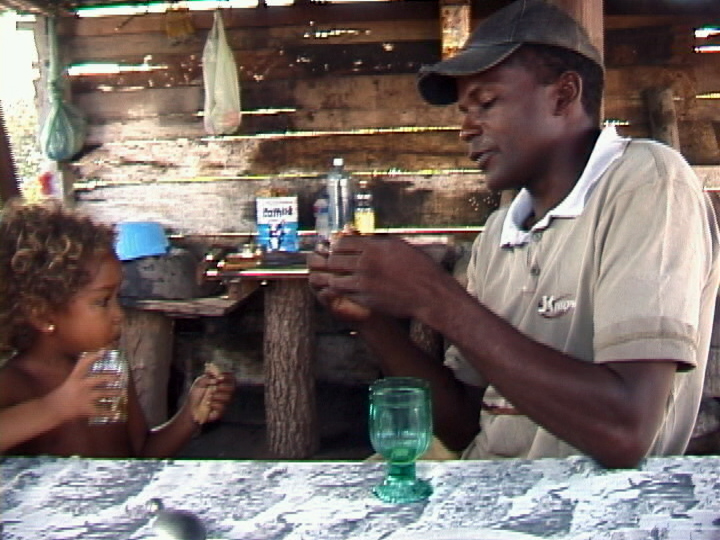
Leonard Abrams directs the engaging film, which focuses not on the widely known quilombos (from the Kimbundu [a language native to Angola] word kilombo) or macombos of northeastern Brazil (Bahia, Pernambuco, Alagoas, etc.), such as Palmares; Carlos Diegues's fine 1984 feature film Quilombo compellingly treated this particular history. Nor does it examine analogous settlements in the Southeast region (Rio, Minas Gerais, and São Paulo), which are the main venues for many of the best-known recent films set in Brazil (City of God, Madame Satã, Central Station, etc.). Instead, it looks at the ones that exist in the North Amazon region, in the states of Maranhão, and Pará, at whose capital, Belém [or Bethlehem], the mouth of the Amazon River meets the Caribbean Sea. Quilombo Country looks specifically at quilombos in Maranhão's Itapicuru-Mirim area, on giant Marajó Island at the mouth of the Amazon in Pará, and in the Trombetas region in the Amazon River basin. (The photo above, from the Quilombo Country website, shows a father and child eating manioc doughnuts in Trombetas.) As it explores each site, the film succeeds in showing how the communities have survived more than a century of economic, political, social and cultural struggle against an array of forces, beginning with the Dutch and Portuguese governments, and then with the Brazilian state and powerful regional landowners, and more recently with globalization and global capitalism with a Brazilian face. In some cases, the quilombos arose out of estates that were abandoned after the collapse of the sugar economy, in the late 18th century (this was one of the factors that led to the transfer of the national capital from Salvador da Bahia to Rio de Janeiro in 1764), yet eventually the land, though occupied and settled, became the target of land grabs for industrial or governmental uses, requiring the quilombolos (residents) to wage battle directly, sometimes by collective force, and in the courts, to retain theirs. In 1988, Brazil's post-dictatorship constitution granted ownership of the land to the residents, but the film shows how racism, indifference and structural social inequalities, in the form of incomplete schools, infrastructure projects that have bisected some of the quilombos, and industrial encroachment, continue to ensure that the quilombolos' lives aren't easy.

Although the ancestral history of the quilombolos is mixed, the African roots, at least in the setttlements Abrams profiles, predominate. This is clear in many aspects of the quilombolos' material and spiritual culture on display. In addition to the practice of Macumba and the various Carnival-style celebrations, musical forms, dances and performances, and various other kinds of retentions, in the forms of aesthetic artificacts and social practices, are central elements of the quilombolos' lives. The film also shows how strong the sense of racial pride, as Brazilians of African descent--as negros--is among the residents. (As I watched the film I also thought about a fascinating book, Blackness Without Ethnicity, by Livio Sansone, that I've been reading, which problematizes some of the understandings and uses of Blackness in certain regions of Brazil.) In the Trombetas quilombo, several of the residents describe the intense racism they faced as soon as they stepped outside the settlement. One of the terms of opprobrium was, get this, "macaca" (meaning "monkey" in Portuguese). In the Marajó quilombo, which also had a strong Native American influence, one of the men also described how he maintained traditions deriving from this heritage, including tying a ceremonial belt and sacred inscriptions that illuminate the multilayered worldview. As the residents show the abiding sense of racial and cultural pride and community in their settlements, some also make it clear that they fear losing it, along with the means to sustain themselves economically, when they leave the quilombo and go to the city. Some of the former quilombolos describe how alienated they are from their rural roots and way of life, and one young woman notes that, among her other indispensible accoutrements of modernity and urbanity, she simply could not live without her TV. The film also shows an elder lamenting the threat played by globalized Black popular culture, here in the form of reggae, which is especially popular among the young (as rock, hip hop, soul, R&B, house, and other global music forms are in other parts of Brazil).

The film emphasizes that despite the society's racism, hostility and indifference, the quilombolos' pride and joy in their history and survival is profound. In fact, Quilombo Country repeatedly underlines how independence and sovereignty, in the face of constant duress, demanded that the quilombolos develop a range of skills, from farming and hunting to construction and river navigation that the descendents have retained. The film shows a rich and vibrant material and spiritual culture. As I noted above, some of these traditions derived from the African, and especially West (Yoruba-Fon, etc.) and Southwest African (Angolan-Congolese) sociocultural traditions, yet some also developed out of contact with the Portuguese and indigenous peoples in Brazil itself. The quilombos' religious-spiritual, aesthetic and sociocultural traditions, which are thoroughly intertwined, especially interested me. Macumba, which I noted above, has survived and provides another source of sustenance for people in many of the quilombos, as have a number of popular folkloric festivals and celebrations, like the Tambor de Crioula (which a sprightly older woman dances as if she were moving on air); the Santa Filomena; and the Bumba Meu Boi, a lively Carnivalesque (and carnivalesque) performance and ritual celebration that combines African, European and Native American elements around a various legends involving a slave and a bull, since ranching was not uncommon in upper Pará. Abrams doesn't delve too deeply into Macumba, but I detected some of the complexity around issues of gender and performance in the scenes that dealt with it.

One of my few criticisms of the film is its aesthetic roughness; it's shot in digital video, and the editing is okay, but it at times it almost feels cobbled together. Chuck D's voiceover provides a great deal of background information whether you're familiar with Brazil or not--and though I am, I did learn a number of new things about these regions I knew little about--but I was curious to know more about his involvement, though, and Abrams's as well; did he accompany Abrams on the trip, who was present for the filming, and so on. On the website there's a downloadable ethnographic report on three quilombos in Maranhão, and reading them made me wish that Abrams had included a personal interview or discussion of how he came to the project on the DVD. Unfortunately, there are no DVD extras on the film or anything else for that matter, like a menu. The DVD I got from the media center starts up immediately after being popped in the DVD player or computer, so beyond fast-forwarding or rewinding, you cannot really control it at all (and our DVD player in Jersey City sent it into continuous loops). I'm not sure if this was the result of the production company or what but it could use a little bit of technical fine-tuning. Overall, I recommend it for anyone with an interest in this area of Brazilian, African Diasporic and South American histories and cultures.
___
*According to City Brazil, you can visit União dos Palmares, which is in Alagoas State, south of Pernambuco and north of Bahia, and see the Parque Nacional do Zumbi, which occupies the area where Palmares and its satellite towns were situated.

Saturday, November 04, 2006

Mose Tolliver RIP


"Black Bird," c. 1988 paint on wood 16" x 20.5," by Mose Tolliver

"Ala. folk artist Mose Tolliver dies," Yahoo! News
Mose Tolliver, NY Times obituary


(David Bundy/Montgomery Advertiser, via Associated Press)
Mose Toliver with one of his paintings, in 2005

Friday, November 03, 2006

Adrienne Rich: An Appreciation

A few weeks ago, poet Adrienne Rich spent several days at the university as a distinguished visiting professor. With one of my colleagues, Robyn Schiff, I had the opportunity to introduce an informal conversation between her and undergraduate and graduate students and faculty. Most were affiliated with the American Studies or undergraduate creative writing programs. For fans of Rich's work and in poetry in general, here are my introductory remarks (which are somewhat rough, as I haven't re-edited them):

"'I know you are reading this poem': Appreciating Adrienne Rich"

I first read one of Adrienne Rich's poems when I was in junior high school. I remember the book; it was Perrine's Sound and Sense. And I remember the poem: "Aunt Jennifer's Tigers." This poem, from her very first, highly praised collection, A Change of World (1951), as my teacher guided us through it and I read it then, was about the possibilities of the lyric, about poetic form and forms, about taking the personal life and transforming it into poetry. It explored the process of animating the inanimate, which is to say, the eponymous tigers who live, like the panthers in Blake and Rilke that we were also encountering in that class, in the young speaker's needlepoint. Rich's lyric gifts in this volume, evident so early on and great enough to earn her the Yale Series of Younger Poet's prize, continue through her work today. But something else about this graceful, sad poem that I could not articulate then touched me deeply, and several years later, when I came across her National Book Award-winning collection Diving into the Wreck (1971), and began reading the poems in it, specifically works like "In the Prison Yard," whose subject is the Attica uprising and its brutal suppression by Governor Nelson Rockefeller, in which the voice opens with the statement that "underneath my lids another eye has opened" and ends with "This eye / is not for weeping / its vision / must be unblurred // though tears are on my face / its intent is clarity / it must forget / nothing," or the title poem, with its unforgettable, mutable mythopoetics that conclude in the following stanza:
We are, I am, you are
by cowardice or courage
the one who find our way
back to this scene
carrying a knife, a camera
a book of myths
in which
our names do not appear…


I realized the deeper changes that she was ringing even in those early poems. Specifically, I recognized how clearly she was contrasting, in the perfectly pitched meter of poetry of its day, the vibrancy and fearlessness of an inanimate life and the pain and repression of an animate one—Aunt Jennifer's, how the social and political commitment was already there, though in a different mode, in that early verse that Auden, the judge of the Yale prize, condescendingly described as "neatly and modestly dressed." Yet he also stated that those early poems "do not tell fibs," and he was right. Rich's critique in this poem or her first two books was not yet the poetry "for the relief of the body / and the reconstruction of the mind," as she described it in "Planetarium," but it also wasn't quiescent or acquiescent either. As I began to read more of her books over the years, to search them out, I found myself galvanized by her witnessing, which is to say, not only a keeping of that eye open that forgot nothing, a recording with the subaqueous camera, with the pen or keyboard, but also by her engagement and commitment—in and through her art, with life, with lives, hers and ours, with the difficult problems of our society that in fact our official public and even our private discourses often wanted and wants to ignore or paper over, except when it can't, which is to say at moments of social, political, economic, and cultural crisis. Adrienne Rich's engagement and commitment, over a lifetime of remarkable books, a continuous process and act of cultural production, crystallized for me in so many poems I have committed, as the poet Michael Harper urges that we do, to mind (if not memory yet).

To give just a few examples, I'll cite the first of her astonishing "21 Love Poems," from the 1978 collection The Dream of a Common Language, slivers of which I have recited to my students in more than one class. The poem is brief so I'll quote it here:

Wherever in this city, screens flicker
with pornography, with science-fiction vampires,
victimized hirelings bending to the lash,
we also have to walk . . . if simply as we walk
through the rainsoaked garbage, the tabloid cruelties
of our own neighborhoods.
We need to grasp our lives inseparable
from those rancid dreams, that blurt of metal, those disgraces,
and the red begonia perilously flashing
from a tenement sill six stories high,
or the long-legged young girls playing ball
in the junior highschool playground.
No one has imagined us. We want to live like trees,
sycamores blazing through the sulfuric air,
dappled with scars, still exuberantly budding,
our animal passion rooted in the city."


"No one has imagined us"; here, it was the two women courageous and visionary enough to want to live and love as fully as they might, daring and joyous to love each other, directly, openly, "like trees...blazing...still exuberantly budding...rooted in the city"—but for so many of us how true this line was and is in many different ways. No one has imagined us. This moral and ethical courage and clarity, of imagining, of seeing, of writing, of acting—of confronting the world, in and through her art, and art it is, of opening up herself, her vision, to a larger and larger world, to its oppositions with the aim, imperfect but constant, of finding a common language or languages, of bridging but not eliding the fragmentary, fractious and incommensurate, not just encompassing it but opening the space of her life and art to it, in all its ugliness and beauty, cruelty and kindness, indefensibility and utter need to be defended, not in a pietics but a poetics, a true making and thinking and seeing, is one of Adrienne Rich's greatest gifts to the world. This production of a critically engaged discourse, an art, that dares to and regularly enters those ruptures, those interstices, those blank and forgotten spaces, of history and society, written "from the marrow of our bones," as she has so beautifully put it in one of her poems, that gathers them into poetry, that refuses to envision a world that could not be better, that will not and cannot be better, which is to say, that can be, is what her poetry, as she in her life, embodies.

"In those years," she begins a 1991 poem of the same name, "people will say, we lost track of the meaning of we, of you, we found ourselves reduced to I," and she goes on to describe the excuses we make, she has made—because she doesn't let herself off the hook—for our flight, which is a recourse, into the "personal," the "only life / we could bear witness to," yet she goes on to note that nevertheless, "the great dark birds of history screamed and plunged / into our personal weather" wounding us all the same as we stood on the shore, dazed, "saying I"—yet Adrienne Rich's poems return us again and again to the meanings of "we," to its potentialities, its power. What does it mean to envision and write into the world a "we" that we continually fail to grasp, to assume, to enact? She has done so again and again, and I'll end with the ending of another poem, from her collection An Atlas of the Difficult World, whose title, I think, shows us in as clear a way possible the work, the poetic labor, which is a labor of courage, of love, of fearlessness, that she's been engaged in for more than half a century: it's from the "Dedications" section of the title poem, and as the little section I'll quote makes clear, it reaches out to that "we" that we often fail or refuse or fear to see, to imagine, that "we" whose names do not appear in the book, except as she opens up the space of this poem, its address, here they, here we, are:
I know you are reading this poem which is not in your language
guessing at some words while others keep you reading
I know you are reading this poem listening for something, torn
between bitterness and hope
turning back once again to the task you cannot refuse.
I know you are reading this poem because there is nothing else
left to read
there where you have landed, stripped as you are.

Thursday, November 02, 2006

Día de los Muertos

On this All Souls Day/Day of the Dead/el Día de los Muertos, I thought I'd post a poem by the late Octavio Paz, one of Mexico's and the world's greatest poets of all time, which speaks to the precious passage--of time, between moments, between worlds.

PazBetween Going and Staying

Between going and staying the day wavers,
in love with its own transparency.
The circular afternoon is now a bay
where the world in stillness rocks.
All is visible and all elusive,
all is near and can't be touched.
Paper, book, pencil, glass,
rest in the shade of their names.
Time throbbing in my temples repeats
the same unchanging syllable of blood.
The light turns the indifferent wall
into a ghostly theater of reflections.
I find myself in the middle of an eye,
watching myself in its blank stare.
The moment scatters. Motionless,
I stay and go: I am a pause

Copyright © Octavio Paz, 2006.

Si Simmons RIP
On this All Souls Day, many respectful departures to Si Simmons, the oldest and longest-lived former member of the Negro Leagues, who made it to 111 years and died the other day. Without his sacrifice and those of so many others, a good portion of today's players, including stars like Barry Bonds, Albert Pujols, David Ortiz, Ryan Howard, and Dontrelle Willis, to name just a few, might not be where they are.

Wednesday, November 01, 2006

Novel Days and So Much Else

National Novel-Writing Month
It's November 1, which means this is the first day of National Novel-Writing Month. It's also the first day of several other specialized months I don't recall, and to tell the truth, the idea that someone could write a novel in a month is a bit preposterous, unless you clarify that the aesthetic standard is not the best novels ever written or even the vast tide of mediocres churned out but the lowest common denominator, which very well could be penned in one month. That is to say, the novel need not be 1) complete, 2) more than a first draft, 3) very good, 4) good, 5) even mediocre, and 6) a novel. I keep reading "50,000" words or "175" pages bandied about as if the length of a work of prose fiction alone determines the genre, but it might be fair to say that at 50,000 words you no longer have even a long, long short story ("The Dead") or a novella ("Seize the Day"), even if what results isn't really, well, a novel. I guess someone'll have to think up a name based solely on length.

William Faulkner did supposedly write The Sound and the Fury, one of the greatest novels in the English language, in a very short time, but it took more than 4 weeks, I believe (16 might be more like it); Barbara Cartland, on the other hand, wrote countless novels (perhaps the number exceeds several hundred) very quickly, even breaking a record by writing 24 in one year, and they did bring many people (I think the number is 1 billion) great pleasure, but as for their quality.... Speed, it strikes me, is a necessity with this project, as is a preexistinng idea; most decent novelists have tended to let the ideas for their books steep for at least a good moment, and of course anyone familiar with most novels since the days of Miguel de Cervantes, François Rabelais, or, moving forward a bit, to England's Samuel Richardson, is aware that they often change in revision, sometimes radically--and sometimes over many, many revisions. My former student Francisco Mejia is a verrrrrry fast writer. He works at almost Joyce Carol Oatesian speed. But I think a month may be even too swift for him....

At any rate, the idea is an interesting and provocative one. At the university we ask our upper-level undergraduates to write a novella in about 5 months (1/2 the winter quarter and all of the spring one), which leads to great anxiety, many lost nights for the professor and students, and some wonderful pieces by the end of the year (or at least good starts), and certainly it's possible to write a novel in less time than it took James Joyce with Ulysses (yet again another of the greatest novels in the English language, requiring 17 years, which show in every line), but...one month! Well--let's say a first draft or much of a draft. That I can see. Maybe I'll try it. If anyone is game, keep J's Theater posted. And get cracking!

PS: Maybe a quick, painless November-written novel to go along with the right Jimmy Choo shoes, closet full of spring 2007 Prada suits, new Mercedes SUV, and McMansion in that gated community in the ex-ex-urbs! The commodity society wins out every time!

Wole Soyinka Speaks on Othello's Dominion, the Immigrant's Domain
When I was in college, I went through a mild literary obsession with Wole Soyinka (at left, tonight, cellphone pic). I'd happened upon Chinua Achebe's Things Fall Apart (which many universities and even high schools now teach, though I wasn't so fortunate to get that kind of institutionalized introduction), and the poetry of Christopher Okigbo (who died in the Biafran War and whose poetry seemed so elusive and exquisite and hopeful and tragic that I wanted to mimic it), and that jumpstarted an interest in anything written by anyone from Nigeria. In those pre-Google days, I went and searched the library shelves and card catalogues, and one of the first names that popped up was Wole Soyinka. I am trying to remember what of his I read first; I think it was the poems in A Shuttle in the Crypt, because I concretely recall thinking about them (elusive and exquisite and not very hopeful but not tragic either) when he was named the 1986 Nobel Laureate. He had written them during his imprisonment during the Biafran War, and yet again, I wanted to mimic them but realized fairly quickly that I lacked not only his linguistic gifts but the context in which they were written. After he received the Nobel Prize, many of his books went into print, and I ended up reading most of the poetry I could get my hands on, his novel The Interpreters, and many of his nonfiction books, like the memoir Aké and his study of African mythology and its relation to African societies. I didn't read any of his plays until sometime later (the mid 1990s), but the spell cast by those poems (which interestingly enough my former classmate and old friend Ngozi Ola's work was deeply in dialogue with) has never fully subsided. I had the opportunity to use some of his theorizations of myth in the first literature class I taught, and I periodically dip into his poetry for inspiration and to remind myself of what I have considered to be a standard.

As part of this fall's One Book One University program, which is focusing on Shakespeare's Othello, Soyinka gave a talk on "Othello's Dominion, the Immigrant's Domain," this evening. I got to speak with him briefly before his peroration, which drew a line from Othello's strange status in Venice through to the United States's protestations of its dis-ease in the world and its ongoing cry of why does the rest of the world dislike us so, touching upon a range of issues, including his own immigration in the 1950s to Britain to study at Oxford and his status as one of the "Princes of Exotica," which changed several years later as waves ("boatloads") of Caribbean immigrants arrived to work in the United Kingdom's factories and rebuild its economy. I saw him calling into question the simple reading of Othello as an assimilationist who ends up being duped; he wanted to show how cut off, isolated, family-less and denatured, defamiliarized, that is, Othello was, and how the violence he enacted were not crimes as we know them, but operating in contexts that are unknown to us today and yet, as in the case of honor crimes across the globe, and the radical alienation of the self resulting in murder and suicide, horrifyingly comprehensible. At least that's what I think I heard, but my immediate thought at the end was that the talk was inspired and enlightening, and that I wanted to read it slowly to grasp all that was in it. Part of the time I was marveling at his sheer performance of the self--his white picked-out afro and goattee, his trim profile, his immaculate buba, his rich, resonant voice. Given the technical glitches preceding the event, I doubt that it was captured on tape and I didn't bring my trusty DAT recorder, but perhaps someone else did record it, and they'll put this and the other Othello events, including a discussion of Tayeb Salih's Season of Migration to the North, featuring three colleagues, Nasrin Qader, Christine Froula and Evan Mwangi, that I introduced the other night, in book or audio form.

Kerry's Gaffe, 5 Questions for the Iraq-mire Gang
The media is in a state of total testeria about John Kerry's gaffe (at least so say the blogs), but then again, he was the (lackluster) Democratic presidential candidate in 2004, he always knows how to put his patrician foot in his platinum shovel-shaped mouth, and the Republican echo-braying machine has gotten whipped up into yet another lather of sanctimony, so of course the mainstream media follow along like the dazed sheeple they are. But here are five questions I'd like one of these media bobbleheads to ask Bush, Cheney, Rumsfeld, or any of their surrogates leading up to the elections next Tuesday. All five are very simple, and let's see if we get a straight answer, outrage, sanctimony, people whipped up into a Hitl...you get my drift.

  1. When Iraqi Prime Minister Nouri Al-Maliki ordered the US military to end its blockade of Baghdad's Sadr City, George W. Bush's compliance effectively broke longstanding military tradition and stopped the search for the Iraqi-American soldier who reportedly was abducted from the home of his bride just a week ago. Why did George Bush bow to the Iraqi Prime Minister's demands and effectively allow him to order the US military around? What is he doing about the fate of the missing/abducted US soldier, and why did he take actions that appear to have abandoned the soldier and possibly further endangered his life? Who controls the US military in Iraq, George Bush and his generals, or the Iranian-linked, Moqtada Al-Sadr controlled Iraqi Prime Minister?
  2. What exactly happened on October 11, 2006 at US Falcon Base, which Iraqi militias hit, and which proceeded to blow up all night long a few weeks ago? Initially we were told that it wasn't an insurgent attack, then it was later confirmed to be one. Were any of the 500-5,000 US troops based there injured, and if so, how many? Were any killed, and if so, how many? Why has there been a mainstream media blackout since October 12, and why aren't we getting anything more than vague assurances from the US military?
  3. Why does the US Air Force need an emergency $50 billion to "bring dead and wounded soldiers" back from Iraq and Afghanistan? $50 billion is exactly half its annual budget. Exactly how many "dead and wounded soldiers" are there, really? Didn't the Congress just appropriate an extra $18 billion to the military back in the late summer, so what exactly is going on over there? What are we not being told about where this money is going?
  4. Iraq is moving closer to being partitioned, which could spark even worse sectarian and tribal battles, as well as expand the theater of this disastrous war to surrounding states like Syria, Iran (which is already involved, as it has close ties to the Maliki government and SCIRI ruling parliamentary party), Turkey (which is basically involved, and has allegedly massed troops at the border of Iraqi Kurdistan), Saudi Arabia (which is strongly urging that there be no abrupt withdrawal for fear of partitioning and widespread violence), Kuwait, and Jordan (to which hundreds of thousands of Iraqis have already fled). What concrete steps is the US government taking to prevent the geonational and political disintegration of Iraq, and what plan do the Bush administration and the US military have in the event that the calls for regional sovereignty take hold and the country does de facto break up into discrete states?
  5. House Republican leader John Boehner (R-OH), who is also involved in the ongoing Foley-Kolbe-Page-gate scandal, made statements today suggesting that it was the troops on the ground, and not Secretary of Defense Donald Rumsfeld and his strategists, as well as the Bush White House and its administrative proxies in Iraq, who are responsible for the missteps, bumbling, and disasters that have taken place in Iraq, pushing it, as military strategists have noted, towards "chaos." Will you demand an apology from Boehner for insulting the brave women and men of the US military, and also demand that any other Republicans who insult the dignity and fortitude of the troops either apologize or resign their positions?
Clifford Geertz RIP
Clifford Geertz, one of the most important, legendary figures in the field of anthropology, and a central giant in 20th century social sciences, the humanities and American intellectual life, just passed away, at 80. Here's the obituary from the Institute for Advanced Studies, in Princeton, New Jersey, where'd he conducted research (they don't exactly "teach" there) for many years.

Post-Traumatic Stress Syndrome Affecting Abandoned New Orleans Teens
I have many thoughts on Adam Nossiter's New York Times story on some of the struggling teenagers of New Orleans, many of whom are raising themselves, but rather than take a week to comment, I'll post the link and welcome any responses.

Damian Maurice (Saunders) Exhibit in DC
Recently I received a flyer for painter Damian Maurice Saunders' new show, which is going up soon in Washington, DC. If you're in town, it looks like it'll be a show to catch.
Maurice Flyer

Tuesday, October 31, 2006

Poems: Nathaniel Mackey + Halloween Bizarrerie

Poems by Nate Mackey
MackeyI'm reading Nathaniel Mackey's newest collection, Splay Anthem (New Directions, 2006), now, and like all of his books--of poetry, fiction, criticism--it requires you to proceed slowly, word by word, line by line, in order that you don't miss the swift and subtle transitions, allusions and elisions, rhetorical shifts and shimmies that accrete to create each complete poem. Although I've met Mackey several times and heard him read twice, it wasn't until Eric Baus gave me a CD of him reading, which I'd listen to from time to time during the day this past summer, that his voice lodged in my consciousness, so now as I make my way through these newest songs of the Andoumboulou, I hear his gentle, lilting intonations under each line. I would argue that most of Mackey's poems, which are written in serial fashion, are non-excerptable, but this collection, like the others, includes poems in various sections, some of which can be broken off to be savored, so here's one section from "Song of the Andoumboulo 42":


_______________________________________

Premature rebirth, fake book of the
dead. Burned or embalmed cosmic
body by default...Screen outside a
screen inside a screen, dreamt im-
munity. Said goodbye having
hardly
begun... Sang with a catch in our throats
cough caught in our throats...
Sang to
have been done with singing,
song
not enough


And here is one that seems to fit almost perfectly within the narrative of his haunting, philosophically profound novels Bedouin Hornbook (which none other than Thomas Sayers Ellis first introduced me to, back in 1989), Djbot Baghostus's Run, and Atet A.D.; it's from the poem "Song of the Andoumboulou 44":


It was a night nowhere near where
we were. Eyes popped, no one saw
me... I bit my reed, it was a black
cat
bone... All I wanted was to
walk with an ushering wind at
each elbow, a bead of blood
poised on the bell of the horn's
lower
lip... the world was only a dream I
dreamt at a stoplight in San Francisco,
Radio
Valencia just up the block
me alive
again


Copyright © Nathaniel Mackey, New Directions Publishing Corporation, 2006.

Halloween Bizarrerie
I haven't witnessed a car accident in a while (thank God), but I saw one tonight. A man in a pretty beat up Toyota was buzzing down my Chicago street; I say buzzing, because it that was the sound; it was clear his gears were audibly stuck or something. As he careered down the street, he was chatting on his cellphone. All of sudden, near the end of the block, he slammed right into the side of a white Jeep Cherokee that was the last legally parked car on that side of the street. My own little car sat almost right across from it. The man in the Toyota stopped after the crash, not getting out, not getting off that damned cellphone, then tried to back up, but his gears were stuck. As he tried to get away, a throng of children, teenagers and adults, many of them in full Halloween costume, rushed out of the building at the corner, right in front of where the Jeep was parked, and within a few seconds kids strolling the nearby streets joined them. Now the man realized he couldn't get away, so he stepped out of his car and started muttering something. I couldn't tell if he was drunk, but I did try to photograph his license plate. Because it was so dark, my cellphone picture was both dim and blurry. So I called out the license plate to the crowd around him, and one young woman repeated it aloud, which led several people to repeat aloud it to a woman who was on the phone with the police. As this was occurring, a young guy in a hoodie, standing pretty far away, starting chanting "Kick his ass! Kick his ass!" Please don't let a full-scale brawl erupt, I thought. But despite the frisson of the accident and its perpetrator standing there, no one appeared in the mood for a melee. The crazy driver got in his car, slowly backed it up (nearly hitting another car!), the drove it around to the cross-street, where he parked it. As he did this, smoke started to billow from his hood, and the gears ground furiously. A boy yelled out, "His steering wheel is on fire." Someone else announced the license plate number again. At this point, I figured they weren't going to let him get away, so I called out to the owner of the Jeep, "He was on a cellphone." That brought a nod of recognition and then a head shake. I went inside--who needed the Halloween Parade in Boystown with such hijinks going on? It was too bizarre, and the moon was only 3/4ths full!

Monday, October 30, 2006

Garry Wills on the Theocrats + Iraq Is Great, Jump Off a Cliff

Garry Wills on W's Theocracy
I haven't had a chance to get to some of the interesting books on the gathering theocracy in Washington, but I did recently read Garry Wills's recent piece, "A Country Ruled by Faith," in the New York Review of Books. To put it directly, he writes about the theocratic underpinnings of the current administration. He starts off by noting that from 1789 to 2000, no American government was "highly religious, specifically highly Christian, and even more specifically highly biblical"; then George W. Bush was appointed by the US Supreme Court, and the fix was in. Wills goes on to state throughout the piece, as he assesses the breadth of the extremists' governmental network of influence, that most Americans have no clue as to the extent of the Talevangelicals's (Dobson, Robertson, etc.) presence or power in our government, though at times it has come to the fore, such as when Harriet Miers' nomination occasioned an outcry and the tidy right-winger John Roberts Jr. and the less tidy Samuel Alito were placed on the Supreme Court. I'd add that that whatever outrages they've been involved in have been so regularly superseded by even greater ones, the Iraq-mire the greatest or worst of them all, that it would take a flowchart the size of one of the Grand Canyon walls to register all of them. I'd forgotten about John Ashcroft's demand that hospitals turn over information on all women having abortions back in 2001, or that attacks against abortion clinics had jumped from 209 during Bill Clinton's final year to nearly 800 during Bush's first--but then again, the horrorshow of September 11, 2001, effectively--and I mean this in the worst way--wiped the memory slate clean for so much of the crap the Bushites rushed to implement before that terrible, enabling event.

I urge J'sTheater readers to check out the piece. Some or even much of it you may know, but there are probably tidbits that you haven't seen before, such as the politicized buying off of Black ministers; of course this use of "taxpayers' money" ($1.5 million to a Milwaukee bishop, for example) fobbed off on Black folks provoked none of the usual Republican outcries, because, as Wills points out, Republican candidates implied that the bribes faith-based coins would be flowing only with their election. Of course there's much more. At any rate, Wills, an acclaimed historian, is quite thorough. He does, according to Tristero on the Digby (Hullabaloo) site, make several errors involving the creationist Discovery Institute. But overall it's an informative, fact-based piece, and it buttresses accounts by former insiders like David Kuo. It is probably fair to say that these crackpots should be kept as far away from federal governance as is humanly (and divinely) possible.

Iraq Is Great, Jump Off the Cliff
Okay, I'm pretty clear on what denial and delusion look like and how they function psychologically and socially. Nevertheless, I have a challenge for anyone who claims that Iraq is "great," "going well," that it's "better than the media portrays," that "Baghdad is as safe as Manhattan," or any of the other deranged rhetoric that we hear periodically. To those of you who spout this crap, I can't promise you any money, but I will blog about you if you can provide documentation (no fake pictures taken in Turkey, now!) that you are an American but not a member of the US military and that you've spent TWO WEEKS living in any part of that country (and this includes Iraqi Kurdistan) OUTSIDE THE HEAVILY PROTECTED GREEN ZONE, WITHOUT US MILITARY PROTECTION, à la former Chicago mayor Jane Byrne's famous stunt where she moved (for a nanosecond) into Cabrini Green, or Corey Booker's actual extended stay, during his council terms, in working-class housing project in Newark.

Because isn't it reasonable to expect that if you are continually asserting that it's so great over there--so great that our Secretary of State, Dr. Condoleezza Rice, had to fly corkscrew fashion into the airport for fear of getting shot down, so great that she had to wear a bulletproof vest, so great that she had to be helicoptered from the airport to the Green Zone lest her convey be blown up by a roadside bomb, so great that as she met with the Iraqi president the lights went off for a while, etc.--certainly some of the diehard champions of the great policy this country is currently pursuing there will have no problems fulfilling this simple challenge. Hell, Republican Congressman Peter King stated that "being in Baghdad is like being in New York." Wow, so it really must be great. I guess King can do us the honor of staying in Baghdad OUTSIDE THE GREEN ZONE, since it's so like Manhattan. I'd love to see a tape of him enjoying the "liberty" and "freedom" his overlord frequently brays on about; wouldn't you like to see him just strolling wherever he wanted when he wanted, as he might on 125th Street or 2nd Avenue or Maiden Lane or Broadway or West End Avenue, because as in Manhattan, a sniper's bullet or IED wouldn't blow a hair of that blowdried pompadour off his astoundingly vacuous head. Maybe some of those diehard Young Republicans or the Bush babykinfolk will do us the honor. Please. I mean, I'm from the most dangerous city in America (according to certain questionable methods), which is in the "Show Me" state, so please, show me and the rest of America how truth-based (as opposed to truthy) your rhetoric is. And hey, no resorting to the private security firms whose bills are devouring our "taxpayers' dollars," you hear? I suggest a week in either Nasiriyah or Basra, since we're constantly told that the "south" of Iraq is so safe, so great, so wonderful, so stable.

Meanwhile, back in the reality-based world, we have this military verdict on the president's brilliant, great, superb policies. It's enough to make you want to take up the Bible and the bottle simultaneously:
The top U.S. military commander in Iraq, Gen. George W. Casey Jr., predicted last week that Iraqi security forces would be able to take control of the country in 12 to 18 months. But several days spent with American units training the Iraqi police illustrated why those soldiers on the ground believe it may take decades longer than Casey's assessment....

"I wouldn't let half of them feed my dog," 1st Lt. Floyd D. Estes Jr., a former head of the police transition team, said of the Iraqi police. "I just don't trust them."....

[Jon Moore, the deputy team chief] estimated it would take 30 to 40 years before the Iraqi police could function properly, perhaps longer if the militia infiltration and corruption continue to increase. His colleagues nodded.

"It's very, very slow-moving," Estes said.

"No," said Sgt. 1st Class William T. King Jr., another member of the team. "It's moving in reverse."

THIRTY TO FORTY YEARS! But then today the President, at a spectacular neo-fascist style rally down in Georgia, shrieked: "the Democrat (sic) goal is to get out of Iraq," while "the Republican goal is to win in Iraq." God knows, if this debacle is "winning," we are beyond f*cked....

Sunday, October 29, 2006

Things and Such

Fall Is Here
"Season of mist and mellow fruitfulness / close bosom-friend of the maturing sun," John Keats's "Ode to Autumn" begins, but I've never been particularly enthusiastic about the fall. My favorite seasons are summer, by an overwheming margin (sun, sun, and more sun!), and then spring (breezes, rains, flowers, truly mellow temperatures), and I've always seen the fall, with its colorful, nudescent trees, its waning hours of daylight, and its rising chill, as the first step to those months I most dislike--frigid, freezing-rainy, sleety, snowy, dim December, January and February. The early evenings, like the cold winds (especially in Chicago) and graying skies take a psychological toll that not even a periodic trip to the nearby beaches, where the steel waves endlessly hammer against the shore before a sunlit horizon, can fully dispel. t also seems as though over the last few years, various personal tragedies involving those close to me have occurred during the fall, though this year, like last, has thankfully so far not taken that turn. (And then there is the fact that I'm away from C and home--and sometimes the distance seems like a continent instead of just half of one.) One fall sensory experience I do cherish, in addition to the sight of Halloween pumpkins and costumes and the flavors of Thanksgiving meals is the taste of cider and its aroma when warmed and mulled, with the right amount of cinnamon, cloves, brown sugar and lemon zest. I bought some cider today at the store, and I'll be mulling it on those evenings when the thermometer begins to drop below the mid 40s and the stacks of work-related materials start to touch the ceiling. I can already taste it now.

Tipton-Palmer Reading and the Gwendolyn Brooks Conference on Black Literature and Writing Keynote
Since we had a visiting fiction writer-in-residence at the university all week, I was unable to attend the 16th Annual Gwendolyn Brooks Conference on Black Literature and Writing at Chicago State University--which is all the way on the other side of the immense nation of Chicago--until yesterday. (Even by car it is quite a trip.) This year's keynote speaker was Walter Mosley; other honored writers at the event included Quincy Troupe and Louise Merriweather. I've seen all of the writers speak and read before, and even had the great fortune to be in an unforgettable Cave Canem workshop class led by Elizabeth Alexander at which Walter Mosley was present and sitting right beside me, drawing and offering gentle critiques and generally effervescing in that lowkey way of his (which led to me writing a poem on the spot that was, for all purposes, complete, a first for me), but I did want to catch at least some of the event, so I made my way down in time for the reception and

Walter's remarks, which, as were the case with prior ones he's delivered there and elsewhere, provocative, incisive and unwilling to let the audience off the hook. The gist of his comments last night were that we are to blame for the state of things; we don't speak up or out enough, and we should hold ourselves and those we call our leaders to far greater task for failures to address the crises of humanity, not only over here (Katrina, the prison population, etc.) but across the globe (Darfur, Iraq, the slave-labor camps in China, and elsewhere). We must be the instruments of action and change. It sounds pretty simplistic, but Walter wove in a great symbolic story about a man who isn't sure what's wrong with him but seeks a diagnosis, and can't deal with the physician's thorough examination to get to the root of the problem, to illustrate his point, and I thought as he wound towards his conclusion that his point hit home especially as we approach national elections that in so many cases are leaving us with few options except the better of two unappealing choices. The other highlight of every Gwendolyn Brooks Conference is seeing, talking with and spending time with all the great people who come through, especially writers I know. This year I got to chat briefly with the person who runs the conference, fellow CCer Quraysh Ali Lansana, meet and get Bayo Ojituku to sign my copy of his new, highly praised Chicago novel 47th Street Black; and hang out late into the night with poets Ruth Ellen Kocher, Matthew Shenoda, Gregory Pardlo, Delisia Daniels, Delana Damron, and the dynamic Chicago duo Toni Asante Lightfoot and Krista Franklin, and a few other of the other attendees and panelists. (How to get them up to Evanston, that is the question.) We even had the experience of witnessing a moment of live, contemporary minstrelsy, at the attendees' hotel in Oak Lawn (a couple dressed as a "Rastafarian" and a "Gypsy," with the man in brown makeup, no less), but I'll say more about that when I get the photos.

Earlier in the day, on my way south, I'd stopped in at the Harold Washington Library Center (one of the great treasures in Chicago) downtown to catch poets John Tipton and Michael Palmer inaugurate the 2006-7 Chicago Poetry Series. I'd never heard Tipton read before. Both were on form, and some of Tipton's work, in particular the final poem from his collection Surfaces, which drew from a theoretical concept by Noam Chomsky as well as the mathematician Richard Dedekind, was a revelation. (Come to think of it, I'd really only seen smaller pieces that had appeared on various online sights or in emails.) Palmer read from The Promises of Glass, The Company of Moths, and a new, gathering collection, introducing the poems with wit and a light touch, even as some of their thematic material had a sharp edge. I'd been babbling only the day before about how I try to will poets to read my favorites of their poems, and Palmer didn't disappoint, as he included his poem "Untitled," dedicated I believe to Pura López Colome, among his selections. (He did not read another of my favorites, the anaphoric gem "I Do Not Want," however.) At the risk of sounding like a poetry social diarist, I will note that among the attendees were my university colleagues, Reg Gibbons and Ilya Kutik (whom I'd never met before); one of the poets I most admire, Ed Roberson; organizer Margaret Sloan; and a host of younger Chicago-area poets, including my colleague Robyn Schiff, Erica Bernheim, Srikanth Reddy, Sarah Lang, and John O'Leary (I think I got his name right). I only got an opportunity to speak with both Tipton and Palmer briefly, but the reading put several bees in my ear for future university events.

Brazil's Incumbent Wins Again
Brazil's incumbent President, Luiz Inácio "Lula" da Silva (below center, Caio Guatelli/Folha Imagem) won reelection to the presidency of Latin America's largest nation, defeating former São Paulo state governor and physician Geraldo Alckmin in a 61-39% runoff blowout. Despite a series of scandals involving his party, the leftist-socialist Workers Party (Partido de Trabalhadores), that wracked his first term, Lula was strongly ahead in the polls leading up to the October 1 first round of federal voting (which also included balloting for Brazil's congressional lower house, one-third of the seats for its upper house, and the state governorships). Then, yet another spectacular new scandal, involving Workers Party members' alleged attempts to pay $770,000 (packed into a briefcase, no less) for dirt on Alckmin, exploded in September, leading enough voters across Brazil to back off Lula to deny him the absolute majority (51%) needed to win outright.
Lula venceu
In the month since, he has campaigned furiously, and used the allegation that Alckmin would privatize industries and cut off a popular program, Family Allowances, that underwrites food and other necessities for some 11 million families across Brazil, to regain popularity. According to the Folha de São Paulo, Alckmin did win the most populous and richest state, his native São Paulo, as well as the three wealthy southern states and three others, but Lula racked up wins across the rest of Brazil. Since he took office four years ago, Lula has been far from the fiery socialist he was during his previous four failed attempts at the presidency. He has generally pursued neoliberal economic policies, helping to bring inflation down, thus lowering the cost of goods, but has not enacted land reform or many of the other policies his party and its allies championed. Overall his success at creating decent wage jobs for Brazil's educated middle-class, as well as its undereducated poor, has been middling. In fact, he has governed more like the moderate leftist leaders of Chile and Uruguay than Argentina's Nestor Kirchner, Venezuela's Hugo Chávez, or Bolivia's Evo Morales, with whose country Brazil has been engaged in a dispute over gas shipments. One ongoing problem for Lula, which looks to worsen, is Brazil's problematic congressional system, which permits a wide array of parties to gain seats, thus requiring the president and his party (if they don't have an absolute majority, which they don't) to form alliances and coalitions, almost in parliamentry fashion, except that there is no prime minister. Lula will probably have to establish coalitions with parties to the far left as well as center-right to pass legislation (and some of the scandals of his first term involved payments by Workers' Party operatives to gain the support of the opposition), though it is more likely that he will encounter stalemates until he and his party clear a series of prosecutorial hurdles, which will certainly arise over the next four years. Unsurprisingly, he has promised dialogue with the opposition and political reform as his first orders of business.

One little-discussed change during his tenure has been the advent of affirmative action quota programs at various Brazilian universities. The University of Brasília (in the capital city and district) was the first to institute quotas, in the second semester of 2004, and after a period of public debate and then a hullabaloo that arose over the use of photographs to assess racial qualification, the program has generated much less controversy. (Similar programs are now operational at other federal universities, such as those in the state capital cities of Rio de Janeiro, São Paulo and Bahia, which have sizable to predominant populations of people of African descent.) I am not really aware of Lula's position beyond general support for the quotas, so I can't attribute their implementation to him; on other issues pertinent to Afro-Brazilians, he has made an effort to establish stronger ties not only with the Lusophone African nations such as Mozambique and Angola, but also with Nigeria, and has appointed at least one high-profile cabinet minister, musician Gilberto Gil. He has not, as far as I can ascertain, been particularly proactive on any other fronts in this regard.

Plane Crash in Nigeria

I read today about the terrible plane crash in Nigeria, in which over 100 people are thought to have died shortly after takeoff from the capital, Abuja. Among them were the chief spiritual leader of Nigeria's Muslims and several politicians. Usually I do not comment on here about tragedies of this sort (or post all the obits that catch my eye) because there always so many and I don't want the blog to become a repository for the macabre, but the scale of these losses is so awful and saddening....

Saturday, October 28, 2006

Brad Kessler @ the University

Brad Kessler's Visit
Birds In FallFiction writer, essayist and goat farmer* Brad Kessler was the visiting fiction-writer in residence at the university this past week. Kessler is the author of several books, including the novels The Woodcutter's Christmas, Lick Creek and Birds In Fall, as well as several highly-regarded books for children. As per usual custom, he spent a week in the undergraduate Writing Major Program, reading and speaking with the senior-year students, talking to the upper level class, and giving both a reading and a talk. His reading on Thursday night was one of the highlights of his visit; he read from the first chapter of Birds In Fall, and I would suggest to any fiction writers that close study of the opening chapter of this book could serve as an instructional unit, particularly given the precision of his prose, his skillful ordering and placement of imagery, figuration and incident, and his masterful juxtaposition of lyrical first-person narration and dramatic action (to put it mildly). On Friday he delivered a talk on poetry's consolatory power, and explored how John Keats's "Ode to a Nightingale" worked, in his opinion, its particular magic for him. He placed it in part in the incantatory, musical aspects of the poetry, and how its logic and statement at times work against, or in tensive relation to, the various deft aesthetic choices (such as the succession of assonant "ow" sounds, to evoke a howl, etc.). During a downtime chat earlier in the week, we'd spoken earlier about turning to poetry at times of crisis and consolation, and I'd mentioned how both abstruse, seeming nonsensical but very musical and lyrical poems, as well as specific content-heavy works, sometimes did the trick for me, but I also recalled how at one point I found myself turning and returning to a poem I find both inordinately beautiful and painful, Robert Hayden's "Those Winter Sundays," whose insistent music and statement both seize your attention. (Reggie H. of course recalls the time I walked around the area behind the monastery at Esopus, memorizing this poem for Michael Harper's and my own satisfaction--and I'm glad I did!) The ending of that poem is one of the finest in literature: "What did I know, what did I know, of love's austere and lonely offices?" Who has not felt that more than once in life? At any rate, it was great to spend time with Brad, who's funny, knows his stuff, loves fiction and poetry, has a New Yorker's sense of strolling, and seems like he'd be a great person to study with. I highly recommend his work, especially Birds In Fall.
___
*He also makes his own goat-milk based cheese; I could not find a fancy word for this profession, though I know there is one. I even came across it once in a dictionary and once online. Does anyone else know this term?

Friday, October 27, 2006

St. Louis Cardinals Win World Series!

The Saint Louis Cardinals won the World Series, defeating the Detroit Tigers 4-2 to take the Major League Baseball Championship, 4 games to 1! The scrappy 83-78 team that was given up for dead before the playoffs began defeated the San Diego Padres and then the superior New York Mets to win the league championship and now, after walloping Detroit, they have their 10th Series championship, placing them second after the New York Yankees in baseball history.

I especially have to give it to the starters. Jeff Weaver, Anthony Reyes and Jeff Suppan all pitched far above what they showed all season, and Chris Carpenter returned to his mid-season form with a combined shutout. The closers also pitched far above their regular season form, especially their late season performances, when the team fell into a swoon and nearly lost their division. The position players also really played superbly, getting hits when they really needed it, and never letting up. Series MVP David Eckstein (a towering 5'7") set the pace by batting .364 and driving in 4 runs, but Scott Rolen and Yadier Molina, who had the lowest average of any regular season starter in the league at .216, also got on base repeatedly and finished with a .412 average. Albert Pujols was able to slack off a bit after carrying his teammates for much of the season (his 19 regular season homers (out of a total of 49) to put the Cardinals in the lead and win games was one of the highest totals since this stat has been recorded.)

But it wasn't only the Cardinals' great play, though; the young and unseasoned Detroit team's many errors were crucial. Luck always plays a role, and the Cardinals capitalized on almost opportunity. In fact, had Manager Tony LaRussa taken a different tack in the second game, in Detroit, the Cardinals very could have wrapped it up in 4 games instead of 5. But 5 was perfect.

The Cardinals usually have their World Series trips bunched up every 20 years, and they usually win at least one, so I'm glad they did it this year!


C O N G R A T U L A T I O N S
C A R D I N A L S!!!