Tuesday, March 04, 2014

Random Photos

There are days--like today--when I wonder how I ever was able to blog during the school year, especially given the number of courses and students I taught, supervised and mentored, the volume of essays and creative work I used to read, the committee duties, etc., and then I think about how tough it is these days, even just finding time to post photographs like the ones below; perhaps my blogging muscle has started to wear down a bit and the fibers are no longer there, or I need a bit of a break to build up new reserves, recalibrate my approach. Who can say? I still do have many blog post stubs waiting to go, from one about Amiri Baraka's homegoing ceremony, to one heralding Black History Month, to one about Twelve Years a Slave, to one about the Jordan Davis murder, to another about the passing of Stuart Hall, to yet another about Martin Heidegger's "black notebooks," but when I'll get to them, as well as to numerous other more personal posts, remains uncertain. Instead, it's back to reading student essays and materials for class, and in lieu of more, here are a few more recent random photos, which I suppose suggests that Twitter, with its imposed concision, and Tumblr, in which words need not be present at all, may have it right after all.

At Cornelius Eady's 60th Birthday Party, in Brooklyn,
Cornelius and band performing
Now-shuttered Broken Angel Arts
Center in Brooklyn; supposedly it may
become a luxury condo building
At Patricia Spears Jones's birthday celebration,
Café Loup, West Village
The stuck snowplow, Jersey City 
Icy light-rail stairs (we were
supposed to ski or snowboard down
them, I suppose), Jersey City 
Gas-masked man, New York Public Library 
Artist Mike Cloud, lecturing
at This Red Door
The Manhattan Bridge, during
one of the successive snowstorms,
from Brooklyn 
More snow falling so thickly that
it rendered Manhattan invisible
Inaugural poet Richard Blanco, reading
at the Writers @ Newark Series
Writer Andrew Solomon, reading
at the Writers @ Newark Series 
The fog that curtained much of
the area, nearly effacing the horizon
between sky and the Hackensack  
A tour group, in the West Village
A New York juxtaposition: a homeless encampment
beneath scaffolding for a new office building & tower 
On the Bowery 
On the Bowery 
Street art, Manhattan

Monday, March 03, 2014

Supposium @ MoMa

I'm trying to aim for brevity these days, so let's see if I can adapt. 

Yesterday at MoMa I attended the Supposium, an interactive "thought experiment," aimed toward moving "beyond default geometries of attention," which comprised "[Six Thought Experiments Beginning with 'Suppose']." That is the way the flyer announced the event and the way it unfolded. Before I describe it in greater detail, I want to thank Chris Stackhouse for forwarding the announcement to me, which allowed me to sign up and attend.

The Supposium announcement
The Supposium was a refreshingly simple but provocative and generative participatory event, of the kind I don't take part in enough, and that should be available to more people, more frequently. There were a sizable number of Bard College, MoMa people, and upstate New York art world people involved, but from what I could tell, there were also people who did not have as direct links to the principles, who included the author and critic Joan Retallack, and Adam Pendleton, very the talented young artist. 

The Supposium worked like this: Pendleton thanked folks and Retallack delivered her intro, which invoked among others John Cage, the first half involved 6 “thought experiments” based on the word and premise “suppose"—a video, by Sandi Hilal, architect and co-founder of DAAR-Decolonizing Architecture Art Residency, based in the West Bank, on architectural forms and discourse in the refugee camps in Palestine; author Peter Krapp talking about simulation and the history of the “thought experiment” going back to Thales; Pendleton riffing on “suppose to choose," with detours through African American Vernacular English (AAVE); poet and critical polymath Fred Moten doing his dazzling thing, letting a long early 1950s piece by Miles play without saying anything, which made some people uncomfortable, before he provide a sideswerve of exegetical lyricism; and finally poet, critic and scholar Anne Carson presenting 73 conditional sentences (If x….,) based on a drawing of a seated figure. As they spoke/performed we were supposed to take notes in reporters' notebooks provided to us, and I did, and then after each finished we had 2 minutes to write down further thoughts, questions, etc.

We broke for 15 minutes of food and drinks. During this period I ran into a number of friends I hadn't seen in a while, as well as others I knew would be there. Then we resumed the project, and the entire room was reconfigured into a giant oval. From this we then broke down into smaller groups, mini-ovals, of varying sizes, to undertake instructions that were on the back page of a handout we all received. In my oval were poet Erica Kaufman, art historian Micah Pollack, two famous artists Lorraine O’Grady, whom I've written about enthusiastically before on this site, and Beverly Sims, Beverly’s husband Henry, and one of Pendelton’s friends, a former Bostonian named Karsten C. As a group I felt we interacted well and fluidly. One common thread for several of us involved having lived in Boston and its environs. I was one of the few who could say much positive about my time there, though it was also often quite difficult in multiple ways.

The instructions from Joan were based in part on Cagean procedure. We had to take six quotes from our notes, write them on notecards, read them to each other. Then we had to shuffle the cards so that we only had one of our cards. We ended up creating an “exquisite corpse” style piece (a cento, really). Each group performed them. Some sang; some presented multichannel-style readings; others spoke in unison; others chanted their words in sequence; one group recreated a “thought experiment” using words from the “thought experiment” presentations. I gather that the goal was for there to be more unscripted exchanges, for people to respond individually too, but perhaps there were too many of us and perhaps many people felt a bit shy. It was great nevertheless to hear all the ways people interpreted, processed and performed what they took from the presentations and the concept of “suppose.”

By then it was 6:30 pm, so everyone said goodbye but we passed in the cards and have until April 1 to return something more for a forthcoming book. I have some ideas that I plan to tinker with. In terms of the event overall I found it a wonderful way to spend a Sunday, a fascinating new mix of people to create something with, and really special for the time I had to chat with the members of my group, not least among them the amazing Lorraine O’Grady. I hope more such events are happening soon!

The room after the break
Joan Retallack, showing us how
to configure the groups
The oval, to the right of me 
The oval to the left of me
Lorraine and Karsten 
Erica and Lorraine
One of the groups (Anne Carson
and Fred Moten at left)

Sunday, March 02, 2014

Rutgers-Newark Student Readings @ KGB Bar

KGB Bar, one of the East Village staples, where many a young writer, including yours truly, has read work in progress. In the 1990s the creative writing programs--or perhaps it was just students organizing them--at NYU and Columbia used to host a joint reading fiction series that brought together what always felt like somewhat contrasting styles: technical proficiency in the case of the Columbia writers, and wilder subject matter from the NYU wordsmiths. Very likely this was just my impression and others went away with different insights, but the gatherings were always a lot of fun, and somewhat bridged the divide between the two behemoth institutions. At other KGB readings I can recall faculty members from both schools also reading, one that I particularly recall involving Randall Kenan, then at Sarah Lawrence, though he has long since departed for more southern climes. 

But it had been a while since I hit KGB, so it was a pleasure to head there last night to catch three Rutgers-Newark affiliated student writers, nonfiction writer Iris Ortiz, poet Adam Bowser, and fiction writer Serena Lin, reading their work live, as part of a series Rutgers-Newark students have been running for the last few years. The bar was still so small as to make a tiny crowd feel like a packed stadium, but I found a spot, sipped a Guiness, and listened to all three writers. I should note that I currently am advising Adam and Serena, so I am quite familiar with their work, and I'd even seen Serena read during last year's student series in Newark, but it was a pleasure to hear all three of them, Iris reading from a personal memoir, Adam performing poems with a bit of local flavor and language, and Serena reading from a moving story about a character's struggles with and loss of her mother.

The warmth of the bar and the liveliness of the introductions (by a few more Rutgers-Newark students I've been lucky to work with) and readings made venturing out in the bitter New York cold a worthwhile proposition. It also made me think that I should check the bar's schedule to once again start catching more readings there if possible.
Iris Ortiz
Iris Ortiz 
Adam Bowser 
Serena Lin 
Serena Lin

Wednesday, February 05, 2014

Random Photos

As so often is the case, I have numerous blog entries half-begun but cannot find the time to complete them. Soon, soon.... In their place, photos. (I am not yet succumbing to the mostly textless lures of Tumblr, I tell myself). And I can muster a paragraph longer than 140 characters. I also will not blame the snow and cold, which are, I read recently, supposed to provoke action. (Cf. Max Weber.) Please click on the images to enlarge them (I think that still works, though Blogger, like every other site, changes its functionality, with little fanfare, explanation or guidance.)

Only in Manhattan: a trouserless man
relieving himself in front of the New
York Public Library (when I mentioned
this to one of the library guards, he
shrugged and waved me on)
The Woolworth Building, shrouded in fog 
In Chelsea Market, an arch of lights
One of the countless worksites in Manhattan
where a luxury tower will soon rise

Along 9th Avenue 
Near 6th Avenue and 19th Street,
yet another worksight (and lift)
Vincent Katz and Chris Stackhouse
at the launch party for the final issue
of the lit journal Vanitas, at Zinc Bar
My colleagues Jim Goodman and Rachel Hadas
at their Writers at Newark reading at
Rutgers-Newark

A young woman eating a large
bell pepper on the PATH (I'd
never seen anyone eat a bell pepper
like this in public--until her) 
The passageway connecting the PATH
World Trade Center site with
Brookfield Place and the North Cove Marina
Inside Brookfield Place's atrium 
World Financial Center ferry heading
to Jersey City (in the distance, left to
right are: Statue of Liberty, Ellis Island,
and the Goldman Sachs tower)
Looking southeastward, from
Brookfield Place's other atrium
(this was the old World
Financial Center, west of the WTC) 
More of the endless snow!
Birds on the light-rail wire, Jersey City 
The Freedom Tower, Frank Gehry's torqued
luxury tower, and the Brooklyn Bridge
from Dumbo (I never tire of this vista) 
Jared Friedman, at This Red Door
On 125th Street, in Harlem
Now gone: the old, reliable Gray's
Papaya (I grabbed a quick bite here
many a night during my penniless
days as an NYU grad student)

Monday, February 03, 2014

New Books: Poetry & Translation

A number of new books now grace my desk, so here is a little information on several that I have had a hand in. I'll begin with Rodney Gomez's Mouth Filled with Night, the second winner of the Drinking Gourd Poetry Chapbook Prize, a national honor given to an emerging poet of color, resulting in a beautiful chapbook published by Northwestern University Press. During my final year and a half at Northwestern, I served on the planning committee and as a judge for the inaugural prize, when a committee of poets and literary scholars awarded to Kristiana Rae Colón, for her striking, powerful book of poems, Promised Instruments.

Before I left, I again participated on jury that selected Rodney Gomez's vivid, moving poems for this year's prize. As the images below show, these are not just impressive first literary sallies, but beautiful books in themselves, and I highly recommend both, as well as eminent poet and Northwestern professor Ed Roberson's Closest Pronunciation, which was also published, as a volume by a senior poet, in conjunction with the contest. Since I left Northwestern I am no longer involved in the Drinking Gourd Poetry Chapbook contest, but I wish the winners my heartiest congratulations, and the prize itself, which introduces the work of writers who might otherwise see publication by such a distinguished press to a wide audience, the very best.

Rodney Gomez's Mouth Filled with Night (2014)
Kristiana Rae Colón's Promised Instruments (2012)
Ed Roberson's Closest Pronunciation (2012)
***
During the period that I was moving back to New Jersey, I began to become involved in helping to launch another wonderful, invaluable book publishing project, The African Poetry Book Series, one component of the African Poetry Book Fund, which the multitalented, prodigious and visionary poet and critic Kwame Dawes helms, at the University of Nebraska. Its mission, to quote the APBF website is as follows:

The African Poetry Book Fund promotes and advances the development and publication of the poetic arts through its book series, contests, workshops, and seminars and through its collaborations with publishers, festivals, booking agents, colleges, universities, conferences and all other entities that share an interest in the poetic arts of Africa. The Fund is committed to seeking the resources to support this mission and to ensure that all its efforts are carried out with excellence.

The Fund will, through the Series and other projects, promote the writing and publication of African poetry through an international complex of additional collaborations and partnerships. The Fund and its partners will offer support for seminars, workshops and other publishing opportunities for African poets.

The other APBF editorial board members include Chris Abani, Matthew Shenoda, Gabeba Baderoon, and Bernadine Evaristo. Distinguished figures from the worlds of literature, business and publishing fill the Advisory Board.

Among the first books the APBF will publish, two are now in print: the winner of the first Sillerman First Book Prize for African Poets, which is Kenyan poet Clifton Gachagua's wry, ever-fresh and compelling Madman at Kilifi, and the great, late Ghanaian poet, novelist, teacher and mentor Kofi Awoonor's The Promise of Hope: New and Selected Poems, 1964-2013, which was in process before his tragic death last fall at the Westgate Towers in Kenya, and which serves as a fine tribute to his extensive poetic gifts and legacy. Both books, published by the University of Nebraska Press, will officially reach bookstores on March 4, 2014, but you can put your orders in now and receive them as soon as they appear. More APBF books are on the horizon, so check the APBF site to see when they will appear.

Clifton Gachagua's Madman at Kilifi and
Kofi Awoonor's The Promise of Hope: New
and Selected Poems, 1964-2013

***

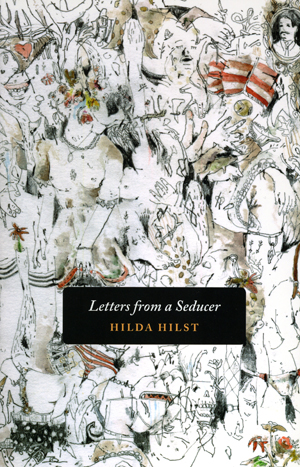
Finally, but not least, a year's work has now achieved fruition with the official release, as of today, of Brazilian writer Hilda Hilst's 1991 masterpiece Letters from a Seducer, which I translated into English last year, working closely with Brazilian publisher A Bolha Editora and its editors, Rachel Gontijo Araújo and Stephanie Sauer (now no longer with the house), and US publisher Nightboat Books and its head, Stephen Motika, who have jointly released the volume pictured below. You can purchase a copy directly from University Presses of New England, who distribute Nightboat's books, or from one of the many online bookstores. Or you can check your local bookstore and if they don't have a copy in-store, urge them to order one or some. I will say only that this text of Hilst's isn't for the faint of heart, just as it wasn't in the original Portuguese, but if you looking for a book that truly charts a distinctive path in late 20th century literature, with a heady dose of trangressive sex, literary intertextuality, meta-critique of writing, and textual depth and music, as well as humor, that could give William S. Burroughs or Kathy Acker runs for their money, Hilst's Letters from a Seducer should be in your hands, pronto.

Hilda Hilst's Letters from a Seducer

Tuesday, January 28, 2014

A New Year, A New Semester


First week of class

The other day I was telling a colleague that I had only been at Rutgers-Newark since the fall of 2012, and he expressed surprise, because, he told me, it seemed to him that I'd been on the faculty for much longer. But it really has only been a year and a half, and I now enter my fourth full teaching semester, summers and the winter breaks not included, which is to say, my second year. Since arriving I have not taught the same course twice; I have taught undergraduate and graduate literature and creative writing courses; I have taught courses geared primarily towards English, African American and African Studies, and creative writing students; and I have taught courses that bridged these various disciplines. Each of these classes has included its share of challenges, some intellectual, some pedagogical, but all have turned out to be quite enjoyable, and one of the greatest benefits of each one has been the students I have had the good fortune to work with. Thus far I have not supervised or work with teaching assistant, and my smallest classes have totaled 12 students (graduate) and 15 or so (undergraduate), while my largest class, last spring, had 40 students (which was, nevertheless, a manageable number).

This spring my courses are Writers at Newark II and History and Myth in Contemporary African Diasporic Fiction. The former is a graduate course that entails reading, discussing and writing about the work of writers who will be visiting and reading in Rutgers-Newark's MFA annual literary series. This spring semester's visitors include two program colleagues, Rachel Hadas (poet, nonfiction writer and scholar) and Jim Goodman (historian and nonfiction writer), as well as Richard Blanco (the inaugural poet), Andew Solomon (the nonfiction writer), Natasha Trethewey (US Poet Laureate), Edward P. Jones (the Pulitzer Prize-winning fiction writer), Matthea Harvey (poet), and George Saunders (fiction writer). I have taught the work of several of these writers before, and appreciate the mix of genres, which mirrors the mix of interests the MFA students bring to the program. We just finished lively discussions of Rachel's The Golden Road: Poems (TriQuarterly Books/Northwestern University Press, 2012) and Jim's But Where Is the Lamb?: Imagining the Story of Abraham and Isaac (Schocken, 2013). Next we will be discussing Richard Blanco's Looking for the Gulf Motel (Pittsburgh, 2012) and Andrew Solomon's Far From the Tree: Parents, Children and the Search for Identity (Scribner, 2013). Both writers will be on campus later this month, and I'm looking forward to meeting and hearing both of them.

My second course is a new version of an undergraduate English course I taught several times at Northwestern, though I have updated it with different texts, trimmed away a lot of what I realized was somewhat unwieldy theoretical material, and recalibrated it so that it better meets the needs of my current students. It officially falls under the rubric of Studies in African and Caribbean Literatures, and is crosslisted both in English and AAAS, though it is more than any thing a Comparative Literature class. Whereas in the past I would sometimes shoehorn as many as 10 books into a term's reading, along with a bookshelf's worth of background and theoretical articles (on the quarter system, no less!--what was I thinking?--my former students in that course and others all certainly deserved medals for endurance and fortitude), I have pared that number down to 7 novels, with a number of short stories mixed in. The writers we're reading include: Chimamanda Ngozi Adichie, Nana Ekua Brew-Hammond, Edwidge Danticat, Nalo Hopkinson, Ana Maurine Lara, Alain Mabanckou, Zakes Mda, ZZ Packer, Ishmael Reed, Yvonne Denis Rosario, and Jean Wyllys, as well as one of my own brief stories, with short theoretical articles by Natalie Zemon Davis, Robin D. G. Kelley, Claude Lévi-Strauss, and Colin Palmer. So far the course is going well, and several new students have signed in, so it should be an intellectually enriching experience for them (I hope) and me.

Tuesday, January 21, 2014

The Snowstorm (Thundarsnortex)

Cold I was expecting. For the last few days the weather forecasters were predicting temperatures in the mid-20s and lower for this upcoming week, the first of the new spring semester, so I have made sure to have longjohns, ski gloves and cap, a heavy wool scarf, and other Chicago-level weather essentials ready. Then, yesterday, I think C and I caught an evening news broadcast that announced a major storm would be blowing through, beginning in the afternoon. Major it is, but the thundersnow arrived in Jersey City this morning.  Snow has steadily fallen, horizontally, and by noon I received an email alerting me that after 3 pm all Rutgers campuses would close for the day.

The university is supposed to open tomorrow at 10 am. We'll see. If the still-falling snow and polar vortex conditions--thundarsnortex, I think Gothamist labeled it--continue, I may not teach my first class until Thursday. A snowplow has visited our street twice so far, a very good sign, but this afternoon I took the light rail, which was running without a hitch, to downtown, to make sure it was running in preparation for tomorrow, hit the post office, and get out and about. The main streets also appear to be ploughed but outside those, here downtown, some of the streets remain untouched. The snowfall is so thick that it's enfolding the tops of our local skyscrapers and lower a curtain such that you cannot even see a yard across the Hudson. Somehow, though, the seabirds, soaring in undulating lines across the water's shirring surface, know where they're heading.


The Hudson River, with its head of snow (Manhattan, usually visible, is straight ahead)
Exchange Place, looking toward the ferry terminal to Manhattan
The parking lot near Harsimus cove
 
Near Exchange Place
 
The light rail platform and tracks