Sunday, December 15, 2013

Photos: Santa Fe, Part 2

More photos from the trip to Santa Fe, New Mexico, including a few photos inside the superlative Allá Bookstore, whose collection of Latin American literature has to be seen to be believed. Enjoy!

New Mexico from the airplane
New Mexico from the air
New Mexico from the airplane
Approaching Albuquerque from the air
On the road from Albuquerque to Santa Fe
The Sandia (?) mountains, on the road from
Albuquerque north to Santa Fe
On the road from Albuquerque to Santa Fe
The New Mexican landscape
Bataan Memorial Building (Old State House), Santa Fe
The Bataan Memorial Building (the Old State House)
Bataan Memorial, Santa Fe
The New Mexico Veterans Memorial, Santa Fe
Chilis and other wares for sale, Santa Fe
An outdoor market, with chilies, serapes, and more
Pueblo-style architecture, Santa Fe
One of the newer adobe-style buildings
Outdoor sculpture, Museum of Contemporary Native Art
A statue in one of the courtyards at the
Museum of Contemporary Native Art
Tisa and Thomas talking to an artist
Tisa (center) and Thomas (right) chatting
with an artist selling her work
Sharan Strange, approaching
Sharan approaching down the colonnade
Major Jackson
Major, checking out some of the work
Santa Fe Plaza, with the American Indian War Memorial in the foreground
Santa Fe Plaza, with the Native American Memorial obelisk in the foreground
The Plaza, Santa Fe
A bandstand in the Plaza
Thomas holding up a painting at Allá
Thomas, holding up a work of art by Álvarez Moran,
as Jim, the owner of Allá, an amazing bookstore, looks on
James & Major at Allá
Jim, the owner of Allá, looking through artworks,
as Major looks at one of the prints he's examining
In Züger's window, Santa Fe
Various sculptures in the window of Züger

IMG_1835
New Mexico Museum of Art

Saturday, December 14, 2013

Photos: Santa Fe, Part 1


With the end of the semester, a mountain of final papers to read, and a bit of recent travel I haven't been able to blog much lately, but here are some photos from a recent trip to Santa Fe, New Mexico. I'd always wanted to go to New Mexico and visit Santa Fe in particular (as well as Albuquerque, Taos, and some of the Indian Reservations, though I'll have to wait for another trip to explore these and other parts of the state), and things worked out such that the Dark Room Collective's 25th Anniversary "Nothing Personal" Reunion Tour concluded with a reading at the Lannan Foundation this past week. Many thanks to the Foundation and all involved with it, to my fellow Dark Room members who made the trip possible and who read, and to all the people who packed the Lensic performance space this past Thursday to hear us. Photography was prohibited at the event, so I was unable to get any photos of the reading, but here are the first of a few photos from the trip.


After recovering from the effects of altitude sickness (which included feeling like I was having a heart attack; nausea; lightheadedness; and exhaustion), a redux of my visits to Boulder/Denver, I spent one morning strolling all around New Mexico's capital city's historic downtown area, chatting with people and looking at all the art on display, admiring and photographing the adobe-style buildings, old and new; popping my head into galleries, museums and bookstores; and walking towards the various, ever-looming mountain ranges, none of which, thankfully were in range. It took a day to acclimate, but I finally was able to say that 7,200 feet above sea level wasn't bad at all (i.e., enough for me). Now I can't wait to go back!


Native artists lined up along the Palace of the Governors' arcade
Native artists and vendors assembling along

the colonnade at the Palace of Governors


An outdoor sculpture, Santa Fe
A bronze sculpture at the Signature Gallery


Museum of Contemporary Native Art
The Museum of Contemporary Native Art

(which has an excellent current exhibit

of emerging and established Native artists)


Arcade looking south, Museum of Contemporary Native Art
The south-facing colonnade and arcade

at the Museum of Contemporary Native Art


Arcade looking north, Museum of Contemporary Native Art
The north-facing colonnade and arcade

at the Museum of Contemporary Native Art


Cathedral Basilica of Saint Francis of Assisi, Santa Fe
The Cathedral Basilica of St. Francis of Assisi


A street in Santa Fe (with the Lensic Art Center at left)
Looking east toward the mountains (the Lensic

performance space, where we read, is visible at left)


IMG_1846
A closer glimpse of the Lensic


An old pueblo-style building at left
A very old pueblo-style building, with colonnade
and arcade, housing restaurants and other businesses
at left; Cathedral Park at right, the mountains
straight ahead


Beautiful old building, Santa Fe
A older adobe-style building

with a beautifully adorned side door


A beautiful wall drawing, Santa Fe
A Native painting adorning a wall

along a Santa Fe street


Wednesday, December 11, 2013

National Book Awards & Poem: Mary Szybist


I watch too much TV, still. I say every single day that I am going to cut back, and I have had periods (like winters in Chicago) when I could go for long stretches watching almost nothing except a show or two (The Wire, Sleeper Cell, Project Runway, etc.), but now that I'm back in New Jersey full-time, part of the rhythm of home involves that infernal digital box (I was going to write cathode ray contraption, but those days are now mostly gone). My TV watching--which does not preclude reading, for classes, for pleasure, etc.--even extended recently to a program I never thought I would sit through, the 2013 National Book Awards ceremony. It ran on CSPAN-2, I believe, and I know that I wasn't the only one watching, because as is now the case with many TV programs, it included a vibrant social media component, which meant that my Twitter feed lit up with comments from Twitterati I follow (or who were retweeting other wits and observers) who were watching the program too.


The fiction finalists

One part of me did think that it was perhaps ridiculous to be tweeting about an awards ceremony focused on book awards, but another part of me said, how wonderful that literary arts, though framed by a strong commercial push from the National Book Foundation and major global and domestic publishers, are not only being celebrated, but televised, and not just televised, but watched and reviewed in real time. Most of the people in my Twitter feed, as did I, tended to celebrate the authors, make positive comments about the winners' work and self-presentation, and cheer about specific books that were nominated and those that won. I thankfully did not see many--any?--negative comments about the authors or their book nor did I see arguments break out about the selections. In truth it is so rare to see living poets, fiction and nonfiction writers, and authors of young adult literature individually or together, and their work, their art, our arts, being celebrated no less, on our dominant cultural mass medium that I think this may have held a lot of negativity in check.


The nonfiction finalists

One person who provoked a smidgen of negative commentary was one of the two co-hosts, Mika Brzezinski. She struck me as somewhat incongruous amidst the proceedings, though it turns out that the National Book Awards finalists were revealed on Morning Joe, the program she co-hosts with former GOP Congressman Joe Scarborough. I am not being snide or snarky when I say that while I think she may be a savvy person--and she has gotten quite far in the world, admittedly with the boost of a famous parent--she does not give the impression of being a regular reader or literary enthusiast. But I have not studied her life exhaustively and could be quite wrong; she did study English at Williams College and very well may consume books the way many around us devour reality TV shows and TV melodramas, and perhaps her performance on Morning Joe is more performance than anything else. She unfortunately did make a major flub when, after having announced the order the prizes would be handed out--there were only four, so it should have been fairly easy to remember them and figure out something was amiss, especially for an on-camera professional--she announced the nonfiction presenter instead of the person presenting the award for fiction. Allegedly she also left before the awards ceremony was over. I guess too much of the book business can get to some.


The poetry finalists

The winners included author and musician James McBride for his Civil War-era novel about a young man who accompanies abolitionist John Brown, The Good Lord Bird (Riverhead Books/Penguin Group USA); nonfiction writer George Packer, for his meditations on the contemporary state of American society, The Unwinding: An Inner History of the New America (Farrar, Straus & Giroux); Cynthia Kadohata's young adult book The Thing About Luck (Atheneum Books for Young Readers/Simon & Schuster); and poet Mary Szybist, who gave the most affecting speech this year, for her collection Incarnadine (Graywolf Press). A few years ago a furor arose because the five fiction finalists were not well known, and most were with smaller presses, but as this year's winners make clear, the big houses mostly cleaned house. There also was for the first time a Man Booker Prize-like longlist, which I think aimed to generate a bit more "buzz" and was a good idea in terms of honoring more writers than fewer, though in a sense it also seems a bit cruel to those who did not advance to the finalist stage. But what are you going to do? In any case there are several more big American/global literary prizes to go (the National Book Critics Circle Award, the Pulitzer Prizes, and the various PEN awards, etc.), so perhaps some of the nominees who did not win this time will merit consideration for some of the ones for later this award season cycle, and other authors, like the great Jay Wright, and my brilliant and prolific Rutgers colleagues Rigoberto González, Jim Goodman, Rachel Hadas, Jayne Anne Phillips, Brenda Shaughnessy, all of whom I believe published new books (several in the case of Rigoberto!), will also receive some of these honors. Congratulations to all this year's winners--and to all 2013 authors too!


The young people's literature finalists

I thought I would post two of the most formally daring poems from Mary Szybist's Incarnadine. Their content and rhetoric give a good sense of the book and its concerns, though these two poems go much further, in terms of their formal daring and visuality, than the rest of the book, thus making them almost unrepresentative. I have to say that I like them and like looking at them and like trying to read them, and like that an author is both tackling the subject of God and the numinous, and yet also doing so in ways that are unexpected. And I like that some other poets and critics, serving as judges, saw fit to honor such daring. Several of my undergraduate students have been particularly interested in poetry's non-verbal qualities and abilities, its multiple capacities for signification, and these poems, hearkening in some ways back to George Herbert in the case of the "How (Not) to Speak to God" and to May Swenson or the Concrete poets, just to offer a few examples, in the case of "It is Pretty to Think," exemplify what my students and I have been talking about.


Enjoy:


Copyright © "How (Not) to Talk to God" and "It Is Pretty to Think," by Mary Szybist, from Incarnadine, Minneapolis: Graywolf Press, 2013. All rights reserved.


Thursday, December 05, 2013

Nelson R. Mandela, 1918-2013


We have lost one of the true heroes and greatest statesmen of our era or any other. A brilliant person, a freedom fighter, a beacon of resistance, a visionary leader, an icon of peace. A person who, alongside others, bore arms when he needed to. A person who, alongside others, consulted the law when he needed to. A person who, alongside others, endured decades years in prison because he had to. A person who, alongside so many other women and men, brought a new dawn and a new day to one of the most benighted countries, wracked by the cancer of institutionalized and systemic racism and white supremacy known as apartheid. A man who chose democracy, who chose inclusion, who chose justice informed and enrichd by forgiveness rather than vengeance. A man who promoted economic, political and justice in the new South Africa. A man who assumed the role of President of a renewed country that was forever changed, giving hope to his people, all the people of his country, and to many more across the globe.
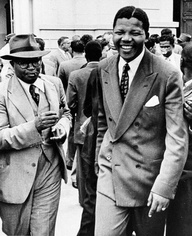
Nelson Rolihlahla MANDELA (July 18, 1918 - December 5, 2013)

The forthcoming New Yorker cover
by Kadir Nelson


Mandela in traditional clothing
A young Mandela
President Nelson R. Mandela
Mandela the young lawyer
Celebrating with Miriam Makeba
Mandela at an ANC rally
Winnie and Nelson Mandela
as newlyweds
"I am prepared to die" (1964)
Mandela at Robben Island

Nelson Mandela with Walter Sisulu

Mandela receiving the Nobel Peace Prize
with South Africa's last apartheid
leader, F. W. de Klerk
MADIBA
Mandela with actor and musician Will Smith

The landmark 1994 South African
presidential ballot
Rest in peace, Madiba, rest in peace.

Videos after the jump:

Sunday, December 01, 2013

World AIDS Day

World AIDS Day. December 1. Today is the  25th World AIDS Day. Around 35 million people across the globe are living with HIV/AIDS, and new HIV seroconversions are declining. Embracing and helping to foster public policies that advance this decline are part of what World AIDS Day aims to do.

You can find more information on the global approach to HIV/AIDS at the World AIDS Campaign's website.

Here are some basic facts about HIV/AIDS, from the UK's World AIDS Day site, that we all should know.

HIV can be passed on through infected bodily fluids, most commonly via sex without a condom or by sharing infected needles, syringes or other injecting drug equipment.

And:

There is no vaccine and no cure for HIV.

And:

Please consider getting tested for HIV so that you know your serostatus.

[Use the AIDS.gov locator below, if it appears on your browser, to find a testing site near you.]

Also:
  • You can now get tested for HIV using a saliva sample
  • HIV is not passed on through spitting, biting or sharing utensils
  • You can get the results of an HIV test in just 15-20 minutes
  • There are a number of things you can do to reduce the risk of serotransmission and seroconversion

Also, HIV/AIDS seroconversion is not a moral judgment, you cannot tell whether you or someone else has HIV/AIDS just the way she or he looks, and it's what one does that is the key factor for HIV seroconversion. These all seem like old hat some three decades into the HIV/AIDS pandemic, but it remains the case that too many people still don't know or fully understand these facts, and many others.


You can find many more facts about HIV/AIDS, including discussions of risk reduction, HIV testing and counseling, prevention and research, and ways to find help, support and treatment if you or someone you know is diagnosed with HIV/AIDS, legal rights, steps for discussing serostatus with family and friends, other health-related issues, and more here.

The much-maligned Affordable Care Act includes coverage for HIV/AIDS treatment and support!

USCA 2013 Federal Plenary on the Affordable Care Act

UPDATE: The ever on-top-it Rod 2.0 featured the following excellent graphic about HIV/AIDS and young gay men. You can find more information on Rod's excellent blog.