Friday, January 27, 2012

Blogs vs. Term Papers

Thank the gods it's Friday afternoon, which means a little respite from classes, at least once the afternoon rolls around. I often feel like I've just emerged from a threshing machine by Friday morning, and today was no different, but by the end of class I felt as I often do when I finish teaching, mentally and intellectually energized, and I even after some student meetings, capable of completing and launching a few new blogposts. So here goes!

***

Often these days I am late in coming to various interesting online conversations, so I only just stumbled over Matt Richtel's article in last week's New York Times, "Blogs vs. Term Papers," on how some faculty members are rethinking ways of sparking student interest in writing essays and critical thinking.  I won't restate his piece but he does explore some of the strategies and new tools, including blogs, categorized by some under the rubric of the "new literacy," that literature and other humanities faculty are using in place of or in addition to the standard short and long-form essays. Among his examples are Cathy Davidson at Duke University, who in the course he cites has jettisoned term papers for internal and external, extensive blogging, and Andrea Lunsford at Stanford University, who has second-year writing students produce a 15-page essay quickly, then expand it into a range of new media forms. As Richtel notes, the students connect well with these alternative forms but, in the case of Lunsford's course, also seek to revise their essay.

Richtel's piece got me thinking about my own use of blogs in a few courses; one of the most successful efforts, I think, was a few years back, in 2009, when I asked students in my aesthetic theory course to post their thoughts on a public blog, "Thinking Aesthetics," and, as you'll see, they often wrote quite thoughtful, sometimes very insightful short responses to the often difficult reading. (One student later told me that this was one of the most difficult courses he had ever taken at Northwestern, but he appreciated it tremendously.) These posts did not preclude essays, but I saw them as another way for the students to wrestle with the material outside of the class, and in preparation for their essays, and most really took to it. I tried from time to time to cite some of their comments in my in-class remarks, though I realize now I could have been more systematic about doing so to integrate these musings more completely.

Here's a snippet on an essay on horror, by one of my former students, George S.--this is an undergraduate writing, mind you:

The theory put forth by Kendall Walton and Alex Neill [in Berys Gaut's article "The Paradox of Horror"] on why people may enjoy horror films and other experiences which provoke negative emotions is absolutely fascinating. It essentially separates the emotion from what it is actually happening, thus it is not the emotion which is negative but occurrence which prompted it. In the case of the death of a loved one, it is not that we are sorrowful because we feel sorrow, but rather because we have lost someone close to us. “That is, it’s the situations rather than the emotions which are distasteful or undesirable, which we (metaphorically?) describe as painful or unpleasant.” (Gaut, 323) The idea of separation of emotion and event is interesting in that it inherently questions the meaning of any emotion. Perhaps we have been conditioned to feel certain ways after certain events, through witnessing other people go through them or simply through pop culture, but who is to say that the emotions of sadness or grief are objectively the correct emotions to feel after an event like the loss of a loved one?

I have also utilized blogs in my creative writing classes in the past, one time in lieu of the journals I ask the students to keep, and I learned this probably wasn't so good, because rather than these online journals being a place where the students really could put anything down--and be writing, by hand, or cutting and pasting things in, or drawing, or all sorts of things that weren't possible in the way they are now on touchscreens and tablet computers--they  became for some a public performance above all. I still do allow blogs and word-processed journals, but most students, I've found, like the physicality of bound paper, codex journals. They like the freedom and challenge of writing or doing whatever they want in them, and they realize that they're portable--and so they can repeat their "eavesdropping" exercise in a way they would have a harder time doing with a laptop, tablet or phone (without using a microphoned recording device).  Some of them, I hope, take up the habit permanently if they already have not.

In the introductory undergraduate creative writing classes I also use threaded conversations, divided up according to groups.  I have found that since the quarter class lengths often do not afford enough time for all the students to comment on the readings on technical and theoretical aspects of writing or by established writers, the threaded conversations offer another means for them to do this. With the graduate fiction students, I ask them to post annotations--short 1-2 page long commentaries--on the critical or creative texts we're reading, and again, I always come across wonderful insights they make as they're working through the texts; often they do cite these commentaries in our in-class discussions.  These annotations are a requirement of the MA/MFA program, and I think about how the online posting method means that not only I but their classmates will have an opportunity to peruse and comment on--or at least mull over--what they're writing and thinking about outside the workshop discussions.

In the fall of 2010, after repeatedly setting up and then not really being able to implement wiki-related projects for my classes, I had all the students in my African-American literature course sign up for Wikipedia in the first week of the course, and one of their requirements was to develop a new entry or revise an existing entry for a writer we discussed in the course or whose work, even if not discussed, would be germane to what we were exploring. They had to use scholarly sources from the library, and produce the citations, which they would then enter on the Wiki page. Nearly all the students produced real advances on the pages that existed, and I felt this was one of the most important projects they undertook given how readily people, even faculty colleagues, who were once disdainful or at least more skeptical, cite Wikipedia as the first and sometimes the final authority. (I have one good friend who frequently sends Wiki links in place of his own commentary; I always want to say, but you can't trust Wikipedia so fully, though I know that many people now do.)

With my current LGBTQ literature class I am requiring all of the undergraduate students (the graduate students have other projects underway) to undertake a Wiki revamp, but I also have assigned two short response papers (I am reading the first set this weekend, and they are quite strong) and a final term paper. Short response papers are to me a very good diagnostic in terms of gauging where students are, how thoroughly they're able to analyze and understand the material, and what sorts of larger inferences they can make based on what they've read. This is officially a theory course, satisfying the department's literature major theory course requirement, but I've also learned that in general, students find theory--and this course includes some exciting theoretical materials from the early post-Stonewall era to the contemporary "post-gay"/"post-Queer"--much more palatable when coupled with creative texts, so their response papers proceed from that pairing.

Lastly, as J's Theater readers know, I have incorporated my beloved Twitter into at least one class. I am always trying to think of more ways to use it, but thus far, I've only been able to slot it into the "Situation of Writing" course for senior-year majors. Their feed, @GetItWrite392: The Situation, runs throughout the length of the course.  This last time I gather from casual conversations that the students were not so impressed, but previous attempts have gone better, and it has provided a spur for the students to seek out  material on writing and publishing and promote it to the wider world, to contact writers they admire directly, and to start conversations with each other and their followers in a way they couldn't within the confines of the classroom or in a closed, Blackboard Course Management System-type space. Twitter makes nearly the entire world open to them. I am less of a fan of Facebook, which I see as having erected very clear walls around itself, so I have not undertaken any Facebook-related projects, but scholars like Jeff Nunokawa have, and they appear quite successful. Maybe I will try out Facebook, or perhaps Google+, which I'm on and which I notice has decided, creepily, to integrate everything in a more Facebook-like manner (to quantify those algorithms to sell to advertisers!), but which also offers the possibility of using Google Docs and Google Books in interesting ways.

In the end I don't think it's good to eschew critical essays, short or long, completely; they require modes of thinking and writing that are valuable to students for many reasons. I do grasp the need for other approaches, however, and as I continue to teach I'm going to continue to examine what others are doing and experiment in my own classes to learn what works and what doesn't so that my students will have the best learning experience I can make possible.

Thursday, January 26, 2012

Movies/Latinos/Race

I am going to post a review of the new movie Red Tails (and one of the still relatively new Shame) soon, but watching the film it dawned on my yet again that Hollywood, by which I mean the entire constellation of people, institutions, structures, and the system of and for mainstream filmmaking in the United States, still has no sense, even after being a century into its development, and over 400 years since black people first arrived on the shores of what is now this country (or 500+ in this hemisphere), of how to portray us on film. But it's not only us, and it's not only Hollywood. So often when I read about black people, or other people of color, people who're not male, not wealthy, not Christian, not straight, not documented immigrants or holding citizenship-level papers, whose lives emerge from anything other than the most normative scenarios, I note how stunted the discussions of these folks tend to be, which I attribute in part to the absence of having someone--journalists, scholars, etc.--writing who have any real familiarity or depth in relation to such folks or topics.

I'll hold up on discussing black folks and Hollywood for now, but I came across an article in the Times that provoked these thoughts anew. By Mireya Navarro, who has written extensively it's titled "For Many Latinos, Racial Identity Is More Culture Than Color," and she traces how the US color=race binary (down to terms like "biracial," so beloved of so many nowadays), bureacratic pigeonholes, and related conceptualizations of identity lead many latinos to choose differing ways of thinking about themselves. One point that Navarro notes is one I rarely hear noted anywhere: on the US Census, for some time now, a majority of latinos have self-identified as "white."  In fact, in most discussions of latinos and certainly in many depictions in the mainstream of latinos, there is no nuance when it comes to race; instead, latino registers as a racial category, and the history and complexity of being a latino in the US gets reduced to and reinscribe racist stereotypes of and commonplaces about who latinos are in the US. With regard to Hollywood and TV as well, I still see not just white-outs in terms of casting and storylines, but when latinos do appear, as in HBO's recent series How To Make It In America, they're cast in the same sorts of stereotypical roles (in the case of this show, all of the latinos, including one of the show's protagonists, played Dominican-American actor Victor Rasuk, were linked to drugs, selling and using) that are for me just maddening.

Fortuitously I came across a January 2012 article, in the Huffington Post, about this very topic concerning latina actresses; titled "Hollywood Typecasting: Some Latina Actresses Are Forever  Relegated to Roles as Maids and Abuelas," it notes the extremely narrow casting range available for most latinas in Hollywood; they are either domestics, sexual spitfires, or grandmothers. One incredibly talented actress, Lupe Ontiveros, has been cast as a maid more than 150 times! She doesn't turn down the roles because she wants to act and has bills to pay, but it's so telling that these tend to be the only roles she can get. As I read this article I though of the irony too the two black actresses nominated for the 2012 Academy Awards, Viola Davis for Best Actress and Octavia Spencer for Best Supporting Actress, were cited for playing domestics. No other black actresses, or other actresses of color, including no latinas, white, black, other, or otherwise, for that matter, playing any other roles over the last year, were nominated for Oscars, and many an actress of color waits for a role other than the stereotypical ones.

Navarro's article also brought to mind the clip below, which I first saw on the Monaga site (h/t Anthony!), of latinos in Hollywood talking about having to choose between being black and being latino; most of them do not and won't, meaning that while they do get parts playing African Americans (or, in some cases, black people of indistinct ethnicity), they often do not get cast as latinos, since the idea of black latinos is too complex for many in Hollywood to grasp. (I have said it before but I'll say it again: there are more black latinos outside the US than there are African Americans within our borders. All African Americans are black, but not all black people are African American.)  In Red Tails, two of the actors, Andre Royo (best known as "Bubbles" in the exceptional HBO series The Wire) and Tristan Wilds (who also starred as a child actor on The Wire and has since gained fame on the new version [why?] of Beverly Hills, 90210) have Latin American roots but are--consider themselves--black Americans. They are black and latino.


Discussions around race and latinos led two younger latinos, Alicia Anabel Santos and Renzo Devia, to film a documentary, "Afrolatinos: The Untold Story," a clip of which is below, to address this issue. The clip also notes that Bianca I. Laureano and others specifically created a blog, The Latinegr@s Project, to take up this topic.


This is an issue not just in the US, though. Last November on Fly Brotha's site, he peeped a documentary by Panamanian-American filmmaker Dash Harris entitled Negro on identity, race and racism among latinos in the US and Latin America. Here's a little taste:


None of this is new or news, of course--at least to most readers of this blog, I'm sure. What I do wish, though, is that more journalists would take up some of the realities Navarro, for her part, particularly concerning the 60% of latinos in the US who are of Mexican ancestry, and the actors and actresses in the black and latino in Hollywood clip for theirs portray, and that there were more folks making films and TV shows who had a grasp of the world that didn't consist in the same tired stereotypes I have been seeing my entire life. (Or that my colleague Ramon Rivera-Servera explores in his work on latinos, race, class, and performance, just to give one example of a brilliant scholarly exploration of these ideas.) Don't films like Quinceañera or Real Women Have Curves have any effect? Don't they suggest that maybe there are more stories out there than the ones we see over and over?  Or, to take two TV examples, if the Steve Harvey Show and New York Undercover, both shows from the 1990s, could cast latinos--and in this case, Afrolatinos--in roles (Merlin Santana in the former, Lauren Vélez in the latter) that depicted them as latinos and went beyond stereotypes, why are we going backwards now?

Tuesday, January 24, 2012

Poem: Jean Valentine

If the winter quarter is akin to a mine, I am deep down in it, so very deep  that I have only a memory of what the surface air, the light, the faces up above look like. A mine of fiction, student fiction--and the grade is a steep one. Often when I am making my way through thick tunnels of prose I think of poetry, hear it, long for it, and today I thought of a poet, and of a poem, that has stuck with me since I first read it, back in 1995, when a graduate school classmate introduced me to this poet's work after we had concluded a class teaching 7th and 8th graders how to write poetry. I had never read or even heard of this poet, or the book, Home.Deep.Blue (Alice James Books, 1989) and my classmate might have been reading it for class, for her workshop, for pleasure. Perhaps she was showing the book to some of the students, though I know we didn't read this poem to them in class. I do remember flipping through the book, and the poet's name engrave itself on my mind: Jean Valentine (1934-). And I stopped at this poem: "Everything Starts with a Letter."

In my mind the title became and becomes still the slightly different "Everything Begins With a Letter." But Valentine knows what she's doing, with her starting rather than beginning. Like so much of her poetry, for which she has received many awards, including the 2004 National Book Award for Poetry, for Door in the Mountain: New and Collected Poems, 1965-2003, from which I have copied this poem, "Everything Starts With a Letter" provides only a glimpse, brief as a flash and as bright, into a life, a memory, a psyche, the life and memory and psyche of the speaker, this lyric voice, so full of drama...but we only get a glimpse, as if through a small hole in a boarded-up window, or a keyhole, and we must construct the rest of the story on our own, of the speaker's relation to "Juliana," who makes appearances in other poems in the volume, whose memory raises a mirror, harsh though its reflection be, to the speaker herself. The poem immediately called and calls to mind poems by Julia de Burgos, Arthur Rimbaud, Jaime Gil de Biedma, among others. But it is very much Valentine's own--her own way of entering the lyric dreams poetry alone can create, full of mystery and compelling, especially in the second stanza, which when I read or recall it always makes me want to know and hear more....  As I said, it has remained a little treasure I carry with me up through today. So here it is:

EVERYTHING STARTS WITH A LETTER

Everything starts with a letter,
even in dreams and in the movies . . . Take
J. Juliana, on a summer afternoon,
in a white silk blouse, and a pale blue-flowered skirt,
--her shoes? blue? but high and narrow heels,
because she asks Sam to carry the plate of Triscuits
into the garden, because she can't manage
the brick path in her heels.
"Oh could you? I can't manage the path in these heels."

J is the letter my name begins with,
O is the letter for the moon,
and my rage shines in my throat like the moon!
Her phoniness, O my double, your and
my phoniness . . .
Now what shall we do?
For this is how women begin to shoot,
we begin with our own feet, men empty their hearts, oh
the false self will do much worse than that,
to get away . . .

Copyright © Jean Valentine, from Door in the Mountain: New and Collected Poems, 1965-2003, Middletown, CT: Wesleyan University Press, 2004.

Wednesday, January 18, 2012

Say No to PIPA & SOPA

Wikipedia, like many sites, is offline today to protest PIPA & SOPA
The US Congress is considering two bills, the Senate's Protect IP Act (PIPA) and the House of Representatives' Stop Online Piracy Act (SOPA), that would censor the Web and Internet, constrain everyday users' access to online materials, and place additional, unnecessary regulations on businesses. 

Millions of people on the Internet have already opposed SOPA and PIPA.

The Senate begins voting next week, on January 24, 2011, so please let your two senators know how you feel. Sign the petition at the link below, and urge Congress to vote NO on PIPA and SOPA before it's too late.

Stop SOPA and PIPA!


Monday, January 16, 2012

Happy Rev. Dr. Martin Luther King Jr. Day

Happy Rev. Dr. Martin Luther King Jr. Day! 


Here is the Rev. Dr. Martin Luther King Jr.'s commencement speech at the historically progressive Oberlin College in the year of my birth. So much of what he said all the way back then has come to pass, but so much still awaits our hard, dedicated, unflinching work.  From the Oberlin College archives:

"Remaining Awake Through a Great Revolution"

Commencement Address for Oberlin College
By Rev. Dr. Martin Luther King, Jr.
June 1965, Oberlin Ohio

"[Oberlin College] President Carr, members of the faculty, and members of the graduating class of this great institution of learning, ladies and gentlemen:

I can never come to this campus without a deep sense of appreciation and gratitude for all that this great institution has done for the cultural, political, and social life of our nation and the world. By all standards of measurement, Oberlin is one of the great colleges, not only of our nation, but of the world. I am also deeply honored to share the platform today with so many distinguished citizens of our nation - particularly our great secretary of state who, through dedicated and brilliant service, has carved for himself a niche in the annals of our nation's history.

Now to the members of the graduating class: today you bid farewell to the safe security of the academic environment. You prepare to continue your journey on the clamorous highways of life. And I would like to have you think with me on this significant occasion on the subject, "Remaining Awake Through a Great Revolution".

I'm sure that you have read that arresting little story from the pen of Washington Irving entitled Rip Van Winkle. The thing that we usually remember about this story is that Rip Van Winkle slept 20 years. But there is another point in that story that is almost always completely overlooked: it was a sign on the inn in the little town on the Hudson from which Rip went up into the mountain for his long sleep. When he went up, the sign had a picture of King George III of England. When he came down, years later, the sign had a picture of George Washington, the first president of the United States. When Rip looked up at the picture of George Washington, he was completely lost; he knew not who he was. This reveals to us that the most striking fact about the story of Rip Van Winkle is not that he slept 20 years, but that he slept through a revolution. While he was peacefully snoring up on the mountain, a great revolution was taking place in the world - indeed, a revolution which would, at points, change the course of history. And Rip Van Winkle knew nothing about it; he was asleep.

There are all too many people who, in some great period of social change, fail to achieve the new mental outlooks that the new situation demands. There is nothing more tragic than to sleep through a revolution. There can be no gainsaying of the fact that a great revolution is taking place in our world today. It is a social revolution, sweeping away the old order of colonialism. And in our own nation it is sweeping away the old order of slavery and racial segregation. The wind of change is blowing, and we see in our day and our age a significant development. Victor Hugo said on one occasion that there is nothing more powerful in all the world than an idea whose time has come. In a real sense, the idea whose time has come today is the idea of freedom and human dignity. Wherever men are assembled today, the cry is always the same, "We want to be free." And so we see in our own world a revolution of rising expectations. The great challenge facing every individual graduating today is to remain awake through this social revolution.

I'd like to suggest some of the things that we must do in order to remain awake and to achieve the proper mental attitudes and responses that the new situation demands. First, I'd like to say that we are challenged to achieve a world perspective. Anyone who feels that we can live in isolation today, anyone who feels that we can live without being concerned about other individuals and other nations is sleeping through a revolution. The world in which we live is geographically one. The great challenge now is to make it one in terms of brotherhood.

Now it is true that the geographic togetherness of our world has been brought into being, to a large extent, through modern man's scientific ingenuity. Modern man, through his scientific genius, has been able to dwarf distance and place time in chains. Yes, we've been able to carve highways through the stratosphere, and our jet planes have compressed into minutes distances that once took weeks and months. And so this is a small world from a geographical point of view. What we are facing today is the fact that through our scientific and technological genius we've made of this world a neighborhood. And now through our moral and ethical commitment we must make of it a brotherhood. We must all learn to live together as brothers - or we will all perish together as fools. This is the great issue facing us today. No individual can live alone; no nation can live alone. We are tied together.

I remember some time ago Mrs. King and I had the privilege of journeying to that great country, India. And I never will forget the experience - it was a marvelous experience - to meet and talk with the great leaders, with the hundreds of thousands of people all over the cities and villages of that vast country. These experiences will remain dear to me as long as the cords of memory shall lengthen. But I say to you this morning, my friends, that there were those depressing moments, for how can one avoid being depressed when he sees with his own eyes evidence of millions of people going to bed hungry? How can one avoid being depressed when he sees with his own eyes millions of people sleeping on the sidewalks at night; no beds to sleep in; no houses to go into. How can one avoid being depressed when he discovers that out of India's population of more than 400 million people, some 380 million make an annual income of less than $90 a year. And most of these people have never seen a physician or a dentist. As I noticed these conditions, something within me cried out, "Can we in America stand idly by and not be concerned?" And an answer came, "Oh no! because the destiny of the United States is tied up with the destiny of India and every other nation." I started thinking about the fact that we spend millions of dollars a day in our country to store surplus food, and I said to myself, "I know where we can store food free of charge - in the wrinkled stomachs of the millions of God's children in Asia and Africa, in South America, and in our own nation who go to bed hungry at night."

All I'm saying is simply this: that all mankind is tied together; all life is interrelated, and we are all caught in an inescapable network of mutuality, tied in a single garment of destiny. Whatever affects one directly, affects all indirectly. For some strange reason I can never be what I ought to be until you are what you ought to be. And you can never be what you ought to be until I am what I ought to be - this is the interrelated structure of reality. John Donne caught it years ago and placed it in graphic terms: No man is an Island, entire of itself; every man is a piece of the continent, a part of the main... And then he goes on toward the end to say: any man's death diminishes me, because I am involved in mankind; and therefore never send to know for whom the bell tolls; it tolls for thee. And by believing this, by living out this fact, we will be able to remain awake through a great revolution.

I would like to mention, secondly, that we are challenged to work passionately and unrelentingly to get rid of racial injustice in all its dimensions. Anyone who feels that our nation can survive half segregated and half integrated is sleeping through a revolution. The challenge before us today is to develop a coalition of conscience and get rid of this problem that has been one of the nagging and agonizing ills of our nation over the years. Racial injustice is still the Negro's burden and America's shame. We've made strides, to be sure. We have come a long, long way since the Negro was first brought to this nation as a slave in 1619. In the last decade we have seen significant developments - the Supreme Court's decision outlawing segregation in the public schools, a comprehensive Civil Rights Bill in 1964, and, in a few weeks, a new voting bill to guarantee the right to vote. All of these are significant developments, but I would be dishonest with you this morning if I gave you the impression that we have come to the point where the problem is almost solved.

We must face the honest fact that we still have a long, long way to go before the problem of racial injustice is solved. For while we are quite successful in breaking down the legal barriers to segregation, the Negro is now confronting social and economic barriers which are very real. The Negro is still at the bottom of the economic ladder. He finds himself perishing on a lonely island of poverty in the midst of a vast ocean of material prosperity. Millions of Negroes are still housed in unendurable slums; millions of Negroes are still forced to attend totally inadequate and substandard schools. And we still see, in certain sections of our country, violence and man's inhumanity to man in the most tragic way. All of these things remind us that we have a long, long way to go. For in Alabama and Mississippi, violence and murder where civil rights workers are concerned, are popular and favorite pastimes.

Let nobody give you the impression that the problem of racial injustice will work itself out. Let nobody give you the impression that only time will solve the problem. That is a myth, and it is a myth because time is neutral. It can be used either constructively or destructively. And I'm absolutely convinced that the people of ill will in our nation - the extreme rightists - the forces committed to negative ends - have used time much more effectively than the people of good will. It may well be that we will have to repent in this generation, not merely for the vitriolic works and violent actions of the bad people who bomb a church in Birmingham, Alabama, or shoot down a civil rights worker in Selma, but for the appalling silence and indifference of the good people who sit around and say, "Wait on time." Somewhere we must come to see that human progress never rolls in on wheels of inevitability. It comes through the tireless efforts and the persistent work of dedicated individuals. Without this hard work, time becomes an ally of the primitive forces of social stagnation. So we must help time and realize that the time is always right to do right.

There is another reason why we must get rid of racial injustice. Not merely because it is sociologically untenable or because it is politically unsound, not merely to meet the communist challenge or to create a good image in the world or to appeal to African and Asian peoples, as important as that happens to be. In the final analysis racial injustice must be uprooted from American society because it is morally wrong. Segregation is morally wrong, to use the words of the great Jewish philosopher, Martin Buber, because it substitutes an I-it relationship for the I-thou relationship. Or to use the thinking of Saint Thomas Aquinas, segregation is wrong because it is based on human laws that are out of harmony with the eternal natural and moral laws of the universe. The great Protestant theologian, Paul Tillich, said that sin is separation. And what is segregation but an existential expression of man's tragic estrangement - his awful segregation, his terrible sinfulness? And so in order to rise to our full moral maturity as a nation, we must get rid of segregation whether it is in housing, whether it is a de facto segregation in the public schools, whether it is segregation in public accommodations, or whether it is segregation in the church. We must see that it is morally wrong. We must see that it is a national problem. And no section of our country can boast of clean hands in the area of brotherhood. We strengthen our nation, above all we strengthen our moral commitment; as we work to get rid of this problem.

Now there is another problem facing us that we must deal with if we are to remain awake through a social revolution. We must get rid of violence, hatred, and war. Anyone who feels that the problems of mankind can be solved through violence is sleeping through a revolution. I've said this over and over again, and I believe it more than ever today. We know about violence. It's been the inseparable twin of Western materialism, the hallmark of its grandeur. I am convinced that violence ends up creating many more social problems than it solves. This is why I say to my people that if we succumb to the temptation of using violence in our struggle, unborn generations will be the recipients of a long and desolate night of bitterness. There is another way - a way as old as the insights of Jesus of Nazareth and as modern as the techniques of Mohandas K. Gandhi. For it is possible to stand up against an unjust system with all of your might, with all of your body, with all of your soul, and yet not stoop to hatred and violence. Something about this approach disarms the opponent. It exposes his moral defenses, weakens his morale, and at the same time, works on his conscience. He doesn't know how to handle it. So it is my great hope that, as we struggle for racial justice, we will follow that philosophy and method of non-violent resistance, realizing that this is the approach that can bring about that better day of racial justice for everyone.

In international relations, we must come to see this. We must find some alternative to war and bloodshed. In a day when man-made vehicles are dashing through outer space, and guided ballistic missiles are carving highways of death in the stratosphere, no nation can win a world war. It is no longer a choice between violence and non-violence; it is either non-violence or non-existence. The alternative may well be a civilization plunged into the abyss of annihilation, our earthly habitat transformed into a tragic inferno that even Dante could not imagine. So this is our challenge: to see that war is obsolete, cast into limbo.

I do not wish to minimize the complexity of the problems to be faced in achieving disarmament and peace. But we shall not have the courage, the insight, to deal with such matters unless we are prepared to undergo a mental and spiritual change. It is not enough to say we must not wage war. We must love peace and sacrifice for it. We must fix our visions not merely on the negative expulsion of war, but upon the positive affirmation of peace. We must see that peace represents a sweeter music, far superior to the discords of war. Somehow we must transform the dynamics of the world power struggle from the negative nuclear arms race which no one can win to a positive contest to harness man's creative genius for the purpose of making peace and prosperity a reality for all of the nations of the world. In short, we must shift the arms race into a peace race.

All that I've said is that we must work for peace, for racial justice, for economic justice, and for brotherhood the world over. We have inherited a big house, a great world house in which we have to live together - black and white, Easterners and Westerners, Gentiles and Jews, Protestants and Catholics, Moslem and Hindu. If we all learn to do this we, in a real sense, will remain awake through a great revolution.

I urge you to continue the tradition that you have followed so long, for this institution has probably done more than any other to support the struggle for racial justice. You have given your time, you have given your earnings, you have given your bodies, you have participated in demonstrations, you have participated in the determined struggle to keep this issue in the forefront of the conscience of the nation. I urge you to continue to do so as you go out into your various fields of endeavor. Never allow it to be said that you are silent onlookers, detached spectators, but that you are involved participants in the struggle to make justice a reality.

We sing a little song in our struggle - you've heard it - We Shall Overcome. And by that we do not mean that we shall overcome the white man. In the struggle for racial justice the Negro must not seek to rise from a position of disadvantage to one of advantage, to substitute one tyranny for another. A doctrine of black supremacy is as dangerous as a doctrine of white supremacy. God is not interested in the freedom of black men or brown men or yellow men. God is interested in the freedom of the whole human race, the creation of a society where every man will respect the dignity and worth of personality. So when we sing We Shall Overcome, we are singing a hymn of faith, a hymn of optimism, a hymn of faith in the future.

I can still sing that song because I have faith in the future. I believe that we, as Negroes, are going to gain our freedom in America because the goal of America is freedom. Abused and scorned though we may be, our destiny is tied up with the destiny of America. Before the Pilgrim fathers landed at Plymouth we were here; before Thomas Jefferson etched across the pages of history the majestic words of the Declaration of Independence we were here; before the words of the Star-Spangled Banner were written we were here. For more than two centuries our forbears labored here without wages. They made cotton king; they built the homes of their masters; in the midst of the most oppressive conditions they continued to grow and develop. Certainly if the inexpressible cruelties of slavery couldn't stop us, the opposition that we now face will surely fail. We will win our freedom because both the sacred heritage of our nation and the eternal will of God are embodied in our echoing demands.

Yes, we shall overcome because the arc of the moral universe is long, but it bends toward justice. We shall overcome because Carlyle is right: "No lie can live forever." We shall overcome because James Russell Lowell is right:

Truth forever on the scaffold,
Wrong forever on the throne,
Yet that scaffold sways the future,
And behind the dim unknown
Standeth God within the shadow,
Keeping watch above his own.


We shall overcome because William Cullen Bryant is right: "Truth, crushed to earth, shall rise again." With this faith we will be able to hew out of the mountain of despair, the stone of hope. With this faith we will be able to transform the jangling discords of our nation into a beautiful symphony of brotherhood, and speed up the day when, in the words of the prophet Amos, "Justice will roll down like waters; and righteousness like a mighty stream."

Let us stand up. Let us be a concerned generation. Let us remain awake through a great revolution. And we will speed up that great day when the American Dream will be a reality. We, in the final analysis, can gain consolation from the fact that at least we've made strides in our struggle for peace and in our struggle for justice. We still have a long, long way to go, but at least we've made a creative beginning.

And so I close by quoting the words of an old Negro slave preacher who didn't quite have his grammar right, but uttered words of great and profound significance:

Lord, we ain't what we oughta be;
We ain't what we wanna be;
We ain't what we're gonna be;
But thank God we ain't what we was! "

Saturday, January 14, 2012

Oh No, the Snow

Classes are entering their third week, but it feels like three months have passed already, and the spring temperatures that popped up for a few days didn't help; I really began to think I should be expecting final revisions on short stories and final critical papers because of the balmier temperatures and people scooting through the streets in shorts and flipflops (!), but a reality check came swiftly enough with the snowfall two days ago.  It began while I was holding office hours, and by the time I left campus, the streets were so treacherous--and my old little car so unroadworthy--that I found myself slowly spinning out on the icy slush just yards after crossing from Evanston into Chicago.  It was as if I were 6 years old and skidding around Steinberg Skating Rink in Forest Park, except that instead of an overcoat, mittens and a wool hat I was wearing a ton of metal and plastic, and instead of other novice and skilled skaters around me I was surrounded by fast-moving missiles, and instead of wooden walls I needed to avoid smashing into trees and lampposts. I was driving very slowly, there wasn't a lot of traffic, I knew to turn into the skid, and I'm fine, but I drove the whole rest of the way home praying that I stayed on the road as opposed to skating off it, or cursing the mayor, Rahm Emanuel, whose salt trucks had apparently not yet reached the far northeast corner of the city.

It wasn't much better on Friday morning as I headed back north to teach. From my front window I could see the main road had been plowed (or at least salted and driven enough to appear passable), and thought, well, why stumble over to the El, which takes forever and would mean standing in the cold, waiting to transfer to the Evanston trains in the cold, and then standing in the packed cocoon for 4-5 stops only to have to trundle back out into the cold and snow to reach class. (I say all of this despite being, as regular J's Theater readers know, a devoted fan of public transportation.) So I thought, why not drive? My car slumbered in its usual post-storm sarcophagus, so I dug it out, and all was going well until I crossed into Evanston and discovered that the salting had stopped at the Chicago border; the northbound lanes were paved with icy slush, and it again was like skating as carefully as possible to get to my destination. Let it suffice to say that 1) I got to class on time; 2) I was able to get home in one piece; and 3) though I cannot afford a new used car, I seriously considered getting one that has four-wheel drive, or something to make the driving experience in this kind of weather more...safe. Last night the temperatures fell to about 0F (according to NPR, it was already -5F without the windchill in the suburbs), and I did not dare venture out.

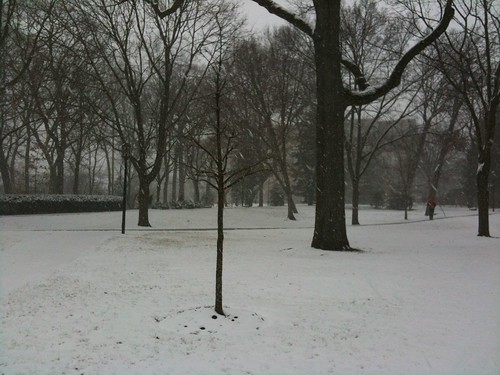
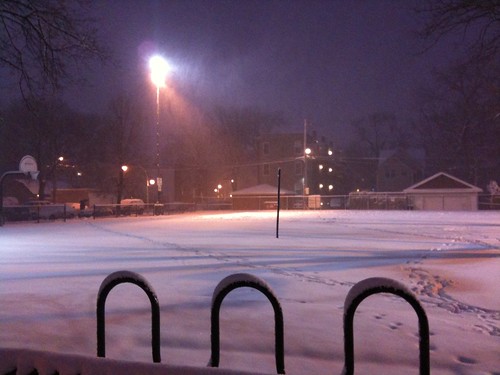
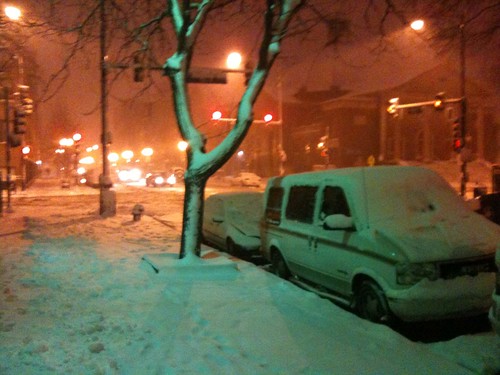
Today it's very cold (20F) but sunny. More snow is allegedly on its way tonight and tomorrow, though we're also supposed to get warmer temperatures, as in the high 30s too, and perhaps even rain. Cold but clear days and nights, or cold but non-icy rain I'll take any day over snow and slush, especially if there's any possibility I'll have to drive in it. Here are some pictures of the snow, which always looks pretty if you don't have to be in it!

On campus, as the snow began falling
The campus, as the snow began falling

During the snowstorm
The street, in the midst of the snowstorm

The local playground, in the snow
The local playground, in the snowfall


Walking to the store, Chicago
The street, heading east towards the lake

Snow falling
A pretty night scene in Rogers Park


Friday, January 13, 2012

Hirst: Out, Out Damned Spot

Hirst's "Urea-13C"
Gagosian Gallery
(Librado Romero/New York Times)
Two autumns ago as part of a colloquium sponsored by the California Institute of the Arts I gave a talk on poetry, money and society at the Museum of Contemporary Art in Los Angeles in which I cited Damien Hirst's infamous diamond-encrusted skull, "For The Love of God," as emblematic of the logic of capitalist aesthetics.  He (and a few others, including the Black-Eyed Peas, for example) was, to my mind, taking a particular articulation of Western aesthetics and aestheticism, informed by post-industrial capitalism, the commodification process and neoliberalism, to its end, at the very moment that capitalism itself was globally imploding. In fact, his artistic trajectory and triumphs were both the symbols and embodiments of that implosion.  Not that I was exactly denouncing him, since I both find his work hollow and often mindless while also thinking his overall approach to art and particular pieces fascinating, but in any case I wasn't the first to critique Hirst, and anyways, who gives a damn what I think?  He's rich, b****! as Dave Chappelle, channeling Rick James, would say, and people far richer than Hirst, like his former collector Maurice Saatchi and his dealer Larry Gagosian, as well as countless connoisseurs who could afford to offer emperors' ransoms to purchase his "art," are the ones who have the last say in his regard. And they are still testifying on his behalf. That said, Hirst's detractors include the likes of the great Anglo-American artist David Hockney, who recently critiqued Hirst's use of assistants to create his art. When I read Hockney's criticism, I thought, well he must know that there's a long tradition of assistants in the Western and other traditions, and the authenticity fetish of the individual artist's craftmanship went out the window with Marcel Duchamp, but still...Hirst does get under people's skins. (In case you are in London, Hockney's remarkable recent paintings are on display until April 9, 2012, at the Royal Academy.)

Hockney's "Winter Timber" (2009)
at the Royal Academy
(Guardian Online)
He also has more life in him than 1,000 cats, it seems. After the critical debacle of his 2009 "return to painting" a few years ago at the Wallace Collection, he is back with a spectacle of a show, or shows, that would make even his most famous peers flush with envy. I say show or shows because one can think of the Gagosian Gallery's multiple-site exhibit of Hirst's work as one collective show or several running in parallel, but all appear to be showing variations not just on the same theme, but the same work itself: his banal "spot" paintings.  I see these paintings and I think, this is an art student's quick insight (or post-LeWittian or Buren-esque hangover), wallpaper for a child's bed or romper room, charming-the-first-time-through gift wrap, the not-very-interesting results of a simple computer algorithm, glorified and blown up into a mini-industry, which is to say, I regard them both with condemnation and simultaneously admiration for Hirst's cleverness, audaciousness and chutzpah. One gallery full of these paintings really ought to have been enough; then you could acknowledge their decorative and simplistic aspects while noting that even if a small child, with no grasp of abstract or conceptual art, had thought of this, it would still be worth viewing. Variations on a theme! Play with scale! Abstraction rebirth after the return of figurative painting! Conceptualism's delights! And, certainly, color! But ELEVEN galleries, featuring 331 paintings across the globe? Really? Really? The response is something C and I often say: "And why not?"

Roberta Smith, writing of the New York shows in her New York Times review, "Hirst, Globally Dotting His 'I'," did not hesitate to say that some of these paintings were "bad." How could she not and still possess any integrity? Full quote: "Well, very bad at times, and yet, at others, not bad at all, in fact rather good." Rather good: for some of Hirst's specific pieces, and the spectacle itself, exert a fascination, and sometimes achieve what could be described as beauty. (Were the 11 galleries in the vicinity of each other, one might even talk of their approximating a kind of anti-sublime.)  But, as she says, too many galleries full of this stuff goes too far.  It got me thinking that it might have been far more interesting and conceptually profound had Hirst, instead of filling the Gagosian galleries with this guff, decided to wrap one of the buildings housing one of the galleries, or perhaps another New York landmark--the Washington Square Arch, the Empire State Building, the Statue of Liberty, the Woolworth Building, Pennsylvania Station and Madison Square Garden, etc., with a patented, stretchable version of his "spot"-painting. Or even if he'd just paid people to wear Hirst-spot clothing for a week, and stand in various places, à la Vanessa Beecroft, looking chic and entitled. A true outrage, on the level of what the 1999 Sensation Show at the Brooklyn Museum--which I saw, with a gang of friends who were motivated to check it out mainly because of the uproar--would have been for him to design tents, cold-weather outfits, even survival implements, for Occupy protesters, and underwrite Hirst-spot plates, cutlery, sheets and warm bedspreads for the numerous soup kitchens and shelters around the US and UK providing nightly meals and lodgings for the many homeless people desperately struggling to make it through to the next day. Just imagine the brouhaha...and praise....

"Moxalactam," "L-Isoleucinal,"
"Cefatrizine Propylene" and “1-Hexadecene"
Gagosian Gallery
(Librado Romero/New York Times)

But alas, we instead have the prospect of acres of spots and dots, large and small, painted, impastoed, screened, crowding white canvases, crowning white walls. And Hirst, blathering on about what it is he does, or doesn't, including growing old, chats about it all with Anthony Haden-Guest, the journalist and socialite. Whatever he does or doesn't, one thing is certain: pounds and dollars keep lining his pockets. And if there is anything that gins up the interest of (many) Americans, and Britons, that's it. As I have said before, genius sometimes lies just on this side of charlatanry....

Tuesday, January 10, 2012

MUTO Manifesto/Exterface Studios

One of the things I love about the Internet, at least as it now exists, which is to say before it is walled off into privatized, unaffordable bailiwicks ruled by a few very rich companies, is that you can surf and happen upon things that you might never encounter if you didn't have the wherewithal to travel, weren't located in a cosmopolitan area or had access to one, didn't know people in the know, and so on.  When I was younger, I avidly visited magazine stores in the various cities where I lived just to browse, sometimes for hours, the offerings on display. I'd flip through magazines from all over the world, news journals, art journals, fashion journals, zines, anything really, just to see what was going on in the wider world that I wasn't seeing in mainstream newspapers or on TV.  So many of these newshops and bookstores are gone, lost to the depredations of gentrification, falling patronage, and yes, the net; a few, like St. Mark's Bookshop, are barely hanging on. The Internet hasn't resolved the economic issues these stores faced, but it has provided another means, at least in some cases, to travel the world without leaving your desktop or, nowadays, your phone or table computer.

I was thinking of this when I came across the digital online  MUTO Manifesto, a year-old French queer periodical based in Paris and affiliated with Exterface Studio, two 26-year-old French art directors who have, in their words, been "working in graphic design since 2000 and photography since 2005." Exterface's previous projects have included editorial and personal photography, exhibitions in Paris, and books published by Éditions Nemo Media and noted gay publisher (NSFW) Bruno Gmünder; and a poster for the  fetish-forward fashion house (NSFW) Slick It UpMUTO Manifesto, a beautiful publication now numbering four specially-themed issues, pairs lyric prose with artful photographs of men (including semi and full nudes), landscapes, and other associative imagery.  It's available, like many free magazine publications, via online publisher Issuu.com. So far, MUTO Manifesto has kept things livelier than many a US queer/gay male publication would, and even if you don't read a word of French, it's enjoyable to flip through, but it's even more enjoyable if you do. (You can always type many kinds of non-English texts into Google translate and get a passable translation these days, another great aspect of the Internet, and you can pull up online dictionaries and other translation services too, for free).  I believe you can also download the issues and yes, read them on your desktop, phone or tablet device if you sign up for Issuu.com. Here are few images from the first four issues (1-4). Check them out and browse Issuu.com's roster of publications, which also include books, zines and other texts.  Amid the clutter, there are some gems, like the ones below.

Volume 1: Juvénile Ardeur
Volume 2: Looney Dudes
Volume 3: La Chasse à L'Homme
Volume 4: Agnus Dei

Saturday, January 07, 2012

Haitians Heading to Brazil

Today's New York Times brought a bit of news I hadn't read anywhere before, which is that Haitians have begun to emigrate from their still post-earthquake ravaged nation to Brazil, which over the last decade, under center-left governments, has become an economic powerhouse. The self-described "Country of the Future" is now one of the countries of today, with 5.2% unemployment drawing not only educated professionals from Europe, Latin America and the United States, but laborers from across the developing world. 

According to Simon Romero's Times article, "Haitians Take Arduous Path to Brazil, and Jobs," around 4,000 Haitians arrived in Brazil since the 2010 earthquake, usually traveling via Ecuador, which has looser vias policies, and have thus arrived at border posts at the edge of Brazil's Amazonian states of Acre and Amazonas.  Romero states that some of the Haitians have been robbed during their journey to Brazil and the wait for legal entry to Brazil has placed some in conditions not unlike what they experienced at hom, but the immigrants are willing to take the risk because of the continuing dire conditions in Haiti, where rebuilding in the capital and other devastated regions has moved at a glacial pace, and because of the job opportunities at Brazil's hydroelectric plants and in its burgeoning industries. I would imagine that the new infrastructure for the 2014 World Cup and 2016 Olympics are also going to provide opportunities, though despite its economic advances, still has a large population of impoverished and barely working-class people, especially across its historically economically disadvantaged northeast.

From Douglas Engle's NY Times clip
Brazil has provided the new arrivals with vaccinations, clean water, and two meals a day at the border posts like Brasiléia, where they stay until granted humanitarian visas, but I imagine if the flow of Haitians and other potential immigrants increases, Brazil will begin to step up border security and patrols. The video clip by Romero and Douglas Engle that accompanies Romero's article says that the local reception of the Haitians has been fairly positive, though a Brazilian also notes local alarm at and some prejudice towards the large number of arrivals, because they're foreign, speak a different language and are "black," though he, like Romero, notes the Haitians have caused "no problems." Some Haitian immigrants have already settled in cities like Manaus, the largest city in the Amazon, and Porto Velho, while others are being courted by companies located in states such as Santa Catarina, in Brazil's rich southern region, and others, like one polyglot cited by Romero, hope to settle in São Paulo, the center for Brazilian industry.

From Douglas Engle's NY Times clip
Jay Forte writes in the Rio Times that Brazil's government has issued new limited work visas for the Haitians, on humanitarian grounds, thus allowing the immigrants work in Brazil instead of remaining stranded at the country's northwestern ports of entry. The immigrants will receive a Cédula de Identidade do Estrangeiro (CIE), or Foreign Identity Card.  Brazil has already spent about 1 billion reais, or about $US 557 million on relief and reconstruction since the Haitian earthquake occurred on January 12, 2011.  The visas will be granted through the Haitian embassy in Port-au-Prince, and allow up to 1,200 Haitians to enter per year. Once they have their status legalized, Haitians will be able to bring immediate family members such as spouses or partners, parents, and children under the age of 24.  According to Forte, in 2009 former Brazilian President Luiz Inácio "Lula" da Silva signed a law granting amnesty to all foreign nationals living without documentation in Brazil, with the possibility of residency status in two years; among the largest groups of undocumented residents in Brazil are, in descending order, nationals from China, Peru, Bolivia, and Korea.


From Douglas Engle's NY Times clip
The Haitian immigrants Haitians are choosing Brazil, as both Romero and Forte note, at the very moment that Brazil is withdrawing the last of its peacekeeping forces, initially sent after the coup, allegedly orchestrated by the United States and France, that ousted democratically elected president Jean-Bertrand Aristide in 2004. Brazil's forces, which anchored the United Nations Stabilization Mission In Haiti (UNSTAMIH), had number as many as 2,200, the largest of any of the countries contributing military personnel, but with the expiration of the UN mandate, extended to October 2011, Brazil's and the other countries' forces were set to leave. I am curious to see how Brazil responds to the Haitian immigrants over the longer term, and whether the new government of Dilma Rousseff, a member of the Worker's Party and ideologically to the left of former president Lula, will continue to show the same openness to immigrants, especially if the economy loses its punch or if the volume of those seeking jobs dramatically increases. I also wonder whether the United States, long the primary destination, alongside Haiti's neighbor the Dominican Republic, of Haitian immigrants, will lose its appeal to Brazil over the long haul. The ties between the US and Haiti date back to the American Revolution, but since the Haitian Revolution, the US has repeatedly and often disastrously meddled in Haiti's internal and external affairs.

Friday, January 06, 2012

Thinking About the MLA, Queer Theory, Literary Study

I described this quarter's movement thus far--it's been only one week and had I followed the suggested teaching schedule I would have taught 7 class sessions, instead of 4--to a colleague at another university as akin to being on, and simultaneously racing, a maglev train, and I won't get off it or be able to lower my pace until late March. So my posting may be very intermittent until then. Last year at this time, and just days into the new quarter I was heading to Los Angeles to undertake my responsibilities on a hiring committee that was interviewing people at the annual conference of the Modern Language Association. I spent most of my few days there in a single large room, asking tough questions of very smart and interesting people, and my evenings recuperating, and that's all I'll say about that, other than great hires emerged from the experience. One highlight of the trip, however, was having the opportunity finally to meet and hang out with poet-genius Will Alexander, which was a delight (and when I returned to Los Angeles last spring, I spent an afternoon not far from the UCLA campus with him and Chris Stackhouse), and also with several old friends, among them my former Dark Room Collectivist, writer and scholar Bethany White, and my former co-worker, the multiplatform artist Ella Turenne.  I don't think I had time to attend a single MLA panel or reading, though I did run across many anxious colleagues who appeared to be presenting at or excited about one or the other.

This year, no MLA. I had no reason to go beyond wanting to see, once and for all, the city of Seattle, which I've never set foot in. (Nor have I ever visited Portland, which I want to visit even more after a mini-marathon of the Carrie Brownstein-Fred Armisen zaniness known as Portlandia. The show is so bizarre and hilarious that it probably has planted an irrevocably skewed vision of the city in my head and any time spent there will be a let-down, but nevertheless, I'd love to go there.)  Nevertheless, I did see that, according to Stacey Patton in The Chronicle of Higher Education, at this year's conference the major focus will be a justification of why teaching literature--and by extension, the humanities and cultural studies--matters. As many a major scholar (Judith Halberstam, Rita Felski, etc.) has articulated far better than I, literary studies faculty have for decades now not made a compelling or convincing case, particularly to those outside academe, for studying literature or for the importance of various critical and methodological approaches, which have become caricatures in portrayals by people on the right and even among journalists and non-academics.  This is not to deny that a good many scholars and literary critics have engaged people outside academe and some, like bell hooks or Stephen Greenblatt, to name two, regularly reach audiences outside university and college walls.  But I do sometimes think that important conversations occurring within academe often don't filter out, and that the many valuable aspects of these conversations are not self-evident without some explanation, some guidance, some justification, however rendered, to people outside academe. 

We live in an age and in a society in which "expert" knowledge is viewed with perhaps more skepticism than an any other time over the last 200 years (and I certainly do acknowledge that this is perhaps a bit hyperbolic and that, as Richard Hofstadter pointed out half a decade ago, the US in particular has always possessed a strong anti-intellectual strain, even as it has produced some of the major thinkers, scholars, and creative people to have emerged over the last two centuries). Just saying that scholarly and critical work, especially literary scholarship and criticism, and the teaching of literature, are important, or that it's necessary for professors to pore over a given work, and to teach students how to do so, to do so with them, to guide them in doing so, holds less weight with many outside academe than it once did.  Yet, as I have pointed out more than once to my students and to friends and colleagues, our contemporary political sphere undoubtedly draws a great deal--too much--of its water from the well of a not-very-good work of prose fiction, a novel, Atlas Shrugged, by Ayn Rand. I would venture that far more people animated by Rand's thought and ideology have read this work or her other creative texts, like the better written but still stilted The Fountainhead than have puzzled through her more overtly economic or philosophical treatises. In fact, these books are among the most effective vessels of and for her ideas; what someone teaching literature can do is explain, perhaps in ways that someone who doesn't do so, is why and how.

One area where this intra-academic knowledge in some ways appears to to have filtered out and yet at others has not is with what is now falls under the broader rubric of queer studies. In the current issue of the Chronicle, both Michael Warner, chair of Yale's English department and a major scholar and critic, and William Germano, dean of the faculty of humanities and social sciences at Cooper Union, muse on the end of Duke University's Series Q, an imprint of influential books in queer studies--and lesbian and gay studies before that--and on the current state of the field, which, it has struck me as I have begun teaching what I think is the first course in my current department in LGBTQ literature and theory ("American LGBTQ Literature Since Stonewall"), and here I echo both Warner and Germano, is as germane as ever.  In some ways, the popular discourse about lgbtq issues is much further along than it was when I was an undergraduate in the late mid-to-late 1980s, or when I was in graduate school in the mid-to-late 1990s. But in as much as some of the key insights of many figures of that era have diffused throughout popular discourse, and we are further along politically and socially, I and anyone else who opens her or his eyes on a daily basis can see how certain things still carry over. It is no longer surprising to me how frequently people adhere to binary notions of sexuality; how frequently offensive terms like "tranny" are tossed about, and how transvestitism, transsexualism, and transgenderism pose a quandary for many; how confused many people still are about the differences between sex, sexual orientation, sexual object choice, and so forth; and how the unrepressed, the normative--heteronormativities and now, homonormativities--not only never left, but in some quarters are thriving. Outside of Logo and MTV, turn on the TV, and what do you see? I think the answer to this question is clear enough.

Lesbian and gay studies, and queer studies coming shortly thereafter, unpacked and examined a great deal of what lies at the core of these issues, and for some in the academy, I sometimes think it really may feel as if the matter, the issues, were long settled. (Or maybe that's just my perspective as I listen to people talk about lgbtq issues within academe vs. outside it.) But in fact, it's not even settled in academe itself. I can recall, as I told my class on Wednesday, how a colleague on the board of the Center for Lesbian and Gay Studies at the City University of New York Graduate Center in the late 1990s spoke enthusiastically of a "post-gay" moment, and many, perhaps most people present, agreed with him. In many senses, particularly in the wake of queer theory and queer studies, we were at a point where we could speak, at least in academic terms, of moving away from the sorts of identitarian-dentificatory-based (i.e., linked to individual psychologies, with  communities arising from these identifications) ways of thinking about the world to approaches that examined larger structures, institutions, the fluidities and mobilities and intersectionalities of self-fashioning and presentation, of performance in the world, in varying contexts, and this was, certainly, exhilarating. But those older approaches were not without their value, because outside the walls of academe, they were and still are in contestation. 

Think about the It Gets Better series of videos and the discourse around this, and how there's little discussion of how other issues, like race and ethnicity, class, gender variance and dissidence, and so forth, factor into how young people not only may be treated but whether or not they'll be able to deal with bullying, homophobic, and heterosexist violence and oppression.  It may get "better" if you are young and white and male-identified and queer and upper-middle-class, and have support networks around you, but if not, then what? That is not to say things are hopeless, but rather that the insights of lesbian, gay, bisexual and transgender studies, and queer studies, especially as they have explored the state of the world with increasingly greater nuance, do offer ways of addressing some of the questions the standard responses in the It Gets Better videos have set forth.

I say all of this to suggest that teaching literature and the insights gained from doing so over the last century have have many purposes, offer many tools, in the world.  One, as the Chronicle article says Stephen Greenblatt suggests, is bringing us towards an understanding of "aesthetic pleasure" and appreciation. Implicit in the idea of the "aesthetic," as not only Clyde Taylor, who wrote a superb critical book some years ago about the European idea of the aesthetic and its multiple, sometimes problematic valences, but going millennia back, Plato and Aristotle themselves would suggest, are questions of the political, the economic, the social and cultural. Literature can help us to better understand these aspects of the world; it never appears in a vacuum and some of the most important things that professors teaching literature do include (but are not limited to) introducing students to works they have not read before; guiding them through and teaching them new ways of reading those works--including ways that they may already be familiar with; helping them understand how those works function in relation to other works, to the times in which they were written, to other periods and times, and to the present moment; exploring the various registers of literary texts, for every work operates on a variety of frequencies, some quite obvious, some quite hidden; and inculcating the multiple potentialities and worths, which should include skepticism of those very values at times, of literature, art and the humanities as human enterprises, of reading and writing, of language and languages themselves, which constitute the primary ways we as human animals, all of us, not just some select few of us, communicate. Of course, as I said, scholars far more distinguished than I have already hashed this out with brio and panache, and are certainly doing so at the MLA right now (or have been doing so). But in case any J's Theater readers wonder what people do in literature classrooms, it's a lot more important and engaging than tossing around gobbledygook. It goes to the very heart of who we are as human beings and creatures in this large and vast world.


Thursday, January 05, 2012

Post-DADT: "His Airman, My Marine :)"

Another reason to celebrate the repeal of the odious Don't Ask, Don't Tell policy: the cutest military couple of the year.


The caption on the soldier on the left's Tumblr site, "Whether or Not," says: "His Airman, My Marine :)"

(And yes, as someone notes in the comments section, that's a DVD of Tyler Perry's movie Why Did I Get Married? on the left. Ironies....)

And (h/t to Reggie H. for pointing to this) a photo just below the one above:


Its caption? "We're not afraid."

Bless them both, and let them finish their service safe and strong!

Wednesday, January 04, 2012

Elliott Carter: Still Ticking-Tocking Away

Elliott Carter
Richard Termine/The NY Times

I'd wanted to post this almost exactly a month ago, when, on December 8, 2011, friends of the composer Elliott Carter (1908-) organized a concert on behalf of his imminent 103rd birthday (December 11) at New York's 92nd Street Y, but J's Theaters perhaps now know how such things go. At the concert, which Carter attended, the performers played a series of the composer's works, all of them written in recent years and, astonishingly, nine--NINE--written since he turned 100 in 2008. I find this just almost inconceivable, but Carter has been incredibly productive in his latter years, and continues to generate works that are not mere echoes or refinements of his earlier work, but which constitute significant efforts in themselves.  For those unfamiliar with Carter's music, which is, I know, not to everyone's taste--and which generates, like Arnold Schoenberg's music, wails even in advance of its hearing--his great insight and innovation was to create works in which individual instruments play their lines, at varying tempos, simultaneously, occasionally shifting into harmonies or counterpoint, only to speed or slow right back out of such. The effect is sometimes one of jarring stratification, at others of a lyrical, atonal strangeness that feels akin the soundworld around us.  Charles Ives, another major American composer whom Carter met when he was young, pioneered compositions along these lines, as have others, but Carter's unusual instrumental combinations, and his variety of tempos, pitches and stratified lines sound unlike anyone else's.

Carter's early works were in a neoclassical mode, but after the mid-century, as he was approaching the age of 50, he began writing work that sounded like serialism but which did not use serial techniques. A good example of this work is the breathtaking the Double Concerto for harpsichord, piano, and two chamber orchestras of 1959-61, in which the harpischord, with its chamber orchestra, and the piano with its own basically produce simultaneous concerti. It has to be listened to be believed (that harpsichord!). The first time I heard it, on a CD--because I have rarely been able to hear Carter's music live--I was spellbound by what sounded like incommensurable soundworlds being fused. Think of a somewhat inebriated Haydn playing his music alongside a contemporary orchestra, on a busy city street. Among his other notable works from this period are the Variations for Orchestra (1954-5), the Concerto for Orchestra (1969), based on a poem by the French Nobel laureate poet Saint-John Perse; the Piano Concerto (1964-65), written to honor the 85th birthday of Igor Stravinsky, whose influence on Carter's earliest music was significant; and the almost unbelievably immense Symphonia: Sum Fluxae Pretium Spei (1993-1996), written, as is evident from the dates, when he was in his 80s. Carter has set the music of a number of American poets, including William Carlos Williams, T. S. Eliot, e. e. cummings, Elizabeth Bishop, Robert Lowell, and John Ashbery to music, especially over the last three-and-a-half decades.

On the New York Review of Books blog, the critic and pianist Charles Rosen offers a fine reading of Carter's music in relation to its exploration of temporality (all music, of course, represents sounds articulated within a temporal framework), "Elliot Carter's Music of Time," and discusses the December 8, 2011 concert, as well as one that ensued a few days later at the Juillard School's Alice Tully Hall. There the new music ensemble Axiom (who on their Myspace page feature a free recording of one of my favorite classical pieces, Claude Debussy's Prélude à l'après-midi d'un faune) performed Carter's Three Explorations, which, according to Rosen, is a song cycle to lines from Eliot's Four Quartets. Rosen highlights what he feels were the more successful pieces and performances, the overall appraisal a positive one; the New York Times's Anthony Tommasini gave the concert a positive review as well.  The 92nd St. Y's site posted videos of Carter talking about his life and work.  The NYRB site features a link to a snippets of the pieces performed at the Y as well as of Three Explorations; all are worth listening to. I am including a few Elliott Carter videos below for any who are curious. I personally hope to hear Carter's music live before he departs this earthly plane, but let me say in any case, Belated Happy 103rd Birthday, Eliott Carter.