Tuesday, September 13, 2011

Photos: Life Burning In Every Moment, Part 2

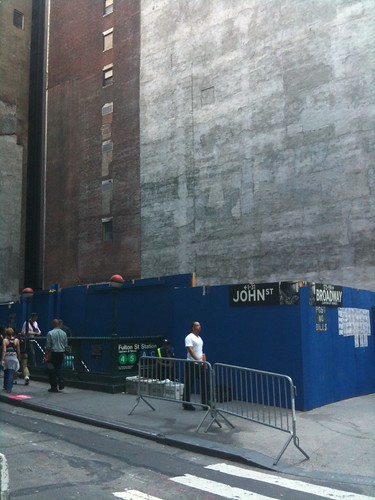
Fulton St. station at John St. (there once was a bldg there)
_____ was here (building site, John St. at the Fulton St. station, lower Manhattan)
World Trade Center Freedom Tower, nearing completion
9/11 Memorial Museum, Ground Zero under construction
World Trade Center building site, with the 9/11 Memorial Museum visible on the right
Washington Square Mews
Washington Square Mews, at night
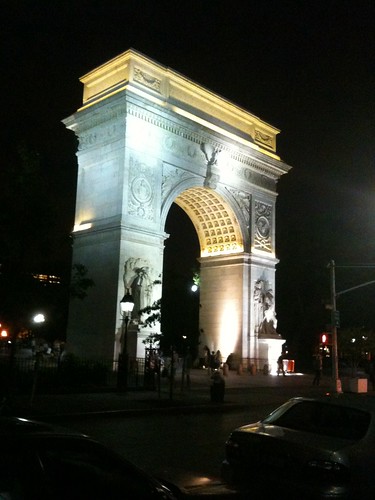
Washington Square Arch, at night
Washington Square Arch, now renovated, at night
Washington Square Arch, renovated
Washington Square Arch, by day
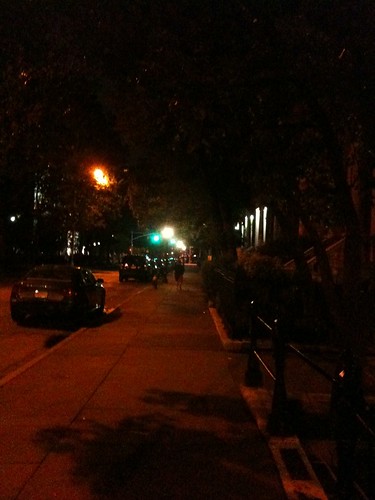
Washington Square North, at night
Washington Square North, where Henry James passed his youth, Edward Hopper painted for years, Catherine Sloper refused her suitor, Alvy Singer walked and chatted with Annie Hall....
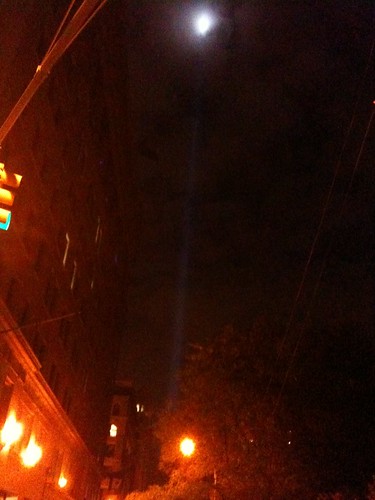
9/11 memorial lights 

Lower Manhattan, with the 9/11 memorial lights visible
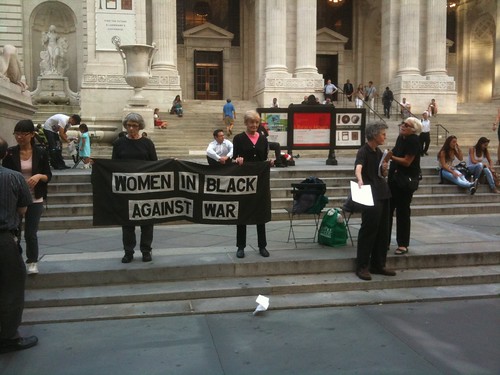
Women in Black Against War, NYPL 

Women in Black Against the War (in front of the NYPL)
Towards the Hudson River 

Beneath the High Line
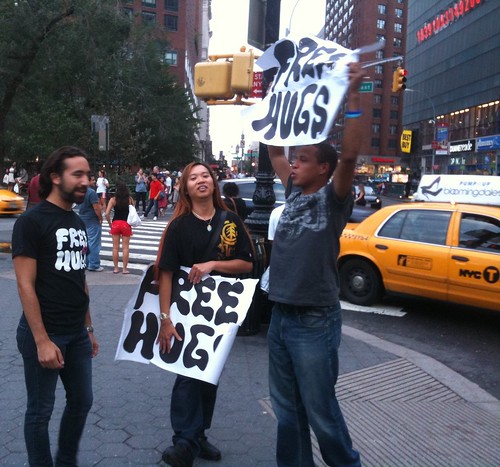
Free Huggers, Union Square 

Free huggers (but their buttons were $2), Union Square
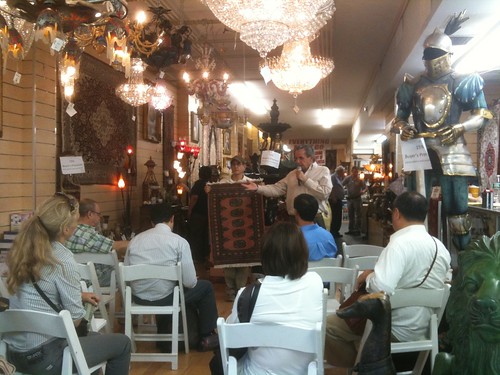
Live auction, 5th Avenue, NYC 

Live auction, 5th Avenue, near Midtown
Dancer-acrobats, Times Sq. 

Dancer-acrobats, 42nd Street Chalk drawing and its artist, Washington Square Park 
Chalk artist with drawing, Washington Square Park
photo

Con Ed worker, after a shift, 23rd St.
Delivery, 6th Avenue 

Delivery, 6th Avenue
Construction on a building, 23rd St.

Construction underway, 23rd St.
History lesson, at Harsimus Cove, Jersey City 
Historical plaque, Harsimus Cove, Jersey City
Mercer Street Books 

Mercer Street Books

Monday, September 12, 2011

Photos: Life Burning In Every Moment, Part 1

Desperate for tenants
Desperate landlord
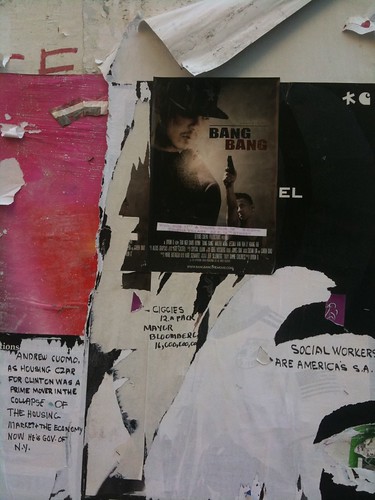
Décollage (with right-wing scribbling on it), East Village
Bang Bang (décollage with right-wing scribblings, East Village)
Shuttered Mars Bar
Shuttered Mars Bar (sic transit Gloria Mundi)
Tribute to the now closed Mars Bar
Mural tribute to the now-closed Mars Bar
Watchful eye
Watchful eye, East Village
East Village scene
East Village street scene
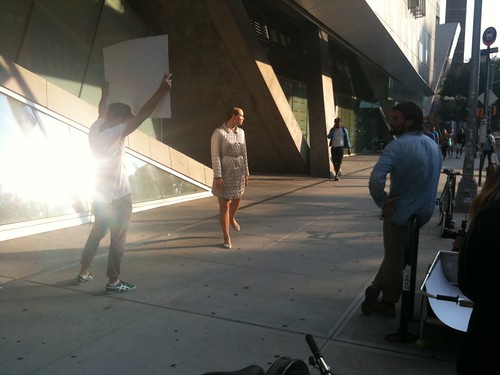
Photo shoot, outside the Cooper Union, East Village
Photo shoot, outside the Cooper Union
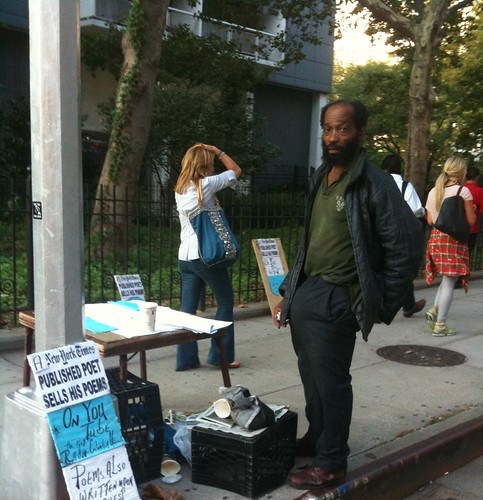
"There but for the grace of God...."
"There but for the grace of God....": West Village "Street poet," near NYU
Kumquats, on the High Line
Lafayette St.
Lafayette Street
[Z]ürcher Studio
[Z]ÜRCHER STUDIO doors
Inside Zürcher Studio
Peering inside Zürcher Studio
BMX Guggenheim Lab, East Village
BMW Guggenheim Lab, empty today, Lower East Side/East Village
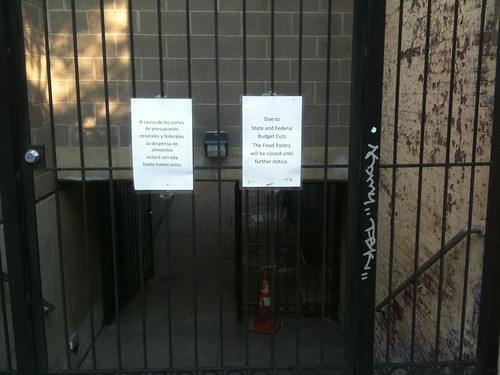
Announcement (Due to budget cuts....)
Announcement: "Due to State and Federal Budget Cuts...."
_____ used to be there
_____ used to be (t)here
Vanzilla
SUV/anzilla, near Cooper Union
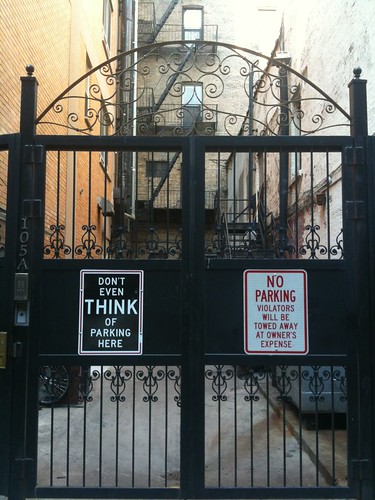
Don't Even Think of Parking Here
P E M E X - Graffiti, East Village
PEMEX'd building, East 10th St and 4th Ave.

Sunday, September 11, 2011

Quote: Paul Krugman

"But what became clear in the policy debate after the 2008 crisis was that many economists — including many macroeconomists — don’t know the simplest multiplier analysis. They literally know nothing about models in which aggregate demand can be determined by more than the quantity of money. I’m not saying that they have looked into such models and rejected them; they are unaware that it's even possible to tell a logically consistent Keynesian story. We’ve entered a Dark Age of macroeconomics, in which much of the profession has lost its former knowledge, just as barbarian Europe had lost the knowledge of the Greeks and Romans.

"As long as monetary policy could bear the burden of macroeconomic stabilization, this didn’t seem to matter too much: even as equilibrium business cycle theory became increasingly dominant in graduate study, central banks, like medieval monasteries, kept the old learning alive. But once we were hit with such a severe banking and balance sheet crisis that monetary policy hit the zero lower bound, it was crucial that the economics profession be able to weigh in knowledgeably and coherently on other possible actions. And it turned out that it couldn’t."
--Paul Krugman, from his Presidential Address to the Eastern Economic Association, "The Profession and the Crisis," in Eastern Economic Journal (2011) 37, 307–312. doi:10.1057/eej.2011.8.

9/11


Friday, September 09, 2011

Can Fiction Improve Empathy and Provoke Aggression?

One of the newer areas of literary scholarly and critical inquiry, at least over the last 10 years, has involved exploring philosophical theories of mind, cognitive linguistics and neuroscience, each distinct, related but not always commensurate fieds, in relation to literature and the arts more broadly. What also has occurred over this same period is that psychologists and brain scientists have increasingly been thinking and conducting research on how the various artistic genres function and what effects they have, in a cognitive and biological sense. (Humanists and scientists in other older fields, such as philosophers going back to Plato, have extensively examined and theorized about the functions and operations of literature and the arts; aesthetics is one of the oldest rooms in the house of Western philosophy, and factors into philosophies across the globe.) I won't dare speak to the literary scholarship involving theories of mind and cognitive neuroscience, but I found two recent articles on psychologists' studies of fiction's effects quite fascinating, not only for what they have to say about the genre's power, but also for what one researcher argues the effects this new understanding about the art form might play, especially on public policy.

Before describing the studies, let me posit that many artists and many who appreciate the arts intuitively grasp how specific artistic genres and forms work.  This is no less true for architects or dancers as it is for poets or fiction writers.  For fiction writers in particular, I would also posit that many recognize in their own experience as writers and readers what's discussed in the studies mentioned below.  As I pointed out in my July review of James Geary's fine survey I is an Other: The Secret Life of Metaphor and How it Shapes the Way We See the World (New York: HarperCollins, 2011), sometimes what we grasp intuitively is correct, that our understanding of how things, especially language, function is, if not always empirically verified or verifiable, sometimes still right at a deeper level, and yet there remains so much still hidden to us and only slowly being revealed concerning how language works; there is so much that exceeds or eludes many of the popular or dominant theories, including some long held by major scholars and critics.  As Geary's book points out, othering--making oneself an other--is constitutively wired into language; it is built into our understanding of the world through language.  As he argues quite effective, the subject of his book, metaphor, turns out to be more than a mere trope or rhetorical device, but intimately connected to our mental and bodily experience in the world.

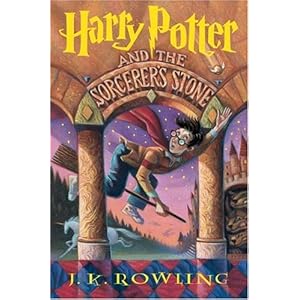
But what does this have to do with the articles I'm talking about? According to two studies recently cited in the Guardian, passages in fiction or fictional works in toto appear to "improve" and affect empathetic feeling in their readers. Concerning those fictional passages, Alison Flood relates how a University of Buffalo team, led by Shira Gabriel and Ariana Young, "gave 140 undergraduates passages from either [Stephanie] Meyer's Twilight or JK Rowling's Harry Potter and the Philosopher's Stone to read." In the former text (which I have not read), a character describes what it is like to be a vampire; in the latter, the young wizards are sorted into their respective Hogwarts Academy houses. The researchers then conducted successive computer tests, using personal pronouns and keywords, to measure identification with and as vampires, and then and as wizards. As it turns out, the study, published in Psychological Science, found that the students reading the text involving a description of vampirism were more likely to identify as vampires, while the students reading the text involving the youthful wizards self-identified as wizards. What the researchers also found was something that writers and readers have long known, which is that
"Belonging" to these fictional communities actually provided the same mood and life satisfaction people get from affiliations with real-life groups. "The current research suggests that books give readers more than an opportunity to tune out and submerge themselves in fantasy worlds. Books provide the opportunity for social connection and the blissful calm that comes from becoming a part of something larger than oneself for a precious, fleeting moment," Gabriel and Young write.
Eat your heart out, Facebook and Twitter!

In a second study Flood cites, University of Toronto psychologist and novelist Keith Oatley gave 166 readers either a translation of Anton Chekhov's actual story "The Lady with the Little Dog" (which my undergraduates and I will be reading and discussing in just a few weeks!) or a more linguistically neutral, documentary account of the plot and characters featured in the story. What Oatley found upon measuring readers' personality traits and emotions before and after the story was that those who read Chekhov's "unadulterated" story, a profound and deeply complex essay in imagination and feeling, were found "to have gone through greater changes in personality--empathising with the characters and thus becoming a little more like them," while those reading the documentary account were less likely to have done so. (I also thought of Rainer Maria Rilke's extraordinary poem "The Archaic Torso of Apollo," which lyricizes and dramatizes what this study demonstrates; the experience with the statue marks the speaker not just empathetically, but transforms him, leading to that final, arresting line: "du mußt dein Leben ändern": you must change your life, but also: you must make yourself an other/another ("other" in German is ander).)

To quote Oatley:

"I think the reason fiction but not non-fiction has the effect of improving empathy is because fiction is primarily about selves interacting with other selves in the social world," said Oatley. "The subject matter of fiction is constantly about why she did this, or if that's the case what should he do now, and so on. With fiction we enter into a world in which this way of thinking predominates. We can think about it in terms of the psychological concept of expertise. If I read fiction, this kind of social thinking is what I get better at. If I read genetics or astronomy, I get more expert at genetics or astronomy. In fiction, also, we are able to understand characters' actions from their interior point of view, by entering into their situations and minds, rather than the more exterior view of them that we usually have. And it turns out that psychologically there is a big difference between these two points of view. We usually take the exterior view of others, but that's too limited.
Or to put it another way: reading fiction allows us to enter those other lifeworlds quite deeply, imaginatively, psychologically and affectively; we become those other people, or identify with them, even if negatively.  We become part of the fictional world, even if temporarily; we change our lives, if only in the moments while in and shortly after leaving a fictional text. (I would argue this occurs in an engagement with other works of art too, as many others have written far more eloquently and persuasively than I ever could.)  A connection occurs--our inner and outer worlds fuse in the experience of reading the text, we draw upon and redraw the fictional world in our heads. And we leave it changed, even if temporarily. (Think of J. W. G. von Goethe's The Sorrows of Young Werther, and its powerful, often deleterious effects on the youth of Romantic-era Germany; think of the Victorian era concerns about the effects of fiction on young women, both good and bad; think of the Beat era's poetry and fictional narratives, which not only captured the experiences of youthful social and cultural rebellion, but provided pointers for readers. And so on.) To those who've read a bit of philosophy or literary theory of an older sort, doesn't this sound familiar?

But it's not just empathy. In the September 7, 2011 issue of Miller-McCune, Tom Jacobs describes a  Brigham Young University research team study, led by psychologist Sarah Coyne, on the relationship between fictional accounts of two types of aggression and behavioral responses.  Coyne previously conducted studies on violence and popular culture, but had not previously studied fiction, so she focused on it in this one. According to Jacobs's article, the study shows that exposure to an account of violence in literature can effect an aggressive response to provocation.  Jacobs is clear to state that Coyne's study does not claim that "reading a fictional account of an aggressive action increases belligerent behavior," but that reading fiction containing one of two types of aggression, physical, or outright physically assaultive action, and "relational," or actions that upset a person's relationship in a group, resulted in responses marked by the particular type of aggression featured in the work.  In the first study, readers of material featuring physical aggression were more likely to respond with physical aggression when provoked during a video game test; in the second study, readers of texts featuring relational aggression responded with that form of aggression when provoked in a similar virtual game. As Jacobs says:
In both cases, provoked people who were given the opportunity to engage in a specific form of retaliatory violence were more likely to do so if they had just read a fictional account of similar activity.
He again notes that reading fiction does not increase aggressiveness, but that having a scene or mental experience, even fictional, of aggression--not a mere picture or mental image, as Wittgenstein might caution us to be wary of describing it, but something more complicated and nuanced, involving neural mirroring and affect, and embedded and embodied in language--can impact our subsequent behavior.  This also parallels what Geary suggested in terms of how certain words, terms, and figuration of many kinds, can affect and effect responses in us that we do not consciously register.

I mentioned that one aspect of these accounts that interested me was the implication one of the researchers, Keith Oatley, drew from the knowledge his study provided. He argues that his is the first "empirical finding" he knows of--though, as we see, there are apparently others--demonstrating a psychological effect produced by reading fiction.  What philosophers and literary scholars have long argued, he has demonstrated through a scientifically validated experiment, i.e., an empirical method.  Professor Oatley thus thinks we could--and ought--make the case that fiction writing might have instrumental value for readers--students, everyone--and thus "economic" value, in our society.  Oatley's specific argument is that "reading fiction improves understanding of others" in that it can improve interpersonal understanding, and thus might be useful in a range of fields, including business studies, law, and so on. While I agree that reading fiction can have instrumental value, I'm not sure I would go so far as to say it "improves understanding of others," let alone for everyone, because as I see the studies, what's going on is that it might not entail more understanding, but rather something antecedent to that, which is to say, pre-rational emotional connection and empathy, or, as the latter study suggests, negative behavioral responses to provocation.

Either way, what all these studies suggest is what writers and readers know--and what Plato warned about concerning poetry, which is to say, imaginative uses, in particular forms, of language--which that literature, and fiction specifically, are more important to and powerful for and on us than they're often taken to be, even by people interested in studying them.  In that sense, then, Oatley is writing--reading fiction is certainly worthwhile, and studying what it does is worthwhile too. Learning to read it, write it, and understand its effects are also truly worthwhile. (He does not discuss it at all, but we should also be aware of another instrumental possible use of this mode of language, which Geary suggests is possible: propaganda.)  I'll only add that none of these studies look at language at the micro level; none studied syntax, meter, pacing. None studied word choice, connotation, denotation, rhetoric. None studied figuration or tropes in any way. None of the three explore the narratives morphologically.  Instead, they look only at fictional narrative in the holistic or macro level, but suggest that fictional narrative, by itself--and the range in terms of talent, skill and art between the work of Stephanie Meyer and Anton Chekhov, I will dare to say, is great indeed--has powerful effects that should be explored more, and estimated in a different way.  I cannot think of a serious fiction writer or poet I know who doesn't already.

Thursday, September 08, 2011

2011 Rugby World Cup Begins

Long time, no sports chatter here. Tonight the National Football League's season begins, while Major League Baseball's season is winding down, and I'll write more about both of those sports soon, but today, a different focus: the 2011 Rugby World Cup.  Running from September 9 through October 23, 2011, the matches will take place in various cities in New Zealand/Aotearoa, including Auckland, Dunedin, Hamilton, Invercargill, Napier, Rotorua, and the capital, Wellington.  Despite still recovering from its last, fairly recent earthquake, New Zealand has readied all the pitches and the matches will go forward.

The United States fields one of 20 teams in the tournament, and is in Pool C, with Australia, Ireland, Italy and Russia. The other pools are A, with host country and powerhouse NZ, Canada, France, Japan and Tonga; Pool B features Argentina, England, Scotland, Georgia, and Romania; and Pool D, which comprises Fiji, Namibia, South Africa, Samoa, and Wales. I am no expert on rugby and have never played it, though my high school and undergraduate alma mater had teams, and only follow it from afar, but I think I'm safe in saying two things: the United States is not a favorite to win, and outside of the upcoming 2012 London Olympics, this is one of the rare events where you'll see athletes from such countries as Georgia, Samoa, Namibia, and Tonga participating and competing against each other.

Matches begin at 8:30 pm today (already September 9) Auckland time, with the host country's famed and revered All Blacks facing off against the team from Tonga. Tomorrow Scotland faces Romania, Fiji squares off against Namibia, France takes on Japan, and Argentina challenges England. The US doesn't have its first match until Sunday, September 11 (I didn't plan this event), against Ireland at Stadium Taranaki in New Plymouth, on west coast of NZ's North Island.

Here are some very recent photos from New Zealand. Enjoy, and I'll be posting more soon.

Filipo Levi of Samoa, in Rotorua (Getty Images)
England's Shontayne Hape, surrounded by fans in Christchurch (Getty Images)

England's coach Martin Johnson inspects earthquake damage at the stadium where his team will playing in Christchurch (Getty Images)
Taniela Moa of Tonga, at Eden Park (Getty Images)
Members of the USA squad prepare to board a traditional Maori waka during the team welcome ceremony to RWC 2011 at Putiki Marae in Whanganui, New Zealand. (Getty Images)
William Servat, Nicolas Mas and Fulgence Ouedraogo line up to receive a gift at the official French team welcome at Orakei Marae in Auckland (Getty Images)
Argentina players take part in a leg stretching exercise during their training session in Dunedin (Getty Images)
Kurtley Beale of Australia's Wallabies is tackled by Nick Phipps during training for the opening match against Italy (Getty Images)
Ma'a Nonu has a reason to smile, he was handed the New Zealand All Blacks number 13 jersey for the Rugby World Cup 2011 opener against Tonga on 9 September (Getty Images)
Red letter day: The Tongan team warm up during the Captain's Run at Eden Park in Auckland (Getty Images)
Australian Prime Minister Julia Gillard talks to James O'Connor of the Wallabies during a meeting with the team in Auckland (Getty Images)
Russian Vladislav Korshunov expressed his condolences to families of those killed in the Russian plane crash (Getty Images)
Japan's Fumiaki Tanaka belts out a song for the crowd after arriving at Auckland International Airport (Getty Images)

Monday, September 05, 2011

Labor's Days or, Are Books Dead and Can Authors Survive?

James Baldwin
As I was trying to winnow down the many things I wanted to write about for today, Labor Day, I realized that I could return to something I'd touched upon before, which was to explore the fate of writing as a career in the face of the economic, political, technological, and cultural changes currently underway. After starting a few drafts of what I wanted to say, I thought to myself, this sounds so dreary and such an awful way to start off the week, especially given the recent gloomy news about no new net jobs being created last month; the strong US and European consensus around policies that will only exacerbate the ongoing economic stagnation and unemployment crisis; and the looming "jobs speech" spectacle involving the President we'll see later this week. As a result I told myself that I'd instead post some pro-labor videos, links and so forth.

But in cleaning up some of my bookmarks, I came across one from a few days ago that made me think today would be a very good day to broach an aspect of the larger topic I'd explored in my review of Jaron Lanier's You Are Not a Gadget. One of the main threads in Lanier's book concerns the fate of all industries touched by digitization and, by extension, the fate of careers linked to those industries.  I won't rehearse my reading of Lanier's important tome except to say that I increasingly see what he discusses, and in some cases decries, coming to pass.

To give one example, I think of his concern about the widespread ceding of personal expression to more automated and systematized forms of commentary, and I consider all the bloggers I used to read regularly and would love to continue following, who have ditched even periodic, personalized posts--about all sorts of things--for Facebook and now Google+ entries, Twitter quips, Tumblr reposts, and the like. (I belog to all these services, though I really only frequently post on Twitter.) Many of these linked commentaries offer glimmers of the originality the bloggers once displayed on their own pages, but they are often severely boiled down versions of what they once posted. What they gain in time, and perhaps in readership, we lose in terms of the former depth and richness of their voices. I personally want to hear what they have to say, at some length, rather than just seeing links and "Likes" and short, witty responses, but I know I'm in the minority on this.

Julia Álvarez
Perhaps the larger and most pressing concern of Lanier's book is how digitization is leading to a hollowing out of the middle classes by technoogically and structurally destroying a series of industries. This sounds alarmist, but as he shows, it is occurring no matter how much we might want to deny it.  In considering his arguments, I have been mulling the funding and thus existential crisis the United States Postal Service, a necessary and public good, whatever its flaws, now faces because of the increasing use of digital mail services, from emails to billing.  The Post Office doesn't register in Lanier's book, but its technological challenge underlines and connects to something everyone should be thinking about and trying to address. Last month, at the Edinburgh International Book Festival, as part of a debate on the "End of Books?", writer and critic Ewan Morrison took up this particular thread of Lanier's when he delivered his bracing talk entitled "Are Books Dead, and Can Authors Survive?" and his conclusions, particularly for labor and "writing" as a profession, were quite serious.

I'll recap his talk below, which appeared in abridged form in the Guardian, but first let me say that despite his title Morrison (nor Lanier) is not arguing that "books" in any and all forms are dead; as the swift transition to and rise in publication of e-books shows, the book as a concept, as an artifact, even if only digital and virtual, as a commodity, is not going to disappear. People are still reading, people are still writing, and people will continue to acquire books, for pay or for free, for the foreseeable future.  The likelihood of those dystopias where books are burnt (Fahrenheit 411) or banished (Brave New World) seems increasingly unlikely.  (Though, I will say, and elaborate in a subsequent post, if we vest everything in technologies that require electricity, what happens if the lights go off?) Concerning "cloud" books and technological control, as Amazon now wields it, Lanier has posed some important questions that Morrison doesn't raise at all, among them: who really owns--and has complete access to--not just the rights or content, but what persists of the material aspects--the text itself, in whatever form--of digital works? For, as Amazon has already displayed, it can arbitrarily remove (and thus effectively ban the sales of) books from its site and e-readers at will, but shut down the possibility of lending them out.  You buy the "book," but...who owns it, really?  I'll also note that Morrison does not press the larger argument about contemporary late capitalism and its discontents, the endless corporate push for commoditization and monopolization, and the collusion of the governments and politicians it buys (and owns) to write laws that benefit these "persons," as the US Supreme Court again affirmed they were in their Citizens United v. Federal Elections Commission ruling last year.

The common issue that concerns both Lanier and Morrison is whether the economic and cultural ecology developed over the last 100 years with publishing, and in particular literary publishing, is sustainable in light of digitization. Morrison begins his comments by stating that

Yes, absolutely, within 25 years the digital revolution will bring about the end of paper books. But more importantly, ebooks and e-publishing will mean the end of "the writer" as a profession. Ebooks, in the future, will be written by first-timers, by teams, by speciality subject enthusiasts and by those who were already established in the era of the paper book. The digital revolution will not emancipate writers or open up a new era of creativity, it will mean that writers offer up their work for next to nothing or for free. Writing, as a profession, will cease to exist.

Gertrude Stein
As grave as that sounds, his argument unfolds like this: over the last 100 years, a fairly substantial number of writers in the United States, the UK, Canada, and other developed countries could live off writing as a career. Many could live off advances, though increasingly fewer over the last 15 years have been able to do so; they could live off freelance gigs; they could live off jobs in and around the publishing industry that were buoyed by it and related and contiguous fields (journalism, bookselling, etc.).  Perhaps the heyday was the period from the 1950s through the early 1990s, and this occurred despite various global and local economic shocks, conglomeration, the shifts in distribution and bookselling. In other words, a vibrant if ever-shifting publishing industry in the West ensured that many authors at least made something off their work.  Yet as e-books gain ground, however, publishers make less money, so advances have begun to fall and publishing as an industry shrinks.  Morrison notes the moment in 2009 when British publishers, already suffering from weak sales, started cutting author advances by as much as "80%."

One result has been a return of a concern from the late 1990s, which was the fate of "mid-list" authors. When I was lucky enough to enjoy a brief Yaddo residency in the late 1990s, I recall that the New York Times and other publications were issuing dire articles about the fate of mid-list writers, and some of the more senior mid-list writers at Yaddo were concerned about their books in the pipeline and their careers. Harper Collins infamously canceled 106 contracts, many of them by mid-list authors, as part of its brutal restructuring in 1997. But by the early 2000s, this problems appears to have abated. Now, as Morrison argues, it's worsening again. Midlist writers, he points out, have often proved to be "the Research and Development department of publishers in the 20th century."  He cites Don DeLillo, but one could name such authors as the acclaimed Jonathan Franzen, for example, or Terry McMillan, whose early books, while acclaimed, were not best-sellers, but who went on to claim that mantle.

One response has been that mid-list writers have turned to self-publishing e-books or working directly with agents to publish their works, embracing Chris Anderson's "long-tail" approach to sales. In practical and commercial terms, the long tail is "Amazon and iTunes, Netflix, LoveFilm and eBay," or 40%-60% of the market, the bounty of completed works that lay mostly hidden before the appearance of online stores and rental sites like the ones above.  This shift has empowered consumers while consequently blunting, and in some cases destroying, the old hierarchy of publishers and PR firms, working in collusion with booksellers and distributors, in pre-marketing and promotion, mass marketing, and "limited shelf space for 'best-sellers.'" This is not a good thing in some ways, or that industries no longer exist, but they have less impact than they once did, and will decreasingly so, except for those already well-capitalized publishers and authors who can dominate the new online sites.

Yet Morrison makes a crucial point that echoes Lanier: few authors and publishers can survive from earnings alone in the new "long-tail" world. Some will do very well, but most will not. Why? Because of a basic fact about digitization: there remains no way to ensure that digital works can be copy-protected, and thus freely distributed, and in a world in which millions of people increasingly expect digital products to be free or available at very low costs, it will be nearly impossible to protect most digital products, no matter what their content. He cites industry after industry that has fallen by the wayside, not only in terms of the physical product itself, but, I'd argue, the entire apparatus built up around it that provided jobs, from service to white collar.

There's the film and home video industry; even just released films are now often available online for free, no matter how doggedly Hollywood, the US and other governments crack down. The music industry, which has been transformed into a shell of itself; artists now make their money through touring rather than sales, and some once best-selling musicians are lucky if they sell 1,000 or 10,000 digital copies of their work, since they're almost always free online fairly quickly. Some areas like classical music can barely produce albums anymore without subsidies. The porn industry: once a billion-dollar money-maker, pornography of all sorts is also widely free online, with homemade porn and webcams displacing the free paid videos.  The computer game industry; the newspaper industry; the photographic industry; telecommunications; even the Internet itself, which is rife with (seemingly) free services, including this blog's host; though "free" is not exactly the case, as Google/Blogger do track and monetize every byte of information passing through J's Theater and every other service they offer.

Whitman, "The Unexpressed"
(from whitmanarchive)
Publishing, and digital e-books, then, are hardly immune. First, the established publishers must watch as Amazon, Google and Apple become the dominant players. Amazon is the master marketer and merchant; Google is a master quantifier and digitizer; and Apple is the master of proprietary hardware and software. Lawsuits have hardly set any of this trio back. Anyone publishing e-books, as my observation of C's experience has shown, must reckon with each of these three behemoths, and they are steadily making it harder to gain a toehold onto their sites.  Amazon in particular has been awash in self-published texts, as well as "spam books" and pirated works; so great are the numbers that it has had to take steps to control the flow of new "books" uploaded to its site. Apple, on the other, recommends working with "aggregators," or middlemen, to surmount the numerous hurdles you encounter publishing anything on iTunes or in the iBookstore on the iPad desktop.

Besides this there's another issue: a consumer's legal and innocent downloading of copies of digital works she has already purchased means they can unintentionally or intentionally but easily end up circulating electronically, and widely (think shared servers, flash drives, cloud services, sophistical digital recording, ripping and cracking technologies, etc.); filesharing services now traffic not just in the newest songs by hit artists, Hollywood blockbusters, or gangbang videos, but in books, including fairly obscure, scholarly ones.  Writer Daniel Alarcón has written about codex book piracy in Peru and other parts of Latin America, but a far more extensive form of book piracy is already underway.  Not only Google, but anyone with a scanner or access to one can transform a print book into digital form, and upload it as a .pdf, and even the most vigilant publisher is helpless if this ends up on a filesharing service. What Morrison also underlines is that every attempt to legally address the problem of digital piracy has led to drastic lowering of costs, which he says is the "slippery slope" to free content.

Ultimately, Morrison and others see a "race to the bottom" in place now. Apple and publishers have been fighting Amazon over pricing concerns, but overall, e-books sell for far less than hardcover books or trade paperbacks, and they are an increasingly larger share of overall book sales. Moreover, as more and more people move to digital reading--and this is already happening in school systems across the US--and younger people acclimate to reading electronic and digital texts, the market for print books will continue to fall.  So what can we do? Morrison notes some alternatives, like crowd-funding; advertising; and producing apps and paid blogs.  But the feasibility of this over the long term and for as large a group of writers (or people in any of the above fields) as has been the case is small. Exacerbating this is that authors many see great personal and immediate incentive to flee the established publishers, but ultimately it is the presence of a publishing ecology, of writers working with publishers and vice versa, that protects the value of writers' labor, at least to some extent, while also providing the larger network of jobs and opportunities that we think of in relation to publishing, some of which (like working in bookstores, independent, chain or otherwise) are rapidly disappearing.

There is also the possibility of a living wage for cultural producers, including writers, but as we have seen over the last 30 years, state-sponsored socialism, even in democratic socialist countries like the Scandinavian ones, is ever under assault, and there are the numerous real-world histories and examples of what occurs when the state underwrites: it wants a say in what's produced. Sometimes this is benign, but as the example of the Soviet Union demonstrated, it can be the exact opposite.  There is the much older patronage system, which will surely return as well: the rich, though no longer titled, will commission works as they see fit. The aesthetes among them may pay for works of the highest quality; the narcissists may seek works that flatter them most; the philistines may play at shocking their class; the ultramoralists and fanatics will try to bury anything that violates their creed.  We will also see what has already long been under way: children and people of privilege, who need not be concerned with or only tangentially worry about how they'll pay their bills, can choose whatever career they like, while those without a financial base can only play the lottery of career-making and hope some combination of talent, luck, charm, and appeal win them a space.

Murasaki Shikibu
紫式部
ukiyo-e by Suzuki
Harunobu (c.1767)
Morrison believes we have got a "generation" before the "writer" as a profession is completely done with, unless we take the political step of demanding that writers get paid a decent wage for their work. Lanier argues for a more subtle and potentially effective form of monetization. I look at both proposals and wonder how either, even if enacted in parts of Europe and Canada, say, could ever occur here. In a society now deeply suffused with neoliberal and libertarian ideology, no matter how much they've failed in reality, it will be very difficult to get people to consider anything of this sort. But perhaps not impossible. You--we--never know unless we try. The same is true for unions, for regulations in general, for any liberal--other than classical or neoliberal--and progressive approaches to the world around us. That is what I think. My conversations with scholars who attest to how difficult it is to publish their work in book form; with publishers who are quaking at the changes underway; and with fellow creative writers who are endlessly seeking out routes suggest that something is afoot.  In his response to Morrison, soon-to-be-published novelist Lloyd Shepard, disagrees with all of this depressing chatter. Some of what he says is true, and optimism is a better pill than pessimism, even facing what appears to be the worst.  Yet I agree with Morrison and Lanier that digitization will only increase as we go forward, and with it, the world as we've known it, including the world of books, will continue to change too.

He concludes plaintively:
I ask you to take the long view, to look a generation beyond where we are now, and to express concern for the future of the book. I ask you to vote that the end of "the book" as written by professional writers, is imminent; and not to be placated with short-term projections and enthusiasms intended to reduce fear in a confused market. I ask you to leave this place troubled, and to ask yourself and as many others as you can, what you can do if you truly value the work of the people formerly known as writers.

On this Labor Day, this is an important--you could say a crucial, but necessary, utterly necessary--charge. Let's get to it.

Saturday, September 03, 2011

Herta Müller's Nadirs: Poetry (In Translation)

HERTA MÜLLER
(Andreas Rentz/
Getty Images)
When Herta Müller was awarded the Nobel Prize in Literature in 2009, I admit that I rolled my eyes in exasperation and thought, another obscure European fiction writer!?, when there are so many others who deserve this global honor, and could use the money on top of it?  (I was, however, glad that a woman was being honored.) I am quite capable of changing my mind on the "obscure European fiction writer" part as on many other things, though, and although I cannot claim to have read any of Müller's oeuvre in the original German (she was born in 1953 into the German-speaking minority in Nitzkydorf, Banat, Romania, during the dictatorship of Nicolae Ceaucescu, and later moved to Germany, a journey echoed in several of her works, including The Passport and Traveling on One Leg), I have now dipped into several of her books in English translation, including the two named above as well as The Land of Green Plums, and her first (published 1982 in Romania, 1984 in Germany), which was the first of hers I came across, in the university library (I later found it for almost nothing at a now-defunct Borders in Chicago), Niederungen, translated and with an afterword by Sieglinde Lug, and published as Nadirs published by the University of Nebraska Press (1999).

EXCURSUS: German speakers and readers will immediately note that Nadirs is a good but imperfect translation of the original title, which has its cognate in several very old English roots and words, including "-neath" (as in "beneath") and "nether," as in nether regions or the Netherlands (i.e., the low countries, which in French is les rendered exactly as Pays-Bas.).  Niederungen means, then, the "low things"--"ung" approximating English's gerundive "ing," or similar words with Latinate endings such as "-ion" or the Norman "-ment," with the sense of "thing" related to the root of that word and an abstracting element; think of "understanding, agreement" (G: Verständigung [understanding-thing]) or "illumination" (G: Beleuchtung [be-light-ing, light-thing], Erläuterung, Illuminierung, etc.) or "opinion" (G: Meinung [minding, mind-thing], to give three examples. "Low" or "beneath" refers to the earthy content and raw language of the stories, the lowly status of the people depicted in them, and, I think, to the fact that a female child, a person of particularly low status in the society rendered so unforgettably by Müller, tells these stories.  (I find such close but untranslatable words in every language endlessly fascinating.) If Nebraska had used as its title Netherings or Nether Things or Lowly Things or Lowlinesses, would it have had as much punch as Nadirs, which though an Arabic-derived word, nevertheless captures the sounds, rhythm, and, in English, some of the meaning, of the German?

I am still not decided on whether Müller deserved the Nobel Prize (probably yes), but that is neither here nor there because who am I but a reader? I must say, though, that her sentences, as rendered in English, and her stories and novels in toto, beguile me. They unfold in the form of a particular visionary or deeply-peering child's or adult's poetry strung together as prose texts, with plots and atmospherics reminiscent of a syntactically distilled Franz Kafka, but with the horror notch were turned up several volumes in terms of the plots.  What poetry, what strangeness!  The title story of the collection is worth the entire volume, but each piece, no matter how brief, offer something to reread more than once, though I also have found that the bleakness of this world she presents requires that I break from it periodically.  I should add that too much of this with the wrong writer comes off really sounding precious and pretentious, like an overworked, well, writing project. But Müller's novels do have plots, bizarre though they may be, and the authenticity of her alienation, as Lug aptly describes it, matches the almost childlike prose evoking the brutalities her characters live through.

A year ago, I told my graduate class about Nadirs in an effort to explicate a point about describing familial memories and personal traumas, which the book abounds in, and shortly thereafter wondered whether it was a good idea to recommend this book instead of something more, oh, conventional. But I have come to realize that anyone writing can learn from a writer like Müller, and even if her work is poles away from the mainstream of American literature, particularly American fiction, it offers ample if idiosyncratic pleasures and lessons.

Here are a few passages, translated by Lug. You will have to turn to the German to see their beauty and strangeness in the original, but I think what I'm suggesting above will, I hope, become clear.

"I wanted to get up from my chair, but my dress was frozen to the wood. My dress was transparent and black. It crackled whenever I moved. I rose and touched Father's face. It was colder than the objects in the room. It was summer outside. Flies were dropping their maggots in flight. The village stretched out along the wide sandy road. The road was hot and brown, and burned out your eyes with its glare." - from "The Funeral Sermon," p. 2

"The long alley with its wild vine, the ink-colored grapes cooking in the sun under their delicate skin. I bake sand pies, I grind bricks into red paprika, I scrape the skin off my wrists. It burns in my bones." - from "Nadirs," p. 11

"The gardens are intensely green. The fences are floating after moist shadows. The window panes glide bare and bright from one house to the other. The church tower is turning, the heroes' crucifix is turning. The names of the heroes are long and blurred. Käthe is reading the names from the bottom to the top. The third from the bottom is my grandfather, she says. She makes the sign of the cross in front of the church. The pond shines in front of the mill. The duckweeds are green eyes. - from "Rotten Pears," p. 76

"Mother lays the black silk stockings on the table. The silk stockings have thick sheer calves. They are black glass. The silk stockings have opaque heels and pointed opaque toes. They are black stone." - from "Oppressive Tango," p. 84

"My blouse is soft, its buttons are small, its buttonholes big. My skirt is like dusk and rises like fog. Tony's hands burn on my belly. My knees float apart and swim as far as my thighs are long. My belly twitches, my temples press down on my eyes. The bridge is hollow and groans, and its echo falls into my mouth. Tony pants and the grass sighs. My skirt rises up under my elbows. Tony's back is sweating on my hands. Up there in the moon, behind my hair, forgotten dogs bark and the night guard is leaning on the long wall of the chalky veins of the old mill and he sleeps. The bridge whirls around my hands, and my tongue turns in Tony's mouth.  With faltering breath Tony digs a hole into my belly. My knees are floating to the edge of the bridge. The bridge falls into my eyes. Hot slime flows into my belly and spreads over me, and seals up my breath and buries my face." - from "The Window," p. 91

"Yesterday during the night shift, a boy got his hands cut off by the five-ton press. The foreman fired a mechanic and gave him a bottle of schnapps and then screwed in the missing light bulbs. In the changing-room they caught the mechanic pouring schnapps into the boy. They pounced on the mechanic, he is in the hospital now." - from "The Intervillage Bus," p. 111

Thursday, September 01, 2011

How to Write Faster

September has wandered in, almost unassumingly, bearing on its bull's back that traditional academic greenlight, Labor Day. For many colleagues, classes have already begun, for me, they resume in a few weeks. I have gotten a jump on my two courses for this fall, my syllabi are almost done, and I'm looking forward to both.  But as always I will miss the imaginative time and space--or, as Elizabeth Nuñez once put it at writers' conference some years ago, the "dream time"--the tiny door of summer opens for attending to my own work, especially my creative work. From Monday through Friday from the time I got back until yesterday, a few short trips notwithstanding, when my golden key returned to its issuer, I daily went to the New York Public Library to write.  And read. I probably did more of the latter, but I did a great deal of the former. Even still, I have more work still to do, because I write slowly. So slowly it's sometimes frustrating.  I have always written slowly--fiction, that is.  One thing I always say to friends is that I wish I could write faster. (These truncated and sometimes semi-coherent blog posts do not count.) Especially fiction. And I'm not the only one, I see: earlier this month in Slate, Michael Agger published a charming article entitled "Slowpoke: How to Be a Faster Writer." Before I recount what he suggests, I will say there are some obvious sparks that work: a contract dependent upon finishing a book by a given deadline; help in writing the book, as in, assistants or an assembly line producing the book you stamp your name on; the academic requirement that you do so (we put the undergraduates through such paces, as I'll describe at some point in the next few weeks); or some more draconian, imminent spur, like death. And then there is graphomania, which is awful in a different way. Also: turn off the TV (very hard to do), stay away from the Internet (cf. above), and just do little but write (not possible in my line of life or work).


When I say writing fiction faster, I don't mean churning out...whatever. I'll say no more about that, but we can all identify candidates to fill that profile. I mean rapid writing that produces high quality work, high quality fiction--writing as fast and as good as, say, Roberto Bolaño (1953-2003), who was admittedly facing imminent liver shutdown when he managed to polish (though he considered it incomplete) 2666 (2004) off, and to a high sheen.  Bolaño wrote about 13 or so books in 10 years, some of the monumentalities like The Savage Detectives and, well, the nearly 1000-page diamond mentioned above, 2666. I think of J. M. Coetzee, who issues a superb novel every 3-4 years or so. To give an example, between 1980 and 2003, he produced: Waiting for the Barbarians (1980), Life & Times of Michael K. (1983), Foe (1986), Age of Iron (1990), The Master of Petersburg (1994), The Lives of Animals (1999--this later became the central chapters of Elizabeth Costello), Disgrace (1999), and Elizabeth Costello (2003). Many very fine writers would produce ONE such book in 10 years. And, Coetzee doesn't repeat himself, or write variations on the same book as some great authors (Bolaño, for example, or Patrick Modiano, David Markson, etc.) do. But he is an exceptional case. Nevertheless, many other writers do come to mind.  Alice Munro, Gabriel Garcia Márquez, Samuel R. Delany, Juan Goytisolo, Jennifer Egan, Haruki Murakami, John Edgar Wideman, Jorge Volpi, etc Two younger very productive fiction writers I know are Tayari Jones and Renee Gladman. They write at a very high level, produce work that echoes no one else, and they aren't rewriting the same book. They make butter but they don't churn.

Against the examples of those who write a lot and quickly and well, there have of course always been the examples of those who write or wrote not so much but quite well. Among the fiction crowd, some who come to mind would include: Scott Fitzgerald, Elias Canetti, Jeffrey Eugenides, Witold Gombrowicz, Jorge Luis Borges, etc. One might also mention a late bloomer like Toni Morrison, who nevertheless has published 9 or so novels, of which 5 (The Bluest Eye, Sula, The Song of Solomon, Beloved, Jazz) I think are very good to exceptional (I haven't yet read A Mercy, I must confess). These writers exemplify the take-your-time-but-get-it-right camp. Or that's one way to read their fictional careers, and I champion it. Tortoise and hare. Take your time. Quality, not quantity, though I think it's fair to say that what's usually rewarded is quality in great quantity, though great quantity with bursts of quality also goes a long way too.

But back to Agger: he first reads Malcolm Gladwell's (ugh!) Outliers and comes across the "10,000-hour rule", the temporal hurdle beyond which one begins to achieve mastery.  I'll do the math for you: that's 417 days worth of writing (or playing the tuba or studying Chinese flash cards or anything else). 24/7/417. Which is to say, a little over a few years or so in reasonable-person time. Agger is frustrated, so he follows a lead Gladwell offers to Saint Louis University professor Ronald Kellogg's The Cambridge Handbook of Expertise and Expert Performance, which doles out all kinds of expertise-laden suggestions about writing and anything else requiring expert performance.  Professor Kellogg underlines what anyone who writes regularly knows--writing is difficult, writing long(er) works is difficult, writing anything of quality is difficult. DIFFICULT. What else does he say?  Some people are Beethovians who compose rough drafts to get things out, others are Mozartians who plan out and delay composing/writing to let the ideas steep. Productivity is equal for both styles. Also: more concrete writing is more memorable, to you and the reader (pace Clarice Lispector). Getting paid for what you write works. See above. Take notes before you write something but don't looking at them as you write. Binge writing is bad, regular writing on a schedule is very good. (A friend once wowed me with an account of how the very productive Caryl Phillips would go hole up in a hotel and bang out a book, then go do exciting things for months on end. Cf. the dole, which is non-existent in the US. So, regular writing alongside whatever else you have to do to make a living.)

Professor Kellogg's trove continues: "Knowledge-crafting" is that state at which the writer is able to be both artist, editor, and reader-reviewer.  You are in your creative zone; you know what works and are able to apply it as you write; and you have a grasp of how it will look at the end. What Kellogg doesn't say is that this often comes in revision, but if you get it right earlier rather than later, so much the better.  But above all, to get to the "knowledge-crafting" state, write regularly, avoid distractions, give yourself breaks, have realistic goals and deadlines, and "maintain low emotional arousal." I.e., if something is stressing you, it's not good for your writing. And, something I advise and do stick to, if you are a writer: you should always be reading, because it gives you a storehouse of knowledge and information to draw upon.  Unfortunately, Agger doesn't receive any shortcuts to writing faster. But what he gains, as does anyone who has read the précis above, is some tips for making his writing a more regular and potentially effective process.  Still: how to write faster? I know, there's always Nike's dictum: Just do it....