Monday, July 23, 2018

2018 Rugby World Cup Sevens in SF

US wing Perry Baker (right) scoring a brace
against Wales, July 20, 2018.
Rugby--though I never played this British invention, despite my high school actually having a team (and a good one), I am a huge fan of the sport, and in the past have posted about the Rugby World Cup, whose next edition arrives in 2019, in Japan. That World Cup will feature the globe's best 15-man rugby teams. (There is an 15-woman squad Rugby World Cup as well, whose next championship will be in 2021). The 2016 Olympics in Rio de Janeiro, though, offered a faster, smaller version of the international game, Rugby Sevens, with 7 players and different, streamlined rules from standard 15-person rugby union play. As a result, Rugby Sevens matches are briefer affairs, and often feature far more thrilling runs up and down the field, eliminating some of the slog and stasis of standard rugby, which is not without its charms too.

South African star Siviye Soyizwapi (left)
racing into the end zone for a try, and finishing as
co-top Rugby World Cup Sevens try scorer
I had not realized until C alerted me to it that this year's Rugby World Cup Sevens were underway this past weekend in San Francisco, but he managed to record the final day's key matches, capturing the championship and other key matchups. In this year's Cup, 24 men's teams and 16 women's teams competed at San Francisco's AT&T Park in games that were structured to take place over a three day span. I was a bit amazed when I first saw how tightly scheduled the competition was, especially compared, for example, to recent tournaments like the recent FIFA World Cup in Russia, or the Wimbledon All England Tennis Tournament. In this tournament, the games were pegged and structured that they flew past without any hitches; the women's championship took place on the 21st, followed by the men's on the 22nd, with various lower-placement and bowl matches artfully dovetailed in.

All Blacks Sevens star Joe Ravouvou, diving
for a try, and finishing as co-top Rugby
World Cup Sevens try scorer
The host US's Sevens squad played with panache throughout, though they finished 2-2. Entering the tournament as the 5th seed, having won a 2016-17 tournament in Dubai, they advanced in the Championship round of 16 by defeating past champion Wales 35-0, then lost to England in extra time 24-19. That sent the US to the fifth place bracket semi-finals against Scotland, which it defeated 28-0, before the team lost to Argentina 33-7, finishing in 6th place. In the opening game, center Martin Iosefo, forward Danny Barrett, and young speedster wing Carlin Isles all scored tries, as did star wing Perry Baker, who scored twice. Longtime team captain Madison Hughes made all five conversions. Against England, the US was behind 7-12 yet couldn't close the gap; by game's end, Hughes, scrum-half Folau Niua and Baker scored, but Hughes managed only two of the conversions, the game concluding with a 24-19 loss for the Americans.

The US's Martin Iosefo, in white, during his breakaway
run in the US-Argentina game, July 22, 2018
In the penultimate shut-out match against Scotland, Maka (KK) Unufe, Hughes, Stephin Hughes, and Isles all scored tries, with Hughes converting each. The US dominated and looked like a team that could have gone nearly all the way, but for the loss to England. Against Argentina, however, the US again struggled to score tries, while being dominated by the stronger and faster Argentinian squad. By half time the US was down 0-19. In the second half Iosefo, who entered as a substitute scored for the US, with Stephin Thomasin converting for the extra point, but it was hardly enough to make up for Argentina's two subsequent tries and conversions, and the final score was 7-33, giving the US a 6th place finish.

Fiji's Sevuloni Mocenacagi, after scoring his try
against South Africa in the Bronze final, won by
South Africa, 24-19, July 22, 2018
In the men's final, for the Melrose Cup, powerhouse New Zealand defeated England 33-12, with South Africa finishing third and Olympic champion Fiji finishing 4th. This was the All Blacks Sevens' third win and second straight in World Rugby Cup Sevens, once again making them the only team to have won the tournament more than once, and the only team to have won it three times. Other than South Africa, other teams from that continent did not fare so well; Kenya finished 16th, Uganda finished 19, and Zimbabwe 23, defeating the last place team this time, Jamaica. Several of these countries, Kenya in particular, demonstrated in the Olympics, however, that they have the talent to give any team a challenge, so it will be exciting to see what the 2022 edition brings.

All Blacks Akuila Rokolisoa sprinting towards
the end zone in the Championship game
against England, July 22, 2018 
All Blacks Akuila Rokolisoa after his
try during the Championship game
against England, July 22, 2018 
All Blacks Akuila Rokolisoa celebrating
after his try in the Championship game
against England, July 22, 2018 
The women's final pitted New Zealand against France, with the All Blacks Sevens winning 29-0. Australia's team finished 3rd and the host US squad finished 4th, after 3rd place finishes in the two prior Rugby World Cups of 2009 and 2013. The US, as host, had an automatic draw, and was ranked 5 in the draw, below Australia and Canada, but as they had shown in prior World Cups, played with brio, defeating China 38-7 in the round of 16, then Russia 33-17 in the quarterfinals, before losing to the All Blacks Sevens 26-21 in a close match in the semifinals and Australia 24-14 in the bronze medal match. The US women in fact were the only team that posed any real challenge for New Zealand. In rugby sevens as in 11-person rugby, whether among the women or men, New Zealand's All Blacks remain the team to beat.

New Zealand's Portia Woodman (center),
breaking a tackle by France in the women's
Championship game, July 21, 2018

Wednesday, July 11, 2018

Quote: Subcomandante Marcos

"Indigenous Brother, Sister:
Non-Indigenous Brother, Sister:

We are here to say we are here.

And when we say 'we are here,' we also name the other.

Brothers and sisters who are Mexican and who are not Mexican.
With you we say 'we are here,' and we are with you.

We are a mirror.

We are here in order to see each other and to show each other,
so that you may look upon us, so you may look at yourself, so that
the other looks in our looking. We are here and we are a mirror.

Not reality, but merely its reflection.

Not light, but merely a glimmer.
Not path, but merely a few steps.
Not guide, but merely one of the many routes which lead to
tomorrow.

Brother, Sister, Mexico City:

When we say 'we are,' we are also saying 'we are not,' and 'we
shall not be.'
-- Subcomandante Marcos, from Professionals of Hope: he Selected Writings of Subcomandante Marcos, Afterword by Gabriela Jauregui, Brooklyn: The Song Cave, 2017.

Saturday, July 07, 2018

FIFA World Cup Photos & Faces

UPDATE: France wins the 2018 FIFA World Cup in Russia, defeating Croatia 4-2 on an own goal by Croatia's Mario Mandzukic (18') , a penalty kick by Antonine Griezmann (38')and two beautiful goals by Paul Pogba (59') and Kylian Mbappé (65'). Croatia's goals were by Ivan Perisic (28') and Mandzukic (69'), who leapt on a major snafu by France's goalkeeper Hugo Lloris. Croatia dominated the game from start to finish, but France pounced on several chances it got, ensuring itself a championship and giving fans a glimpse of the immense talent the team possessed this year, and will have for a few more World Cups to come.

***

In past years I've provided some imagery to illustrate the World Cup and other major sports competitions (rugby!), so here are a few more photos from the matches. Enjoy!

Dylan Bronn (TUN) trapping the
ball while facing Dele Alli (ENG),
Group G match, Volgograd, June 18, 2018
(Ryan Pierse/Getty Images Europe)
England's players (Lingard, Maguire, Sterling,
Alli, Trippier, Kane) walk out for second half
vs. Sweden, July 7, 2018, in Samara
(Alex Morton/Getty Images Europe)
Midfield Kylian Mbappé before France's
game with Uruguay, July 6, 2018
(Getty Images)
Samuel Umtiti (FRA) battling Paolo Guerrero (PER)
for the ball, June 21, 2018
(Laurence Griffiths/Getty Images Europe)
Nacer Chadli (BEL) tries to control the ball
while facing off against Gabriel Jesus (BRA),
July 6, 2018, in Kazan (Kevin C. Cox/Getty Images Europe)
Brazilian players showing dejection after Belgium
goes up 1-0 off Fernandinho's own goal
(l-r Gabriel Jesus, Alisson, Thiago Silva, Fernandinho,
Marcelo, Miranda, Paulinho, Willian), July 6, 2018,
Kazan (Kevin C. Cox/Getty Images Europe)
Nigeria's Bryan Idowu, John Obi Mikel and
Oghenekaro Etebo rush to protect the goal
against Argentinian supestar Lionel Messi
in Nigeria's Group D match against Argentina
in Saint Petersburg, June 26, 2018
(Francois Nel/Getty World Images)
Philippe Coutinho (BRA), on the right, races
to keep Romelu Lukaku (BEL) from controlling
the ball, July 6, 2018, in Kazan
(Catherine Ivill/Getty Images Europe) 
Belgian star Romelu Lukaku embraces French former
World Cup champion player and superstar Thierry
Henry, Belgium's assistant coach, after defeating
Brazil in Kazan, July 6, 2018
(Catherine Ivill/Getty Images Europe)
Bryan Idowu (left) and Alex Iwobi (middle) of Nigeria
try to keep Croatia's Luka Modric from reaching the ball
in the Group D match between Nigeria and Croatia,
Kaliningrad, June 16, 2018 (Francois Nel/Getty Images Europe)
Hector Herrara, Jonathan Dos Santos and Hirving Lozano
after their loss to Brazil, July 2, 2018, Samara
(Matthias Hangston/Getty Images Europe)


Cristiano Ronaldo reacting during Portugal's match
against Uruguay, June 30, 2018, in Sochi
(Julian Finney/Getty Images Europe)

Friday, July 06, 2018

2018 FIFA World Cup in Russia

UPDATE 2: France wins the 2018 FIFA World Cup in Russia, defeating Croatia 4-2 on an own goal by Croatia's Mario Mandzukic (18') , a penalty kick by Antonine Griezmann (38')and two beautiful goals by Paul Pogba (59') and Kylian Mbappé (65'). Croatia's goals were by Ivan Perisic (28') and Mandzukic (69'), who leapt on a major snafu by France's goalkeeper Hugo Lloris. Croatia dominated the game from start to finish, but France pounced on several chances it got, ensuring itself a championship and giving fans a glimpse of the immense talent the team possessed this year, and will have for a few more World Cups to come.

***

UPDATE: England won their match against Sweden 2-0, so the quarterfinals are nearly set: France against Belgium, and England vs. Croatia, which went down to the wire, i.e., penalty kicks, against the wily Russian team!

France's Kylian Mbappé (right) controls the ball
against pressure from Uruguay's Lucas Torreira
(AFP)
As we near the end of the first week of July, the major tournament, the 2018 version of the FIFA World Cup, for the world's reputedly most popular sport, soccer--or (association) football outside the US--also approaches its end. Taking place across the vast nation of Russia, it has been a smoothly run and mostly scandal-free set of matches thus far, beginning with the opening group games that pitted 4 teams each against each other to decide who would advance to the knockout round. Although there were questions about Russia's efforts to secure the World Cup, much akin to previous financial controversies that have plagued FIFA, this World Cup has run perhaps more smoothly than the 2014 Winter Olympics in Sochi, which seemed to be in danger of featuring unfinished venues and the target of potential attacks right up to the moment when they went off without a hitch, or the 2014 edition in Brazil, which unfolded as the country was entering a several economic crisis.

Antoine Griezmann & Kylian Mbappé of France
(TASS via Getty Images)
For the first time in several World Cup meetings, the United States did not qualify, but neither did a few of the world's perennial soccer powers, including 4-time (1934, 1938, 1982, 2006) prior winner Italy, nor Chile or the Netherlands. FIFA's ranking tables included most of the entrants numerically, in descending order (skipping the teams that did not make it): Germany (1), Brazil (2), Belgium (3), Portugal (4), Argentina (5), Switzerland (6), France (7), Poland (8), Spain (10), Peru (11), Denmark (12), England (12), Uruguay (14), Mexico (15), Colombia (16), Croatia (20), Tunisia (21), Iceland (22), Costa Rica (23), Sweden (24), Senegal (27), Venezuela (33), Serbia (34), Australia (36), Iran (37), Morocco (41), Egypt (45), Nigeria (48), Panama (55), South Korea (57), Japan (61), Saudi Arabia (67), and host Russia (70). Fortunately for fans--well, soccer fans in general--the rankings often correlate to teams' presence in the World Cup, which they achieve by winning regional association matches, but they do not guarantee success at the World Cup.

A distraught Neymar Jr.,
after Brazil's loss to Belgium
(AFP/Getty Images)
In the first round matches, this World Cup provided a few shockers. First, in Group F, South Korea's and Mexico's victories over Germany knocked the top ranked team and the 2014 World Cup victor out of the tournament; other top ranked teams that failed to advance included Costa Rica, Peru, and Poland. First time participant Panama also was sent off the pitch, as were the scrappy footballers from Iceland, who became fan favorites in part because of the tiny size of their country compared to many of the other competitors, and the Super Eagles of Nigeria, who carried the hopes of their country and much of sub-Saharan Africa on their shoulders, but only finished with three points, or one win and two losses. (What was not known was that Nigeria's captain, Jon Mikel Obi, was playing the Argentina match while keeping silent about the fact that his father had been kidnapped in Nigeria and ransomed for $28,000; his father, thankfully, was released several days later.) On the other hand, standout teams were Uruguay, Croatia, and Belgium, Brazil, Denmark, and France all advanced to the knockout round, as did host Russia, which was in the weakest group, A, yet played quite well, amassing 8 goals, the second-most of the round, tying it with England, and playing with forceful enthusiasm. Both Spain and Portugal showed signs of vulnerability, yet both also went onwards to the round of 16. Argentina, with its superstar Lionel Messi, barely did so after tying Iceland, losing 3-0 to Croatia, and slipping past Nigeria 2-1.

Belgium's Kompany (in air at right),
heads the ball which ricochets off
Brazil's Fernandinho (17), for an own goal
(Frank Augstein/Associated Press)
The second round proved to offer more shockers; France dispatched Argentina 4-3 on two decisive goals by its 19-year-old shining light Kylian Mbappé, thus sending the Albiceste back to Buenos Aires,  perhaps concluding Messi's World Cup career. Uruguay beat Portugal, perhaps closing out the career of the Portuguese Selecção's world famous Cristiano Ronaldo. Belgium played a lethargic match against Japan, which shone for nearly the entire time, yet the Diables Rouges came back to send the better team packing with a stoppage time winner and 3-2 score. Mexico, another fan favorite, lost to Brazil 2-0, and up through this game, the Brazilians displayed their trademark jogo bonito, showing brilliance at times in their passing and footwork, though they did not seem to be as eager to score as some of their opponents. Another huge surprise with the large number--three--games decided by penalty kicks, which aided the lower-ranked Russia to knock off Spain 4-3 in PKs, which sent shockwaves through the stadium. England triumphed over Colombia 4-3 in PKs after its goalie's heroics, and Croatia, the tournament's sleeper team, defeated Denmark 3-2 in PKs after 1-1 score.
Colombia's Yerry Mina (13) celebrating with
teammate Dávinson Sánchez (23) after scoring
against Poland (Thanassis Stavrakis/AP)

We are now in the quarterfinals, and so far, France and Belgium are giving every sign of providing the side of the draw that will produce in the eventual victor. In France's case, in addition to Mbappé, its veteran goalkeeper Hugo Lloris has been stellar, and shut down an evenly matched Uruguayan team to preserve the 2-0 victory achieved by defender Raphaël Varane heading the ball in (on a beautiful pass by forward Antoine Griezmann) and by Griezmann on a pass by forward Corelin Tolisso. So evenly matched were the teams that both France and Uruguay took 11 shots, with 2 of les Blues on target vs. 4 from the Uruguayan side; each team had nearly the same number of fouls (17 for Uruguay, 15 for France); and each received 2 yellow cards. The difference was France's control of the ball, at 62% of the match, and the skill of its defense (Lucas Hernández, Samuel Umtiti, Varane, and Benjamin Pavard) in shutting down Uruguay's threats, while maximizing its few opportunities. Mbappé, Griezmann, Varane, Tolisso, and the rest of the French team constitute one of the best squads the country has fielded since its World Cup victory in 1998, and if they get past Belgium, they could and should win it all.

South Korean players (in red) in shock after defeating
Germany (in green) (Dylan Martinez/Reuters)
While Belgium played without brio against Japan, it came out in full force against Brazil, whose star, Neymar Jr., had begun to spur memes because of all of his histrionic diving and flopping around, though he was legitimately being pushed around during Brazil's opening match against Switzerland. The referees seemed to be averse to calling any penalties against Belgium whenever Neymar and his teammates ended up crumpled on the field, so Brazil would have to recalibrate and deploy its dazzling skill work to manufacture goals. Unfortunately, despite putting on a clinic in the first half, the Brazilian team could not seem to convert chances, and found itself down 2-0 on an own goal by defense Fernandinho, one of the goats of the 2014 tournament, offer a header by Belgian star Vincent Kompany, and a stunner by Kevin De Bruyne that Romelu Lukaku had set up. Brazil led in shots, 27-9, shots on target 9-3, in possession 59%-41%, and in corners 8-4, yet repeatedly failed to follow up on loose balls or potential scoring opportunities. Renato Augusto finally did score in the 76th minute on a pass from Philippe Coutinho, but it was too little, too late, and now the objectively best remaining team heads home. For its part, Belgium stretched Brazil's defense wide open enough on quick runs up field to create the opportunities that gave it the 2-0 lead, and looks to be a danger in the France game and if it heads to the finals. Brazil's exit was not as shameful as 2014, but once again, despite its impressive talent, the Seleção seemed less interested in winning than in putting on a show. The two, I hope someone reminds Brazil, are more than compatible and what many a soccer most wants to see.
Nigeria celebrate after scoring a penalty
kick against Argentina (Reuters)
The remaining match-ups, on the weaker side of the draw, are intriguing: both England and Sweden have played above their rankings,  but the Three Lions' squad has the edge in talent and defense, with the x-factor striker Harry Kane, who has been the team's standout player and converted a number of opportunities so far. It also has some of the better younger players in the tournament, chief among them midfielder Dele Alli, defender Harry Maguire and goalie Jordan Pickford. If England can stay on the attack and open up Sweden's defense, the game is theirs. Russia's host nation fairy-tale effect has taken it quite far (cf. the US, South Korea, France, etc. in past tournaments), but Croatia has shown itself to be of the best teams in the tournament and will put the home field Sbornaya to the test. The Blazers have played unflappably so far. Russia's play has been a bit heavy-handed, so one question will be whether the referees decide to call fouls and dole out yellow cards--or in some cases, red cards that should have come but remain in pocket--which they've seemed reluctant to, which could work in Russia's favor in knocking Croatia's scorers off their game. I should add that given the tensions now besetting the Russian-US relationship, and all of the mounting evidence in the alleged Trump-Russia criminal conspiracy, Croatia has my support in this match-up.

Brazil's players stretch Danilo during a training
session on July 3, 2018 (Andre Penner/AP)
A few final points I want to make are that at a time of increasing ethnonationalism across Europe and the US, as well as across the globe, it has been encouraging to witness once against the more racially and ethnically diverse "national" squads perform with aplomb, belying the discourse, promulgated by far-right and anti-immigration parties like the British National Party, Alliance for Germany, National Front, League of the North, etc., that cross-racial and ethnic diversity are a bad thing, that unity and cooperation, even temporary, is not possible and that their their teams are somehow weakened by "impurity." Former colonial and imperial powers France, Belgium and England (UK) would not be where there are in this tournament without their Black, Arab, and mixed-race players. There have been articles about the anger anti-immigration and white nationalist soccer fans have felt about the mixed-race cast of their teams, so it has been especially satisfying to see those teams--save Germany, which crashed out early--kick and shoot their way to the trophy. These teams' successes may be mostly symbolic, and does little to dismantle the underlying structures and systems that enable racism and white supremacy, nor do they provide any answers to the economic and political crises fueling the international migration flows, yet they do represent a publicly visible and global counterweight to the illiberal discourse that is increasingly sweeping across the West and other parts of the globe.

A victorious Belgium celebrate their
defeat of Brazil (AFP)
A second point is that the US, when it reappears in the World Cup, will have to overcome a considerable gulf in terms of coaching, development and skill levels to be competitive. This year's top teams, most European other than Brazil, have played with a sharpness I don't see the US yet able to achieve, but given the depth of US soccer talent, with the right coaching staff and the best players, the US could conceivably go as far as it dreams. The same is true for the African squads, and, as Japan displayed, Asia's best teams too, but between national developmental programs and the European leagues, European teams still have the advantage for the time being.

Thursday, July 05, 2018

Andrés Manuel López Obrador (AMLO) Wins Mexican Presidency

Andrés Manuel López Obrador speaks
at a press conference in Mexico City, July 3,
2018 (Photo: Manuel Velazquez/Getty Images)
from New York Magazine
Three times can sometimes produce a seismic charm, or so it appears for Andrés Manuel López Obrador (AMLO) (1953-), who was finally elected President of Mexico on July 1, this past Sunday. Though a longtime member the leftist Partido de la Revolución Democrática (Democratic Revolution Party, or PRD) and a failed candidate in the contested 2006 and 2012 national elections, AMLO, a former Governor of the Federal District, ran under the aegis of a new left-leaning coalition, Juntos Haremos Historia (Together We Will Make History), that comprised the progressive Movimiento de la Regeneración Nacional (National Regeneration Movement/MORENA) and Partido de Trabajadores (Labor Party/PT) parties with a socially conservative party, Partido Encuentro Social (Social Encounter Party/PES). AMLO will assume office on December 1, 2018, which, given Mexico's current parlous state, will not be a moment too soon.

AMLO's chief rivals in this year's presidential election were Ricardo Anaya of the Partido Acción Nacional (National Action Party/PAN), the center-right party of former president Vicente Fox (who served from 2000-2006) an antagonist of US Republican presidents George W. Bush and Donald Trump; José Antonio Meade of the Partido Revolucionario Institucional (Institutional Revolutionary Party/PRI), the neoliberal, longtime ruling party to which incumbent president Enrique Peña Nieto (2012-2018) belongs; and two independent candidates, Jaime Rodríguez Calderón, who had previously become the first independent candidate to win a state governorship when he helmed Nuevo Leon; and Margarita Zavala, a noted lawyer, and the wife of former president and PAN figurehead Felipe Calderón (in office from 2006-2012).

In essence, AMLO was not just leading a visibly left coalition but represented the only left-leaning option for Mexican voters in this presidential election. As the campaign progressed, Mexico's political and social elites grew increasingly alarmed, and perhaps rightly so. Yet the hiccuping economy, metastasizing violence, which even marked the lead-up to the election, and continuing allegations of extensive, high-level government corruption, blunted the right's blizzard of "Mexico will turn into Venezuela"-scare tactics, some with racist and classist tones, including advertisements, robocalls, videos, and social media attacks, not unlike ones that had doomed AMLO's chances in the prior two elections.

In one instance, a PRI operative named Enrique Ochoa Reza tweeted that PRI politicians who switched parties to MORENA were "Prietos que no aprietan" (Dark-skinned/black people who can't get a hold), playing on the double meanings of "moreno/a" (brown/black man/woman) and "prieto" (dark/black person), as well as the feminine form of the former word (morena=brown woman/black woman) and the verb aprietar (not being able to keep somebody). Ochoa Reza did apologize for the racist aspect of his slur, but not the misogynistic one. Additionally, there were allegations of US and Guatemalan meddling in the campaign, and Ochoa Reza accused Russia of interfering on behalf of AMLO, a charge the eventual victor laughed off.

The attacks, however numerous and outrageous, could not overcome Mexican voters disgust at the current state of affairs. AMLO won in a landslide, defeating Anaya by 21 percentage points while winning 53% of the total vote and popular vote. The final tally in an election that saw a 63.6% turnout (or 56.6 million voters out of 89.9 registered voters) was as follows, with AMLO winning 31 of Mexico's 32 states, and the first outright majority for a presidential candidate since 1989:

2018 Mexican Presidential Candidate & PartyVote Total
AMLO (National Regeneration Movement/Juntos Haremos Historia)30,112,109
Ricardo Anaya (PAN/Por México al Frente)12,609,472
José Antonio Meade (PRI/Todos por México)9,289,378
Jaime Rodríguez Calderón (Independent)32,743
Margarita Zavala (Independent)31,983

While his ideology has long been diametrically opposed to what we see with a figure like Donald Trump, they share a vocal populist nationalism, AMLO's rooted in the left and democratic socialism instead of Trump's ethnonationalist and racist authoritarian approach. What this might mean for the cozy relationship between Mexico's large corporations and land owners and the government and for an approach to a renegotiated North American Free Trade Agreement (NAFTA) that privileges international structures and rules over the country's laws remains to be seen, but given the Juntos Haremos Historia/MORENA's capture of 312 of 500 seats in the Chamber of Deputies, and the strong popular mandate for the coalition and new president, AMLO could throw wrenches in Mexico's steady march towards privatization and economic (classical) liberalization, in favor of policies that more effectively and immediately address the rising economic inequality and insecurity that millions of Mexicans are facing.

During the campaign AMLO announced that he would push to reform some of the perks of the presidency, including cutting his salary and that of top officials, selling presidential planes, creating a public park out of the presidential grounds, and ending the lifetime pension former presidents receive, with the savings being directed towards Mexican seniors, who have a far less secure and comparatively robust retirement savings system than US's fixed pensions, 401K savings plans, and Social Security (which itself is admittedly always under threat from US conservatives and neoliberals). He also attacked the International Monetary Fund as an enabler of and participant in Mexico's corruption, suggesting he might pull back not just from the IMF but from other international financial systems that have long kept Mexico under yoke. One key question would be how projected new NAFTA negotiations might change as a result of this approach.

As Nathaniel Parish Flannery argues in a recent Forbes article, "The AMLO Era: Why Mexico's 2018 Election Matters," nearly half of Mexicans live in poverty, and despite the country's prowess in manufacturing, wages remain abysmal. Stemming governmental corruption and addressing the country's sluggish growth rate, rising economic and social inequality, the persistent lack of jobs in the formal economy, and low, stagnant wages across all labor sectors could have beneficial, ramifying effects on all aspects of Mexican society. The question for AMLO and Mexico's congress is how to spur all of this such that all the wealth does not continue to flow upwards to the relatively tiny sector of rich elites. Strategies to create a viable and vibrant middle class, which would necessitate a retreat from the neoliberalization of the prior PRI and PAN administrations, transformed tax and business policies, support for public education and farmers, and a strengthened safety net, could be among AMLO's and the new left-leaning Congress's potential steps.

Some of this, beyond NAFTA talks, will hinge on the "new relationship" AMLO has vowed to forge with Mexico's often domineering neighbor the United States. While the US and Mexico are among each others' largest trading partners and cooperate extensively in a range of areas, the two current leaders, Trump and Peña Nieto, have been at loggerheads, in part because of Trump's persistent attacks on Mexico and Mexicans, beginning the day he announced his presidential campaign and slandered Mexican immigrants, and because Peña Nieto understandably has refused to pay for Trump's desired border wall. AMLO has already challenged the border wall idea in a pamphlet he published, entitled Oye Trump (Listen Up, Trump). One goal AMLO outlined was development of Mexico's "internal market," so that "Mexicans can work and be happy where they were born, where their family is, where their customs and cultures are." Creating an expanding middle class is crucial to ensuring this market can flourish, and to transforming the migrant flows.

Another challenge for AMLO will be to figure out a way to lower the violence that has plagued Mexico. Neither Calderón's nor Peña Nieto's approaches worked; corruption remains endemic at all levels, and organized crime is strong as well. In addition, since September 2017, 130 political figures, from the municipal to the national level, have been murdered, and journalists across Mexico have been targeted for investigative and critical work. AMLO supposedly has suggested amnesty for low-level drug offenders, which sparked criticism, but it also is the case that Peña Nieto's initial policy approach of militarized attacks on the cartels failed, as did prior attempts to negotiate with organized crime. Rising pay for all workers, and better wages for domestic security and military forces could help to thwart the power of organized crime to infiltrate them, but AMLO also has suggested a "peace plan," involving human rights organizations, religious organizations, among others, to negotiate a decline in the murder rate.

I see less of a parallel with Hugo Chavez, to who AMLO has been repeatedly compared, and more of one with the presidency of Luiz Inácio "Lula" da Silva, Brazil's now imprisoned but still widely popular former president. Formerly a firebrand leftist from his country's Worker's Party, Lula lost three elections before finally becoming president in 2003, and governed for two terms. Lula moderated his platform in his successful campaign, presiding over a series of liberalized economic policies that on the one hand led to considerable growth, but which included a range of social policies that helped lift millions of Brazilians out of poverty, increased Brazil's safety net, and created a visible if fragile middle class. Unfortunately, Lula did not target systemic corruption with the same zeal, and now finds himself crucified not only because of his opponents' vengeance, but as a result of his and his successor's failure to truly wrestle with the beast of corruption during the height of their successes. With AMLO, domestic economic policies and global financial trends could prove his ally or enemy, but a failure to address systemic corruption, impossible a task as that may be, could destroy not only the tremendous support he now enjoys, but damn his and his coalition's future, let alone Mexico, for decades to come.


Image Text Ithaca: Photos of Alex Haley's Memorial & Birth HomeThe

As I mentioned in my previous post, on one of my first afternoons in Ithaca, as a group of the faculty walked to Jason Livingston's car, parked on Cascadilla Street, to head out to the rural barn where the creative seminar took place, Jason pointed out to me one of the town's mostly hidden monuments: author and cultural icon and activist's Alex Haley's birth home, which features a memorial stone and garden right outside. I mentioned in the earlier post that Haley, co-author of The Autobiography of Malcolm X (1965) and Roots: An American Family Saga (1976), was born in Ithaca during the period when his father, Dr. Simon Haley, a noted professor of agriculture at Alabama A&M, among other historically black institutions, was enrolled in a master's degree program in agriculture at Cornell University, one of the northern universities that admitted black students in small numbers before the wide-scale US college and university integration of the 1950-1975 period.

I visited the site several times and took a number of photos, thus the repetition in some of the shots. As I also mentioned in my earlier post, the tall stone detailing Alex Haley's life was almost completely obscured by plants, as was the little brick patio and bench; had Jason not pointed it out to me, it would have been easy to walk right past it. It wasn't clear to me whether the homeowner or the city was responsible for maintaining the site, but as things stand, neither was doing much at all even to clear away the branches. Had I more time, I would have rung the bell of the homeowner for a chat; perhaps on another visit.

The memorial stone
The house on Cascadilla Street
The Black Lives Matter
sign in the window
The stone up close
Branches obscuring the memorial stone
The stone up close
The overgrown mini-patio
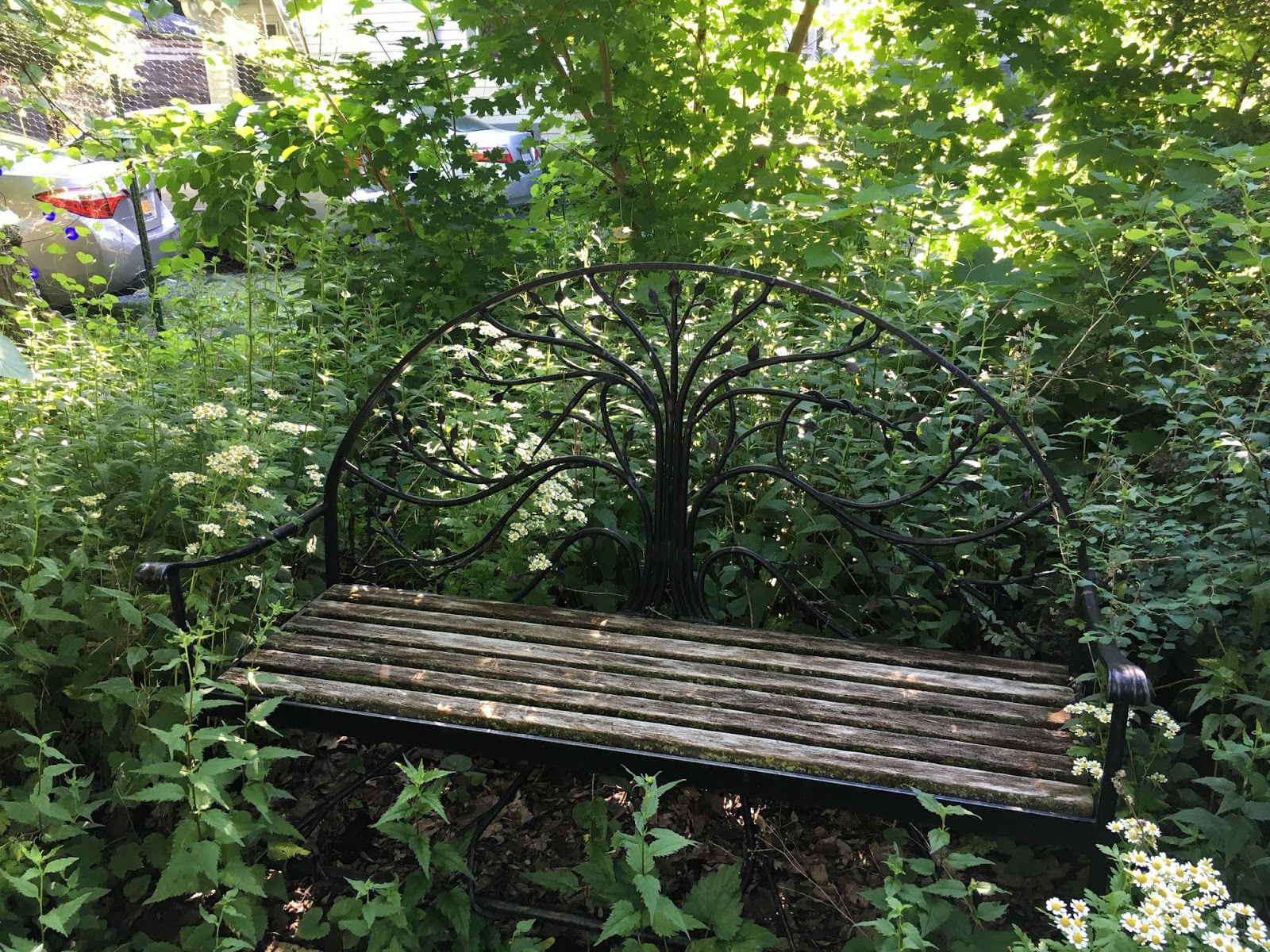
The bench
Another view of the garden
The patio 
The bushes near the memorial 
The patio up close 
The bench
The stone from another view
The stone buttressed 
Another view
Yet another view
Cascadilla Street
Daisies near the bench
The daisies up close
The stone up close
The memorial stone
Cascadilla Street