Saturday, September 27, 2008

Signal On + Memorials + Debate #1 + Brazilian Poets in Chicago

I'm back in the Chi, classes are underway. This fall's load looks to be a little lighter than the past few years, since I'm teaching only a graduate workshop and an undergraduate honors seminar, and I'm supervising just a few undergraduates and graduates, all of whom are sharp and talented as they come, so it should be an enjoyable quarter.

***

In the time since I last posted, nearly a month ago, so much has happened on many fronts out there in the wide world, but I do want to note a few things, starting with the passing of a few important people: the first is Reginald Shepherd, a poet I knew, though not well, but whose poetry and criticism I grew to appreciate a great deal. His early and untimely death still shocks me. On the CC list I wrote the following:

I remember his essay, "On Not Being White," in Joseph Beam's anthology In the Life, which annoyed me for a good while until I reread it and made an effort to understand where he was coming from.* I also remember when Reginald's first book came out and all the buzz around it, and how I excited I was to meet him for the first time back at one of the old OutWrite conferences in Boston, in the late 1990s.

He could be, to use Shakespeare's and everybody else's phrase, a piece of work, but he was certainly a brilliant poet and a lively critic. His passing is a real loss for Black, Black LGBTQ, and American poetry, but I hope he finds real peace.
His lyrical facility, the deep and relentless exploration of desire and yearning for love and acceptance that surged through his stanzas, his skill with metaphor and a particularly deft gift for the music of rhyme are all hallmarks I register when I think of his work. Without hesitation I can say that Reginald was easily one of the most important Black/gay poets to emerge over the last 25 years, and I'm very sorry that we have lost his voice. He was only 45, and leaves his partner, Robert Philen, and many family members.

Also, Edgardo Vega Yunqué, the Puerto Rican/Nuyorican author, also passed away earlier this month. I met him once, at a reading featuring some of New York's important Latino writers that I helped coordinate at one of my former jobs. I wasn't at all familiar with his work, but hearing Vega Yunqué read and talk about his life and work, he struck me as a real treasure. Original, funny, feisty, cantankerous, and like so many, deserving of greater honors and attention than he ever received. After the reading I went and found some of his work, which reminded me in many ways of Ishmael Reed, not least in its caustic humor and social criticism. Like Ishmael, Vega Yunqué was a social activist, and played a key role in building and nurturing Puerto Rican/Nuyorican/Latino letters and arts in New York; he was one of the founders of the vital arts center Clemente Soto Vélez Cultural Center on the Lower East Side. He was 72.

Then there was the news of the tragic death of one of the most celebrated writers of the contemporary era, David Foster Wallace. I've taught his work a few times over the years, and consider his story "The Girl With Curious Hair" to be a comic masterpiece. I'm less a fan of his novel, Infinite Jest, which I admit I advanced only about 300 pages into, but whatever my thoughts about that work, I must say that Wallace was blindingly talented and offered one of the most influential, ironic takes on our society to be found in recent literature. A huge loss.

And then yesterday I read about the passing of one of the consistently superb actors--and activists--of the last half of the 20th century, Paul Newman, at 83. Very sad.

***

I watched the debate between Senators Barack Obama and John McCain last night. My own thoughts about the contest aren't important, because it appears that Obama achieved what was most necessary: positive reviews by many in the influential establishment media, and very positive reviews by independent voters and in quick post-debate polls. While I will definitely be watching the Vice Presidential debate between Joe Biden and the walking disaster known as Sarah Palin, I'm not sure if I can bear another Obama-McCain talkfest, especially if Obama, however successful his tactics, refuses to challenge McCain more and if McCain's rage and contempt have him seething like an old and overheating radiator.

***

One highlight of this week was the series of readings in Chicago by four noteworthy contemporary Brazilian poets, Maria Esther Maciel, Virna Teixeira, Paulo Henriques Britto, and Sérgio Medeiros. The poets, from Belo Horizonte, Fortaleza by way of São Paulo, Rio de Janeiro, and Matto Grosso do Sul via Florianópolis respectively, all appeared in the Brooklyn-based literary journal Aufgabe's issue no. 7 (2007), which featured a special section on Brazilian writing, edited by poet and translator Ray Bianchi. Ray also organized the readings, with Aufgabe editor E. Tracy Grinnell, and they took place at three different venues across Chicagoland: the university, the University of Chicago, and at Chicago's main branch Harold Washington Library in the Loop. Colleagues at the university, along with Litmus Press, the Chicago Poetry Project, and the Consulate General of Brazil in Chicago, all sponsored the events.

I attended the first reading, at the university, which my colleague, prodigious author and translator Reg Gibbons, had helped to coordinate and which he introduced. All four of the poets read either excerpts from longer work or a few short poems in Portuguese, and either they or Ray followed with English translations. One of the things that intrigued me was that two of the poets, Henriques Britto and Teixeira, both wrote in English as well as Portuguese; for Henriques Britto it resulted from his having spent part of his youth in Washington, DC, and he later told me that his first poetic language was English. Teixeira told me that she wrote in English when she was living for several years in Scotland, though now she wrote almost always in Portuguese. In the case of both poets, the English was idiomatic and lyrical, with Henriques Britto's more discursive and assured in its handling of rhyme, and Teixeira's grounded in concise and evocative imagery.

With regard to their Portuguese texts, I noted and asked about the differences during the question and answer session. Medeiros, who told me about a new language melding Portuguese, Spanish and Guaraní that was developing in southern Brazil (where he lives), read from a long poem that was both fragmentary and composed along the lines of what I would identify as the Language poetry movement's "new sentence." Maciel's briefer poems drew upon the rich homophonic, rhyming polysemous possibilities of Portuguese, which she contrasted with a few visually grounded prose poems. Teixeira's short poems moved from image to image, and, as became clear soon enough, were often inspired by works of art. The fourth poet, Henriques Britto, read poems in fixed forms: sonnets, a half-sestina, and a full villanelle. They sounded as adroit and nimble in Portuguese as in English.

When the writers spoke about influences, they listed many of the best known names in 20th century Brazilian poetry: Carlos Drummond de Andrade, João Cabral de Melo Neto, the two de Campos brothers, Augusto and Haroldo, and Cecília Meireles. They also mentioned English-language authors such as Walt Whitman and Emily Dickinson, and the great modernists Wallace Stevens and, from a later generation, Elizabeth Bishop. In reading the poetry in the special section, I wondered about more recent national and international trends and influences, because a number of the writers are in conversation with them. Other questions during the Q&A touched upon the contemporary literary landscape in Brazil, national vs. regional trends there today, the presence and influence of literary journals (which Ray does touch upon in his introduction to the special section), and the problem of a readership for poetry. Three of the writers, I believe, are also university professors, though I didn't gather that any of them taught creative writing per se; that is, it seems, a peculiarity thus far of the English-speaking world (mainly the US, Britain, Canada, and Australia). Teixeira mentioned that she was a medical doctor, and the precision of her work, in retrospect, bore this out.

I attended a second round today at the Harold Washington Library, and got to hear all the writers read more of their work. Maciel read one of my favorite poems from the special section, a poem consisting only of a litany of single words separated by commas, which ends with "palavra" (word). It was titled "Palavras preferidas" in Portuguese, and "Favorite Words" in English. The translator managed to capture some of the richness of the original's sonorities and playfulness, but there is nothing like hearing "ferrugem" (iron) or "ruido" (noise) or "arara" (arara!) pronounced by a native Portuguese speaker, Brazilian or from Europe or Africa. It's almost as if paper's crinkling in the mouth as a song emerges. Lovely: amável!

The event was heartening on many levels, but I also hope it's a signal that more such events will be possible in the future.

Sunday, September 07, 2008

Some Politics & Other Stuff

Ah, the socialism continues: late Friday, conveniently after the US stock markets had officially closed and two days after the Dow Jones Index plummeted more than 300 points, we learned that the federal government would, contrary to Treasury Secretary Henry Paulson's earlier assurances, surprise surprise, nationalize Fannie Mac and Freddie Mac! Today we learned more about the plan, which will can the two institution's leaders (but not require that they pay back their multimillion-dollar bonuses), wipe out most shareholder value, and saddle taxpayers with hundreds of billions of dollars of new debt. It appears to have been a necessary move given both companies', but especially Freddie Mac's, deteriorating financial situations, which had investors in the US and across the globe worrying about a possible global financial crisis if both failed.

Aren't you excited?

So this is what we get with reckless deregulation, no congressional oversight, and unshakeable conversative faith in the "market" and its powers to correct itself. "Conservative" governance, who'd have ever thought it would be the means by which we'd move as a nation ever closer to the old Soviet Union? Nationalized banks, domestic spying on citizens with legislative approval, an establishment press that has merged with a political party (the Republicans), show elections...perhaps the right-wing neocons have kicked Leo Strauss to the curb and are taking direct cues from the ghost of Joseph Stalin.

Concerning the banks, let's see what else we learn about this "deal" in the next few days. I can assure you, the reality is going to be far more costly than we're being told right now.

+++

Speaking of socialism and nationalized banks, did you know that so far 11 US banks have failed so far this year, which is nearly four times the number that failed last year?

Let me say that again: nearly four times as many US banks have failed in 2008 as in 2007 (it was 3 last year). And it's only early September. (36 have gone under since W took office.)

The most recent bank to fail, Silver State Bank of Henderson, Nevada, had none other than John McCain's son Andrew on its Board of Directors until he resigned on July 29, 2008. He was, and I'm not making this up, on its audit committee. According to the above-linked article on Huffington Post,

prior to coming to Silver State, he was the director of the Choice Bank in Scottsdale, Arizona until its merger with Silver State Bancorp which has 13 branches in Southern Las Vegas, and 4 branches in Arizona, and California.


Has your establishment TV press and punditocracy made much of this? I know, I know, there's a shiny new liar media celebrity darling on the hustings these days, telling tales fanciful enough to make Aesop jealous. There's also that dreary news about the rising unemployment rate and cuts in jobs, rising inflation, record foreclosures and cascading home values. It's enough to make anyone forget about a commercial banking sector under serious distress, though the failing banks are another key sign of how troubled the current US economy is.

But I guess acknowledging this constitutes whining, right?

+++

Hurricane Hanna's rains hammered us yesterday, but turned out to be manageable enough, which got me thinking about not only the physical and economic toll these storms create in the US, but the psychological frenzy, which makes me wonder how they're perceived elsewhere. Such as in Haiti, one of the countries that is often battered by the tropical storms that move through the Caribbean. Haiti suffered serious hits from Hurricane Gustav, then Hannah, and now Ike.

Here's Stephen Gibb's take in The Guardian Online: "Hurricanes like Gustav and Hanna seem only to matter if they hit America"

+++

One thing that I've found breathtaking over the last few days is Alaska Governor Sarah Palin's relentless and shameless lying at her public appearances. But, I have to note, it's a brilliant strategy and proof that she is more in the mold of George W. Bush than just in ideological and theocratic terms. In fact she fits in perfectly with the Republican electoral strategic game plan that's been in place and mostly successful for decades.

Why do I think it's a brilliant strategy? Because the psychological and cognitive effects of the steady repetition of lies, weakly or half-heartedly challenged by the establishment media and, more importantly, Democrats, will, coupled with the McCain campaign's and the GOP's constant and insistent attacks on the "liberal" media and the Democratic Party, resist subsequent media or Democratic attempts to debunk, challenge or correct them. They are going to stick for a certain percentage of the population. She will be Mrs. I Stood Up to Congress on the Bridge to Nowhere despite the fact that this is a TOTAL LIE.

Since the McCain campaign has also decided, without much pushback except mealy-mouthed quibbling it appears, to keep her away from direct journalistic questioning or inquiry, there are few avenues for challenging her directly on her lies. When she finally does sit even for a friendly interview, as she supposedly will do with ABC's Charlie Gibson soon, it's unlikely he'll press her on the basic untruthfulness of her statements. (He has proved to be a notorious dope for the GOP this election season.) But regardless of which journalist is asking questions, Palin actually has two options: she can follow John McCain's lead and simply deny she ever said what she did, or Dick Cheney's, and admit that she was wrong, then simply go back out on the campaign trail and tell the exact same lies on the campaign trail! How much do you want to bet she'll get away with either strategy?

A good friend suggested the other day that the late Tim Russert would have held her to the truth, though I reminded him that Russert was on record in the Plame proceedings as a stooge for the current White House. Do you think he'd ask Sarah Palin the following series of simple questions?

Journalist: Mrs. Palin, you said at your unveiling last Friday, and then again in your speech at the Republican National Convention, and have repeated at each subsequent campaign stop, "I told the Congress 'thanks, but no thanks,' for that Bridge to Nowhere." But Congress, without your input, canceled the earmark for the Bridge to Nowhere in 2005, before you were elected to your governorship. Since Congress canceled the earmark before you were even elected, how could you possibly have said "Thanks, but no thanks" to Congress?

Palin: Blah blah blah.

Journalist: On top of not telling Congress anything at all, because you couldn't, because the earmark had already been canceled, you still pushed for it, and accepted the $223 million of unrestricted funds for your state.

Why do you keep claiming you did something you absolutely did not do? And despite there being a record of your actions, why do you keep claiming to have been against this particular earmark when you were for it and actively sought it, even though it had already been canceled?

Palin: Blah blah blah.

Journalist: So if you did not tell the truth about this basic issue, and keep failing to tell the truth about this basic issue, on campaign stop after stop, why should Americans trust anything you say?


After that the journalist could ask about current affairs and, looking into her on the record background, inquire about:

-her earmark binging,
-her hiring an Abramoff-affiliated lobbyist to gain the earmarks for Wasilla,
-her leaving the town of Wasilla in debt and an ongoing lawsuit,
-her support of corrupt US Senator Ted Stevens (R-AK), which including running a 527 on his behalf and vocally supporting him just this past summer;
-her history of raising taxes, including sales taxes, which disparately impact working-class and poor people, and the sort of windfall profits tax the GOP has criticized Obama for suggesting,
-her attempts to ban books at the Wasilla Public Library when she first became mayor,
-her loyalty tests and repeated history of firing employees on flimsy pretexts,
-her failure to cooperate with the Troopergate investigate despite saying she would,
-whether she agrees with the secessionist Alaska Independence Party and whether she truly "loves America,"
-whether she believes the extremist statements, including anti-Semitic and anti-gay ones, that have been uttered in her presence at her church,
-whether she believes that her presiding over a state that is geographically near to a foreign country counts as foreign policy experience.

Oh, and whether she and the Republican Party not only support but celebrate premarital teenage sex. Given how they've demonized inner-city folks on this issue, I would be curious to hear her thoughts.

How much do you want to bet (the Grand Canyon, anyone?) that nothing of the sort will happen? Ever.

UPDATE: An enterprising American actually did ask Palin (and McCain) a few questions, which is more than all the establishment media combined. Let's see how long it takes for them to get off their behinds and do their jobs.

+++

One way to deal with a racist idiot like Rep. Lynn Westmoreland (R-GA)....

+++

Last night C and I watched Lanre Olabisi's August the First on PBS. Though it has flaws, I recommend it, and must add that not only haven't I seen this particular story ever told before on film. Novelty shouldn't be underestimated. I'll try to write a review soon.

I also hope to write a review of James Wood's How Fiction Works, which I read in part for my graduate fiction workshop this fall and because I've found Wood's probing, nontheoretical, aesthetically oriented and somewhat conservative readings nevertheless enlightening and useful in the past. In particular, his reading of what he calls "hysterical realism" in his previous study, The Irresponsible Self: On Laughter and the Novel (FSG, 2004), provided me with a valuable means for talking about a great deal of contemporary American fiction, and for assessing some of the work of my graduate fiction writing students.

Before it ends, I hope we can catch Bill T. Jones's Fela!, which I've heard praised a great deal. A friend, the poet, playwright, musician and performer Karma Johnson, is in the cast. (Seun Kuti, I realized later on, performed at SummerStage the day after Tisa and I caught Rachid Taha!)

I'll also try to write something about J. M. Coetzee's most recent novel, the 2007 Diary of a Bad Year (Viking), which, like his utterly strange and formally inventive earlier post-Nobel Prize anti-novel novel, Elizabeth Costello, I cannot stop thinking about. Here is just one passage in the work, which makes use of a simple yet clever formal device to tell what ends up proving to be not only an intellectually provocative and ethically instructive, but by its end and despite its faults, emotionally probing story. The selection is from the 11th "Strong Opinion," "On the curse":

We thought they were powerless, he says, that was why we did what we did; now we see the were not powerless at all.

"Tragic guilt," writes Jean-Pierre Vernant, "takes shape in the constant clash between the ancient religious conception of the misdeed as a defilement attached to an entire race and inexorably transitted from one generation to the next . . . , and the new concept adopted in law according to which the guilty one is defined as a private individual who, acting under no constraint, has deliberately chosen to commit a crime."

The drama being played out before our eyes is of a ruler, George W. Bush (whether Bush turns out to have been a pawn in the hands of others is not relevant here), whose hubris lies in denying the force of the curse on him and of curses in general; who indeed goes further and asserts that the cannot commit a crime, since he is the one who makes the laws defining crimes.


Friday, September 05, 2008

Back Up & Running

And now, finally, I'm back to my previously scheduled program, many stones, three surgeries, two stents, and a month and a half later, just as the summer, unfortunately, is winding down and the academic year is about to barrel in. Neither C nor I thought in July that things would turn out to be so complicated, but such are the body's vagaries. If I say that neither of us would like to see the inside of a hospital anytime soon, or spot evidently crazed people who later turn out to be one's nurses, or overhear hospital staff regaling each other about homeless people's chicaneries to get food, or juggle any of the countless forms required every time you set foot near the patient intake center, or I don't think I'd be stretching. But throughout the medical professionals, like C, have been exemplary, so let me say thank you. The experience yet again highlighted for me the necessity of comprehensive, truly universal health insurance, and the urgency, for all of us, not only to elect people at every level of government who will support it, and then to hold them fast to its implementation as soon as possible.

As I posted before, I greatly appreciate all the get-well wishes, posted here or sent via email. They've truly been a balm.

***

Many J's Theater readers know that had I been feeling better, I was likely to post shots from a major athletic extravaganza like the Beijing Olympics. But I had vowed to myself before the events took place not to promote them in any fashion on this site, mainly because of host nation China's horrendous record, past and recent, in so many areas of human and political rights, and because of the ongoing bloody repression of the Tibetans and other social, political and religious dissidents and minorites there. (Let me be clear that in calling out China I am not absolving the United States or any other country). It just so worked out that I was in constant enough pain during the period of the Olympics that I was unable to post anything (I could barely type at certain points), but I was captive and lucid enough that I watched most of the televised events, especially towards the end. The Chinese really know how to stage mass events and win gold medals, no? Does anyone think they won't be atop the gold and total medal counts by the next summer Olympics in 2012, in London? And will the corporate press ever live down the shame of covering for the Chinese authorities and, as they've done during both major US party conventions last week and this week, failing to do their jobs by reporting on the serious issues in China and the attempted protests, the imprisonment and the suppression of dissent?

As I said, I was couchbound for weeks, and watched a slew of events, including ones I little enjoy like beach volleyball, team handball, and shooting (which turned out to be pretty interesting). My favorite athletic moments beyond the more obvious ones, such as the swimming races, which, despite the Michael Phelps hype (though he admittedly was unbelievable), or the US men's team's (the "Redeem" team) basketball games, provided great drama, or the gymnastic competitions, which naturally received a lot of press, not least because some of the Chinese female gymnasts were visibly underage, were numerous. They included the individual and team victories by various US fencing squads (women's foil, women's and men's sabre); the gold victory by the all-black French epee fencing team (above left), and the bronze by French baby giant judoka Teddy Riner (at right); the triumph by the lone out gay male athlete in Beijing, Australian Matthew Mitcham, in the mens' 20 m platform diving (though NBC saw fit to suppress his victory celebration with his partner); the medal victories by athletes from tiny countries, like the Dominican Republic's boxers or Togo's kayaker or Panama's long jumper; and the gold, replete with a compelling background story, won by men's under 55 kg freestyle by Henry Cejudo.

One of my favorite sports, track and field, did not disappoint. I believe I watched nearly all the running events that wer televised, including the marathons. Most exciting I thought were Usain Bolt's spectacular victories in the men's 100 and 200 m, the Jamaican women team's 100 m sweep, the American men's 4x400 race, and the last minute victory by American Sanya Richards (below, with her fellow relay team members) of the women's 4x400 race, which almost felt like it had been scripted in a Hollywood; Romanian Constantina Tomescu's breakaway victory in the women's marathon, which required a gutsy decision by the winner to push herself as much as possible and then not let up; the 1-2-3 victory by the Americans in the men's 400 m and 400 m hurdles; and the blazing triumph that bespectacled 110 m Cuban hurdler Dayron Robles turned in.

On a sports listserve I belong to, I commiserated with other fans about NBC's coverage, but I have to say in retrospect that things weren't so bad overall in part because some of the less popular sports (equestrian; weightlifting, etc.) were broadcast, just not on NBC. Between MSNBC, USA Networks, Oxygen, and Telemundo, and NBC's online site, it was possible to see a great deal of what was taking place in Beijing, often live. Thus I got to see the rowing events, wrestling, soccer, baseball, and quite a bit of other stuff that wasn't featured on the main channel. (I suspect, however, that some sports, like modern pentathlon, were just not broadcast at all. Oh well.) I hope this becomes standard policy for the future.

***

I have been following the political races too, and watched most of the Democratic convention and about as much of the Republican one as I could stomach, which is not much. Whatever my quarrels with Senator Barack Obama's positions, detailed on this very site over the last year or so, I was utterly moved and impressed by his acceptance speech last Thursday. The speech itself was prehaps less soaring that some of his other ones, but the performance overall, which includes the setting, the history-making quality of the event, its significance for our political culture, nearly brought me to tears. It has been interesting to note the contrast between the tones of the two conventions, the quality of speechmaking and political rhetoric at the one last week, a great deal of it inspiring, visionary and hopeful, and this week (so much of it acid, detached from the problems we face as a society and as a world, and in complete flight from the debacle of the last eight years. The political commentary by the punditocracy I've found almost uniformly abysmal, with the sole exception of MSNBC's Rachel Maddow. (Who thankfully will be getting her own show next week!)


(Jay L. Clendenin / Los Angeles Times)

Most of the people on air appear less informed about basic aspects of the party's and candidates' platforms, their histories, their ideologies, and what they're saying and how they're saying, than my two cats. They are very good at regurgitating talking points issued by the McCain campaign and RNC, or reciting whatever they've read on Drudge Report. I expect Fox always to be at the bottom, and they do not disappoint ever, but the major broadcast channels, as well as CNN and even PBS, have proved to be quite bad. Watching Charlie Rose the other night, with "liberal" Al Hunt (Mr. Judy Woodruff?) downplaying or simply not broaching every valid criticism of the unqualified and constantly lying, self-described "barracuda" that John McCain has chosen as his Vice Presidential pick made me want to puke.

And can I just say this: it really says everything about John McCain that he picked someone who has lied, blatantly, in each of her first three public appearances since being named to his ticket. Think about that: on each of the first three times Sarah Palin spoke as the Republican VP pick to the American people, she blatantly lied, not just about one issue, but about multiple ones. Most obviously, she lied about that "Bridge to Nowhere" in Ketchikan. Congress canceled the earmark in 2005, taking the issue off the table. Let's state this again. Congress canceled the earmark IN 2005, TAKING THE ISSUE OFF THE TABLE. She was not elected UNTIL 2006. Yet she still advocated for the earmark in 2006 while running for office, and when Congress sent the money, without specific requirements for the bridge, she used it, in part to build a "Road to Nowhere"! Last Friday, she said before the paltry crowd in Dayton and the world that she had "told Congress" no thanks—I know her boss is clueless about Google, but is she? How dumb does this woman think we all are?

In addition to the cynicism it displays about the political stakes we face, the sexist assumptions that women would vote for any woman, and in particular this social and religious extremist, and sheer contempt for politics in general, McCain's selection of Alaska governor Sarah Palin undergirds one of Obama's fundamental critiques of McCain last Thursday: the Arizona senator, in addition to being out of touch, too far to the right, and lacking in any principles, has terrible judgement and a reckless temperament, both of which this choice embodies.

As people close to me will testify, I was very disappointed with Obama's selection of Senator Joe Biden, whom I think of as a Washington insider whose foreign policy instincts and pronouncements I've tended to find pretty suspect. He essentially agreed with Hillary Clinton and John McCain on invading Iraq, with poor excuses as to why, and on the Georgian crisis, he's been pushing almost the same line as the Bush administration. (Why on earth have none of the Democrats called more forcefully for bringing Russia to the table to discuss the situation? It's clear that McCain's campaign is hitched financially, via advisor-lobbyist Randy Scheunemann, to Georgia's leader, Mikheil Saakashvili, but the Democrats aren't also on Georgia's payroll, are they?) I was much more in favor of Obama picking someone like Montana's governor Brian Schweitzer, for example, who really brought a lot to the ticket, including ideological and geographical diversity. Schweitzer would have been a fresh face with substance behind it, unlike Palin, and as he showed at the convention last week, he possesses that coin that the establishment media seek like a jones: the man's a geiser of authenticity, real, unvarnished folksiness. From the perspective of several weeks, however, I'll give Obama the benefit of doubt. I think he and his team were right, and Biden looks like a very good choice as running mate, especially compared to Palin.

As of today Obama retains his national lead as well as leads in many states. But I was born and grew up in a state, Missouri, in which there are many people—perhaps not a majority, but close to it—who will find this woman's personality and the establishment media's bowdlerized version of her personal history, scrubbed almost completely of the pertinent and highly disturbing facts, quite appealing. There are more than a few places across the country, in Missouri and elsewhere, in which the politics of resentment and ressentiment, as well as cynicism, subterfuge, sub rosa racism, and host of other dangerous crap, which the GOP is playing to the hilt, very well may prove effective. So I worry. I really do.

But then I also keep in mind that the basic facts of today, the rising unemployment rate, the dodgy financial system and the collapsing real estate market, the rising costs of living, the ongoing wars in Iraq and Afghanistan, the steady tide of news about un-Constitutional activity that emanates from the White House—all of it may trump the exhausted and yet still caustic ploys the Republicans and their allies are turning to, it may trump the relentlessly flogged narrative of the POW-hero-"maverick" the press repeats like a mantra, and it may trump the presence of this dangerous, horribly unqualified woman whom the McCain campaign is itself so unsure of they will not let her near their very "base," the establishment media, they have quickly turned against like rattlesnakes in order to cow.

But as I've said it will not be easy—and not one of us who wants someone other than John McCain and Sarah Palin in the White House (and yes, there are options such as Cynthia McKinney and Rosa Clemente, Ralph Nader's traveling roadshow, and various folks on the right, like Bob Barr, who'd be worse than McCain-Palin) should assume it will be.

***

On a completely different note, the one and only Jennifer Saunders (French and Saunders, Absolutely Fabulous) will have a new show on US TV, a sendup of daytime talk shows entitled The Life and Times of Vivienne Vyle. It headlines Sunday's upcoming Sunday Comedy Block, starting at 9 pm EST. I can't wait!

***

In a few days I'll try to post some reviews and other things. I haven't gotten half as much reading as I'd hoped to, certainly far, far less than last summer, but I haven't been totally idle, or addled.

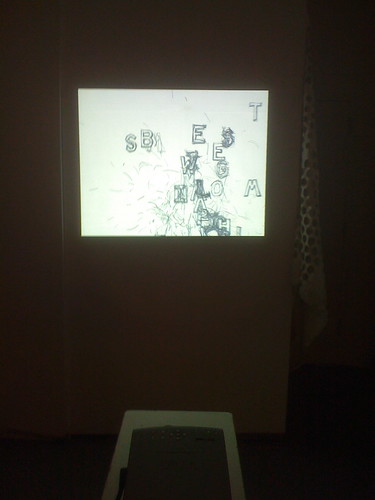
I did get out to the opening of CONTRANYM, a show curators Kelly Kivland, Alisoun Meehan and Chris Stackhouse mounted in the New Voices, New York series at chashama ABC gallery, in the East Village. The gallery itself was a toaster, but the art, by Robert Delford Brown, John Cage, Victoria Fu, Stephanie Loveless, and Brian Kim Stefans, was cooking in the best way.

In addition to chatting with the curators and Brian, I had the opportunity to meet fellow Cave Canem poet Myronn Hardy, whose book of poems The Headless Saints appeared earlier this summer. Here are some photos from that event. Enjoy!

The crowd at Contranym
Brian Kim Stefans's digital piece at Contranym
Brian Kim Stefan's digital film, "Scriptors"
A Robert Delford Brown Fluxus-style piece
Part of the collaborative Robert Delford Brown "Fluxus"-style piece, "Explosion of a Tile Factory"
At Contranym
Inside and outside

Sunday, August 10, 2008

Dropping In + A Few Remembrances

It has been a while, a long while, since my last post, three weeks in fact, and unfortunately though I would like to say I'm better, it's probably best to say that I'm still facing some health challenges right now. I do want to thank everyone who's posted on the blog or sent private emails with good wishes, links to YouTube videos, and e-cards. I definitely appreciate all of them. I do hope some of the medical options I have work out, sooner rather than later, and that I can return to posting regularly, or at least semi-regularly. Until then, I'll keep reading your blogs and posting when I feel up to it. And again, thanks for your concern.

***

I'd be remiss if I didn't post a few memorial links for some notables who've passed in recent days.

They include one of Cave Canem's sages and longest-lived Fellows, Ms. Carrie Allen McCray Nickens, with whom I had the very good fortune to be in a workshop back in 1999. Carrie was a font of talent, knowledge, experience, courage, and wisdom, and like everyone at CC, I will miss her voice, stories and emails, along with her generous spirit, tremendously. She was 95.

Poet and musician Kevin Simmonds, who often checked in on Ms. Carrie, sent along this poem she wrote to be read at her funeral. Would that we all head home with such a smile in our hearts.

Sing No Sad Songs For Me

Sing no sad songs for me
For I have heard the robin sing
And felt the rush of wind through my hair.

Sing no sad songs for me
For I have known the love of man for woman,
And heard the first birth cry of a newborn.

Sing no sad songs for me
For I have held the second and third generation
In my arms, and reveled in the continuity of family.

Sing no sad songs for me
For I have walked with my fellow man,
And been touched by God's abiding love.

So sing no sad songs for me
Sing songs of peace, love and joy
For I have been touched by God's gentle grace and gone home.

Copyright © Carrie Allen McCray Nickens, 2008.

Also, taken too soon, the comedian and Chicago native Bernie Mac (Bernard McCullough) who passed away in Evanston at age 50. I almost cannot believe the reports that he's gone. And the great musician, actor and soul-stirrer Isaac Hayes, whose music formed much of the soundtrack of my childhood and which I still listen to often today, died at age 65.

Here's a video of him singing "Shaft." Check out that outfit--the man was, as they used to say, baaaaaaadddddd!!!!


And Alexander Solzhenitsyn, the 1970 Nobel Laureate in literature, who was one of the foremost dissidents during the late Soviet period and whose novels recounted his and countless lives and deaths under that regime. Today, I learned that one of the most beloved poets of the Palestinians, Mahmoud Darwish, also died. He was 67.

Here's one of his poems, from the Academy of American Poets site:
I BELONG THERE

I belong there. I have many memories. I was born as everyone is born.

I have a mother, a house with many windows, brothers, friends, and a
prison cell

with a chilly window! I have a wave snatched by seagulls, a panorama
of my own.

I have a saturated meadow. In the deep horizon of my word, I have a moon,

a bird's sustenance, and an immortal olive tree.

I have lived on the land long before swords turned man into prey.

I belong there. When heaven mourns for her mother, I return heaven to

her mother.

And I cry so that a returning cloud might carry my tears.

To break the rules, I have learned all the words needed for a trial by blood.

I have learned and dismantled all the words in order to draw from them a

single word: Home.


From Unfortunately, It Was Paradise by Mahmoud Darwish translated and
Edited by Munir Akash and Carolyn Forché with Sinan Antoon and Amira El-Zein.
Copyright © 2003 by the Regents of the University of California.
Reprinted by permission of the University of California Press.
All rights reserved.

Thursday, July 24, 2008

Things and Whatnot

I've been away from here for nearly a week, but this time I have an excuse: kidney stones. Once again I'm weathering a bout of them, and as anyone who's ever experienced them knows, they are among the most painful illnesses anyone can encounter. In addition to totally immobilizing you at the first signs of attack because of the excruciating pain, which I have likened variously to having someone powerdrill through your lower back, plunge a knife repeatedly down the side of your groin, and inflate a portion of your stomach and intestines until they're near bursting, there's the matter of their passing out of your system. That is, if they do; if they don't, they have to be broken up, zapped, laser, sometimes even extracted. I've never had to endure any of these last few treatments, but I can say that there's no shortage of pain at any point. I think I'm past the worst part, but I probably will be posting only intermittently over the next week or so as I recover.

***

I've been intending to note the appointment of a new Poet Laureate of the United States. This year's new American lyric pied-piper is Kay Ryan, a native Californian who, as far as I know, has never been much of a public figure or a proselytizer for her art. Her brief, often wry, enjambed and rhymed, usually lyric poems, which have appeared in periodicals over the last four decades and in six collections, have many admirers, though until a few years ago, I don't think she received much recognition from the major contemporary critics. She has, however, been lauded by the Poetry Foundation and other arts institutions over the last decade. It'll be interesting to see what sort of approach she takes to the post; I've tended to think that the people appointed to this post really ought to have a history of working in at least a few different communities (and not just academic ones) and one or two concrete outreach plans for the post. The late Gwendolyn Brooks was an exemplary example. But that's just my take.

***

Thomas Disch, the 68-year-old polymathic speculative fiction writer and poet, died by his own hand a few weeks ago. I first learned about Disch's work via the writings of the one and only Samuel R. Delany, and though I've only read a few of them, I can agree with many of the appraisals that he was an extraordinarily smart man. I may be one of the few people who has read more of his poetry than his fiction, and though I'm not great fan of the poetry, he was certainly clever, and could combine dark subject matter with fixed forms sometimes to striking effect. His science fiction novels, however, which stood among the New SF work of the 1960s and 1970s, will remain his forte. Disch also produced notable work in other genres, including a computer novel, opera librettos, and children's literature, one of the last of which, The Brave Little Toaster, became a Disney film. According to the obituaries I've seen, he'd faced a series of successive traumas, including losing his partner, Charles Naylor, of many years; health and financial problems; and potential eviction from his New York home. He did, however, publish his final novel earlier this year, a satire entitled The Word of God: Or, Holy Writ Rewritten.

Tuesday, July 22, 2008

Random Photos

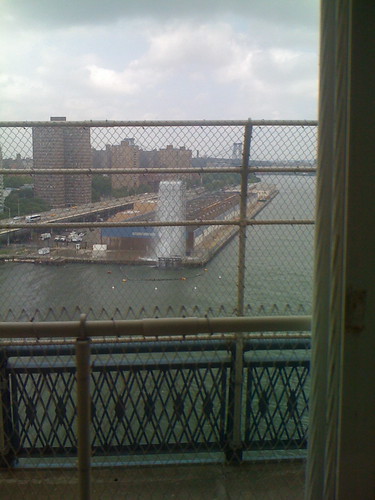
One of the waterfalls
One of Olafur Eliasson's waterfalls, from the R train (?) on the Brooklyn Bridge
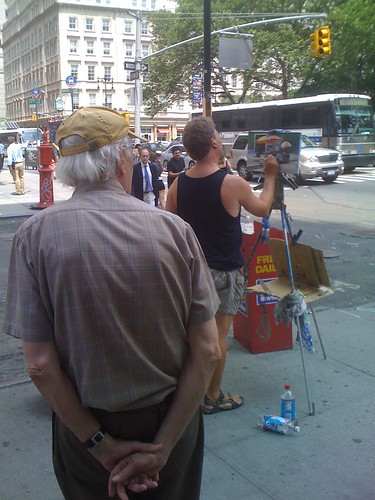
Painting en plein air
A street painter, near City Hall Park
The Fountain Pen Hospital
The Fountain Pen Hospital!
Leo Villareal neon sculpture, Brooklyn Museum
Leo Villareal's "Chasing Rainbow," at the Brooklyn Museum
Kehinde Wiley painting @ the Brooklyn Museum
Kehinde Wiley's "Napoleon Leading the Army Over the Alps," at the Brooklyn Museum
One of Olafur Eliasson's waterfalls
Another of Olafur Eliasson's waterfalls, from the vantage of FDR Drive

Friday, July 18, 2008

RIP Lindon Barrett + FISA + iPhonery + Miscellany

It's been a long while, more than a week, since I last posted (I've added my unfinished post from yesterday). It's not for want of things to post about, but a general lassitude and inability to muster the energy to write up things as well as add photos and hyperlinks.

Posting one-line entries isn't my thing, but far too many paragraph-length posts have died on the...cybervine? Or remain as ghost entries in the editing box. And so much has happened over the last few months too. So here go a few brief notes.

+++

My sincerest condolences to the family, close friends, colleagues, and students of Lindon Barrett, a brilliant scholar, who, I'm sad to report, was recently murdered in his home. I posted the following on the CC list yesterday about Lindon, whom I met only once in person, in DC many years ago, but we did speak over the phone more than once and he never failed to offer sage advice or read a manuscript if needed when I had to call upon him.

I'm so sorry to hear of this horrible news. Lindon was so smart, a lovely man, and one of the important figures in the new generation of black and out LGBTQ scholars who've reshaped departments over the last decade and a half. His intellectual range was impressive. I worked with him a little bit in the early 1990s, and he was unfailingly helpful and kind. His tragic death is so saddening.

A member of his family has suggested donations to the Winnipeg Public Library in his memory, as he greatly loved books and literature, which his scholarly work testifies to.

There's also this Lindon Barrett tributes site, if you knew Lindon and would like to post some memories or kind thoughts about him. A terrible loss, for so many reasons.

+++

HAPPY BIRTHDAY, NELSON MANDELA!

+++

Both Audiologo and Eileen posted in the comments section about how their Senators with the FISA vote last week, which left me so apoplectic I couldn't even post a denunciation. Both of my home-state senators also voted against the bill in its final, toxic form, and my Congressperson also voted against the House's version of this immunity giveaway. But as is now well known, and I gather forgotten (and forgiven?), the Democratic nominee Barack Obama not only voted for the bill but offered a series of insulting, distorted justifications for doing so. I have wracked my brain trying to figure out why he sold out on this, and I keep coming back to the idea that, as was the case with Bill Clinton with the first Bush-and-Reagan administration crime syndicate, he's decided that rather than investigate and prosecute the full range of violations by this current administration, he's going to take give them every pass to clear off the stage in the hope that he can start fresh and not look back. I would imagine that since figures in the Democratic leadership repeatedly acceded to or complied and colluded with the administration, and since it appears increasingly likely that Obama will be president, he's also decided that to ensure smooth relations with them--the leadership--he'll give them a free pass as well. It's all very disgusting, disillusioning, and par for the course, but we do end up with the governments we deserve, and until we create viable party options, particularly to the left, we will be stuck with the capitutionalist and collusionist Corporatocrats at the federal level. As I said, both of my Senators and my Congressperson did not fall in line, so it's not the entire party, but it must be noted that in the case of the former, neither one made any effort to filibuster, hold or in any other way obstruct the passage of this bill. Why?

Remember, the actions of the president were so grave that the extreme right-wing Attorney General John Ashcroft, on his sickbed, refused to sign on them; his deputy, James Comey, also refused to sign off; Comey contacted the head of the FBI and requested that authorities be stationed in Ashcroft's hospital room to keep a close eye on the actions of the president's henchmen, including the disgraced and now nearly unemployable Alberto Gonzales; both men and a number of other top officials Justice Department officials were threatening to resign en masse if the administration didn't stop what it was doing and adhere (more closely?) to the law. Learning what was behind all of this is only one of many reasons why I think the new FISA bill should never been passed, but there are many others, based on the text of the horrible bill itself. As Eileen points out, the ACLU has filed suit to prevent the law from taking effect, so let's see what happens, but cynically, I wonder if the courts will shelve it, and if Obama, when president, if he starts receiving the sort of extreme, biased and unmerited criticism that Clinton did, will see how far he can stretch its now tyrannical provisions.

The Strange Bedfellows Congressional accountability PAC is still seeking funding, so if you can contribute, please do so.

+++

jottI was a little fascinated by the iPhone frenzy last week, but having joined in the iKlatsch last winter, when the price of the phones dropped considerably from their July 2007 launch prices, I was not going to seek an upgrade. After listening to C's caution about the 2.0 upgrade for the first generation phones, which proved a disaster for countless customers, I waited until Saturday morning to update my phone, and it went off without a hitch. Both old and new users have access to one of the best things Apple has devised yet, an application (app) store, which is easily accessible and has a sizable number of free and lowcost apps you can download swiftly and easily.

I downloaded about a half dozen, then ended up erasing most of them because I didn't need them on my phone, but as a result of my colleage Alex W.'s suggestion, I signed up for Evernote, which I haven't really figured out how to use yet but has the capability of translating any photographed text into printed text (sort of like an OCR scanner), and I also kept Jott, which allows dictaphone-style notes that a computer transcribes and then emails to you! I have used it a few times and it does work well, though I have to speak slowly and spell out words my accent usually mushes together. And best of all, both are free! Now I just have to figure out how to use them. One unpleasant side effect of the new upgrade, however, has been a more sluggish overall trend to the phone's operation. It's as if the new software added molasses to its circuits. I do sync it regularly, though, and back up my computer, because I learned the danger of not doing so a few years ago....

+++

For the first time in a few years, I didn't watch this year's Major League Baseball All Star Game, which was played at the soon-to-be-destroyed Old Yankee Stadium. (I think I only voted once, online.) Or to be more accurate, I watched the introduction of the players, which the league switched up this year by including a tribute to past Hall of Famers and All Stars alongside the elected and appointed players, a nice but eventually boring touch, and then we went back to whatever C was watching. (I can't even remember what happened on half of what I've seen on TV this summer; it's all starting to blur together, save Life on the D-List with Kathy Griffin, which is unfailingly packed with ridiculousness, which is to say, hilarious). Those who know me well know that I am, or was, a longtime baseball fan; I used to memorize stats, read boxscores daily in the newspaper, and follow the on-field minutiae of various players I championed. But this season, as has been increasingly the case over the last few years, my interest has waned substantially. Part of it has been the ongoing doping-steroid scandal, which MLB, the Players Union, Congress, and the courts have all handled poorly. Part of it is, I think, my own personal maturity and a shift in interests, along with a general dwindling enthusiasm about most professional sports and athletes. Part of it is my recognition that in these incredibly difficult and uncertain economic times, most of the people on these teams are making millions of dollars per year, and many still want and crave more. And part of it is outrage at situations like the one Willie Randolph faced with the New York Mets' ownership and hierarchy. The net result is that while I do still check the box scores regularly, I've yet to attend a baseball game this season or watch a complete one on TV, and can go days without knowing whether the Cardinals or Yankees or any other team won or lost (that is, if I miss the late evening news sports wrap ups.) The All Star Game came and went; I barely recognized half this year's players--a sign I'm getting old and haven't kept up--and even when I learned that the American League had yet again won, thus giving that league's eventual champion the home field advantage in the World Series, I didn't bother to check the game's box score. I guess I really should try to catch a game in Yankee Stadium by the end of the year, though, since I haven't been there in years. As for Shea....

+++

By this point last summer, I think I'd read about 4-5 books I'd had on my waiting shelf, but this year it's been slow going. I'm not sure, but I think I'm still trying to get up to gear. I have browsed a number of books for my work, and my little bookshelf at the library stays full with volumes for projects. One book I've been reading for pleasure is Nathalie Stephens's Je Nathanaël, which imagines and embodies the eponymous, absent assistant from André Gide's Les nourritures terrestres (The Fruits of the Earth) (L'Hexagone, 2003). Queer, hybrid and challenging its core, it's a lyrical text in which substitution and transformation in and as language repeatedly take form before one's eyes in the shifts between words, passages, forms, genres--languages. Stephens writes in both French and English, and has the mastery of both languages to draw as much out of both as possible. I've been studying and luxuriating in the book's French and thinking about how it differs from the English of Stephens's other works, but also considering how the deep(er) knowledge of the other language frees up hidden possibilities in English, how it colors and queers it. Here is one little passage, in French:

Entre deux mots le souffle.
Entre deux corps le chagrin.
Entre deux villes la douleur.
Entre deux voix le désir.

Entre nous le livre à feuilleter. (p. 59)


And, quite appropriately of Gide himself, and what he did write and couldn't in his era:

Je suis un livre qui a déjà été écrit.
Je suis le livre que personne n'ose écrire.

Qui es-tu Nathanaël? (p.65)

Who are you, Nathanaël, a question Gide asks of the assistant, but that Stephens raises reflexively, for the lyric's speaker, as the author, to the reader. Who are you?

Thursday, July 17, 2008

From the Garden (Finished Post)

Passing Strange unfortunately is closing on July 20, 2008, so if you can, catch it! Spike Lee is going to film it on Saturday, so it ought to be available on DVD soon, but if you can, see it live!

===

Some photos of the garden's fruits:


A few days ago, a tomato and the first ripe blackberries and blueberries

Today, many more blackberries and a blueberry

An alpine strawberry (aka squirrels' desert)

Some of the ripe blueberries

More blackberries, ripe and unripe

Interestingly enough, the blackberries have provided an opportunity to watch evolution in action. We originally planted two different types of blackberry bushes, one thorned, the other not. I don't believe anyone told C or me that the former was hardier than the latter, but in any case we soon saw that the thorned bushes were more aggressive (and more capable of keeping away animals--those thorns are like tiny razors, I kid you not), though both plants kept growing and originally bore fruit. But we cut both back, and eventually the thorned ones have taken over. They have crept underneath and across the yard, underneath the fence and into our neighbor's yard, and are full of fruit. The thornless bushes have almost completely disappeared, and last year, were virtually fruitless. Which is unfortunately, because the fruit was just as good, and much easier to pick.

Tuesday, July 08, 2008

Thanks, Democrats!

FISA Bill

FISA Bill


(click on the document to see a high-resolution version)

So what can you do?

You can visit this site, Blue America PAC vs. Retroactive Immunity, for more information on this horrible bill, and to donate money for a targeted campaign to oppose several of its most heinous Democratic enablers. So far, the PAC has collected over $200,000 from 4,000 donors. You can write, call or fax your Congressperson or Senator, and demand that she not support this bill, which will be put up for a vote tomorrow.

Monday, July 07, 2008

Review: Passing Strange

Working backwards through the weeks, I meant to finish an earlier stub about going to see the extraordinary Broadway musical play Passing Strange, which was my birthday gift from C, but rather than tag something onto the end of that, I'll try to restate it without covering a lot of the ground that numerous reviewers, on blogs and elsewhere, have already trodden. Its garland of nominations, for the musical play itself (because, really, it's nothing like most of the "musicals" you'll typically find on Broadway) and for its authors and actors, attest to its excellence, and having seen it and urged others to as well, I can testify that it's one of the freshest, funniest, liveliest, most provocative, smartest, and unforgettable musical stage pieces I've seen. The songs and the performances, by the entire cast, are still in my head weeks later, as is the underlying current of feeling, the riverbed of ideas and wit, that Passing Strange flows along. It's brightened my own work since I've seen it, and almost every creative person I know who's caught it talks about the sparks it's set off in them as well.

The musical dramatizes the trajectory, in vivid, song-filled tableaux, of the socially, culturally and aesthetically alienated Youth (an alter ego of the show's remarkable creator, author, lyricist, co-composer, and narrator, Stew [above, from http://www.passingstrangeonbroadway.com], but played by Daniel Breaker), a native black middle-class Angeleno whose distinctive interests, musical and otherwise, set him apart, not only from other kids and members of the community, but from his mother (played by beautiful poet, playwright, singer, and actor--and CCite--Eisa Davis, in a superb performance). Or to describe it better, Youth's non-stereotypical interests, in rock music in particular, match those of many young black kids, only we rarely see them portrayed on the stage, especially in the sort of public forum Broadway affords. After engaging in other aspects of youth, like sex, drugs, and dreaming of becoming a musician and getting far away from home and finding himself, Youth flees (escapes) due east--beyond the prison of middle-class expectations and respectability that have, we learn, constrained his mother's and other in the community's dreams, and beyond the ocean, literally--landing in liberal Amsterdam, and then Berlin, whose ideological extremes are show here to great comic effect, where he interacts with various kooky characters who are richly depicted by the same actors who play his first set of adolescent friends and antagonists: De'Adre Aziza, Colman Domingo (who also appears on Logo's Big Gay Sketch Show), dreadlocked Chad Goodridge, and Rebecca Naomi Jones. Wherever Youth goes, singing, dreaming, wrapping himself in irony and paper-thin confidence, searching for his authentic self and holding moments of emotional reckoning at bay, he conveys in marvelous songs what he's going through, though in Berlin, in hilarious, ironic fashion, he tries to gain currency from the sort of stereotypical identity he's been resisting all his life. Youth also is searching for family, his correct and true family, and the musical suggests that one's blood, at the end, is as important as constructed ties. Ultimately, Youth tragically realizes this too late, though in one of the most incredible scenes, Narrator (Stew) and Mother, from her grave, reconnect, and their plangent exchange, lands right in the center of your heart. "It's all right," Mother says, in what could have been a pat and flat resolution, but Stew repeats it, the two of them going back and forth until not only Stew, but you the spectator, believe them, and him. Yet the final note isn't just one of foregiveness, but of acceptance. Stew's mother had thought his quest was just a "passing phase," but as she and he both come to see, it's the truth of his life, and art, and that acknowledgement grounds the story in truly moving moment of truth.
In recitative fashion, the scenes comprise sets of songs that permit all of the performers opportunities to shine, in singing, acting, and, often enough in dancing, and they do. The afternoon we went, not a single cast member failed to touch the stars at some point, though Stew, Daniel Breaker, and Eisa each blew me away. Stew's guitar-playing and singing left me speechless more than once; the stocky, bespectacled Narrator, in addition to a stage natural's timing, has a voice to outshine almost any of the major rockers out there, and the show offers him many opportunities to showcase not only his singing and acting, but also his gifts as a songwriter and dramatist. In another world, this man might have been a major musical superstar. Breaker could have disappeared in Stew's shadow, but he succeeds in making Youth feel like both a parallel and a separate character. And Eisa! In addition to lighting up the stage when she's on it, her final scene with Stew was one of the musical's show-stoppers. You could probably map out the story's plot points after the first few songs, but Stew and co-composer and co-orchestrator Heidi Rodewald surprise again and again with the complexity of their writing, particularly in terms of lyrics, their knowledge and use of musical styles, and the integration of the funky, spunky music and drama. My musicological knowledge is minimal, of course, but I found so many of the songs' melodies and hooks more infectious, and certainly more creative, than the vast majority of what passes for popular music these days. The incisiveness, breadth and wit of the lyrics' references was also a wonderful surprise--these are some smart folks!--but it was never pretentious. (Even the show's title, which is explained in the accompanying Playbill, demonstrates this.) Instead, Stew's existential plight, rather than being merely enacted, is discursively--and lyrically--created before your eyes and ears.

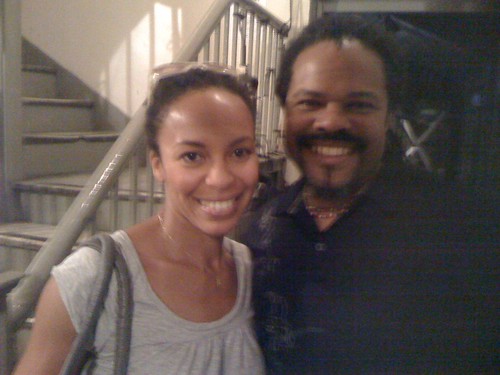
What also ensures and furthers the musical's achievement is the inventiveness of the staging: using a minimal set with props, with a spaceship-like wall of multicolored, endlessly combinable neon lights as the rear wall, and bassist Rodewald, keyboardists Jon Spurney and Christian Gibbs, and drummer Christian Cassian on risers at the stage's corners, every scene strikes not only the right chord, but often a delightfully unexpected and novel one. One set of lights flare when Stew is in Amsterdam, another mark the passage and arrival in Berlin, and throughout, in coordination with the music, acting, and dancing, they help to create the rock-inflected, existential world Stew aims to portray. I left very thankful that C and I'd had the opportunity to see the show, but also with renewed faith about the possibilities for musical theater, and, dare I say it, Broadway. After the show, C suggested we say hello to Eisa, and we went backstage, got to praise most of the show's actors, and then spend a few minutes speaking with Ms. Davis. (Photo below). I heard recently that Spike Lee is going to film Passing Strange, but I recommend seeing it before the cast changes or...well, let's just hope that Mr. Lee in his groove when he's shooting this one. Thank you, C, and to the entire cast and crew of Passing Strange, thank you as well!

With Eisa Davis

Sunday, July 06, 2008

Rachid Taha @ SummerStage

So few posts, I know...but perhaps by mid-July or later I'll be back at least half-speed. These days it's all I can do to hammer out a sentence here (let alone a paragraph) before I can the entry and say, maybe tomorrow....

But since I've started, let's see how far I can get.

+++

First, two recent brilliant students I worked with have launched a blog, The Unplanned Adventures of Mir Mir and Bess. (I know them by their given names, which I imagining the rest of the world will soon enough, given their talent, inventiveness, and vision as young authors.) They're on a post-graduate, unplanned cross-country tour that so far has taken them through various cities and towns in the midwest and west, and to attractions both well known, like Four Corners (where Colorado, Utah, New Mexico, and Arizona meet), and thankfully less so, like the "Garden of Eden" in Kansas that features a barbed wire collection (!), and a creepy stuffed two-headed calf. That is, when they're not speeding down deer-laden, pine tree-lined mountain roads to catch sunrise at the Grand Canyon's north rim. I'm looking forward to the rest of their adventures, particularly in California and the deep South, though I imagine their distinctive takes on every place they visit--like trash cans in Las Vegas resembling "daleks" proving that the city is "evil"--will continue. Be safe and have a great time, M & E!

+++

It's been years since I went to a Summerstage concert (the last one I really remembered paired Mos Def and De La Soul--was that before 2001?), but Tisa suggested we catch raï-rock superstar Rachid Taha yesterday, and so we tromped through the rain over to Central Park's Rumsey Fairground and caught what I thought was a sizzler. Yes, Taha appeared unsteady on his feet and teetered at the edge of the stage shortly after he finished his first song. Yes, someone we ran into at the event told us that he had had to be revived, with several hearty splashes of water, for a performance. Yes, he had trouble holding the microphone at one point and expelled several streams of spit in various directions. Yes, the rain showers came and go But when it came to the songs, he was on it. But I'll get to Taha in a minute.

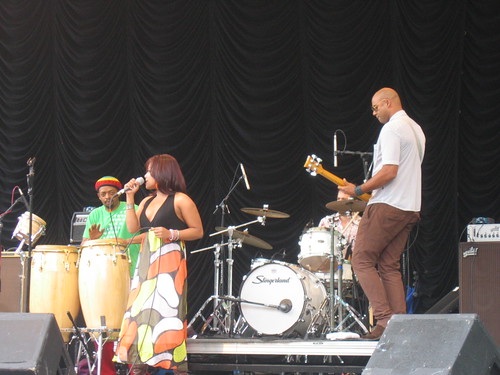
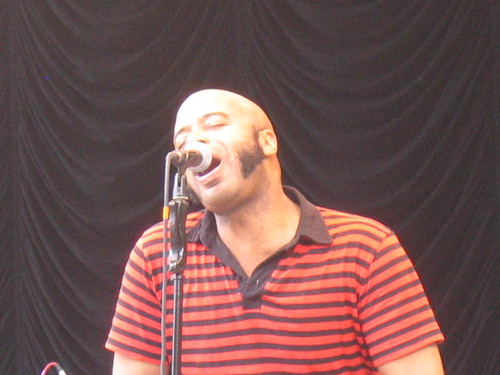
The two intro bands, especially the first, were well worth the trip. Apollo Heights, a group that's been around for two decades, opened first, and I though I'd heard of them during the first Afropunk festival a few years ago, catching them live was a revelation. (Why don't I attend more live concerts?) Playing new pieces as well as songs from their CD, White Songs for Black People, the band, which comprises Danny Chavis (lead guitar), Marvin Levy (drums), Hayato Nakao (bass/programming), Monk (Brother Earth) (3rd guitar), Honeychild Coleman (rhythm guitar), Daniel Chavis (lead vocals), Micah Gaugh (backing vocals, keyboard), and Damali Young (guest drums), set the afternoon off like a round of firecrackers. I was too busy taking photos and trying not to sink into the muddy turf to take notes, but song after song, and especially "Christine," with its drawn out cadences and heavy drone, made an impression, and by the end of their moody, melodious set, I really wanted to hear a lot more. (iTunes or Lavamus!) The second band, Dengue Fever, from Los Angeles, mixes Cambodian pop and lyrics with rock, and while interesting enough, they went on a bit long. I loved lead singer Chhom Nimol's voice and the band's grooves for the first few songs, but after about 6 or so of the songs featuring jumpy B-52-style beats, I was ready for M. Taha.

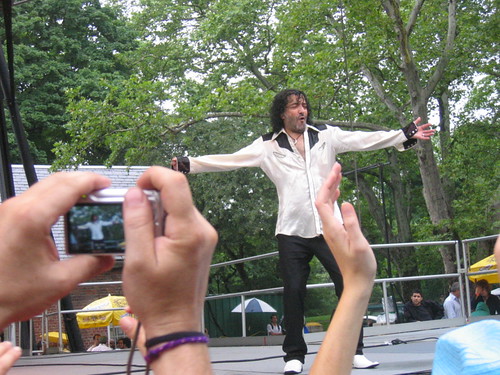
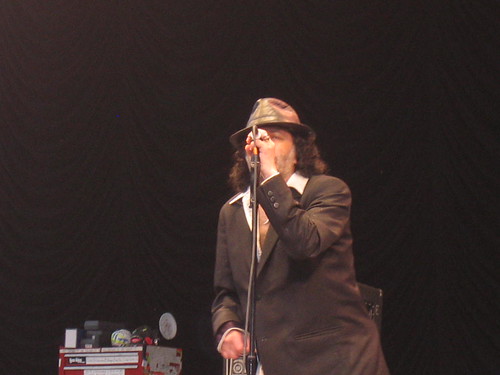
And then there he was! Bearing a cigarette like a talisman, shambling across the stage as if unsure of where he was, and belting out song after song like a true pro, with breaks from the singing, dancing and posing taken up by his slurping down some sort of yellow-greenish liquid and fiddling with his pants at the back of the stage. He had the entire crowd hopping in short order, so much so that by the time we left, it looked like I'd crossed a mudpatch. But it was great hearing "Habina," "Kelma," "Ecoute-Moi Camarade," and many other hits, as well as one of his most famous and beloved songs, his cover of the Clash's "Rock the Casbah"--"Rock el Casbah," which he ended the concert with, on the best note. My lower body is still sore from all the dancing. Below are some photos from the day. When I post some videos of YouTube, I link one here.

Crowd at Summerstage
The crowd at SummerStage yesterday
Taha fans, with Algerian flag
Some of Taha's fans, with Algerian flag
Excited crowd at Taha performance
The crowd
Rachid Taha
Taha performing
Taha
Taha crooning
Dengue Fever
Dengue Fever performing, with lead singer Chhom Nimol at left
Lead singer for Apollo Heights
Apollo Heights' lead vocalist Daniel Chavis
Honeychild Coleman, Apollo Heights
Apollo Heights on stage
Apollo Heights

Tuesday, July 01, 2008

Away from Blogging + FISA Mess + Cauleen Smith's The Fullness of Time TONIGHT!

It's been a while, I know. I've been recuperating, writing, reading, wending my way to the library, wrangling with grant applications and budgets, trying to wrap up lingering threads from the school year, and so forth, and while my interest in blogging never wanes, my ability to do so often dwindles to intent without action. (I have some stubs from the last week I'll try to fill in.)

I do browse others' blogs, though, and continue to be inspired by the rich range of voices, thoughts and ideas, approaches, and skills out in the blogosphere. The media like to portray blogs as nothing more than digital diaries, and bloggers (still-sigh!) as unwashed narcissists, but the reality is that some of the freshest, most interesting writing I come across across a range of topics, but especially on the political front, exists on blogs. The establishment media, especially the people who are affiliated with print publications and TV, long ago ceded the sharpest critical acumen to netizens, though you'd never guess that if you took the mainstream punditocracy appraisal of blogging at face value. I don't, and ceased to long ago. And I know I'm not the only one.

***

The FISA bill shenanigans aren't over yet. The Democratic-led Senate, after giving George W. Bush all he hoped for and more with this horrible excuse for a bill, has postponed a vote on the bill until after July 4, 2008.

As I wrote before and also posted on the CC list, anyone and everyone can contact the Democratic presidential nominee Barack Obama's campaign directly at:

1 (866) 675-2008 [Dial 6, then 0, on the menu] (They do pick up quickly.)

I've called and I urge others to do so as well. If you have or intend to support him, please call his campaign, let it know you are or will be a supporter and then register your strong disapproval against his position that this horrible bill is a "compromise" deserving of his vote. If you do not support him but also do not support the Republican Party's delight that this bill is on the verge of being passed, please let his campaign know this as well.

There is no reason for him to support this bill unless he believes it's a good idea. He has previously said he does not support telecom amnesty, and he's said that he does not support warrantless wiretapping of Americans. The former would kill pending civil lawsuits, while the latter, which is likely illegal, would be quashed So why is he supporting this bill? Tell him that you think it's a bad idea.

If you're an Illinois resident, you can contact his Senate offices at:

1 (202) 224-2854 / Fax: (202) 228-4260

And if you can contact all the other Senators at the following Congressional toll-free numbers. You just ask to be connected to your Senator:

1 (800) 828-0498
1 (800) 459-1887
1 (800) 614-2803
1 (866) 340-9281
1 (866) 338-1015
1 (877) 851 - 6437

Several Senators, including New York's senior Senator, Chuck Schumer, have now stated that they'll oppose this horrible legislation. Wisconsin Democrat Russ Feingold has called it "capitulation" to Bush. Connecticut Democrat Chris Dodd, who'd previously promised to filibuster it, has said he'll again consider filibustering it. But Barack Obama is now the leader of the Democratic Party, and he could quash this monster if he dared. So he needs more pressure. Apply it, please.

***

Cauleen Smith's The Fullness of Time is at screening tonight at The Kitchen in NYC.

Tisa says:
You must try to come see Cauleen Smith's new film, Tuesday, July 1,
at the Kitchen, for FREE.

I met Cauleen while she was filming DRYLONGSO in Oakland, CA, back of the day, and realize now that certain folks in her creative community at that point became the nexus for some of my most enduring Bay Area friendships.

Anyway, I'm so down with the Afrofuturists (bump postmodernity), and supporting Cauleen's work...

Audiologo writes:

This coming Tuesday, July 1st, Cauleen Smith, one of my favorite filmmakers is coming to town to premier her latest work THE FULLNESS OF TIME at the Kitchen in NYC at 8pm. Afterwards there will be a discussion with Cauleen and Executive Producer Paul Chan.

I got to program Cauleen's work back in the day when I was running the Women of Color Film and Video Festival in Santa Cruz. She was brilliant and singularly visioned even back then. Having started out as a visual artist and set designer, filmmaker/writer Smith has a wonderful sense of story, and an amazing eye for color and light.

She has a feature film to her credit, DRYLONGSO, that starred Will Power and a number of artists from the Oakland, California area. It's one of the rare films to present an intelligent portrayal of young black people, and a black female artist, that also deals with questions of race, gender, cultural access, violence, class, and intergenerational dynamics, and even budding romance. The casting and acting is spot on, and similar to the complex issue-filled work of Charles Burnett, the film excels as a piece of cinema. Since then she's returned to her roots in more experimental narrative fare, and has continued to make compelling art.

This latest work concerns Cauleen's ongoing futurist explorations (she's a founding member of Carbonism, a post-Afrofuturism arts ethos) with the story of "sister-from-another-planet" who has traveled to Earth to learn about its way and lands in post-Katrina New Orleans. Smith shot the work in New Orleans and collaborated worked with New Orleans resident poet/educator Kalamu ya Salaam and the Students At the Center group.

I would go a long way to see a film by Smith even if it was just about snaking a drain, so I'm definitely going to see this. If you're in the area I hope to see you there. For more info, see the attached flyer.

These are two folks to listen to. I won't be able to catch it, but I hope it'll be screening again in NYC. (Or Chicago.) Soon.

Monday, June 23, 2008

In the Garden + Oe & Pamuk on Writing

The weather has been so lovely since I've been home that I must thank the gods. Just before the end of the school, when it was still cool and rainy in Chicago, the New York area suffered through a heat wave that has been conspicuously absent since I've returned. Instead, it's been intermittently warm and cool, rainy but not especially muggy, and sunny hours have given way to brief showers before switching back, especially over here in New Jersey. One result is that the gardens are thriving. C did most of the early spring work since I was toiling in the concrete, glass and limestone fields of Evanston, but I did manage to spend one weekend months ago removing the thick ground cover of magnolia leaves that had the effect of protecting a number of the plants during the mild winter.

So far, most of the perennials have returned: among the herbs, two types of sage, African and pineapple, are back, as is the lavender, the rosemary, the mint, the lemon balm, and the thyme. C. planted dill and basil, which are also flourishing. A colleague asked how to keep basil growing from year to year, and I haven't figured out an answer yet; every time I've planted and harvested it that's been the ended of it, but perhaps other gardeners have some thoughts on this. Slightly limey soil does seem to help it take root.

Among the flowers, the roses, rhododendrons, azaleas, and honeysuckle have all bloomed, and the hydrangeas are now in spectacular form. The fruits and vegetables are also in very good shape: the blueberry bush I bought is in the ground, alongside the other, the two different types of strawberries are already growing, as are the blackberries, whose bushes are again creeping across the lawn, and brussel sprouts, red cabbage, collard greens, tomatoes, and peppers are also emerging.

In general, the backyard is turning into an English garden. I will take more photos when we get a respite from the rain and I can take the lawnmower to it.

Here are some photos:

Hydrangeas in the front garden
The hydrangeas, after a rainstorm
Honeysuckle and blackberry bushes
The blackberry bushes in front (the blueberries are hidden), with the honeysuckle canopy behind it
Mint
Mint
Two types of hosta
Two types of hosta, growing in what was once a bare patch at the back of the yard
Red cabbage
Red cabbage (some of the leaves have proved delicious for caterpillars)
Rosemary and pineapple sage
Little strawberries
Budding strawberries (which have since disappeared--a cat? a rabbit? an opossum?)
African sage (and basil at left)
African sage, with tiny basil sprigs at left, and peppers (?)
Dill and tomato plants
Tomatoes and dill (the wispy sprigs at right)
Brussel sprouts and peppers
Brusssel sprouts (at left), peppers, African sage

‡‡‡

Daily Yomiuri Online newspaper offers a brief snippet of a conversation with two of the leading international writers, Turkish Nobel Laureate Orhan Pamuk (whose highly praised novel Snow I finally finished after months of sustained effort), and Japanese Nobel Laureate Oe Kenzaburo (whose Seventeen is one of the best novels I've ever read about a far-right young nut). From the interview:

Oe: I believe poetry is the best kind of literature. I wrote my first poem as a primary school student. I looked inside a dewdrop on a persimmon leaf and found another world inside it, and wrote about it in a short poem. Unfortunately, I could not become a poet, but in my novels I continue to claim the existence of other worlds.

My writing style involves repeated rewrites. These revisions comprise 80 percent of my life as a novelist. I am trying to achieve a kind of polyphonic expression that I learned from [Russian novelist Fyodor] Dostoyevsky. I want to create a collective voice expressing a truth that transcends the voices of individuals. This can be achieved in a novel, but not in poetry.