Saturday, September 15, 2007

Memorial & Celebratory Reading for Phebus Etienne

Here are some photos from the memorial reading for Phebus Etienne last evening at NYU. A sad occasion on level, but I would bet I'm not the only person who left feeling filled with joy at hearing her axe-sharp--to echo Aracelis Girmay's description--and evocative words brought so movingly to life and seeing all the Cave Canem and Kundiman-affiliated writers celebrating, as well as a few other former classmates from ten years ago, celebrating her. I also would bet I wasn't the only person who felt she was there with us.

Before the reading, l-r: Greg Pardlo, Shane Book, Evie Shockley, and Ron Villanueva

People in fellowship before the reading

Dante Micheaux introducing the reading, before presenting one of Phebus's poems

Sarah Gambito reading

Ron Villanueva in recollection

Greg Pardlo speaks about his friendship with Phebus

Jan Gill O'Neil, who was a very close friend of Phebus's (I first met them at the same time, I think, back in 1995)

Aracelis Girmay, speaking fondly about Phebus

Evie Shockley reading one of Phebus's poems and one of her own

Vikas Menon, presenting one of Phebus's poems and one of his own

Joe Legaspi, who was one of Phebus's closest friends, reading an incredibly moving remiscence

Mendi Obadike reading one of Phebus's poems

Mendi and Keith Obadike, before they began their song in tribute to Phebus

Khalil Murrell, who talked about his friendship with Phebus

After the reading

Poets remembering and celebrating Phebus

Friday, September 14, 2007

More on Jena 6 + Conflux: Psychogeographers Hit NYC

Jena SixBack in late July I posted about the Jena 6. (There's more here.) Prosecutors have reduced charges on several of these young people, but next week, September 20, 2007, is the scheduled sentencing date for Mychal Bell, the only one of the defendants to be convicted in this grotesque, racist miscarriage of justice.

Color of Change has created a page for the Jena 6. You can sign a petition and donate money to their defense fund.

They've designated next Thursday, September 20, as a National Jena Day of Action, and if you'd like to volunteer to hand out flyers or call Louisiana officials to challenge the legal proceeding and haven't already signed the petition, you can get involved here.

Here's a YouTube video of Jack & Jill Politics' Baratunde Thurston interviewing Color of Change's James Rucker at Yearly Kos.

Update: A Louisiana appeals court has thrown out the conviction against Mychal Bell, ruling that he should not have been tried as an adult in the earlier proceedings. At the time of he was found guilty of attacking a white classmate after a racial incident, he was 16 years old. He had been jailed since December and was awaiting sentencing on September 20. Prosecutors still have the option of trying him on other counts, and some of the other defendants may still be put on trial, so please do not relent in pressing for all charges to be dropped against these young people.

>>>

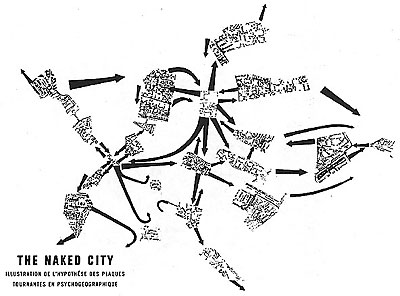
Naked City
Fellow psychogeographers and dérivistes, the place is NYC and the time is now:

Conflux Festival 2007

Conflux is the annual New York festival for contemporary psychogeography, the investigation of everyday urban life through emerging artistic, technological and social practice. At Conflux, visual and sound artists, writers, urban adventurers and the public gather for four days to explore their urban environment.

People from a wide variety of backgrounds and cultures come together at the festival to re-imagine the city as a playground, a space for positive change and an opportunity for civic engagement. The Village Voice describes Conflux as a “network of maverick artists and unorthodox urban investigators…making fresh, if underground, contributions to pedestrian life in New York City, and upping the ante on today’s fight for the soul of high-density metropolises.”

From architects to skateboarders, Conflux participants have an enthusiasm for the city that’s contagious. Over the course of the long weekend the sidewalks are literally transformed into a mobile laboratory for creative action. With tools ranging from traditional paper maps to high-tech mobile devices, artists present walking tours, public installations and interactive performance, as well as bike and subway expeditions, workshops, a lecture series, a film program and live music performances at night.


But you probably already knew about it.

As you probably also already knew about Steve Lambert's Top Secret Project, which is taking place tomorrow, and which you still have time to sign up for and participate in.

Maybe I'll see you. Or I won't.

It ought to be fun in any case.

Remember, you can map your coördinates anywhere your mind happens to be....

>>>

Boulovani*

*Anyone who draws portraits of Maxwell is going to catch my eye. (Click image for more.)


Image © 2007, Bobby Jones.

Check his work out.

Wednesday, September 12, 2007

Things & Thoughts + Memorial for Phebus

C said yesterday that he thought I would have gone down to Ground Zero (ground zero? why wouldn't the term be capitalized given its sacralization since the ultratragedy that occurred six years ago), but I told him that while I understand the need and desire for government officials and family members of those who died on that day to participate in an official service, I personally feel the way for me to honor the 9/11 horrors and their aftermath is to remember them, in silence, and, though I didn't say to this, to consider ways that we might prevent them in the future, beginning with not getting involved in wars that help to generate more terrorism while underming the longterm health of our society, government and constitutional system, the rest of the world. Thus my post yesterday. I can remember the weeks and months right after 9/11 when I and so many others exchanged our stories of life that day in person and on the phone, how we sent emails back and forth (Samuel Delany's was one of the most memorable), how we felt relief at seeing people we hadn't seen in years, how some friends and acquaintances could not get out of New York and its environs fast enough, and then the moment came, how some of us tried to transform our experiences--or even just feelings--into art (and Ulli Baer, like others, later published an anthology of some of these earliest pieces, including one of mine); and then perhaps a year and a half later, the stories ceased being narrated, revised, exchanged, circulated. The memories were still fresh--how could they not be--and still are, but the stories of those memories, the accounts themselves, have become echoes that are still perceptible under the surface of everyday life, especially in and around New York, even if no longer so audible. But then whenever I walk down a street that was vibrant in its shabbiness during the summer of 2001, but which became a sorrow-edged row of empty storefronts in the summer of 2002, and which is now a haunt of the wealthy who ply more and more of Manhattan's grid, some of those stories, and the world they encapsulated that is certainly gone, once again buzz in my ears.

***

It's no news to anyone that for years New York City was browning, so to speak, except in certain neighborhoods (the Upper East Side, Upper West Side, SoHo, parts of the West Village, Tribeca, etc.), as hundreds of thousands of White residents left for the suburbs of Long Island, the northern counties, New Jersey, Connecticut, and other hospitable places near and far. The nadir of New York's image as a multiethnic, chaotic city came, I think, in the 1970s. The Blaxploitation films, and subsequent ones like Dog Day Afternoon, Taxi Driver, Fort Apache, The Bronx, The Taking of Pelham One Two Three, Gloria and the hilarious The Out of Towners are just a few of the films reflectiong this era of the unlivable metropolis, and there are countless others, extending well into the early 1990s, like Spike Lee's masterpiece Do the Right Thing.

As has been clear for since before 9/11 and certainly since then, that's changed. As have the demographics of New York City: there are now more White residents and fewer African Americans, but also more Asians, more Latinos (who can be of any race), and, as always, a lot of immigrants of all racial backgrounds. A while ago I posted on the falling numbers of African-Americans in New York City, which is becoming unaffordable for people of any race who aren't very rich, and as the linked New York Times article, White s are returning to and Blacks are leaving the cities noted, I imagine, for wherever's more affordable, especially during a period of wage stagnation and rising prices. The article also notes that despite the ethnic transformation underway, New York possesses an ethnic equilibrium that few other cities or metro regions in the country can boast of. Nevertheless, as more and more poor and working class people, especially brown and black ones, are dispossessed and exiled and Manhattan in particular, but Brooklyn as well becomes ethnically and economically monochrome, where will the people who keep the city running--the people who person the service jobs--live, and will the city that remains still be a draw?

It isn't only New York, though. Hurricane Katrina and its disastrous aftermath drove out a sizable portion of New Orleans's Black community, which has dropped from 67% to 58% of the population. (The city overall has recovered only about 60% of its population.) To the horror of the world and the delight of right-wing Republicans and some real estate magnates, black New Orleaneans were scattered to all corners of the country. Many of the discussions I've seen about the reconstruction of New Orleans note that there appears to be little more than lipservice paid to bringing back a large portion of the working-class and poor Black people or to creating a city that would improve their lives. The aim is to create a tourist-friendly living museum, which chunks of Harlem, the East and West Village, and many other parts of New York have become. (On a Times blog, historians Madhulika Khandelwal and Joshua Zeitz offer somewhat different, enlightening perspectives.)

More broadly, gentrification has also changed other cities, like Washington, DC, which is steadily losing its Black population to Maryland, Virginia, and more distant points. I think that these changes are cyclical--New York, as I say above, was supposedly on its last legs in the 1970s and "ungovernable" during the last years of Ed Koch's mayorship and the first two of David Dinkins's, yet is now on an upswing, and I can only wonder what cities like New York, Boston, Atlanta, and Chicago will look like, what their urban cultural mixes will be like, 1o or 25 or even 50 years on.

***

Yesterday I heard a radio report, later confirmed by a TV news account, that according to data from the New York Department of Health and Mental Hygiene, over the 2001-2006 period, the rates of HIV seroconversion were up by 33% among New York men under 30, though they had fallen by 22% among men over 30. Most troubling were two statistics: first, that males between the ages of 13 and 19 constituted the group with the fastest-growing rate of H.I.V. infection; HIV diagnoses doubled for this group in the five year period. And second, more than twice as many Black men, and 55% more Latino men, reported HIV diagnoses as White men, with 90% of the diagnoses of men under 19 among Blacks or Latinos.

Quoting the New York Times's City Room blog article directly:
Dr. Thomas R. Frieden, the city’s health commissioner, offered a blunt assessment of the data.

“We’re headed in the wrong direction,” he said in a statement. “Unless young men reduce the number of partners they have, and protect themselves and their partners by using condoms more consistently, we will face another wave of suffering and death from H.I.V. and AIDS.”

Dr. Frieden’s statement included statements of support from leaders of the National Black Leadership Commission on AIDS, Gay Men of African Descent and the Callen-Lorde Community Health Center.


Thoughts? Suggestions? What can we do/what can be done, especially for adolescents who are susceptible to HIV seroconversion, and probably not receiving adequate and comprehensive sexual education in school these days?

***

As for disturbing US news--and I don't mean the Petraeus-Crocker Kabuki-carnival in Washington, which is distressing and dispiriting, or the ongoing horrorshow in Iraq, etc.--there are few things that can top this (which I quote directly from the The Smokinggun website):

Six Held In West Virginia Torture Horror
Cops: Black woman raped, beaten, abused during week-long captivity

SEPTEMBER 11--A black West Virginia woman was sexually assaulted, stabbed, and tortured while being held captive by her white abductors, one of whom told her, "That's what we do to niggers around here." The 23-year-old victim was freed Saturday after cops responded to the home of Frankie Brewster for a "welfare check on a female that was reportedly being held against her will." When cops arrived, Brewster claimed she was the only one home, but then the victim limped to the door and said, "Help me." According to six harrowing criminal complaints, the woman, who apparently had been held for more than a week, had four stab wounds in her left leg, bruised eyes, and had been repeatedly sexually assaulted and humiliated. The woman told police that she was forced to lick Brewster's "toes, vagina, and anal cavity." Brewster's son Bobby forced the woman to eat dog and rat feces, according to one complaint filed in Logan County Magistrate Court. The victim, who is now hospitalized, was raped at knifepoint, choked with a cable cord, and had her hair pulled and cut during the ordeal. Police, who have arrested six defendants for their roles in the abduction and attack, are looking for other suspects who may have lured the victim to Brewster's home. The arrestees are seen in the below mug shots. Pictured clockwise from the upper left are Frankie Brewster, 49; Bobby Brewster, 24; Danny Combs, 20; George Messer, 27; Alisha Burton, 22; and Karen Burton, 46. (11 pages)


I did not link from the Raw Story website, whose comments section for this article evidently drew some of the nuttiest, most virulently racist people running around out there, but one person does claim that these folks had a Bush/Cheney bumper sticker on one of the trailers and another points to parallels with the Abu-Ghraib torture scenarios, which, let's not forget, Rush Limbaugh waved off as fraternity-style hijinks. Sadly and unfortunately, brutal, inhumane attacks against women, particularly Black women, or against racial and ethnic, religious, sexual, and socially different people are nothing new, but still, the specifics of these allegations were so horrible I almost could not believe what I was reading.


***

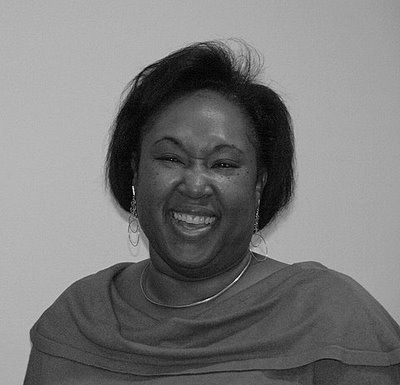
Phebus EtienneOn a different note, I received from several different people this notice about a memorial reading for Phebus Etienne (1965-2007, at right) this upcoming Friday at NYU. It's a divine roster reading in memory of a divine person and poet (whom I first met at NYU), who left us far too soon:

Memorial Reading for Phebus Etienne
Friday, September 14, 2007, 7 p.m.

Reading Phebus' poems are her friends Sarah Gambito, Aracelis Girmay, Joseph O. Legaspi, Vikas Menon, Dante Micheaux, Khalil Murrell, Mendi Obadike, January Gill O'Neil, Gregory Pardlo, Evie Schockley, & R.A. Villanueva

@ Lillian Vernon Creative Writers House
58 West 10th St. (between 5th and 6th Aves.)
New York City

Reception to follow


Tuesday, September 11, 2007

9.11.2007

9/11

And following on a suggestion by Not Atrios, tell

Senate

House

Media

that we want US troops brought home from Iraq as soon as possible, and that the Democratic-led Congress refuse to support a coup that will install a US puppet, be it Ayad Allawi or anyone else;

that we do NOT want a war with Iran or military strikes on Iran or the Iranian people, whether directly or by proxy, and that the the Democratic-led Congress not compromise even in the slightest on this issue;

that we want the Democratic-led Congress to revisit and completely rethink its capitulation on the warrantless wiretapping bill, which includes restoring the oversight of the independent, secret federal court; providing NO immunity or indemnification for phone companies that participated in any illegal activity; and severely constraining the power of the Executive and his offices to conduct spying of any form, using any technology, on Americans;

that we want the the Democratic-led Congress to pass a comprehensive voting bill which, among other things, makes all source code reviewable by government authorities; maintains a printed paper trail and preserves this trail for at least 100 years, with any willfull destruction of it publishable as a serious felony; makes all votes cast fully auditable by public officials and citizens; criminalizes and enforces the law on actions like voter caging, intimidation of voters and willfully striking voters from voting lists to deny them their franchise; and permits people who have completed their jail and probation terms to vote;

that the president's choices for the new Attorney General are unacceptable right-wing hacks and that at the very least he should select someone chosen by a bipartisan, blue-ribbon panel, and that the Democratic-led Congress should not give any leeway given the successive debacles of the John Ashcroft and Alberto Gonzales tenures at the Department of Justice;

that we want all of the investigations initiated by Democratic-controlled Congress to result in action, not just a series of queries, shrugs, whines and idle demands--they must review the U.S. Constitution and use all options available to them, beginning with enforcing the subpoenas; and they absolutely must not let this president and his administration get away with anything else;

that we finally have a full and complete investigation of the incompetence that led to the horrific tragedies on September 11, 2001, and afterwards, and that the president and vice president be forced to testify separately and under oath about their actions before, during and after this tragedy;

that the Democratic-led Congress and any journalists who still feel their profession has any worth stand up to the morally and ethically bankrupt, corporatized "mainstream" media and its broken, RNC-derived narratives any longer.

***

If you have any demands to present to Congress, please add them in the comment section.

Sunday, September 09, 2007

Wide Angle's Brazil in Black and White

The other night C and I watched the PBS show Wide Angle's Brazil in Black and White, a show on the rise of affirmative action programs at Brazilian federal universities that was also a focused exploration of the increased political activism among Afro-Brazilians. The show introduced five college aspirants living in or near Brasília, Brazil's 51-year-old planned federal city in the country's interior. The students all sought to attend the free Federal University of Brasília, one of the country's best institutions, which implemented affirmative action a few years ago in an effort to increase the number of Black and brown (mixed-raced) students. As I recall the statistics, Brazil's Black and brown population totals about 80 million people, or close to 50% of the population, and yet well over 90% of the students at the Federal University of Brasília were White (or considered themselves as such). (I should add that a particularly brilliant researcher from the University of Brasília working on issues of racial, political and sociocultural formation through private social clubs in Rio's suburbs was resident last year at the university.)

Unlike in the US, where most university affirmative action plans do not involve quotas and where affirmative action over its entire lifespan as a federal and state program has benefitted White women more than any other group, the Brazilian university affirmative action plans involve set quotas, with 20% or so of the spaces in an entering class reserved for Black and brown people, but there's a catch: because the vast majority of Brazilians could probably claim some African ancestry (nearly 49% of White Brazilians in the country's predominantly European south have more than 10% of African ancestry, according to genetic testing), candidates for the quota positions must first self-identify as Black and then submit to a qualification panel that uses facial images and other factors to determine racial status. In part, this is to prevent "White" students from claiming "Blackness" as another advantage, but it has not always turned out well; in one high-profile case that anti-affirmative action critics like to tout, two identical twin brothers were differently assessed, with one being declared Black and the other White. The confusion and arbitrariness of the racial decision-making played into the storyline, as the three "Black" high school students each worried whether or not they would qualify. I won't give away the verdicts, but one whose mother noted that her Blackness was "in her eyes" refused to take the affirmative action option while two others did. All three were students at public high schools in outlying districts of Brasília, a large (2.3 million people), while the other two aspirants were Whites living in considerably better circumstances. One young man, a senior at the elite Catholic school Academia Galois, lived in great luxury, while the fifth college aspirant, who'd failed in five attempts to enter Brasília's medical program, both before and since the affirmative-action changes, came from a middle-class background that could afford to pay for her continual academic preparation.

The complicating factor for all five was that unlike at American colleges and universities, admission to Brasília, even taking into account the new affirmative action plans, rested primarily on one requirement: passing the brutal vestibular, or university admissions exam, a kind of SAT-with-advanced placement exams. Personally essays, interviews, rich parents all have little role at the free, public state institutions--or at least at the best ones, which are usually located in the state capitals. I would imagine that the exam's difficulty automatically puts the public school students at a disadvantage, which became clear when the three young Black women took it. It was also clear from the scenes of the elite Catholic school, which was known for its success at preparing students to pass the vestibular, that there were very few brown or Black students enrolled there. So ultimately, while the affirmative-action programs may help admit more Black students, the show made clear that the disparity in education--and multiple social factors and indicators in general--was an ongoing problem that led to disparate outcomes and needed to addressed. (You can even see the lists of successful vestibular candidates, I believe, in Brazilian newspapers like Correio da Bahia.)

The show's broader interest was in the waxing political outspokenness of Afro-Brazilians and the criticism and negative reactions among Whites and even some Afro-Brazilians. In addition to the university affirmative action programs, which one White scholar at Brasília claimed would lead to "racism" (!), Wide Angle noted that Afro-Brazilians have been pushing for affirmative action programs in other areas, with varying degrees of success. One featured organization, EducAfro, an activist group based in São Paulo, has been pushing for expanded affirmative action in hiring, improved funding for education, and racial consciousness, affirmation and solidarity. The peaceful EducAfro demonstration in the show erupted into a confrontation with the police, but did lead to a closed-door huddle with a city official and minor promises. That was only one part of a multipronged political effort, however. Wide Angle also showed Brazilian lawyers in a training session with NAACP Legal Defense Fund lawyers to learn how to better use Brazil's laws and Constitution to press for changes on many levels. For despite Brazil's never having Jim Crow laws and its Black success stories of lore, and alongside its longstanding self-deluding notion of being a "racial democracy," a fiction millions of Brazilians cling to against numerous signs to the contrary, the racial and color lines are fairly distinct and hard to dispel. The vast majority of Brazil's poor and disenfranchised are Black and brown, and this is a legacy of more than three centuries of slavery, a terrible emancipation law and process in 1888, and socially and politically codified racism, classism, and white supremacy over hundreds of years.

One result that I've noted on here before is the propensity in Bahia, for example, for Blacks to vote for White politicians over Black ones, almost by default; a cabdriver there broke it down simply enough for me as "Negro não vota negro," and Wide Angle showed that despite the vast numbers, the cabdriver's assessment was right on. There are only a handful of Black legislators in either of Brazil's congressional houses. (Defying this trend, Rio has had a Black female Congresswoman and Senator, Benedita da Silva, the first ever in the country, who was later its first female and Black governor.) One of the few currently holding a federal office, a Senator from Rio, was actively pushing some of the affirmative action legislation, but he noted that he was constantly met with resistance and denials. The great fear, he pointed out, was that the masses might actually get a fair shake, including a real education. And then there'd be no turning back.

Watching the program underlined for me how far along in many waysBlack Americans have come, despite the long history of racist oppression and exclusion, and the ongoing problems of racism and white supremacy. Our sucesses did not come with constant struggle, considerable suffering and violence, and unyielding persistance and endurance. Much is the blood and many are the tears along our path, and the road continues before us. We've had to use of every means available, from persuasion to marches to litigation, and even when we've won we've still had to struggle to see those victories realized in real time. Yet we are much farther along than generations our ancestors were in so many ways, and farther along, in key ways, than our fellow Black people in many parts of the globe, including Brazil. Seeing similar yet different processes underway in Brazil was fascinating and heartening, as was the cross-cultural dialogue and exchange taking place between the Afro-Brazilians and African Americans. Brazil has a long way to go, not least because of the extraordinary economic stratification, one of the worst of its kind in the world, where a very small number of mostly White people own and control the majority of the country's financial wealth and economic resources, an issue the quasi-Socialist President Luiz Inácio Lula da Silva and his Workers Party have not really come close to rectifying, but then it's clear that no Brazilian government is going to effect the changes necessary, though it can take steps, like the affirmative action programs, to foster the conditions for change to occur. Real change will come, and is coming, from Afro-Brazilians themselves, and they made clear on this program that they weren't going to turn back.

Saturday, September 08, 2007

Photos: On the Periphery of Fashion Week

One of the signs that I'm approaching the end of my summer sojourn at home and consequently my last weeks at the library writing and researching is the presence, in its varied forms, of Fashion Week. The tents and fashionistas not only turn Bryant Park into their hive, but claim parts of the library's research branch as well. I was hoping to see André Leon Talley milling about, but no such luck. Here are a few photos from this past week.

Workers putting up a new Sean John poster in the 42nd Street subway

Folks snapping photos, with the tents in the background

People having lunch and strolling, some I'm sure oblivious to all the nearby excitement

One of the tent entrances

Models and fashionistas gathered outside another entrance, at the library

"Fashion" screams out from magazine pages as well

Gertrude Stein serenely presiding: "and then there is using everything."

Friday, September 07, 2007

Videos: On the Conde

I can't believe it! I've finally succeeded in posting a video to Blogger! Here are three street scenes from the main commercial strip in the Colonial Zone, el Conde.

Unfortunately Blogger would not post the other two videos, so here they are, linked from YouTube.

And one more:

Just people walking down the street....

Thursday, September 06, 2007

Travels

I find it's always hardest to blog after a hiatus. As a friend was noting, you have to be in the mood to set your thoughts (or ramblings or whatever you have) down, and even a few days or weeks out of practice can make it difficult to put anything down. (Thus my first year conceptual rule to post something every day, which sometimes meant quotes or whatever I could muster.)

It's also hard to blog after a wonderful vacation, even a brief one. We went to the DR, and as we always do, had a ball. In addition to spending time with the incomparable Mr. Anthony Montgomery (Papi Monaga), we also got to hang out with friends like Anthony B. of DC and David, Byron, Richard, Kenny, Keith, Amauri, Jerry, Ruskin, and Maripoli, who're in Santo Domingo; to finally meet Ernest (the other Montgomery), his partner José, and other cool folks like Tyson, Duron, Tyree, Raleigh, Fabricio, and Ricardo. I must single out for praise Anthony's Sunday night extravaganza, which more than made up for the curfew and the steady disappearance of so much of the Colonial Zone gay nightlife, as well as the wonderful gathering at Tyson's home, where Richard broke off a piece and then some in the kitchen, on Monday. In addition, Anthony showed us how to get to "the yellow brick road," which we followed via rental car, C driving the stick and me navigating, with a few detours, all the way to Guayacanes, with its perfect, narrow uncrowded beaches, main strip and beach road that appears to have been transported straight from rural Mississippi. I know people love to hit the resorts in DR, but my advice: try other spots if you can.

One of the highlights of this trip was returning to the Plaza de Cultura area, in the Gazcue neighborhood (the location of the heavily fortified US Embassy, as well as many governmental buildings), where I attended the Dominican book festival in 2006, and visiting two of the museums there. C and I thought that the Noche de Hiphop might be either its own exhibit or part of one, and also thought that it might be located at the Museo del Hombre Dominicano, an anthropological and historical facility that focuses on the history and culture of the DR, so we dropped in there first. I can say that if you speak Spanish and want to learn something about the history, which extends back beyond Columbus's arrival in 1492, and rich cultural heritage of DR, then by all means visit this museum. I was struck by the emphasis it places on the country's African roots--there isn't just one plaque or diorama, but several sections--really, how could there not be?--both in terms of Africa itself and its retentions in the eastern half of Hispaniola. There was neither sugarcoating nor any of the omitting, eliding and hedging that one might find in some other "official" accounts of the country's heritage, such as the guidebooks we found in our hotel rooms when we were in Samaná several years ago, or on sites like (the infamous) DR1. Other highlights included a breakdown of regional versions of and costumes from Dominican Carnival (the most famous being the one in La Vega) and the vodún-related gagá.


One of the panels on the African roots of DR culture


Artifacts from vodun-related religious practice


Los Protestantes, a panel on the religious traditions of the 1824 African-American immigrants to Samaná and other easter Dominican cities, and the subsequent Anglophone Caribbean immigrants to San Pedro de Macorís, the native city of Sammy Sosa and Alfonso Soriano

On the other hand, the museum's physical state on certain floors was saddening. Dim or no lights, displays that could have used some cleaning and attention, faded or abraded lettering, no guards present (except for touts who offered a "tour"), no air circulation in what was essentially a kiln--it was awful. I immediately thought, if $700 million weren't being diverted to the white elephant of a subway line, a small portion could easily go to making this exhibit presentable. On the first floor, there was a traveling exhibit, "Madre Africa," featuring a series of excellent plastic artworks and marvelous little illustrative watercolors that nearly made up for the dismal upper floor. Unfortunately, the person charged with watching over this exhibit was nearly somnabulent, and could barely rouse himself to respond when I asked a few questions. There were some books for sale, but it was unclear to whom the money should be paid. A group of high school (or university?) students cycled in and quickly out, as if the presence of all those drums, masks and fetishes threatened to summon up something they weren't prepared for, and I thought, were there a competent docent around, the students could have learned quite a bit from what was by far the best exhibit in the museum. In an adjacent room, there was a fine, room-length series of vitrines featuring Taíno artifacts, as well as a diorama that both C. and I had to photograph. Two people working in this room were chatting away; perhaps at some point they stopped to address any questions the students might have had, though I doubt it. I was glad that we stopped in, but I do hope someone alerts the government that it could spend a bit more money and do a better job of showcasing itself in what is supposed to be one of its premier cultural institutions.


A display showing artifacts from a gagá ceremony (I believe)


In the "Madre Africa" exhibition space


A student taking notes before one the Taíno exhibits

We then walked to the Museo de Arte Moderna (Museum of Modern Art), which was hosting the national visual arts biennal. Almost as soon as we entered, C spotted the elevated platform where the hiphop performance took place, and it turned out that that was only one of a series of special musical evenings (jazz and funk, bachata, merengue, etc.) to be held in conjunction with the exhibit. The Modern Art Museum was in considerably better shape than its brother museum, and the Bienal exhibits, dedicated to the painter Soucy de Pellerano, which covered three floors, were expertly mounted and eyecatching. In general, there was more painting and mixed-genre visual art than anything else; a few installations of a conceptual bent, a few sculptures, a few videos, a few works defying easy categorization, some artworks with sound but no sound art, and no live performances. An artist that none other than Anthony introduced us to, Juan Mayí (whose studio and gallery are in the Zona Colonial and open to visitors), received the top prize; his brilliantly colored, heavily worked, multilayered abstract canvases and related works in sculptural forms possess a polish and depth that easily exceeds much of what I've seen in Chelsea galleries, with the added element that Mayí is working out of multiple traditions and makes art that seethes with intelligence and emotion, that seems urgent in its appeal, rather than conniving to fit into an au courant marketing gambit.


Mayí's award-winning painting, part of a series, Memoria Signica


Maria Román's "Con el negro detrás de la oreja, hay un país en el mundo (Poliptico)" [top] and "Con el negro detrás de la oreja, hay un país en el mundo (Poliptico)" [bottom] (The phrase, "a black behind the ear" is common in parts of Latin America, and was even uttered by Brazil's former president, F. H. Cardoso, speaking of his own mixed ancestry)


C at right, with Jhonny Bonnelly's "Arte-Facto" looming above


Raúl Morilla's "Involuciando los orígenes"

Most of the selected works seemed conversant with the major contemporary international art trends while also commenting directly on Dominican themes. One thing I wished to see--and it may very well take place on a day or evening to come--was a live performance piece that explored negotiating daily life in DR from the perspective of someone who wasn't one of the wealthy or cultural elites; I realize that there very well may have been such pieces in past exhibits. Some of the artworks were merely clever, but in general, I found compelling formal elements or arguments in a great deal of what was on display. I'm unsure if or when I'll be able to catch the exhibit again, but I'd love to in order to look at everything at much greater length.

Another revelation in the museum was the brief but illuminating collection of Dominican "modern" art on the museum's top floor. The exhibit proceeded chronologically, and showed how powerful the influences from Europe and other parts of the Americas were until the 1940s through the 1960s, when a number of notable Dominican painters and sculptors, working in styles from post-Cubism to geometric abstraction to expressionism and expressionist realism, and inspired by antecedents like Celeste Woss y Gil, and later Jaime Colson, Dario Suro, and George Hausdorf, came into their own. Eligio Pichardo, Clara Ledesma, Paul Giudicelli, Elvis Avilés, and Katya Paiewonsky were some of the names I filed away in my memory. One artist whose work I fell in love with was Antonio Prats Ventós (1925-1999), a Catalonion native and political refugee who became of the DR's major sculptors. Prats Ventós repeatedly won the top prize at past Bienales, and is perhaps best known for his works such as the sculptures in the Plaza de la Trinitaria (the Trinity of Founders of the Dominican Republic) in Santo Domingo.
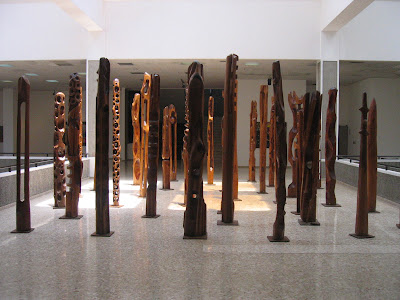


I believe--and of course, I forgot my notebook during this excursion--this installation of sculptures is called "El Bosque." In addition, there was this one, which I believe is titled "la Selva."


(You have to approach both to fully experience them.) Both, operating on the principals of abstraction and metaphor, and packed with symbolic power, left me with a feeling of almost indescribable delight. According to María Ugarte, they are two of Prats Ventós's major works, which means that the Museum of Modern Art's possession of both is a real coup. I have no idea whether its funding is exceeds to a great degree that of the other museum, though apperances would suggest this to be the case, but it's clear that whoever oversees this institution is determined that it show, as best it can, some of the treasures of Dominican culture and contemporary art.

I cannot travel without returning with at least one new book, and so I did. (I took Orhan Pamuk's Snow, which I'd been struggling to read for most of August--and before that, a good deal of the spring--and only recently made headway in, after finally resigning myself to his difficulties--or ineptitude?--in narrating this thematically fascinating realist novel in even a quasi-linear, forward-moving fashion.) I purchased Professor José Luis Paéz, S.J.'s Breve Introducción a la Cultura Dominicana (Santo Domingo: ABC Editorial, 2006). In addition to being a gorgeously designed book, it's truly brief yet informative, easy to read even if your Spanish skills are moderate (you may need a dictionary, but after the 15th "hay que" and passive construction, you can grasp the gist of his arguments), full of excellent photos (which do not, unfortunately, always correlate with the text), and informed by contemporary humanities and social science discourse, so you're not getting a flat, monochromatic discussion of cultural formation, transition and transformation, but a surprisingly nuanced and agile one. There are better books on Dominican history, race relations and so forth, but Paéz's little book, which ranges from the Taínos to bacheteros, is one that anyone interested in DR history and culture--which is the book's focus--could benefit from reading.

***

I was sorry to hear that Luciano Pavarotti had passed away after a bout with pancreatic cancer. Anyone who knows my tastes in classical music is aware that while I do love opera, I'm not a great fan--brace yourself--for the Italian operatic tradition. Yes, I know, you may be saying, as a former boss of mine did, that without it there's no operatic tradition to speak of, unless you count the scant offerings from the French and Germans (save Wagner) and what passes for opera after the turn of the 20th century. But that's the opera--from Richard Strauss's Salome to Steve Reich's Dr. Atomic that I'm most interested in. Nevertheless, I can appreciate talent, and hearing Pavarotti on CD and mp3 files rendering his greatest roles, with his often astonishing range as a tenor, from the works of Giordano, Rossini, Donizetti, Puccini, and yes, Verdi (alright, one of the greatest operatic composers of all time) warmed me to all their works. I'm not such an operatomane that I can comment much more than this on Pavarotti's greatness, but great he was, and not only opera, but music in general--because he had long since branched out--has lost a great one.

Sunday, September 02, 2007

Photos: Away


Carnaval costumes, Museo del Hombre Dominicano

One of the early Dominican modernist works (title unknown)

Antonio Prats Ventós "El Bosque"

At the Museo del Hombre Dominicano, from the 2nd floor
Another one of the regional Carnival costumes
A Persian rug repairer, in the Zona Colonial

The construction of a second Chinese arch, Chinatown, Santo Domingo, off Avenida Mella (the strip through the 'hood)

Two men on the pier, Playa Guayacanes

Submerged piers and beach houses, Playa Guayacanes

Dominican brotha stylin, on the way back to Santo Domingo

I'm not even sure where we were heading (?)