Tuesday, April 17, 2007

Poems: Nikki Giovanni

Nikki Giovanni, whom I have spoken about in variously places previously as one of my favorite poets in childhood and adolescence, gave the rousing, consoling conclusion to the Virginia Tech convocation today. You can view that here. I realized as I watched the clips of Giovanni's speech that she has written quite a lot about the pain of loneliness, of making choices in the faces of various kinds of difficulties, of the constrained life. I wonder if Cho Seung-Hui ever read any of these poems, like "Cotton Candy on a Rainy Day," or "Choices"--in the best of all worlds, they might have helped him, lifted him, reached him. Poetry sometimes can have that effect. Below is Giovanni's poem "Cotton Candy on a Rainy Day," whose treacly title belies its simple profundity. I've added another one, a bit more witty, to show her range. The students, her colleagues, and everyone at Virginia Tech are lucky she's there.

COTTON CANDY ON A RAINY DAY

Don't look now
I'm fading away
Into the gray of my mornings
Or the blues of every night

Is it that my nails
keep breaking
Or maybe the corn
on my second little piggy
Things keep popping out
on my face
or
of my life

It seems no matter how
I try I become more difficult
to hold
I am not an easy woman
to want

They have asked
the psychiatrists psychologists politicians and
social workers
What this decade will be
known for
There is no doubt it is
loneliness


BEING AND NOTHINGNESS
(to quote a philosopher)


i haven't done anything
meaningful in so long
it's almost meaningful
to do nothing

i suppose i could fall in love
or at least in line
since i'm so discontented
but that takes effort
and i don't want to exert anything
neither my energy nor my emotions

i've always prided myself
on being a child of the sixties
and we are all finished
so that makes being
nothing


Copyright © 1978, Nikki Giovanni.

Monday, April 16, 2007

Trethewey Wins Pulitzer + Tragedy at VTech + Poem: Natasha Trethewey

natasha tretheweyI am so elated to type these words: Natasha Trethewey has won the Pulitzer Prize for Poetry!

She was honored for her brilliant recent volume, Native Guard (Houghton Mifflin, 2006), which appeared last year to great acclaim (and was a past J's Theater Book of the Month pick as well). Natasha was a member of the Dark Room Collective many years ago, and was one of the first winners of the book coverCave Canem Poetry Prize, for her début collection, Domestic Work (Graywolf, 2000), and she later published She is also the fourth Black poet to win the Prize for poetry, following in the tradition of Gwendolyn Brooks, Rita Dove, and Yusef Komunyakaa. I've known her for almost a decade and a half, and can say without hesitation that she's a terrific, gracious person who really deserves this extraordinary honor. I am so happy for and proud of her! Congratulations, Natasha!

One of the two runners-up in the category was poet Martín Espada, another poet I know and think the world of. Martín was one of the earliest readers at the Dark Room's reading series, and has mentored and taught quite a few younger poets. Congrats to Martín as well.

Also, Eisa Davis, another fellow Cave Canem writer, was a finalist in the Drama category for her play "Bulrusher"! Congratulations, Eisa!

And other winners include Ornette Coleman in the Music category (no, you did not read that wrong--someone other than a classical music composer received the Pulitzer in music!--they must be fuming in quite a few university music departments), for his recording Sound Grammar; Atlanta Journal-Constitution columnist Cynthia Tucker, who often challenges the middling conventional wis-zards on Sunday talk shows, received the Pulitzer in Commentary; and John Coltrane was honored nearly 40 years after his death with a posthumous citation for his "his masterful improvisation, supreme musicianship and iconic centrality to the history of jazz." I only wish his wife, Alice, who died not long ago, had lived to see this day.

Finally, I must note that as was predicted by some in the media, Cormac McCarthy received the Pulitzer Prize in fiction for his most recent novel, The Road, which is the current pick of Oprah's Book Club. I haven't read it, but reader Kai did praise it strongly--at least up to its final scene (right, Kai?). I'll be getting to it one of these days soon.

***

I was busy with university business pretty much all day--we had on campus a very fine visiting poet, Josh Weiner, whom I'll write about soon--so I didn't get an opportunity to check the web or hear the full report from C on the horrific events that occurred today at Virginia Polytechnic Institute, in Blacksburg, where a gunmen went on a rampage and killed more than 30 people, including students, faculty and staff members, then killed himself.

Since I know only some of the particulars of the incident, I won't expatiate on the crime itself, except to say that my heart goes out to the families of the dead and injured, and to the Virginia Tech campus as a whole. Such events sadden me tremendously. Some reports are suggesting that this is the worst shooting and worst university mass-murder of all time. It certainly has to be one of the worst instances of a mass killing in the US outside of a war battle zone, outstripped only by the 9/11 suicide bombings and the Oklahoma City massacre. Such a senseless, horrible crime is almost too awful to register, much like the daily accounts of slaughter that reach us from cities across Iraq and Afghanistan and Sudan, that we heard about in Rwanda, in East Timor, in Bosnia and Herzegovina, in Chechnya and Ingushetia....

When C and I lived in Virginia, we became aware of how easy it was and is to purchase guns there. I was and remain incredulous at the idea that anyone would need to purchase handguns right away, without a background check and waiting period, let alone 2 or 5 or 10 or 25 or 100 pistols and rifles and automatic rifles and machine guns and so on in one pop, unless she or he were outfitting a police force, or a military unit. Then, a few years ago, I believe that Virginia tightened its laws and limited the numbers of certain types of guns people could purchase per month, enraging a sizable number of fanatics, but I believe (though I could be wrong) that it's still the case that almost anyone can purchase an unlimited number of guns there at a gun show. Why? Again, what good can come from such a loophole?

As I said, my knowledge of the case is minimal, and I don't know where the murderer purchased his weaponry or why he went on this rampage, but given how easy it is to acquire guns in that state, and in particular, automatic weaponry, I wouldn't be surprised if after impulsively deciding that he was going to avenge some perceived hurt or humiliation he did some shopping there before his spree. Perhaps this will lead state legislators to tighten the laws further, but I'm not holding my breath. (There are already cries on the blogosphere that students, faculty and staff armed with concealed handguns could have prevented the crime. Personally, I find the prospect of anyone other than a policeperson walking around the university with weapons of any sort utterly terrifying.)

In the meantime, let's extend a moment of silence to those who were slain and to the survivors.

***

Back to a more positive note, here's a poem by Natasha Trethewey, from Native Guard:

THEORIES OF SPACE AND TIME

You can get there from here, though
there’s no going home.

Everywhere you go will be somewhere
you’ve never been. Try this:

head south on Mississippi 49, one-
by-one mile markers ticking off

another minute of your life. Follow this
to its natural conclusion – dead end

at the coast, the pier at Gulfport where
riggings of shrimp boats are loose stitches

in a sky threatening rain. Cross over
the man-made beach, 26 miles of sand

dumped on a mangrove swamp – buried
terrain of the past. Bring only

what you must carry – tome of memory
its random blank pages. On the dock

where you board the boat for Ship Island,
someone will take your picture:

the photograph – who you were –
will be waiting when you return

"Theories of Time and Space" from Native Guard: Poems by Natasha Trethewey. Copyright © 2006 by Natasha Trethewey. All rights reserved.

Sunday, April 15, 2007

Reading at Woodland Pattern + Poem: Ethelbert Miller

(Okay, I hope that this blog reappears after I've posted this, because I've been forced over to the new Google Blogger (after having tried it once and lost my blog for several days), but here goes....)

Friday, I was on the road again, this time to Milwaukee, to read at the extraordinary Woodland Pattern Book Center with poet E. Ethelbert Miller. Despite the fact that it's closer to Chicago than St. Louis, I'd never been to Milwaukee before. After my Friday office hours and a number of other university-related duties, I hopped on the road and made the short, easy hour-and-thirty-minute drive. I'd also never read with Ethelbert, though back during my Dark Room Collective days the rest of the writing group and I had been his guests at the Ascension Reading Series. Chuck Stebelton, who runs the Myopic Poetry Series in Chicago and runs Woodland Pattern's poetry series, invited us up, and was an exemplary host, as was everyone affiliated with the bookstore, including Anne Kingsbury, who wined and dined us in royal fashion (c.f. chicken potpies with our initials in them!).

The store, from outside

Woodland Pattern which is the kind of bookstores that many writers, especially poets, dream about. In addition to one of the best poetry collections in the country, the store also has racks and cabinets full of rare chapbooks and broadsides, and an exhibition space that features shows of original book and visual art, and a friendly, staff that knows quite a bit about arts and letters. Many of them are writers themselves. An exhibit of multimedia artist Joel Lipman's stamp poetry pieces graced the walls of the room where we read, and the book center has an online site with information about his life and work.


One of the rooms, with the chapbook filled file bureau at the center of the photo (that's Ethelbert at right speaking with a former DC resident)

The reading was really enjoyable and energizing; I was especially pleased at the turnout and at the enthusiastic response, and it was also wonderful to meet local poets like Rick Ryan and Shelly Hall. Ethelbert, who read second, found a way to tie so many common strands in our quite different work together, including our tributes to recently deceased like Phebus Etienne, our joint love of baseball, and W's ongoing, senseless vanity war in Iraq. It was also a joy to sell some books!


Post-reading confab (I don't know the name of the guy on the left, but from l-r are Rick Ryan, Dante [who'd visited with the Chicago poets I know a few years ago], Ethelbert, and Anne Kingsbury)

I told the folks at Woodland Pattern that I'd be back one of these days, and I intend to return and browse at length.

Here's one of Ethelbert's love poems, tender, epigrammatic and bearing added layers of meaning through the reference to none other than Mr. Sun Ra:

SPACE IS THE PLACE

Love is the last planet in our solar
system. Your heart crying like the
rings of Saturn. How can we believe
in stars in this darkness? I watch
the sky for your return. Inside my
hands nothing but gravity.

Copyright © E. Ethelbert Miller, 2007.

Saturday, April 14, 2007

Poem: Vénus Khoury-Ghata

Here's a poem by a poet I learned about a few years back, mainly because of her translator, the great poet Marilyn Hacker. The poet, Vénus Khoury-Ghata (1937-), is one of the giants of Lebanese literature, a literature marked by the often troubled, sometimes tragic, divided history of that country and the surrounding region. Khoury-Ghata's poetry, in French but strongly flavored by the Arabic she learned from her mother, reflect this tumultuous history, as well as the rich vein of her own personal experiences, which has encompassed a wide array of themes, including religion, village and more cosmopolitan life, cross-cultural exchange, and death and loss. I am posting both the French and Marilyn Hacker's translation; both are from the Poetry International Web site.

Pour Noha Al Hegelan

Si haute était la terre en ce temps-là
les femmes suspendaient linge et nuages à la meme corde
des anges s’accrochaient à leurs jupes pour les empecher de suivre les âmes égarées

Tout ce qui faisait commerce avec l’eau avait une âme
jarre calebasse bassine
les seaux repechaient celles qui végétaient dans l’indifférence des puits

Toute ombre mouvante était esquisse de revenant
tout chant de coq se transformait en présage
l’annonceur des naissances parlait plus haut que la cascade
mais plus bas que le vent qui avait mainmise sur le dedans et le dehors
dilatant les champs pauvres
repoussant l’horizon d’un arpent lorsque les maisons s’étrécissaient aux dimensions des cages

Le sage évitait de croiser son chemin
il vous cassait un homme sur son genou comme une paille


Copyright © 1999, Vénus Khoury-Ghata


For Noha al Hegelan

At that time the earth was so high up
women hung out clouds and laundry on the same line
angels gripped their skirts to keep them from following stray souls

Everything that frequented water had a soul
clay jug, gourd, basin
buckets fished out the ones stagnating in the wells’ indifference

Every moving shadow sketched a phantom
every cock-crow became an omen
the announcer of births spoke louder than the waterfall
but more softly than the wind which had taken over the indoors and the outdoors
swelling the paltry fields
pushing back the horizon of an acre as soon as the houses shrank to the size of cages

The wise man tried not to cross its path
it would break a man for you over its knee like a straw


Copyright © Translation: 2001, Marilyn Hacker

Thursday, April 12, 2007

Memoria + Poem: Jorge Luis Borges

I saw in yesterday's papers that author Kurt Vonnegut and actor Roscoe Lee Brown passed away. Vonnegut was 84 and Brown 81. Both were fascinating, talented, irrepressible figures. Vonnegut, because of his singular works, which combine often science fiction, comedy and political critique, was a major cultural icon for several generations. Brown had a distinctive look, acting touch, and a voice that could heat coffee. I instantly associate both with my youth; I read Vonnegut's Cat's Cradle in junior high school and later tackled Slaughterhouse Five during my high school years (it wasn't on the curriculum), and I watched Brown playing versions of the same character in films, such as Uptown Saturday Night, and on TV shows like Soap, The Cosby Show, and A Different World (well, by then I was an adult, but...). Several other recent passings include the blues singer Dakota Staton, at 76; the actor Calvin Lockhart (also of Uptown Saturday Night fame), at 72, whose beautiful face could make your heart skip; and the artist Sol LeWitt, at 78, a genius of conceptualism, who expanded the boundaries of what we think of as contemporary art. (I also learned that the mother of a very dear friend of my just passed away. What a week.) To all of them, I say, this is but a tiny and inadequate tribute, but thank you.

Once upon a time, I used to have a glass wall in an office I occupied. This was in New York City, back in the last century (it sounds so long ago!). And on that wall, every week I'd post poems facing out so that those who passed by could read them. I did this for a while, posting poems by friends and by well known poets that I'd either type out, print out from what'd been emailed to me, or photocopy. Often people would pass right by the posted poems the first few times, then, for whatever reason, they'd realize that what their eyes glazed past wasn't another flyer or a list of rules for the floor, but a poem! And then many of them would stop and read them. One of the poems that I posted that my itinerant fellow floor mates most liked was "The Other Tiger," by the Argentinian fictionist Jorge Luis Borges. It is a classic poem, one of his finest, and perhaps quintessential in its display of his philosophical playfulness and depth. but I'm not going to post that today. Instead, I think I'll post another, briefer poem by him, which shows his wit and gravity, in keeping with the week's mood.

LIMITS

There is a line by Verlaine I shall not recall,
There is a nearby street forbidden to my step,
There is a mirror that has seen me for the last time,
There is a door I have shut until the end of the world.
Among the books in my library (I have them before me)
There are some I shall never reopen.
This summer I complete my fiftieth year;
Death reduces me incessantly.

Copyright © Jorge Luis Borges, 1967, translated by Anthony Kerrigan, by Grove Press, Inc., from A Personal Anthology.

Wednesday, April 11, 2007

Poem: Linh Dinh

Young, prodigious, linguistically daring, a hoot: Linh Dinh. My introduction to Linh's work came in the form of one of Renee Gladman's scrumptious little handsewn Leroy chapbooks (No. 8). Linh's was titled A Small Triumph Over Lassitude. Adorning the cover was an image by artist Layla Ali. I savored this and several of the other Leroy collections (by Rachel Levitsky, C.S. Giscombe, Hoa Nguyen, Bhanu Kapil) for a while, and they migrated with me from Jersey City to Chicago, sat for a while in my office, then made a few other journeys; now I can locate only Linh's chapbook. At another point, a former colleague of mine and I would speculate if Linh Dinh was several people--or at least two--because he published so much. When he came to Chicago in the fall of 2005, I naturally forgot to bring this gem of a chapbook with me for him to sign. I also forgot to ask him about the prevalence of "pigs" in the text. The poems later made it into one of his full-length book collections, but in my opinion they almost got lost in it; sometimes a chapbook is the perfect portion.

Here's one of his poems that reminds me, interestingly enough, of Harryette's work:

SOUVENIRS

Aphasia (sunrise)
Toothache (sunset)
A smelly window (sunrise)
A stinking door (sunset)
Strep throat (sunrise)
Glossolalia (sunset)

A century among thee comets.
A century among pigs.
A century on this earth.
And I still don't know where to go
To get a half-decent haircut.

An hour early. A minute late.
A day early. A century late.

He was neither late nor early, having arrived
At his appointed laceration
At exactly
The anointed time.

Copyright © Linh Dinh, 2001, from A Small Triumph Over Lassitude, Leroy Chapbook Series.

Tuesday, April 10, 2007

Poem: Harryette Mullen

It's been said that Maya Angelou could read a random page in a phone book and make it sound exciting; but I can think of only a few poets who could actually take those lines of names or ads or both and make a compelling poem out of them: Harryette Mullen. Of course Harryette works with other tools than phone book entries, but you are liable to find all kinds of strings and hidden operations in her work--some are more overt than others. I don't think that she'd consider herself part of the OuLiPo family, but she is definitely in a funky conversation with them. What I particularly love about Mullen's poetry is that it manages to be simultaneous playful in multiple sense and socially engaged, which is something that whole schools of poetry have aspired to but only intermittenly managed. The poem below is a very good example, and I thought, in tribute to Phebus, that I'd stick with another great Cave Canem-affiliated poet today.

ELLIPTICAL

They just can't seem to . . . They should try harder to . . . They ought to be more . . . We all wish they weren't so . . . They never . . . They always . . . Sometimes they . . . Once in a while they . . . However it is obvious that they . . . Their overall tendency has been . . . The consequences of which have been . . . They don't appear to understand . . . If only they would make an effort to . . . But we know how difficult it is for them to . . . Many of them remain unaware of . . . Some who should know better simply refuse to . . . Of course, their perspective has been limited by . . . On the other hand, they obviously feel entitled to . . . Certainly we can't forget that they . . . Nor can it be denied that they . . . We know that this has had an enormous impact on their . . . Nevertheless their behavior strikes us as . . . Our interactions unfortunately have been . . .

Copyright © Harryette Mullen, from Sleeping With the Dictionary, University of California Press, 2002.

Monday, April 09, 2007

RIP + Poems: Phebus Etienne

When I returned to Chicago today, I received the devastating news that Phebus Etienne (at left, photo by Amanda Johnston), a fellow Cave Canem poet and New Jerseyan, had recently passed away of a heart attack. She was only 41. The news brought me to the brink of tears, because it is just so unbelievable. I still cannot fully grasp it. I first met Phebus when we were at NYU together, over ten years ago. The graduate creative writing program there, as at many schools, is separated along genre lines, so most of the writers I took classes with and befriended primarily or exclusively wrote fiction. But I'd spent a lot of time with poets before I returned to graduate school, I knew a few poets who either were finishing up in the program (like Danielle LeGros-Georges and Ronaldo Wilson) or beginning it, and at the time I was even writing (a few terrible) poems, and so I developed an acquaintance with Phebus, Joseph Legaspi, January Gill, and some of the other poets who were enrolled in the poetry track. I would see Phebus and the other poets not only at university readings, but at other events around the city, and though we never really hung out, I cherished the time I ran into her. One of the things I always recall from the times I saw her was how sweet and truly friendly she was, and her laughter, which embodied the bright spirit she possessed. I remember wishing that the fiction writers in my program were as cohesive as the poets or the doctoral students, but I also realized that Phebus was a special person who fostered this kind of connection. I treasured the times I ran into her, because I felt an immediate sense of community with her.

A few years later, I returned for my second year of the Cave Canem workshops, in Esopus, and was so pleased to see Phebus among the new fellows. We had an opportunity to talk a little, about NYU, life in New York and New Jersey, poetry, and a few other things. I also finally had an opportunity to hear some of her poetry, and saw quickly that she was as fine a poet as the person I'd come to really like. It was clear to me that summer that in addition to talent she had an anchoring spirit; she was generous, kind, really interested in other people's thoughts and works and successes, and was someone that many different sorts of people could bond with, quite easily. Phebus had no airs or affectations, at least none that I could see; she was a lovely, down-to-earth, modest, and sometimes quite frank person whose poetry reflected her personality and values. We were at Cave Canem together again in 2001, which was a tougher year for me, but my brief moments with Phebus, that year at Cranbrook, were as enjoyable as ever, and again, I had the pleasure of hearing her read and talk about her poetry.

After my last year at CC, I ended up commuting to Providence, and a year later taking the job in Evanston, so I rarely saw Phebus. But occasionally I would run into her at Cave Canem events, and then this past summer, I had an opportunity to reconnect with her a little when we were on the fellows' events planning committee for Cave Canem's 10th anniversary celebration. One of the last times I saw her, I think, was at the celebration itself, a remarkable series of events, and then afterwards, when Keith and Mendi Obadike gave me and Phebus, who lived in Montclair, a ride home. Her smile, her grace, and her joyfulness, her high voice, her laugh, her beautiful smile, are all things I recall as if she were right here beside me; it is heartbreaking that they were taken from the world so soon. In addition to championing so many other poets and working to ensure Cave Canem's vibrancy, she was working hard on what will be a superlative book of her own poems when it's finally published. It's entitled Chainstitching. In it she addressed, among so many other things, her mother's passing and its effects on her, her life as a Haitian-American woman, a Black woman in this society, and the various byways of histories as they related to her personal experience.

She was taken too soon--it's still so hard to believe.

Here is one of Phebus's poems, from 2nd Avenue Poetry's Volume 2.

SERPENTINE INCIDENTS
after Wallace Stevens


1.
Eve, breathless with novel sensation.
Lips, tongue teasing Adam's erection.
Later, she saw the serpent's slanted daffodil eyes,
The ever-smiling mouth. She woke
Crying, spelling desire as shame.

2.
Confounded by the late, late movie,
Cleopatra's insomniac spirit muttered,
"What the hell is this?
After suicide with asps, my last resistance.
Did I come back white and forget? Damn!"
How else could she explain her saga played out
By an epidermal stranger with violet eyes.

3.
In the hills where Taino danced,
A single woman wanted peace from three vicious sisters
And bought a secluded acre with wild shadows. An albino
Serpent languished on her avocado branch.

4.
Serpent jaw creaked open and consumed
Whole prey wider than its body.
Not tall as the cherry hibiscus,
The daughter wanted her father in battle stance.
"Your namesake was slayer of the dragon Python," he
reminded as he placed a machete in her hand.

5.
The water sang refrain of washwomen
at daybreak. The serpent bathed
Searching for inattentive creatures,
Belly beating tempo on wet stones.

6.
A husband writhed atop his mistress
As his wife hung the wash. The serpent
Paused at her feet, shook its head at her circumstance
And continued to travel.


7.
A stealth cat wanted to claw crevices on a spiraled white layer.
The marquis head rose, bared fangs and shattered curious bravery.

8.
Skin merchants coveted capture in the distance.
Forked tongue smelled fear and envy.
Muscled body undulated high in leaves,
scales gleaming like platinum.

9.
Electric summer on MLK Boulevard.
Pet serpent explored pea green deli counter.
Favorite eatery abandoned, a woman dreamed
Of armor, Excalibur as man and perfect against demons.


Copyright © Phebus Etienne, 2007, from Chainstitching.

Here is the title poem:

Chainstitching

After I buried my mother, I would see her often,
standing at the foot of my bed
in a handmade nightgown she trimmed with lace
whenever I was restless with fever or menstrual cramps.
I was not afraid, and if her appearance was a delusion,
it only confirmed my heritage.
Haitians always have relationships with the dead.
Each Sabbath, I lit a candle that burned for seven days.
I created an altar on the top shelf of an old television cart.
It was decorated with her Bible, a copy of The Three Musketeers,
freesia, delphinium or lilies if they were in season.
My offering of her favorite things didn’t conjure
conversations with her spirit as I had hoped.
But there was a dream or two where she was happy,
garnets dangling from her ears,
and one night she shuffled some papers,
which could have been history of my difficult luck
because she said, “We have to do something about this.”

She hasn’t visited me for months.
I worry that my life is an insult to her memory,
that she looks in and turns away
because I didn’t remain a virgin until I married,
because my debts will remain unforgiven.

Lightning tattoos the elms as florists make
corsages to honor living mothers.
I think of going to mass at St. Anne, where she was startled
by the fire of wine when she received her first communion.
But I remember that first Mother’s Day without her,
how it pissed me off to watch a seventy year-old daughter
escort her mom to sip from the chalice.

Yesterday, as the rain fell warm on the azaleas,
I planted creeping phlox on my mother’s grace,
urging the miniature flowers to bloom larger next year
like the velvet petals of bougainvillea that covered our neighbor’s gate.
I crave a yard to plant lemon and mango trees as she did.
Tonight I mold dumplings for pumpkin stew,
add a dash of vinegar for spice as she taught me,
sprinkle my palms with flour before rolling the dough between them.
I will thread my needle and embroider a coconut tree on a place mat,
keep stitching her presence in my life.


Copyright © Phebus Etienne, 2007, from Chainstitching.

Update: Here are other bloggers who've written or posted tributes to Phebus:
Reggie Harris
January Gill O'Neil
Cherryl Floyd-Miller
Tayari Jones
Oliver de la Paz
Mendi Lewis Obadike
Tara Betts
Amanda Johnston

Sunday, April 08, 2007

Too Much TV + Poem: Victor Hernández Cruz

I actually am back to watching more TV than I want to now that the new quarter has begun. Really this isn't a problem, except that I hate (most of what's on) TV, and yet easily get addicted to (more than I want to of what's on) it. From late September through late March, I usually had several manuscripts to read every evening (if I properly spaced them out, which I didn't, but that's another story), but now, with a somewhat lighter reading workload, I have a bit more time, and I haven't turned as much of the free time over to reading for pleasure (or for self-education, edification, etc.) yet. In fact, I'm still trying to find my way back to reading for pleasure (although I did finish Vladimir Sorokin's strange and very disturbing novel Ice during our recent trip, which I'll blog about soon, and finally finished Cyrus Colter's equally strange and disturbing 1973 novel The Hippodrome, which my colleague Reg Gibbons had passed on to me as part of a gift packet of several Colter works that TriQuarterly and the university's press had reprinted about a decade and some years back). I've also begun Roberto Bolaño's The Savage Detectives, which is a book for which the word "enchanting" is not too strong a term, and several books I recently brought back, including Guillaume Dustan's Dernier roman, which is anything but. (I have also been reading quite a bit on Central African religions, retentions in the African Diaspora, and so forth, but that is for two projects I'm working on, so I don't count it towards the pleasure side.)

I have also been trying to catch up on DVD movies. C. and I did finally watch Half Nelson, a pretty good film with excellent performances by Ryan Gosling and Shareeka Epps (why wasn't she nominated for an Academy Award???). I've also watched Favela Rising (better than I thought), On the Downlow (much worse, though the actors were attractive and the idea admirable), Inch'Allah Dimanche (tough to sit through and its ending was implausible), and the much-hyped new Casino Royale, with the blond buff broken-nosed Bond, Daniel Craig--and Mr. Jump Britain-Parkours himself, Sebastien Foucan (!), who [SPOILER ALERT!], like all the main Black male characters, ends up either being killed off or turns out to be a dupe. (My tolerance for such default nonsense is minimal, but the movie was still entertaining and, compared to most of the last few Bond films, thrilling.)

Nevertheless I have been watching a lot more TV. I'm amazed at how easily I get lured in and end up not only watching, but wasting precious time psychologically (and sometimes emotionally) immersed in some of these shows. I don't feel guilty for watching them, but I do often feel as if something vital has been drained out of my brain, and only the most persistent efforts will recover it. I also feel that so much TV these days entails a problematic form of highly mediated voyeurism that seeks to make viewers increasingly more passive and more infantile--and with the steady bombardment of ads and the widespread product placement--TV is well along the path of serving as the chief instrument for turning all of us into consumers whose consciousnesses are thoroughly industrialized. Knowing all of this, I still keep watching. And I'm not talking about C-SPAN, local access TV (which is fascinating both in Chicago and NY), and the paltry offerings of PBS (which I do watch regularly) or any of the most informative shows that occasionally pop up on TV these days. I've become hooked on Survivor: Fiji, after vowing not to watch that show (ever) again, in part because instead of the cheap racialist stunt they started off with last season, this time they've gone the opposite approach, which is to find the most diverse (and not obnoxious or stereotypical) cast in a while; BET's College Hill, which this season pairs 4 Americans with 4 Virgin Islanders, and the former do not come off well at all; American Idol, though primarily because of my fascination with the current cultural phenomenon that is Sanjaya Malakar; The Amazing Race All Stars 2, because I want to see if the Charla-Mirna or Eduardo-James (names?) pairs can finally win it all (Joyce-Uchenna, who'd previously won, and the really annoying "bad gay" Team Guido have both been eliminated); Human Giant, yet another bizarre MTV comedy show, which is almost like a cross between The Andy Milonakis Show with Kids in the Hall, though with more the former than the latter; and, on top of these, there are the new seasons of The Sopranos and Entourage, two shows that I was not especially interested in, and The Apprentice, for which my interest really oscillates. As I find myself facing more deadlines and my interest in some of these shows wanes (the Sopranos opener was pretty boring tonight and Entourage was both predictable and frantic), I probably will decrease my TV viewing, but right now, I'm both enjoying and struggling with the viewing....

***

Years ago, when I had to find poems that would both inspire and instruct the 7th, 8th and 9th grade public school students I was teaching, one of the poets I turned to was Victor Hernández Cruz (1949-), a Puerto Rican native who moved to East Harlem at the age of 5 and began publishing his poems in the 1960s. Hernández Cruz is a central figure in the development of late 20th century Puerto Rican/Nuyorican and Latino poetry. He also was linked to the Umbra group of writers, which included figures such as Steven Cannon and Ishmael Reed and edited Umbra, the group's literary journal. I want to say that I first came across his name in one of Ntozake Shange's poems, which provided a mini-education all their own, or whether I first heard Reed mention him, but either way, his books, which include Snaps, Mainland, Tropicalization, are essential reading. Here's one of his poems, which I think of as a very New York poem, from Rhythm, Content and Flavor (1989), which also appears in Globe Fearon's Latino Poetry. His play with metaphor was something the children instinctively picked up on, as well as his movement from negation to affirmation, and his seductive conversation poem, which might lead the reader to conclude at first that the poem couldn't be that profound.

SIDE 32

I am glad that I am not one of those
Big Con Edison pipes that sits by the
River crying smoke
I am glad that I am not the doorknob
Of a police car patrolling the Lower
East Side
How cool I am not a subway token
That has been lost and is sitting
Quietly and lonely by the edge of
A building on 47th Street
I am nothing and no one
I am the possibility of everything
I am a man in this crazy city
I am a door and a glass of water
I am a guitar string cutting through the
Smog
Vibrating and bringing morning
My head is a butterfly
Over the traffic jams

Copyright © 1989, Victor Hernández Cruz, from Rhythm, Content and Flavor, Arte Publico Press, all rights reserved.

Saturday, April 07, 2007

Diana Ross at Madison Square Garden

C. got tickets so that we could go see Diana Ross perform live at the Madison Square Garden Theater last night. This was the first time I'd ever seen her perform live. It goes without saying that Ross, who was celebrating her birthday, gave an excellent performance. She sang for about an hour and a half, changed costumes five times, danced, did a little bit of talking, expressed her love for her fans repeatedly, and performed songs from nearly every period of her career, touching upon most of the best known ones, like "Baby Love," "I'm Coming Out," "Do You Know (The Theme from Mahogany)," "Upside Down" (during which she gave a shout out to Nile Rodgers, who was in the audience), and many others. One of the best moments was when she performed a few songs from Lady Sings the Blues. She handled these pieces superbly, and it made me want to hear her in a more intimate cabaret or café-style setting. (A fan of hers that we chatted with on the PATH ride home told us that her long-buried but now released Blue Album featured fine performances of Jazz standards.) Perhaps the only weak spot was the newest song she sang, "I Love You," which concluded the show and was both too simplistic and too saccharine; perhaps if she'd slotted it in amidst everything else it wouldn't have stood out so, but she ended the concert with it. Overall, however, she was incandescent, and her voice--!!! As for the photos, well, we thought cameras weren't really allowed, and so had only a very handy (and potentially confiscatable) model, but it turns out that fellow concertgoers had no qualms about bringing movie quality equipment in, which seemed to only intermittently rouse the ushers to issue warnings. I tried to steady my hand as best I could, and Ms. Ross is clearly visible, but....

Update: Here's Stephen Holden's NY Times take on the concert. He wasn't as sold on Diana Ross's voice as I was, and agreed with the fan who yelled out that she looked "35"--I'd say 45 and a few days, but so what? She looked great and sang well too.


Friday, April 06, 2007

Poem: Anna Akhmatova

A few weeks ago, while participating at a reading at Notre Dame, I had an opportunity to spend an afternoon hanging out with Lyrae Van Clief-Stefanon (one of whose poems I featured a few poests ago). Lyrae suggested we go to Notre Dame's bookstore, and we quickly gravitated to the poetry section, where we ended up lucubrating for a few hours, just reading, taking notes, writing parts of poems. One of the books I pulled off the shelf was a fairly recent collection of Russian poetry, and the following poem, by one of the greatest poets in the Russian language, Anna Akhmatova (1889-1966), which Paul Schmidt translated.

I have always been a fan of Akhmatova's poetry, but didn't remember this one, which manages to convey the suffering she endured when, from 1924 to 1952 she was publicly condemned and declared a social and political persona non grata (and the similar proscription that befell her friend, the composer Dmitri Shostakovich) and banned from publishing her work, and to show music's transcendent power, beyond (despite the idealogues) ideology or creed. Its brevity and simplicity immediately struck me, and so I copied it down and read it aloud to Lyrae. For a little while that afternoon I could get it out of my head.

MUSIC
(To Dmitri Shostakovich)

Something miraculous burns in music;
As you watch, its edges crystallize.
Only music speaks to me
When others turn away their eyes.

When fearful friends abandoned me
music stayed, even at my grave,
and sang like earth's first shower of rain,
of flowers suddenly everywhere alive.

Copyright © Anna Akhmatova

Thursday, April 05, 2007

Black Blogger Activism + Snow + Poem: Wallace Stevens

Other blogs may already have covered this, but I thought this Brown University Media Relations article, "E-Activism: Analysis of Black Bloggers in the Blogosphere," was insightful. It discusses a study, the first of its kind, by Brown researcher Antoinette Pole on how Black bloggers are using their blogs for political purposes. According to Pole's report, which she developed from in-depth interviews with 20 Black bloggers conducted in November 2005, and which appears in the International Journal of Technology, Knowledge and Society,

85 percent of respondents use their blogs to engage in political advocacy and to raise money for charitable causes. A majority of the bloggers said they encouraged their readers to vote or to register to vote; 40 percent of the bloggers asked their readers to contact elected officials; 35 percent suggested that their readers sign a petition or attend a rally, protest, or march. Several of the bloggers mentioned using their blogs to endorse candidates for office. Compared to other research examining blogging and political participation, black bloggers appear to be engaged in these online advocacy efforts and philanthropic endeavors to a greater degree than their white counterparts, according to the paper.


According to the article, the paper is part of a book Pole is working on, entitled titled Blogging the Political: Politics and Participation in a Networked Society, which will explore the impact of political blogging on politics and participation.

+++

(Please click on the photo below to get the full effect.)


Yes, it's April 5, and yes, that's snow (the sun, which was also shining, isn't visible in the photo)....

I'm not complaining, because I'm quite aware that soon enough, it'll be infernal outside and while I love very hot weather, I'm also aware that we may have temperatures and conditions in store that will make nearly all of us dream of soon-to-be quaint things as snow caps and glaciers and permafrost and ice-covered arctic circles.

Which brings me, associatively enough, to that infamously gnomic and brilliant poem by none other than the infamous (as in infamous in his racist discourse, sexism, etc.) sage of Hartford, Wallace Stevens:

THE SNOW MAN

One must have a mind of winter
To regard the frost and the boughs
Of the pine-trees crusted with snow;

And have been cold a long time
To behold the junipers shagged with ice,
The spruces rough in the distant glitter

Of the January sun; and not to think
Of any misery in the sound of the wind,
In the sound of a few leaves,

Which is the sound of the land
Full of the same wind
That is blowing in the same bare place

For the listener, who listens in the snow,
And, nothing himself, beholds
Nothing that is not there and the nothing that is.

Copyright © Wallace Stevens

Wednesday, April 04, 2007

Random Musings + Poem: Lyrae Van Clief-Stefanon

You can't base an entire baseball season on just three games, but so far the New York Mets have looked like the National League's team to beat, reprising their strong start of last season, and the defending champion Cardinals have looked really punchless, much like the dreadful team that limped through last season's second half. The Mets have power, speed, and so far their pitching looks decent; the Cardinals' best starter is out with a sore elbow, their outfield is a mess, and their bats are silent. Overall, the Mets will probably face the stiffest competition from Atlanta, Philadelphia, Houston, Los Angeles, and, it pains me to say, the Chicago Cubs. I haven't figured out who the strongest teams in the AL are yet, though Detroit, the Yankees, the Los Angeles Angels of Anaheim, and the over-hyped Boston Red Sox have very strong squads. I'll be watching Texas from time to time primarily because Sammy Sosa, so readily reviled (as a doper) by the sports media and fans and exiled, is back and playing for the Rangers, and I also want to see how the sports media respond if and when Barry Bonds breaks Hank Aaron's all-time home run record. Will they all go into cardiac arrest?

On more than one blog and news site I saw the remarkable news that Senator Barack Obama (the composite photo at right is from the Huffingtonpost.com) had attracted more than 100,000 donors, more than any of the other candidates, and more than his two main rivals combined. (I would caution readers about giving out his Obama08 campaign your phone number, however; I was besieged at odd hours until I finally had to demand that they communicate with me via mail and email.) His campaign raised a total of around $23.5 million, exceeding the $20 million quarterly take of the presumptive leading Democratic presidential candidate, Senator Hillary Clinton, who has so far bankrolled $26 million total, putting them both far ahead the other Democrats, as well as most of the sorry lot of Republicans who are vying for the job. While I always wish that the presidential campaign season were shorter (as in Britain and much of Europe) and publicly funded, and while I also recognize that money raised is no guarantee of victory, Obama's ability to generate funds and small donors, particularly online, is an excellent sign. I also know that it'll probably will lead to even more vicious attacks, coded messages, and so on against him, from his Democratic rivals, the Republicans, and the mainstream media. I've spoken to a number of people who're convinced that Obama "cannot" win, that American "will not vote for a Black man," and so on; some of these folks are Black themselves and they very well could be right, though I hope they are very wrong.

Eddie Robinson, one of the greatest football coaches of all time, died Tuesday in Ruston, Louisiana, at the age of 88. He began his legendary coaching career at what would become Grambling University in 1941, and finished with a 408-165-15 record, breaking University of Alabama coach Paul "Bear" Bryant's win total and sending hundreds of players to the National Football league, as well as to a host of other professions. One of his former players, Doug Williams, became the first Black quarterback to win a Super Bowl, in 1988 (God, but doesn't that just seem like yesterday!), with Washington, and Grambling, despite its comparatively small size and location, has become one of the best known historically Black universities in the country. Several reports I heard on the radio or came across online noted that over the years, some critics expressed criticism of Robinson's failure to be more vocal about racism, but what I also picked up was that his players championed his profound preparation of them not only for the gridiron, but for life itself.

Robert Mugabe's criminal misrule hangs on by a thread, but the support for that thread, it strikes me, has not yet vanished, and comes from several of the major neighboring states in Africa, such as South Africa, and to a lesser extent, Tanzania, Mozambique, Angola, Uganda, Botswana, and Namibia. Although South Africa is the only state that could force Mugabe's hand, all of these countries should be decrying his brutal, chimerical, corrosive reign, which has left Zimbabwe's economy in shambles, causing masses of his fellow countrypeople to starve or to flee to neighboring nations for food and peace. Despite the other nations' own problematic political records, they should also condemn the unfettered violence against the fractured opposition, led by the Movement for Democratic Change (MDC), and in particular, Morgan Tsangvirai; this man and the opposition have been the target of repeated attacks by Mugabe's military, paramilitary and police forces, courts and popular supporters for several years, and just a day ago, before today's feebly sustained general strike, which the Zimbabwe Congress of Trade Unions (ZCTU) called, nine members of the MDC were badly beaten after being taken into custody. Mugabe also recently issued threats against Britain's ambassador to his country, and is daring outside and internal opponents to topple him. I understand the historical, ideological and political reasons why South Africa's post-apartheid leadership would almost as a default take his side against a former colonial master like the UK, or a neocolonial entity like the US, but at the same time, it must now be as clear as Cape Town's bay to Thabo Mbeki and others that the socioeconomic toll, by which I mean the human toll, of Mugabe's corrupt tenure, requires the strongest diplomatic and economic measures possible. He can no longer tinker behind the screen.

Earlier this week, as I was driving up to the university, I heard that Charles Burnett's 1977 masterpiece, Killer of Sheep, was going to be given its first theatrical release ever, which clarified a mysterious sidebar I saw in last week's New Yorker. (Reggie H. was kind enough to send Manohla Dargis's New York Times commentary on the film to the CC list.) I saw this movie when I took a Black film course as an undergraduate, and what I recall is that it's one of the most poetic and moving fictional portraits of Black American life ever to be captured on celluloid, with exceptional naturalistic acting, lyrical cinematographer, and some of the most appropriate uses of music one could experience in cinema. Although Killer of Sheep was Burnett's student thesis film at UCLA, it ranks as a major work, perhaps his magnum opus, and deserves the highest praise possible. Burnett has gone on to direct a number of important works, such To Sleep with Anger (1990), Nightjohn (1996), and The Glass Shield (1994), which is one of the most chilling essays on police corruption (and one of Michael Boatman's best acting performances bar none) in the American cinematic roster, but neither he nor his work have ever received the wider popular acclaim they deserve. With this theatrical release, perhaps Burnett will finally draw in more of the viewers his works merit, and perhaps renewed interest among funders so that he can continue to advance one of the finest aesthetics in contemporary American filmmaking.

***

The poem for the day is by one of my favorite poets, Lyrae Van Clief-Stefanon, whose poetry is as beautiful and gracefula and unforgettable as she is, and who has the "bop" form down cold:

BOP: HAUNTING


In the evening she comes, her same unsatisfied self,
with the hard, smug look of salvation. Mama,
stop bothering me. When we argue, she says
what you’re saying is not scriptural.
You need to get back in your Bible.

In one dream, I slap her. I’m tired of her mouth.

I hate to see the evening
Sun go down

Yesterday, I dreamed a vampire
held my wrist, dared me to wake
to her, corporeal, stolid. Mama,
was that you? I refused to touch
her body in the casket.
At the gravesite I refused everything
but dry-eyed silence,
her picture in my hand.

I hate to see the evening
Sun go down

This is what I get for conjuring—
Mama, after me all night,
fussing about the holy ghost
when what I need is sleep.
But last night I lay dreamless.
I didn’t sleep sound.

I hate to see the evening

Sun go down

Bop: Haunting, Copyright © 2002 by Lyrae Van Clief-Stefanon. Reprinted from Black Swan by Lyrae Van Clief-Stefanon. (This book won the 2002 Cave Canem Poetry Prize, and was published by University of Pittsburgh Press.)

Sunday, April 01, 2007

Civil Rights Game

Last night Major League Baseball played its first Civil Rights Game, which in essence was a glorified final spring training game, in Memphis, Tennessee. Memphis is certainly significant, as it's the location of the Civil Rights Museum, formerly the Lorraine Hotel, where Martin Luther King Jr. was assassinated in cold blood in 1968, and was racially segregated along Jim Crow lines into the late 20th century, and Tennessee itself, obviously, was a slave state and member of the Confederacy. The aim of the game was to highlight the progress the league has made since Jackie Robinson integrated it in 1947, and to call attention to the precipitous drop in African-American players, who once constituted some of its biggest stars and nearly 1/4th of its players, but who now are a diminishing presence on most clubs, with some, like Houston, having not even one African-American starting position player or pitcher. While there were never a lot of Black catchers or pitchers, there are less than a handful of Black Americans starting at either of these two positions (though two of the best younger pitchers in each league are African Americans) in the entire league.

What tends not to get articulated by man in the media is that Black American baseball players have to a great degree been replaced not just by Latino players, but by Black Latino players; many of baseball's contemporary stars are Latinos of evident African descent. The majority of these players are from the Dominican Republic, Venezuela, Puerto Rico or Cuba, all of which have complex racial histories and sizable-to-majority populations of mixed-race people. The racial demographics and economies of all four countries include people who are outright considered "Black," with variations based on class, region, and history, though when this is translated to the racial logic that now holds in the US, ethnicity (Latino) almost automatically cancels out race (Black)--though sometimes not the case for Cubans and Puerto Ricans. The most common name cited in support of the presence of Black Latinos in the major leagues is Sammy Sosa, but I would assert, isn't Orlando "El Duque" Hernández Black? David Ortiz? Manny Ramírez? Carlos Delgado? José Reyes (shown above)? Albert Pujols? Not African Americans, at least in the ethnic sense that term denotes, but aren't they Black people?

The presence of Black Latinos, however, doesn't mitigate the waning number of Black American players. In part, the replacement is the result of neoliberal economics and market forces; it's cheaper to groom and sign impoverished talented and determined young men from the Dominican Republic or other countries than to fund programs for Black Americans here--and why more Black baseball players have not banded together to create such programs and push the extremely wealthy major league franchises to do more is beyond me--and baseball now competes with a host of other sports that draw African American young people, from basketball and football, whose professional leagues are predominantly African-American, to other sports such as boxing, ice hockey, soccer, tennis, track and field, lacrosse, and so on. Baseball is also increasingly drawing on an international talent pool, as Japan's leagues have made it easier to draft its best players, and South Koreans, and Canadians and Australians also are increasingly being drafted. (One of the most talented younger starting Black catchers is from Canada.) A delegation that included the New York Mets' Dominican General Manager even went to Ghana to sell the sport there and scout new sources of talent. It's also the case that African Americans have in recent years excelled in sports that once had little to no Black presence, such as golf, rowing, and fencing. Yet talented African Americans continue to vie to enter baseball's major leagues, only in far smaller numbers, and continue to excel, which may perhaps mask the problem. Last year's National League MVP was the Philadelphia Phillies' Ryan Howard, an extraordinarily talented Black American born in St. Louis. (The AL MVP was also Black, but a native of the Dominican Republic, the beloved Big Papi, David Ortiz.) The World Series runners-up, the Detroit Tigers, have had as many as five Black Americans rotating through their starting lineup (two went to the new Washington Senators) in recent years, while other teams, like the Florida Marlins , the Tampa Bay Devil Rays (whose entire starting outfield consists of Black Americans), and the Los Angeles Dodgers, actually have managed to find a number of young Black American and Black Latino players. Yet the fact remains that some teams have shown little interest in the issue, or have made no demonstrative effort to field Black American players, and in the case of Houston, had only one non-White starter as recently as a year ago.

I watched a little of the game, which pitted last year's World Series champion St. Louis Cardinals (my favorite team) against the Cleveland Indians, who've been up and down over the last few years. The Cardinals played like the season had begun, and won 5-1. During the broadcast, a number of Black American Hall of Famers, like Lou Brock and Dave Winfield, as well as Spike Lee, journalists and others concerned with the issue, spoke about the problem of declining African-American presence, but I have to say I heard little that was really informed about race or economics, or about concrete steps anyone was going to take to rectify things. Really, is a symbolic game going to bring about any changes? Will it put any pressures on the ballclubs or owners? Will it lead to new programs? How many young African Americans even watched the game, and why isn't baseball marketing Howard and other younger Black American players more? I also thought about the two teams who participated in the game: the Cardinals currently have only one Black American starter, Preston Wilson, among its position players, and no Black starting or relief pitchers, while Cleveland has no Black American starting position players, and one very good Black American starting pitcher, C.C. Sabathia. Both teams have a number of Latino players of African descent; Saint Louis's star is Albert Pujols, one of the best younger players in the game, and the starting catcher, Yadier Molina, is Puerto Rican, while Cleveland has several younger Black Latino players, like Jhonny Peralta, Andy Marte, Fausto Carmona, and Joshua Barfield. The first three are Dominican, and Barfield is Venezuelan. By the discourse that predominated yesterday, none of these players was Black--and any sense that they might inspire young African American players seemed lost on the commentators, even though many young Latino players cite African Americans like Ken Griffey Jr., Willie Mays, and others, as inspirations, and certainly Roberto Clemente, one of the greatest outfielders ever, also a (proud) Black Puerto Rican, inspired African Americans during the years he played. During the 50th anniversary celebrations for Jackie Robinson's play, I noted--and certainly I wasn't the only one--that some of the Black Latinos openly paid homage to Robinson and to the Negro Leaguers, and the New York Yankees even have a Dominican player, Robinson Cañó, whose first name is an homage to the revolutionary pioneer. Did I hear any mention of this connection or others yesterday? No. Were promising younger Black American high school or college players brought to watch the game? Not that I know of, but I may have missed this aspect of the program. Indeed, I didn't even hear anything about inspiring the huge and increasing population of Mexican-American young people to participate in baseball. (Truth be told, I've pretty much given up on any sophistication or nuance in mass media discussions of race and ethnicity, particularly involving African Americans and Latinos.)

Tonight the Cardinals will open the season against the Mets, who have no African-American starters, but one of the most racially and ethnically diverse teams in the league. I'm rooting for the Cardinals, but I'm also rooting for baseball--and Black baseball players, current and retired--to help turn things around.

Poem: Robert Hayden

Since it's National Poetry Month, here's one of my favorite poems, by poet Robert Hayden, which I'd loved for years and which Michael S. Harper finally got me to memorize years ago, when Cave Canem held its summer workshop retreats in Esopus, New York, at Mount Saint Alphonsus.

It hasn't left my head since, and I even recited it just last week to Crystal Williams's class. The poem's statement used to push me towards tears, though now I can handle it okay, but the final two lines of the final stanza (or pentastich) never cease to awe me.

(And to honor the month, please pick a book of poetry or a poet, and read at least one poem once a week, very slowly, aloud, and listen to the language, let it reside in your ears and body, and then in the space around you. And then urge at least five people you know, whether they read poetry or not, to do the same. Just one poem, once a week, for this month. See how many people take you up on the suggestion.)

THOSE WINTER SUNDAYS

Sundays too my father got up early
and put his clothes on in the blueblack cold,
then with cracked hands that ached
from labor in the weekday weather made
banked fires blaze. No one ever thanked him.

I'd wake and hear the cold splintering, breaking.
When the rooms were warm, he'd call,
and slowly I would rise and dress,
fearing the chronic angers of that house,

speaking indifferently to him,
who had driven out the cold
and polished my good shoes as well.
What did I know, what did I know
of love's austere and lonely offices?

By Robert Hayden, "Those Winter Sundays" from Angle of Ascent: New and Collected Poems. Copyright © 1962, Robert Hayden.

Friday, March 30, 2007

Hither and Thither

Back, but not exactly into the swing, more like a swizzle. I've been struggling to reorient myself to Central Time, so I've been walking around--or sitting around--feeling wiped and sluggish when not under the iffy weather. I heard that it'd been sunny and warm in Chicago, but since I've gotten back, it's been mostly mild and rainy, as if the city isn't sure whether or not to look forward, to spring, or back. If the rain ceases and it warms up this weekend, I plan to visit the lakeshore....

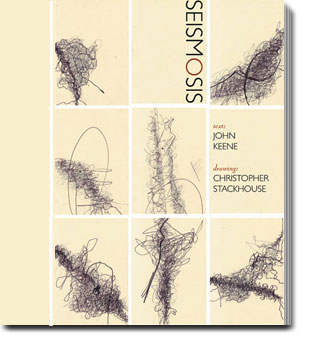
Yesterday, I did pull myself together to head down to Columbia College Chicago and chat, alongside Ed Roberson, with Crystal Williams's poetry classes. The topic was ekphrasis, a poetic mode I've long been interested in, with an emphasis on Seismosis, and the discussion was fruitful. The student poets posed sharp questions, and when in a later discussion on poems by several well-known writers, they expressed special enthusiasm for a Claudia Rankine prose poem--on Mahalia Jackson, from Don't Let Me Be Lonely--I almost felt like dancing around the tables. Of course I knew that under Crystal's guidance they'd be a very good group, and they were. Ed was, as always, profound. In addition to reading one of his poems, he found apt and succinct ways to make unforgettable points, such as when ekphrasis began. He suggested--and I'm probably screwing it up somewhat--that it was when the poet saw and felt and entered the artist's hand (or eye, or sense of the camera's lens, etc.) as it began to move and act on the image, the idea, the concept from which the work being explored originated. A version of this, in more mystificatory form, flows through Seismosis. At any rate, I'm very excited because Ed'll be in residence next fall at the university, benefitting both the students and the rest of us, and I look forward to being able to hang out with him more often.

But back to the sluggishness: I do plan to write a few impressions on our brief but enjoyable trip; C's version, with photos, is here.

The week before we traveled, a young scholar, Noura Wedell, delivered a presentation on Seismosis, among several other texts, at a conference, "Lyricisme et littérature," at the Centre d'études poétiques at the École nationale supérieure (ENS) Lyon. She was interested in several issues in particular, including genre, and the relation of the texts, as poems specifically, to the drawings; the politics of citation in the text, both obvious and more subtle (and the text is, specifically, a homage/hommage, to two important and little known figures, William White and Norman Pritchard, among others); and what sort of production the text "wills" itself to be, which is an open(-ended) question. I'd have loved to have been there, having only passed through Lyon with C. many years ago.

On other topics, I never watch the Oprah Winfrey Show (any more), but I intend to find out when she'll be interviewing the extremely reclusive author Cormac McCarthy (at right, from cormaccarthy.com) whose new novel, The Road, she selected for her Book Club. This is, I think, a major event in the annals of recent American literary culture, primarily because Oprah is again selecting contemporary fiction for the Book Club, after the Franzen flap and several years' hiatus, and because McCarthy, for the readers who may not be familiar with him, is one of the most reclusive and best living American fiction writers. I keep wondering what led him to agree to the interview, and how it'll proceed; he supposedly praised Oprah highly through his spokesman, but would admiration and respect for her and her book advocacy really be enough? He supposedly hasn't given more than 2 interviews in the last 40 years, and although not as extreme as Thomas Pynchon, has tended to shun the publicity circus that constitutes our broader literary scene. When I think of his works, I automatically summon up their highly poetic and fascinatingly arcane language, their consistency in terms of setting (usually the Southern Appalachia or Southwest) and plot (usually an outcast male character or characters are on the run or in pursuit of someone), the texts' relentless, forward-moving action (and comparative lack of interior characterization), and their often stomach-turning violence. McCarthy's novels--at least the several that I've read--are among the most insistently violent in American literature. Blood Meridian, or the Evening Redness in the West (1985), his masterpiece, has scenes of violence possessing the power not only to provoke horror and astonishment, but awe. (A female writer I know refused, when we were in graduate school, to read his work because it was so violent.) Suttree (1979) comes close. All The Pretty Horses (1992), another of his best works, is less violent and also more straightforward and transparent in terms of its prose style; it's probably his best known work, and the sole one to win one of the three major US literary awards (so far), the National Book Award, in 1992. But back to the interview: I would bet that Oprah will send him a list of questions in advance, they'll perhaps go back and forth so that it's well scripted, and he'll be pleasant and polite, while she'll interview in total pro mode. If she has read any of his prior books, however, she might benefit readers everywhere by pressing him on the topic of extreme violence in his work, particularly in texts such as Child of God and Blood Meridian, as well as on his rendering of female characters, his larger, apparently very bleak vision of the world, the effect of his interactions at and with the Sante Fe Institute on his writing, and his thoughts on the Coen brothers' film version of his weakest novel, This Is No Country for Old Men. Really, he ought to answer any questions she poses, since after having his work selected by her, he'll sell more copies than he ever has before.
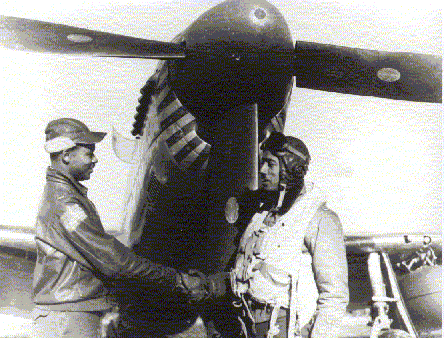
I saw that the Tuskegee Airmen were honored yesterday in Washington. On the one hand, I don't put much stock in official events like this, which are tend to be more about the spectacle and less about the substance, and yet given what these heroes and others like them had to endure, I had to ask yet again: why did it take so damned long? Their story is one I heard often growing up. Several of the airmen were native St. Louisans, and one, Wendell O. Pruitt (at right, receiving a handshake from fellow pilot John F. Briggs, photo from ALLSTAR Learning Laboratory's Blacks in Aviation page) who died in 1945, was a legend. (The infamous Pruitt-Igoe housing project was named in part after him, as is a relative of mine.) The Preznit managed to stumble over his words, as always, and Republican Congressional leader John Boehner (Ohio) couldn't pronounce "Tuskegee" correctly to save his life, but that didn't diminish either the ceremony or its significance. As one of the airmen I heard on NPR say, their resolve, courage and remarkable record was central to the integration of the Army and US military in general, and they appreciated the government's recognition, however belated.

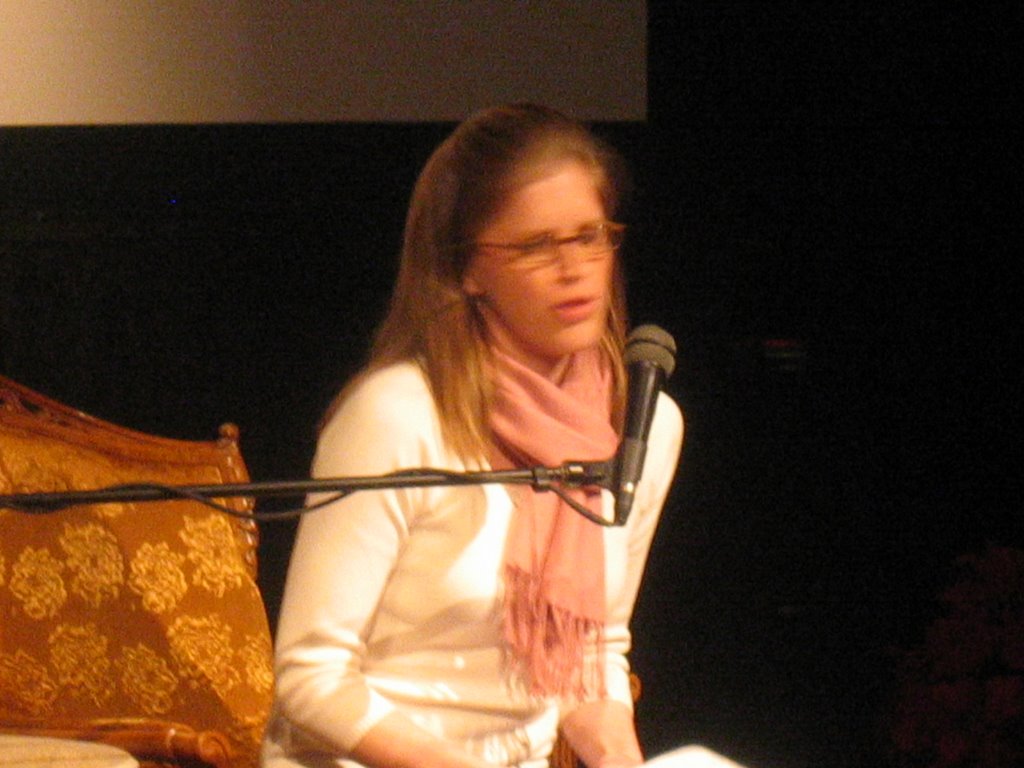
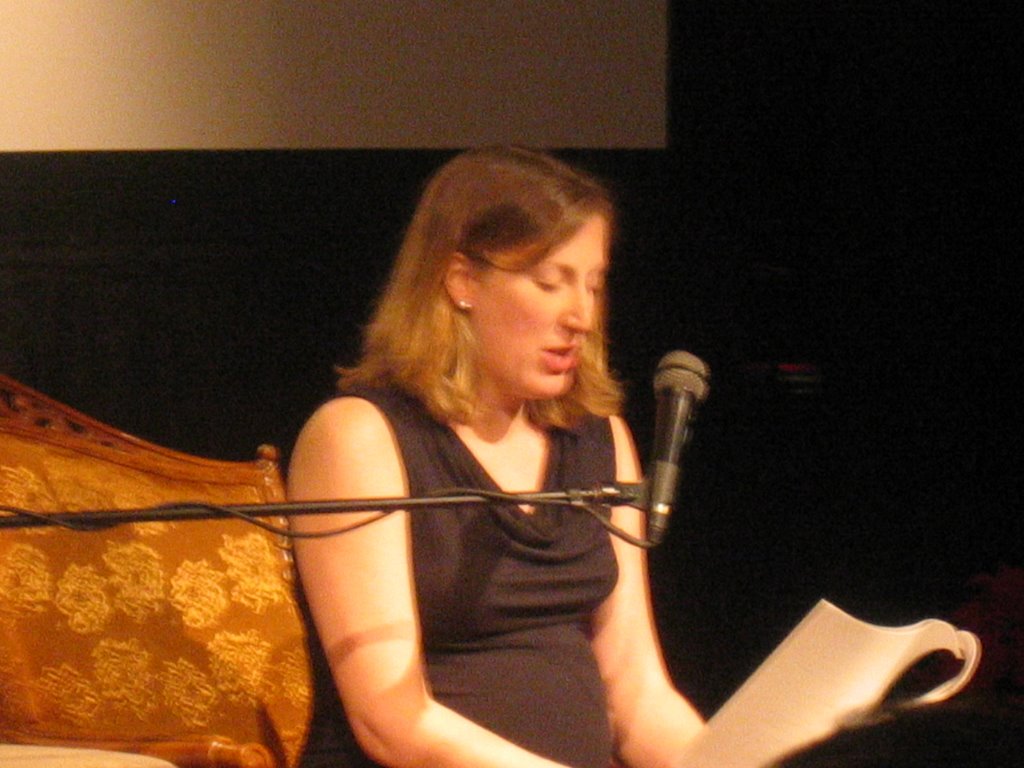
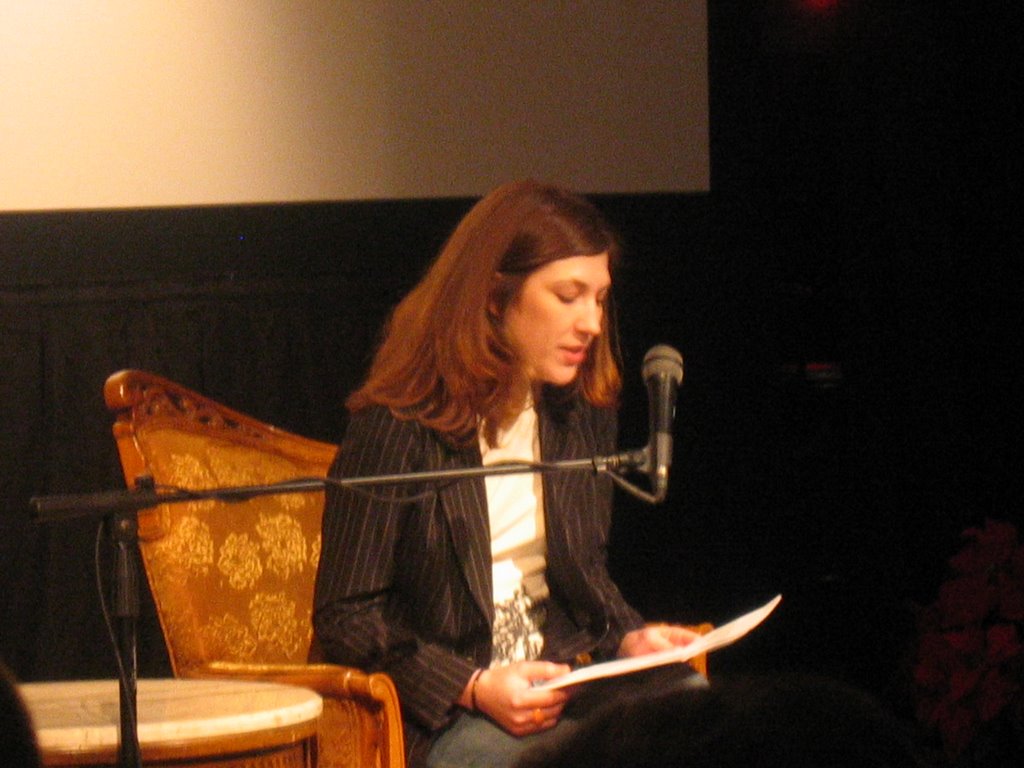
Tonight I had the opportunity to see three of graduate students I've taught, Rosemary Harp, Andrea Uptmor, and Heather Dewar, read with author Tara Ison, a former Blattner Fellow and visiting professor at a university-sponsored reading at the Chopin Theater in Chicago. I'm posting photos from the event, and I have to say I was beaming with pride and delight all the way through, because I had such a great time working with all of them, and their work tonight was so polished and engaging. I also enjoyed hearing the excerpt from Tara's new racy new novel, The List, about a couple's break-up, and purchased a copy. Once I get around to reading it, I'll probably add it to the list of recommended books.


Heather Dewar

Rosemary Harp

Andrea Uptmor

Tara Ison (the photo is terribly blurred)

Thursday, March 29, 2007

Baseball Anyone?


This Sunday, at 8:05 pm, the 2007 Major League Baseball seasons opens, with Albert Pujols leading the World Series champion St. Louis Cardinals against the New York Mets in St. Louis. Chris Carpenter will start for the Cardinals, while future Hall of Famer Tom Glavine takes the mound for the Mets. A dream start to what ought to be an exciting season....

Friday, March 23, 2007

Celerity Nascent Charter School Teachers' Firing and Reinstatement

Though I'm away, I thought I'd post the following petition, which I urge all J's Theater readers to review and sign. I'm also posting poet Marilyn Nelson's response, which is a model of how to respond to this kind of situation.

First, the story as reported by the Los Angeles Times, which poet and scholar Evie Shockley forwarded and brought to my and many others' attentions (thanks, Evie)!

***

Not the lesson they intended
Two L.A. charter school teachers lose their jobs over a planned Black
History Month presentation.
By Carla Rivera
Times Staff Writer

March 19, 2007

Administrators at a Los Angeles charter school forbade students from reciting a poem about civil rights icon Emmett Till during a Black History Month program recently, saying his story was unsuitable for an assembly of young children.

Teachers and students said the administration suggested that the Till case in which the teenager was beaten to death in Mississippi after allegedly whistling at a white woman ˜ was not fitting for a program intended to be celebratory, and that Till's actions could be viewed as sexual harassment.

The decision by Celerity Nascent Charter School leaders roiled the southwest Los Angeles campus and led to the firing of seventh-grade teacher Marisol Alba and math teacher Sean Strauss, who had signed one of several letters of protest written by the students.

The incident highlights the tenuous job security for mostly nonunion teachers in charter schools, which are publicly financed but independently run. California has more than 600 charter schools, and their ranks continue to swell. According to the California Teachers Assn., staff at fewer than 10% of charter schools are represented by unions.

"I never thought it would come to this," said Alba, who helped her students prepare the Till presentation, in which they were going to read a poem and lay flowers in a circle. "I thought the most that would happen to me [after the event was canceled] is that I'd get talked to and it would be turned into a learning and teaching experience."

School officials refused to discuss the particulars of the teachers' firings but said the issue highlights the difficulty of providing positive images for students who are often bombarded by negative cultural stereotypes.

"Our whole goal is how do we get these kids to not look at all of the bad things that could happen to them and instead focus on the process of how do we become the next surgeon or the next politician," said Celerity co-founder and Executive Director Vielka McFarlane. "We don't want to focus on how the history of the country has been checkered but on how do we dress for success, walk proud and celebrate all the accomplishments we've made."

McFarlane said details of the Till case were too graphic for an assembly that included kindergartners. The principal, Grace Canada, could not be reached for comment. McFarlane, speaking for the school, said her review of the incident did not support the teachers' allegations that Canada had used the term sexual harassment to describe Till's behavior.

But Alba said that when the principal informed the class that they could not recite their poem, she gave the example of a construction worker whistling at her as she walked down the street.

"She said that she would be offended by that and that what Emmett Till did could be considered sexual harassment," said Alba. "She used the phrase a couple of times and when I objected, she said 'OK, inappropriately whistled at a woman.' "

Many parents said their children affirmed that account. Marcia Alston, mother of a seventh-grader, called the school to say she was appalled at its interpretation of history and the treatment of the teachers. She said that in the conversation, the principal used the term "rude" to describe Till's actions.

"Mr. Strauss and Ms. Alba were excellent teachers," said Alston. "The fact that they and the students had signed a letter, I thought, was good; it was something they were passionate about and it could be used as a learning tool."

Verna Hampton, whose daughter was in Alba's homeroom and signed a letter, said she was especially offended that the incident occurred during Black History Month. Hampton said her daughter told her there was nothing offensive in the letter she signed.

"Those teachers should not have lost their jobs for standing up for what they felt was right; that sends the wrong message," Hampton said. "The kids didn't even get a chance to say goodbye."

Alba, 30, began teaching at Celerity when it opened in the fall of 2005 shortly after she received her credential. She taught social studies and science and is now looking for another job. She is writing to the school's board of trustees to request a hearing, and Strauss has drafted a letter to the board complaining that his firing was unjustified. Under the
contract signed by the teachers, they can be fired with or without cause.

In the letter terminating his employment, dated March 6, Strauss was said to have been "disparaging the school to students and parents and authorizing by physical signature a nonsupportive message to the administrative staff."

According to Alba and Strauss, individual students wrote 10 to 15 protest letters, some of which were signed by other students. Neither the teachers nor the students made copies, they said.

"The kids felt strongly about this, and because these are my students, I felt one of my jobs was to pay attention to them," said Strauss, who is earning a credential at Cal State Dominguez Hills. "It's important anywhere a teacher works that the employer be willing to listen and keep an open mind and maybe even be willing to change their mind if they learn something new."

Frank Wells, a spokesman for the California Teachers Assn., said the Celerity incident highlights the importance his group has placed on organizing charter school teachers statewide.

"This points out the vulnerability of teachers in some charters where they don't have safeguards and can be fired for any or no reason," Wells said.

Celerity Nascent (the name is derived from words meaning swift or accelerated development) opened in the Jefferson Park area last school year as a K-6 charter campus with about 330 students. Seventh grade was added this year, and there are plans to add eighth grade next year.

Of its nearly 500 students, 80% are African American and about 19% are Latino. McFarlane, who is black, said 65% of the staff members live in the neighborhood and that part of the school's mission is to create jobs in the community.

Most students are below grade level in reading when they enroll, and many have behavioral problems, school officials said. McFarlane, who worked for 14 years as a teacher and principal in the Los Angeles Unified School District, said that with its focus on project-based, "culturally responsive" learning, student achievement is rising and parents are more involved in their children's learning.

Gary L. Larson, a spokesman for the California Charter Schools Assn., said Celerity is well-run and its administrators highly regarded. He defended the school's right to judge the appropriateness of the Till presentation and to dismiss teachers.

"If they felt that it was too sensitive in nature, and as long as they are following approved procedures, they have the authority," Larson said.

Many parents agreed with the school's decision to omit the Till presentation. During February's Black History Month program, the seventh-graders' poem, based on the book "A Wreath for Emmett Till," was replaced by a reading on the civil rights struggle as a whole.

"There's no celebration in the Emmett Till story," said Stephen Weathers, president of the school's parent organization. "He was beaten for whistling at a white woman, and I don't want my daughter to know that in the fourth grade. I don't think a celebration of Black History Month is a forum for that story. It's important, but that wasn't the stage for it."

Scot Brown, associate professor of history and African American studies at UCLA, said it was unfortunate that school officials and the teachers did not find common ground.

"I'm surprised that the teachers and principal could not work out a way for students to do this presentation in a way that highlights the significance and importance of Emmett Till's loss to the larger black freedom struggle," said Brown. "It's much bigger than the acts of violence you don't want kids exposed to."

"It sounds to me that by laying a wreath and saying a poem, the students and teachers were working through the meaning of his sacrifice to the black freedom struggle, and that's very important."

carla.rivera@latimes.com

***

Re-instate Celerity Nascent Charter School Teachers' Position

In March 2007, the administration of the Celerity Nascent Charter School in Los Angeles fired
seventh grade teacher Marisol Alba and math teacher Sean Strauss for their participation in events planned for the school's Black History Month program.

The school also forbade its students to read a poem, "A Wreath for Emmit Till," written by Marilyn Nelson, or to lay a wreath of flowers as part of its memorial to the slain youth.

According to an article in the L.A. Times, school officials felt that the details of Till's murder were "too graphic"* for its younger students.
The article quoted Celerity co-founder and Executive Director Vielka McFarlane as saying:

We don't want to focus on how the history of the country has been checkered but on how do we dress for success, walk proud and celebrate all the accomplishments we've made.

Marisol Alba had helped her students plan the Black History Month program and was dismissed for her activity. Fellow teacher Sean Strauss signed a letter of protest drafted by the students after the program was cancelled. He was dismissed for doing so.

In 1955, Emmit Till, a 14-year old
Chicago native, was visiting the town of Money, Mississippi when he allegedly whistled at a white woman. Till was African-American. The boy was abducted by two white men, pistol-whipped, shot in the head and weighted down with a 74-pound gin fan before being dumped in a nearby river. The men were acquitted by an all-white male jury. Both of his killers publicly admitted their guilt in a national article in Look magazine. The savage murder and the trial received worldwide attention and galvanized the civil rights movement in the United States.

To sign the petition, please go to:

Re-Instate Celerity Nascent Charter School Teachers Petition

*I would not that McFarlane also repeatedly suggested that Till's actions might have constituted sexual harassment, thus completely misunderstanding the history of racial and racist power relations in this country, and in particular during Mississippi and the former Confederate states during the period when he and so many others were brutally killed.


***

Marilyn Nelson's Response

From award-winning poet Marilyn Nelson, via poet Tony Hegamin, the Program Director of the Soul Mountain Retreat:

March 20, 2007

Dear Ms. McFarlane and Ms. Canada:

It has come to my attention that controversy apparently related to my book, A Wreath for Emmett Till, has led to the firing of two of your teachers. I feel compelled to defend Marisol Alba and Sean Strauss, who were fired because they had signed one of several letters written by students to protest the summary cancellation of the seventh grade's contribution to the Black History Month program at Celerity Nascent Charter School.

From what I understand the seventh graders had planned to read a poem and create a wreath of white flowers in memory of Emmett Till, who was lynched when he was their age, for allegedly whistling at a white woman. I cannot tell from the newspaper article exactly why the seventh grade‚s wreath for Emmett Till was deemed "unfitting for a program intended to be celebratory." But one might argue that the lifelong courage of Mamie Till Mobley, Emmett's mother, who spent nearly fifty years campaigning against lynching, is well worth celebrating. One might celebrate Emmett Till's contribution to the then nascent Civil Rights Movement. One might celebrate how far we have come since the year of his death. One might--as was apparently the point of the program--celebrate Black History.

But the news coverage indicates something more troubling than a failure to honor our painful history and its triumphs. I am shocked to learn that there may truly be African American women who would consider what happened to initiate the chain of events leading to Emmett Till‚s murder in any way related to "sexual harassment." May I remind you that fifty years ago, and perhaps still now, what happened, -- if it DID happen -- was not that a man whistled at a woman, but that a BLACK man (or, actually, a 14-year old boy with a bad stutter, on the first day of his first trip without his parents, hundreds of miles from home, in a Mississippi town which surely his mother would have warned him about) allegedly whistled at a WHITE woman. I am deeply concerned that an educational administrator and the president of the P.T.A. of a school whose student body is 80% African American would so completely miss the point; that you hope to teach children to "dress for success, walk proud, and celebrate accomplishments," yet choose not to teach such a pivotal moment in our history of upward striving. Your decision to cancel the seventh grade's part of the Black History Month program suggests that you know or care little about Black History: Do you allow the students of Celerity Nascent Charter School to know that slavery existed?

Even more troubling than that initial decision, however, is your deciding, in a school in which, according to the Los Angeles Times, "most students are below grade level in reading when they enroll, and many have behavioral problems" to fire two teachers who have turned things around to such an extent that seventh graders (a notoriously difficult age to teach) are so committed to their project that they wrote letters of protest. This whole incident reminds me of a scene in Ralph Ellison's great novel, Invisible Man, in which the protagonist, standing in front of the statue which symbolizes the school's mission, wonders whether the teacher who is holding a veil over the head of a kneeling slave is raising the veil, or lowering it. Ms. McFarlane and Ms. Canada, might it be that you have fired teachers who were raising the veil? Might it be that you are lowering it?

I suggest, Ms. Canada and Ms. McFarlane, that your firing Ms. Alba and Mr. Strauss has taught the students of Celerity Nascent Charter School one of the most important lessons to be learned from the study of Black history: that people in power often wield that power unjustly and unwisely, and that it is our responsibility to speak truth to power and to resist injustice. Harriet Tubman, Frederick Douglass, Martin Luther King, Rosa Parks, and Mamie Till Mobley would have been proud of your students‚ passionate and clear view of your decision to cancel their program. They would have signed the students' letters of protest, too. You have accelerated the original injustice by firing teachers who encourage your students to think. Thus you commit injustice against both teachers and students.

I encourage you to reinstate Marisol Alba and Sean Strauss. With all celerity.

Yours truly,
Marilyn Nelson
East Haddam, CT