Friday, February 17, 2006

Michael Bracey's "Africans within the Americas" Exhibit

Tonight I went with my cousin, artist and designer Raquel D., to a reception for an exhibit of photographs by a friend of hers, Chicago-based photographer Michael Bracey. Titled "Africans within the Americas," the exhibit of African Diasporic images opened on January 30, 2006 at Northeastern Illinois University's Fine Arts Gallery, and runs until February 24. Tonight's even coincided with the publication of Bracey's book of the same name.


Bracey has traveled throughout the Americas and Africa photographing people of African descent, and one of the aims of this show was to show the commonalities across national, ethnic and linguistic boundaries, which his fine, evocative photographs achieve.

He took the photos in this exhibit in the US, Belize, Brazil, Cuba, Dominican Republic, Haiti, Panama, Jamaica, and Ghana, and in some cases, it was hard to tell, at least at first glance, where the people captured in the images were from. I played a little game where I would not look at the captions but just guess, and the only ones I got correct were the photos from Salvador da Bahia (which has very distinctive architecture), and one shot of Dominican men laughing (though it could easily have been a shot of non-Dominicans photographed in, say, Maryland or Virginia).

The photos in the exhibit are all black-and-white; their formal strength lies in their assured composition, framing, and use and contrast of light and shadow. What appeals to me about many of them is their in medias res quality, which is to say, how they mostly do not feel staged and plunge us right into scenes from lives as they're playing out. There are a few portraits, which interested me less (though the one of the young Baiana featured below is lovely) than the others freezing a moment in the subject's everyday experiences that gain poignancy because of Bracey's artistry. Perhaps my favorites were a shot of a young Jamaican guy, from the back, his dark back contrasting against the sky, his short twists peaking from beneath his leather cap; a triptych of an old man walking up a street in Panama; and another featuring a father and child in rural Bahia, the child stretched out, its arms up, waiting to be embraced or even lifted, between his father's legs, as the rural homestead and parched landscape hovered in the distance.

One thing I wondered was what would sort of photos might result from visiting spots in these countries that are not particularly known for having a strong "African" imprint, but which do have distinct populations of African-descended people? So for example, in Brazil, in addition to Salvador, what about Rio de Janeiro (which struck me on each visit as a "Black" city) or São Paulo, or even somewhere in the south of that country, like Porto Alegre, which has a small Black population (and a slave history, etc.)? In the US, what about Denver, or Los Angeles, or Oklahoma City? What sorts of commonalities, both to the better known Black metropoles (Washington, New York, Port-au-Prince, Santiago de Cuba, etc.) and in transnational, transdiasporic terms, might arise? Another thing I thought would be to see what Black Europe or the Black Middle East (problematic as these terms are) looked like, as well as what I think of as the imaginary African-America in other parts of the non-African-Diasporic world (say, in Fiji or New Zealand). Oh well--Bracey is only one person, and this is an ongoing project. He did mention that his next project would involve photographing Blacks in Mexico, which I think is incredibly timely, so I'm going to look out for it.


Here's Raquel checking out one of my favorites of the photos. It depicts a young Bahian woman taking a break from her job as a restaurant tout.

Some of the people at the reception

The artist Michael Bracey.

If you're in the Chicago area and are interested in catching the exhibit, it's at

5500 North St. Louis Avenue
Chicago, IL 60625
773-442-4944
The show runs until February 24.

To see a lot more of Michael Bracey's photos and purchase his book, you can check out his website.

Thursday, February 16, 2006

Brazell Panel Discussion at Princeton 2/22

I came across the following announcement, of an event based in part on the unsolved murder of Rashawn Brazell, on Frank Léon Roberts's Brooklyn Boy's Blues site.

I'm borrowing the image, which is linked to the event site.
Rashawn_Brazell

From Frank's site:

A panel discussion on “Injustice, Intolerance and Intersectional Identity” is set for 6 p.m. Wednesday, Feb. 22, in 101 McCormick Hall at Princeton University.

Featuring Kwame Anthony Appiah, the Laurance S. Rockefeller Professor of Philosophy and the University Center for Human Values at Princeton, the discussion will explore the roles of the media, the police and the public in normalizing violence against individuals who stand at the intersection of marginal identity categories.

Appiah will be joined by Clarence Patton of the National Coalition of Anti-Violence Programs and Rashad Robinson of the Gay and Lesbian Alliance Against Defamation in analyzing how intersectional identity informs the management of hate crimes in America.

The discussion will draw primarily upon the unsolved murder of 19-year-old Rashawn Brazell, a black gay man from Brooklyn whose dismembered body parts were found in garbage bags throughout the borough's subways in February 2005. Desire Brazell, his mother, will make the opening remarks.

The panel will be moderated by Larry D. Lyons II, a PhD candidate in Princeton's department of English and co-founder of the Rashawn Brazell Memorial Fund.

Wednesday, February 15, 2006

Hackett Curbed + New Abu Ghraib Photos + Cheney on FauxNews

Today I got the following note from Paul Hackett (at left, with a supporter), the Iraq War veteran who was running in the Democratic US Senate primary in Ohio. It appears that national party leaders and hacks (Dean, Reid, Schumer, etc.) forced him out, so that Congressman Sherrod Brown (D-OH) would face no primary challenge in his quest to unseat the goggle-eyed, quasi-moderate Republican Mike DeWine. I know zilch about Brown, who I've read is quite liberal-progressive, but it's appalling to me that the Democratic Party is short-circuiting democracy (yet again) and leaving the voters of Ohio, which is wracked by one of the most spectacular Republican financial scandals in US history, with even less of a choice as to whom they want to (s)elect.

To my mind, Hackett represented the sort of Democrat that we have got to start electing to Congress, since we do not have a viable progressive third party at the federal level (outside of Vermont). Hackett spoke his mind frequently, openly criticized Emperor Katrina and the inept, corrupt local and national Republican Parties, and recently, when a loudmouthed GOP partisan threatened him publicly, Hackett asked the pseudo-tough creep if he really wanted to throw down. He was ready to step to it! Naturally the guy backed off. (He probably would do well to stay away from the trigger-happy Vice President, though.) Rather than buying the illogical Newspeak on Iraq put forth by the Emperor and his guild, Hackett, who'd dodged IEDs and commanded troops there, was clear that we should start bringing the soldiers home. Rather than playing hide-and-go seek when it came to the turds of legislation the Republicans have foisted on this country, Hackett made his opposition clear. Rather than play silly word games about gay people and gay marriage, he said all people should be treated equally under the law, period. Now, he's been forced out. So Brown had better win, that's clear, Diebold or not.

Back to Hackett:

Tuesday, February 14, 2006

Dear John,

Today I am announcing that I am withdrawing from the race for United States Senate. I made this decision reluctantly, only after repeated requests by party leaders, as well as behind the scenes machinations, that were intended to hurt my campaign.

But there was no quid pro quo. I will not be running in the Second Congressional District nor for any other elective office. This decision is final, and not subject to reconsideration.

I told the voters from the beginning that I am not a career politician and never aspired to be--that I was about leadership, service and commitment.

Similarly, I told party officials that I had given my word to other good Democrats, who will take the fight to the Second District, that I would not run. In reliance on my word they entered the race. I said it. I meant it. I stand by it. At the end of the day, my word is my bond and I will take it to my grave.

Thus ends my 11 month political career. Although it is an overused political cliché, I really will be spending more time with my family, something I wasn't able to do because my service to country in the political realm continued after my return from Iraq. Perhaps my wonderful wife Suzi said it best after we made this decision when she said "Honey, welcome home." I really did marry up.

To my friends and supporters, I pledge that I will continue to fight and to speak out on the issues I believe in. As long as I have the microphone, I will serve as your voice.

It is with my deepest respect and humility that I thank each and every one of you for the support you extended to our campaign to take back America, and personally to me and my family. Together we made a difference. We changed the debate on the Iraq War, we inspired countless veterans to continue their service by running for office as Democrats and we made people believe again. We must continue to believe.

Remember, we must retool our party. We must do more than simply aspire to deliver greatness; we must have the commitment and will to fight for what is great about our party and our country; Peace, prosperity and the freedoms that define our democracy.

Rock on.

Paul Hackett


He really did write "rock on," which is another reason he had and has my support. Oh well. Senator Barack Obama won a Grammy the other night. I think that's about as close to "rocking" as the current crop of Democrats are going to get anytime soon, sadly enough.

÷÷÷

I just saw the link to and came across the Raw Story's article on the newly released Abu Ghraib photos, which an Australian TV station, SBS Dateline, has just released. The Sydney Morning Herald writes about them here. I refuse to post any of them them, but the link is here. They're beyond horrifying, and when I think that these are only the synecdochic tip of a much more toxic iceberg of torture, secret prisons, extraordinary renditions, warrantless domestic spying, and other heinous activities that this government has been engaged in, I find that my ability to say any more about them right now shuts down.

Instead, for the time being I'll defer to one of my intellectual sheroes, the late Susan Sontag, wrote a brilliant New York Times Magazine piece about the first set that were released back in 2004, "Regarding the Torture of Others." Acclaimed reporter Seymour Hersh said some time ago that there were even worse videos too, involving child rape and other horrors, which Rumsfeld and the others have striven hard to keep classified and out of public view. Sontag, however, had another take. Their eventual emergence into the public domain, she concluded, would be "unstoppable."

÷÷÷

For those who may have missed it, our wild-shooting Vice President is on FauxNews this afternoon, giving a live interview about the shooting. Here are some of my favorite outtakes:

FAUXNEWS: Your Highness, why do you think the radical, opposition, leftist, communist, non-mainstream, evil Democrats and their lackeys in the liberal press are getting so worked up about this?

VP: The last Osama tape. If you play it backwards, you can hear him telling them to go IUD against Bushie and me. Total brainwashing. Also, they're pissed they weren't invited.

FAUXNEWS: Yes, they're definitely taking orders from Al Qaeda, those Democrats. Why did you decide to give the president a breather on Saturday and not bother him until the next morning with the information that you'd been forced into an unpleasant situation?

VP: I know he likes his Tom Cruise videos and pretzels, so what's 14 hours? Rover told me he asked if Whitty was thinking of converting to the Commie Democrat party or had mentioned Abramoff before I pulled the trigger. That kinda crap does set a man off like a rocket launcher.

FAUXNEWS: Mr. Vice President, it's been alleged that you might have had a beer or two before Mr. Whittington walked behind you and therefore into your line of fire, and imitated a quail. Is this true?

VP: I only had a fifth of single malt and a few martinis, don't crash with the heart meds, you know, which I split with Pammy [Willeford], so that doesn't count. Helps improve the sightlines.

FAUXNEWS: Naturally. You mention Ms. Willeford, the Ambassador to Switzerland, who was with you on this hunt. Initially she wasn't identified. Why?

VP: Pammy's a good girl. No Brokeback stuff with this one. Lynnie gets a bit huffy about these things, though I didn't bitch when she was off writing her lesbian novel. But sometimes you gotta keep learn to keep a few secrets. Executive privilege, family values.

FAUXNEWS: Exactly. Some moonbats, including the local police, have asked whether you were hunting at dusk....

VP: Look, the sun's to blame for that. And the radical enviro-terrorist-Saddamists. If evolution really existed, wouldn't the sun stay up in the sky even longer by now? Plus what's wrong with moonlight? But it was bright enough that I only fell a few times, so I don't see what the big deal is.

FAUX NEWS: We feel the same way about the left-wing-Islamofascist solar system. Have you heard about Mr. Whittington's condition?

VP: He's fine. A little fibrillar blip, sorta thing I have one about every other week. Blanchard and the rest are praying over him, which ought to draw the buckshot out, and Rover's given him a call, so he's definitely going to work harder to get better.

FAUXNEWS: Rover, what a patriot. He even got the Senate to back down on the warrantless, uh, um, domestic terrorist surveillance program.

VP: I told Bushie, hey, good thing it wasn't Hillary, Kerry or Reid coming outta that covey. We both had a good laugh. Also good thing I didn't have a Bushmaster AR-15, 5.56 mm NATO! Pammy, I mean, Lynnie's gonna get me one of those for my birthday so I can go out and target-practice with the Minutemen. I hear they're pretty good shots....

Tuesday, February 14, 2006

St. Valentine's Day Poem: Thylias Moss

To all, a Happy St. Valentine's Day!

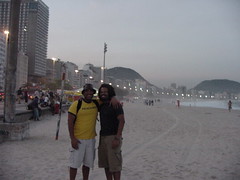
John & Curtis in Rio
This wasn't taken on St. Valentine's Day, but it's one of my favorite photographs (courtesy of Allen Gallery) and captures the spirit, especially since we're still slogging through wintry February!

***

Since I posted a love poem I wrote a few days ago, here's a poem by one of my favorite poets, who always always knows how to make even the most hackneyed subjects sounds fresh and arresting: Thylias Moss (at left, reading, courtesy of UIUC). (I think this is the second poems of hers I've posted; the last time was last April, during (Inter-)National Poetry Month, when I paired one of her poems* ("Staking Territory") with one by Cuban poet Nancy Morejón. But truly, every month should be Poetry Month, and every day should be St. Valentine's Day!

THE MANDATORY KISS

Sometimes your lover means to swallow you,
your surname disappearing into his history.
He inhales more deeply than you, pulling the air
to the bottom of himself, inflating his shadow.
The rhythm of his breathing is so intense you danse
to it. When you kiss him, you breathe like
another shadow.

It's a simple change of address, your mail and
liabilities rerouted. Like divers with one tank,
you could take turns and both ascend; you'd lose only
the pleasure, would make the kiss mandatory.

I just hope Judas got more than he paid for, the
Savior's skin under his lips, dimpling then springing
back like reciprocation.

Copyright © Thylias Moss, from At Redbones (Cleveland State University Press, 1990).

--
*I can't ever get the "search" function to work properly with my blog. I type in "Thylias Moss" and it tells me it can't anything. Not even the "Advanced Search" option works. Is it because it's still in Beta format? Is it Firefox? Does anyone have any suggestions? Thankfully my memory isn't completely shot.

Monday, February 13, 2006

Katrina Evacuees Fighting Eviction + Brazell Anniversary + Two Controversial Musicians

EvacueesAccording to numerous reports, about 12,000 families that had to flee the destruction caused by Hurricane Katrina and the inept government responses following it are now facing eviction from their government-subsidized housing today; last week 4,500 families stopped receiving funding. Calling these actions disgusting, barbaric and criminal barely suffices.

Although the Emperor Katrina stood before the backdrop of New Orleans's St. Louis Cathedral and claimed he would work his damnedest to ensure funding so that that city and other parts of the Gulf Coast would be rebuilt, he and the Republican-controlled Congress have dragged their feet.

FEMA, which came under withering criticism during last's fall's tragedy and has continued to garner harsh critiques because of its ongoing ineptitude, has said it will stop sending out rent support, though attorneys for the evacuees are filing for a temporary stay.

As ABC News's Mary Roberts reports:

Attorneys on Sunday delivered papers to the home of U.S. District Court Judge Stanwood Duval, asking him to grant a temporary restraining order to stall the evictions. By late Sunday night there was still no word on Duval's ruling.

"We have provided the court with statements from people showing they have not been treated fairly by FEMA," said Bill Quigley, an assistant dean of the Loyola University Law School, who filed the motion with civil rights attorney Tracie Washington.

***

About 10,500 families, or 88 percent, have received rent-assistance checks from FEMA, said Libby Turner, the agency's transitional housing director. The cash can be used to pay for an apartment or to continue their hotel stays. It also can be put toward fixing their ruined homes.

Quigley and Washington are asking the court to issue a temporary restraining order suspending all pending FEMA evictions of all evacuees.

There are links and instructions on ways to respond at Steve Gilliard's News Blog.

Meanwhile, Spencer Hsu of the Washington Post reports that a Republican select committee is set to release a report condemning the government's response to the horrific hurricane. It details 90 findings of failure at all levels of government. We learned last week that despite the initial lies fed to the public, Brownie alerted his boss and the White House on the day of the hurricane that the levees had broken. But then we learned even before then that there had been repeated warnings on the precarious state of the levees under a Category 4 or 5 hurricane (and Katrina was a Category 3) years before, despite the lies initially fed to the public. How will they get out of this one?

Hurricane Katrina exposed the U.S. government's failure to learn the lessons of the Sept. 11, 2001, terrorist attacks, as leaders from President Bush down disregarded ample warnings of the threat to New Orleans and did not execute emergency plans or share information that would have saved lives, according to a blistering report by House investigators.

A draft of the report, to be released publicly Wednesday, includes 90 findings of failures at all levels of government, according to a senior investigation staffer who requested anonymity because the document is not final. Titled "A Failure of Initiative," it is one of three separate reviews by the House, Senate and White House that will in coming weeks dissect the response to the nation's costliest natural disaster.

The 600-plus-page report lays primary fault with the passive reaction and misjudgments of top Bush aides, singling out Homeland Security Secretary Michael Chertoff, the Homeland Security Operations Center and the White House Homeland Security Council, according to a 60-page summary of the document obtained by The Washington Post. Regarding Bush, the report found that "earlier presidential involvement could have speeded the response" because he alone could have cut through all bureaucratic resistance.

***

The report said the single biggest federal failure was not anticipating the consequences of the storm. Disaster planners had rated the flooding of New Orleans as the nation's most feared scenario, testing it under a catastrophic disaster preparedness program in 2004.

About 56 hours before Katrina made landfall, the National Weather Service and National Hurricane Center cited an "extremely high probability" that New Orleans would be flooded and tens of thousands of residents killed.

Given those warnings, the report notes Bush's televised statement on Sept. 1 that "I don't think anybody anticipated the breach of the levees," and concludes: "Comments such as those . . . do not appear to be consistent with the advice and counsel one would expect to have been provided by a senior disaster professional."

+++

BrazellToday's New York Times marks the one-year anniversary of the murder of Rashawn Brazell (at left, photo from the New York Times) a young sgl Brooklynite, with an article by Kareem Fahim and John Koblin, entitled, "A Year after a Teenager Was Dismembered, Still No Answer."

Several of my earliest posts (here, here) on this blog (back in March 2005) concerned the aftermath of the killing, and the work of so many Black gay bloggers and others to increase awareness about the killing, press the police to take it seriously, and honor Brazell. As a result, the Rashawn Brazell Memorial Fund now exists.

The Times writers begin:

The tips have slowed to a trickle, and the leads have all but dried up.

Detectives know little more about what happened to Rashawn Brazell, whose limbs and torso they found in trash bags in a subway tunnel and in a recycling plant in Brooklyn last year, than they did in the weeks after he vanished from his home in Bushwick.

In some ways they know less, having discarded early theories about Mr. Brazell's killer, including hunches that the person might be a transit worker or someone with medical training.

"We still don't know where he got killed, or why," said a senior investigator who has supervised the case since its beginning. "It's frustrating."

As cold cases go, Mr. Brazell's stands out, as much for the grisly way his body was disposed of as for the person his relatives and friends said he was: an energetic, grounded 19-year-old who loved music, cooking and going to clubs and who, with his résumés prepared, was set to go hunt for a job the day he disappeared.

"This victim was not leading a criminal lifestyle," said the investigator, who was not authorized to speak for attribution since the case is open. "You have to feel for that family."


+++

Two Musicians: "One died, and the soul was wrenched out of the other in life..." (John Ashbery, "Street Musicians," from Houseboat Days [Viking: 1977].)

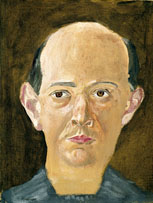
SchoenbergHe (at right, "Self Portrait," undated) was born 132 years ago in September in Vienna, Austria, and died just over 50 years ago in Los Angeles. The very mention of his name, let alone the music he composed, continues to provoke irrational responses in some concertgoers. Yet he's widely recognized as one of the most important musicians of the 20th century; his trained several of the most singular musicians ever to appear (Alban Berg, Anton Webern, etc.), and was himself major innovator whose chief developments include atonalism (which he called pantonalism), the incorporation of a vocal line in the string quartet, and most importantly, the 12-note compositional method, or dodecaphony, which became one of the dominant compositional methods for four decades. Even musicians who were opposed to him, including Igor Stravinsky, incorporated elements of it or utilized it in their work. So why are people still afraid of his work? James Levine, the chief conductor of the Boston Symphony Orchestra and the Metropolitan Opera, is willing to take up the challenge. One woman I once worked for, a Met subscriber, decried having to sit through his unfinished, conceptual masterpiece Moses und Aron, which she called the "Maidenform opera." On the other hand, when composer Byron M. and I went to see another of his works performed at Carnegie Hall, a guy was scalping tickets outside! His best works still sound strange and novel, even though elements of them have been incorporated into the works of jazz and rock & roll musicians. So what's the big deal in 2006?

He (at right, drawing © by Peterchev) was born 100 years ago, also in September, in St. Petersburg (which became Leningrad, then Petrograd, and is once again St. Petersburg), Russia, and died in Moscow in 1975. He composed 15 symphonies, several operas (one of which almost led to his death), fifteen string quartets (and a chamber symphony), as well as ballets, film scores, concerti, and numerous other works. To some he is also one of the greatest classical composers of the 20th century, while to others he is a prolific hack. Did he agree with the tenets of the Soviet regime, as some of his greatest compositions seem to imply (the 5th and 10th Symphonies), or did he oppose it and nest his dissidence in his often highly ironic melodies and tart harmonies (the 4th, 9th, and 13th Symphonies)? Is his work merely a continuation of Gustav Mahler's mixed with Beethoven's or something truly original? What about the symphonies that appear to be propagandistic, like the 3rd ("May Day"), or bombastic, like the 11th ("The Year 1905"), or shoddily constructed, like the 12th ("The Year 1917"), which is one of my favorites? Should it be interpreted as a paean to the October Revolution, or do its simple melodies and haphazard construction point to a necessarily more complex interpretation? Meanwhile, Manchester, UK, "tunes up" for the centenary; I'd love to be able to catch even a little of it.

Sunday, February 12, 2006

2 Reviews (The Reception; Me and You...) + Another Take on Winter Olympics

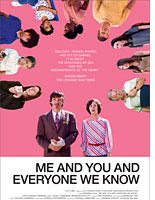
The ReceptionOn Friday night I finally rented John G. Young's The Reception, which Bernie blogged about, with praise, last summer. Tonight, courtesy of Netflix, I finally saw video artist and filmmaker Miranda July's sparkling little film Me and You and Everyone We Know. These two movies easily constitute the best 1-2 film combo I've seen in a while (perhaps since Tsai Ming-Liang's Goodbye, Dragon Inn and Wong Kar-Wai's 2046 last spring). The inventiveness of both film's plots, the high quality of their scripts, the very persuasive acting (especially in July's film), and the sense that I was watching original visions unfold in ways that hadn't been tried endless times before or that drew upon the tired conventions that have soured so many Hollywood films for me underscored the ongoing importance and necessity of independent film as the real heart of American cinematic art.

The Reception, a chamber drama set in and around a house in upstate New York, near Kingston, spans only a short but tense week but evokes a rich and compelling world. Jeannette (Pamela Stewart), the house's owner, is a wealthy White Frenchwoman with writerly pretensions who's fled a series of bad relationships and is lubricating her troubled days and nights with copious amounts of red wine. She lives in a quasi-marriage with Martin (Wayne Lamont Sims), a Black, gay HIV+ artist, who when not serving as her companion, caretaker and comforter, and suffering through her drunken cruelty, shuts himself up in a barn he's converted to his studio, though he's painting nothing. He too has fled past crises, in Paris and New York, and when the film opens--quite effectively in medias res--we grasp his and Jeannette's intimately symbiotic but platonic and dysfunctional relationship.

Things threaten to break wide open when Jeannette's daughter Sierra (Margaret Burkwith) arrives from New York with her new husband, fellow schoolmate and law student Andrew (Darien Sills-Evans), who's also Black. Since she's found a husband, she'll be able to inherit the house and money from her mother. Jeannette is quite enthusiastic about her new son-in-law, who exudes bourgieness and confidence, while Martin takes kindly to him as well. We quickly learn, however, that Jeannette, very young when she had her daughter, basically abandoned Sierra to her abusive ex-husband, so anger and recrimination linger between them. The mother's domineering behavior provides the film's title when she decides, against her daughter's wishes, that there will be a reception to honor the newlyweds. What also becomes even clear is that Jeannette's love for Martin, which is tinged with domination and neediness, cannot be reciprocated in the ways she craves. After Andrew warms up a bit towards Martin, they take a long walk through marvelously picturesque woods, and the younger man presses the older man about his life in upstate New York. Martin reveals in words what his actions have effectively already demonstrated: his profound, searing loneliness. Black gay men aren't a high priority up there, he tells Andrew, and he's been sublimating his emotional pain and isolation in the bucolic setting.

[SPOILER ALERT] Yet the first sign of trouble has already appeared shortly after they all convene outdoors for the first time and are heading back into the house. We hear Andrew mumble what sounds like "your mother" is sexy...or does he say "Martin?" Sierra alerts him to the fact of Martin's homosexuality, warning him that should keep his mouth shut. This is a key detail, because what is really at issue is the elaborate house of illusions each of the characters has erected to get by; each will in turn come tumbling down. At Jeannette's soirée to show off her daughter and son-in-law to local friends, Andrew gets very drunk (and ghetto--Sills-Evans has it down), and when Martin attempts to calm him and put him to sleep, he responds with a passionate kiss that stuns the older man. The next day he confronts Andrew, who's come snooping in his studio, and the deceptions begin to unravel: Andrew is really DeAndre, an old friend of Sierra's who's participating for pay in her elaborate ruse to get her money. He's also, we learn, a longtime New York escort of wealthy older White men, who's has fallen fast and hard for the gentle, honest brother he's been forced to spend time with. This revelation speeds the film to its powerful conclusion, in which all of the characters come to terms with the fictions they've been maintaining, and Martin overcomes his sense of shame and abjection by placing his own happiness and wholeness first.

The acting of the four principles is uneven; the two women are less convincing than the men. But this may be because Sims and Sills-Evans really shine. Sims conveys Martin's tightly coiled and repressed bundle of personal torment superbly; each time that Jeannette strikes out and humiliates him, Sims shows the visceral pain Martin experiences and the swift psychological deflection that follows. As a result his transformation, which is also a peeling away of layers of figurative scar tissue, thoroughly convinces. Just as fine is Sills-Evans, first as a somewhat pompous straight man, and later as a boho gay urbanite who is willing to openly make known what he wants. What especially moved me was seeing the sort of people I recognized from my own life, on screen. The plot is, as I said above, inventive and fast-paced, but never implausible. The writing, which tackles a range of themes, is strong and rarely descends to cliché. Though the ending on one level seemed almost too neat, on another, it was also very believable and heartening; I thought to myself, this little American film is like an anti-Brokeback. Yet because the two male leads are Black men and because it's a low-budget flick shot in 8 days on digital video for $5000, it will never get the same level of attention and praise. And perhaps it isn't as great a film as the Ang Lee production, which I've yet to see. But it certainly deserves some accolades.

One final thing I'd like to note is the representation of Black men and male bodies in this film. While I enjoy seeing attractive, muscled Hollywood stars, it was also refreshing and exciting to see regular-looking men, Black men, for a change in a feature film, or on TV outside "reality" or crime shows. Seldom still do such images make in onto the big screen. Sims, though well-built and quite handsome, has a pitted, lived-in face the the camera fortunately didn't hesitate to linger on. Sills-Evans is tall and skinny, with full, uneven lips, widely spaced teeth and the thinnest grown man's arms, clothed or nude, I've seen in a movie in some time. When they initially connected emotionally, and then sexually, however, their scenes smoldered. Their averageness, their everydayness made the development of their relationship feel even more real and powerful, and made them, at least to my eyes, that much more beautiful.

Me and You and Everyone We KnowMe and You and Everyone We Know (IFC Films) is a 2005 feature debut from video artist, writer and actor Miranda July. Several major critics, like David Edelstein, named it to their Top Movies of the Year lists, and it's not hard to see why. In addition to offering a tightly and yet seemingly lightly structured narrative, excellent acting and delightful music, July's movie offers some of the sharpest commentary on our contemporary, atomistic, inward-looking society, the rampant sexualization of our culture and its complex effects on children, and the ways in which art and life intersect.

The film revolves around two parallel narratives which eventually connect: the first involves a single, loopy video performance artist, Christine Jesperson (July), who's creating seemingly inconsequential but very humorous personal videos for herself when she's not serving as a chauffering around clients for Eldercar (the name is self-explanatory). The other focuses on a man whose marriage has fallen apart. Richard Swersey (John Hawkes)--no, fellow writers, I didn't make that name up--a Vincent Gallo lookalike, is a White shoe salesman whose Black spouse, Pam (JoNell Kennedy), has met another man and is throwing him out; his two adorable sons, the adolescent Peter (Miles Thompson) and 6-year-old Robby (Brandon Ratcliff), respond to the trauma by not responding directly; instead, they sit hooked to a computer, creating trompe d'oeil visual images from keyboard punctuation (in this instance, a tiger) based on a guidebook, when not engaging in sexually precocious Internet play. Richard's immediate response to this turn of events provides one of the film's most striking images: performing his own private drama in public, he goes outside their window, sets his hand on fire, then tries to beat out the flames on the front lawn.

If this sounds like bizarrerie, it is, and yet July manages to make it pay off in the end. Everyone, she seems to be saying, has her or his touches of weirdness, and sometimes, with the right context (the right person, the right form, the right perspective, with enough humor), the strange and odd don't seem so strange and odd anymore. Or they do, but they don't bother us, because they're properly placed. Such is the case for Christine, who ends up taking one of her clients to buy shoes, and falls for Richard. In the course of subsequent events, she decides to submit her personal artistic creations to the local contemporary museum, and this occasions one of many funny moments, and the beginning of a metacommentary, when the haughty curator not only doesn't want to accept her videotape by hand, but doesn't even want to speak to or really look at her. Richard, who struggles throughout the film with his own inarticulateness and inability to fully see beyond his isolation, becomes smitten with Christine and vice versa. This leads to another of the film's highpoints, Richard and Christine's stroll down an anonymous-looking city street near his job, which becomes an unforgettable philosophical meditation on life and love that the film's plot eventually bears out.

As excellent as the adult actors are, the children steal the show. Each of enacts in the most convincing fashion possible their own battles with isolation and precocity; in the neighborhood where Richard decamps at the instigation of his friend and coworker, the extremely bright but severe little girl next door, Sylvie (Carlie Westerman), has created a "hope chest" as part of her "dowry," and is in certain ways functioning at an adult level even though she hasn't reached puberty. Two other neighborhood girls, Heather (Natasha Slayton) and Rebecca (Najarra Townsend), pretend they're 18 years old and bait Richard's coworker in a disturbing erotic game whose ends they don't really comprehend, but which they decide they'll act on. To satisfy one of their queries, they enlist Richard's son Peter in appears to be his first sexual experience. But then it depends upon how you define sex; both of the boys are farther along than either parent imagines, as 6-year-old Robby wanders into cybersex, provoking the film's most troubling potential consequences. Thompson's affectless, hangdog persona charms to no end, while Ratliff's big-eyed stares and canny innocence are magnetic. Both young actors galvanize the screen whenever they're on it, demonstrating that they're actors to watch for the future and that July is one of the better younger directors out.

The film's narrative threads cleverly, humorously and ironically braid--though without a perfect knot, thankfully--in the end. The adults deal with the effects of their almost childlike approach to the world. The children, we realize, are well along in the process of growing up. For both, the possibilities of wonderment remain, as does opportunities for real interpersonal connections. Christine's video creations prove not only to be works of fine art, but also the means for the sort of psychological and emotional reconciliation that otherwise might have no outlet. Just as Peter has created his own picture, without a guide, that he shows to Brandon, who asks what it is, and gets the reply, "Me and you and everyone we know," so July, with an original and disarming personal vision translated beautifully onto the screen, creates one of the freshest portraits of American life in some time.

———

Journalist Paul Farhi takes an acerbic but convinging position on the Winter Olympics in today's Washington Post, titled "Where the Rich and Elite Meet to Compete." Unlike the summer version, these games have historically been dominated by a half-dozen or so mostly very rich North American and European countries, and because of the financial requirements of training equipment and so on, will continue to be for years to come. Though 85 countries are now participating, many are only sending a few athletes (or even just won). The truth is, he states,

As always, the biggest delegations, and the big winners, will come from a familiar pool. In the history of the winter competition, dating from its inception in 1924, competitors from only six countries -- the Soviet Union/Russia, Germany (East, West and combined), Norway, the United States, Austria and Finland, in that order -- have won almost two-thirds of all the medals awarded. Only 17 countries have ever amassed more than 10 medals during the past 19 winter Olympiads. Only 38 countries have won even one medal.


This final point was one Bob Costas kept making during his opening ceremony commentary, though without the more acute analysis Farhi provides. China seems poised to break open the tiny circle of winter Olympiad competitors and medal winners, though through the first day, Norway, Germany, Italy, Austria, the US, France, the Netherlands and Italy have unsurprisingly snapped up all the available medals. Still, there's almost two weeks more to go.

Saturday, February 11, 2006

Lenny on Rod 2.0 + Tyson Poem

KravitzRod 2.0 knows how to bring it. Today he featured this photo of Lenny Kravitz, culled from Queerty, on his page. There wasn't any real commentary with it, but who needs commentary when it comes to Lenny? Everytime I see photos of him or am listening to him on my iPod, I remember how a friend of mine and I were strolling through the streets of SoHo, back when it was still an art district and not yet another high-priced shopping arcade. We were supposed to be heading to some gallery show or other, and were deep in conversation, when I glanced across the street and saw Lenny Kravitz standing right there on the sidewalk. He still had his dreadlocks then. He might even have still been with Lisa Bonet (see, it really was that long ago). The first thing I thought was, he's even better looking in person. The second thing I thought was, he's tiny. The third thing I thought was, I should go say something. We crossed the street to say hello. I melted like a schoolboy, and was unable to sputter out more than a few words. It was ridiculous. I could hold it together much better now. And he's even better looking these days than he was then.

===

TysonThe Lenny pic also made me recall that through the years, poets have written poems about famous and beautiful people, and in particular, pop/cultural icons, as have I. Whitman eulogized one of the greatest presidents we've ever had, Abraham Lincoln; Auden ruminated about his predecessor W. B. Yeats, whose fame accrued not only from his poetry but from his political activities; Frank O'Hara wrote about Lana Turner and James Dean, among others; Bernadette Mayer has a poem that extols the virtues of Carlton Fisk; Elizabeth Alexander evocatively imagines herself dating Michael Jordan in a dream, and has persona poems about Muhammad Ali and many others; Kevin Young based a whole book of poems (one of my all-time favorites) on Jean-Michel Basquiat; Reggie Harris invokes Mike Tyson in the ring with marvelous skill; and on and on. But I think I may be the only person thus far to have written and nearly published (because the poem was accepted but then the journal went out of business, or on hiatus, or something of the sort) a poem to model/actor Tyson Beckford. (I can't remember if I've already posted it here once, but hell, why not do it again in 2006?) Maybe other people have gotten into the act, so do let me know if there are other Tyson B. poems out there. For whatever reason, I was trying to write a sonnet some years ago and what came out was this poem about the process. As should be clear, it is not a strict sonnet and is not really to Tyson, but about love in general.

Once when I read it to an audience the first time, several (White) people actually asked me afterwards, "Who is Tyson Beckford?" I had to explain to them that he was (then) the Ralph Lauren model, to which they sort of responded with bemusement, and then I said, "the Black Ralph Lauren model," and they immediately recognized the reference. Another time I read the poem, I prefaced it with an explanation of who Beckford was and is, and several (Black) people laughed and said, "We know who he is!" Indeed.

A SONNET TO TYSON BECKFORD

strikes me as frivolous
in this late September light
the City hunkers down
in stocks and indifference
and children starve
on either bank
of the silver river

but even beauty has its role
on the trading floor of moral reckoning
and though every lyric is a voucher
of our failure there are times
when only a poem
like daydreams or a lover's arms
can satisfy a certain quality of hunger

Copyright © John Keene, 1996-2006.

Friday, February 10, 2006

Winter Olympics + Egypt wins Africa Cup + Préval Leads

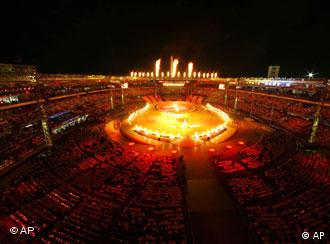
The Winter Olympics in Turin/Torino, Italy (at left, Deutsche Welle), have officially begun. I hadn't previously posted about them because, to tell the truth, I really hadn't been that interested, and it wasn't until I got a couple of emails from Reggie H. (cf. below) and saw the photos of the fantastic costumes on the BBC News site that I realized they'd started. (I actually am watching the opening ceremony now.) Actually, I'd been hearing quite a bit about the US team scandals, such as the skeleton team's fired coach, Tim Nardello, who allegedly had sexually harassed some competitors, and about Zach Lund, one of the chief skeleton competitors, who's been suspended (or banned) for a year because he was using a hair-restoration product that contained a banned, masking chemical, and though he'd warned the US team and his sport's federation about it, the official body changed the rules, and, well, you get the picture. It sounds kind of crazy given that he was very up front about using the product and given that this particular chemical wasn't a problem until recently, but what do I know? Anyways, things aren't looking so good for the US skeleton team.

Actually, I wish they'd go back to having the summer and winter Olympics in the same year, because since they switched, I've experienced Olympics overload. To me, it doesn't feel like there's enough of a break--during which my desire to watch the Olympic competitions built up--between them anymore, even though in real chronological terms, the four year gap remains for each successive seasonal contest. I can barely remember where the last ones were--wasn't it Salt Lake City? The futuristic introductory ceremonies to the games in Albertville, France in 1992 are still memorable, but the 2002 Salt Lake City games bring up only a blur. C. and I always used to watch parts of the winter games, and my favorite partwas the parade of nations. But the Winter Olympics are never as interesting as the Summer Olympics in this regard, since there are always fewer competitors per country and they're often wearing baggy winter clothes, while the latter has more countries and the athletes marching into the stadium usually sport some highly distinctive, sometimes nationally inflected or derived, and sometimes very revealing, costumes.

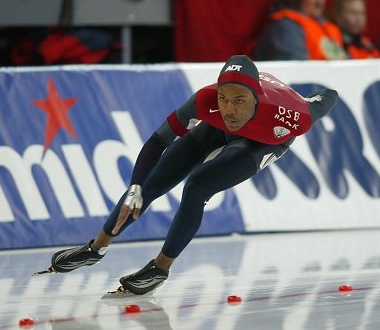
Reggie H. did send two great articles, one about how diverse the US team is this year, and the other about Chicago native Shani Davis, one of the US speedskating team's best hopes for a (gold) medal, so I am going to try and catch some of those races. I also love watching the alpine skiing contests, especially the downhill race and the Super G; just watching the racers jump out of the gate as the horn goes off and the cowbells ring is exhilarating, and watching them fly down the hairpin turns on the icy hills sends a shiver up my spine. My favorite downhill skier for several Olympics was the sexy Italian playboy, Alberto Tomba (above, at right), who not only won his races, but usually provided fodder for the tabloids. This year, one of the US's best downhill hopefuls, Bode Miller (sort of) admitted he was blitzed during some races, and the response, from his teammates, coaches and the media, was the predictable Puritanism, which completely turned me off, because while I wouldn't want the poor thing crashing into a tree, I personally would much more interested in following the exploits of a photogenic wildman or woman who boozes, parties, has some good public spats, and then brings home the gold than a someone displaying saintly behavior.

I also used to like the women's figure skating when it had some drama back in the late 1980s and 1990s. There was Debbie Turner, who was the first Black medal winner, who was balancing med school, her training and personal issues; Kristi Yamaguchi, the only Asian-American women to win the gold in figure-skating, whom the media basically seemed pressed to pay attention to; and the enthralling scandal involving the working-class "girl from Clackamas County, Oregon," Tonya Harding (at left) who arranged to have thugs wallop the leg of her chief competitor, the Massachusetts sweetheart, Nancy Kerrigan! That was one of the best reality shows ever to come on TV! I'll never forget Kerrigan lying on the floor, crying out, "My leg, my leg!" as the cameras rolled. Ukraine's entry in those Olympics, Oksanna Baiul, didn't really become interesting until after she'd won the gold medal, and then fell into the usual US celebrity patterns of outlandish behavior, including drunk-driving, before she had her moment of redemption, etc. Then there was France's ice-skating competitor, Surya Bonaly, always in singular outfits and bad makeup that never suited her, who was always doing astonishing flips but never getting the highest scores. I don't remember hearing that there'd be any excitement like these past competitors provided, so I probably will skip the women's ice skating. In the men's competition, there's one American competitor, Johnny Weir, a native (?) of Newark, who supposedly described himself as "princessy." I love it. Rudy Galindo was the last out gay man to compete for the US, but I maybe the "princess" will surprise us, and bring home a medal as well.

Santino's Hideous OutfitUpdated: The drama in US women's figureskating is already underway, as two-time Olympic medalist Michelle Kwan is now declaring that because of the flight and her participation in the opening ceremonies parade, she's suffering a recurrence of a groin injury which may keep her off the ice. Kwan, who won a silver in 1998 and a bronze in 2002, was not expected to medal this year, but her talent and competitiveness are such that it wouldn't have been out of the question. If she drops out, it'll mean a reshuffling of the US's female entrants in the competition. (Maybe someone can convince her to wear Project Runway über-narcissicist Santino's Thanksgiving turkey ice-skating outfit (at right, Project Runway) to provide viewers with an unforgettable image from these games.)

I used to always watch the bobsled competition, which was dominated for years by the Communist Bloc, especially East Germany. Then there were the Jamaican and other Caribbean entrants trying to make their mark. It's another one of those rapid-fire sports that looks extremely dangerous and gets my heart racing. In Salt Lake, a sister won a gold medal in the women's pairs competition, the first ever in the Winter Games. I'm not sure who the top teams are this year, but I'll probably try to catch some of the bobsledding.

Then there's the speedskating. In addition to Shani Davis (at left) other potential American medalists include Derek Parra, Chad Hedrick and Apolo Anton Ohno (below, at right), who brought the "soul patch" to national popular consciousness during the Salt Lake City games. He also got into a tiff with a Korean skater, who ended up being disqualified, which gave Ohno the gold in one of his races, so I am hoping there'll be some drama in their races this time through. The women's speedskating used to be dominated by the Dutch and German women, but now that China is going all out, I do want to see how well their team does in both the men's and women's races.

There are some Winter Olympic sports I haven't ever followed, like curling. I'm sure it's compelling enough if you're participating, but from what I recall, it involves ice, a thing that looks like a spittoon and a broom, and people crouching down and yelling and blowing. Uh huh. Canada is supposedly very good at it. As they are in ice hockey, which hasn't been that exciting since 1980, when the US team defeated the Soviets for the gold. My money is on the Canadians, the Czech Republic or Russia for this year's gold in ice hockey, though the US squad consists mostly of NHL players.

::Well, I'm actually watching the opening ceremony tonight, and the pre-parade bits were beautifully choreographed. The pageantry always strikes a deep chord in me. The parade of nations so far has been interesting as well. The flagbearers' dresses, which are supposed to look the Alps, are great. Bob Costas is, as always, a font of obscure but interesting information, like the facts that there are 6 African countries competing, that Iceland's capital has more discos per capita than any country north of the equator (!), and that the Moldovans are so poor that people in a town near Turin/Torino are collecting money to play their expenses. It's also wild to hear the 1980s pop, new wave and R&B the Italians are piping in to accompany the parade; this was the soundtrack to my young adulthood, but it works really well here. The American participants are mugging and chatting on cellphones (yes, there really is a phonecall that is that important someone had to stay on it while marching in!) to it (Aretha Franklin's "Freedom" to be specific). The US First Lady looks suitably medicated, with that strange rictus smile she often sports, but that could be because she recently met with the new pope. I'd think she'd be utterly relaxed being so far away from the steadily accruing messes created by her husband. Free delicious pasta and red wine on a paid vacation would relax me. Sofia Loren, Isabel Allende, Susan Sarandon, Nawal el Moutawakel, and the other women who carried the Olympic flag were the epitome of dignity, while Yoko Ono nearly managed to steal the show with her presentation of her late husband John Lennon's peace poem. Truth be told, the world needs peace now, and badly.

Let the games begin!

≥≥≥

Egypt (at left, BBC) and Ivory Coast played a tight, scoreless game, with both teams missing some excellent scoring chances in today's Africa Cup of Nations soccer championship.

In one such miss, Ivorien star Didier Drogba sent a sure goal right above an empty net. So it came down to penalty kicks.

Egypt hit 4 to Ivory Coast's 2, giving the host country its fifth African Cup championship overall, and the most of any team in the competition's history. It's too bad they didn't qualify for the World Cup!

≥≥≥

PrévalSo far, former Haitian president (1996-2001) René Préval, the 68-year-old agronomist who was once closely linked to deposed former president Jean-Bertrand Aristide, is leading the presidential polls at about 50.8%, with about half of all the votes counted. Yesterday's initial tallies, mainly from the capital, Port-au-Prince, and its necklace of slums and suburbs, showed Préval leading by about 68%, but coastal and outlying provinces have dropped his totals; he must achieve the 50% mark to avoid a run-off.

Former deposed president Leslie Manigat is currently polling second at 11.4%, while millionaire businessman Charles Henry Baker is third at 8%. Baker's already sullying the waters by alleging fraud, though international observers and the US have stated that despite the disastrous conditions at the start of voting on Wednesday, the election was generally fair and legitimate.

A reluctant candidate, Préval faces numerous challenges. The wealthy and political élites, who constitute the main parliamentary opposition, are primed to challenge his rule because most of his support has come from the country's impoverished majority, including partisans of the pro-Aristide Lavalas Family Party. Yet Préval is no longer a member of Lavalas, and cannot be assured of control over its political gangs. Then there is the problem of the coup plotters, some of whom, like Guy Philippe, also ran for office, and will want access to power; many of the militants who participated in Aristide's ouster have not surrendered their guns. Add to this the United States, which since the selection of Warrantless Wiretapper in 2000 has made life hell for Aristide, withholding money, supporting the intransigence of the opposition, and conspiring with anti-democratic elements to drive Aristide from power, which occurred in 2004. US Assistant Secretary of State for Western Hemisphere Affairs Roger Noriega, who is alleged to have played a key role in forcing Aristide out, has issued threats to Préval about any connection with his "twin," Aristide, including allowing the exiled leader to return from South Africa. Préval, for his part, has said that Aristide is free to return, but may still have to face trial.

His main immediate challenges when he finally wins will be to cajole or convince the opposition to cooperate, to keep Lavalas calm, to tread carefully with the coup plotters, and to get any and all financial help he can to rebuild the country's infrastructure and create jobs. In his previous tenure, he was able to achieve at least a few of his goals, so there is hope. But it will be very, very difficult, even with his "twin" now a continent away.

Thursday, February 09, 2006

Quote: Martin Puryear

"I came from a generation where the work was itself the information, and so there remains this belief that the work itself can have an identity that hopefully can speak. Whether it's through beauty or through ugliness or whatever quality you put into the work. That is what the work can be about. The work doesn't have to be a transparent vehicle for you to say things about life today or what you see people doing to each other or things like that. Not that that's not in the work ever, because I think the work can contain a lot of things, but my vehicle typically is to make work that is about the presentation of the work itself and what went into the making of the work as an object."
--Martin Puryear (photo © Foglemanphoto.com), from "Time," Season 2, Episode 7, in art: 21: Art in the 21st Century, PBS documentary, 2003 (quoted from "Abstraction in the 20th Century, Or What the Goog Don't Know about Total Risk, Freedom, and Discipline," Franklin Sirmans, in Something to Look Forward To, Phillips Museum of Art, Franklin & Marshall College: Lancaster, PA, 2004.)

Wednesday, February 08, 2006

African-American Lives on PBS Part II

Last week I posted about African American Lives, the Henry Louis Gates, Jr.-hosted geneology program on PBS that traces the family histories of several high-profile African-Americans, including Oprah Winfrey, Whoopi Goldberg, T.D. Jakes, Sarah Lawrence-Lightfoot, Ben Carson, Quincy Jones, Ben Jamison, and Chris Tucker. As I originally wrote, I was initially somewhat skeptical given that the program was focusing only on the family histories of this handful of élite figures, but as with last week's episode (which I was cutting back and forth from to catch snippets of Project Runway), I found tonight's episodes, well, riveting.

Tonight's show focused on even earlier histories and the points at which family trees broke off, which led Gates to suggest the use of genetic testing to go even further back. One way of looking at genetic testing is to read it as a kind of genetic essentialism--if you can trace your ancestry back, through scientific markers (via the mitochondrial DNA, and for men by the markers on the Y chromosome), you might begin to believe that it confirms that you're one race or another, or one national identity or another, or something of this sort, when the truth is that races, ethnicities, nations, and so on, are historically mediated sociopolitical, socioeconomic and sociocultural constructions. Race historically has not always depended upon the markers we usually attribute to it: skin color, hair texture, familial ties and ancestry, blood quantum, etc.; sometimes it has been profoundly economic, or politically and socially contextual. The concept of "race" changes all the time, depending upon political, social, economic and cultural contexts, with different groups have shifting among racial categories and differently "raced" performativities.

Yet race does exist as a lived and living experience, as an ontological reality (as I once asked Walter Benn Michaels after a talk at Columbia in which he suggested we give up the idea of race, Are you willing to forgo your racial identity as a White man right now?), based on those very same political, social, economic and cultural contexts, and there are commonalities, in terms of biological ancestry and heritage, that we share, often to degrees that we cannot fully recognize or reckon. So another way of thinking about genetic testing is, I think, in terms of tracing out those ancestral threads, without making the leap to say that they confirm or authenticate one's racial identifications, raced subjectivity, and so on. Conversely, it can undermine our undestanding of race and racial identity if we take an essentialist approach, but I'll say more about this a little later.

Anyways, the first hour dealt primarily with Gates's and his participants' attempts to go even further back in their family trees. There were some fascinating discoveries. One of Quincy Jones's forebears on his mother's side was a member of the Lanier family, which owned five plantations and 180 enslaved people in Mississippi. (This same family, which has branches in Louisiana as well, also produced Thomas Lanier Williams, I believe, also known as Tennessee Williams.) It so turned out that his particular ancestor lived on the estate that was in the line of fire during the Civil War siege of Vicksburg (one of my favorite battles in that war, in which the Union Navy under Admiral David Farragut proved its mettle and broke the Confederacy in two), so the house was shelled, and Union troops arrested his great-great-great White grandfather as a spy, with this man's wife (because Quincy's female forebear with this man was a Black bondswoman) writing down her anguished commentary about the Union soldiers for posterity (and this show).

Several of the participants learned that they were descended from Black Union Army soldiers; there were 200,000 Blacks who served in the Union Army in various capacities (there was no mention of Black Confederate troops or their descendants), and their descendants are spread out across the country. Sarah Lawrence-Lightfoot and Gates both could trace an ancestor to Union service. Gates in fact learned that yet another ancestor, a free Black person, had moved from New Jersey to Hardy County, Virginia (now West Virginia) in the 1810s; he was curious about this, and learned from one of the historians that in fact, Hardy County had a small but thriving Black community, as was the case in pockets throughout the slaveholding South, though a historian made clear that this was freedom up to a certain point; it was precarious and contingent, always subject to the whims of the White majority (or in the case of South Carolina and Mississippi, minority) population, the elites, politics and economics. Watching this history revisited and considering the tenuousness of life for most our history gave me even more appreciation for my ancestors, our ancestors, and the extraordinary fact that they were able to accomplish beyond mere survival. Gates was actually able to go even further back, learning that he had ancestors, the Redmans, living in the early post-colonial (1770s-1790s) period. There his trail broke off. For many of the others, it broke off at various points during the late slavery era (1840s-1863/1866).

The second hour broached something I'd talked about before, which is the tension between folk histories and the "truths" genetic testing appears to offer. All of the participants submitted to genetic testing, which consisted primarily of three procedures:
  • Admixture test, which breaks down the percentage of DNA in broad geographic-anthropological categories (African, European, Native American, East Asian)
  • Mitochondrial DNA test, which traces chromosomes inherited directly along the matrilineal line
  • Y-chromosome test, which traces a chromosomal marker inherited directly along the patrilineal line

Genome MapBefore the participants got their admixture test, Gates sat in on a classroom with a White professor who discussed the concept of race and the test. What he showed was that his own profile turned out 86% European, 11% African, and 4% Native American. Gates then asked him if this meant that 1 out of 10 ancestors was probably Black, and the professor said yes; yet he was a White man. (Thus torpedoing the one-drop rule.) When Gates asked him if he'd told his mother, the White man replied that yes, he had, and she'd told him not to broadcast this fact. (Of history and ancestry).

Unsurprisingly, the admixture test showed that all of the participants had sub-Saharan African ancestry. Yet it showed that all also had other non-sub-Saharan African ancestry. For six of them, the African ancestry breakdown was above 70%. One of the fascinating moments came when Oprah told Gates that she didn't think she had any European ancestry. And she was right. She was the only one of the participants not to. But, she, like all the others, said she thought she had Native American ancestry, which in fact many (most?) African-Americans I've come across in life claim. As it turned out, she was also right--but the only other person who also had Native American DNA markers was Chris Tucker. All the others' vivid and enduring family lore did not match with the scientific results. As it turned out, the profiles that I was able to jot down looked like this:

  • Oprah: 89% Sub-Saharan, 8% Native American, 3% East Asian (which basically means than 9 out of 10 ancestors were Africans, about 1 out of ten was Native American, and somewhere East Asian ancestry, which could also be Native American, or Chinese laborers who worked in the South, entered her ancestral family tree)
  • Mae Jemison: 79% sub-Saharan African, 13% East Asian, 8% European,
  • Chris Tucker: 83% sub-Saharan African, 10% Native American, 7% European
  • Whoopi: 92% sub-Saharan African, 8% European

Of course this doesn't mean that Chris Tucker is 83% African, or 83% African American and 27% something else; it only means that his genetic admixture broke down according to these broad categories.

For three of the participants, however, the European percentage was a lot higher. In Jones's case, it was 34%, in Lawrence-Lightfoot's 45%, and Gates himself learned that his admixture came out 50% African and 50% European, which not only shocked him, but basically meant that about half his ancestors could trace their ancestry to Europe, the other 50 to sub-Saharan Africa. This occasioned some quips from him ("Do I still qualify for affirmative action?" was one of them) but it also was provocative in that it undermined any strict biologistic correlation to racial identity or racial essentialism, at least in his case. In fact, it sort of proved that race as we live it cannot be pinned to genetic markers and ancestral histories. Gates is a Black person (as is Lawrence-Lightfoot, or Jones, or any of the others) and lives as one, and would be one in Europe (especially these days), despite what his admixture test says. So ultimately what sort of meanings can be ascribed to the findings?

Then, in order to address the issue of a lack of precise records and information about their African ancestors (no one was too pressed about their European ancestors, at least on camera), and for the sake of good drama, they took the mitochondrial and Y-chromosomal tests, to see if they could find matches that would pinpoint on their maternal and paternal lines where in Africa their ancestors came from. I have to admit that this part surprised me quite a bit, because I had thought the tests would point to DNA matches with people living in what are now the nations of Ghana, Senegal, Guinea, Togo, Ivory Coast, and Benin, as well as Nigeria and the Congo region, which are the main places that tend to come up in histories of slavery. But, the tests, at least of this sample of African Americans, offered a different geneological narrative. One of the things I learned was that 1 in 4 of all African slaves who reached the United States were from the Congo Basin-Angola area; I had no idea the number was so high, even though there are traces of Congolese-area Bantu cultural retentions throughout the US South (and popular place names like Congo Square, etc.). But this also links many African-Americans ancestrally to Blacks throughout the Americas, as there are strong Congo ancestral and cultural imprints in Brazil, Cuba, Haiti, Colombia, Venezuela, Ecuador, and so on, and even among the Blacks in Mexico. The other thing I hadn't realized was that in terms of the Y-chromosome, 3 out of 10 African-American males have a direct paternal lineage to Europe, and not Africa (or to Native American), though given the history of slavery, this was less surprising.

In the cases of the participants, the results sometimes showed multiple nodes in different areas of West and South-Central and Southern Africa, with greater concentrations in some areas than others. Oprah was convinced that she had Zulu ancestors, but it turned out not to be. What was traceable, with the help of two Boston University historians of the slave trade and era who were able to explain the routes of importation, came out to:

  • Oprah: matrineally--Kpelle of the interior of what's now Liberia (but also Guinea, Ivory Coast, as well as Bantus in Cameroon and Zambia)--I kept waiting for her to say she was heading there--Dr. Ellen Johnson-Sirleaf, you may want to drop Cousin Winfrey a line about this!
  • T. D. Jakes: patrilineally--Ibo-Nigeria (and he mentioned that his Nigerian friends had already told him this just by looking at him)
  • Ben Carson: matrilineally--Lunda-Congo/Angola
  • Whoopi: matrilineally--Papel-Bayot-Guinea-Bissau
  • Sarah Lawrence-Lightfoot: matrilineally--Mandingo & another group-Guinea-Bissau
  • Quincy Jones--patrilineally--Tikar-Cameroon (who're known for their musical and artistic gifts, no less)
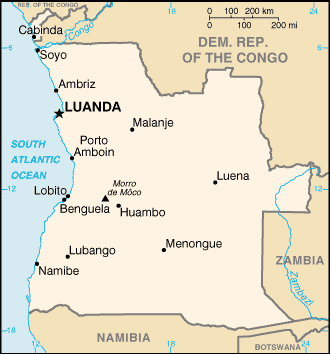
AngolaChris Tucker had one of the most interesting stories: he had a 100% match with the Mbundu people in Angola. (Cf. above about the Congo-basin-Angola links.) So Gates and he flew there, and actually met with the head of the country's slave museum, who recounted how many of slaves passed through the port, how they were baptized and then rebound, how many of them did everything they could not to be shipped across the ocean. Next, they visited a woman who oversaw the voluminous slaving records the Portuguese kept. (She also looked like she could easily have mistaken for a native Black Chicagoan.) She told him that around the time that his ancestor would have been enslaved, a Queen Victoria in an interior region of Angola, Matomba (?), had resisted valiantly against Portuguese colonization, but when her army was finally defeated, the Portuguese shipped as many of the people out of that area as possible. They would have had to walk a month, bound and chained, to the seacoast at Luanda. (At this point I said to myself, once again, how did they do it? How did they survive?) So naturally, Gates took Tucker to this region of Angola, which had hundreds of years later fiercely resisted the government, and had been badly bombed. (There were still signs of the bombing of the provincial capital, Malanje.) They then went into the interior of this region, and met with a village elder, who told of how relatives had been taken away...and you know where this is heading. They received their cousin (at least as confirmed biologically, though there was no proof that it had been this village or one that had stood in its spot, but statistically he was in the right place) and welcomed him home. Tucker looked almost stunned by the ceremony, the warmth and sincerity of the performance, then very moved; his frequent silliness gave way to real amazement and awe. It got me very verklempt (I know, these narratives of return are always at base fictions, but still!). Now of course he'll have many more--hundreds?--little cousins to put through school!

And then there was Professor Gates. Poor thing, on both lines, his unbroken lineage markers went directly back to...Northern Europe! There was only one little dot in Africa, on the very northern tip of Egypt near the Nile, but most of the people sharing his matrilineal DNA were located in England and the Netherlands (the result, very likely, of a White female indentured servant at some point in early America), and those sharing his Y chromosomal markers were all over northern Europe, but from Amsterdam west to Austria. (I may have these reversed, but in either case, it was almost all Europe, to his dismay.) He admitted to being envious of Tucker and of not having a directly traceable link to Africa as everyone else, and joked with his students about being "Professor Blackman." He'd said that when he was in Africa, people told him they thought he was Sudanese. So a geneticist at Cambridge ran another very new test, that took the 50% admixture from Africa, and tried to match it up to DNA-mapped groups in the database. And lo and behold, it turns out that Gates learned that the closest match was with people who were Mende (as in the Sowei: women's society mask at left, Bayley Museum, 1981), with Yoruba correlations also being fairly close, of Sierra Leone. (And where had the Mende originally migrated from? Sudan, I found online!) So he declared, though not with any great enthusiasm, that he was Mende--which is of course what he'd originally suggested one might be careful about doing, but hey, a brotha can get caught up in the moment. (I also thought of how Robert Farris-Thompson talks about the Mende retentions in African-American art, such as quilting, in Flash in the Spirit).

All in all it was fascinating, and I'm glad I caught it. Some may argue about Gates's tics (like the constant use of the world "Negro") and self-interest, and yes, it might have been interesting had he focused not only on our richest and brightest but on a parallel sample of Black Americans from Boston to Seattle, Charleston to Los Angeles, but I find the man charming and he hosted and produced one of the more compelling programs I've watched on TV in a while (that wasn't on HBO). He made sure to turn the camera on the others, and to question easy assumptions about race, ethnicity and ancestry, even if some of the participants adhered to them. It also made me wonder about taking one of the genetic tests; I'd considered it before when Howard University was seeking participants, but then I resisted, in part out of worry that the government might get ahold of it (as if they wouldn't anyways). But now I've thought about considering it again, just to see how certain family stories bear out, as well as observations by others. One thing I wonder is, how would I respond if the admixture test came back at any less than 60-70% African? It wouldn't make me feel any less Black, which to me is a primary and lifelong identification, but I think it would still make me feel...strange. Because what does it really say? These are your ancestors, but they're not who you thought they were? They don't fit the stories you've always been told, or that you've created for yourself? And while I'm pretty sure that the mitochondrial link would go back to Africa, I'm not so sure about the patrilineal one. How would that color things?