 |
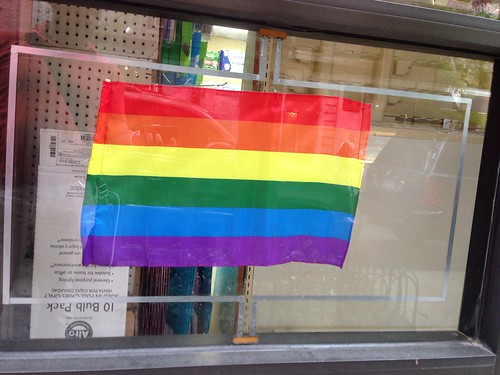
| Pride Flag, Soho |
With most of its majority rulings over the last few years, the conservative/libertarian-leaning
US Supreme Court has regularly managed to outrage liberals and progressives, and cheer business and rightist interests, but it also occasionally raises eyebrows on all sides with a surprise decision or two that at least on the surface appear reasonable. So it was, in the latter case, with two of the final rulings the Court handed down this term, on Friday, in
Hollingsworth v. Perry, which upheld a federal court ruling that invalidated
Proposition 8, that state referendum that had abruptly halted and prevented same-sex marriages in
California, and in
United States v. Windsor, which struck down the
Defense of Marriage Act (DOMA), introduced by Republicans, passed by bipartisan US Congressional majorities and signed into law by then-President
Bill Clinton in 1996, banning federal recognition of same-sex marriages well in advance of any state allowing them.
As a result of these two findings, same-sex marriages can resume in California, perhaps within days, and the federal government will now recognize same-sex marriages in those states that allow them, a number that continues to increase, by according them an array of federal rights and benefits that had previously been available only to opposite-sex couples. Coming on the cusp of
LGBTIQ Pride weekends around the country, both rulings count as major victories in the long struggle for gay rights and marriage equality, but in the case of the latter victory, the effects remain unclear and will certainly be limited by the fact that a majority of US states not only do not permit same-sex marriage, but have changed their constitutions specifically to bar it. In addition, neither ruling goes as far as 2003's
Lawrence v. Texas, which removed a major federal disability from LGBTIQ people's (and heterosexuals') lives by striking down all state-based sodomy laws. In a number of US states, LGBTIQ people can still be fired from their jobs, lose their children, be barred from visiting ill partners and loved ones, and incur other forms of discrimination
just for being perceived to be gay.
In the case of my home state,
New Jersey, we have civil protections for LGBTIQ people, but although our legislature did vote up a same-sex marriage bill, our conservative governor,
Chris Christie, not only refused to sign it, a position he reiterated after the SCOTUS rulings came down, but has called for a statewide referendum to determine whether we will have a right that nearly all the surrounding states (including all of
New England, New York State, and
Maryland) now enjoy. It seems likely that New Jerseyans would affirm marriage equality at the ballot, since polls show a majority of state residents support it, but putting rights to a vote is never a good idea, and a positive outcome is always uncertain. In any case, Chris Christie appears to be doing this primarily to stay in the good graces of the national GOP, in hopes of gaining the 2016 President nomination, if not a subsequent one. On a personal level, as a product of the post-Gay Liberation moment, I remain critical of the mainstream gay rights movement's focus on marriage, a problematic, often oppressive bourgeois institution on many levels, and its drive towards homonormativity and uniformity, the latter of which has been especially destructive to and for queer people. We have not decided to get married, and I am not sure if we will. Yet I also support ending discrimination in all forms, and of being able to gain recognition, and removing economic burdens, under federal law, something that people in same-sex marriages until Friday rulings could not do. I think this is especially crucial for older queer couples, married queer couples with children, and queer couples who are experiencing serious health crises.
More in keeping with the Supreme Court's horrendous rulings, and with, as scholar
Tavia Nyong'o put it so aptly in a tweet to me, the increase both in tolerance
and inequality, were two others I want to highlight, that undercut even more the happiness I felt at the DOMA and Prop 8 rulings. First was the Court's gutting of the landmark
1965 Voting Rights Act, signed into law by President
Lyndon Johnson, to address the decades-long efforts to prevent black people and other minorities from voting and exercising our democratic rights. By a 5-4 majority in
Shelby County, Alabama v. Holder, Attorney General, the Court essentially struck down Section 4, which provided a "coverage formula" defining "covered jurisdictions" as states or political jurisdictions that had "maintained tests or devices as prerequisites to voting" and had had low voter registration or turnout levels in the 1960s and early 1970s, and thus required, as per Section 5, "pre-clearance" by the
US Justice Department before they could enact new voting laws.
As a result, all of the states formerly labeled as covered jurisdictions, which had egregious histories of barring African Americans and other people of color from voting, ranging from poll-taxes to changing election sites and dates, to canceling elections outright (all of which were accompanied by violent, sometimes mortal, forms of intimidation), can now revert to form if they like, and once again start legislating laws making voting burdensome to impossible for black voters and others. Chief Justice
John Roberts delivered the Court's majority opinion, declaring among other things that "Blatantly discriminatory evasions of federal decrees are rare." In his opinion, it would be up to Congress to clarify the law, a likelihood that seems dicey given the current obstructionism of the GOP. Associate Justice
Clarence Thomas wrote a brief, separate concurrence calling for Section 5 to be struck down as well. Associate Justice
Ruth Bader Ginsburg delivered her dissent, joined by the three liberal justices, from the bench, stating in her opening paragraph that Congress, "recognizing that large progress has been made...determined,
based on a voluminous record, that the scourge of discrimination was not
yet extirpated" in 2006. She is right, and
the potential for voter suppression and discrimination in the former "covered jurisdictions" is, as the past has shown, going to require not just vigilance and resistance but new laws to counter the actions of this activist court.
Another deeply problematic ruling that flew under the radar, but which
reporter John D. Echeverria of The New York Times astutely caught was
Koontz v. St. John's River Water, which may have the effect, as Associate Justice
Elena Kagan wrote in her dissent, of "work[ing] a revolution in land-use law," and not in a way beneficial to most residents of a given jurisdiction. In essence, the 5-4 ruling, written by Associate Justice
Samuel Alito, severely harms sustainable development laws, by creating an incentive for local government officials to, as the
Times notes, reject development plans or allow developers to run amok rather than risk a lawsuit that could very well go against these governments based on the new post-Koontz standards. In addition, the finding places a new burden on local governments to justify mandated fees for permits, making compromises to address potential environment degradation less likely given the court's ruling in favor of developers and corporations. The
Times points out that in the case of waste disposal
Many communities impose development-impact
fees on developers if a proposed project would require expanding
waste-disposal sites or building new ones. Before Koontz, a developer
could raise a constitutional challenge if the charges were unreasonable,
but judges typically deferred to local governments in such cases.
After Koontz, developers have a potent new legal tool to challenge such
charges because now the legal burden of demonstrating their validity is
on the communities themselves.
Finally, there was
Fisher v. University of Texas at Austin, the court's most high-profile
affirmative action case this term, in which 7 members of the Court, with Associate Justice
Anthony Kennedy delivering the majority opinion--and with both Associate Justices
Antonin Scalia and
Clarence Thomas delivering concurring opinions (Thomas's included the perversely ironic line "
The Constitution does not pander to faddish theories about whether race mixing is in the public interest")--vacated a lower court decision to defer to the University of Texas's use of race in achieving and maintaining diversity in its student body and in deciding whether its plan to do so was narrowly enough tailored to meet the stricter standards required by two previous SCOTUS decisions,
Grutter v. Bollinger and
Gratz v. Bollinger, and the infamous
Regents of the Univ. of California v. Bakke. With Justice Kagan recusing herself, only Justice Ginsberg offered a dissent, writing that she has "several times explained why government actors, including state
universities, need not be blind to the lingering effects of “an overtly
discriminatory past,” the legacy of “centuries of law-sanctioned
inequality," and thus voted to affirm the Court of Appeal's decision in favor of the University of Texas. The practical outcome does not ensure admission to
Abigail Fisher, the 22-year-old white plaintiff, but it does mean that the University of Texas will now have to go back and rethink its admissions plan so as not to fall easy pray to a similar lawsuit in the future.
In many online discussions of this decision, I or any reader could quickly spot the rants against affirmative action, the alleged deleterious effects on white applicants, the dismissal of the sustained impact of past discrimination, and on and on, but very rarely did I see a basic fact that
Time presented in clear and fairly concise fashion, which is that over the entire history of affirmative action,
white women--i.e., people just like Abigail Fisher--not black people, not latinos, not native americans, not asian americans, but
white women, have been the primary and majority beneficiaries of affirmative action policies. I remember a good friend of mine who taught at
NYU pointing this out to me and others at a panel debate with conservatives at
Rutgers back in the late 1990s, and then coming across this information repeatedly online over the last 15 years, but what continues to adhere in the public discourse is the belief, articulated on Friday, by radio talkshow host
Brian Lehrer on his
WNYC, that black people have been the main beneficiaries of affirmative action, which represents discrimination against white people. I should also note Abigail Fisher's suit failed to point out that
Texas admitted only 5 black or latino students with lower scores than Fisher, but did extend admission to
FORTY-TWO WHITE students. Additionally, 168 black or latino students with scores better than Fisher
were not admitted. But fact, facts.
I'll end with a slightly adapted version of note I sent to some friends in reference to affirmative action, American institutions of higher education, one several I have had very close ties to:
I recently finished reading Craig Steven Wilder's book, Ebony and Ivy: Race, Slavery and the Troubled History of America's Universities (Bloomsbury, forthcoming fall 2013), which I picked up at BookExpo America, and will just say that if the oldest universities and colleges in this country (including Harvard, founded in 1636, or Rutgers, founded in 1766) ever fully addressed their horrific history--and it is very, very bad, as Wilder's excellent, authoritative historical study makes very clear--on slavery, the extermination and forced removal of native peoples, the development of medical and the natural sciences using black and brown bodies, the enrichment of elites (whose names, from Williams to Bard to Amherst, etc. are all over these institutions) and so much more, they would have to admit black and native people free for hundreds of years. Most of us don't have a clue about the full and ugly early history of this country, or the institutions that made it possible, and how race, racism and anti-affirmative policies towards a sizable portion of us have continually privileged and benefited white Americans, including people who only later became white.
I do plan to review Wilder's book, but I also hope it informs future discussions about race and higher education, because ignorance of this history has meant a severely underinformed discussion and debate.