Showing posts with label liberalism. Show all posts

Friday, January 30, 2015

The New New Republic?


UPDATE: In a Huff Post Live chat with Marc Lamont Hill, newly appointed New Republic Senior Editor Jamil Smith, who is African American, asked that readers give the magazine a little time to rebuild before declaring it dead.

Roughly a little over a month ago The New Republic imploded. The now 101-year-old mainline liberal publication, founded in 1914 by Progressive journalists Herbert Croly, Walter Lippmann, and Walter Weyl, with the financial support of members of the Whitney family, and which had changed ownership many times over the years, found itself hemorrhaging writers as a result of editorial changes pushed by its newest owner, Chris Hughes, an out gay, Facebook-cofounder, Harvard College graduate, near-billionaire, and Obama campaign internet strategist, who purchased a majority stake in the magazine in March 2012.

With the Harvard tie he is hardly out of place TNR; the Washington-based magazine has had a long history of white male Crimsons, beginning with Croly and Lippmann, up through avowed racist owner and publisher Martin Peretz, and editors Michael Kinsley, and Andrew Sullivan, filling its pages. Hughes, however, is a product of the new Silicon Valley world and its "disruption" ethos, though these ideas did not immediately manifest themselves when he bought the magazine. He kept its editor, Franklin Foer, a returnee to the magazine after a prior stint from 2006 through 2010, and TNR most continued as it had, advocating a mainstream liberal--often varying degrees of neoconservative (as in its pro-Iraq War stance under Peter Beinart), neoliberal or mildly libertarian ideology at times--approach to politics, economics and culture. It also continued as a magazine staffed mainly by white Ivy League graduates, with some rare exceptions.

Chris Hughes and Franklin Foer
(© James Estrin/New York Times)
Throughout the magazine's 100th anniversary year, tensions were mounting. The New York Times reports that TNR, an acronym Hughes urged staffers to nix in favor of The New Republic, was losing "$5 million per year," a small sum compared to his overall fortune, admittedly, but nothing to sniff at either. Despite Hughes's push for higher traffic, some longtime staffers, like literary editor Leon Wieseltier, continued to champion TNR's traditions and longstanding format, publicly airing comments of this sort at the magazine's centenary celebration last November. By hiring Guy Vidra, a former Yahoo exec as CEO, one month before the ceremony, however, Hughes indicated as clearly as possible that he was going in a new direction. Hughes' and Vidra's new plans include removing "Liberal" from the masthead, truncating the publication schedule from 20 to 10 issues, moving the editorial offices to New York and transforming the publishing venture into what Vidra has described as "a vertically integrated digital-media company." (As The New York Times puts it, Vidra said that he intended to "break shit.") Hughes' decision to pursue this route allegedly accelerated after his husband, Sean Eldridge, Political Director of Freedom to Marry, lost his Congressional race for New York's 19th district by 30 points.


In December, Hughes ousted Foer, and appointed Gabriel Snyder, a former Bloomberg, Atlantic Wire and Gawker staff member, in his place. The mass exodus, of Wieseltier and others began, with concomitant denunciations by a wide array of TNR writers, including an open letter signed by a luminaries' list (Robert Reich, Hendrik Hertzberg, Jeffrey Rosen, Andrew Sullivan, Sean Wilentz, etc.) that appeared on Facebook.  So extensive were the losses in human capital that the magazine had to suspend print publication during December, though it has continued with its online presence throughout the internal tempest.

Not all critics sided with Foer, Wieseltier and Reich; some, like the Atlantic's Ta-Nehisi Coates, highlighted the magazine's mostly monochrome editorial staffing and its sometimes horrendous racist history, about which I'll say more in a few paragraphs. But in general, the attacks, from a wide array of quarters, on Hughes in particular, were damning, which left me wondered how he and TNR would recover.

It now appears that TNR is again up and running, with new staff under Snyder, though on its site no masthead is yet accessible. From Facebook I learned that acclaimed poet Cathy Hong Park will be in charge of poetry, a welcome shift from the past. (TNR certainly could stand to publish more poetry and fiction--and perhaps even playlets and cross-genre works--as it once did.) Whether there will be other staff members who are not white and not male, as well as non-staff contributors who break the longstanding TNR political and cultural l remains to be seen, though a scan of its current pages suggests that this is happening. At any rate, TNR will prove its commitment by sustaining any changes, and I don't expect that when it comes to politics and economics it will be trending in the direction of Socialism, let alone Trotskyism. Its owner has those many millions to protect (from taxes), don't forget.


One could argue about all of this, WHO CARES? I remember saying this about TNR back during the early 1990s, during which former editor Michael Kinsley, now a confirmed contrarian, was appearing on CNN's Crossfire show and writing TNR's TRB columns, and a friend who would later briefly work for the Clinton administration reminded me of the conservative-within-liberal politics influence that any number of its writers and staffers have had in Washington. It was, in fact, allegedly "the in-flight magazine of Air Force One" during Bill Clinton's presidency, and its importance didn't end in 2000. To repeat, Hughes, the owner, Publisher and Editor-in-Chief, has close ties to the current President of the United States. But you need only look at early 2000s editor Peter Beinart's full-throated advocacy for George W. Bush's invasion of Iraq in 2003, which played a crucial role in amplifying the case for and push towards war. (Beinart has since, thankfully, come to regret his hubristic stance.)

Or one could point to Jonathan Cohen's campaign, cited by various DC journalists and politicians, for the passage of Obamacare, which counts of one of President Obama's great successes, to underscore that TNR, despite its smallish subscriber base of 45,000, has consistently played a central role in the Democratic Party's--especially Democratic Leadership Council/neoliberal--political and legislative echo chamber. Kinsley wasn't the only staffer to make the leap to the broader public arena. One could quickly cite former editor and (neo-) conservative Andrew Sullivan, whose TNR notoriety included promoting the supremacist Charles Murray-Richard Herrnstein Bell Curve tome, as another figure whose tenure at the magazine led to an outsized voice in the public, especially official Washington, discourse. As a post-TNR blogger, Atlantic staffer and author, he was invited to meet and advise President Barack Obama along with other "liberal" journalists very early in the president's first term, in 2009.

Whether TNR can possibly have that same role remains unclear.

An article posted within the last few days, however, represents a positive step in TNR's process of at least beginning to come to terms with some of the worst aspects of its past. On January 29, TNR published South Asian Canadian, Toronto-based journalist and comics critic Jeet Heer's insightful, historical reflection, "The New Republic's Legacy on Race." As any person of color familiar with liberalism can attest, an economically, politically and socially open-minded approach does not guarantee good or progressive racial politics, or a challenge to racism, white supremacy, sexism, classism, or many other corrosive ideologies. Heer notes the magazine's mixed history on racial issues and racism within its ranks. On the one hand, it can point to periods of enlightened publishing policies and discourse, Heer notes, during the Civil Rights Movement; on the other hand, there is the 38-year Marty Peretz era, whose stench still perfumes any discussion of TNR.

Heer shows, as other commentators online have noted, that not only was Peretz notorious for uttering anti-black, anti-latino, and, especially, anti-arab and anti-muslim comments, but he infused the magazine with a racist, neoconservative, hyper-Zionist ideology that its pages often reflected. Sometimes his editors and writers, like Kinsley, did not so much agree with him as mostly remain silent publicly about the magazine's toxic rhetoric. Why did so few of these liberals not speak out against Peretz, even after leaving the magazine? In the case of Sullivan, the attacks on affirmative action, black intellectuals (which was in essence a trashing of Cornel West) and the push for the Bell Curve material, or with late editor Michael Kelly, who supported Bush's Iraq War folly, the support for Peretz's perspective was nothing less than that of a true believer. Heer doesn't stint on the magazine's editorial ignominy, noting the centrality of racist stereotypes, downplayed in some of the commentary about both, in articles by notorious disgraced plagiarists Stephen Glass and Ruth Shalit.

2008 covers
Moreover, despite the publication of some black and other writers of color, many of them conservatives in politics, culture or both, during the Peretz era and after, the magazine's record on hiring and publishing staff who were not white has been abysmal. (See that luminaries list, which had few women on it as well.) Many online defenders have mentioned Dayo Olopade, who had an excellent five-year run as one of TNR's best younger talents, but can anyone name any other black, asian-american or latino writers--and if so, beyond one or two--who came to wider public notice because of their work at TNR? On top of this, its coverage of cultural issues has been terribly limited, especially for a magazine based in Washington, of all places. Art critic Jed Perl, and literary critic Ruth Franklin, outside of a few instances (eg. Perl on Ai Wei-Wei, Franklin on Zadie Smith), seldom or only irregularly covered exhibitions or books, respectively, by artists of color, especially Americans.


Both Perl and Franklin are gone now; will their replacements be any better? Will they come from a broader pool of writers or still mainly be Ivy seedlings? Will the magazine, in its ideological push to replicate contemporary Silicon Valley modes of operation and in its shift to the East Coast capital of hypergentrification and displacement, let alone Wall Street's lair, New York City, be able to rethink its neoliberal and sometimes neoconservative drift, or at least provide platforms for dissenting Left voices, even if it is not about to replace The Nation, Mother Jones, or other more progressive organs? And now that it is based away from DC can it possibly have the same political and legislative influence it had? Will it be as close to the next president, Democratic--or Republican--as it has to the most recent three?

Will people soon be saying who cares? about TNR? Or will it gives us all reasons, good, bad or otherwise, not to?

Sunday, October 02, 2011

Freedom Budget + Occupy Wall Street's Declaration

Much ado about various responsibilities, so no time for intensive blogging, but the ever brilliant Geoffrey J. pointed me toward the following remarkable document, the Freedom Budget For All Americans: Budgeting Our Resources, 1966-1975, To Achieve 'Freedom From Want,'" which the A. Philip Randolph Institute of New York published in 1966. In edition to the eponymous Randolph, the longtime president of the Brotherhood of Sleeping Car Porters, one of the most important 20th century labor organizations for African-Americans, and a beacon in and of the Civil Rights Movement, other signatories to the document include many of the leading lights of the mid-century labor, progressive, civil, human and equal rights movements, crossing all racial, ethnic, ethnic, and class backgrounds. (There are almost no women on the list, but this document appears almost at the early point of what we now think of as the full-flowering of women's movement and second wave feminism; there are also almost no openly queer signatories, save Bayard Rustin, but the document precedes the Stonewall Riots by 3 years.)

A page from the Freedom Budget, 1966
It's a remarkable document, and I urge you to read it at your leisure, but sooner rather than later; it's hosted on invaluable the Internet Archive site, which allows you to read documents online, download them in a range of formats, and forward them to others quite easily, free of charge.

The Freedom Budget makes an engaging companion template to the Declaration of the Occupation of New York City, which was accepted by the General Assembly of the Occupy Wall Street protests, which I first wrote about almost three weeks ago, on September 29, 2011. I am linking to it, but also posting it in full. Whatever one may feel about the protests, which I personally believe are among the most important to have occurred in the US in some time, the principles below articulate a good deal of what a great many people--a great many of the 99% of us who have not been the beneficiaries of the disaster-capitalism, supply-side, neoliberalism-meets-libertarianism economic debacle that has marked not just the decade preceding the Global Financial Crisis 2.0 of 2007-2009 (+), but of the 3 decades before--feel about what has gone wrong, while highlighting a number of other issues that are important to progressives in the US. The document below, like the protests, is both an important start, and a vital link in a long tradition of dissent and protest from the left that has preceded it. Do read it, amend it, talk about it, challenge and debate about it, but above all, pass it on.
Declaration of the Occupation of New York City
Posted on September 30, 2011 by NYCGA
THIS DOCUMENT WAS ACCEPTED BY THE NYC GENERAL ASSEMBLY ON SEPTEMBER 29, 2011
As we gather together in solidarity to express a feeling of mass injustice, we must not lose sight of what brought us together. We write so that all people who feel wronged by the corporate forces of the world can know that we are your allies.

As one people, united, we acknowledge the reality: that the future of the human race requires the cooperation of its members; that our system must protect our rights, and upon corruption of that system, it is up to the individuals to protect their own rights, and those of their neighbors; that a democratic government derives its just power from the people, but corporations do not seek consent to extract wealth from the people and the Earth; and that no true democracy is attainable when the process is determined by economic power. We come to you at a time when corporations, which place profit over people, self-interest over justice, and oppression over equality, run our governments. We have peaceably assembled here, as is our right, to let these facts be known.

They have taken our houses through an illegal foreclosure process, despite not having the original mortgage.
They have taken bailouts from taxpayers with impunity, and continue to give Executives exorbitant bonuses.
They have perpetuated inequality and discrimination in the workplace based on age, the color of one’s skin, sex, gender identity and sexual orientation.
They have poisoned the food supply through negligence, and undermined the farming system through monopolization.
They have profited off of the torture, confinement, and cruel treatment of countless animals, and actively hide these practices.
They have continuously sought to strip employees of the right to negotiate for better pay and safer working conditions.
They have held students hostage with tens of thousands of dollars of debt on education, which is itself a human right.
They have consistently outsourced labor and used that outsourcing as leverage to cut workers’ healthcare and pay.
They have influenced the courts to achieve the same rights as people, with none of the culpability or responsibility.
They have spent millions of dollars on legal teams that look for ways to get them out of contracts in regards to health insurance.
They have sold our privacy as a commodity.
They have used the military and police force to prevent freedom of the press. They have deliberately declined to recall faulty products endangering lives in pursuit of profit.
They determine economic policy, despite the catastrophic failures their policies have produced and continue to produce.
They have donated large sums of money to politicians, who are responsible for regulating them.
They continue to block alternate forms of energy to keep us dependent on oil.
They continue to block generic forms of medicine that could save people’s lives or provide relief in order to protect investments that have already turned a substantial profit.
They have purposely covered up oil spills, accidents, faulty bookkeeping, and inactive ingredients in pursuit of profit.
They purposefully keep people misinformed and fearful through their control of the media.
They have accepted private contracts to murder prisoners even when presented with serious doubts about their guilt.
They have perpetuated colonialism at home and abroad. They have participated in the torture and murder of innocent civilians overseas.
They continue to create weapons of mass destruction in order to receive government contracts. *

To the people of the world,

We, the New York City General Assembly occupying Wall Street in Liberty Square, urge you to assert your power.

Exercise your right to peaceably assemble; occupy public space; create a process to address the problems we face, and generate solutions accessible to everyone.

To all communities that take action and form groups in the spirit of direct democracy, we offer support, documentation, and all of the resources at our disposal.

Join us and make your voices heard!

*These grievances are not all-inclusive.
 These grievances are not all-inclusive, indeed. Now read the Freedom Budget, and note how many of these issues are addressed or touched upon both in its in general principles, and in its specific plans for how the government might spend its--our--monies.

We have a ways to go, but to the people of Occupy Wall Street and all the sibling protests, all over the country and the world, you are on the best track, a new one building upon many older ones, and I like many people say: thank you!

Wednesday, July 27, 2011

Debt-Limit Ceiling Blues (Or Obama the Moderate Republican, Revisited)

Though the looming disaster of the US Congress's failure raise the debt-limit ceiling, a procedural vote that has been fairly routine in the past, has been a topic I've debated writing about for weeks now, what provoked today's post was seeing yet again in a New York City MTA station--23rd St., at 6th Avenue to be exact--a young mother, with children (this young woman had both a 5-6 year old and an infant who could have been no more than half a year old) begging for cash to feed herself and her children. That, and thinking about the ongoing US 9-16% unemployment/underemployment rate, and reading in yesterday's New York Times about the extremely disturbing racial and ethnic wealth gap, caused to a huge degree by the 2008 economic collapse, the bursting of the housing bubble, and the subsequent explosion of joblessness and underemployment, guided me to today's entry. Seeing yet another young woman, with a child in tow, begging for money to feed herself and her child, on top of reading about the grim economic statistics particularly facing Black and Latino Americans, during this ongoing Great Recession (though it's allegedly "over") and then watching this sickening Grand Guignol play out in Washington, DC over the debt-limit ceiling vote, the deficit and the debt, is enough to make me want to go Robespierre.

Yes, I know the contemporary Republican Party is far to right even of its most recent White House incarnation, George W. Bush, let alone its icon, Ronald Reagan, and includes a raft of fantasists, nihilists and anarchists who would make William Godwin or Mikhail Bakunin jealous. Yes, I grasp that even with a near filibuster-proof majority, the Democrats in the Senate were too fractious to pass much of the legislation that their counterparts in the House, under Nancy Pelosi (D-CA), pushed through over and over. And yes, I know that almost immediately upon taking office President Barack Obama cast himself as a "centrist," hovering above the fray and rejecting what liberal, progressive and even some conservative economists argued were policies to address the employment crisis and rebuild the country after the bursting of the housing bubble and the gross dereliction of the Federal Reserve, ratings agencies, and Wall Street. His approach initially was more of the neoliberal same. Yes, I know that we have an establishment, mainstream media consisting of millionaires and millionaire wannabes, the children and heirs of millionaires or friends thereof, who are insulated from the problems millions of Americans face, and are more eager for "centrism" and "consensus" and splitting the difference and never calling the GOP out, even if these same media types vote for Democrats or call themselves "liberals" in secret.

But even taking all of these things into account, I find myself coming back to a basic question, and it centers on the president: was there any need whatsoever for Barack Obama to yoke the necessary, usually "clean" debt-ceiling limit vote to a crazy attempt to ram through "Shock Doctrine" style deficit cuts, including to vital social safety net programs like Social Security, Medicare and Medicaid, when before and since the 2008 economic collapse two basic economic facts have always been apparent: 1) creating JOBS would have the effect of lowering the deficit and government spending, because more jobs mean more tax revenues AND in the absence of jobs, people necessarily draw more on the invaluable social safety net, thus increasing the deficit and requiring more borrowing; and 2) by allowing all the Bush tax cuts to expire--ALL OF THEM--resetting them to the marginal tax rates under Bill Clinton and with the Affordable Care Act (Obamacare) in place, the country would plug a $4 TRILLION deficit hole over 10 years.  At almost no point since he took office, and certainly at no point whatsoever since the Republicans won the House in 2010 in part by terrifying seniors over claims that Obama had cut Medicare (!) through implementation of Obamacare, has the president made either of these facts clear. The first is so self-evident that it would likely have only needed to take root with a little nurturing, while the second definitely needed to be restated by every liberal in Washington, though it's increasingly clear that neither will get much airing, because the endgame of the current and future circuses involving Obama, the Democrats and the Republicans is to permanently lower taxes on the rich, gut social safety net programs, and transfer more of society's burdens onto the middle-class, working class and poor. Ancien régime, c'est nous!

Back in January 2010, after a year of exasperation at our then-new president, whom I not only enthusiastically voted for but helped to elect (both to the presidency and to his prior seat, as the junior US Senator from Illinois), I posted a blog entry, "Is Barack Obama Really Colin Powell," asking whether in effect we had elected a moderate Republican--Colin Powell--rather than a liberal Democrat to the nation's highest office. As is often the case with these blog posts, it merited little response, but that did not surprise me.  Since Barack Obama's election, I have often felt loath in criticizing the president, and family members and most of my friends have not wanted to hear any criticism from me or anyone else of the president, certainly not from his diehard opponents on the right, nor from those who, appealing from the left and having supported him, have felt great disappointment what portended to be a transformational presidency rapidly slips away.  Despite some early positive signs, such as his appointment of Sonia Sotomayor to the US Supreme Court, which remains, I think, one of the most important achievements of his presidency; his signing of the Lilly Ledbetter Fair Pay Act of 2009; and decision to bail out of General Motors and Chrysler, again and again whenever Obama has tended to choose neoliberal or sometimes even conservative options over liberal or progressive ones, and the former tendency has grown stronger over the last year, particularly after the Republican assumption of the House in 2010.

Even when I wrote my earlier post, was still willing to give Obama an opportunity to show that in fact he was not what I feared, someone seeking not only to extend Bill Clinton's neoliberal economic approaches (i.e., Rubinomics, which was exactly the route he took, appointing as Treasury Secretary Wall Street agent Timothy Geithner and as his chief economic advisor former Harvard University president and notorious bully and deregulatory guru Larry Summers), but many of the worst supply-side economic theories of Ronald Reagan and the neoconservative geopolitical and military approaches of George W. Bush. Well, one year later, I think it's clear that my worst fears have not only been confirmed but exceeded. In that earlier post, I even mentioned that Obama had thus far avoided Herbert Hoover's approach, in 1929, of tepid governmental approaches coupled with austerity, volunteerism, and market-based boosterism, and that a president Powell might very well have taken the earlier Republican president's model as his own, but as of July 27, 2011, it's fair to say, as The New Republic's John Judis argues, that President Obama has doubled down on Hooverism, not only adopting his predecessor's rhetoric, but intensifying the failed economic policies such that he has called for greater spending cuts and inadequate tax increases that exceed even the expectations of the average Republican voter! Obama's Deficit Commission, also known as Simpson-Bowles, was unable to agree on a recommendation because several of its clearheaded Democratic members and more obstinate Republican ones refused to be railroaded into buying into the economically problematic approaches that have long been pushed by the Peter G. Peterson Foundation, the Heritage Foundation, the Cato Foundation, and similar right-wing and libertarian propaganda outfits, whose endgame is, as I suggested above, lower personal and corporate federal marginal tax rates  (Peterson is a billionaire so he benefits handsomely, as would his heirs), privatization or gutting of social safety net programs (privatized Social Security would benefit Peterson, a hedge funder, and also flood Wall Street with cash), and increased economic burdens on middle-class, working-class and poor people (because in the absence of a safety net, we're on our own).

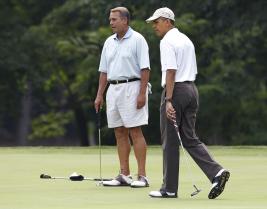
President Obama & House Speaker
John Boehner, R-OH, on the
first green as they golf
at Andrews AFB, MD
Saturday, June 18, 2011.
Charles Dharapak/Associated Press
Now, I read enough blogs and websites (via fastnewsReader and other apps!) to grasp that I was not alone in my appraisal of Obama back in January 2010.  Since then, though, I have read more and more folks coming to a similar conclusion and level of dismay. One of my favorite bloggers (and public intellectuals), who has been repeatedly proved right in his assessments and predictions, is Nobel laureate and Princeton University professor Paul Krugman, who, I should note, was critical of Obama's centrist stances during the primary season. (Krugman has, at the same time, praised Obama when praise is due.) Today, Krugman simply posted on his New York Times Conscience of a Liberal blog, "Obama, the Moderate Conservative." Krugman linked to a Fiscal Times piece by former Reagan economic advisor Bruce Bartlett asking, "Barack Obama: The Democrats' Richard Nixon." There is Salon writer Michael Lind's persuasive "Why the GOP Should Nominate Barack Obama in 2012," which walks through some of the same points I made back in 2010, though we all know that would never happen. Another online writer I regularly read, the brilliant gadfly lawyer Glenn Greenwald, posted months back that in fact Obama was not being forced to push such extreme plans--let's note again, to the right of even average Republican voters--but that he wanted to: "Obama's 'bad' negotiating is actually shrewd negotiating." And, to be fair, as Greenwald notes, some commentators, like Digby of Hullabaloo, warned even before Obama took office that he was pushing for that hideous "Grand Bargain" establishment Washington and New York's elite want so badly: cutting Social Security and Medicare, and lowering personal and corporate taxes to ensure the social safety net can never be adequately funded again. I could go on, but I'll stop here because it's numbing to continue.

So what about that young woman and her two children, seeking money just to eat, or the others I've written about on here, or the millions I haven't mentioned, all around us, barely hanging on? Well, they're nowhere in mind among those participating in the Washington carnival as it's unfolding. All the "fiscal austerity" we're being subjected to means things will get even worse for her--and everyone else, except the billionaires, bondholders, corporate execs, etc.--before they get better.  We may have a something akin to a budget default if the President cannot persuade the two houses of Congress to pass one of the two competing horrid bills they've submitted, or, in the absence of such, refuses to invoke the 14th Amendment to honor the nation's debts. (We should never forget that the Treasury very well could print money until forever if it wanted to.) We may or may not get some of the severe cuts-coupled-with-inadequate revenues that the President/Republicans/Washington establishment/Wall Street are jonesing for, but it's unlikely we're going to see him or any other major Democratic politician (Bernie Sanders, I-VT, is an independent) not only call for a major jobs program but vocally defend the social safety net at the very moment when its existence is proving invaluable. It's unlikely Barack Obama will face a third-party primary challenger from the left or even a viable left-leaning third-party candidate in the general election, since the various third-party organizations now being touted are just more center-right establishmentarianism seeking tax cuts and a gutted safety net, i.e., failed GOP policies. Would I vote for someone primarying Barack Obama? I don't know. Would I vote for a 3rd party candidate like Ralph Nader? I didn't in 2000 and I'm not sure I would in 2012. Would I just not vote at all? On top of this, and I gather the people in the White House just don't care, are clueless or have some hidden strategy I just can't grasp, the possible GOP nominee may run on an economically populist program given the president's intransigence on addressing the unemployment problem, she or he will very likely be even worse, since current GOP plans would do even more severe damage to the fragile US economy, as conservative policies are demonstrating in the UK right now.  In terms of Obama's GOP challenger, I still think John McCain would have been worse on every issue, but then again, other than Justice Sotomayor, can I be sure of that?

Right now, we're stuck, and liberals and progressives might want to think very carefully about how to proceed, given the lack of any channels to anyone running anything in Washington these days. I hate to end on such a down note, but we're in a very ugly place right now, and that young woman and her two children, and millions more like them, will be hanging on by a wing and a prayer and the beneficence of others, while the people in Washington, including the President himself, fight their damnedest to give even more of what's left of this country to those who already have almost all of it.