UPDATED: See: corrected "Codes of Vulnerability."
January, to those in the literary studies and related fields, means the annual conference of the Modern Language Association (MLA). This year's gathering took place in Chicago, but instead of heading to give a paper, sit on a hiring committee or interview for a job, I headed to attend two off-site events, one focused on translation and organized by Patrick Durgin, a poet and publisher of Kenning Editions on January 10, the second an experimental reading that the Red Rover Series organized at the Outer Space Studios in Wicker Park on January 11. Given the bad run of weather in the Midwest and more than a decade of familiarity with sudden snowstorms and treacherously icy runways, I was concerned about whether I would even get there by the time of my evening event, and my concern was not misplaced, because the first leg of my connecting flight, from Newark to Philadelphia, was delayed by 1 1/2 hours, which meant that I had to run--literally, sprint, with my bad knees--to my departing gate, which in Philadelphia's airport requires transport via a winding, slow bus! I barely made the flight (by minutes), landed in Chicago, picked up my rental car, and then spent 2 1/2 hours in driving iced rain, in part because I hopped on the expressway and a fire on a CTA train (on which my cousin's husband was riding to his job at the airport!) necessitated a partial shutdown of the highway, which meant that after being stuck in gluelike traffic I had to divert via local roads to my hotel, gliding across sheets of ice, past mountains of snow (Chicago had gotten 9 inches in its last snowfalls) and amidst crazy driving....I arrived at my first scheduled event a bit out of harried, but thankfully, in one piece, and on time (7:30 pm).
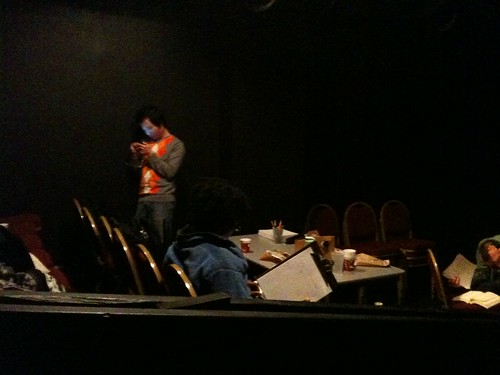
The translation event, pithily titled New Translation, was held at the School of the Art Institute of Chicago's Sharp Building on Friday. The translators included Nathanaël (speaking, with her usual cogency and grace, about translating Hervé Guibert from French), Anna Deeny (speaking about translating several different Hispanophone writers, including Alejandra Pizarnik and Raúl Zurita from Spanish), Daniel Borzutzky (speaking about translating Zurita and Gabriel Soto Román from Spanish), Urayoán Noel (speaking about translating Amanda Berenguer's "concrete poetry," which he defined in relation to the usual connotations of this term, from Spanish), Jonathan Stalling (speaking about several different authors from Chinese and his creation of a "phonotactic" structure to do so), Jennifer Scappettone (speaking about translating F. T. Marinetti's "aerofiction" and "aeropoetry" from Italian), Joshua Clover (speaking about translating--which he called the "last gasp of close reading"--Jean-Marie Gleize from French), and I. Translator Johannes Göransson was unable to attend.
The event unfolded without a moderator; we were to time ourselves, reading a small amount of our translations and speaking about the process and anything else related to the topic, theoretic, critical, scholarly, or otherwise. With 8 translators, however, things went long, though everyone offered up insightful comments about their practice and the texts they were translating. Daniel Borzutzky in particular offered one of the most clarifying presentations, linking our presence in Chicago to the Chicago School of Economics, which used Chile, Raúl Zurita's and Daniel's native country, then under the control of a military dictatorship, as its testing ground, with sometimes disastrous, often problematic results (its Social Security program, its huge inequality gap several decades ago, etc.), and was now using turning those same neoliberal policies back on the US, in particular Chicago, under the tenure of "liberal" Democratic mayor Rahm Emanuel. Another really interesting point he made, echoed by others, was how transgressive Zurita's writing about nature was, in light of the Pinochet dictatorship and its severe censorial constraints.
I ended up going last, and so restricted my comments to the minimum, instead reading a few sections of Hilst as well as a little of her Portuguese to convey the rhythmic and sonic challenges her work posed even for Lusophones reading it aloud. I also noted how she played with the idea contained in the word "oco" (hollow, hole) throughout, telling the reader that Stamatius, both through her use of words echoing this one ("coco," "trouco," "toco," "pouco"--all of which contain the sound of "oco," or "OH-koo") and by having one of the protagonists, Stamatius/Tiu, tell the readers he was going into his own "hollow," and then titling the final section of the novel "De outros ocos" ("Of Other Hollows"). I also answered a question about Hilst's use of a pornographic linguistic register and discourse, to which Nathanaël, who with Rachel Gontijo Araújo collaboratively translated Hilst's The Obscene Madame D, added important information. It was an excellent event, and afterwards most of us headed a few doors down for dinner and drinks, and multilingual conversation.
 |
| A snapshot of the panel (© Jennifer Scappettone) |
 |
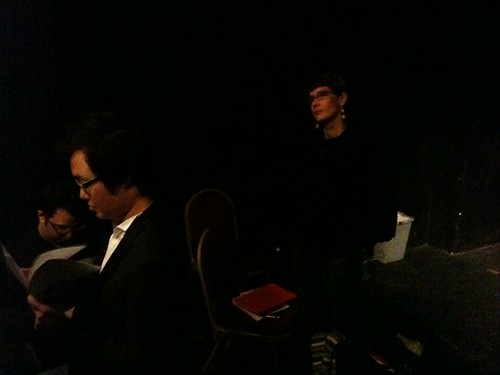
| Poet, critic and Cal Arts professor Christine Wertheim, before the event began |
 |
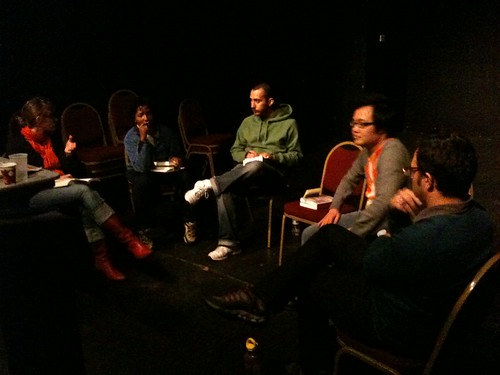
| The translators, from left: Urayoán Noel, Daniel Borzutzky, Anna Deeny, looking down, Nathanaël, and assorted attendees (Joshua Corey is wearing glasses) |
 |
| More of the attendees (translator Steven Teref sits next to Christine Wertheim at right) |
 |
| Patrick Durgin, organizer |
 |
| Joshua Clover, Jonathan Stalling, Urayoán Noel |
***
The second event that brought me to Chicago was "The Vulnerable Rumble," a reading-performance organized by local poets and activists Jen Karmin and Laura Goldstein, along with Laura Mullen in from Louisiana, as part of their Red Rover Series. Established back in 2005 by Jennifer and Amina Cain, the Red Rover Series has insistently fostered innovative poetic practice and performance or, as the series subtitle states, "[readings that play with reading]." During my decade in Chicago I was fortunate to catch a number of their events and participate in several of them; we even partnered together on May 2011's "Poetry for Labor" event at Haymarket Square downtown. Saturday's gathering, held at the Outer Space Studio, the upstairs artist-run performance space in the Wicker Park neighborhood, was #71, and staged as a special event for (and in response to?) the MLA's theme of "Vulnerable Times," or, in MLA President Marianne Hirsch's words
Vulnerable Times addresses vulnerabilities of life, the planet, and our professional disciplines, in our own time and throughout history. Its aim is to illuminate acts of imagination and forms of solidarity and resistance that promote social change."
As always, Jen, Laura and Laura thought carefully and creatively about this theme, and devised an open, aleatory program that, as I told Carla Harryman (one of the liveliest and most daring participants, whom I'd read for years but never met until this event), felt akin to what one might have encountered decades (the 1960s-1980s) ago, before poetry readings turned into tidy, academic-friendly affairs. Or, as I thought to myself, somewhat like the vibrant performances that Thomas Sayers Ellis thought up from time to time for the Dark Room Writers Collective.
Some two dozen-plus poets--Kazim Ali, Amaranth Borsuk, Amy Catanzano, B. K. Fischer, Chris Glomski, Alan Golding, Rob Halpern, Carla Harryman, Lyn Hejinian, Douglas Kearney, Philip Metres, Laura Moriarty, Ladan Osman, Danielle Pafunda, Lily Robert-Foley, Kenyatta Rogers, Heta Rundren, Jennifer Scappettone, Evie Shockley, Jonathan Stalling, Divya Victor, Barrett Watten, Christine Wertheim, Keith Wilson, Ronaldo V. Wilson, and Kate Zambreno, as well as Jen, Laura and Laura--were scheduled to perform. Whether all of us did I cannot say; the poets I know from the list above all did make appearances, but several of I know but never met I cannot say for sure read. At any rate, while Red Rover has more than once presented readings that break the usual form of reading, I could not remember one I'd attended--and none I'd ever participated in--that included so many poets and with such a free-form approach.
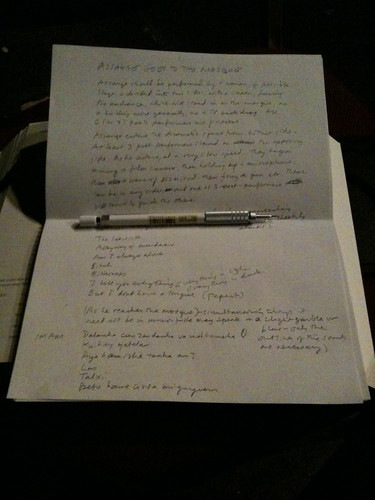
Laura, Jennifer and Laura imaginatively theorized and wrote the event's aims and approach in their "a vulnerable manifesto," which they read from at the evening's start, pointing out "often an order that allows one voice at a time to be heard, or one voice, the automatic discomfort at interruption- the exposure of muted layers that slide up against brains not programmed with patience." And: "if i hold you off for a minute before i must succumb, will i experience the rare sensation of my voice as presence? it's all i can think of in this moment but maybe you will think of more. i think more can happen that we haven't thought of yet, i'm sure." More specifically, all of the participants received a list of nine loose guidelines, or "Codes of Vulnerability," which were also posted around the studio space.
1. The curators announce the beginning and end of the performance.
2. Readers self-determine the order by choosing when to appear onstage.
3. The evening proceeds by readers interrupting each other to take turns onstage.
4. Readers can choose to stand in silence, as a signal that they will soon begin.
5. If a reader does not wish to be interrupted, shake head or make a stop signal with hand.
6. Readers can halt or disable their own live readings.
7. Duets and choral readings are divine, welcome co-readers by waving hands forward.
8. Readers can reappear and read more than once.
9. Strategies are encouraged to respect each reader’s time and space for the work to be heard.
10. Failure is also encouraged. See Judith Halberstam’s The Queer Art of Failure,
“Work together. Revel in difference. Fight exploitation. Decode ideology. Invest in resistance.”
Indication by raising the hand or shaking one's head. Duets and choral readings. Self-halting and disabling. Strategies to encourage reader time. Failure. What principles, and I say that without irony. Oh, if only more poets would internalize many of these! What became clear as the evening proceeded was that many of us did, and rather quickly; there were some who read briefly, some who leapt in and then out, some who paired up more than once but never too long, some who added a theatrical or performative element to change the reading dynamics, and a few who seemed to step right back into the usual holding-of-the-floor at length, as if any other approach would not do. But, as Jennifer said and underlined, even failure at these "codes" was acceptable, so anything went.
One other interesting and important element was the presence of a stool featuring the works of Amiri Baraka, who'd passed away only days before. In a note to participants, Jen Karmin called attention to Baraka's death, and several of us decided that, if we could, we'd honor him by reading his work. To facilitate this for everyone, Jen provided several Baraka texts, including Dutchman, which factored in several times later on, and, I think--though I could have this wrong--The Amiri Baraka Reader. I made a point of creating a .pdf featuring several Baraka poems, as well as my own, and determined that before I read anything I'd written, I'd bring him into the space with me, and for all of us.
There were many highlights, but the event launched with performances that set the tone for what might follow. First, Christine Wertheim, crouched in the front left corner of the room, took one of Jen Karmin's hands (I believe it was Jen's) and began a cry-wail that turned into a series of repeating lines, after which Lily Robert-Foley and Heta Rundren, emerging from their seats along the right wall's floor, rose and began an antiphonal song-chant that instantly shifted the tone and atmosphere. In an order I cannot recall, Kazim Ali moved into the front of the space, and shortly thereafter Doug Kearney glided through the packed crowd reading Amiri Baraka's "Ka'Ba." Someone from Robert Halpern's Music for Porn before Halpern did, reminding me of Halpern's reading last year at Poets House in NYC, and later Halpern himself read from the text himself--or did someone else also read from it? Yes: Lily Robert-Foley.
Amy Catanzano read a long, funny piece that riffed off net-speech. Jonathan Stalling sat and read/sang softly, intently in Chinese. Doug, Ronaldo V. Wilson and Amaranth Borsuk read in tandem, and Lyn Hejinian read twice with others: once with Barrett Watten, and once, towards the night's end, with Jennifer Scappettone, partially to the accompaniment of "Planet Rock" (I think), played by Ronaldo on his computer. Phil Metres, who was sitting beside me, read while on his hands and knees, and tore up and handed out pages from one of his books. I got one and erased some of the words, but I did not read them. His "The Blues of Charles Graner," exploring the horrors of the participants in Abu Ghraib, became:
The Blues
the Christian
knows
but the corrections
officer can't
help love
a grown man
piss him
Later on, B. K. Fischer (I think) read, as Jen Karmin and Evie Shockley pulled at opposite ends of the rope, and then Evie, the floor hers alone, read a powerful poem, playing artfully with repetition, recursion and subtraction. Ronaldo ended the evening wearing a black mask, a paisley scarf wrapped around his head, on his side, as Jen (and Laura G.?) intervened by removing chairs. It was over. We all applauded.
(I should also note that I finally met a poet I'd first heard about when I was 18 years old, from her son, who was one of the first people I met in my freshman year of college: Lyn Hejinian. A very good friend, Dorothy Wang, who attended the event, had mentioned meeting up with Lyn Hejinian the day before, and said she would be reading at this event, which I almost could not believe--after all these years, after quoting her in my first book, after reading and following her work for decades, I would actually meet this extraordinary poet in the flesh! I finally did meet her, and she was as lovely and gracious as I imagined. So that was another highlight of the evening for me.)
At some point early on, Carla Harryman--celebrating her birthday!--rose and inspected a plastic pot featuring various implements (a jump rope, a cone hat, a kazoo with streamers), and then, with Baraka's Dutchman, interrupted someone reading. There was a chair (visible in the photos below), and when things slowed a bit, I rose, suppressing my anxiety about interrupting anyone and just inserting myself into the proceedings, and, with Baraka's "An Agony. As Now," one of my favorites of his early poems, she and and I went back and forth, she reading Lula's lines from Dutchman, and I channeling Baraka. We performed the exchange, which seemed fitting given the format and the texts. I even felt like Clay/Baraka declaiming! I decided to practice a bit of self-curtailment and near the end of the poem I stopped. Maybe I even uttered this. I think it just felt too strange simply to walk off, though that is what I did. Did someone else join Carla Harryman? Did she stop too? Did anyone raise her or his hand? Did anyone nod a head to bring others up? I want to think someone did. Interruption was less frequent than patience and politeness mixed with volition about taking the floor. It worked.
Later Christine began reading from Dutchman. I thought about another Baraka poem, "SOS." Or "Letter to E. Franklin Frazier," which cuts me to the bone, to read with her. Or the poem I worked on listening to others. Or one of the ones I'd purposefully brought. But I stayed in my seat because some inner mechanism said, you have had your turn, and let others have the floor. So I sat and listened and watched and wrote. But I was utterly in the moment. It was thrilling, in the true sense of that word, and wonderful--full of wonder--in the deep sense of that word too. Like: I wonder if people are also finding this as fun as I am. I wonder if mixed in with the fun is a kind of anxiety about what might come next. I wonder when the poets I know who haven't gone will get up and should I act in some way to ensure they get a chance? I wonder how people are responding to this resetting of power, and authority, and exchange? I wonder if the men will respect the codes? They (we) did, and I thought it a remarkable event. Afterwards others concurred, or that's what I thought I heard. I want to do it again. And in the break I heartily thank Jen, Laura and Laura, and all the other participants as well as everyone else present, in the audience, for making it such a marvelous experience. Because that's what it was. An experience, with the emphasis on the root of that word that links to experiment. As the Red Rover Series has succeeded in pulling off, for nearly ten years.
A few photos (I aimed the lens at the light sources so some of the photos are a bit dark.)
 |
| Jennifer Scappettone and Christine Wertheim |
 |
| Kate Zambreno holding forth |
 |
| Carla Harryman |
 |
| Alan Golding |
 |
| Barrett Watten and Lyn Hejinian (with Evie Shockley, Danielle Pafunda and Christine in back) |
 |
| Amaranth Borsuk, Douglas Kearney and Ronaldo Wilson |
 |
| B. K. Fischer, Phil Metres (kneeling) and Jen Karmin |
 |
| Some of the performance |
 |
| Ronaldo V. Wilson |
 |
| Ronaldo, at the evening's conclusion |
 |
| The door to the wonderful |