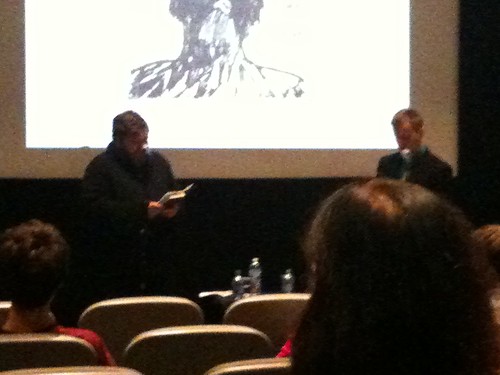
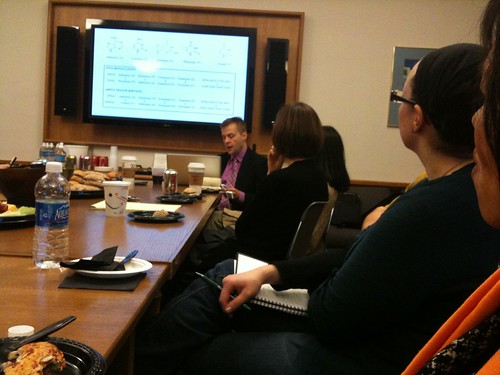
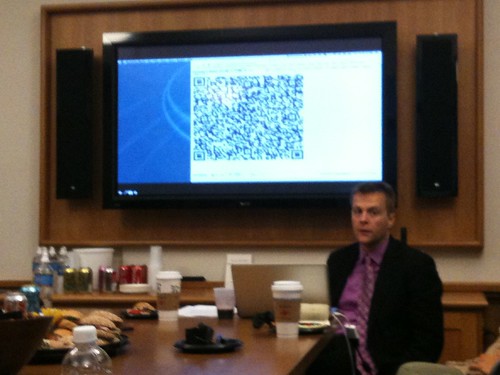
Two of my Northwestern colleagues, Reginald Gibbons and Ilya Kutik, both poets and scholars, and both long involved in bringing a trove of Russian literature into English, introduced him and are current translating Revkin's and other Russian poets' texts. Reg I have written about extensively on here, but he is, for those unacquainted with his work, an award-winning poet, novelist and short-story writer, and an equally regarded translator from Spanish and Ancient Greek. Among his many honors, his collection Creatures of a Day (LSU Press, 2008), was nominated for the 2009 National Book Award. He cofounded and codirects Northwestern's MA/MFA program, and was formerly chaired the English department. Ilya, a native of Lvov (Lviv), and graduate of the Gorky School of Literature, teaches in Northwestern's Slavic department and is one of the founders of the "meta-realist" or "meta-metaphorist" school of Russian poetry, and was close to Allen Ginsberg and Joseph Brodsky, among other major poets. He has published a number of volumes, several translated into English, and his most recent critical studies include Writing as Exorcism: The Personal Codes of Pushkin Lermontov, and Gogol (Northwestern University Press, 2005), and Hieroglyphs of Another World: On Poetry, Swedenborg, and Other Matters (Evanston: Northwestern University Press, 2000).
The writeup of the event read as follows:
Andrei Levkin (who will be visiting from Moscow) is a writer of "poetic prose" related in style and stance to the contemporary Russian poetic school known as "metarealism." The latter is centered on a particular mode of thought--unfamiliar in English-language poetry and prose--that is highly metaphorical, often apophatic, and fast-moving. Metarealism began in the 1980s (Ilya Kutik was a founder and remains one of the primary figures) and has produced a number of very widely known and highly honored poets, including Alexander Eremenko, Aleksandr Chernov, Elena Schwarts, Olga Sedakova, the late Alexei Parshchikov. It is also poetically affiliated in spirit and approach with such predecessors as Boris Pasternak, Marina Tsvetaeva and Osip Mandelshtam, as well as more recent luminaries like Bella Akhmadulina, Victor Krivulin, and Arkadii Dragomoshchenko (translated in the US by Lyn Hejinian).I was curious both to hear what Levkin, as well as Ilya and Reg had to say about "meta-realism" and to hear Levkin reading his prose. But as I said, there was only a tiny bit of reading, and a great deal of trying to unpack what "metarealism" is. Here's what I took away: metarealism (meta = something setting beside or with + realism) entails heavy use of a figure, apophasis, traditionally understood as "mentioning without mentioning," that is not exactly metaphor (or simile), nor metonymy, but involves a bit of both. In it, an absence becomes a presence, and figuration proceeds from that absent presence. Thus, a chain of figures can unfold from a metaphor (or metonym, depending) signifying an absent object, or person, or anything, and thus a signifying chain is set in motion that a Russian reader can and will pick up, but which not click for non-Russians.
The idea of a negative space, or absence, as the starting point, seems key, as opposed to the way metaphor (and metonymy) work in English, whereby the presence of something stands in for something else (or in contiguous relation to it). A "double-saying," to use Reg's term. Thus apophasis, even as a figure, is far less common in English, though certain poets (George Herbert, Wallace Stevens, etc.) do utilize apophatic figures. In Russian as in English, the apophatic carries mystical (metaphysical?) resonances that English translations cannot capture, and extends beyond literature to visual arts as well. In apophatic theology, the ineffability of God requires that rather than describing Him or Her or Them in positive terms (immanence, which is to say, presence), that the description proceed by what S/He or They are not (transcendence, which is to say, presence).
I should note that there is a form of apophasis that isn't uncommon in English, and it's known as paralipsis, praeteritio, preterition, parasiopesis, or cataphasis, and was a favorite of Richard Nixon's, among other politicians (keep your ear ready to see if and when it appears during this election cycle). It involves saying something while denying you're saying it. So (and these my versions, not Nixon's actual words), "I will not question the motives of those on the other side pressing for my impeachment," or "My opponent is a lying thief who hates babies and puppies, but I'm not going to say a bad words about him." Other related figures include epanorthosis (accumulation and statement by negation) and occultatio (statement of something by not stating it). And so forth. It is clearly related to the rhetorical figure of irony, and as such can be quite effective. Apophasis, though, as the metarealists use it, is more subtle.
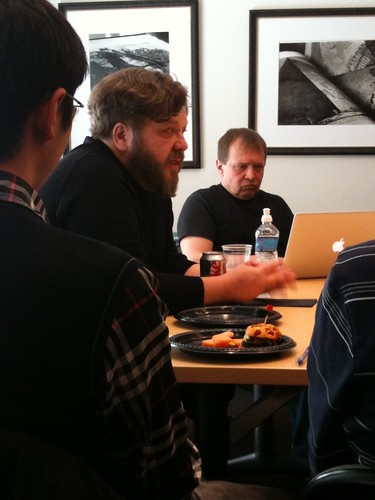 |
| Ilya Kutik (l) and Andrei Levkin (r) |
A clearer example: Reg and Ilya discussed translating a poem by Andrei Voznesensky (1933-2010), a homage to Robert Lowell (1917-1977), in which Voznesensky notes the angle of Lowell's head, tilted as if there were an invisible violin there. But there is no violin. Yet by the end of the poem that Voznesensky hopes to hear the music of that absent violin. Or, in the same poem, Voznesensky notes a notch, cut by Peter the Great (1672-1725) in a hut, and how Lowell was tall enough to touch the notch. In the poem the apophatic figure involves Lowell not becoming that notch or in some connective relation to it, and thus becoming the Czar, but fitting into the space of that notch, the absent space that notch creates, which thus invokes Lowell's presence. Lastly, in the same poem, Reg pointed out, Voznesensky mentions how tombstones in a grave are like Post-It notes. One can imagine this metaphor with ease, and a grave metonymically links to the dead, and death itself. So Voznesensky goes searching among them for Lowell, now buried in a grave, and the absent Lowell and the Post-it notes, in aggregate, transpose into the book of Lowell, the books of Lowell, that Voznesensky can read.
Hmm. I think I get it, sort of. Ilya also spoke about the iconostasis, and how in a Russian Orthodox Church, a wall stood between the altar and the congregation, unlike in Roman Catholic or Protestant churches, and how the presence of this wall of icons made active the presence of the hidden altar.A senior colleague, Larry Lipking, asked whether in all this there was not the residue of the theological, of Orthodox traces, and Ilya averred, saying that in fact there were. He also pointed out how the idea of "the word made flesh," a theological idea that also carries back to orality, of course, still remained active for Russian poets and readers, and noted how Kasimir Malevich's (1879-1935) famous black square painting was also called "The New Icon," not simply to be provocative or blasphemous, but because, in an apophatic gesture, the black square represented the absence of the icon, so central to Orthodoxy, only the (white gessoed) canvas frame remaining. Double hmm.

As he was speaking and Reg, I believe was responding to him, I thought about his comments about the relationship between his work and contemporary art, and about how Jean-François Lyotard, in his famous essay on Barnett Newman and the idea of the "contemporary sublime," noted that one of the most important shifts to take place among the 40s and 50s generation of artists, the Abstract Expressionists and their peers, was to ask the question not of "what is it?" or "why is it?" but rather, "Is it there?" which is also to say, "what is there?" The idea of filling space, as opposed to filling it with an image or a particular kind of composition or color, to question pictorial space itself as presence and negation, seemed to be operating, in some way, with Levkin, in contrast to the other Russian prose writers, like Tatyana Tolstaya say, or Vladimir Sorokin, of whom I've written some on here. Thus for Levkin "what is there?" and "is it there?" perhaps functioned apophatically instead of the more usually prose fictional question, from which narrative proceeds: what is happening, and who is doing what in relation to what's happening. That of course is the ground of fiction across the globe.
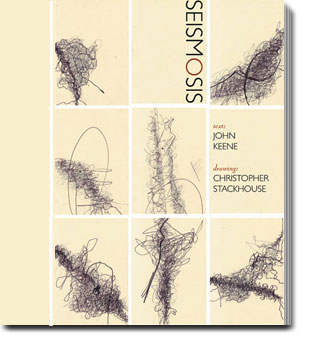
I still must say I'm not sure I fully grasp "metarealism" or apophasis, and I also thought about the widespread presence of the negative--down to actually statements, as in "Analysis III," questioning what absence itself reveals--in Seismosis, not that I knew then or now that much about negation, apophasis, or so on, but all of that's for another discussion. I will raise my antennae when I'm reading Levkin's work in translation, or that of any of the many Russian poets of the 20th century, especially those in the metarealist school, linked to it or inspired by it, trying to be aware of how the apophatic works.