As I was returning on a late-evening, slow train from
Boston after attending the annual
Associated Writing Programs (AWP), I tried, before briefly falling into a deep sleep--and nearly missing my stop at
New York's
Penn Station-- whose spell only my
iPhone alarm and the conductor's loud yell broke, I tried to remember the first AWP I attended, and I couldn't. The conferences and years and cities blur, though some, like the gathering
Baltimore several years back, or
Denver's two years ago, marking my first visit ever to that city, or the prior one last decade in
New York, or the several in
Chicago, one of which I had to miss because of my father's death, remain as alive to me as if I were still there. So too do a few that I could not attend for various reasons, including the AWP conference that took place in
Vancouver. Yet whatever I may feel in the months and weeks leading up to each AWP conference I attend, I always return from them physically exhausted but intellectually and creatively energized, and this year was no exception. I overheard someone saying that by Friday afternoon 12,000 people had attended, a number that may or may not be astonishing and a high, though because of the layout of the
Hynes Convention Center and the nearby hotels, this year felt far less frenzied than that maelstrom of last year's conference in Chicago. By the first full day I'd been there I was feeling overwhelmed by the circus-like atmosphere, and was glad that I could head home and revive myself before returning for another day of events.
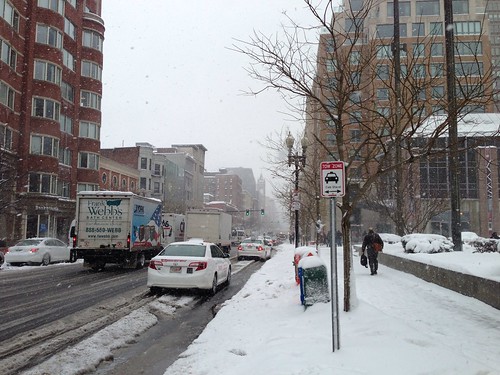 |
| Snowquestered Boston |
The AWP conference also always feels a bit more upbeat than the
Modern Language Association (MLA) conferences, perhaps because the literary world, far more so than the scholarly-academic one, still (
thankfully!) includes large numbers of non-professionals, lovers and enthusiasts of literature and books, amateurs and dilettantes and tyros, and this is not a bad thing. AWP, and the American (by which I also include
Canada and increasingly the global Anglophone literary sphere), as
Mark McGurl and others have persuasively argued, is part of a
literary-industrial complex, with an increasingly institutionalized, rationalized, stratified, hyper-commodified hierarchical system of actors, laborers, commodities, but what AWP also makes clear is that anyone who can afford to get into (or can inventively sneak into, at least for the first few days) the panels or readings or Book Fair, for example, can interact with anyone else who's there, and there are always a range of offsite events (readings, performances, musical events, etc.) that attendees accord just as much, and sometimes
more value, than anything occurring within the conference itself. In fact, these offsite events often enrich and add considerably more value to your experience of the conference, and both offer a counterbalance and a leveling effect to the increasing dominance of academe. They also demonstrate that although there are numerous gatekeepers in the Anglophone American literary world, powerful publishers, institutions, famous authors and teachers, a history and tradition that must be acknowledged and reckoned with, creative writing at its core, as is the case
for all art and art forms, remains fully beyond the grasp of anyone or any institution that would want to reduce it to a mere cog in the wheel of global-American capital, though it is that.
 |
| Snowquestered Boston by night |
Perhaps it is a question of perspective, but this year's conference also felt more diverse, in the sense of pluralism more so than multiculturalism, than prior ones, and even the briefest perusal of the major official readings shows that the organizers have really made an effort to feature an ever wider array of voices from within the institutions that make of AWP. (For writers outside institutions, it's another story.) Yet I still often feel that there are too many blind spots that persist, particularly in terms of the composition of panels. A friend who attended the
Digital lit panel, for example, noted that not a single writer of color was on it or discussed. (This was the subject of a paper I gave at the MLA and so I was particularly interested to hear how the AWP panel turned out, especially since I could not attend it.) The same was true of other generalist panels at the conference. Yet in other cases, where panel organizers did the work of trying to look beyond a narrow ken, the panels were more racially and ethnically diverse. As
VIDA has once again made clear, the problem of sexism also continues to plague the American literary landscape, and AWP, given its power, can become a force to change things. But the barriers in terms of race, ethnicity, gender, sexuality, and class that are endemic to academe and academic institutions carry over into a conference like AWP. As I said, I felt this year's conference was better than prior ones, but that could be my limited perspective. It is up to AWP's members and participants, though, as much as to its organizers, to continue the improvements the organization has made.
 |
US Poet Laureate and Dark Room longtime member
Natasha Trethewey opening the Dark Room Reunion Reading
at the AWP Conference |
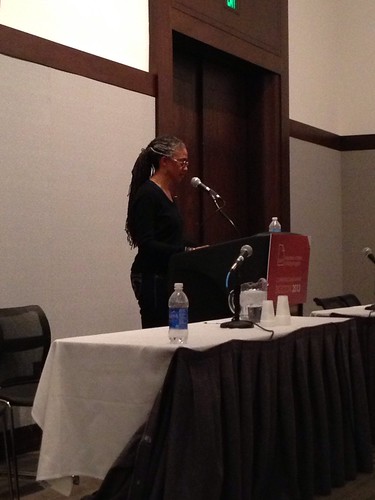 |
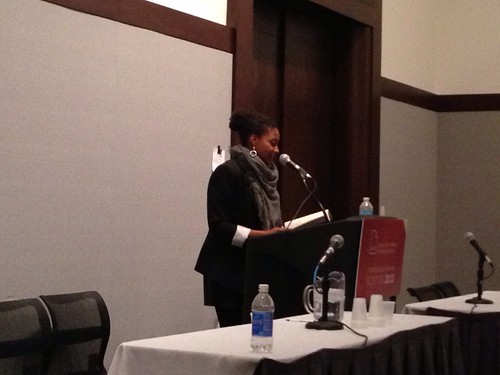
| Dark Room cofounder Sharan Strange reading her work |
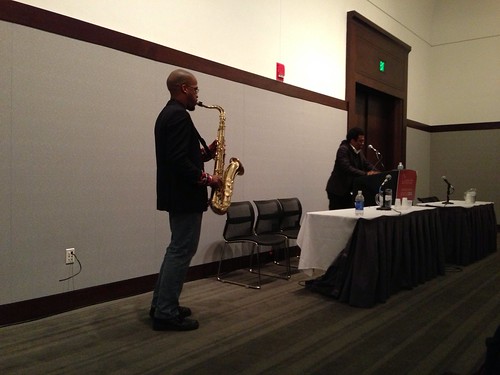 |
Saxophonist James Brandon Lewis performing
with Thomas Sayers Ellis at the Dark Room Reunion reading |
 |
| Tracy K. Smith concluding the Dark Room reading |
My chief reason for attending this year was to participate in the
Dark Room Writers' Collective reunion reading, which took place on Thursday afternoon at 3 pm at the Hynes Convention Center. It was an especially important reunion because Cambridge was where the Dark Room began, and on a personal level, it was where I went to college and worked for many years; Boston was the city where all of us cut our literary teeth as writers, and the Dark Room's final home before its dissolution in the late 1990s.
Natasha Trethewey, the current
Poet Laureate of the United States, could not participate because she is an AWP board member, but she did introduce the event, which included amany of us who had been members through the years:
Tisa Bryant, Tracy K. Smith, Artress Bethany White, and
Kevin Young; founders
Thomas Sayers Ellis, Janice Lowe, and
Sharan Strange; and I. As has become a tradition at reunion readings, a younger writer, poet
Abiku Roger Reeves, joined us, as did the talented young saxophonist
James Brandon Lewis, who performed expertly with Thomas. A number of other fellow members who couldn't attend were there in spirit. The room was full, and despite starting a little after 3, we didn't go over and were able to participate in a lively Q&A afterwards with the audience, which included a number of writers, elders and youngsters, all of us had met, learned from and worked with over the years. So goes the Dark Room motto: TOTAL LIFE IS WHAT WE WANT.
My other reason for attending was to join students to answer question at the
Rutgers-Newark MFA table, at the Book Fair, something I'd done for
Northwestern's MFA program at last year's AWP. I am always fascinated by the range of people who stop by the table to inquire about the program. During one lull, however, passing before the table wasn't just one of the many amazing authors peopling event, but, as I quickly noted, extracting my camera for posterity's sake, one of the greatest living authors in the
Arabic or any language,
Adonis (Adunis), who was supposed to pay a visit to Chicago (and the Poetry and Poetics Program at Northwestern) in the fall of 2011, but was too ill to do so. I stopped him and
Khaled Mattawa, and translator and escort for the day, asked if I could take his picture, and he graciously allowed me to do so. Though I had had to miss his event the prior day, I also got to thank him in person for his work. After he'd moved on, several other people milling about nearby asked who he was, and I was glad to tell them.
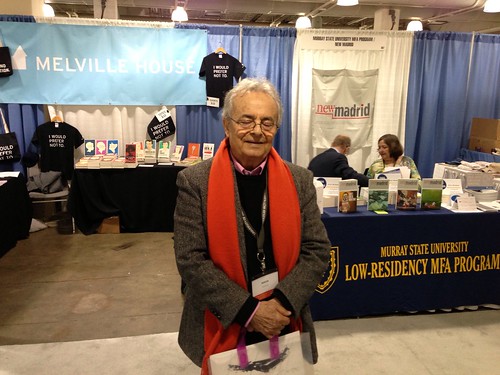 |
| The extraordinary Adonis (Adunis - أدونيس;) |
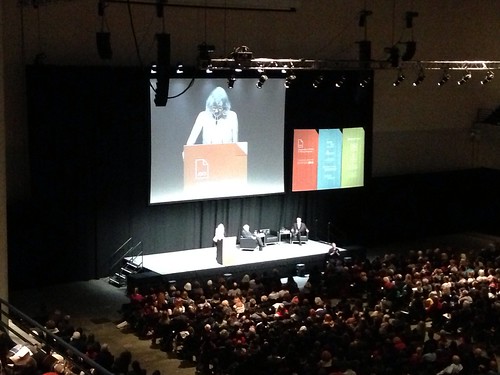 |
At the Derek Walcott-Seamus Heaney
reading and conversation at AWP |
The third reason I attended the conference was to attend a dinner at a great
Ethiopian restaurant hosted by
Prairie Schooner and the
University of Nebraska Press, with the great
Kwame Dawes serving as Chief-of-Ceremony and colleague
Chris Abani (whom I'd never met in person) as reader, in honor of the
Sillerman First Book Prize for African Poets, on whose panel I'd served in selecting the inaugural winner, the tremendous young
Kenyan poet
Clifton Gachagua. He wasn't there nor was one of the judges,
Bernardine Evaristo, but in attendance were two others,
Matthew Shenoda and
Gabeba Baderoon. I also had the opportunity to meet poet
Nathalie Handal, who'll be visiting Rutgers-Newark in several months, and two British poets whom I've admired from afar for many years:
Kadija Sesay George and
Dorothea Smartt. (In fact they'd been on a panel the prior afternoon, but because my train was delayed by over two hours as a result of the snow and who knows what else, I had to spring to
my event and so was unable to catch them.) Also present and offering spirited remarks was
Laura Sillerman herself. One final treat of the evening was a video that convened two of the giants of contemporary African literature; in it
Kofi Anyidohoo interviewed
Kofi Awoonor, who later read from a new long poem.
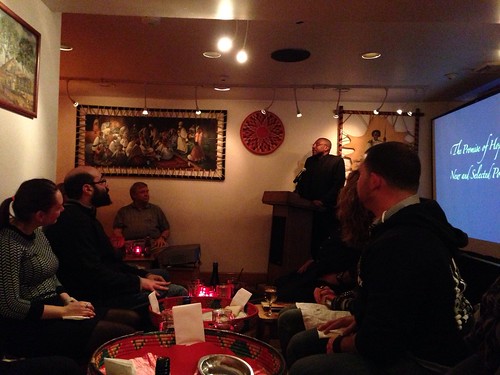 |
Kwame Dawes, leading the proceedings
at the Sillerman Book Prize dinner |
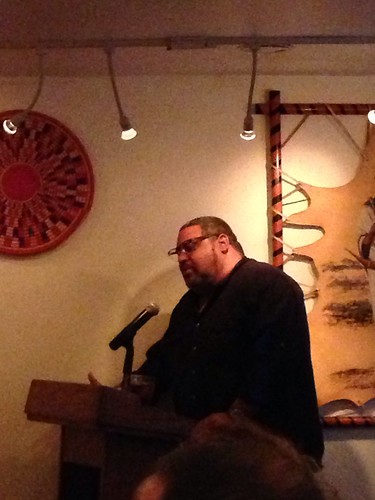 |
Chris Abani, reading poems by great
African poets, and his own beautiful poetry |
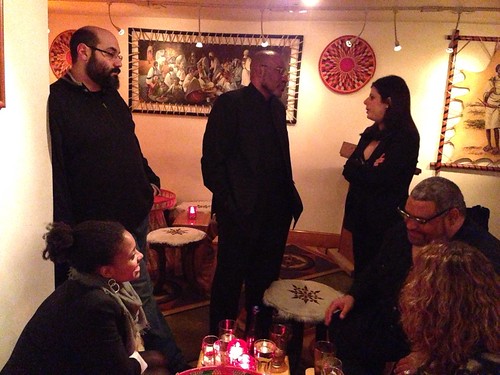 |
After dinner (l-r): Tracy K. Smith, Matthew Shenoda, Kwame Dawes,
Nathalie Handal, Chris Abani, and another dinner guest |
I ran into so many writers over the weekend I could fill multiple blog posts just listing them, and I will inevitably leave people out, so I'll say instead that it was wonderful as always running into so many old friends and making new ones, and I especially appreciated having the opportunities to chat and spend time with some of them at various points throughout the trip. I must mention that the first person I ever read with outside college, at the Dark Room, was
, one of my heroes, and I happened upon him Friday afternoon as I was leaving the Hynes with the Dark Room writers and other friends. I can hardly express how important he has been to me as a writer, as an intellectual, as someone who puts his ideas and art into practice, and I cherish ever opportunity I have to see him. As it happened as I was speaking with him, the head of Rutgers-Newark's MFA program,
shortly after I joined the Dark Room, was passing by, so they got to speak and I felt that in that moment, a circle was coming together, uncannily. There were many such moments, including running into my former
on the train up to Boston; Martha was a dear friend when we were in graduate school and now teaches in New Jersey, and we were able to exchange information so that we will no longer have to play phone tag as we had for years.
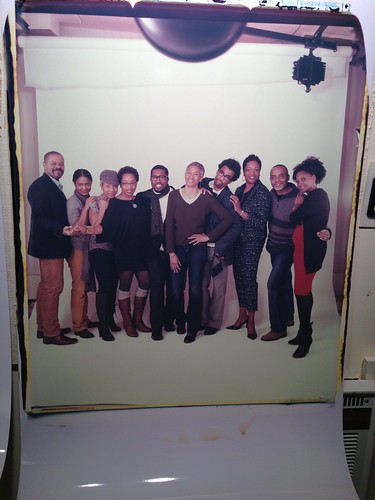
One final highlight of the visit was participating in a Dark Room photo shoot conducted by the acclaimed photographer
. Thomas, who'd serendipitously happened upon her during one of her visits to New York, arranged for several photos using a large frame color
camera, and in addition to the fun of hanging out, watching Dorfman work her photographic magic was priceless. Many aspects of prior AWP conferences have faded, but I don't think I'll soon forget this one or the enjoyable time I had. That it occurred in Boston makes it that much more special.