Friday, April 07, 2006

John Ashbery Day (NYC)

In addition to today being the birthday of former English poet laureate and Romantic master William Wordsworth, Boston activist William Monroe Trotter, Jazz avatar Billie Holiday, sitarist-par-excellence Ravi Shankar, and supreme ironist Donald Barthelme, as well as the anniversary of a 1712 New York slave revolt, it was, after the printing and issuance of the mayoral proclamation, John Ashbery Day in New York City. I learned this at the reading Ashbery (1927-) gave at the New School University, on the second day of the three-day festival organized by poet and critic David Lehman and others on his behalf.

The reading took place in the Tishman Auditorium (above), on W. 12th Street, an amenable, egg-shaped, post-Deco decorated venue I've been to many times for great readings and have even once had the honor of reading at. Cave Canem annually holds their prize readings there, and the New School itself brings numerous well-known and not-so-well known writers in every year. By any measure, Ashbery is one of the best known and most famous living American poets, and has received every major poetry prize available, save the Nobel. He is also one of the most prolific, with over 20 books and many more chapbooks and small-press volumes, as well as a volume of visual art criticism, a collection of belles-lettres, and a novel (with James Schuyler), and plays. His first book, Some Trees, won the Yale Younger Poet's Prize back in 1956, and he was nominated for a National Book Award just a few years ago, I believe. (For some judges, this has become almost reflexive.)

Yet there's a paradox with Ashbery, because unlike most of the other very well-known and honored poets, he has been insistently criticized and dismissed by not only some notable academic and non-academic critics, but also by some of his peers (James Dickey, Richard Howard, etc.), because of his continual experimentation with both form and content, his hermeticism and allusiveness, his humor and silliness, sometimes verging on artlessness, his use of dream logic and illogic, since his earliest work, which advanced the traditions established by British and American Modernists such as W. H. Auden (on whom he wrote a master's thesis), T.S. Eliot, William Carlos Williams, Hart Crane, and Wallace Stevens, but with strong input from the French Surrealists, other European poets such as Rainer Rilke and Boris Pasternak, and all manner of American high, sometimes avant-garde and mass or popular culture from the era of Ashbery's childhood and adolescent development on through to today.

Ashbery is almost always called "difficult." Yet unlike most difficult poets, he traffics regularly in popular cultural material and references that high culture critics have tended to dismiss, while also writing works that defies easy formal or theoretic classification. For example, he wrote an entire book of poetry in prose, Three Poems, that is based both on Traherne's meditative poetry (an admittedly rarefied source) and the readily available self-help manuals that one can find at any bookstore. In another volume, Houseboat Days, usually regarded as one of his most "difficult," he wrote a poem that references Daffy Duck in its title but goes on to catalogue a range of recondite allusions, from Fernando de Rojas's epic to Dryden's heroic tragedy on the Mogul emperor, Aureng-Zebe. Nijinsky and Franz Kafka, among others, also appear as ghostly presences in the same volume. In another, he writes a sestina that incorporates the characters from Popeye ("Farm Implements with Rutabagas"), transposes his own lines atop a Peaches and Herb song ("It Was Raining in the Capital"), and invokes a classical Roman divination form in another ("Sortes Vergilianae"); this book's title is drawn from the beautiful, enigmatic Giorgio di Chirico painting that's emblematic of Ashbery's work, The Double Dream of Spring. Such is John Ashbery (below).

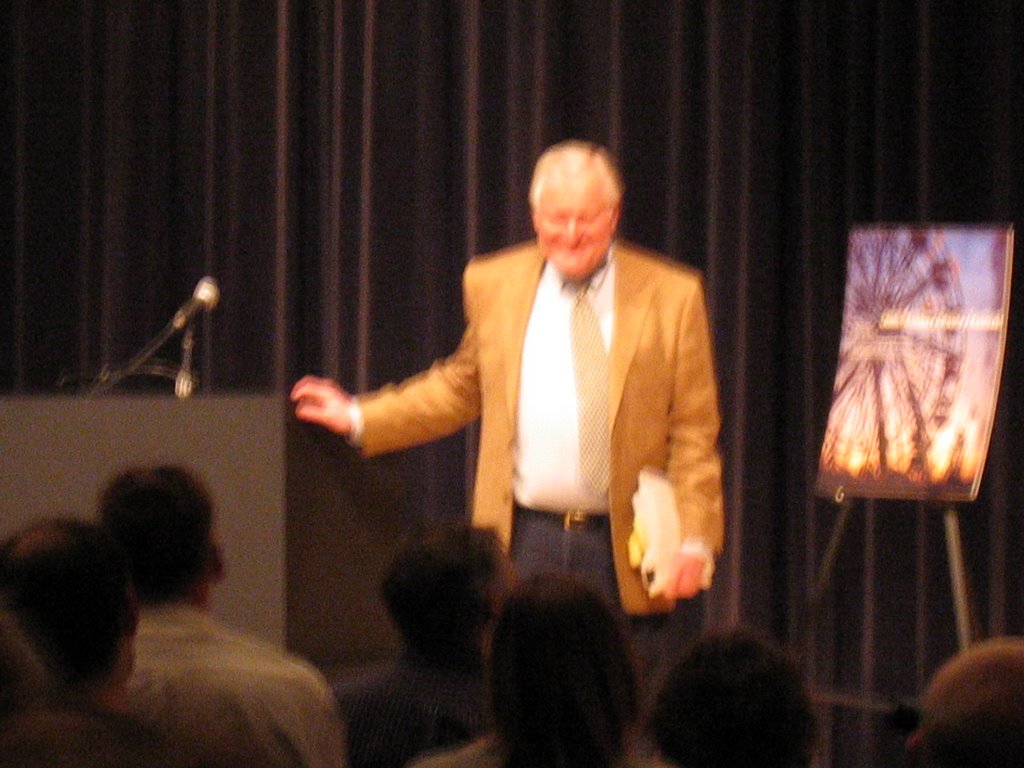
He is, as I've written before on here, one of the most influential living poets in English, particularly in countries as Canada, the UK, and Australia. In fact, he may be the most influential in terms of the effects of his aesthetic, and the number of poets whose poetics can be traced to him. Several generations of major figures show varying degrees of Ashberian influence (or counterinfluence), and at least one school of contemporary American poetry (Language) can trace its formal origins directly to him, even if its political concerns have from its beginnings been quite different. If one were seeking a "queer" poet who could be said to have truly queered, in the broadest sense, the poetic body, Ashbery would be he. A study entitled The Tribe of John discussed this topic in some depth, but it could easily be expanded upon today with at least five or six new chapters. Lehman himself is a star acolyte of Ashbery's, as is the man, James Tate (1943-), who introduced Ashbery tonight. (Strangely, Tate, shown below, looked almost twice as old as Ashbery, while Ashbery seemed to be about half a decade short of his 79 years.)

About the reading, I'll say that Ashbery was quite funny. About half the poems he read were among his best known, like "Qualm," which mentions Warren Harding and was thus very appropriate for the current political climate, "Soonest Mended," which he admitted was autobiographical, "What Is Poetry," a famous ars poetic and self-defense of his aesthetic, and "At North Farm," whose citation of the Finnish epic the Kalevala prefigures the long poem, "A Wave," in the volume it heads. He also seemed to choosing other poems randomly from his Penguin Selected. One of the first poems he read, "He," was hilarious, and my friend and fellow writer David M., who isn't a big fan of poetry readings but decided to join me this time, said he really enjoyed this poem. It's a simple lyric, structured anaphorically (the same word is the first word of each line: "he") that proceeds in dreamlike fashion, but actually tells a story. I hadn't ever thought of the poem as being comical (absurd yes, funny no) until I heard Ashbery read it, and this came through in a number of his poems, which verge on silliness by incorporate all kinds of verbal detritus, which in the best pieces, especially the more recent ones, he manages to weave into a very convincing lyrical fabric. He read one piece from his collection based on Henry Darger's paintings, Girls on the Run, which I find tiresome through and through, and repetitive of earlier, better work in Flow Chart (which he also read from, again to comic effect), then concluded with a final, fairly recent poem from Your Name Here: Poems that brought together the multiple registers of American speech, in which life's "elusiveness" and "mysteries" are both concealed and revealed, but which was also shot through with the perceptions of loss and his own mortality that have become his late career hallmarks. The standing ovation that capped the 50-minute reading (it felt shorter) was long and demonstratively heartfelt.
Thursday, April 06, 2006

Guardian on Men's vs. Women's Novel Choices + Black Abstraction Show at Studio Museum + Poem: Barbara Chase-Riboud

I'm always skeptical of arguments that attribute certain types of behavior or choices based on gender. Yet they keep coming. Today, Charlotte Higgins, the Guardian Online's art correspondent, writes that University of London scholars Lisa Jardine's and Annie Watkin's research shows that "the novel that means most to men is about indifference, alienation and lack of emotional responses. That which means most to women is about deeply held feelings, a struggle to overcome circumstances and passion." These men, in other words, value Beckett, Kafka and Salinger, while women like Atwood, Austen and Drabble.

CamusThe article lays it out:

Professor Lisa Jardine and Annie Watkins of Queen Mary College interviewed 500 men, many of whom had some professional connection with literature, about the novels that had changed their lives. The most frequently named book was Albert Camus's (at left, Today in Literature) The Outsider, followed by JD Salinger's Catcher in the Rye and Kurt Vonnegut's Slaughterhouse Five. The project, called Men's Milestone Fiction, commissioned by the Orange prize for fiction and the Guardian, followed on from similar research into women's favourite novels undertaken by the same team last year.

The results are strikingly different, with almost no overlap between men's and women's taste. On the whole, men preferred books by dead white men: only one book by a woman, Harper Lee, appears in the list of the top 20 novels with which men most identify.


Women, by contrast, most frequently cited works by Charlotte and Emily Brontë, Margaret Atwood, George Eliot and Jane Austen. They also named a "much richer and more diverse" set of novels than men, according to Prof Jardine. There was a much broader mix between contemporary and classic works and between male and female authors.

The piece goes on to say that while the male research subjects didn't regard novels as a constant companion to their "life's journey," the women did, and that the gender clichés the (admittedly limited) research established shocked Jardine and Watkins, though in historicizing the findings, it led them (and certainly anyone familiar with the English novel's 18th century beginnings) back to the period when the genre was considered primarily to have appeal to women (Tristram Shandy and Tom Jones were novels of that era that brought men into the fold).

Jardine's and Watkins's chief suggestion is that the book publishing industry take the findings into account, as men between the ages of "20 and 50" don't read novels, and the industry is still male-dominated in some key ways and doesn't always take female readers' interests and affinities in aggregate seriously. (In the US publishing industry, from an economic perspective, one would be quite wrong in asserting this, though from in an intellectual perspective, I think it's worthy of discussion) Though the NEA's own 2004 study, "Reading at Risk," correlates somewhat this last point, in the United States at least, I wonder what a larger survey, or one taken in the US might show. It also makes me think about the importance of novels in my own life, but also how they function in relation to the dichotomies that this Queen Mary College study maps out.

†††

Williams' 'Trane'Uptown is the place to be, as the "Energy/Experimentation: Black Artists and Abstraction, 1964–1980" show has just opened at the Studio Museum in Harlem. Curated by scholar Kellie Jones, it's one of the biggest shows focusing specifically on Black abstract artists in the last few years, and includes works by 15 of the major ones of the late 20th century, including Alma Thomas, Jack Whitten, William T. Williams (whose "Trane" is pictured at left, Studio Museum in Harlem), Sam Overstreet, Melvin Edwards, Barbara Chase-Riboud, Howardena Pindell, and Martin Puryear, among others.

The grand opening was last night, and I couldn't make it, but I definitely intend to make my way up there to catch it as soon as I can. The New York Times's Holland Cotter writes a thoughtful review that notes how this vital body of artwork has gotten lost in the larger narrative of (African-)American art, which makes this show an crucial historical and representational intervention, though he also points to these artists' influences on subsequent generations of Black and non-Black artists--and they are all over (and referenced at various moments in) Seismosis. There have been a few fairly recent, strong shows of Black abstract artists, including at Franklin & Marshall College just a few years ago, and most survey books on African-American art (if not American art) do devote critical space to this aesthetic movement and its offshoots, but this one is a an important one for the capital of American art, New York, where many of these artists have lived and worked. Don't miss if it if you can.

†††

My poem for today is a transcription of one of Chase-Riboud's (1939-) "Cleopatra" poems, which composer Mark Vores set to music. Chase-Riboud is probably best known as a sculptor and novelist (Sally Hemings, 1979; Echo of Lions, 1980, on which the movie Amistad was [illegally?] based; Venus Hottentot, 2003), but she is also a published poet. Her first book, From Memphis to Peking, was edited by Toni Morrison and appeared in 1974, and Portrait of a Nude Woman as Cleopatra, which appeared in 1987, received the Carl Sandburg Literary Award.

Chase-RiboudO, FRIENDLY ENEMY, WE HAVE LOVED

O friendly enemy, we have loved,
Loin and haunch, limb and flank, truth and lies,
Tressed like a pair of ancient Armenian vines
Grown together root and branch in stunted
Commingling without End or Beginning.
If we part, you will leave with half of me,
Or I with half of you, and nothing will kill
The pain of dismembering.
That ache like some rare jewel
Will hang round our necks to touch,
In tender tremulance, an old wound of amputation
That burns and groans in limbs no longer existent
But splintered and crushed
In some long-forgotten and useless War.

Copyright © Barbara Chase-Riboud, All rights reserved.

Wednesday, April 05, 2006

Black Chefs' Struggles + E. Patrick Johnson Speaking on Gays & Gospel + Direland on Anti-Gay Poland

G. GarvinIn today's New York Times, Michael Ruhlman pens a 3-page article on "Black Chefs' Struggles at the Top." C. and I have caught and enjoyed Turn Up the Heat with G. Garvin on TV One several times (his hyper-butch, LL Cool J-esque persona fascinates me, as does his repetition of the phrase, "This your boy!"), and he like some of the other chefs who're profiled offers his thoughts on dealing with stereotypes and racism in upscale restaurant kitchens, as well as the persistence and emotional toughness required to succeed. Ruhlman and his interviewees attribute part of the problem to the absence of Blacks in the cooking school pipeline, and he reports that not only external factors, such as low and often warped expectations among restaurant owners and non-Black chefs about Black cooks and their skills and talents, but also familial dissuasion, based on a range of factors, play a role.

(Bernie of Bejata recently added culinary training to his list of skills, so I wonder what he thought of the piece. I also thought about my younger brother, an excellent cook who's worked in an assistant capacity in a number of kitchens, but who has yet to finish his education, despite my and other family members' encouragement and support.)

The article ends on a positive note, however:

After graduating from Stanford, Beth Setrakian, 49, got her first job as a pastry chef in 1979 for Mark Miller at the Fourth Street Grill in Berkeley, Calif., where, she said, "I was definitely the only African-American in the kitchen." She opened her own business, Beth's Fine Desserts, in San Francisco in 1988; she said it now has annual sales of around $8 million.

"There are so many black cooks," she said, adding: "We're on the verge of change. And thank goodness, because the heritage that we bring is a great addition to American cuisine as a whole."


˚˚˚
For those in Chicago, one of my brilliant colleagues will be speaking tomorrow evening, so please catch it if you can. E. Patrick Johnson is one of the co-editors, with Mae Henderson, of the new Black Queer Studies volume, and also has an essay in Frank Léon Roberts's and Marvin K. White's I'll Take Tomorrow (which I got the other day and highly recommend):

NU Prof. E. Patrick Johnson
(Dept. of Performance Studies, School of Communication)
will present
Gays & Gospel
an evening of lively discussion and song
examining gay men’s contributions to church music
********
Prof. Johnson will be joined by Kent R. Brooks, Director of Music Ministries at the First Calvary Baptist Church of Durham, North Carolina

The event will take place at
The Chicago Temple
77 West Washington Street, in the Loop
(The Temple is located directly opposite the Daley Center and the Picasso sculpture; closest Red Line stop is Washington)

This Thursday, April 6th @ 6:30 P.M. Take the "EL" downtown for an evening of music and conversation! Reserve your tickets today!

Admission $10/$5 for students and Chicago History Museum members

For tickets, visit www.chicagohistory.org/reservations or call 312.642.4600.

˚˚˚
LegierskiDoug Ireland has yet another fascinating piece on the increasingly extremely anti-gay climate in Poland, where right-wing twin brothers, who were former child-actors, the Kaczynskis, hold the government's reins (Lech is the President of the country, while the other, Jaroslav, a legislator and powerbroker, is the leader of the largest parliamentary party, Law and Justice). Since gaining power in October 2005 elections, the Kaczynskis, in league with ultraconservative elements of the Roman Catholic Church and even more viciously anti-gay parties, have launched an all-out assault on LGBT people there, in contravention of the EU's human rights laws and protections. EU officials have called Poland to task, but the Kaczynskis and their allies are determined to turn the clock back socially and politically.

Among the recent crises that have befallen LGBTs in poland, the Warsaw City Council, controlled by the Kaczynskis' party, ordered the closing of Le Madame, a popular gay nightclub that has also served as an important Leftist cultural and political space, a theater and lecture hall, a center for the country's dissident public sphere. Le Madame is owned and run by Krystian Legierski (above right, photo from Direland), a Black Polish-born gay activist. When the police attempted to shut down the establishment on March 29, 2006, it found that over 200 people inside refused to leave, which led to a blockade and siege whose temporary end Legierski was able to negotiate, with the proviso that the City Council not shutter the club for 48 hours. Even American actor John Malkovich joined the press conference at Le Madame to argue for its continued existence. As Ireland reports above, on March 31, the police again raided the club and closed it for good. Two smaller Left parties in the City Council have called for an emergency meeting concerning the closing of the center, but for now, the Polish "Stonewall" remains closed.

Tuesday, April 04, 2006

Bishop Book Controversy + Poem: Elizabeth Bishop

BishopA poetry post: A few days ago, the New York Times reported on the brouhaha surrounding Farrar Straus & Giroux's recent publication of a volume, ""Edgar Allan Poe & the Juke-Box: Uncollected Poems, Drafts and Fragments," by the late Elizabeth Bishop (1911-1979).

In her lifetime, Bishop, who is widely regarded as one of the major English-language poets of the 20th century, only published 90 poems total, across several collections, but these pieces are generally held by fellow poets and many scholars to achieve a linguistic precision and formal perfection that few other, far more prolific American poets ever match in their total output. A deliberate, meticulous stylist, Bishop did not issue volumes unduly, and in the case of some of the poems that appear in this volume, it appears she crossed them out completely in her notebooks, though she did not destroy them or, as writers such as Kafka did, order that her executors destroy them.

Alice Quinn
, the extremely powerful and influential poetry editor of the New Yorker, assembled the collection at former Bishop editor Robert Giroux's suggestion, and it has already provoked at least one harsh public critique, by the equally powerful and influential Harvard poetry scholar Helen Vendler. Her scathing review in a recent issue of the New Republic, "The Art of Losing," included the assertion that "in the long run, these newly published materials will be relegated to what Robert Lowell called "the back stacks," and this imperfect volume will be forgotten, except by scholars. The real poems will outlast these, their maimed and stunted siblings." As if that weren't acidic enough, she added: "I am told that poets now, fearing an Alice Quinn in their future, are incinerating their drafts." The Times could not get further commentary from her, but did note that because of Quinn's position few other poets, including people who've written extensively about Bishop, would dare go on the record criticizing the book, though the highly lauded poet Frank Bidart, who was a friend of Bishop's and a student and the editor of her close friend, Robert Lowell, did imply that Bishop would have not have minded, while Billy Collins, the former poet laureate, states that perhaps Bishop's Complete Poems, which came out in 1979, should have been her epitaph and added that he always deleted his earlier drafts. The newspaper also notes that New Yorker editor David Remnick has issued a mild mea culpa for featuring one of the poems, "Washington as a Surveyor," without a note that the work was previously unpublished, though anyone even vaguely familiar with Bishop's oeuvre would have been able to guess this.

I would like to look closely at this collection. I usually am in favor of the publication of posthumous texts, whether of completed or incomplete work, unless the author has explicitly asked that this not be done, though in all such texts the work should be thoroughly contextualized as unfinished or unpublished for one reason or another. Such texts are often very instructive for authors who read them carefully. Albert Camus's The First Man, Pier Paolo Pasolini's Petrolio, and Ralph Ellison's Juneteenth (which provoked some controversy itself) are three such novels that come to mind. It also made me think about my own drafts, which I usually keep but which I only periodically organize, a problem that has led to occasional (personal) confusion at times about which draft is the final one. Like some of the writers I most idolize, I am rarely convinced that my work is finished, unless it is published in a complete volume (which is to say, not a journal or anthology, but a book of which it is an integral part), at which point, I suppose, it belongs to the world.


***

Here is one of the briefest and most exquisite little poems in Bishop's The Complete Poems, 1927-1979, "Sonnet. It's one of the last poems she wrote, one of several in this form, and perhaps not as well-known as some of her truly famous poems like "One Art," "Sestina," "The Moose," "The Bight," "The Armadillo," "Crusoe in England," "The Man-Moth," and "At the Fishhouses," to name some of the most memorable ones. It's less expansive in many ways than any of these others, and yet captures central aspects of Bishop's life and art in its 14 lines.

SONNET

Caught--the bubble
in the spirit-level,
a creature divided;
and the compass needle
wobbling and wavering,
undecided.
Freed--the broken
thermometer's mercury
running away;
and the rainbow-bird
from the narrow bevel
of the empty mirror,
flying wherever
it feels like, gay!

Copyright © Estate of Elizabeth Bishop, from The Complete Poems, 1927-1979 (New York: FSG, 1979).

Monday, April 03, 2006

New York City's Black "Evacuation" + Upcoming NYC Poetry Events + Poem: Langston Hughes

Today's New York Times reports that New York City is experiencing a significant decline in its Black population, the result of an exodus of African Americans to other regions of country coupled with a slowing Black birthrate and a lower influx of Caribbean-born Blacks and Africans. According to the Times, this is the first time this has occurred since the Civil War-era draft riots of 1863. By 2000, Census figures suggest, the Black percentage of New York City's population had fallen below 25%, while the total outflow from 2000 through 2004/5 was over 210,000 people.

MapAs the map at left shows (click on it to enlarge), most (49%) of the Black emigrants headed to the South, followed by the New York suburbs(3o%), with lower numbers moving to other parts of the northeast (14%), the midwest (3%), and the West (4%). The Times asserts that the primary reasons may be economic and sociocultural, which sounds about right to me. As the city and region become increasingly unaffordable, many middle and working-class Black people can find better cost of living options and job opportunities in other parts of the country, and many are choosing the Southeast because of ancestral and direct family ties, as well as because of the large Black population and familiar cultural frameworks already there. For retirement purposes, the climate and living costs in the South are hard to beat.
Over all, more black residents who left New York City moved to Florida than to New Jersey.

But black residents who left the city were more likely to remain in the region if they had higher incomes and were college educated. And while black migrants to the South include some aspiring professionals, a larger share were lower income, less educated and elderly.

"All this suggests that New York City out-migration of blacks is unique in its scope — net losses to most states — and pattern — especially destined to the South," Dr. Frey said.

Reversing a tide from the South who altered the complexion of the city earlier in the 20th century, the number of American-born blacks leaving the city has exceeded the number arriving since at least the late 1970's.

"You have older people who leave the North just to go back to a place that is kind of slower, or where they grew up or went on vacation when they were younger — and when you retire, your money doesn't go very far in New York," said Sylviane A. Diouf, a historian and researcher at the Schomburg Center and co-author of a study of black migration. "You also have young college-educated people who find that the South has lots of economic potential and a lower cost of living."

BeardenAs I was reading this piece, I thought about how C. and I know a few people who've left New York in the last decade. Several of them have moved to Washington, DC, Philadelphia or the Atlanta area, usually for job reasons. Two of C.'s coworkers left Brooklyn and bought a home in New Jersey. A good friend's parents, natives of Haiti, built a home in south Florida and retired there. A number of other friends and acquaintances have repeatedly spoken of leaving New York, with economic reasons almost always factoring into their rationales. The Times article doesn't really discuss which boroughs are losing the most people, but I'd imagine that Manhattan is probably hemorraging Black residents and probably more rapidly than the other four, since from the northern to the southern tip and from the Hudson to the East River it's pricing out almost everyone not earning a hefty salary. Once upon a time, I had several Black friends who lived in various parts of Manhattan, but now other than the ones living Harlem, which is steadily whitening, and one friend living in the east 20s, I can't think of any Black New Yorkers I know who don't live in the Bronx, Brooklyn, Queens, or Staten Island, all of which used to be considerably more affordable than Manhattan, but which are becoming costly themselves as gentrification radiates outwards in all directions, including into Hudson County in New Jersey and Orange County on the west side of the Hudson River in New York State.

The Times does not report that despite the losses over the last half decade, New York City still has the largest Black population in the United States, at over 2 million people. Almost no American media have ever reflected this fact (and numerous TV shows and films have repeatedly reinscribed this visual erasure), though it's evident if you walk down (m)any city streets. A great deal of what we think of as "American" culture, as well as popular culture, has its origins in or has been shaped (or reshaped) by Black New Yorkers. Nor does it contextualize the fact that the city has had Black residents since its beginnings as New Amsterdam; these earliest Black settlers, free and enslaved, helped to build not only Wall Street (including the original wall that stood there), but many other neighborhoods throughout all five boroughs. Nevertheless, economics appear to be accomplishing the very eventuality that people like Rudy Giuliani seem to dream about, which is to push all the Black people, except for a few tokens, out of New York City, beginning with Manhattan, thus freeing up land and resources, and releasing racists from the ontological (physical and psychic) burden of racially inflected socioeconomic inequality and oppression....

The article does note that more than 500,000 white residents have also left the city, primarily for the suburbs (50%) and other cities in the Northeast (15%). This broaches what I think is the most important question underlining this piece, which is how will people of modest means--the majority of New York City residents throughout its entire history--be able to live in a city where housing and living costs now price all but the affluent out?

Update: One thing that came to me this afternoon was the situation of Black New Yorkers who in prison outside the city; what is the size of this population, and how does this factor into the population decline? The Times report article does note that people in the military are not counted as residents, but what about the imprisoned population outside Rikers and other city prisons and jails?

(Image above right, © The Dove, 1964, Estate of Romare Bearden, ACA Galleries, New York and Munich)

∞∞∞

Here are some NY-area upcoming poetry readings and events (many thanks to Reggie, Erica, and Greg, who forwarded them):

At Dixon Place Homotext
Tuesday, April 4, 7:30 pm
New gay & lesbian literature night
hosted by Pamela Booker
welcomes R. Erica Doyle & Carol Zoref (or A. Naomi Jackson?)
Dixon Place, 309 E. 26th St. (betw. 1st & 2nd Aves.), 212-532-1546; $5.

At Poet's House:
Tuesday, April 11, 7pm
National Poetry Month Reading
With Michael Collier, Natasha Trethewey & David Tucker
$5, Free to Academy of American Poets and Poets House Members
Presented in association with the Academy of American Poets.

Thursday, April 20, 7pm
Poetic Bestiary: A Panel Discussion
With Sandra Alcosser, Mark Doty & and Linda Hogan
$7, Free to Members

Thursday, April 27, 7pm
Archipelagos of Poetry and Politics: A Reading and Conversation
With Édouard Glissant and J. Michael Dash
Introduction by Jayne Cortez
Readings by Brent Hayes Edwards
Admission Free
Presented in conjunction with PEN World Voices: The New York
Festival of International Literature.

Poets House -- 72 Spring Street, 2nd Floor, New York, NY 10012

At Medgar Evers College, CUNY
Tuesday, April 11, 2006, 7-9pm
Creative Writing Program
PUBLIC READING SERIES SPRING 2006

A discussion of contemporary, progressive BLACK POETRY featuring
2005 New York Foundation for the Arts Fellows in Poetry
R. Erica Doyle, Christopher Stackhouse & Gregory Pardlo
and special guest, Erica Hunt
in The President's Conference Center
Medgar Evers College
1650 Bedford Ave., Brooklyn,
Free admission, Reception to follow
Directions: subway: 2,3,4,5, to Franklin Avenue
For more information contact the English Department
at 718-270-4940.

This event is being presented in cooperation with the Cave Canem African American Poet‚s Workshop and Retreat and the Artists & Audiences Exchange, a public program of the New York Foundation for the Arts (NYFA).

At the New School University:
John Ashbery Festival (I'll write more about this tomorrow)

Thurs.-Sat., April 6-8. For more information, call 212.229.5611 or email writingprogram@newschool.edu.
Location: All events take place at 66 West 12th Street unless indicated otherwise; see schedule below for room assignments.

The New School graduate Writing Program sponsors a three-day festival honoring the great American poet John Ashbery. Ashbery has won the Pulitzer Prize and National Book Award, as well as MacArthur, Guggenheim, and other prestigious fellowships, and is the author of more than 20 books of poetry, including Some Trees (1956), Self-Portrait in a Convex Mirror (1975), A Wave (1984), Can You Hear, Bird (1994), and Where Shall I Wander (2005). He is also the author of three books of critical prose and co-author, with James Schuyler, of the novel A Nest of Ninnies. In 1988 he served as the inaugural editor of "The Best American Poetry" series. He holds a titled professorship at Bard College. During the three days of the festival, poets, critics, and scholars from far-flung places will discuss various aspects of Ashbery's achievement. David Lehman, poetry coordinator of the New School Writing Program, is organizing the festival together with Robert Polito, the Writing Program's director.

Thurs., April 6
1:00 p.m.
Ashbery's Landscapes: Marit MacArthur, Timothy Gray, Ann Mikkelsen, and Kacper Bartczak on an Ashbery poem, room 510.
2:30 p.m.
Selected Prose and Selected Translations: David Kermani, Micaela Morrissette, Eugene Richie, and Rosanna Wasserman, room 510.
4:30 p.m.
Poets and Artists: Jane Hammond, Archie Rand, Jane Freilicher, and Karen Wright, Tishman Auditorium.
7:30 p.m.
Homage to Ashbery: A Group Reading: introduced by David Lehman. Mark Bibbins, Star Black, Marc Cohen, Billy Collins, Douglas Crase, Jacek Gutorow, Daniel Halpern, Vicki Hudspith, Tomoyuki Iino, Deborah Landau, Ann Lauterbach, James Longenbach, Geoffrey O'Brien, Ron Padgett, Robert Polito, Pawel Marcinkiewicz, David Shapiro, James Tate, Susan Wheeler, Dara Wier, and John Yau, Tishman Auditorium.

Fri., April 7
11:00 a.m.
Roger Glbert, James Longenbach, Meghan O'Rourke, Jacek Gutorow, and Melcion Mateu-Adrover, room 510.
2:00 p.m.
Tomoyuki Iino, Jennifer Quilter, Andrew DuBois John Emil Vincent, Pawel Marcinkiewicz, and William Burgos, room 510.
4:30 p.m.
John Koethe, Dara Wier, John Yau, and Lacy Rumsey room 510.
7:30 p.m.
John Ashbery introduced by James Tate, Tishman Auditorium.

Sat., April 8
2:00 p.m.
The Heroes: Bob Holman, Vicki Hudspith, and David Lehman, Bowery Poetry Club, 308 Bowery (at Bleecker).
3:00 p.m.
"Litany": John Ashbery and Ann Lauterbach, Bowery Poetry Club, 308 Bowery (at Bleecker).

∞∞∞

HughesHere's a Black New York(er's) poem, Langston Hughes's "Jazzonia," which I'm typing out from The Book of American Negro Poetry, James Weldon Johnson, editor (New York: Harcourt Brace & Co., 1969). I've always loved this poem, and Hughes (1902-1967), a Missouri native whose early poetry represents the quintessence of the Harlem Renaissance literary and cultural movement, captured the spirit, ethos and essence of Black New York City life and feeling in poem after poem. Here, Hughes presents the transtemporal, intracultural matrix that jazz presents:

JAZZONIA

Oh, silver tree!
Oh, shining rivers of the soul!

In a Harlem cabaret
Six long-headed jazzers play.
A dancing girl whose eyes are bold
Lifts high a dress of silken gold.

Oh, singing tree!
Oh, shining rivers of the soul!

Were Eve's eyes
In the first garden
Just a bit too bold?
Was Cleopatra gorgeous
In a gown of gold?

Oh, shining tree!
Oh, silver rivers of the soul!

In a whirling cabaret
Six long-headed jazzers play.

Copyright © Estate of Langston Hughes.

Sunday, April 02, 2006

Poem: Prageeta Sharma + Mendi & Keith Obadike's Sour Thunder on iTunes

SharmaBecause baseball season is about to begin and because today is the first day of National Poetry Month (every day should be a "poetry" day, but...), here's a poem by Prageeta Sharma, whose first book, The Opening Question, won the 2004 Fence Modern Poets Series.

ADVANCE

There are baseball threats and there are baseball Jaunts
as there are baseball careers, credit cards and juice,
pilgrims plumb fires to burn their lanterns--
full moon, not tawdry but sentient, not consciousness
but wonder, charms bat cave.

The bats exist as brownnosers perhaps aching to inch
at the heart palpitations of adulthood without the exclusion
of free speech, there are soldiers who ride themselves over to the park.

There are shot nerves and window dressings,
wince a little for a treat and that's home plate,
venues of marketplace and trees inducted into
a hall of name, an effulgence reflected in a half-turn
or a bit of lumber, a dry cry from baseball.

Copyright © Prageeta Sharma, 2004.

≥≥≥

Obadikes with NimoSpeaking of the oral/aural arts, multigenre artists Mendi Obadike's and Keith Obadike's (at right, with musician and chemist Koo Nimo at Kwame Nkrumah Science and Technology University in Kumasi, Ghana, photo © Keith + Mendi Obadike) internet opera and sonic book The Sour Thunder, which premiered at Yale in live and netcast form, and which I got to see at the Studio Museum in Harlem, is now available for download at Apple's iTunes music store.

Mendi writes:

I'm happy to say that Bridge Records just put my album The Sour Thunder out on iTunes. It's a mix of songs and poems, including "Trouble" and "Even the Magnolia" from Armor and Flesh.*


The entire album, which is classified under "Hip Hop/Rap," is available at the iTunes store for $9.99.
--
*Mendi's debut collection received the 2004 Naomi Long Madgett Award and is published by Lotus Press (Detroit).

Saturday, April 01, 2006

Our National Nightmare + Congresswoman Fierce

Our national nightmare rendered in the most basic pop cultural terms: it was a very, very bad televised blind date, which we realized as soon as it began, yet the producers and those with major financial stakes foisted the date on us nevertheless, and we knew things were going awfully and let him know that his priorities were off, that he didn't know how to treat us, until the spectacular screw-up, which left 2,700 bodies in its wake and far too many of us in a daze, a truly terrible one that led a majority of us to go along with one of the worst choices we've faced in quite some time, and even though we knew how to quit him, the producers and the moneyed interests, through some handicraft and subterfuge, forced us to keep the date going, and it's only gotten worse, utterly and almost indescribably worse. We can't even play that we want it to go on any longer, we have nothing left to laugh at or about, there's nothing appealing about this creep, and some of us refuse to bide our time any longer, because every day now is like Groundhog Day; we just want him to leave us alone, be gone. We won't be calling him again, unless we are just too foolish for words, which given our history and what we've been through isn't out of the question....

(Thanks, Bernie, for the Alternet links!)

+++

McKinneyA "wackjob" and "nutsy-cukoo [sic]"? Someone who speaks the "insanities" inside her head? Well, a notorious chickenhawk likes more polite labels such as "'Representative Awful." The virulent racists out there, however, go for the jugular, with such touching epithets as "ghetto slut," a "welfare drag queen," and worse.

Why? Well, a cop accosted her at a Capitol Hill security checkpoint, grabbing her arm, and she had the temerity to push him away/slap him/smack him/punch him (take your pick). She wasn't wearing her Congressional pin, so he didn't recognize her; she's since said she regretted the confrontation, though she hasn't apologized. The Capitol Hill police have had prior scuffles with and in Congress; they threw Democrats out of a Republican-led hearing, an act for which Republican Congressman Bill Thomas later apologized, and they arrested Cindy Sheehan at the most recent State of the Union speech for First Amendment-protected expression.

As for McKinney, don't forget that she had the courage to say that the current Disaster-in-Chief and his friends might have known about the September 11, 2001 attacks in advance and did nothing. For saying this, she was viciously attacked in the press, as well as by the GOP and members of her own party, lost her Congressional seat (which she later regained)....

BTW, I love her hair. It looks wonderful. She looks wonderful and radiant. I don't agree with punching police, but then again, she is an elected member of Congress and I have to wonder if a Congressperson who wasn't Black and female would have been stopped as she was. She's been a target before. Even if I don't agree with everything she has to say, I still say more power to you and keep speaking out, Congresswoman Cynthia McKinney!

Friday, March 31, 2006

Friday Rambles

"Same as it ever was, same as it ever was..." -- Talking Heads

Often after reading the worst of the day's news in the morning (to give just a few examples, the state of the war in Iraq; the attack on the young Black woman by members of the Duke lacrosse team; the increasing social and political marginalization of African-American men; the utterly simplistic, nativist, racist rhetoric in which the discussions around immigration are couched; the newest twist in the Abramoff scandals and anything having to do with the Republicans in Congress or with the Bush administration; the most recent, dire predictions about global warming and the environmental crisis that the earth faces; the political crises in Uganda and Belarus; and on and on), I almost feel incapable of typing a word. I rarely think my responses are adequate...and then I resolve I'll return to posting about more personal things, and then I realize I have other things to do, and the day progresses, and...

≠≠≠

Earlier this morning I'd thought about a longish post that took up the themes of writing and displacement, from a personal perspective, but it's the end of the day and I don't really remember all the interesting stuff (or fluff) that was floating in my head. I had thought about writing about my desire for a certain level of continuity and stability, particularly in terms of spaces and place, particularly when I'm writing, but how I've had to work around it because of the peripatetic nature of my adult working life, which has often required creating contingent, temporary spaces (on trains, planes, in different rooms, etc.) in which to dream, think and create, but also how the themes of mobility and portability, of transition, translation and transportation have appeared again and again in my work, in various forms--as subject matter (I actually wrote a genre-mobile piece years ago called "Transits"), as different formal strategies, as necessary aesthetic and ethical approach, and so on. But now I'm talking around what I'd hoped to write, so I'll break of here and talk about something more practical, and perhaps try to reconstruct the earlier projected thought for an upcoming post.

≠≠≠

Today I sent off something approaching the final version of the text of a book I've been working on for three years, a collaboration with the artist Christopher Stackhouse, which now has a publisher (who hopes to bring it out by May or June), and will have an introduction, we believe, by a fellow writer/scholar. Reading this text still startles me at times, because I cannot believe I wrote some of the pieces, which approach a lyrical and formal strangeness that I'd always wanted to achieve but couldn't in some of my past poetic work. (I usually experience this more with poetry than with fiction, where a word, phrase, sentence or two may have this effect, but not an entire piece.) The project itself still startles me as well, because neither Christopher, an excellent poet in his own right, nor I initially had sat down together and decided to work on it. Its genesis lies in the hand and eyes of another poet, Veronica Corpuz, who had, without our knowledge, combined poems of mine with drawings of Christopher's, to create an impromptu textual conversation. As things go, it was a daring gesture on her part, because neither of us knew about it at first, but we both quickly agreed that it was a good idea, and though the work has changed substantially and though she's no longer associated with the work, I will always appreciate the initiatory role she played. Another poet and artist will be bringing it to bookstores, so I'll say more about this when the time approaches

≠≠≠

I still have not finished watching parts two (Un Couple Épatant/An Amazing Couple) and three (Après la vie/After the Life) of Belgian director Lucas Belvaux's Trilogy, which are out on Netflix. When the films first appeared in the US at festivals, I wanted to catch them but couldn't, though my friend Tisa B. did and described their very interesting thematic architecture to me. Belvaux filmed a thriller (Part 1), a comedy (Part 2), and a drama (Part 3), in which six main characters, or two sets of male-female pairs, reappear, though each work focuses on a different pair. I chose to watch the films in the order Belvaux suggests, beginning with the thriller, Cavale (On the Run), which stars Belvaux himself as an escaped, violent former revolutionary who eventually makes his way to a chalet, and then.... Well, you have to see the unexpected ending, which is the high point of the film. I've been watching (or trying to watch) the comedy for months, but I end up watching a little bit and then going on to something else. It's not bad; it's actually a tighter movie in acting and formal terms than the thriller, but for whatever reason I can't seem to finish it. Then there's the drama, which looks interesting enough, but I want to finish the comedy before I watch it. As I've been watching these movies, I started to wonder why more independent filmmakers don't try things of this sort, or why writers don't. Usually writers will continue with one protagonist over a series of works, but not utilize different, sometimes marginal characters in one work and then elevate them to chief status in another, while shuttling the protagonist from one work to the background of another. Faulkner is one example of someone who did this with both novels and stories (I'm thinking of Quentin Compson, for example, in Absalom, Absalom versus The Sound and Fury versus his minor role in a story like "That Evening Sun"), though sometimes the different, related narratives don't fit together exactly. It takes a certain obsessive, multidimensional--not in spatial terms, that is, but in narrative terms--imagination to pull it off, I think, with great attention to details, which is probably why it happens so rarely. But the possibilities are fascinating.

≠≠≠

Here's a photograph I took today in Greenwich Village with my cellphone (click on it to enlarge it):


Captions?

Thursday, March 30, 2006

MLB Season Begins Next Week + NCAA Basketball Final Fours

Baseball Classic BracketEarly next week will mark the beginning of the 2006 Major League Baseball season. The ongoing steroids scandal, which has been an issue nearly two decades, overshadows this year's campaigns. One of baseball's greatest hitters ever, San Francisco Giant Barry Bonds, may break the lifetime home-run record set by Hank Aaron, 755 round-trippers, later this season, but Bonds is accused of having used steroids and has admitted to using other problematic (though not banned) supplements, and so one chief question will be whether Bonds' achievement is valid at all. The US Congress, as if it doesn't have enough to do, has said it will investigate the steroids problem, as will MLB, but both are years too late. MLB enacted stricter testing rules and penalties last year, but this does nothing to address the past problems or the potential for future abuse, with designer drugs that may take years to be detected.

For the first time ever, a truly international baseball tournament, the World Baseball Classic, preceded the season. Sixteen teams from North and South America, Europe, Asia, and Australia competed, and the final game featured Japan's squad defeating Cuba's 10-6 in a thrilling game. At one point, Cuba, a team some sportswriters suggested couldn't compete the with the other star-packed squads from the Americas, pulled within a run on a spectacular home run by outfielder Frederich Cepeda, but then couldn't make up the one-run difference, which quickly became four. Japan's pitching was superb, and MLB single-season hit champion Ichiro Suzuki got 2 hits, scored 3 runs and batted a robust .364 for the tournament.

As was widely reported, the US players couldn't score in the clutch and often looked listless. In addition to losing to neighbor Mexico, the US also fell to (South) Korea, eventual champion Japan and a Canadian team made up mostly of minor leaguers. Future Hall of Famer Ken Griffey Jr. hit an amazing .524, which included 3 homers, but he couldn't drive in runs all by himself. Team Dominican Republic was expected to reach the finals, but fell to the Cubans in the semifinals. The Cubans, who almost were not allowed to participate by the current US administration, face a quandary, as they cannot keep their second-place prize earnings and wanted to donate it to the Hurricane Katrina survivors, but may not be able to do so.

Overall viewership and game attendance exceeded MLB's expectations, so it appears that the WBC will return for at least a second time four (or two) years from now

VirgilOne fascinating note I came across on Dominican Today, by following a link, via Anthony Montgomery's Monaga blog on Luis Llosa's upcoming film version of Peruvian author and conservative former presidential candidate (his cousin/brother-in-law) Mario Vargas Llosa's The Feast of the Goat, was that this year marks the 50th anniversary of the first Dominican player in the major leagues, Ozzie Virgil Sr. (at right, Topps) who debuted with the New York Giants in 1956.

For whatever reason, I'd always thought that there'd been a Dominican player before Virgil Sr.; there were Cuban players going back to the early 20th century, and Puerto Rican Hi Bithorn had played in the 1940s, but most Latino players, no matter what their nationality, weren't allowed to compete in the major leagues until after Jackie Robinson broke the racialized color line in 1947. (I think one of the first Afro-Latinos to play was Cuban Minnie Minoso.) Since Virgil's 9-season career, over 400 Dominicans have played in the major leagues, including stars like Hall of Famer Juan Marichal; the Alou brothers, including Felipe Alou, the first Dominican manager in the major leagues; Sammy Sosa; and current stars Pedro Martínez, Manny Ramírez, Albert Pujols, David Ortiz, and Alex Rodríguez.

Predictions? I always hope the St. Louis Cardinals make it to the World Series, and they have the pitching this year to do it. Other top National League teams will include Atlanta (as always), Houston, and the Los Angeles Dodgers. In the American League, the Yankees, Red Sox, last year's champion White Sox, the Minnesota Twins, the Los Angeles/Anaheim Angels, and Cleveland's teams should be strong contenders.

•••

I've barely followed the NCAA men's basketball tournament this year, but I wanted to call attention to the fact that this time, a true underdog has made it to the final four. On Saturday, 4th seed LSU faces 2nd seed UCLA, while upstart 11th seed George Mason faces 3rd seed Florida. Three of the 1st seeds (Memphis, Connecticut and Villanova) were knocked out in the round of 8, and George Mason knocked off the Nutmeg State's Huskies. This is George Mason's first NCAA visit, and it would spectacular if they won it all. Meanwhile, South Carolina defeated Michigan in the NIT men's final tonight. In the women's NCAA tournament final four on Sunday, it's nearly an all ACC affair, as Duke, Maryland and North Carolina, along with LSU, will face off for the championship game.

Wednesday, March 29, 2006

On (not) blogging + BET's DL Exposed + Harmonica Sunbeam

For whatever reason, I've found it difficult to resume my blogging, which I felt was getting a bit ragged and mechanical as approached my year-long/365 post goal (it's now a year and almost a month, and 387 posts). I almost feel as if I used up the last bit of my non-assigned (for my creative work) mental fuel in my end-of-term reading and grading and I haven't yet been able to restore it. My usual methods, which include

  • hanging out with friends;
  • chatting on the phone with friends;
  • reading for enjoyment (sporadically up to the last few days, though I have started my 6-month project of reading notable American novels that I'd either never read, skimmed or basically forgotten with Sinclair Lewis's satire Babbitt, which I hope to write about on here at some future point);
  • listening to music (every day);
  • city strolling (I've only done this a few times);
  • going to look at art or making it (I haven't done this yet, though the Basquiat, Goldin, and many other shows are up now);
  • movie-watching (I have watched Junebug [charming and quite good] and Palindromes [perverse and provocative] so far);
  • gardening (still too cold but I hope to start later this week);
  • avoiding TV (unlikely);

and so on, haven't worked so far. I can talk about things with C., but when I get ready to write about them on this blog, they vanish. But then I also think that in part I'm still trying to readjust to my new sabbatical schedule. It still doesn't seem real (and certain university duties, such as reading graduate students' work, supervising my honors literature student's brilliant essay, and responding to departmental and program projects, continue sabbatical or not). But it is, and while I have been able to resume my creative work (and I do want to say something down the road about the tensions between creative work, teaching and administrative duties), I guess it will take a little longer for me to fully step back into this particular theater.

***

BET SpecialLast night, C. and I cut back and forth between a reality show (The Amazing Race) and a surreally bad one, BET's "News Special," "The Down Low Exposed." Produced by J.L. King, this show, which as C. said is easily several years too late, demonstrated evidence from start to finish of the controversial author's imprint. First there were its numerous sensationally presented, faulty premises, such as

  • that the "down low" is a unique or coherent or uniquely American and African-American phenomenon
  • that the "down low" is a discrete "lifestyle" (or "life style" [sic]), or that there is one bisexual, homosexual, transgender, etc., "lifestyle"
  • that Black men were the only ones on this putative "down low"
  • that Black men on the "down low" were the primary vectors for the spread of HIV to Black women and to everyone else that they had sex with
  • that they were somehow "to blame" for the spread of HIV/AIDS
  • that the spread of HIV/AIDS could be viewed irrespective of any larger social context except the Black church
  • that unprotected male same sex (and in particular, rape) in prison was a central cause of HIV/AIDS seroconversion among Black women
  • that bisexuality and homosexuality were either discrete identities and yet were the same thing

and on and on. So it went with this sorry spectacle, which ignored the larger social context of the closet, the long-demonstrated actuality of complex sexual identities and performances, and the agency of women or people in general. For the most part, it, like King, was interested in pathologizing Black men's behavior and talking in reductive, simplistic, sensationalist terms, which of course sell books and draw viewers. King, BET and whoever else was involved in this mess did have the sense to include voices of sanity and clarity, including Dr. David Malebranche (it was great seeing David puncture the balloon of nonsense that the show kept inflating as soon it started up after each commercial break), Dr. Robert Fullilove, Phill Wilson, an Atlanta sgl preacher whose name escapes me, and several unidentified (would it have been so hard to give everyone on screen's name, BET?) speakers.

But then there was beret-sporting author Terri McMillan, giving what she claimed was her "last" but of course very necessary interview on her failed marriage to Jonathan Plummer. She left out neither her deranged facial expressions nor her spite, and as was the case during her appearance on Oprah Winfrey's show, she made sure that she had to be seen as a victim, underlining the fact she'd been sued by her ex-husband and that for the "last year" she'd been agonizing about her health. Any discussion of the fact her role in marrying a 21-year-old confused, foreign man, her early suspicions about his sexuality, her artistic and financial profit from the story of their lives, or anything else was again absent.

As for King himself, I can't say I got a clear answer on anything from him (not that I was expecting one), except that he still buys into retrograde, heteronormative ideas about sexuality, identities and identifications, and relationships, and was probably laughing all the way to the bank (or his online bank statements) this morning. (After he participated in BET's online DL Chat, that is...please, J.L. King, stop it!) But then did I really expect anything more from BET? Of course not. Instead, I have to ask, can someone please make an accessible TV-ready show or documentary, drawing upon the collective genius and wisdom contained in We'll Take Tomorrow, to counter the crapola that this show represented? Maybe a foundation can even pay (for) BET/Viacom to run it...

***
Harmonica Sunbeam
Frank Léon Roberts
highlights the ongoing health struggles performer and longtime club MC Harmonica Sunbeam is facing these days. Frank links to her blog, where Harmonica notes that she's had to discontinue her tea-dance hosting at New York's La (Nueva) Escuelita because of a recent very difficult 8-month HIV/AIDS-related health crisis.

Sunbeam is one of my favorite club hostesses, and whenever I hear her name, I always recall a night about five or six ago at the Octagon when, to the strains of the remixed theme from Spiderman, she gave one of her unforgettable performances, which included a money-collection moment that was unforgettable. As a plastic sand bucket lowered on a rope from a balcony to the dance-floor level C., friends and I were standing on, Harmonica Sunbeam began rhythmically chanting "That's right, uh huh, uh huh," to the beat, and the coins and dollar bills began flowing, and flowing, and flowing... That same night, she also introduced a skit, performed by denizens of the club, which excerpted scenes from the Steven Spielberg-directed film version of Alice Walker's acclaimed novel The Color Purple! You had to see it to believe it--and only in a Black gay club, chile!

Like many who've enjoyed her humor and distinctively legendary realness over the years, from her days featuring those Coke bottle-bottom glasses (as Sheila Noxema, thanks Larry!) to her recent pastel-wigged glamor, I'm wishing her a complete recovery, and look forward to her return, with even more vigor and fierceness, to the dance floors of New York and other cities across the country and the globe.

If you want to drop her an inspirational note, you can do so here.

Monday, March 27, 2006

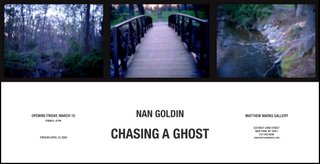
Gallery Show: Nan Goldin

A few weeks ago, in the midst of everything else, I received the following invite from French writer Ariel Kenig. Since I was in Chicago I wasn't able to attend the opening, but the show continues until April 22:

Goldin Invitation

From Matthew Marks' Gallery's website:
Matthew Marks is pleased to announce Nan Goldin: Chasing a Ghost, the next exhibition at his gallery at 522 West 22nd Street. This will be the artist’s first show in New York in three years.

The central work in the exhibition will be Sisters, Saints, & Sibyls, a landmark new multimedia installation that focuses on the experience of “women who are trapped, literally and figuratively, in both psychological and mythical contexts.” This three-screen projection was commissioned by the Festival d’Automne in Paris, where it was presented in October of 2004, and it is now being exhibited in the United States for the first time. Thematically, the installation explores Goldin’s personal narrative of her sister Barbara’s institutionalization and suicide at an early age, presented alongside tracings of both the mythological history of Saint Barbara and the artist’s own contemporary history of hospitalization. She writes, “I intend to explore the relationship between the story of my sister, myself, and Saint Barbara, and, more generally, the parallel between saints and modern rebellious women.” Technically, Sisters, Saints, & Sibyls is the first installation by the artist to include moving pictures and a fully narrative score and voiceover; it is thus the first significant foray into cinema that the artist has made in her career. This new form is a natural development of her slideshow presentations, like The Ballad of Sexual Dependency, for which she first became well-known.

Goldin will also be exhibiting over three dozen new color photographs made during the past three years, including a number of new landscapes and a group of pictures that continue to explore the life of the artist’s nephew, Simon. Five large-scale triptychs stemming from Sisters, Saints, & Sibyls will be included as well.

This is the artist’s sixth exhibition at Matthew Marks Gallery since 1992. Goldin’s work was the subject of a major touring retrospective exhibition organized by the Whitechapel Art Gallery in London and the Centre Georges Pompidou in Paris; the exhibition traveled to the Reina Sofía, Madrid; Fundação de Serralves, Porto; Castello di Rivoli, Turin; and Ujazdowski Castle, Warsaw. In addition, Goldin’s work has recently been included in exhibitions at the Musée d’Art Contemporain de Montréal; the Institute of Contemporary Arts, Boston; the Contemporary Arts Museum, Houston; the Art Institute of Chicago; and, here in New York, the New Museum of Contemporary Art, the Whitney Museum of American Art, and the Museum of Modern Art. This year, her work will be on view at the Grey Art Gallery, New York, and the Grimaldi Forum, Monaco.

Nan Goldin: Chasing a Ghost will be on view at the Matthew Marks Gallery located at 522 West 22nd Street (between 10th and 11th Avenues), through April 22, 2006. Hours: Tuesday through Saturday, 11:00 A.M. to 6:00 P.M.

Sunday, March 26, 2006

Event: Hip Hop Retrospectives @ NYU

Zulu NationFrom Jason King, via Jennifer Brody, a conference for Hiphop heads:

NYU Skirball Center presents


HIP HOP RETROSPECTIVES
A three-part discussion series that takes a look back at the road paved by pioneers and a look forward at a culture that some feel has yet to realize its greatest potential.
Produced by JASON KING
Co-sponsored by the Tisch School of the Arts


MONDAY APRIL 3 @ 7 PM
THE MAKING OF AFRIKA BAMBAATAA AND THE SOUL SONIC FORCE'S 'PLANET ROCK'
A discussion of the making of the most famous recording in hip hop history, bringing together the original creators more than 20 years after its release
Speakers:
ARTHUR BAKER, Producer, “Planet Rock”
FAB 5 FREDDY, Hip-Hop Pioneer, Author, Filmmaker
MONICA LYNCH, Former President, Tommy Boy Records
JOHN ROBIE, Keyboardist, Programmmer and Writer on "Planet Rock"
TOM SILVERMAN, Chairman, Founder and CEO, Tommy Boy Music and Special Guests

Moderator: DAVID TOOP, Author, The Rap Attack series, Musician

SATURDAY APRIL 8 @ 7 PM
THE FUTURE OF HIP HOP
Music's sharpest minds get five minutes each to offer three wishes for the future of hip hop


Speakers:
TA-NEHISI COATES (Village Voice, Time)
JALYLAH BURRELL (Pop Matters, Prefix)
RICHARD GOLDSTEIN (Former Editor, Village Voice)
MARGO JEFFERSON (New York Times)
SACHA JENKINS (Ego Trip)
BAKARI KITWANA (Why White Kids Love Hip Hop)
CRISTINA VERAN (Voice, One World)


MONDAY APRIL 10TH @ 7 PM
EXECUTIVE DECISIONS: 30 YEARS OF POWERFUL WOMEN IN HIP-HOP
Pioneering women in hip-hop who have worked as record label CEOs, presidents and senior execs reflect on the challenges they faced climbing to the top of a male dominated industry

Speakers:
CARMEN ASHHURST, Former President, Def Jam Recordings and Rush Communications
DENISE BROWN, Attorney, Former Head, Black Music Division for Warner Bros. Records
ANN CARLI, Film Producer, Former Senior Vice President, Jive Records
LISA CORTES, Film Producer, Former President, Loose Cannon Records
MONICA LYNCH, Former President, Tommy Boy Records
Special Tribute to SYLVIA ROBINSON, Founder of Sugar Hill Records

Moderator: DANYEL SMITH, Author, Former Editor, Vibe


WHERE
All events are held at
THE SKIRBALL CENTER FOR THE PERFORMING ARTS
566 LaGUARDIA PLACE (south side of Washington Square Park) between Washington Square South (4th Street) and 3rd street
A,B,C,D,E,F,V to West 4th Street


TICKETS (PER RETROSPECTIVE EVENT)
$15 general public, $10 nyu faculty and staff, $7 nyu students or buy a full festival pass
Tickets: www.skirballcenter.nyu.edu
Box Office: 566 LaGuardia Place
Ticket Central, 416 West 42nd Street, 212 279 4200

These Retrospective events are part of FEST FORWARD: HIP-HOP UNBOUND a two-week hip-hop festival at NYU, April 3-15 featuring performances by and events with THE COUP, ROB SWIFT, UNIVERSES, DECADACE THEATER + FULL CIRCLE PRODUCTIONS, DUJEOUS, MC AKIM FUNK BUDDHA, BI-TRIP, POP MASTER FABEL and many more!

GET YOUR TICKETS NOW! Festival passes are available.

Festival curated and produced by Rika Iino, Jason King and Wiley Hausam
Media Partner: The Village Voice??
This event is made possible with public funds from the New York State Council on the Arts (NYSCA), a State Agency

Please see WWW.SKIRBALLCENTER.NYU.EDU for more information

Saturday, March 25, 2006

Animated Gif: Summit 2002

This is one of those animated gifs I created back in 2002. I am trying to recall exactly what summit or nadir provoked it, though I think the buildup to the War in Iraq amidst so many other social and political problems at that point was central to what I was trying to get across.

Friday, March 24, 2006

Drawing: Man Sleeping

Another from the archives:


"Young man sleeping, Rotch Library, MIT"
© John Keene

Thursday, March 23, 2006

Drawing: Overhead

From the archives, an overhead drawing:

"Overhead sketch, Rotch Library, MIT"
© John Keene

Tuesday, March 21, 2006

Drawing: Student Studies

From the archives, several studies on the same page (the heading has the same title as one of my favorite Cecil Taylor pieces):

"Student studies"
© John Keene

Monday, March 20, 2006

Drawing: Darcy Prather

It's spring break week and I've just come off an industrial-strength quarter, so I'm reaching into my old Website archives for stuff to post these days.

This is a drawing of Darcy Prather, whom I didn't know, though his brother Dax and I are the same age and graduated from different, rival high schools in St. Louis. Darcy was an undergraduate at MIT when I drew this, and I sketched him at a public event there. I later realized that he was Dax's younger brother, and at some point after this drawing, he went on to become a Rhodes Scholar.

"Darcy Prather"
© John Keene

Thursday, March 16, 2006

Roberts-White Anthology Now Out + NBCC Award Winners

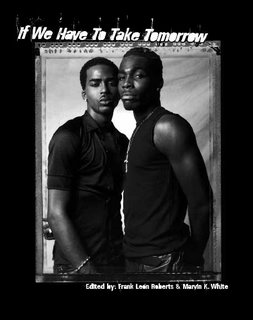
TomorrowFrank Léon Roberts sent me the following email today about the wonderful new anthology that he's edited with award-winning poet Marvin K. White:

Friends:

I just wanted to give you a quick heads-up on the release of my co-edited book with Lambda Literary Award-winning poet Marvin K. White, If We Have To Take Tomorrow: HIV, Black Men & Same Sex Desire. The book has just been published through an important collaboration between the Institute for Gay Men's Health Crisis, AIDS Project Los Angeles, the Black AIDS Institute, Gay Men's Health Crisis, New York State Black Gay Network and the National Black Justice Coalition. A full copy of the book in the pdf format is available at http://www.blackaids.org/.

The book is a collection of essays by some of the brightest new voices in black gay America on the politics of masculinity, sexuality, and black gay identity in the age of HIV/AIDS. It features beautiful essays by Dr. David Malebranche, Thomas Glave, Tim'm T. West, Kenyon Farrow, Rev. Osagyefo Sekou, E. Patrick Johnson, Jason King, Reginald Harris and Charles Stephens, among many others. The photography of Luna Luis Ortiz and Gerald Gaskin is also featured throughout the text. It's a tiny little book with a big heart.

There are several ways for you to order free hardcopies of Tomorrow. First, you can contact Regina Kines at the Black AIDS Institute. You can also contact Patrick "Pato" Herbert at the AIDS Project Los Angeles. In the upcoming weeks, the publication should be available on Amazon.com and at select bookstores in New York City, Los Angeles and throughout the country.

Please take a moment to help "promote" the book by posting information on blogs, websites, and email list-serves. Community based, political publications such as Tomorrow go a long way with the support of people such as you. You can find a write up about the book on my personal weblog here.

Some others links about Tomorrow:

Keith Boykin's comments
The Black AIDS Institute
AIDS Project Los Angeles

Much love,
Frank


I know many of the writers in this collection very well, and am really looking forward to their pieces. I also recommend the 2003 anthology that this serves as a follow-up to, Think Again, which was edited by Colin Robinson and Steven G. Fullwood.

‡‡‡

DoctorowI've been meaning to post a note about this year's National Book Critics' Circle Awards, which were announced two weeks ago. The NBCCs general stand as the third in a trio of the most prestigious annual US national literary awards given for a particular work (the other two being the Pulitzer Prizes, which also include awards for journalism and are announced in the late spring, and the National Book Awards, which are announced in the fall). Unlike the other two major prizes, they come with no cash awards, their currency being the prestige and honor of receiving the award.

This year's winner of the National Book Critics Circle Award for Fiction is E. L. Doctorow (photo above, from The Villager), one of the writers I most admire, for his Civil War novel The March. I think this book is one of his best works in years (and among his best ever); he'd previously received the very first NBCC award for fiction, in 1976, for his landmark novel Ragtime, and again in 1989 for Billy Bathgate (another very good novel). He is one of the most acclaimed American fiction writers never to have received a Pulitzer Prize, so perhaps that organization's fiction committee will do the right thing and give him the prize for The March, which unlike some past make-up Pulitzers, definitely deserves it. According to Hillel Italie's article in the Washington Post, Doctorow said

"I've wondered for many years if awards are good for literature....But I find when I'm offered an award I tend to accept it."

The article continued:

"The independent witness of book writers I think provides the deepest and profoundest ... form of communication in our society," said Doctorow, 75, who observed that books are written in silence and read in silence, a "soul to soul" bond unique in the modern world.

The NBCC Poetry award went to Jack Gilbert, a senior poet who received the 1962 Yale Younger Poets Prize and has received numerous other poetic honors over the years. I haven't read his book of poems, but I did read a number of really great books of poetry, by younger poets such as Tyehimba Jess, A. Van Jordan, Richard Siken, and others, that could easily and should have won. (No writer of color has ever received the poetry award, I think.) In the General Nonfiction category, Svetlana Alexievich was lauded for her oral history, Voices from Chernobyl: The Oral History of a Disaster, which was published by a small but very distinguished press, Dalkey Archive, in Normal, Illinois. I'm very excited by this award and hope that it means increased sales and recognition for Dalkey, which continues to be one of the main publishers of formally experimental prose from across the world.

The other winners (none of which I've had a chance to read yet) were:
(Autobiography) Francine DuPlessix Gray, Them: A Memoir of My Parents
(Biography) Kai Bird and Martin J. Sherwin, American Prometheus: The Triumph and Tragedy of J. Robert Oppenheimer
(Criticism) William Logan, The Undiscovered Country: Poetry in the Age of Tin
(Ivan Sandrof Lifetime Achievement Award) Bill Henderson, founder of the Pushcart Press
(Nona Balakian Citation for Excellence in Reviewing) Wyatt Mason

One other comment stuck out in the Washington Post article, concerning the notoriously finical critic Logan:

Logan, an NBCC criticism finalist in 1999, acknowledged Friday that his demanding assessments have caused hard feelings, saying that one poet threatened to run him over and another poet to threaten assault by hand.

Now that's what I call provoking a reaction! Who said poetry's stakes were low?

He then joked that his wife, herself a poet, was relieved to be married to him because "I could not review her."


Thank the gods for small favors!