Monday, February 05, 2007

Colts Victors (+ Prince + Mars Controversy, etc.)

I woke up this morning to the radio announcer saying it was -5 F this morning without the wind chill, but the icy climate here in Chicago may also be the result of the Chicago Bears' loss in yesterday's Super Bowl to the Indianapolis Colts. It was an auspicious game, marking simultaneously the first time an African-American head coach had made it this far and the first time two--Lovie Smith for the Bears and Tony Dungy for the Colts--would be facing each other. The Bears had dominated the National Football Conference, primarily because of their defensive prowess; their main weak point remains their less-than-top tier starting quarterback, Rex Grossman. In contrast, the Colts, one of the top American Football Conference teams, have one of the league's best quarterbacks, Peyton Manning, and best receivers, Marvin Harrison, but their defense for much of the season was horrendous. If the Bears' defense could keep the scoring low and if Grossman and running back Thomas Jones could put some points on the board, the Bears would have the edge; if not, then it was Indianapolis's game to lose. As the contest began, both teams would have to deal with Miami's relentless downpour.

As it turned out, after a spectacular opening few minutes, during which the Bears' kick and punt return star Devin Hester set a Super Bowl record for the longest touchdown return (92 yards), and after Grossman threw a touchdown pass to receive Muhsin Muhammad, fortune shifted to the Colts. Manning, Harrison, receiver Reggie Wayne (above right, with tight end Bryan Fletcher), and the two backfielders, Joseph Addai and Dominique Rhodes, repeatedly drove their team down the field, and while they could not get touchdowns every time, they were able to pass Chicago by the midpoint of the game 16-14, and pull ahead 22-14 after the half-time break. For much of the second quarter and second half, Chicago's Grossman could not get a handle on the ball, could not convert third-down possibilities, and simply looked off kilter. He slipped on the wet field at one point, and threw several interceptions, including one in the fourth quarter to backup defender Kelvin Hayden, that effectively sealed Chicago's defeat. After the getting the ball back, he threw another interception, and the Vince Lombardi Trophy went to Dungy (who unfortunately has cast his lot with the horrible homophobes of the American Family Association) and the Colts.

I turned off the sloppy broadcast, which for much for the evening featured water-fogged shots, after the fifth or six incoherent invocation of "God" by the owner, Jim Irsay (whose father infamously moved the team in the middle of the night from Baltimore), and Dungy--did they think they'd dropped down at a revival meeting? Was God not on Chicago's side as well?--but I do congratulate the coach on making history and finally vindicating his talent and skills, which had been called into question by critics and his prior employers in Tampa Bay. As I noted to sports-loving friends, perhaps this victory will also mean that football fans no longer have to hear the sportswriters and commentators harping on the fact that Peyton Manning, considered by many of them to be a deity alongside the Patriot's Tom Brady, had not won the Super Bowl. I would like to see Lovie Smith lead the Bears back next year, though he'll still have the problem of his inconsistent quarterback, and a much tougher schedule to negotiate. That is, if the Bears re-sign him (and they should do so as soon as possible), and if he doesn't return, that spells an opening for the Saint Louis Rams....

Added note: Commenter Eileen rightly mentions the halftime entertainer, Mr. Prince Nelson Rogers, and I must admit that I tuned out when he came on. I was a major fan of Prince's in my youth, had a crush on him, wanted to live in that paisley-park of a world that his music conjured up...but I haven't been too Princified in recent years, and I wondered, why weren't some new musicians, from the current generation of musical artists, out there? Prince did manage to add his take on instrument malfunction, though I've heard no outcry about it (the phallic usually seems to occasion less outrage than the mammary/vaginal), but in general, for me he quickly disappeared into the surroundings. (And he certainly wasn't going to be singing any of my favorites among his songs, like "Lady Cab Driver," "Controversy," etc.)

Also, I paid very little attention the ads. Often I muted them, so I missed the homophobic one from Mars, makers of Snickers and M&Ms, that's being harshly criticized on AmericaBlog. Did anyone else catch this one? I did notice several violent ads, including one warning about heart disease that was brutal enough to induce a cardiac arrest. I also found Coca Cola's attempts to commodify Black history disgusting and offensive; and given that the last thing that many African Americans--or anyone else, for that matter--need to be drinking is corn syrup and additive laden sodas like Coca Cola, whose production takes a tremendous toll on the environment, Coca Cola's ads were especially ironic. But it's not me they're thinking about; it's the millions of children, in particular, that they want to hook on their potentially teeth-rotting fizzy juice, whose consciousnesses they want to industrialize. Somehow, I doubt the American College of Dentistry or the American Diabetes Association would be happy without their assistance.

Update: Courtesy of Audiologo (thanks so much!), here is the link, from This Modern World, to Mars's offensive Snickers commercial.

Thursday, February 01, 2007

Chilly Chi + Turn Signals Please + Black History Month

Well, I've learned my lesson. I won't be commenting again on this blog about how unseasonably warm it is in Chicago, knowing full well my propensity for talking things up (as C will attest) and what this city and region, despite global warming, still have in store. Tonight It's 12F, without the wind chill factor, though I ventured out to a reading (which I'll blog about I hope tomorrow), I tried to spend as little time as I possibly could outdoors. This afternoon, between my morning and afternoon workshops, I decided (foolishly) to walk to the post office to mail some bills, and although I have never and will never have my face in a threshing machine, I was able to imagine the feeling just walking into the eastward wind. In addition, every morning, the sidewalks and my car have borne a light coat of snow and ice. It might not have been a White Christmas, but it's been a very White January.

Wherever in the vast plains those arctic winds are coming from, I wish they could go back. It is days and evenings like this that give me endless appreciation for whomever invented the radiator and thought of 7+ foot thick brick and concrete walls for houses and apartment buildings, and double-paned windows....

***

Another note about Chicago. Every day that I drive to and from Evanston, I say that I'm going to write about Chicago driving, even though I know full well from the statcounter associated with this blog that very few of my readers come from the Arctic City. But nevertheless, on the off chance that I have some Chicago readers other than my wonderful former students and a few colleagues, I am going to recommend one thing that even the worst drivers I have encountered driving in Boston (where, as I once told Reggie H. people were liable to drive backwards at upwards of 20 miles an hour down the street and then someone proceeded to illustrate my point, right then and there), or New Jersey (where the highways are basically raceways), or New York City (where you play a game sort of like Bumper Cars except that you never actually touch the other car, only at 10x the speeds), or Washington DC (which is a giant driving maze without walls), or anywhere else but Chicago appear to have learned during their period of learning how to handle an automobile. There is a lever which connects to a mechanism that creates a blinking light on either side of your car's front and rear lights. This mechanism is generally known as a turn signal or blinker. (I have no clue what the correct term is in Spanish, though I would guess it's something like señal de vuelta, maybe, maybe not.) At any rate, these lights are very useful. They indicate when you plan to make a turn left or right, be it onto a street or into an alleyway or parking lot, or if you plan to change lanes, or if you aim to pull into a spot to park. In every other place that I've lived, most of the drivers realize that the turn signal/blinkers are for these multiple purposes. But not, it seems, in Chicago. Change lanes, often no signal. You signal you're going to park, and someone pulls right up behind you so you can barely back up; or they stop in the middle of the city's narrow residential streets, as if waiting to pick up someone, and lo, here they come backing up, into what could be one or two different parking spaces--but without a turn signal. And the person in front of you slows down to a crawl, with their break lights on? Are they going to stop for some reason? No, they're making a turn! I'm not sure why this basic aspect of driving is so hard for some of the good people out here to grasp, but I'm appealing to them: please learn to use your turn signal/blinkers. Please. You're not only doing yourself a huge favor, but everyone else as well. Please!

***

Today is the first day of Black History Month, which I was fortunate to have been introduced to formally as a grade schooler, during those heady days in the early and mid-1970s when cultural affirmation was beginning to take root in many parts of the country. This was also not too long after the heyday of the Black Arts and Black Power movements, and so in addition to my introduction to Black history in school--in a Roman Catholic school, mind you, that went on to rename itself after the nation's first Black* Catholic bishop--I also took "African" dancing lessons and Black drawing classes and the like. It was not only edifying, but incredibly fun. (Especially those dances.) As I was in a predominantly Black environment at the time (though I'd gone to a multracial, multiethnic Montessori school for preschool), celebrating Black history seemed natural; nearly all the teachers and the students were Black, and the few White nuns and Fr. Ed appeared to go along with it (again, this was a very different period from today). Lining the hallways were the posters about famous Black people (from Harriet Tubman and Frederick Douglass to Mary McLeod Bethune and Ralph Bunche), and we learned a bit about famous Black people from Missouri, like our then-Congressman, Bill Clay, and Madame C.J. Walker, who'd lived in St. Louis, and George Washington Carver, as well as famous Black public figures, like the late Martin Luther King Jr. and Shirley Chisholm. (We didn't hear too much about famous Black entertainment figures from the state and city, like Chuck Berry, Redd Foxx, Dick Gregory, or Tina Turner, but then the emphasis was on certain types of role models, i.e., world leaders, scientists, and so forth, and not others, i.e., people in entertainment; Scott Joplin and Bobbie McFerrin Sr. were a few of the musicians whose work I remember hearing discussed, but I had to hear about the other famous St. Louis and St. Louis-area musicians, like Miles Davis, Clark Terry and Joe Bowie (of Art Ensemble of Chicago fame), and so on, at home.) I cannot recall if Anheuser-Busch had begun releasing its great Kings and Queens of Africa calendars and posters back then--I want to say they did, but I might be conflating memories--but I do know that non-American famous Black people, like Haile Selassie and Anwar al-Sadat were mentioned approvingly.

Then we moved to the suburbs, and I was no longer at a predominantly Black school, and wasn't getting any sort of exposure to Black history or culture outside my home or family or immediate neighborhood. I was in fact the only Black person in my class, and only one of three Black children in the entire larger new school I attended. (My new neighbors up the street had already all graduated from the elementary school and were away in high school, while the other neighborhood kids went to a different school named, appropriately enough, after Frederick Douglass.) If any discussion of Black anything came up in any of my classes for those first two years, I don't remember it at all. At the next school I attended for junior high, I was one of two Black students in my class, and one of a little over a dozen in all 7-12th grade classes combined. In English we studied grammar and read poetry and fiction, none of it by anyone Black. In history, we learned about the Greeks and Romans and British (though none of the Black denizens of any of those cultures). In Latin and French and Musical Education--well, no Black people turned up at all. Religion, same thing. (The North African St. Augustine was a year away.) Around this time my parents joined one of those organizations (not Jacks & Jills) which believed in bringing Black children, especially ones scattered about the suburbs, together to socialize. The organization or members hosted various events, and it was at one of the older kid's parties a few years later that I first heard "Rappers Delight." They also had a public recital, and though I was painfully shy, I did agree to participate in one of them. Around this time, I was becoming fascinated by Langston Hughes, whose work I knew about from early childhood on, though I didn't learn he was a native Missourian until reading one of those Black history posters. To me he was the most famous Black American poet (then and now), and though Nikki Giovanni was my favorite at the time, I considered Hughes to be the poet whose work I should try to publicly recite. (I also thought of Paul Lawrence Dunbar, but Hughes was more contemporary.)

So for the recital, I decided that I would memorize one of his poems, and I picked one of the most obvious, which I'd been familiar with from my prior Black history classes and books at home and at my godparents' homes: "Dream Deferred." To me, it is one of the central poems of the Black American experience, and though I was terrified to death by the prospect of reciting this short poem aloud, when the time came, I got up and delivered it, I think without faltering. The one comment I remember after that experience was that a woman complimented me on the performance and on wearing my afro combed back "like Frederick Douglass." I don't remember "Dream Deferred" by heart anymore, but one of the pleasures of my class this past fall was that I had the opportunity to read it again with students. Here it that poem, by an artist and figure I adore more and more as I grow older, (James Mercer) Langston Hughes (1902-1967), whose birthday is today:

Dream Deferred

What happens to a dream deferred?
Does it dry up
Like a raisin in the sun?
Or fester like a sore--
And then run?
Does it stink like rotten meat?
Or crust and sugar over--
like a syrupy sweet?
Maybe it just sags
like a heavy load.
Or does it explode?

And here is another poem by him, that captures in all its simplicity the spirit of Carter G. Woodson's original "Black History Week" and now, of Black History Month, "My People":

My People

The night is beautiful,
So the faces of my people.

The stars are beautiful,
So the eyes of my people.

Beautiful, also, is the sun.
Beautiful, also, are the souls of my people.

Both poems © Estate of Langston Hughes, 2007.

Friday, January 26, 2007

Serena! + Lighter Richer, Darker Poorer + Spinning Into Butter?

I never tire of watching Serena Williams play; in addition to her heartstopping talent, singular fashion sense, and on-court expressivity, she always carries about her person and career the requisite amount of drama, and her performance at this year's Australian Open did not disappoint. After missing nearly all of 2006 with one of the many injuries that have increasingly plagued her in recent years (and also provided her with time to begin her acting career and hit the town with the likes of Rick Fox), and with many of the tennis world's pundits decrying her lack of fitness and declining abilities, the 25- year-old star and two-time champ returned to Melbourne unseeded, and proceeded to plow through the field of ranked women, becoming only the second unseeded woman in the history of the Australian Open to do so. In the final, against the new international darling, Maria Sharapova, Serena put on a demonstration clinic, serving and acing her opponent 6-1, 6-2, which brought her a 3rd Australian Open title, and her 8th Grand Slam victory. During the trophy presentation (pictured above, AP Photo/Rick Stevens), she was as charming and gracious as possible, and dedicated the win to her slain older sister Yetunde Price ("I love her very much" was Serena's moving tribute). Serena's elder, diffident, cygnine sister Venus, the pioneer of the sisters' winning ways, with back to back Wimbledon and US Open wins half a decade ago, was absent as well, suffering through her own spate of injuries and thus unable to participate , though anyone who's followed these two for more than a hot minute could easily imagine they'd probably decided that this major tournament was Serena's to walk away with. And, being the embodiment of fierceness, she did.

+++

A study by Joni Hersch, a law and economics professor at Vanderbilt University, confirms something that I've always figured, and which makes perfect sense given the history and ongoing problems of our society: the lighter-skinned (and taller) an immigrant, the more she or he will make. As Travis Loller reports in his article, "Study Says Skin Tone Affects Earnings," in today's Washington Post, Hersch controlled for other factors and found that skin-tone still appeared to be the key in earnings differences. Yet despite the fact that many cultures have a bias towards lighter skin tones and hues, the key factor according to the study was a US preference, above and beyond that of the immigrant's original culture or society. Quoting the article:

"On average, being one shade lighter has about the same effect as having an additional year of education," Hersch said.

The study also found that taller immigrants earn more than shorter ones, with an extra inch of height associated with a 1 percent increase in income.

Other researchers said the findings are consistent with other studies on color and point to a skin-tone prejudice that goes beyond race.

Hersch took into consideration other factors that could affect wages, such as English-language proficiency, education, occupation, race or country of origin, and found that skin tone still seemed to make a difference in earnings.

That means that if two similar immigrants from Bangladesh, for example, came to the United States at the same time, with the same occupation and ability to speak English, the lighter-skinned immigrant would make more money on average.

"I thought that once we controlled for race and nationality, I expected the difference to go away, but even with people from the same country, the same race _ skin color really matters," she said, "and height."

Although many cultures show a bias toward lighter skin, Hersch said her analysis shows that the skin-color advantage was not due to preferential treatment for light-skinned people in their country of origin. The bias, she said, occurs in the U.S.

Economics professor Shelley White-Means of the University of Tennessee at Memphis said the study adds to the growing body of evidence that there is a "preference for whiteness" in America that goes beyond race.


The Post article contains more specifics about Hersch's methodology and sample size, and notes that it correlates with a study that William Darity Jr., an economic professor at the University of North Carolina, conducted on skin tone and wages among Black people. (I would even go so far as to venture that were similar studies conducted in every nation in the Americas, the results would be similar.) Hersch will be presenting her findings at the American Association for the Advancement of Science in San Francisco next month, and suggested that this might be another route for legal redress (though I do believe there have been some skin-color suits in the past). Finishing this article, I thought again of discussions, with friends and acquaintances, as well as pieces I've come across online and elsewhere, on the persistence of skin-color discrimination, both within specific groups (African Americans, Latinos, etc.) and of course in the broader society, pointing to an enduring racist and supremacist social logic that all the expressions and performances of Black Is Beautiful or overt and covert acts of resistance, assertion and counterargumentation won't dispel, at least not any time soon.

+++

Last quarter, the university's Center for Writing Arts brought playwright Rebecca Gilman to campus to speak about her work. I ended up only catching a small part of the talk because of a prior engagement, but I did purchase one of her plays, the highly praised Spinning into Butter, which explores the crisis that ensues at small Vermont college when someone starts posting anonymous, racist letters on the door of one of the college's few African American students. The situation is not, however, as it initially seems, as the college's administrators soon eventually discover. I haven't finished the play, but I was curious to find out if any Jstheater readers had seen the play staged and what your impressions were. I also saw on imdb.com that Mark Brokaw's film version of the story, starring Sarah Jessica Parker, Miranda Richardson, Beau Bridges, Mikelti Williamson, and Victor Rasuk, has completed filming and may hit screens later this year. That's another incentive to finish the play....

Wednesday, January 24, 2007

70000 Visitors + Audiologo Event + The Oscars + Whose SOTU?

I usually don't check the stat counter at the bottom of the Jstheater page, but the blog has now had 70,000 visitors, and so far this month, there have been nearly 3,000 page loads, comprising 2,244 unique visitors, 1,799 first-time visitors, and 445 returning visitors, a small number, but exciting nevertheless.

In addition to the current daily pages, in the past most of the first timers have pulled up a page from 2005 or so featuring a photo of Destiny's Child (Beyoncémania is far from dead, I realize), but in recent months the main draws have been the January 2006 archives, the November 2005 archives, the Alice Coltrane mini-tribute, the link to excerpt from the Idris Elba interview, my commentary on MTV's True Life: I'm Dead Broke, and the short Autumn in January-Charles Rangel post from a few weeks ago. An eclectic list, to say the least.

Jstheater visitors are primarily accessing the site from the US, but there have first-time views and returning visitors from all over the globe. Just today, as of 3 pm, people (or autobots?) from, in descending order, the US, Bahamas, the Netherlands, Germany, Mexico, France, Portugal, UK, Poland, Italy, India, Dominican Republic, Slovakia (Hi Francisco!), and Spain have popped by--to an old post so far. I wish I could keep up the daily posting schedule I achieved two years ago, but with my current workload, it's just not possible. I am trying to maintain a semi-regular stream even of tiny posts, including quotations, photos, drawings, and the like, though, so we'll see how it goes. I also am trying to cut down on all the errors, but I'll willingly admit that these days, it's a miracle if I can look at a computer screen, let alone a book, for longer than 10 minutes without my eyes tiring (and yet the stack of required reading material steadily grows).

To all the Jstheater readers out there, I offer a deep thanks!

∆∆∆

For those in and near Princeton, Audiologo will be screening one of her works tomorrow night. She writes:

The re-screening of my sound/video work "Tarry On/Because I Must" is set for the following time
and location:

Thursday, January 25th, 7pm - 8pm
Woolworth Center (Music Building),
Room 106 (first floor).

There will be light refreshments.

I wouldn't miss it if I were nearby.

∆∆∆

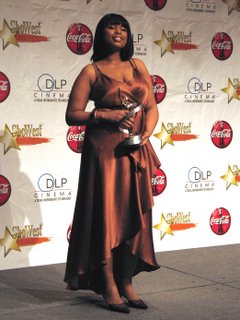
Jennifer Hudson I was happy to see that President Al Gore's An Inconvenient Truth had been nominated for two Academy Awards, one for Best Documentary, and one for Best Song, "I Need to Wake Up," sung by Melissa Etheridge. I still haven't seen the film, but it's next in my Netflix queue, so I think I'll be able to catch it before the awards presentation show.

As has been the case for the last decade or so, I haven't seen most of the contenders for the top prizes. Once upon a time I tried to see every one of the major award contenders despite having not a dime to my name, but then life impinged, and now I'm lucky if I catch even a handful. (I did see the best nominated film last year, Brokeback Mountain, which didn't win.) I did see Dreamgirls, and while I enjoyed it (and reviewed it here), I didn't think it was as great as many critics I've read. Nevertheless I'm glad that it did receive a number of nominations, particularly for its music, art direction, costumes, and for its chanteuse extraordinaire, Jennifer Hudson (at left, with her Golden Globe Award), I have a feeling that she'll win the Best Supporting Actress award, and Beyoncé Knowles will win Best Song, for the beautifully sung but not so great "Listen," and the Motion Picture Academy will pat itself on the back for not fostering the very discord the film portrayed.

I also saw Volver, which I hope to review eventually, but Penélope Cruz sizzled in her Anna Magnani-esque star turn. The film itself was a mess in terms of plot and characterization, with enough melodrama for a dozen telenovelas, but Cruz blazed through the folderol, and made it clear to me that with the right script, she has real acting talent. She's up against Meryl Streep (who's won it several times already), Helen Mirren yet again channeling a Queen Elizabeth (and the Motion Picture Academy loves things British and royal, and Mirren's a great actress anyways), the always outstanding Judi Dench (who may cancel Mirren out), and Kate Winslet, who's blond, talented and foreign (canceling out both Dench and Mirren), so perhaps Cruz has a chance, though I doubt it.

Among the Best Actor nominees, I am torn between the award going to two performances I haven't seen; I almost would like to see Peter O'Toole win because he's been nominated so many times and is still around, but then everyone says that Forrest Whitaker terrifyingly inhabits his Idi Amin role in The Last King of Scotland, so perhaps he should win. I want to catch Whitaker's performance, though, before Oscar night. As for the other actors, I'm delighted that Will Smith was nominated, but was his performance that great? Everything about The Pursuit of Happyness reeks of Hollywood, which is one reason I haven't gone near it yet, though I usually will watch anything that Smith is in. Also, can we have a yearlong moratorium on nominations going to people impersonating or engaging in mimicry of other real people, living or dead, for a change? Do Hollywood screenwriters even remember how to write excellent non-biopic roles any more? (Yes, yes, I know, cf. Winslet, Wahlberg, etc.)

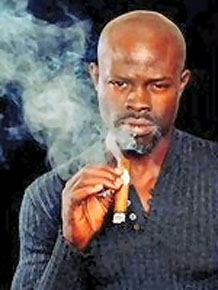
Djimon HounsouAmong the Best Foreign films, I did see Guillermo del Toro's Pan's Labyrinth, and thought it one of the best movies I've seen in the last year. I hope to review it soon, so I'll only say that it was so imaginative, well acted, superbly structured, and thematically grounded that it had me thinking about the possibilities of cinema (and literature, for that matter) as an art and as a means for addressing history and politics for several days after I'd watched it.

With the other awards, I have to say I really don't care, though I think that Eddie Murphy is probably going to get the Best Supporting Actor award, but Djimon Hounsou (at right) should win on general principle, or if the voters see them as canceling each other out, it'll go to Mark Wahlberg in the Martin Scorsese vehicle, The Departed, another film I haven't seen, though I used to be a Scorsese enthusiast. His last few movies have broken me of that, though. I imagine he'll receive the Best Director award for his body of work. And I hope Gore wins for his documentary, just on general principle; maybe it'll be the catalyst for his entering the race and winning the office that was stolen from him 7 years ago, saddling us with the mad bull who, horrible to say, still has nearly two years left to smash up everything in sight, which is to say, to continue to completely misgovern.

∆∆∆

I missed the emperor decider's speech last night, as I was in class until 9:30 pm Chicago time, but today I got C's appraisal and read a little about it online. I had to conclude that as I already knew, I hadn't missed a thing. In addition the usual vomitus of mendaciousness about the Iraqmire and the GWOT™ (which I think was renamed), there was the horrendous proposal to further screw up the health care system by further subjecting it to bad conservative/neoliberal ideological tinkering, as a way of providing more money and power to the insurance industry and yet another tax break to rich people, and there was the national ID system to increase the tracking of citizens and facilitate immigrant slave force. (Ahem--why won't the mainstream media discuss the fate of those immigrants arrested in the Swift Co. raids, or where they're being housed? Does anyone know where the "detention facilities" that Halliburton received the contracts for were built?) Given the sheer awfulness of these ideas, along with the rest of the exceedingly banausic tripe issuing from the ed's tongue-poked lips, I had to wonder why the networks even kept the cameras on, though I realized after reading about Dana Milbank's and others' most recent rounds of silliness today that it was to catch Hillary Clinton "daydreaming," Barack Obama "barely lifted his head" from his copy of the remarks, and Mrs. Speaker Nancy Pelosi blinking furiously. Saint John "Surge" McCain slumbering at his dear decider-pal's twaddle, however, was not worthy of the MSM's concern.

I did, however, catch James Adomian's hilarious version of the speech ("I believe this nation continues to be strong in its own steadfast"), which includes a very brief Democratic response, culminating in slapstick, by an actor who has Obama's voice down, going up against a pseudo-Clinton.


Then I both watched and read Virginia's junior, Democratic Senator James Webb's excellent response. Perhaps the networks should have just gone with Webb and done the country and the world a huge favor.

Sunday, January 21, 2007

More Democratic Candidates

Hillary Rodham ClintonThe Democratic field grows larger by the day. As has been widely predicted for several years, New York's junior Senator and the first First lady ever to serve in Congress, Hillary Rodham Clinton, has launched an exploratory committee to run for the presidency. As she states it, she "in it to win it," but then anything less would be out of character. Democratic hack Terry McAuliffe--who as head of the DNC presided over years of electoral losses before ceding the post to Howard Dean, who helped to engineer this past fall's electoral comeback--has already begun suggesting that her campaign will be Thatcherian in nature--Lord help us! Nevertheless, I'm excited by the possibility of her history-making run and possible win, because by every conceivable measure Hillary Clinton and the constellation of politicians, policy makers and administrators around her would leave a positive legacy, even with the (remnants?) of the Iraq War overshadowing at least her first few years. Yet I'm also concerned that were she to win, we'd experience a return domestically of the previous Clinton administration's DLC-tinged rhetoric, small-bore policies and triage politics that effectively constituted one of the more successful moderate conservative administrations in the last 50 years. After 8 years of Bushism, a more radical course of action is necessary. Overall, I find the prospect of a forthcoming Clinton campaign very exciting, and am eager to hear her goals for getting out of Iraq and for her governance, and witness how she deals with the expected attacks and outrageousness coming from the media, the right, and even some in her party. Whitewater, for which she and her husband were fully exonerated was, I'll never forget, a creature nurtured and propelled primarily--at least in its early stages--by the "mainstream media."

Bill RicharsonIn addition, today New Mexico's governor and former Congressperson, Clinton administration Energy Secretary and US Ambassador to the UN Bill Richardson announced he'll run for president as well. I view Richardson, who'd become the first Latino president of the US, as one of the less likely primary winners, but given the crowded field and his moderate-to-progressive stances, his victory in the primaries isn't inconceivable. Two landslide gubernatorial wins in 2002 and 2006 point to a strong, effective and popular campaigner, his successful infrastructure initiatives show that he can push through efficacious policies, and his brokering of the cease-fire in Darfur indicate that even as a governor, he not only has an interest in international affairs, but hasn't lost his diplomatic skills. I'm particularly interested to hear his views on how to extricate ourselves from the debacle in Iraq (and the unfolding, preventable one in Afghanistan) and rebuild our ties to allies, as well as improve our international standing, especially in the Muslim world. As with Clinton and Obama, I'm excited that he's in the race, and can't wait to see how it all unfolds over the next two years.

Speaking of Democratic candidates and the expected media attacks (that keep coming), Fox News has launched its own, ignorance-laden smear against Barack Obama. As I said a few posts ago, it'll only get worse.

::::

The other day, Raw Story provided a link to one of the strangest and most disturbing stories in recent memory; yet I could also see this as a Todd Solondz movie. (Just so long as Bruce LaBruce or Gaspar Noe doesn't get ahold of it first.)

On a different continent, extremists in Nigeria, who seem to be endlessly focused on everything but the real problems facing that country, are agitating to ban anything and everything gay....

::::

Two coaches made NFL and US sports history today: Lovie Smith led the Chicago Bears to the NFC Championship over the New Orleans Saints, while Tony Dungy coached the Indianapolis Colts to the AFC Championship over the New England Patriots, thus each becoming the first African-American coaches ever to take teams to the Super Bowl, and just as historically, at the same time!

The Bears defeated the league's Cinderella team on a superb ground game by running back Thomas Jones and their game-transforming defensive unit, to finish 39-14, while the Colts roared back from a 21-6 deficit under the steady arm of star quarterback Peyton Manning, and sent the Patriots packing 38-34.

The wins are a great vindication for both Smith and Dungy; the soft-spoken Smith is the lowest-paid head coach in the NFL and is in the final year of a 4-year contract, while Dungy, who weathered the suicide of his son last year, was fired from the Tampa Bay Buccaneers despite leading them to the conference championship in 1999, and nearly won the conference championship in 2003 with Indianapolis.

Congratulations to both teams, and, pace St. Louis Rams, GO CHICAGO BEARS!

Saturday, January 20, 2007

Short Prose: José Balza

BalzaSome years ago, an acquaintance traveled to Venezuela, and as a gift, he brought back a collection of stories by José Balza (1939-, photo at right, ClubCultura.com), whom he was told was one of the most important literary figures in that country. I hadn't taught myself enough Spanish to read or understand even a paragraph at the time, but was so excited to receive the gift that as soon as I had it, La mujer de espaldas (Monte Avila Editores, 1986) in hand, I set out not only to try to read but translate a few of the stories, in order to see what I could appreciate beyond mere comprehension. Just getting through several of the stories, none of which were very long, taxed all my powers, but in addition to being deeply impressed by Balza's style, I was able to write out several translations that I later showed to a Spanish speaker who felt they passed muster. Nevertheless, I decided to set Balza's book aside until I knew enough Spanish to read it without pausing after every other word, and since that was a benchmark for the then-distant future, it disappeared from my active bookshelf. So I hadn't thought about Balza, who is still writing and publishing, and is a professor at the Universidad Central de Caracas, or the translations until recently, when I was trying to organize my computer files yet again, and came across one of them, "Enlace" ("Link"). In it, Balza directly cites a writer who was his obvious inspiration throughout the story collection, Jorge Luis Borges, and the text is a Borgesian piece, in theme and tone, but condensed in method. In contrast to the moment when I first translated it, the story feels very close to my current personal experience. I am posting it below. (Click here to read an interview with Balza, in Spanish.)

LINK

For Sael Ibánez

In spite of all these years, I still fall prey to that vivid and dense anxiety that arises on contact with my students. I have always conceived of each hour of my classes as a castle of a thousand doors which uniquely permit me, each at the same time, to enter.

Among my students there have tended to predominate the naive, the easy believers, and those incapable of imagination. Sometimes, for certain exams, I recommended various bibliographies (that is to say: different exams, multiple approaches to a theme); and among each group of students (and recommended texts) I slipped, as a tribute to Borges, an imaginary author and a non-existent book.

One day, the least bold of them not only chose precisely this very volume, but even more unreal to me, focused his exam on a synthetic treatment of this book: he centered it on an adaptation of this book, and then, established principles that could only have been extended from this text. Before signing his own name, the student wrote down a textual citation. No one had known about this passage until today. I don’t know if my invention coincided with something real; I did not want to know if the student created a theory and an author so as not to deceive me (himself) or if, astonishingly, he was (is going to be) the mysterious author of this ambiguous bibliography.

Copyright © José Balza, Monte Avila Editores, 1972, 1986, translation by John Keene.

Friday, January 19, 2007

Celebrating Toni & Setondji + Barocas at Powell's North + Other Countries Reading

Here are some photos from two recent Chicago events I attended: the celebration and open mic at Muse Café for Toni Asante Lightfoot and Setondji Gbegan's nuptials, and the Barocas/Palmer/Hanafi reading at Powell's North.
::::
On Monday I dropped by Muse Café to celebrate Toni's and Setondji's wonderful news and hear a host of poets perform and offer tributes. I congratulated Toni and Setondji then, but let me just say congratulations again, and may the radiance of both of your spirits combine and shine forth.

People chilling at Muse Café before the festivities; multivalent artist Michael Warr is sitting at left, and Eliza Abegunde Hamilton is at right.

Another shot of the café, and Toni getting things going at the mic

Folks listening to the reading (Krista Franklin, Eliza, Tracy Hall, and Emily Evans are in front)--Setondji, in back, has on the brown-and-white striped sweater

The beautiful Toni performing--beautifully, of course!

Setondji and Toni, the lovely couple, at the mic

What would a celebration be without dancing?

Or (just after) a kiss?

(I'll post more photos when I can!)

::::

Last night, after a loooooonnnnng day at the university, I drove down to Powell's North to see Zach Barocas and two writers I'd never heard of, Justin Palmer and Amira Hanifi, read their work. I usually stay away from Powell's, not because it's not a great store, but because it has such a dizzying array of titles (I counted at least 16 just last night after a cursory review of a few of the flats and shelves) calling my name that I find it dangerous to go in there. (I've found some fascinating and obscure books in there as well, such as a volume of probate records of African Americans in Boston from the 1700s and early 19th century, to name just one.) It was a great reading, and someone brought delicious cakes, wine, soft drinks (do people even use this term any more), and these lozenge-sized pretzels that were filled with sweet mustardish filling--only in Chicago!

Justin Palmer, the first reader; his long, lyric piece led listeners on a humorous journey.

Amira Hanafi, the second reader, read a long poem, with extensive critical material on environmental degradation, that put me in mind of a humming factory floor.

Zach read from his first collection, Among Other Things: Poems and Proposals, which gathers his characteristically short, almost apothegmatic yet wide-ranging poems and poem-proposals that often serve as, well, quiet proposals about the lyric itself. One of my favorite is "There's Nowhere Left to Go But Home." A few years ago he (co?-)established the Cultural Society, which features a great website and has published a number of broadsides over the years, as well as his book. One of the poets he dedicated a poem to was Peter O'Leary, who's also in Chicago.

One of his best poems was dedicated to his wife, Kimberley, who ran one of my favorite stationery stores in the West Village. She now has a store and company, Letterbox, in Minneapolis.

He's reading one of his proposals: Among Other Things is a poem-proposal definitely worth checking out.

::::

Other Countries IIITomorrow's upcoming event, from lisa moore, the founder and publisher of redbone press, on behalf of Other Countries III: Voices Rising: Celebrating 20 Years of Black Lesbian, Gay and Transgender Writing (G. Winston James and Other Countries, editors):

the men of Other Countries have organized a book
launch in New York City for this Saturday, 7 p.m. at
South Oxford Space, 138 S. Oxford St. in Fort Greene,
Brooklyn. Call 917-364-1491 for more information. I've
attached a pdf with the event information for you to
pass to your friends; also attached is a jpg in case
you'd like to post it to your blog.

your contributors' copies arrive Monday, so i'll be
shipping them to you all next week. i'll include a
letter about upcoming publicity, discounts if you
purchase through RedBone Press, etc.

the books will be available on amazon.com and barnes
and noble.com, and through spdbooks.org (my
distributor).
Alongside the poetry, stories, essays, reflections, recollections, and other pieces by the 60 contributors, one of my early stories, from about exactly 10 years ago, is in the collection.

Thursday, January 18, 2007

Wells on Blackness in Brazil

I caught Zach Barocas's gig at Powell tonight, and I'll post photos from it and from the celebration (with open mic!) for newlyweds Toni Asante Lightfoot and Setondji Arnaud Gbegan tomorrow (I hope).

Tonight I'll post a link to an article on one of my inexhaustible interests, Brazil. More specifically, yesterday's Brazzil.com article, by Mark Wells, is entitled "Blackness's Fear and Stigma Make Brazil a 6% Black Country." As I read the title I recalled the now infamous and possibly apocryphal encounter, early in W's presidency when, during a meetinng with Brazil's then-president, scholar Fernando Henrique Cardoso, he blurted out "Do you have Blacks too?" Supposedly National Security Advisor Condoleezza Rice had to explain to him that Brazil has the largest Black population outside of Africa. But what exactly does that phrase, "the largest Black population," mean in the Brazilian context exactly? Wells interrogates this supposition by asking, as others (such as Eduardo Telles, Livio Sansone, my former colleague Michael Hanchard, and many others before--David Haberly, Anani Dzidzienyo, etc.--have done) whom exactly are people who speak of Brazil's "Black" population referring to and marking by this term? Who's considered Black, who considers herself or himself Black, how is Blackness socially produced, and where do the empirical versus non-empirical (contextually contingent, performative, etc.) boundaries really lie in a country that has lived, for nearly its entire history (including back to the 1500s and "New Lisbon") with its own racial fantasies and assumptions, very few of which have been beneficial to people of phenotypically obvious people of African descent? I also think of the comment by Marcelo Cerqueira, head of the Grupo Gay da Bahia, who noted in my interview with him that the culturally grounded gay pride celebrations in Salvador weren't surprising because Bahians were "all black here," by which I think he meant, the city and state were predominantly Black and pardo (mixed-race), but perhaps also that the spirit of Bahia was strongly "Black." This is something that Brazil itself now touts, to some extent, to draw in tourists.

And yet, as Sansone and others have shown, and as C and I witnessed with our own eyes, a color hierarchy exists in Bahia as well, with whites dominating the political and economic structure as surely as in other states in that country. I asked our cabdriver why there weren't more Black (by which I think I rather crudely meant Black-looking) political candidates--because we were there during an election--and his comment simply was that Blacks didn't vote for Blacks. Bahia's last governor, Paulo Souto, and its current one, Jacques Wagner, would both, I imagine, consider themselves White Brazilians (Souto is also of Arab descent). Other states have elected "Black" politicians; Rio most famously had its only Black and first female governor, a favelada Benedita da Silva, who served from 2002 to 2003, who in 1994 was also the first Black female Senator elected , in the history of that country (Carol Moseley Braun's similar pioneering election occurred just two years before in 1992).

At any rate, Wells tries to untangle the rhetoric on race, in the process showing how historically, socially produced hierarchies, combined with racial ancestry, discursively and productively tend to mark Brazilians, regardless of their self-definitions. He also cites Sansone's research and book, which shows that some younger Brazilians are choosing to define themselves as negro (black) rather than pardo, and that this increases with education, a counterintuitive notion, given that higher education used to be a path towards whitening. A final point he makes that I find fascinating is the use of the off-on switch, so to speak, between self-definition as negro vs. mulato. As I read this, I thought of a really stupid exchange the other night on Chicago Tonight, a local PBS show, in which the segment host challenged a journalist from Ebony on whether Barack Obama (yes, here we go) wasn't "biracial" and not "African American." Instead of simply stating that one could easily satisfy both categories, she flubbed and basically agreed with them man.... Sigh. Okay, despite the fact that there are no "pure" races and so no one could really be "biracial," and despite the fact that Obama calls himself "African American" and "Black," I thought the subtext of this exchange, particularly from the host's standpoint was twofold. If Obama isn't viewed as really, authentically (sigh) African American, he's more palatable (to White people?), and if enough pundits and media people can keep questioning his authenticity, maybe it'll delegitimate him in Black people's eyes (not working), or at least make them feel better and less likely to resort to calling him a crypto-Muslim?...anyways, this off-on notion is provocative, and he mentions Internet guru Omar Wasow, who is (and calls himself) Black, though some would consider him "biracial"...and my colleague Dwight McBride has written about the flight from Blackness on the Internets and the resort of other kinds of racial markers but "Black, which connects with Alondra Nelson's and others' discussions of race and the cyberworld...but now I've wandered far from Mr. Wells, so I'll let you read what he has to say. Some paragraphs:

In the context of racial mixture, being black possesses various meanings that result from the choice of racial identity that has African ancestry as origin (African-descendent). Or in other words, to be black, is, essentially a political position, where one assumes a black racial identity (13).

University of São Paulo social anthropologist Lilia Moritz Schwarcz also makes reference to the idea of black identity as a political position highlighting the difference between the terms preto and negro:

"Even during the slave years the etymological usage of these apparently synonymous terms already revealed differences in sense: Negro referred to the disobedient, rebellious slave, while Black (preto) denoted the loyal captive. A news story that appeared in the Correio Paulistano (The São Paulo Post) in 1886 demonstrates this clearly in employing the terms as if they referred to two wholly distinct realities:

"One particular day, the black João Congo was quietly working on his master's farm when he noted that two fugitive negroes were approaching, who soon said - 'Leave this life behind, old black (preto), it's not for you' to which the loyal (preto) black replied - 'I'm not going to go wandering about here and there like some runaway negro.' Irritated, the negroes retorted - 'Die, then, you black coward'" (14)

In the context of Brazilian terminology and folklore, 'old black' refers to the folkloric figure of the preto velho, the old, docile, submissive, black slave that is somewhat reminiscent of the American Uncle Tom figure. Considering these last two statements, it becomes obvious that a black identity goes beyond just one's phenotype or physical appearance.


Thoughts?

Wednesday, January 17, 2007

Upcoming Readings & Art Events + Ashbery w/ Solomon

Zach Barocas recently wrote to say that he'll be reading tomorrow at 7 pm in Chicago. Here's the info:

I'll be reading poems in Chicago with Justin Palmer & Amira Hanafi on Thursday, January 18th at Powell's Books, 2850 N. Lincoln Ave. You can get the scoop here or call Powell's at 773 248 1444. I look forward to seeing you there.


Zach, a former New Yorker, lives in Minneapolis, has been publishing broadsides and books for several years, and is a poet and critic. His first book, Among Other Things: Poems and Proposals, appeared this past year from the Culture Society.


I haven't been to a reading at Powell's in a long time, so I'm looking forward to catching it.

***

Speaking of poets, I was surprised to see John Ashbery the subject of a Deborah Solomon profile, "Well Versed," in this past Sunday's New York Times. Notable poets still regularly pass under the media's radar, which is why, to give one example, Natasha Trethewey's appearance last spring on the News Hour with Jim Lehrer was so refreshing. Ashbery is wry throughout, with a touch of camp. When Solomon asks him where he turns for consolation, he replies, "Probably to a movie, something with Barbara Stanwyck." You won't hear that coming out of Ted Kooser's mouth....

***

Freelon:Universal LanguageMaya Freelon writes that she'll be in two exhibits in New York soon:

Access:A Feminist Perspective
Rhonda Schaller Studio
New York, NY
1/18/07 - 2/10/07 (Reception January 20th, 3-5pm)
Rhonda Schaller Studio
547 West 27, Suite 529
New York, NY 10001
www.RhondaSchallerChelsea.com

Her:Humanity
Casa Frela Gallery
New York, NY
2/5/07 - 3/31/07 (Reception February 18th, 12-8pm)
47 West 119th Street
New York, New York 10026
www.casafrela.com

She's a talented young multigenre artist who "interrogates social issues by juxtaposing traditional and contemporary media," to quote her website. Her visual works, with their vibrant color and sensuous textures, shimmer across genre boundaries in their aim of evoking and provoking a "universal language" (Pictured above, Historical Significance, Tissue Paper and Ink, 16"x12"x2", 2006). If you're in New York, check her shows out.

Tuesday, January 16, 2007

Obama's In!

He's in!

Now, if only you'd stop falling into mushy Lieberman-speak and resurrect the progressive spirit and policies you were espousing before you entered the US Senate. Your party's in power and the American people gave you all a vote of confidence; you weren't asked to do the soft-shoe and wait for your kick in the pants. We already have several "moderates" planning to run on the Democratic ticket, Mr. Senator, and the major one still hasn't unequivocally made up her mind about Iraq.

Monday, January 15, 2007

MLK Jr. Day

Here's a small excerpt from Rev. Dr. Martin Luther King Jr.'s "Beyond Vietnam" speech, which he delivered to clergy and lay people concerned about the war, at Riverside Church in New York City, on April 4, 1967. Rereading it, I felt like it was especially appropriate for our current national and international moment.


The full text of this remarkable oration, as well as more of Martin Luther King Jr.'s speeches and other materials on his life and work, are available at the Martin Luther King Jr., Research and Education Institute at Stanford University.

Let's also remember Dora E. McDonald, who was Rev. Dr. King Jr.'s longtime assistant; she worked closely with him for most of the 1960s, and also worked with Andrew Young and Dr. Benjamin Mays, the former president of Morehouse College.

Sunday, January 14, 2007

Remembering Alice Coltrane + Books Tossed + Zadie Smith on Imperfection and the Novel

I've been so bogged down in reading that I haven't had a moment to blog, but so much as always is happening in the world that I want to thank all the other bloggers out there who've been able to capture and comment on some of it.

***
ColtraneOne thing I heard today via email was that Alice Coltrane had passed away. The widow of one of the greatest musicians of all time, John Coltrane, Alice Coltrane was a extremely talented harpist and keyboardist who became one of the important (and unfortunately still rare) major female solo instrumentalists in jazz, yet also a spiritual visionary who created a new music stream. She marked out her own musical aesthetic in a number of works from the late 1960s that often comprised lush, string-heavy, avant-garde melodies, showing a wide range of influences from indigenous African and South Asian musics to the classical European tradition, which she played on harp, organ, piano, and eventually Indian instruments, and which were increasingly underlined by an intense spiritual focus.

Born Alice McLeod in Detroit, she began her career working with vibraphonist Terry Gibbs. She married Trane in 1965, replacing McCoy Tyner as the pianist in her husband's combo, and played with him until his death. Several years later, Alice Coltrane began to study under Swami Satchidananda, who became her spiritual guru, and eventually she became a spiritual teacher herself, assuming the name Swamini Turiyasangitananda and founding the Vedantic Center in Los Angeles. Aspects of Satchidananda's philosophy and her own syncretic vision can be found on most of her recordings from Huntington Ashram Monastery (1969) on, but it would be true to say that a spiritual quality suffuses her music from the beginning. Perhaps her greatest album was Journey in Satchidananda (1970), a tribute to her guru that also includes the tune "Something About John Coltrane," but many others, including A Monastic Trio (1968), Ptah the El-Daoud (1970), Universal Consciousness (1972), World Galaxy (1972), Reflection on Creation and Space (1973), Turiya Sings (1974), and Translinear Light (2004, with her son Ravi Coltrane, shown at right, from AMS Artists), show her musical range and gifts, including her singing and chanting, to great effect. She recently played with Ravi at a rare concert, held last year at Newark's New Jersey Center for the Performing Arts, to great acclaim. (What I would have given to have been back in New Jersey to catch this event!) Some of my favorite Alice Coltrane tunes are among her best known, including "Blue Nile," "Journey in Satchidanda," "Atomic Peace," "Shiva Loka," "Gospel Trane," "Turiya," "Turiya and Ramakrishna," "Galaxy around Olodumare," and her rendition of Trane's "A Love Supreme."

It's a total cliché to say she was an "original," but she was. Rest in peace, Alice Coltrane.

***

A few posts ago I noted that the Fairfax County Library system was culling and disposing of books that no one had taken out in at least two years in order to make space for more "popular" texts. Below is just one list of the books have been sold off or jettisoned. I think it's fair to say that there's a huge qualitative difference between most of these works and the output of Stephen King, Tom Clancy, Mitch Albom, Michael Crichton, Whitley Strieber, and John Grisham, to name just a few of the regular best-sellers--prodigious authors all of them. But the librarians have decided the people must get what they (think they) want, thus the jettisoning. I personally believe the library's (potential) readers will be the poorer for what's lost, but that's just me.

From Jon Swift's site, which includes a hilarious take on this excision:
The Works of Aristotle Aristotle (Centreville)
Sexual Politics Kate Millett (Centreville)
The Great Philosophers, Karl Jaspers (Centreville)
Carry Me Home, Diane McWhorter (Centreville)
The Sound and the Fury, William Faulkner (George Mason Regional)
The Mayor of Casterbridge, Thomas Hardy (George Mason Regional)
For Whom the Bell Tolls, Ernest Hemingway (George Mason Regional)
Desolation Angels, Jack Kerouac (George Mason Regional)
Doctor Zhivago, Boris Pasternak (George Mason Regional)
Remembrance of Things Past, Marcel Proust (George Mason Regional)
Oh Pray My Wings Are Gonna Fit Me Well, Maya Angelou (Chantilly Regional)
The Glass Menagerie, Tennessee Williams (Chantilly Regional)
Writings, Gertrude Stein (Chantilly Regional)
Jane Eyre, Charlotte Bronte (Chantilly Regional)
Doctor Faustus, Christopher Marlowe (Chantilly Regional)
Great Issues in American History, Richard Hofstadter (Chantilly Regional)
The Autobiography of Alice B. Toklas, Gertrude Stein (Chantilly Regional)
One Day in the Life of Ivan Denisovich, Aleksandr Solzhenitsyn (Pohick Regional)
Babylon Revisited: And Other Stories, F. Scott Fitzgerald (Reston Regional)
To Kill a Mockingbird, Harper Lee (Reston Regional)
The Aeneid, Virgil (Sherwood Regional)
The Mill on the Floss, George Eliot (Fairfax City Regional)

He notes that you can contact the Fairfax County Library or email its board to let them know your thoughts on this.

***

Zadie Smith, the wunderkind author of White Teeth, The Autograph Man, and On Beauty, published a cogent essay on novel-writing and its disappointments, in yesterday's Guardian Unlimited. It's a long piece that I've only skimmed, but I'd love to hear others' thoughts on it. An excerpt:

A great novel is the intimation of a metaphysical event you can never know, no matter how long you live, no matter how many people you love: the experience of the world through a consciousness other than your own. And I don't care if that consciousness chooses to spend its time in drawing rooms or in internet networks; I don't care if it uses a corner of a Dorito as its hero, or the charming eldest daughter of a bourgeois family; I don't care if it refuses to use the letter e or crosses five continents and two thousand pages. What unites great novels is the individual manner in which they articulate experience and force us to be attentive, waking us from the sleepwalk of our lives. And the great joy of fiction is the variety of this process: Austen's prose will make you attentive in a different way and to different things than Wharton's; the dream Philip Roth wishes to wake us from still counts as sleep if Pynchon is the dream-catcher.

Monday, January 08, 2007

Poor Pessimists + Publish or Perish

Just the other day I posted James Howard Kunstler's pessimistic criticism and referred, without specific sources, to the idea that pessimism is considered bad for your health. Lo and behold, in today's New York Times, Dr. Richard Friedman confirms this: Don't worry, be happy, or else. "Yet Another Worry for Those Who Believe the Glass is Half-Empty" describes a 10-year Dutch study showing that people who are temporary pessimists--temporary, mind you--are more likely to die of heart disease that people who are "by nature" optimists. Friedman explores the issue pessimism in relation to depression, and wonders if treating depression specifically might help to ensure longer lives, but his ultimate assessment, as I read it, is that while pharmacological and other forms of treatment probably won't change physiological outcomes, they may help depressed people be less depressed, which is to say, be a bit happier and more productive, even if they fall dead sooner than people who silver linings to every cloud and half-full glasses and a loss as just a transition to a new stage, etc. Depending upon how you look at it, it's enough to make one...

***

As for depression, at least for those in academe, here's a doozy, though not anything that anyone already teaching in the humanities didn't already know: either you publish books or you get to stepping. The Boston Globe's Christopher Shea reports in "Monographomania" that, according to a two-year study of English and foreign-language departments just issued by the Modern Language Association, younger professors have to produce books--and in many cases, not just one, which is to say, the dissertation as a book--if they want tenure. While the book requirement once was the case at research universities (and not even uniformly at all of these), it's increasingly the standard at other universities and colleges, including ones with teaching, advising and administrative duties that make publishing difficult to the point of nearly impossible. Whereas several published articles might have once sufficed, now junior professors coming up for tenure are expected to have published a book or secured a publishing contract at the very least, and at many universities, to have another one on the way, while also publishing scholarly articles. In most cases, people are expected to publish sooner rather than later, and more rather than fewer works are always better. The problem with this logic is that publishers are publishing fewer scholarly monographs rather than more--the article notes that sales for some have fallen to 250 copies sold in some cases, and since even university publishers are under a financial gun, they have cut back sharply--making it harder for many young scholars to secure publication. Additional issues include the fact that some books take years to write (to take only one example, I taught selections from Renato Poggioli's famous text, The Theory of the Avant-Garde, last quarter, and I believe this landmark work, now somewhat superannuated by later theorists, was a late career distillation of his ideas; perhaps he could have produced it earlier, but likely not, since it bears the hallmarks of years of learning and thought), and some works produced out of pressure aren't worth reading even a year later; and as Shea also states, many English and foreign language departments no longer consider other forms of scholarship--bibliographies, annotated texts, works for general audiences, translations, and so on, all of which are crucial to the life and development of the humanities--to suffice for untenured professors, at least in the absence of a book. (Depending upon your department, of course, that book must be published by one of the "top" university or trade presses, as well. It also helps if you're writing in a hot field, have a new or interesting methodology, are really smart or insightful, or all of these and more. Publishers tend to be more willing to look at books that satisfy most or all of these criteria, but there's still no guarantee.)

Shea notes that this has led some in the MLA to question what the effects are on younger scholars, on faculties, on the humanities, and on classroom teaching, but he also points out that few departments at schools that are strictly organized on teaching lines (and even some of those follow these same rules) want to step outside the corral, for obvious reasons. (There is the related issue of being promoted after tenure, which also requires books, awards, etc.--though books is the surest means in this pathway too.) For prior generations of humanities scholars--well, people who got jobs by the early 1980s, say, before the job market began to contract--this was less of an issue, but now that the situation has taken hold acrosss the board, Shea suggests that the MLA doesn't think things are going to get better anytime soon, though they've made some very good recommendations. I've heard the idea of electronic publications bandied about for several years, and I hope it takes off, especially given the situation in publishing (New Press publisher André Schiffrin talks about the shift in university publishing in his concise and informative The Business of Books), but I think it's going to take another (half?-)generation for this to fly, creating for far too many. In the meantime, I think of the friends I have who were or wanted to be humanities or social science scholars who ended up leaving academe because of their struggles first over their dissertations and later over their books, which led to other problems in their lives. Perhaps the MLA will pay for counseling, and work closely with universities, colleges, and rich foundations like Mellon (which has encouraged some excellent initiatives over the last decade in this area) to ensure that the situation changes, and sooner rather than later, for more rather than fewer.

Sunday, January 07, 2007

Autumn in January + Rangel's The Man

I usually am the first one to complain about Chicago's January temperatures, which often dip into the low digits, and with the wind chill, sometimes below zero. I've never been a winter enthusiast, and have tended to associate the period from early December through early March with shoveling snow, frozen extremities, and wearing enough clothing to keep two people warm, or put another way, wearing an extra person on my back. After I started teaching in Chicago, I had to redefine my sense of "frozen" upwards (or downwards, in terms of climate). St. Louis had cold winters and some snow; Boston actually got blizzards galore; Virginia suffered ice storms that shut everything down, and I mean everything; and New York and New Jersey have had winters that would make you want to hibernate. But Chicago is by far the coldest place--or was the coldest place--I'd ever lived. Usually right after Christmas, and especially if C and I've taken a trip somewhere tropical, I begin preparing myself for the coming freeze, because while multiple layers of woolens and a car really do go far, there still is little to psych you up for a windy, wintry -5F blast barreling off Lake Michigan, even if lasts no longer than the short trip between one building and another. This year, however, all indications pointed to an unseasonably warm winter not only on the Eastern seaboard but also in many parts of the Midwest, and so far, it's turned out to be just that here. While the thermometer didn't reach 70F this Saturday, as it did in parts of New York and New Jersey, it was noticeably mild and around 50F or so. I attributed the lack of higher temperatures to the haze, like a gigantic tarpaulin, that stretched grayly above the horizon. When I put on my parka on Saturday night, mainly as armor for the wait on the El platform as I was headinng to catch a movie, I realized I could have gotten away with a fall jacket. It was chilly, but not really cold. A brotha on the platform wanted to chat, and remarked about the weather. He said he'd run out of the house in only a hoodie and was worried that he'd been freezing, but he felt fine. "But I see you're bundled up, and as my mother always said, this is flu weather," he pointed out to me, and I nodded, because I'd always heard that too. I snapped a few pictures, which I'm posting below, but I think my exhalations barely condensed. By the time I got out of the movie, around midnight, it was still not too cold, and if it weren't so late and the distance to the theater so formidable, I'd have considered walking half the way back.

A nail shop on Diversey

El car window reflection

Interior of a bar on Ravenswood (shot surreptiously through the front window)

An alleyway, Rogers Park

***
The other day, in the comment section, Bernie wrote in to note that his gregarious and pugnacious Congressman, Charlie Rangel, whom C and I once met on the street in Manhattan ("Where's the barbecue?" was one of his unforgettable lines), is set to become the first Black Chairperson of the Ways and Means Committee. Tomorrow's NY Times has an article by Robin Toner, titled "After Many Years, It's Rangel's Turn at the Helm," on the 76-year-old legislator's ascension, which he's been awaiting for some time. He doesn't take much BS, so he'll be one of the many correctives to the proto-fascist claque that occupies the big white house on Pennsylvania Avenue. Do you think visions of tax rollbacks and income indexes, wrapped up in sugarplums, are dancing through his dreams?

Friday, January 05, 2007

James Howard Kunstler's Jeremiads

More picturesWe're told that a pessimistic attitude is bad for our health, and that we should aim for an optimistic viewpoint on the world, which on balance is probably best for longterm physiological and psychological well-being. Philosophically, routine pessimism without some leavening aspect, such as humor or a sense of hope, can degenerate into nihilism, but it's also the case that pessimistic critique that's edged with purpose and possibility, with a vision of a better world, that aims to serve as a corrective for absence of critical thought, is undeniably necessary. James Howard Kunstler is just such a critic.

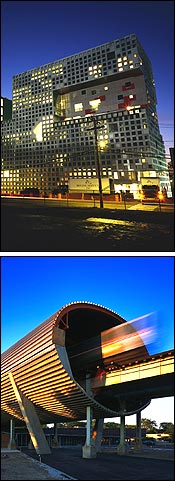
I've read some of his provocative essays in the ever-alarmist Atlantic Monthly, and have often nodded in agreement with his perceptiveness, usually shorn of any of the many useful theoretical underpinnings that are common in academic writing, about our national state of affairs, though his nostalgia and Cassandraesque predictions occasionally go too far. Today, while netsurfing for images of MIT's post-post-modernist Simmons Hall (at right, Andy Ryan, Boston.com) the immense spongiform dormitory designed by Steven Holl that initially drew rapturous reviews but which has since turned out to be a maintenance nightmare, I happened upon his site, kunstler.com, which is a virtual warehouse of his acid assessments of the ravenously consumptive, house-of-cards society that the United States has become. (A few months ago I was telling C about how we were living in the "lottery" economy, and now Kurt Andersen, in New York Magazine, is saying that it's a "casino" economy, with revolutionary drumbeats beginning offstage.)

One of the highlights is Kunstler's Clusterfuck Nation column, apparently updated every Monday. It consists of acerbic jeremiads on some aspect of contemporary American life, though a recurrent theme involves our national pursuit of unsustainable modes of living, and our blindness to what's to come if we stay on the same paths. The most recent one, from this past Monday, assesses his gloomy forecasts for 2007, as America's suburbanization economy teeters and the world increasingly suffers from higher oil prices, global warming, and other problems. Other tart links include his Daily Grunt blog, the Eyesore of the Month (which is where an image of Simmons Hall turned up, along with a number of awful urban, suburban and exurban houses that bear the anti-aesthetic (and not anesthetic, unfortunately) marks of the dwelling that is being erected next to our home in New Jersey, as well as some architectural structures that I find quite beautiful, like the CalTrans headquarters), and links to his books, including The Long Emergency: Surviving the Converging Catastrophes of the 21st Century, and Cities in Mind (which talks about the "fiascos" of contemporary Atlanta and Las Vegas, among other things).

Here's a quote from his New Year's Day 2007 entry on the current state of things:

The inertia part of the story is that this collective hallucination (that jive-capital was real) was sustained through 2006 by the sheer massive weight and flow of jive capital and its ability to elude scrutiny by countless chimerical conversions from one abstruse form to another -- from loan, to bond, to bet, to position, to Christmas bonus. . . . The final result, though, was a nation with an increasingly impoverished middle class, a bankrupt public treasury, and all remaining wealth (notional or residual) creamed off by a racketeering upper crust of logrolling insiders who, for the moment, could convert their dollars into multiple mansions, private jet planes, and sky boxes at the gladiatorial combats du jour.

The rest of the US economy was increasingly composed of a suburban development hyper-boom that amounted to little more overall than a colossal misinvestment in a living arrangement with no future (and the irreparable destruction of the remaining US landscape). The building-and-selling of suburban houses and the ancillary accessorizing of them with collector highways, strip malls, and big box stores, fast food huts, and all the jobs associated with constructing, lending, evaluating, selling, servicing, and staffing these things, along with additional rackets like home equity withdrawal refinancing to keep the cash registers ringing in the Wal-Marts and Home Depots -- these were the activities supposedly keeping the "regular" (i.e. lumpenprole) economy chugging along. If you subtracted all this "housing bubble" activity from the rest of this economy since 2001 there was very little left besides, hair-styling, fried chicken, and open heart surgery.

Yet, marvelous to relate, the whole toxic, entropy-laden, creaking, reeking cargo of shit-and-deceit that comprised this system just managed to keep rolling along for another year without collapsing under its own stinking, fantastically stupid weight.

The luck part of the story came partly from the weather -- there was barely any hurricane activity in US territory last year and global warming was so advanced that the northern states set records for warm winter temperatures -- which redounded into the fossil fuel part of the 2006 story.