Thursday, April 13, 2006

Poem & Note: Derek Walcott


The people one runs into at the bank in New York City: here's a poet, a very famous one, I spotted on Tuesday. I told the young customer assistance representative who was helping me that sitting just a few feet away from where we were conversing was one of the greatest living poets. After I told the young man who this was--he'd never heard of this poet--he went and Googled him, and came back smilling. I said hello to this poet, whom I've met several times, and he sort of nodded vaguely (he wouldn't know me from Eve), and then I attempted to snap a surreptitious picture. The photo succeeded, only my flash went off (once again, it wasn't set on manual!), which led to a mini-scolding by the customer assistance who was sitting at the desk, as well as the person helping the poet. Ah well--I think of it as one of my US Weekly moments, only for the Academy of American Poets set.

Here's one of his gems.

CODICIL

Schizophrenic, wrenched by two styles,
one a hack's hired prose, I earn
me exile. I trudge this sickle, moonlit beach for miles,

tan, burn
to slough off
this live of ocean that's self-love.

To change your language you must change your life.

I cannot right old wrongs.
Waves tire of horizon and return.
Gulls screech with rusty tongues

Above the beached, rotting pirogues,
they were a venomous beaked cloud at Charlotteville.

One I thought love of country was enough,
now, even if I chose, there is no room at the trough.

I watch the best minds rot like dogs
for scraps of flavour.
I am nearing middle
age, burnt skin
peels from my hand like paper, onion-thin,
like Peer Gynt's riddle.

At heart there is nothing, not the dread
of death. I know to many dead.
They're all familiar, all in character,

even how they died. On fire,
the flesh no longer fears that furnace mouth
of earth,

that kiln or ashpit of the sun,
nor this clouding, unclouding sickle moon
withering this beach again like a blank page.

All its indifference is a different rage.

Copyright © Derek Walcott, from bonvibre's Phat American Poetry Book.

Wednesday, April 12, 2006

Mendes da Rocha wins Pritzker + Poem: Régis Bonvicino

Mendes da RochaThe Hyatt Foundation, which awards the annual Pritzker Architecture Prize, has named Brazilian architect Paulo Mendes da Rocha (right) its 2006 laureate. Thomas Pritzker, chairman of the Hyatt Foundation, said that the 77-year-old São Paulo resident "has shown a deep understanding of space and scale through the great variety of buildings he has designed, from private residences, housing complexes, a church, museums and sports stadia to urban plans for public space. While few of his buildings were realized outside of Brazil, the lessons to be learned from his work, both as a practicing architect and a teacher, are universal.”

Lord Palumbo, chair of the prize committed, noted "the joyful lilt of Brazil [he brings] to his work...[Mendes da Rocha is] never afraid of innovation or of taking risks...indeed, a worthy choice," while Rice University architecture and prize juror Carlos Jiménez said that "he builds with exceptional economy to achieve an architecture of profound social engagement, an architecture that transcends the limits of construction to dazzle with poetic rigor and imagination." The jury's citation also mentioned his skillful restoration and renovation projects. Mendes da Rocha will receive his bronze prize medal and a $100,000 grant on May 30, 2006 in Istanbul, Turkey. He's the second Brazilian to win the Pritzker; Oscar Niemeyer, the designer of the futuristic capital of Brasília and other modernist landmarks in Brazil and elsewhere, received it in 1988.

I've never seen any of Mendes da Rocha's buildings in person, but from the photographs, they do appear to combine conventional industrial building materials--concrete, stone, glass--to noteworthy effect, sometimes by means of ingenious features, imaginative, lyric geometries, and well-thought out site design. They also exceed many of the limitations of the "Brutalist" style with which he made his mark, beginning in the 1950s. Below are a few of the images Land + Living features on his work.

Guaimbê Residential Building
The Guaimbê Residential Building, São Paulo, Brazil, 1964 (Photo by José Moscardi)
Paulistano Athletic Club
Paulistano Athletic Club, 1958 (Photo by José Moscardi)
Paulistano Athletic Club
Paulistano Athletic Club, 1958 (Photo by José Moscardi)
Forma Store
Forma Store, São Paulo, 1987 (Photo by José Moscardi)
Mario Mosetti House
Private home for Mario Mosetti, Cabreuva, São Paulo State, 1995 (Photo by José Moscardi)

***

Here's a poem by a contemporary Brazilian poet, Régis Bonvicino (1955-), a São Paulo native whose poetry captures the variegated spaces and places of that vast and expanding metropolis. The poem below, "Garbpoem," translated by Odile Cisneros, is taken from Chicago Postmodern Poetry. An interview with Bonvicino is available here.

GARBPOEM

Her teeth could merchandize
pot
though they merchandize Colgate
droplet earrings hang from her earlobes

to sell or vender
her feet don't tread on false ground
and stride barefoot
in a clip or a film

her feet advertise
incorruptible plastic sandals
b(p)rutish Venus
drinks any old drink, backstage,

now at times looks
like a transvestite
also
now Hollywood is at her feet

she poses, full of herself
she shows off her silicon breasts
she wears coats, in winter, from otter's fur
or from some other species

her head is full of hidden cocaine
she admits to having hobbies among which
her favorite one: performing blow jobs
it's more aseptic, under control,

and saves her clitoris
keeping the smell of cosmetics
on her body and clothes
on her lips, botox

her nose advertises an allegorical scent
from her long and wavy hair,
blind letters fall, they occasionally
flash back, she wears a choker

she cleans her own tongue
mainly the back side
with a new product
to freshen her breath

she sells no clothes
she sells her lips
the lips sell her mouth
a cornucopia of herself

she listens to techno and hip hop
she fingers the white lines
She can't read or write
Anything but her name

Copyright © Régis Bonvicino, copyright © Translation by Odile Cisneros

Tuesday, April 11, 2006

Festival of African Rap

FestivalSince April 9, the Festival de Rap Africain has been taking place since this past weekend in Conakry, Guinea (Guinée). This is the festival's fifth year, and the theme for 2006 is "Let's Record Our Children."

I'm not familiar with many of the groups (well, none other than Neg' Marrons [see below]), but I would love to see and hear how hiphop is developing and transforming as a musical form and practice in sub-Saharan Africa, especially now that hiphop and rap have become a vital mode of cultural, political and social production across the globe.

(Interestingly this festival does appear to be focused specifically on Francophone Western African; there are no groups from North, Central or Southern Africa, or from non-Francophone countries on the roster. I also wonder if the rappers rap in French and French-derived idioms, or if they mix in African languages, English, and languages, and how this sounds over beats. What is their flow like?)

If anyone has any information on or links to audiofiles or CDs for any of these musicians and groups, please do post them in the comment section.

Musique festival 09/04/2006 > 16/04/2006
Conakry Guinée
Le Rap aussi - Festival de Rap africain
5e édition avec pour thème « Enregistrons nos enfants »

Programmation (Programming)


Dimanche 09 avril 2006 Palais du Peuple

Idéal Black Girls (Guinée)
Silatigui (Guinée)
Masta G (Guinée)
Fac Alliance (Guinée)

Samedi 15 avril 2006 Centre culturel franco-guinée

Neg'MarronsNeg Marrons (France)
Deeg J Force III (Guinée)
Nix (Sénégal)
Silatigui (Guinée)
Masta G (Guinée)

Dimanche 16 avril 2006 Stade du 28 septembre - Conakry

Daara J (Sénégal)
Deeg J Force III (Guinée)
Bill de Sam (Guinée)
Methodic (Guinée)
Secta’a (Gabon)
Kajemm (Côte d’Ivoire)
Légitime défense (Guinée)
Sista Fa (Sénégal)

Stages de formation du 10 au 15 avril 2006

En management Luc Mayitoukou (Africa Fête) – Lotère Gomis (Awadi) Babacar Ndiaye (Psicd) – Riyad Chaloub (BGDA)
Danse Hip Hop Eric Mézino
Technique de DJ D.J. Moses
Mao Condel B
Ecriture de texte Mohamed Salif Keita et les Rappeurs

Monday, April 10, 2006

Thoughts on the Current Immigration Discussion

Today, over 1 million immigrants and their supporters rallied across the country, in cities from Atlanta to New York (the photo at left is from the Washington rally, Evan Vucci/AP). My own thoughts on the immigration issue are simple and may be naïve, but here they are:

1) All of the immigrants who are already here should be offered a simple and clear path to naturalization. The INS (or whatever it's called now) should address the problem of anyone who has serious criminal convictions (and I don't mean traffic violations or marijuana possession) here or in their native country, but in general, everyone else should be given a clear and realizable opportunity to become a citizen. All. Of. Them. The last I looked, all of the nativist Republicans in the House or Senate who were pushing for draconian penalties against the immigrants (Sensenbrenner, Tancredo, etc.) were descended from European immigrants, some of whom arrived no more than a century ago (and in many cases were given all kinds of opportunities at the expense of Native Americans and African-Americans), and some of whose ancestors were the objects of harsh anti-immigration sentiment and actions. How quickly and completely they forget.


2) If most Americans are concerned with the economic impact of uncontrolled immigration, and studies on the issue are mixed, though it does appear that adult American citizens who did not graduate from high school are most negatively affected (and this would include white, black American natives, and latinos), then the criticism and penalties should be laid at the doorstep of US businesses that flout the laws and continue to employ undocumented workers, which does depress wages in specific industries while increasing profits. On almost every other measure, immigrants benefit the economy. So long as the US economy keeps growing and businesses keep employing undocumented workers in large numbers without penalty, immigrants seeking jobs will try to get here. The economics seem clear to me, though I could be quite wrong in this.


3) The guest-worker program is a long-term mess waiting to happen. The guest workers will be counted for voting purposes, like Native Americans, African-American enslaved people and women once were, without voting rights and few other civil rights. This is already happening with undocumented workers, and the guest-worker program would write it into law. Again. Employers will continue to employ undocumented workers despite the numerical limits (of 400,000--is this supposed to be a cruel joke?). None of the guest workers will want to go home unless things improve in their home countries or they earn enough to create a viable life back there. Their children, if they have any on US soil, will be American citizens, further tying them to the US. Nothing will be solved. The German and other European models for this sort of program should give everyone pause, though the president, with his negative capital, was hoping that his lackeys in Congress would pass it, though they had another plan altogether in mind.


4) Since the US government, both the White House and Congress, claims to to take national and border security seriously, it needs to show that this is more than rhetoric and shadowplay. I'm not sure what's going on with the multimillion-dollar boondoggle that we call the Department of Homeland Security, but four years after 9/11, it doesn't appear that there's any real or concerted effort to control the flow of people into the country, unless they are baseball players from Cuba or a European Islamic scholar against whom the current administration has a particular ideological animus. If people can enter the country freely, legally or otherwise, they will, especially if there are available jobs here. For those immigrants who are looking for work, this is a no-brainer.


5) The US needs to revisit the NAFTA agreements and any other pro-free market international trade programs that have devastated particular sectors of treaty members' economies. Mexico's agricultural sector suffered terribly after NAFTA went into effect, and continues to suffer. Neither "free trade" nor the "free market" are "free," despite the neoconservative and neoliberal orthodoxies that the Republican party and much of the Democratic party, especially the DLC wing, subscribe to. Planned, closed economies cannot be the countermeasure, but every US "free-trade," "free market" program needs to be revisited and reworked carefully, particularly if it's only benefitting corporations and shareholders, while millions of working-age people no longer have any realistic employment options. Citizens across Latin America have woken up to the failures of neoliberalism, and Americans need to open our eyes as well.


6) Much of the hysteria involving the immigration issue is focused on Latinos, and in particular, on Mexicans. I'm sure there's no one out there who doesn't already know this, but almost the entire Southwest was under Spanish control, and then was part of Mexico, before it became US territory. Mexicans and people of Mexican heritage have lived in parts of the West and Southwest for centuries. As I pointed out about a month or two ago, Herbert Hoover oversaw the mass deportation of Mexican immigrants and Mexican-Americans, i.e., US citizens, during the Depression, and only recently was there any apology or acknowledgment of this. This is not to imply that the current Mexican immigration is a kind of karmic payback, but I do want to note that Mexicans in particular have longstanding historical, cultural and social ties to the US. Mexicans, like Canadians and the citizens of other countries that are geographically or historically linked to the US are going to come to the US for job opportunities if they're here, as will people from elsewhere in the world. How many undocumented Canadian citizens are there in the US? I don't see any outcry against Canadians, because most Canadian immigrants to the US are, I would imagine, white.


In fact, there is almost no outcry against undocumented immigrants from Europe (and it's as if the immigrants from Africa, the Caribbean [except for Cuba] and Asia are not acknowledged at all), even though our major cities, and many industries, are full of them. The men working on the lot next to our home in New Jersey are from Eastern Europe. Are they documented? Before I bought my car, half of the cab-drivers I encountered in Chicago were from Romania. Were they documented? Yes, the majority of immigrants to US come from Mexico, but this shouldn't surprise anyone, because the US and Mexico are historically and economically linked and many Mexicans have long had ties to the US. There are numerous immigrants from other countries--in my neighborhood and throughout Chicago, I regularly come across immigrants and refugees from Nigeria, Sudan, Haiti, El Salvador, Dominican Republic, Poland, Romania, Russia, and so on. In fact, from 1990 to now, as I reported before, more immigrants from Africa came to this country than all the Africans brought to the US during the period of the slave trade. The immigration issue is not a Mexican or even Latino issue--even if most of the immigrants are from Latin American countries--but a human rights issue.


6) The nativists fail to look at another issue that we should be talking about, which is that if the ideology of neoliberalism and free market globalization are what they are going to keep pushing, they need to rethink issues of nationalism, national sovereignty, citizenship, and the concept of borders altogether. We are quite far from a situation of Kantian perpetual peace pervading a united, one-nation state, yet economic free-trade ideologues seem to believe that goods and services can and should cross borders at will, but fail to acknowledge the real-world national and local issues and crises that arise when real people do so. What do national sovereignty, nationalism, citizenship, constitutionally guaranteed rights, and borders of all sorts mean in an age of globalization, transnationalization, and global and transnational capital?


7) Criminalizing anyone who assists undocument workers is wrong. Building a 700-mile wall is ridiculous. Changing the law to eliminate birth-citizenship is outrageous. Expelling 12-20 million people is absurd and would be impossible anyway even if it weren't.


8) Finally, African Americans individually and as a whole really ought to be thinking carefully about the current immigration situation and its effects on this country. In most of the largest waves of immigration prior to 1965, immigrants of African descent were in the minority, and in places where there was a sizable African-American population, whether Boston, Philadelphia, Savannah, Charleston, New York, etc., African Americans were usually been pushed to the back of the line in favor of the new, mostly European immigrants. Immigrants of African descent usually blended into the African-American population within a generation or two. With the arrival over the last three decades of millions of Africans and people of African descent from Latin America, as well as millions of other Latinos, Asians, Arabs and European people (of all races), I think that we need to revisit and challenge static views of racial prerogatives, race and racial authenticity as they've has traditionally functioned in the US. I also hope the recent waves of immigration provoke a rethinking among African Americans about how we stage racial and ethnic identities in the economic, political and social spheres. Who is black and how do we speak about blackness, and race in general? What is authentic blackness? What is the black real today? How do we and can we represent it? Must one history or set of historical narratives, or racial, national or ethnic (or any other, for that matter) identity or identification trump or cancel out another, or mustn't we begin to think with complexity about who we are? (And this is the case not only for African Americans, but all Americans.) Barack Obama is us. I also hope it will provoke active coalition building to address a number of crucial issues the country faces, and in particular, that African Americans and black people in general face. White supremacy is not going anywhere anytime soon, so thinking of ways to promote countersocialization and counter-processes of identity formation and identification that do not yet again make and reify African Americans as the absolute negative Other, and that foster dynamic cross-racial alliances and means of identification across and within ontological racial boundaries with replicating the current racialized social hierarchies, are some of our current major challenges.

Sunday, April 09, 2006

Interview in Stop Smiling Magazine + E-Voting 2006 Crisis

A terrific student of Ron Shavers' and mine, Michael Moreci, chatted about books and art with me a few months ago in a Chicago cafe, and the result, "John Keene to the Genre Police: You've Just Been Made, My Sons," is up at Stop Smiling Magazine. Thanks, Michael, thanks to this past year's and the year before's English 392 classes (if any of you read the piece you'll see your imprints all over it), and thanks also to Ron!

»»»

There are many excellent, highly informative notices, essays and articles across the web on the problems with our voting systems. Here's a very recent one I found by John Gideon of VotersUnite.Org and VoteTrustUSA.Org, on The Brad Blog, which regularly reports on the disaster that we call our US voting system. Yes, it has always been problematic. Yes, the article is alarmist. Yes, we should take it as seriously as possible and be as active in our local communities as possible to ensure that uncertified, flawed or otherwise screwed up voting systems (from the striking of people from the voting rolls to the disenfranchisement of former convicted felons to undercounts and miscounts in areas with large numbers of poor and working-class voters to harassment, intimidation and electioneering, etc.) and machinery (easily hackable, non-robust, no paper trails, etc.) are not in place. There are have extensively documented problems with every major election since 2000, including the ones last year and earlier this year.

The Brad Blog: 'E-Voting 2006: the Approaching Train Wreck"

An excerpt:

Normally this space is taken with my ideas of what are the "Top 5" voting news stories for the week. Today I am going to use this space to talk about what I see as the beginning of a disaster in the making with our elections. This isn't the election fraud that some point to when they talk about the vendors and some elections officials. It's not about recounts or audits. This is a real, get your hands around it, happening problem that will disrupt our election process if we do not do something about it now. While we have been involved in all of our issues about Direct Recording Electronic (DRE or "touch-screen") voting machines or paper ballots the electronic voting machine vendors have been wreaking complete havoc across the country.

So far this year two states have conducted primary elections. In Texas there is at least one candidate who has stepped forward and has challenged the election because of anomalies in vote counts and known voting machine failures. One county's machines counted some votes up to 6 times which resulted in approximately 100,000 more votes being counted than were cast. Though the vendor, Hart Intercivic, initially blamed the problem on human error, they finally had to admit that it was a programming error and not poll workers or voters who had erred. In Illinois some county officials are threatening to withhold final payment of funds on contracts with Sequoia Voting Systems because of failures with their machines that ended with results in the primary not being known for over a week after the voters went to the polls. In both states the involved vendors were very successful in the media with deflecting the blame from their machines to "human errors" or "glitches". However, when you listen to people who were there and who saw and worked through the problems you get a very different picture...

Saturday, April 08, 2006

Friday Night and Saturday Afternoon

After leaving the John Ashbery reading last night, David and I walked over to the IFC Film Center (at right, formerly the Waverly, now swanked out with an adjoining bar), to see the newest Matthew Barney film, Drawing Restraint 9. We'd gone together to see the final entry in Barney's Cremaster films Cremaster 3 (the one starring sculptor Richard Serra, which also included a giant, lots of Celtic imagery, a car destruction derby in the Chrysler Building, and one of the most ennervating, interminable scores I've ever sat through) a few years back at Film Forum, and I'd concluded that Barney's dreamlike narratives and images were interesting and technical prowess and determination to realize them remarkable, he seemed like someone who was being praised because the critics really didn't understand what the hell he was up to but didn't want to end being on the wrong side of critical history. He also struck me as someone who had access to way too much money. Still, I think some of the Cremaster films, especially Cremaster 4, which stars Ursula Andress, is brilliant, and the idiosyncratic symbolism in the service of a sustained personal mythology that opens out to public interpretation and as a device to link the films together intrigues me quite a bit. So I'm not writing off or hating on Barney by any means.

The new film is a collaboration between him and his wife, the Icelandic singer and actress Björk. It's received a lot of praise from the usual quarters, including the New York Times. It is an arresting film, though I was troubled by what seemed to me to be yet another, highly elaborated strain of Orientalism, in the form of a 21st century avant-Japanoiserie, that at least one critic, Steven Holden, is reading as an enlightened East-West encounter (cf. his Times review). Hmm. Is my compass set to always detect or misdetect misreadings and misrepresentations of the Other? What would a better, non-Eurocentric cinematic encounter with Japanese life and customs look like, and would I know it if I saw it? Am I missing Barney's irony, his comparison of the "frivolity" of one kind of ritual, to another? Might not a real(istic) attempt to come to terms with the incomprehensibility and incommensurability of the other result in just this sort of film, so perhaps am I not giving him enough credit? These are things I've been thinking about.

In the film, Barney and Björk play these (very fashionably accoutered) attractive westerners who get on launches, then board a Japanese whaling ship, where they perform an elaborate Shinto marriage-tea ceremony (as imagined by Barney), which requires them to shave off facial hair, wear octopus undergarments, and in the case of Barney, faun-like horns, and then remain in the tea-ceremony room, which slowly fills with liquified petroleum jelly, which is Barney's preferred sculptural medium. As the room slicks up with the viscous amber fluid, the two lovers perform a horrifying (too mild a word, really) self-transformation. Meanwhile, the crew of the whaling ship sees and seizes a giant piece of ambergris (fake ambergris, or whale vomit, since the real stuff would be astronomically expensive, and not even Barney has those kinds of of millions), and then places it in a huge congealed petroleum sculpture, which is in the form of the "drawing restraint" emblem that Barney has been developing since he was in art school. The more I think about it the more it starts to make sense, at least the inner logic of the film, though the description, as I reread it, sounds almost nonsensical. At any rate, after the transformation, the two lovers have united with nature, and there's a charming shot of two whales following the whaling ship, which was both ironic and almost a bit naive, cutesy and sentimental. Björk in Kennedy's Times piece describes the film as representative of her aim of rejoining with nature, and this comes through, yet any real sense of a non anthropocentric engagement with nature, whales, or, to get back to what the Times was championing, a centrifugal exploration of Japanese culture, anthrological, zoological or otherwise, seemed to be missing, but then with Barney's work, I don't think that's the point. It's all about his (interior) vision, though this time, it's also fused with Björk's.

After the film, I felt utterly drained. Part of it was that it was 135 minutes, but it felt like 300 and at times moved glacially. This seemed appropriate during the run-up to and during the tea ceremony, but at times the longueur was just that--and too long. Then there was the wrenching "transformation" scene in the oily tea room. Let me not forget the music. While Drawing Restraint's score was often haunting and memorable, and nothing like Cremaster 3's score, which included unbearable bagpiping and grating metal--it was enough to make a person go completely insane--the repetitiveness and loudness of the music also took their toll. I can take throat-singing in small doses, and Björk's singing and songwriting in large ones, but this film overdid both. One of the best musical bits was the lower octave brass bursts that announced the whaling ship's approach to the ambergris and the beginning of (exciting) action. David concurred in feeling drained--and dazed. We walked around the neighborhood a little bit afterwards to get our bearings back, but as we walked up Hudson St., I felt almost as if I were rising from a very deep and heavy REM sleep. Seeing this film did make me want to see more video art, though, as well as find out what Barney was going to do next with this "restraint" theme.

On Saturday, I decided to venture back over to the City catch the reading of Ashbery's rarely performed play (farce?) The Heroes at the Bowery Poetry Club, mainly because Patricia Spears Jones (at left) and Chris Stackhouse were in it. Unfortunately, it took me so long to get over to the Bowery that by the time I arrived, the staged reading was over. I did get to see Patricia, who said that the performance had gone off with aplomb, and mentioned that her new book is coming out in May (wonderful news!). She also was kind enough to introduce me to two writers whose names and works I'm quite familiar with but had never met, Dara Wier and Vincent Katz. Since I missed the play, I figured I'd catch Ashbery read his long, two-columned poem "Litany," which was originally published in As We Know and which I've always thought of as an experiment that didn't exactly work out, with poet Ann Lauterbach. I'd forgotten our camera at home, so I used my cell-phone camera, which requires the kind of steady hand I lack, but which does take video, so I actually have three micro-clips of Lauterbach and Ashbery reading this work that achieves what Satie aimed for with his music, and which Tan Lin is aiming for with some of his pro(s)etic work, like Blip.Soak: lyric background noise or aural furniture.

Only Lauterbach and Ashbery (at right) both have expressive voices (and Wier and James Tate were also sitting at the tables and I guess were going to spell the two lead voices at some point), and the combination made me think not only of Thomas Glave's, Samuel Delany's and Chris Mazza's double-columned fictions, but of a really amazing fictional piece that one of my most brilliant honors students, Tai L, wrote a year-and-half ago, based on a technique that was used in a youth mental treatment facility. It involved piping two distinct dialogues into different earphones that a young patient had to wear, to supposedly therapeutic effect (I think I'm getting this correct), but as I immediately said to Tai when she told me about it and I read her rendering of it, I thought it might have the opposite effect (especially, now that I think of it, depending upon the content of the texts and the sound and pitch of the voices, etc.). When she performed it with another wonderful former student of mine, Eileen K, the effect was derangingly mesmerizing. The competing voices, combined with the simple lyricism, created a feeling of simultaneous confusion and bemusement. I have written texts of this sort myself, with the aim of creating the very sensations I felt as I heard Tai's and Ashbery's texts, though I hadn't known about Tai's rationale and justification at the time; Ashbery's was one I was quite familiar with.

Patricia left to get some food, and after a little while, Chris and I decided to head uptown to an opening in Chelsea. The abstract painter Ed Clark, a New Orleans native, was showing new paintings in his "Rebirth" exhibit at the G. R. N'Namdi Gallery at 526 W. 26th St. On the C train heading up there, we ran into poet and critic Geoffrey Jacques (in the center of the image below, Chris is at left) who was also on his way to the show. At left is a general scene at the opening.

As the N'Namdi Gallery's exhibition notes say:

Clark has always been an inventive and creative artist, experimenting with techniques--his innovative use of the push broom, for example, and his method of working on paper with dry pigment, inspired by the "pouring sand" technique of the Pueblo tribe of the American Southwest.


Because of Clark's technique, the canvases give the effect of the acrylic's horizontal movement in space, and where there were patches of impasto or layering, vertical mobility. The almost glamorous quality of the beauty created by his choice of colors yields develops greater depth through the visible marks of the painter's action in creating them. Chris mentioned the abstractionist Richard Mayhew; Mayhew's images, if I'm recalling them correctly, float and hover more, and offer a sense of stillness, whereas Clark's seem as if they're heading somewhere, drawing my eye right towards the edges and off the canvas. I thought and could see moods, and music, and movement. I plan to revisit the gallery soon to look at the works again.

The painter Ed Clark, at left, speaking with two unID'd women

Friday, April 07, 2006

John Ashbery Day (NYC)

In addition to today being the birthday of former English poet laureate and Romantic master William Wordsworth, Boston activist William Monroe Trotter, Jazz avatar Billie Holiday, sitarist-par-excellence Ravi Shankar, and supreme ironist Donald Barthelme, as well as the anniversary of a 1712 New York slave revolt, it was, after the printing and issuance of the mayoral proclamation, John Ashbery Day in New York City. I learned this at the reading Ashbery (1927-) gave at the New School University, on the second day of the three-day festival organized by poet and critic David Lehman and others on his behalf.

The reading took place in the Tishman Auditorium (above), on W. 12th Street, an amenable, egg-shaped, post-Deco decorated venue I've been to many times for great readings and have even once had the honor of reading at. Cave Canem annually holds their prize readings there, and the New School itself brings numerous well-known and not-so-well known writers in every year. By any measure, Ashbery is one of the best known and most famous living American poets, and has received every major poetry prize available, save the Nobel. He is also one of the most prolific, with over 20 books and many more chapbooks and small-press volumes, as well as a volume of visual art criticism, a collection of belles-lettres, and a novel (with James Schuyler), and plays. His first book, Some Trees, won the Yale Younger Poet's Prize back in 1956, and he was nominated for a National Book Award just a few years ago, I believe. (For some judges, this has become almost reflexive.)

Yet there's a paradox with Ashbery, because unlike most of the other very well-known and honored poets, he has been insistently criticized and dismissed by not only some notable academic and non-academic critics, but also by some of his peers (James Dickey, Richard Howard, etc.), because of his continual experimentation with both form and content, his hermeticism and allusiveness, his humor and silliness, sometimes verging on artlessness, his use of dream logic and illogic, since his earliest work, which advanced the traditions established by British and American Modernists such as W. H. Auden (on whom he wrote a master's thesis), T.S. Eliot, William Carlos Williams, Hart Crane, and Wallace Stevens, but with strong input from the French Surrealists, other European poets such as Rainer Rilke and Boris Pasternak, and all manner of American high, sometimes avant-garde and mass or popular culture from the era of Ashbery's childhood and adolescent development on through to today.

Ashbery is almost always called "difficult." Yet unlike most difficult poets, he traffics regularly in popular cultural material and references that high culture critics have tended to dismiss, while also writing works that defies easy formal or theoretic classification. For example, he wrote an entire book of poetry in prose, Three Poems, that is based both on Traherne's meditative poetry (an admittedly rarefied source) and the readily available self-help manuals that one can find at any bookstore. In another volume, Houseboat Days, usually regarded as one of his most "difficult," he wrote a poem that references Daffy Duck in its title but goes on to catalogue a range of recondite allusions, from Fernando de Rojas's epic to Dryden's heroic tragedy on the Mogul emperor, Aureng-Zebe. Nijinsky and Franz Kafka, among others, also appear as ghostly presences in the same volume. In another, he writes a sestina that incorporates the characters from Popeye ("Farm Implements with Rutabagas"), transposes his own lines atop a Peaches and Herb song ("It Was Raining in the Capital"), and invokes a classical Roman divination form in another ("Sortes Vergilianae"); this book's title is drawn from the beautiful, enigmatic Giorgio di Chirico painting that's emblematic of Ashbery's work, The Double Dream of Spring. Such is John Ashbery (below).

He is, as I've written before on here, one of the most influential living poets in English, particularly in countries as Canada, the UK, and Australia. In fact, he may be the most influential in terms of the effects of his aesthetic, and the number of poets whose poetics can be traced to him. Several generations of major figures show varying degrees of Ashberian influence (or counterinfluence), and at least one school of contemporary American poetry (Language) can trace its formal origins directly to him, even if its political concerns have from its beginnings been quite different. If one were seeking a "queer" poet who could be said to have truly queered, in the broadest sense, the poetic body, Ashbery would be he. A study entitled The Tribe of John discussed this topic in some depth, but it could easily be expanded upon today with at least five or six new chapters. Lehman himself is a star acolyte of Ashbery's, as is the man, James Tate (1943-), who introduced Ashbery tonight. (Strangely, Tate, shown below, looked almost twice as old as Ashbery, while Ashbery seemed to be about half a decade short of his 79 years.)

About the reading, I'll say that Ashbery was quite funny. About half the poems he read were among his best known, like "Qualm," which mentions Warren Harding and was thus very appropriate for the current political climate, "Soonest Mended," which he admitted was autobiographical, "What Is Poetry," a famous ars poetic and self-defense of his aesthetic, and "At North Farm," whose citation of the Finnish epic the Kalevala prefigures the long poem, "A Wave," in the volume it heads. He also seemed to choosing other poems randomly from his Penguin Selected. One of the first poems he read, "He," was hilarious, and my friend and fellow writer David M., who isn't a big fan of poetry readings but decided to join me this time, said he really enjoyed this poem. It's a simple lyric, structured anaphorically (the same word is the first word of each line: "he") that proceeds in dreamlike fashion, but actually tells a story. I hadn't ever thought of the poem as being comical (absurd yes, funny no) until I heard Ashbery read it, and this came through in a number of his poems, which verge on silliness by incorporate all kinds of verbal detritus, which in the best pieces, especially the more recent ones, he manages to weave into a very convincing lyrical fabric. He read one piece from his collection based on Henry Darger's paintings, Girls on the Run, which I find tiresome through and through, and repetitive of earlier, better work in Flow Chart (which he also read from, again to comic effect), then concluded with a final, fairly recent poem from Your Name Here: Poems that brought together the multiple registers of American speech, in which life's "elusiveness" and "mysteries" are both concealed and revealed, but which was also shot through with the perceptions of loss and his own mortality that have become his late career hallmarks. The standing ovation that capped the 50-minute reading (it felt shorter) was long and demonstratively heartfelt.

Thursday, April 06, 2006

Guardian on Men's vs. Women's Novel Choices + Black Abstraction Show at Studio Museum + Poem: Barbara Chase-Riboud

I'm always skeptical of arguments that attribute certain types of behavior or choices based on gender. Yet they keep coming. Today, Charlotte Higgins, the Guardian Online's art correspondent, writes that University of London scholars Lisa Jardine's and Annie Watkin's research shows that "the novel that means most to men is about indifference, alienation and lack of emotional responses. That which means most to women is about deeply held feelings, a struggle to overcome circumstances and passion." These men, in other words, value Beckett, Kafka and Salinger, while women like Atwood, Austen and Drabble.

CamusThe article lays it out:

Professor Lisa Jardine and Annie Watkins of Queen Mary College interviewed 500 men, many of whom had some professional connection with literature, about the novels that had changed their lives. The most frequently named book was Albert Camus's (at left, Today in Literature) The Outsider, followed by JD Salinger's Catcher in the Rye and Kurt Vonnegut's Slaughterhouse Five. The project, called Men's Milestone Fiction, commissioned by the Orange prize for fiction and the Guardian, followed on from similar research into women's favourite novels undertaken by the same team last year.

The results are strikingly different, with almost no overlap between men's and women's taste. On the whole, men preferred books by dead white men: only one book by a woman, Harper Lee, appears in the list of the top 20 novels with which men most identify.


Women, by contrast, most frequently cited works by Charlotte and Emily Brontë, Margaret Atwood, George Eliot and Jane Austen. They also named a "much richer and more diverse" set of novels than men, according to Prof Jardine. There was a much broader mix between contemporary and classic works and between male and female authors.

The piece goes on to say that while the male research subjects didn't regard novels as a constant companion to their "life's journey," the women did, and that the gender clichés the (admittedly limited) research established shocked Jardine and Watkins, though in historicizing the findings, it led them (and certainly anyone familiar with the English novel's 18th century beginnings) back to the period when the genre was considered primarily to have appeal to women (Tristram Shandy and Tom Jones were novels of that era that brought men into the fold).

Jardine's and Watkins's chief suggestion is that the book publishing industry take the findings into account, as men between the ages of "20 and 50" don't read novels, and the industry is still male-dominated in some key ways and doesn't always take female readers' interests and affinities in aggregate seriously. (In the US publishing industry, from an economic perspective, one would be quite wrong in asserting this, though from in an intellectual perspective, I think it's worthy of discussion) Though the NEA's own 2004 study, "Reading at Risk," correlates somewhat this last point, in the United States at least, I wonder what a larger survey, or one taken in the US might show. It also makes me think about the importance of novels in my own life, but also how they function in relation to the dichotomies that this Queen Mary College study maps out.

†††

Williams' 'Trane'Uptown is the place to be, as the "Energy/Experimentation: Black Artists and Abstraction, 1964–1980" show has just opened at the Studio Museum in Harlem. Curated by scholar Kellie Jones, it's one of the biggest shows focusing specifically on Black abstract artists in the last few years, and includes works by 15 of the major ones of the late 20th century, including Alma Thomas, Jack Whitten, William T. Williams (whose "Trane" is pictured at left, Studio Museum in Harlem), Sam Overstreet, Melvin Edwards, Barbara Chase-Riboud, Howardena Pindell, and Martin Puryear, among others.

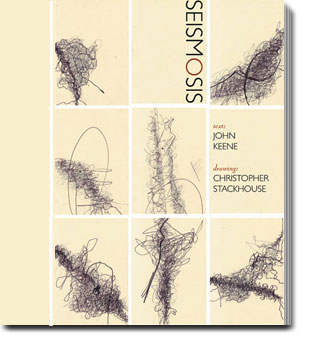
The grand opening was last night, and I couldn't make it, but I definitely intend to make my way up there to catch it as soon as I can. The New York Times's Holland Cotter writes a thoughtful review that notes how this vital body of artwork has gotten lost in the larger narrative of (African-)American art, which makes this show an crucial historical and representational intervention, though he also points to these artists' influences on subsequent generations of Black and non-Black artists--and they are all over (and referenced at various moments in) Seismosis. There have been a few fairly recent, strong shows of Black abstract artists, including at Franklin & Marshall College just a few years ago, and most survey books on African-American art (if not American art) do devote critical space to this aesthetic movement and its offshoots, but this one is a an important one for the capital of American art, New York, where many of these artists have lived and worked. Don't miss if it if you can.

†††

My poem for today is a transcription of one of Chase-Riboud's (1939-) "Cleopatra" poems, which composer Mark Vores set to music. Chase-Riboud is probably best known as a sculptor and novelist (Sally Hemings, 1979; Echo of Lions, 1980, on which the movie Amistad was [illegally?] based; Venus Hottentot, 2003), but she is also a published poet. Her first book, From Memphis to Peking, was edited by Toni Morrison and appeared in 1974, and Portrait of a Nude Woman as Cleopatra, which appeared in 1987, received the Carl Sandburg Literary Award.

Chase-RiboudO, FRIENDLY ENEMY, WE HAVE LOVED

O friendly enemy, we have loved,
Loin and haunch, limb and flank, truth and lies,
Tressed like a pair of ancient Armenian vines
Grown together root and branch in stunted
Commingling without End or Beginning.
If we part, you will leave with half of me,
Or I with half of you, and nothing will kill
The pain of dismembering.
That ache like some rare jewel
Will hang round our necks to touch,
In tender tremulance, an old wound of amputation
That burns and groans in limbs no longer existent
But splintered and crushed
In some long-forgotten and useless War.

Copyright © Barbara Chase-Riboud, All rights reserved.

Wednesday, April 05, 2006

Black Chefs' Struggles + E. Patrick Johnson Speaking on Gays & Gospel + Direland on Anti-Gay Poland

G. GarvinIn today's New York Times, Michael Ruhlman pens a 3-page article on "Black Chefs' Struggles at the Top." C. and I have caught and enjoyed Turn Up the Heat with G. Garvin on TV One several times (his hyper-butch, LL Cool J-esque persona fascinates me, as does his repetition of the phrase, "This your boy!"), and he like some of the other chefs who're profiled offers his thoughts on dealing with stereotypes and racism in upscale restaurant kitchens, as well as the persistence and emotional toughness required to succeed. Ruhlman and his interviewees attribute part of the problem to the absence of Blacks in the cooking school pipeline, and he reports that not only external factors, such as low and often warped expectations among restaurant owners and non-Black chefs about Black cooks and their skills and talents, but also familial dissuasion, based on a range of factors, play a role.

(Bernie of Bejata recently added culinary training to his list of skills, so I wonder what he thought of the piece. I also thought about my younger brother, an excellent cook who's worked in an assistant capacity in a number of kitchens, but who has yet to finish his education, despite my and other family members' encouragement and support.)

The article ends on a positive note, however:

After graduating from Stanford, Beth Setrakian, 49, got her first job as a pastry chef in 1979 for Mark Miller at the Fourth Street Grill in Berkeley, Calif., where, she said, "I was definitely the only African-American in the kitchen." She opened her own business, Beth's Fine Desserts, in San Francisco in 1988; she said it now has annual sales of around $8 million.

"There are so many black cooks," she said, adding: "We're on the verge of change. And thank goodness, because the heritage that we bring is a great addition to American cuisine as a whole."


˚˚˚
For those in Chicago, one of my brilliant colleagues will be speaking tomorrow evening, so please catch it if you can. E. Patrick Johnson is one of the co-editors, with Mae Henderson, of the new Black Queer Studies volume, and also has an essay in Frank Léon Roberts's and Marvin K. White's I'll Take Tomorrow (which I got the other day and highly recommend):

NU Prof. E. Patrick Johnson
(Dept. of Performance Studies, School of Communication)
will present
Gays & Gospel
an evening of lively discussion and song
examining gay men’s contributions to church music
********
Prof. Johnson will be joined by Kent R. Brooks, Director of Music Ministries at the First Calvary Baptist Church of Durham, North Carolina

The event will take place at
The Chicago Temple
77 West Washington Street, in the Loop
(The Temple is located directly opposite the Daley Center and the Picasso sculpture; closest Red Line stop is Washington)

This Thursday, April 6th @ 6:30 P.M. Take the "EL" downtown for an evening of music and conversation! Reserve your tickets today!

Admission $10/$5 for students and Chicago History Museum members

For tickets, visit www.chicagohistory.org/reservations or call 312.642.4600.

˚˚˚
LegierskiDoug Ireland has yet another fascinating piece on the increasingly extremely anti-gay climate in Poland, where right-wing twin brothers, who were former child-actors, the Kaczynskis, hold the government's reins (Lech is the President of the country, while the other, Jaroslav, a legislator and powerbroker, is the leader of the largest parliamentary party, Law and Justice). Since gaining power in October 2005 elections, the Kaczynskis, in league with ultraconservative elements of the Roman Catholic Church and even more viciously anti-gay parties, have launched an all-out assault on LGBT people there, in contravention of the EU's human rights laws and protections. EU officials have called Poland to task, but the Kaczynskis and their allies are determined to turn the clock back socially and politically.

Among the recent crises that have befallen LGBTs in poland, the Warsaw City Council, controlled by the Kaczynskis' party, ordered the closing of Le Madame, a popular gay nightclub that has also served as an important Leftist cultural and political space, a theater and lecture hall, a center for the country's dissident public sphere. Le Madame is owned and run by Krystian Legierski (above right, photo from Direland), a Black Polish-born gay activist. When the police attempted to shut down the establishment on March 29, 2006, it found that over 200 people inside refused to leave, which led to a blockade and siege whose temporary end Legierski was able to negotiate, with the proviso that the City Council not shutter the club for 48 hours. Even American actor John Malkovich joined the press conference at Le Madame to argue for its continued existence. As Ireland reports above, on March 31, the police again raided the club and closed it for good. Two smaller Left parties in the City Council have called for an emergency meeting concerning the closing of the center, but for now, the Polish "Stonewall" remains closed.

Tuesday, April 04, 2006

Bishop Book Controversy + Poem: Elizabeth Bishop

BishopA poetry post: A few days ago, the New York Times reported on the brouhaha surrounding Farrar Straus & Giroux's recent publication of a volume, ""Edgar Allan Poe & the Juke-Box: Uncollected Poems, Drafts and Fragments," by the late Elizabeth Bishop (1911-1979).

In her lifetime, Bishop, who is widely regarded as one of the major English-language poets of the 20th century, only published 90 poems total, across several collections, but these pieces are generally held by fellow poets and many scholars to achieve a linguistic precision and formal perfection that few other, far more prolific American poets ever match in their total output. A deliberate, meticulous stylist, Bishop did not issue volumes unduly, and in the case of some of the poems that appear in this volume, it appears she crossed them out completely in her notebooks, though she did not destroy them or, as writers such as Kafka did, order that her executors destroy them.

Alice Quinn
, the extremely powerful and influential poetry editor of the New Yorker, assembled the collection at former Bishop editor Robert Giroux's suggestion, and it has already provoked at least one harsh public critique, by the equally powerful and influential Harvard poetry scholar Helen Vendler. Her scathing review in a recent issue of the New Republic, "The Art of Losing," included the assertion that "in the long run, these newly published materials will be relegated to what Robert Lowell called "the back stacks," and this imperfect volume will be forgotten, except by scholars. The real poems will outlast these, their maimed and stunted siblings." As if that weren't acidic enough, she added: "I am told that poets now, fearing an Alice Quinn in their future, are incinerating their drafts." The Times could not get further commentary from her, but did note that because of Quinn's position few other poets, including people who've written extensively about Bishop, would dare go on the record criticizing the book, though the highly lauded poet Frank Bidart, who was a friend of Bishop's and a student and the editor of her close friend, Robert Lowell, did imply that Bishop would have not have minded, while Billy Collins, the former poet laureate, states that perhaps Bishop's Complete Poems, which came out in 1979, should have been her epitaph and added that he always deleted his earlier drafts. The newspaper also notes that New Yorker editor David Remnick has issued a mild mea culpa for featuring one of the poems, "Washington as a Surveyor," without a note that the work was previously unpublished, though anyone even vaguely familiar with Bishop's oeuvre would have been able to guess this.

I would like to look closely at this collection. I usually am in favor of the publication of posthumous texts, whether of completed or incomplete work, unless the author has explicitly asked that this not be done, though in all such texts the work should be thoroughly contextualized as unfinished or unpublished for one reason or another. Such texts are often very instructive for authors who read them carefully. Albert Camus's The First Man, Pier Paolo Pasolini's Petrolio, and Ralph Ellison's Juneteenth (which provoked some controversy itself) are three such novels that come to mind. It also made me think about my own drafts, which I usually keep but which I only periodically organize, a problem that has led to occasional (personal) confusion at times about which draft is the final one. Like some of the writers I most idolize, I am rarely convinced that my work is finished, unless it is published in a complete volume (which is to say, not a journal or anthology, but a book of which it is an integral part), at which point, I suppose, it belongs to the world.


***

Here is one of the briefest and most exquisite little poems in Bishop's The Complete Poems, 1927-1979, "Sonnet. It's one of the last poems she wrote, one of several in this form, and perhaps not as well-known as some of her truly famous poems like "One Art," "Sestina," "The Moose," "The Bight," "The Armadillo," "Crusoe in England," "The Man-Moth," and "At the Fishhouses," to name some of the most memorable ones. It's less expansive in many ways than any of these others, and yet captures central aspects of Bishop's life and art in its 14 lines.

SONNET

Caught--the bubble
in the spirit-level,
a creature divided;
and the compass needle
wobbling and wavering,
undecided.
Freed--the broken
thermometer's mercury
running away;
and the rainbow-bird
from the narrow bevel
of the empty mirror,
flying wherever
it feels like, gay!

Copyright © Estate of Elizabeth Bishop, from The Complete Poems, 1927-1979 (New York: FSG, 1979).

Monday, April 03, 2006

New York City's Black "Evacuation" + Upcoming NYC Poetry Events + Poem: Langston Hughes

Today's New York Times reports that New York City is experiencing a significant decline in its Black population, the result of an exodus of African Americans to other regions of country coupled with a slowing Black birthrate and a lower influx of Caribbean-born Blacks and Africans. According to the Times, this is the first time this has occurred since the Civil War-era draft riots of 1863. By 2000, Census figures suggest, the Black percentage of New York City's population had fallen below 25%, while the total outflow from 2000 through 2004/5 was over 210,000 people.

MapAs the map at left shows (click on it to enlarge), most (49%) of the Black emigrants headed to the South, followed by the New York suburbs(3o%), with lower numbers moving to other parts of the northeast (14%), the midwest (3%), and the West (4%). The Times asserts that the primary reasons may be economic and sociocultural, which sounds about right to me. As the city and region become increasingly unaffordable, many middle and working-class Black people can find better cost of living options and job opportunities in other parts of the country, and many are choosing the Southeast because of ancestral and direct family ties, as well as because of the large Black population and familiar cultural frameworks already there. For retirement purposes, the climate and living costs in the South are hard to beat.
Over all, more black residents who left New York City moved to Florida than to New Jersey.

But black residents who left the city were more likely to remain in the region if they had higher incomes and were college educated. And while black migrants to the South include some aspiring professionals, a larger share were lower income, less educated and elderly.

"All this suggests that New York City out-migration of blacks is unique in its scope — net losses to most states — and pattern — especially destined to the South," Dr. Frey said.

Reversing a tide from the South who altered the complexion of the city earlier in the 20th century, the number of American-born blacks leaving the city has exceeded the number arriving since at least the late 1970's.

"You have older people who leave the North just to go back to a place that is kind of slower, or where they grew up or went on vacation when they were younger — and when you retire, your money doesn't go very far in New York," said Sylviane A. Diouf, a historian and researcher at the Schomburg Center and co-author of a study of black migration. "You also have young college-educated people who find that the South has lots of economic potential and a lower cost of living."

BeardenAs I was reading this piece, I thought about how C. and I know a few people who've left New York in the last decade. Several of them have moved to Washington, DC, Philadelphia or the Atlanta area, usually for job reasons. Two of C.'s coworkers left Brooklyn and bought a home in New Jersey. A good friend's parents, natives of Haiti, built a home in south Florida and retired there. A number of other friends and acquaintances have repeatedly spoken of leaving New York, with economic reasons almost always factoring into their rationales. The Times article doesn't really discuss which boroughs are losing the most people, but I'd imagine that Manhattan is probably hemorraging Black residents and probably more rapidly than the other four, since from the northern to the southern tip and from the Hudson to the East River it's pricing out almost everyone not earning a hefty salary. Once upon a time, I had several Black friends who lived in various parts of Manhattan, but now other than the ones living Harlem, which is steadily whitening, and one friend living in the east 20s, I can't think of any Black New Yorkers I know who don't live in the Bronx, Brooklyn, Queens, or Staten Island, all of which used to be considerably more affordable than Manhattan, but which are becoming costly themselves as gentrification radiates outwards in all directions, including into Hudson County in New Jersey and Orange County on the west side of the Hudson River in New York State.

The Times does not report that despite the losses over the last half decade, New York City still has the largest Black population in the United States, at over 2 million people. Almost no American media have ever reflected this fact (and numerous TV shows and films have repeatedly reinscribed this visual erasure), though it's evident if you walk down (m)any city streets. A great deal of what we think of as "American" culture, as well as popular culture, has its origins in or has been shaped (or reshaped) by Black New Yorkers. Nor does it contextualize the fact that the city has had Black residents since its beginnings as New Amsterdam; these earliest Black settlers, free and enslaved, helped to build not only Wall Street (including the original wall that stood there), but many other neighborhoods throughout all five boroughs. Nevertheless, economics appear to be accomplishing the very eventuality that people like Rudy Giuliani seem to dream about, which is to push all the Black people, except for a few tokens, out of New York City, beginning with Manhattan, thus freeing up land and resources, and releasing racists from the ontological (physical and psychic) burden of racially inflected socioeconomic inequality and oppression....

The article does note that more than 500,000 white residents have also left the city, primarily for the suburbs (50%) and other cities in the Northeast (15%). This broaches what I think is the most important question underlining this piece, which is how will people of modest means--the majority of New York City residents throughout its entire history--be able to live in a city where housing and living costs now price all but the affluent out?

Update: One thing that came to me this afternoon was the situation of Black New Yorkers who in prison outside the city; what is the size of this population, and how does this factor into the population decline? The Times report article does note that people in the military are not counted as residents, but what about the imprisoned population outside Rikers and other city prisons and jails?

(Image above right, © The Dove, 1964, Estate of Romare Bearden, ACA Galleries, New York and Munich)

∞∞∞

Here are some NY-area upcoming poetry readings and events (many thanks to Reggie, Erica, and Greg, who forwarded them):

At Dixon Place Homotext
Tuesday, April 4, 7:30 pm
New gay & lesbian literature night
hosted by Pamela Booker
welcomes R. Erica Doyle & Carol Zoref (or A. Naomi Jackson?)
Dixon Place, 309 E. 26th St. (betw. 1st & 2nd Aves.), 212-532-1546; $5.

At Poet's House:
Tuesday, April 11, 7pm
National Poetry Month Reading
With Michael Collier, Natasha Trethewey & David Tucker
$5, Free to Academy of American Poets and Poets House Members
Presented in association with the Academy of American Poets.

Thursday, April 20, 7pm
Poetic Bestiary: A Panel Discussion
With Sandra Alcosser, Mark Doty & and Linda Hogan
$7, Free to Members

Thursday, April 27, 7pm
Archipelagos of Poetry and Politics: A Reading and Conversation
With Édouard Glissant and J. Michael Dash
Introduction by Jayne Cortez
Readings by Brent Hayes Edwards
Admission Free
Presented in conjunction with PEN World Voices: The New York
Festival of International Literature.

Poets House -- 72 Spring Street, 2nd Floor, New York, NY 10012

At Medgar Evers College, CUNY
Tuesday, April 11, 2006, 7-9pm
Creative Writing Program
PUBLIC READING SERIES SPRING 2006

A discussion of contemporary, progressive BLACK POETRY featuring
2005 New York Foundation for the Arts Fellows in Poetry
R. Erica Doyle, Christopher Stackhouse & Gregory Pardlo
and special guest, Erica Hunt
in The President's Conference Center
Medgar Evers College
1650 Bedford Ave., Brooklyn,
Free admission, Reception to follow
Directions: subway: 2,3,4,5, to Franklin Avenue
For more information contact the English Department
at 718-270-4940.

This event is being presented in cooperation with the Cave Canem African American Poet‚s Workshop and Retreat and the Artists & Audiences Exchange, a public program of the New York Foundation for the Arts (NYFA).

At the New School University:
John Ashbery Festival (I'll write more about this tomorrow)

Thurs.-Sat., April 6-8. For more information, call 212.229.5611 or email writingprogram@newschool.edu.
Location: All events take place at 66 West 12th Street unless indicated otherwise; see schedule below for room assignments.

The New School graduate Writing Program sponsors a three-day festival honoring the great American poet John Ashbery. Ashbery has won the Pulitzer Prize and National Book Award, as well as MacArthur, Guggenheim, and other prestigious fellowships, and is the author of more than 20 books of poetry, including Some Trees (1956), Self-Portrait in a Convex Mirror (1975), A Wave (1984), Can You Hear, Bird (1994), and Where Shall I Wander (2005). He is also the author of three books of critical prose and co-author, with James Schuyler, of the novel A Nest of Ninnies. In 1988 he served as the inaugural editor of "The Best American Poetry" series. He holds a titled professorship at Bard College. During the three days of the festival, poets, critics, and scholars from far-flung places will discuss various aspects of Ashbery's achievement. David Lehman, poetry coordinator of the New School Writing Program, is organizing the festival together with Robert Polito, the Writing Program's director.

Thurs., April 6
1:00 p.m.
Ashbery's Landscapes: Marit MacArthur, Timothy Gray, Ann Mikkelsen, and Kacper Bartczak on an Ashbery poem, room 510.
2:30 p.m.
Selected Prose and Selected Translations: David Kermani, Micaela Morrissette, Eugene Richie, and Rosanna Wasserman, room 510.
4:30 p.m.
Poets and Artists: Jane Hammond, Archie Rand, Jane Freilicher, and Karen Wright, Tishman Auditorium.
7:30 p.m.
Homage to Ashbery: A Group Reading: introduced by David Lehman. Mark Bibbins, Star Black, Marc Cohen, Billy Collins, Douglas Crase, Jacek Gutorow, Daniel Halpern, Vicki Hudspith, Tomoyuki Iino, Deborah Landau, Ann Lauterbach, James Longenbach, Geoffrey O'Brien, Ron Padgett, Robert Polito, Pawel Marcinkiewicz, David Shapiro, James Tate, Susan Wheeler, Dara Wier, and John Yau, Tishman Auditorium.

Fri., April 7
11:00 a.m.
Roger Glbert, James Longenbach, Meghan O'Rourke, Jacek Gutorow, and Melcion Mateu-Adrover, room 510.
2:00 p.m.
Tomoyuki Iino, Jennifer Quilter, Andrew DuBois John Emil Vincent, Pawel Marcinkiewicz, and William Burgos, room 510.
4:30 p.m.
John Koethe, Dara Wier, John Yau, and Lacy Rumsey room 510.
7:30 p.m.
John Ashbery introduced by James Tate, Tishman Auditorium.

Sat., April 8
2:00 p.m.
The Heroes: Bob Holman, Vicki Hudspith, and David Lehman, Bowery Poetry Club, 308 Bowery (at Bleecker).
3:00 p.m.
"Litany": John Ashbery and Ann Lauterbach, Bowery Poetry Club, 308 Bowery (at Bleecker).

∞∞∞

HughesHere's a Black New York(er's) poem, Langston Hughes's "Jazzonia," which I'm typing out from The Book of American Negro Poetry, James Weldon Johnson, editor (New York: Harcourt Brace & Co., 1969). I've always loved this poem, and Hughes (1902-1967), a Missouri native whose early poetry represents the quintessence of the Harlem Renaissance literary and cultural movement, captured the spirit, ethos and essence of Black New York City life and feeling in poem after poem. Here, Hughes presents the transtemporal, intracultural matrix that jazz presents:

JAZZONIA

Oh, silver tree!
Oh, shining rivers of the soul!

In a Harlem cabaret
Six long-headed jazzers play.
A dancing girl whose eyes are bold
Lifts high a dress of silken gold.

Oh, singing tree!
Oh, shining rivers of the soul!

Were Eve's eyes
In the first garden
Just a bit too bold?
Was Cleopatra gorgeous
In a gown of gold?

Oh, shining tree!
Oh, silver rivers of the soul!

In a whirling cabaret
Six long-headed jazzers play.

Copyright © Estate of Langston Hughes.

Sunday, April 02, 2006

Poem: Prageeta Sharma + Mendi & Keith Obadike's Sour Thunder on iTunes

SharmaBecause baseball season is about to begin and because today is the first day of National Poetry Month (every day should be a "poetry" day, but...), here's a poem by Prageeta Sharma, whose first book, The Opening Question, won the 2004 Fence Modern Poets Series.
ADVANCE

There are baseball threats and there are baseball Jaunts
as there are baseball careers, credit cards and juice,
pilgrims plumb fires to burn their lanterns--
full moon, not tawdry but sentient, not consciousness
but wonder, charms bat cave.

The bats exist as brownnosers perhaps aching to inch
at the heart palpitations of adulthood without the exclusion
of free speech, there are soldiers who ride themselves over to the park.

There are shot nerves and window dressings,
wince a little for a treat and that's home plate,
venues of marketplace and trees inducted into
a hall of name, an effulgence reflected in a half-turn
or a bit of lumber, a dry cry from baseball.

Copyright © Prageeta Sharma, 2004.

≥≥≥

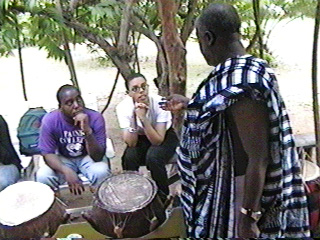
Obadikes with NimoSpeaking of the oral/aural arts, multigenre artists Mendi Obadike's and Keith Obadike's (at right, with musician and chemist Koo Nimo at Kwame Nkrumah Science and Technology University in Kumasi, Ghana, photo © Keith + Mendi Obadike) internet opera and sonic book The Sour Thunder, which premiered at Yale in live and netcast form, and which I got to see at the Studio Museum in Harlem, is now available for download at Apple's iTunes music store.

Mendi writes:

I'm happy to say that Bridge Records just put my album The Sour Thunder out on iTunes. It's a mix of songs and poems, including "Trouble" and "Even the Magnolia" from Armor and Flesh.*


The entire album, which is classified under "Hip Hop/Rap," is available at the iTunes store for $9.99.
--
*Mendi's debut collection received the 2004 Naomi Long Madgett Award and is published by Lotus Press (Detroit).

Saturday, April 01, 2006

Our National Nightmare + Congresswoman Fierce

Our national nightmare rendered in the most basic pop cultural terms: it was a very, very bad televised blind date, which we realized as soon as it began, yet the producers and those with major financial stakes foisted the date on us nevertheless, and we knew things were going awfully and let him know that his priorities were off, that he didn't know how to treat us, until the spectacular screw-up, which left 2,700 bodies in its wake and far too many of us in a daze, a truly terrible one that led a majority of us to go along with one of the worst choices we've faced in quite some time, and even though we knew how to quit him, the producers and the moneyed interests, through some handicraft and subterfuge, forced us to keep the date going, and it's only gotten worse, utterly and almost indescribably worse. We can't even play that we want it to go on any longer, we have nothing left to laugh at or about, there's nothing appealing about this creep, and some of us refuse to bide our time any longer, because every day now is like Groundhog Day; we just want him to leave us alone, be gone. We won't be calling him again, unless we are just too foolish for words, which given our history and what we've been through isn't out of the question....

(Thanks, Bernie, for the Alternet links!)

+++

McKinneyA "wackjob" and "nutsy-cukoo [sic]"? Someone who speaks the "insanities" inside her head? Well, a notorious chickenhawk likes more polite labels such as "'Representative Awful." The virulent racists out there, however, go for the jugular, with such touching epithets as "ghetto slut," a "welfare drag queen," and worse.

Why? Well, a cop accosted her at a Capitol Hill security checkpoint, grabbing her arm, and she had the temerity to push him away/slap him/smack him/punch him (take your pick). She wasn't wearing her Congressional pin, so he didn't recognize her; she's since said she regretted the confrontation, though she hasn't apologized. The Capitol Hill police have had prior scuffles with and in Congress; they threw Democrats out of a Republican-led hearing, an act for which Republican Congressman Bill Thomas later apologized, and they arrested Cindy Sheehan at the most recent State of the Union speech for First Amendment-protected expression.

As for McKinney, don't forget that she had the courage to say that the current Disaster-in-Chief and his friends might have known about the September 11, 2001 attacks in advance and did nothing. For saying this, she was viciously attacked in the press, as well as by the GOP and members of her own party, lost her Congressional seat (which she later regained)....

BTW, I love her hair. It looks wonderful. She looks wonderful and radiant. I don't agree with punching police, but then again, she is an elected member of Congress and I have to wonder if a Congressperson who wasn't Black and female would have been stopped as she was. She's been a target before. Even if I don't agree with everything she has to say, I still say more power to you and keep speaking out, Congresswoman Cynthia McKinney!