Monday, July 11, 2005

All Star Round Up

It's that point in the baseball season when the teams take a momentary pause and the fans have their lone opportunity to demonstrate their infinitesimally small influence through the popularity contest known as the All Star Game. This year, the All Stars are playing in Detroit's vast Comerica Park, the home of the Tigers, who have a fairly distinguished baseball tradition punctuated by some abysmal stretches in the late 1990s and early 2000s. (The last All Star Game in Detroit, in 1971, featured 18 future Hall of Famers.) Detroit's current, young team (featuring Dmitri Young, pictured at left, and Rondell White, right) has improved greatly over recent years, but is still in fourth place.
Young and White
The practical result of this location is that both teams will follow the meretricious American League rule authorizing the designated hitter, which was introduced in the early 1970s to pump up runs and excitement, and has marred the so-called "American pastime" ever since. It's thus likely that there may be a lot more runs and home runs this year, which is important because last year, the even more meretricious Commissioner of Baseball, a troglodyte named Bud Selig who allowed the steroids scandal to metasticize and simultaneously ran a decent baseball team (the Milwaukee Brewers) completely into the ground over the last two decades decided to tart things up yet again and award the winning All Star league home advantage in the World Series! The two events have nothing to do with each other, but Selig forced his brilliant idea upon the league and so what once was a showcase for the fans' favorites is now a win-or-else for the most popular and talented to ensure that their home teams, or at least the final pennant winners in their leagues don't suffer a disadvantage come October. Stupid, stupid, stupid!

My favorite NL team, the St. Louis Cardinals, who were humiliated in last fall's World Series, will have their Chauncey Gardineresque manager, Tony LaRussa, as manager of the NL team and six players in the game; three, OF Jim Edmonds, SS David Eckstein and 3B Scott Rolen were elected to start, though Rolen has a banged up arm and is bowing out. Three other players--1B (and one of the greatest players of all time) Albert Pujols, starting pitcher Chris Carpenter (who has a 13-4 record, and a 2.51 ERA), and closer Jason Isringhausen, have also been named to the team. Pujols actually will start at DH, given the National League team a necessary added burst of power. In general, the AL's starting team is loaded with better hitters, while the NL team has several of the top starting pitchers (future Hall of Famer Roger Clemens (who was lit up like a Times Square billboard last year), former Rookie-of-the Year Dontrelle Willis, Carpenter, Liván Hernández) in all of baseball, so it'll be interesting to see whether the pitching neutralizes the hitting.
Lee
At the break, the Cardinals are in first place with a 56-32 record, best both in the Central Division, one of the weakest in the major leagues, and in the entire National League. They lead their next closest rival, the Houston Astros, by 11.5 games, and are on track to win the NL pennant (so they need the NL to win this one). They have winning records both at home and on the road, and have gotten steady production from Pujols, who has a .332 average with 20 homers, 20 doubles and 69 RBIs, Edmonds (16 HRs and 51 RBIs), and OF Reggie Sanders (18 HRs and 44 RBIs), and even better starting pitching than last year. The new additions--Eckstein at SS and Grudzielanek at 2B have worked out well. In addition to Carpenter's outstanding consistency, starter Matt Morris is 10-2 with a 3.10 ERA and has given up far fewer HRs this season, and the three other starters (Mark Mulder, Jason Marquis and Jeff Suppan) have been decent. Mulder sparkled early on, but has faded, while Suppan struggled and has steadily improved. Marquis, though a pitcher, is batting .392!

The other top teams in the NL are, surprisingly enough, the Washington Nationals, formerly the Montreal Expos, who weren't expected to be more than middling, and the San Diego Padres, who have coasted near the bottom for the last several years. The Nationals play in what is easily the toughest NL division--all five teams (Washington, Atlanta, Florida, Philadelphia, and the NY Mets) have .500 or better records and could either win outright or at least earn the Wild-Card berth into the playoffs if they can find a means to win regularly. Atlanta is always a threat, though they usually fizzle in the playoffs or Series, while Florida has twice won the big prize as a Wild Card team. Philadephia has a great lineup, and the Mets have Pedro Martínez (10-3, the most strikeouts in the league, a future Hall of Famer and larger than life personality) and many talented players, though their baserunning and dismal closing has doomed them repeatedly this season. Ultimately the Cardinals, who have fared only 7-8 versus this division, have to be ready to throw down come playoff time. Overall, I think they're the team to beat, because of their strong starting and closing pitching and their powerful lineup, especially if Rolen returns to form, but they will encounter a challenge from surging Houston and Chicago teams (led by Derrek Lee, pictured above right) in their division, and in the playoffs, from the East has to offer.

In the AL, I have tended to root for the New York Yankees, the corporate behemoths (and for a brief moment, "America's Team") who've won the most World Series and AL pennants of any team (the Cardinals are second in the first category), and who have been on a rollercoaster ride all season. Way down, zooming up, plummeting, soaring, and now they're steadily rising again, having moved from last place in the AL East to end up just 2 games behind their division's leaders, last year's World Series Champions, the Boston Red Sux. (I loathe this team for multiple reasons). The Boston team has supplanted front-runner Baltimore, and the Yankees, who have struggled with consistent starting pitching, seem to find the pieces falling into place. They do have the largest payroll in the major leagues, though, and usually are expected to win, especially by their deranged owner, the formerly convicted felon George Steinbrenner. I think the Red Sox have the talent to win the division and defeat the Yankees in the playoffs, but both teams have some serious question marks, and the best AL team all season has been the Chicago White Sox--yes, the Chicago White Sox--who have a new manager, former SS Ozzie Guillén, and dazzling starting pitching. In fact, two of the White Sox's starters, Mark Buehrle (10-2) and Jon Garland (13-4) are in the All Star game. Like the Yankees, they're in a very competitive division, with perennial challengers Minnesota, and a clean young Cleveland squad that wants to win as well. In the AL West, the Los Angeles Angels of Anaheim (???)--what was wrong with California Angels?--are again in first, but the Red Sux, Baltimore Orioles and Yankees all have winning records against West division teams, and the White Sox and Minnesota have better starting pitching, so I am ready to state that the AL West winner won't go all the way. I could be wrong, though. All in all, there's much more parity in the AL, with nine teams hovering between .600-.500 winning records, so the team with the best tools, most determination, and the craftiest manager will win the end. (That is, if George Steinbrenner doesn't just charge up some young miracle along the way.)
Griffey
I'm looking forward to the second half of the season. I just hope the Cardinals can sustain their first-half pace. The Yankees are going to compete no matter what. They can't afford late season tailspins, though. It ought to be fun, just like the pressure-packed All Star game, which takes place tomorrow, without such regulars as future Hall of Famer Ken Griffey Jr. (at left), who is having one of his best seasons in many years. Play ball!

Sunday, July 10, 2005

Sunday Quote: Sergei Parajanov

Parajanov and Vardanov"I believe you have to be born a director. It's like a child's adventure: you take the initiative among other children and become a director, creating a mystery. You mould things into shape and create. You torment people with your "artistismus" - scaring mother and grandmother in the middle of the night. You dress yourself up like Charlie's Aunt, or as (Hans Christian) Andersen's heroes. Using feathers from a trunk, you transform yourself into a rooster or a firebird. This has always preoccupied me, and that is what directing is.

A director can't be trained, not even in a film school like VGIK (Soviet All-Union State School for Film Art and Cinematography). You can't learn it. You have to be born with it. You have to possess it in your mother's womb. Your mother must be an actress, so you can inherit it. Both my mother and father were artistically gifted."
--Director, writer and artist Sergei Parajanov (1924-1990), in a Kinema interview with Ron Holloway

Saturday, July 09, 2005

Claude Simon Memoriam

Simon While scrolling through my Yahoo! news bulletins, I came across the news that one of my literary heros, Claude Simon, the 1985 Nobel Laureate and one of world's most distinguished and innovative writers, had died this past Wednesday, at the age of 91. Simon was one of the leading practitioners of the French literary movement known as the Nouveau Roman (New Novel), which emerged towards the end of the 1950s. Among its other best known exponents were Alain Robbe-Grillet, Natalie Sarraute, Michel Butor, Robert Pinget, Claude Ollier, and the early Marguerite Duras.

Though French critic Émile Henriot coined the term in a 1957 Le Monde article to describe works by writers who appeared to create a new style with each novel, through critics such as Roland Barthes the term eventually came to characterize what could be described as a tonally and psychologically neutral, perspectivally objective and estranging, often documentary narrative practice that extended the literary project of European modernism in suppressing naturalism (though not always realism) and sentiment, and (early) post-modernism in the the collaging of tone, characterization and point-of-view. Its immediate parallels in the other French arts were the cinematic works of Alain Resnais (especially his marvelous Last Year at Marienbad for which Robbe-Grillet co-wrote the screenplay and a "ciné-roman") and Jean-Luc Godard's films of the mid-1960s, and the objective serial music of Pierre Boulez and Jean Barraqué. French and foreign critics quickly recognized the significance and innovation of the nouveau roman, and critics and artists outside France, including Susan Sontag (in her experimental novels of the 1960s), Christine Brooke-Rose (at least initially), Rayner Heppenstall, and Uwe Johnson, adopted some of its techniques. Sontag also served as one of the chief critical champions of the nouveau roman in the US.

I've always thought that Simon was the most formally difficult of the nouveau-romanciers, in part because his work breaks the most, at least formally, with traditional narration. This led to some controversy about whether he was truly a nouveau romancier, as some critics and proponents felt that his work, especially the novels of the 1960s, moved too far away from the "pure" nouveau roman style. Looking closely at his work, I cannot disagree about the impurity: Simon's particular version of the nouveau roman showed the strong influence of William Faulkner, especially in the American author's four remarkable novels of time and memory Light in August, As I Lay Dying, Absalom, Absalom, and The Sound and the Fury, Marcel Proust, and to a lesser extent Virginia Woolf and James Joyce. Although his earliest novels, like Le tricheur (The Con-Man, 1945), La corde raide (The Tightrope, 1947), Gulliver (1952) and Le sacre du printemps (The Rite of Spring, 1954) were traditional in form, in a series of novels beginning with Le vent (The Wind, 1957), he began to experiment radically with perspective and temporality, creating dense, allusive, fragmentary, sometimes parallel, nonlinear texts that flowed in an almost montage-like manner, primarily through thematic, metaphoric, imagistic, and verbal association. Also characteristic from Le vent were Simon's riverrine sentences, eschewing punctuation and unfurling like the movement of thought or dream or memory themselves, and the use of sharp and indelible imagery. (In subsequent works Simon employs, or rather deploys, the parenthesis quite expressively.)

After Le vent and L'herbe (The Grass, 1958), he published the trilogy of novels that cemented his reputation and marked out his distinctive aesthetic approach, combining history, dream and personal memory, particularly of his experiences in the Spanish Civil War and World War II: La route des Flandres (The Flanders Road, 1960 [Prix L'Éxpress and Prix de Nouvelle Vague]), an extraordinary work, and my favorite of all his novels, La Palace (1962), and L'Histoire (History, 1967 [Prix Médicis]). The next several works carried on the experimentation of the 1960s trilogy, with settings in Ancient Greece--La bataille de Pharsale (The Battle of Pharsalos, 1969)--and New York--Les corps conducteurs (Conducting Bodies, 1971). Triptyque (Triptych) followed in 1973. In 1981, Simon published another of his most noteworthy books, the grand and intricate Les Géorgiques (Georgics, 1981), in which he superimposes several different genres, temporal modes, and three protagonists. He has since published four other novels, the most recent being Le tramway (The Trolley, 2001), and also authored several volumes of essays and plays.

One of his slighter books that I especially enjoy is L'Invitation (The Invitation, 1987--Dalkey Archive Edition, 1991), published right after he'd won the Nobel Prize. It recounts his visit, along with a number of other famous writers, including James Baldwin, to various sites in the Soviet Union during the initial perestroika period. Though like all of Simon's novels it's hardly easy reading, as it employs his signature stream of consciousness method, labyrinthine sentences and precise use of detail, The Invitation contains mordant critiques of the dying Communist system and its staged "reality," which Simon and other visitors see right through, and is one of his most accessible works.

During a long stretch in my 20s, I was utterly entranced by his work and gleefully tackled The Flanders Road (one of many books that I first came across on the shelves of Boston's venerable Avenue Victor Hugo Bookstore, on Newbury Street--does it still exist?), History and Georgics in swift succession. In my imaginary head-to-head authorial battles, he had Robbe-Grillet and Butor beat cold. (Sarraute was above such scuffles; I didn't learn of Pinget or Ollier until later.) Like I true adept, I then attempted several novels in a Faulknerian-Simonesque-Widemanian vein, never getting past page 20 or so with any of them. His influence, though heavily attenuated, I think, still lingers and always will (I think my tendency towards complex sentence structure, though, was hardwired in).

The influence of the nouveau roman has diminished tremendously, even in French literature, and now constitutes more of a historical school than anything else. Nevertheless, Butor at 79 and Robbe-Grillet at 83 soldier on (the latter was teaching at NYU as recently as a few years ago). The best works of the nouveau roman's exemplars, though heavily copied, still feel fresh--if you don't believe me, take a look at Georgics or The Flanders Road, or alternatively, Robbe-Grillet's La Jalousie (Jealousy, 1957), Nathalie Sarraute's Le Planétarium (The Planetarium, 1959), and Michel Butor's La Modification (The Modification, 1958).

Friday, July 08, 2005

Javier Torres's Vereda Tropical (2004)

I don't remember Vereda Tropical, Javier Torres's 2004 fictional depiction of the late, gay experimental Argentinian writer Manuel Puig's exile in Rio de Janeiro being in the theaters or festivals last year, but as soon as I came across it on Netflix, I added it to my queue and recently got an opportunity to watch it.
Vereda Tropical
Though it's not a great film and at a few points it left me cold, I would recommend it for two reasons: Fabio Aste, the attractive lead, turns in a strong and determined performance, and the film captures in entertaining fashion the experiences of one of Latin America's major authors at the nexus of several interesting, at least to me, historical moments--the waning period of the military dictatorships in Latin America, and the dawning of the AIDS era.

Puig was an effeminate gay man from the sticks who ended up studying cinema in Europe (Cinecittà in Rome to be exact) and living there, published his first books at the end of the 1960s, and by the mid-1970s had to leave Argentina because his fiction, which had gained him international acclaim and which was for the most part not overtly political, drew the ire of former president and strongman's Juan Perón's widow and successor Isabelita (she was overthrown in 1976 by a military coup). Also driving his exile was his refusal to live in the closet and conform to a macho conception of masculinity.

Brazil, though under a military dictatorship during this period, did not consider Puig, a foreign, famous gay author, to be a threat, and Rio then as now offered a more open sexual environment, as the film demonstrates. For Puig, the city, with its beaches, discos and opportunities for casual sexual liaisons provided a space of social and, at first at least, considerable aesthetic liberation. Yet this was also the period during which the AIDS pandemic emerged, and the film portrays Puig's great fear that he too might succumb to the disease as did a number of his most notable Latin American literary peers, including the fellow Argentinian writer Néstor Perlóngher, who is briefly depicted in almost caricature form, and the Cubans Severo Sarduy and Reinaldo Arenas.

I've read Suzanne Jill Levine's excellent biography of Puig and almost all of his translated books (my favorites being The Kiss of the Spider Woman, Tropical Night Falling, Pubis Angelical, Eternal Curse on the Reader of these Pages, and Betrayed by Rita Hayworth), so I approached the movie with a lot of background, but as with most biographically based films, I accept that the filmmaker is going to alter the life story in various ways, and Torre does, though to no ill effect. Despite the temporal modifications, he keeps the focus on Puig's main documented relationships, at times combining and collaging them to improve the dramatic impact. We see Puig's struggles with his married boyfriend, a working-class man from Brazil's poor Northeast, whom the author wants to abandon his wife and family so that they can set up house; his appointments with his wealthy, female society friends; his collaborations with a female scholar who eventually would travel with him to a conference in Texas (Puig later lived in New York and had such an excellent command of English that he wrote one of his best novels in it); a few sexual assignations; and his partying side with a visiting more libertine female pal from Argentina.

Where the movie definitely succeeds, in addition to Aste's and Mimí Ardú's performances, is in its depictions of the brightness and openness Rio, especially through color, scenery, and setting. It looks like a light-filled, almost paradisiacal place where both lovemaking and artmaking are truly possible (and it is). Yet what Torres also shows us is how the presence of so much beauty and possibility, and the seeming open but in reality set mores of another culture, can also become a torment, as it did for Puig. Aste's large, expressive eyes alone often perfectly semaphore the longing, thwarted desire and loneliness that are consuming this author who has emerged victorious from many of his past battles yet still has so many more to face.

Where the film stumbles, in addition to some choppy editing, the stilted acting by some of the bit players, and Aste's occasional overmincing before the camera, is in its inability to embody for the viewer the deepest sense of what motivated Puig's writing, which I would suggest was his fascination with films as a mode of escape and reality, and how it connected to his life. Torres does capture one of Puig's creepy and carnivorous techniques, which involved audiotaping his lovers, often secretly, and transposing their words into his texts, to brilliant effect. (Eternal Curse, for example, is almost completely written in razor-sharp, highly nuanced dialogue.) Torres shows how two lovers, including his long-term boyfriend, call him out on this, fearing that their words and lives have been cannibalized, that they are going to be exposed, and Puig's pleading explanations fall flat; it was at this point that I wished Torres, who does employ a few fantasy sequences, had utilized a technique similar to Puig's in the Kiss of the Spider Woman, merging the real-time recorded dialogue of the lovers into fictional sequences, which would have made the author's secretive and disturbing practice clearer.

The film suggests that Puig didn't really high intellectual aspirations (and writers who knew him commented on this), nor really does it convey his profound artistic and aesthetic ones, which are evident in the texts themselves. Despite the dwindling appeal of post-modernism, the novels still show great formal and content originality, especially in how they fuse an insistently cinematic consciousness with a novelistic one. Yet the film doesn't really give us this, and we don't get the sense that it was fame exactly either that motivated Puig. Instead, Torres seems to suggest that the yearning for domestic and emotional stability, as well as for unrequited sexual tricks (and we get one in the form of a handsome and young working-class Brazilian housepainter whom Puig repeatedly and unsuccessfully woos), were his spurs.


I'm not sure that Levine's biography or the works themselves fully validate this reading. At times the film felt like it was verging on cliché, though more than a kernel of truth certainly lies in what's portrayed of Puig's suffering, which eventually drove him to his final resting place of Cuernavaca (by way, if I recall correctly, of New York). But I do wonder whether Torres might not have striven a bit harder to show--and perhaps it is too difficult to do with writers, for whom so much occurs within the mind--more of Puig's artistic vicissitudes and particular texts' intersections with his lived experience, especially his love of films. Because cinema, more than anything else, sparked his writing, and as the biography makes clear, his unique synthesis certain offers a number of options to an inventive and talented filmmaker. What also might have been interesting was to see, even briefly, the moment of artistic achievement--the concept becoming text, the movie dialogue slowly being transformed into something new in a given novel--yet I who have zero filmmaking experience would imagine that this might be among the most difficult things of all to capture on screen. I just wish Torres had pushed and played a bit more--certainly Puig would have appreciated it.

All in all, however, Vereda Tropical is a fascinating film, and worth the few hours it takes to watch it.

Thursday, July 07, 2005

London Terrorist Attacks

The newsmedia and many blogs have covered to the extent possible this morning's terrorist bombings in London, so I don't have much to add beyond my expression of unsurprised horror, sadness and outrage that London was attacked and my condolences to the families of the 40 or so people who were killed and my best wishes to the more than 300 injured.
After the Attack
Only those wearing blinders fail to see that the Iraq War has become a chief recruiting tool for Al Qaeda and its sympathizers or to acknowledge the overall rise in terrorist acts over the last three years, at least as documented by the US State Department; and given that Britain's Labour Prime Minister Tony Blair has been not only the US's, but in particular George W. Bush's, most stalwart ally since the September 11, 2005 attacks, first in toppling the Taliban in Afghanistan, and then in the ill-advised war in Iraq, it was only a matter of time before Britain itself suffered a terrorist blow, especially in its sprawling, ancient capital city. Even the British security services recognized this, though it appears they initially believed today's terrorist threat was aimed at Israeli interests, and warned the Israeli embassy minutes before the first bomb went off, which kept Israeli Finance Minister (and former Prime Minister) Benjamin Netanyahu in his hotel room and away from the site of his meeting, which was to occur, it seems, just above where one of the bombs went off! Yahoo! News has reported on this, but I saw no mention of it on the TV news or in several of the online newspapers I browsed, so perhaps it's not common knowledge or is just being suppressed. With the "mainstream" media these days, how can you ever know?

I've railed in other spaces against the surveillance society that Blair has fostered in Britain over the last decade, but one good outcome of all the security cameras in London may be that it'll be easier for the British authorities to catch the people who planted the bombs, which seem to have gone off by timer or remote, and in so doing to uncover or unravel other cells or any web of people linked, even tenuously, to Al Qaeda. Also, though I am no fan of the police, from all accounts I've seen, I gather that the British police, fire and rescue, and emergency officers, who had previously drilled in case of such an eventuality, responded swiftly and with great care and professionalism.

I sincerely hope that New York's and our country's senior officials are taking note, since the Big Apple unfortunately remains a prime target. In fact, the London attacks can--and probably should be seen--as an indirect attack as well on the US. Despite the tragedies of 9.11.2001 and all the vows to improve coordination (let me add that on that day the New York police and fire officials, like innumerable New Yorkers, performed a heroic effort), just a year ago C. and I, like hundreds of thousands of New Yorkers and New Jerseyans, encountered utter pandemonium and found it extremely difficult to leave the city during the blackout; it was if there were no plans for such a major contingency, which thankfully was not the result of terrorist actions. Supposedly Mayor Bloomberg and the police did learn valuable lessons that day, and I hope they've woven them into everything else they've learned in order to be able to provide the best response if the worst occurs again, which I pray it won't.

Today I did notice a few police on the NJ Transit Light Rail train, but none on my PATH train, though I'm told they were out in force earlier in the day. Perhaps the attacks, horrible as they were, may spur the government also to address the many lingering security holes across the nation, including the outdated and underfunded Coast Guard, the underprotected chemical and nuclear facilities, the general porousness of the southern border and the ability of illegals to gain access to sensitive national and private facilities. Perhaps.

Lost in the news today was the Zarqawi group's shocking murder of Egypt's top envoy to Iraq, Ihab Al-Sherif. This was very significant news given that Sherif was going to be the first official ambassador to Iraq from a predominantly Sunni Arab country, and Egypt also has been a close ally of the US in the region. Instead, Egypt is now withdrawing its staff, and last night Pakistan withdrew its envoy after he survived an attempted attack (Bahrain's was wounded but survived a kidnapping). At the same time that this was occurring, Iraq was signing a military accord, which included training, with Iran, the second nation in W's infamous "axis of evil." Iran just elected one of the most ultraconservative leaders in its recently history, Mahmoud Ahmadinejad. The W administration's claims, after the failure to find WMDs and decisively link Hussein to Al Qaeda, included the desire to promote a secular, Western-leaning democracy in Iraq; instead, the conservative Shi'ite majority won and now control the government, the Sunnis remain disaffected and many are fueling the rebellion, and the nation the US most hoped to thwart, Iran, is now the Iraqi government's closest ally in the region. (We shouldn't forget that Ahmed Chalabi, who funneled so much bad information to the US government that he got to sit behind Laura Bush at the 2004 State of the Union address, and who transformed the now-jailed Times reporter and government shill Judy Miller into another info drop, is not only Iraq's Deputy Prime Minister of and Acting Oil Minister, but a close friend of--alleged counteragent for--Iran.) You couldn't make this stuff up....

At any rate, one very positive bit of news is that fellow CC'er and poet Christina Springer and her family, who moved to London last year, I believe, are safe and doing well, and as she often does, she has posted a poem about her experiences on her site, which is always worth the visit.

Wednesday, July 06, 2005

Lorenzo Thomas RIP + Memín Pingüín Update

Last night I learned that poet, scholar and superriffer Lorenzo Thomas, who was a member of the seminal Black experimental group Umbra and a teacher and mentor to several generations of younger poets, had died in Houston after a long battle with emphysema.

I first learned of Lorenzo Thomas during my Dark Room years when one of my fellow poets mentioned his name and then, not long thereafter, as if by conjuration, I found his book Chances Are Few in at the Avenue Victor Hugo Bookstore. I read and reread it several times, finding his particular aesthetic approach, which combined formal and syntactic experimentation, a broad allusive range (from popular culture to the Négritude poets), multiple languages (Thomas was a native of Panama and grew up in New York), with vernacular elements, provocative and inspiring. Here is one example, from "Broadway-Lafayette Espadrille":

FORWARD

The Broadway number jumbled up my brain
My mind's dream of Walt Frazier
And/or Black Revolution. And rifa
All down to my feet moving swift

In my sneakers. Is this the wrong Broadway?

Swoop back downtown. The same burthen
Too much reefer
On my head back and forward
Through the City all day

So many linguistic registers combine in these three brief stanzas, with their deft use of phrasing, rime, diction, and repetition: they're vertiginously alive. Lorenzo's work is rife (con y sin rifa!) with this sort of lively music that also, as the quote makes clear, cuts with a socially critical blade.

Over the years I'd come across Thomas's poems and criticism, but I only had the opportunity to meet him twice, the first time in the fall of 1994 (I can't even recall where; perhaps it was a National Black Writers Conference?), and then again two years ago, at the 2003 Associated Writing Programs Conference in Baltimore. Both times he was modest and gracious and funny and commanding in presence in that way that people who carry something profound inside are, and in our brief conversation in the Queen City, in which I gushed as I often do when I'm in the presence of someone whose work I greatly admire, he directed me to one of his online pieces, which I checked out as soon as I could. I also have returned again and again to his book of criticism, Extraordinary Measures: Afrocentric Modernism and 20th-Century American Poetry. As a poet and critic, he was the real deal.

Here is a link to the Houston Chronicle's thorough obituary. And here is a link to Cave Canem's poetry site, where you soon should be able to purchase a copy of Thomas's public discussion last fall at the New School University, as part of Cave Canem's Legacy Conversations, with one of his former students, the equally amazing poet, Harryette Mullen.

Here's another Lorenzo Thomas poem, which riffs off one of the most famous poems in American literature and history, Robert Frost's "The Gift Outright," which the aging poet delivered from memory at John F. Kennedy's inauguration in 1960.

INAUGURATION

The land was there before us
Was the land. Then things
Began happening fast. Because
The bombs us have always work
Sometimes it makes me think
God must be one of us. Because
Us has saved the world. Us gave it
A particular set of regulations
Based on 1) undisputable acumen
2) carnivorous fortunes, delicately
Referred to here as "bull market"
And (of course) other irrational factors
Deadly smoke thick over the icecaps,
Our man in Saigon Lima Tokyo etc etc

Copyright © Lorenzo Thomas, 1979.

***

According to a report yesterday on CNN.com, Black Mexicans are officially demanding an apology from the government for its issuance of the racist, briskly-selling Memin Pinguin stamps. The Reuters wire article, "Mexican Blacks demand stamp apology," says

The Asociación México Negro, which represents some 50,000 blacks living on the Pacific coast, said in a letter to Fox that Memin Pinguin, a 1940s comic book character drawn with thick lips and a flat nose, was stereotypical and racist.

"Memin Pinguin rewards, celebrates, typifies and cements the distorted, mocking, stereotypical and limited vision of black people in general," said the letter signed by leaders of the association.

The letter marks the first official complaint from a Mexican group over the stamps, which went on sale last week and provoked a storm of controversy in the United States. U.S. civil rights groups said they should be withdrawn.


Meanwhile, Mexican President Vicente Fox has refused to apologize and denies the depictions are racist. His foreign minister Luis Ernesto Derbez is blaming "specific groups in the United States who make a living from this kind of scandal" for the brouhaha. Such defiance, especially in the face of public criticism from the W administration, isn't surprising. Mexico and the US have been at political loggerheads for the last three years, with some of the lowest points occurring during the run-up to the Iraq War, when Washington tried to bully Mexico into supporting the invasion, and in the last 12 months, when Congressional Republicans have returned to their traditional focus on illegal immigration.

What Fox and his officials ignore in such comments and defiance is any recognition of the obviously and visibly racist cast of the depictions in 2005 (we're not talking about the socially accepted views of Black people either in the US or Mexico in the 1940s, when the comic strip originated) or of Mexico's specific racial situations and problems, not only with regard to Black people, but to the country's large Native American population. Racial degradation and racism aren't just issues in and for the US, as some non-Americans like to suggest, but racism, white supremacy and marginalization are societal problems that Black communities across the Americas face.

I would venture that such imagery would not receive governmental support in any of the countries in this hemisphere that either have a predominantly African-descended populations or in countries with substantial or even tiny but publicly identified Black populations; in fact, I wonder if nations like Argentina, Paraguay or Chile, the first of which is said to have no remaining indigenous Black population whatsoever (this is actually untrue) would go so far. So what is Mexico's problem? I should add that blatantly racist, coon-inspired depictions are not unheard of, however, on Spanish-language TV programs, some of which are broadcast in the US (and one can find racist stereotypes on US TV just by flipping through the channels--BET broadcasts them on a daily basis).

The CNN article continues,

"The stamps are 101 percent offensive, there is no doubt about it," said Rev. Glyn Jemmott, a Catholic priest in the 98 percent black village of El Ciruelo in Guerrero state, and one of the signatories of the letter.

"What is evident is the level of tolerance of racism that exists in the country. We are accustomed to racism to the point where anyone who dares question it runs the risk of being considered unpatriotic," he told Reuters by telephone.
***
Mexicans are often accused of discrimination against Indians, who often live hand to mouth in poor communities.
Meanwhile, the stamps are selling like cut-rate iPods, with some sheets commanding up to $200 on the Internet. It'll be interesting to see if Fox and Cia. respond directly to the Asociación México Negro or if he continues to cast this as a foreign-generated kerfuffle. In the case of the latter, I doubt it'll give him any real political boost. He certainly doesn't need any help in boosting his ignominy.

Update: Bernie forwarded me the link to this piece, "Mexican comic character--lovable or loathsome; different past, different perceptions," via Negrophile, by historian Myrna Santiago, which appeared today in the San Francisco Chronicle.

My thoughts: a very interesting piece. But I wished she had focused on the the basic point that racial stereotyping of the sort that Memin Pinguin represents doesn't just appear in a vacuum. I'd be far more interested in learning about its local and national sources, and whether there were other similar representations in Mexican popular culture and media, both in the 1940s and today (I would suppose that there are). Which is to say, I wish Professor Santiago had historicized the issue more--not just personally, but in terms of Mexican cultural and social history. Was it imported from the US or elsewhere? (One correspondent to this site, Lex, said that it mimicked a "Cuban" character, which immediately made me think of the commentary surrounding Lázaro Cárdenas's Black Cuban wife; Santiago mentions Pinguin's mother's "Afro-Caribbean" accent, which sparks a number of other questions, particular surrounding the depiction and performance of her alienness and Blackness, which would dovetail with some of the mythology about there being no Blacks in Mexico, etc.) Certainly by the 1940s such harshly stereotypical imagery, particularly from the US, had been exported all over the world, as part of the ongoing ideological war against Black people here. How did it and does it connect with Mexico's own racial and racist histories? Were there similar depictions in Mexican popular culture before Pinguin? Coon shows, minstrelsy, Jemima figures? What was occurring in Mexican history (the revolutionary period of 1920-1940, the Second World War, the Depression, etc.) at the particular moment when Memin Pinguin appeared? Was the minstrelsy of Pinguin meant to deflect critical focus on the elites, as a means of solidarity among the various diverse groups during a period of crisis, as a comical and lovable little (Black) buffoon that even the brown-skinned but not Black marginal members of society could laugh at? Were there any popular positive, less stereotypical representations of Black (or Indian, etc.) figures, especially given that one of the heroes of the Mexican Revolution of 1910-1920, and one of the country's most visionary figures, Emiliano Zapata, was allegedly part Black? Maybe that's the groundwork for internal conversations that could occur first on the other side of the border, and then we can dialogue across the larger border/frontera. I definitely appreciate her offer and I hope there can be one--or many.

Tuesday, July 05, 2005

Douglass's "What to the Slave Is the Fourth of July?"

About a year ago on a message board I'd subscribed to I posted a link to Frederick Douglass's myth-challenging speech of July 5, 1852, "What to the Slave is the Fourth of July?" Since it's the day after a national celebration of independence in a country that is steadily witnessing many of its basic liberties vanish or surrendering them outright as it engages in an illegal and poorly planned war, and since the United States has never fully reckoned with its slave past or adequately taken into account and addressed the needs of those former slaves' descendents, Douglass's lecture, I think, is especially appropriate for today.

As the Yale historian David W. Blight (thanks, Elizabeth A, for pointing it out) notes in his recent Time note on the speech, which Douglass delivered to a mostly white audience at Corinthian Hall in Rochester, New York, Douglass wrote it at a time when the political and social struggles surrounding slavery were beginning to approach their crescendo (Stowe's Uncle Tom's Cabin had only been published a few months earlier and the Civil War would official begin less than a decade later after the election of Abraham in Lincoln in 1860), and at a moment of tremendous personal stress and transformation. He was moving from the "moral suasionist strategies of abolitionist, William Lloyd Garrison, to political abolitionism and the possible uses of violence to overthrow slavery," Blight notes, and this change in vision and tone comes through in the text.

Blight continues, "In thought and feeling, Douglass the ironist had never been in better form. No abolitionist had ever brought the two great intellectual traditions of antislavery—the Enlightenment and the Bible—together with such power. The meaning of slavery and freedom in America had never found such a voice at once so terrible and so truthful. As Douglass took his seat, 600 white Northerners roared, wrote a journalist, with 'a universal burst of applause.'"

You can read the complete text of Douglass's speech here, at the Archives of American Address Frederick Douglass page.

Monday, July 04, 2005

Kakutani on Howard Bryant's Juicing the Game

Juicing the GameHoward Bryant, the talented author of the acclaimed Shut Out: A Story of Race and Baseball in Boston and the younger brother of brilliant writer and friend Tisa B., has just published a new book, Juicing the Game: Drugs, Power and the Fight for the Soul of Major League Baseball (Viking, 2005) on the steroid scandal, and in the process has hit a grand slam, which seems the like most appropriate metaphor given Michiko Kakutani's glowing review, "The Taint Baseball Couldn't Wish Away," in tomorrow's New York Times.

Kakutani is one of the toughest (and sometimes harshest) book critics writing today, so a rave from her is noteworthy. About Bryant's new book, she says," "In 'Juicing the Game,' Mr. Bryant...provides a smart, savvy appraisal of the steroid scandal, looking at its genesis and evolution and its implications for the game." She continues:

Mr. Bryant's book, which draws upon in-depth interviews with players, baseball executives, union leaders, team managers and journalists, is informed by a deep knowledge of baseball history. And it's valuable not only for its lucid, unvarnished account of the steroid scandal and its long-term consequences for the game, but also for putting that scandal in context with other conflicts like the decades-old clash between owners and players, the divisiveness fostered by the growing importance of television (which tends to showcase individual heroics over team efforts, home runs over less spectacular plays) and pitchers' complaints that the game's recent infatuation with offense has devalued their own craft.
You can read the full review online (the NY Times requires registration). I also highly recommend Bryant's excellent first book on the Boston Red Sox, race and racism, which decisively clarified and historicized for me many of the negative anecdotes, factlets and arcana that I'd heard over the years about last year's Major League championship team.

Saturday, July 02, 2005

Saturday Quote: Leslie Marmon Silko

Silko"It is very important how time is seen. The Pueblo people and the indigenous people of the Americas see time as round, not as a long linear string. If time is round, if time is an ocean, then something that happened 500 years ago may be quite immediate and real, whereas something inconsequential that happened an hour ago could be far away. Think of time as an ocean always moving. What is interesting to me about Einstein and post-Einsteinian physics and some of the discoveries in particle physics is what they have discovered about the nature of time. The curvature of time in space. So I grew up among people whose experience of time is a bit different. In their sense of time 500 years is not a far distance and that's why there is no need for the reinterpretation. That passage of time doesn't mean the same thing to us as it might mean in a culture where the people stretch the string out and say Oh, this was a long time ago. That is not the way my people experience time."
--award-winning author Leslie Marmon Silko (1948-), in an interview with Thomas Irmer

Friday, July 01, 2005

Luther Vandross RIP + O'Connor steps down

VandrossToday brought the very sad news of Luther Vandross's passing, at the age of 54, in a hospital in Edison, New Jersey. A native New Yorker, Vandross began as a backup singer to artists like David Bowie and Bette Midler, then later sang jingles before launching his first solo album, Never Too Much, in 1981. His inimitably rich and supple voice, which never fails to leaven me, and his songs, which ranged from soul and R&B ballads to the catchiest pop you could imagine, have served as the lyric soundtrack to several generations. In particular, Vandross seemed to be able to capture again and again in his music the sheer joy you felt--and despite being a male singer, his work seemed to embody both the male and female emotional response--when falling and feeling in love. (He noted, however, that he didn't want to be thought of as the "prophet of love.")

Luther Vandross eventually became a Grammy-winning, multimillion-selling recording artist in his own right, earning plaudits from many of the extraordinary singers he had long admired, including Aretha Franklin, Patti Labelle, and Roberta Flack. He had battled weight problems all his adult life, and some reports I've seen suggest that these struggles may have played a part in the devastating stroke he suffered at his home in Manhattan in 2003, from which he never fully recovered, though Oprah Winfrey late last year filmed him undergoing physical therapy. To Vandross himself, wherever he is, I say thank you; to his family and friends I send my sincere condolences; and to all out there, I say please put on a Luther Vandross song at some point today and every day for the next few weeks, months, years: "forever, for always, for love."

***
0
Changing directions and again turning to politics, I and the rest of the country learned today that Sandra Day O'Connor, the 75-year-old conservative jurist from Arizona and the first woman to sit on the Supreme Court, has announced her retirement, effectively immediately. Although she was a lifelong Republican who was nominated to the Court by Ronald Reagan in 1981, and although she was reliably conservative in her early years in the court--at least in terms of how that term was once understood in our public discourse before the W administration took over--O'Connor eventually became the powerful and decisive swing vote in a series of major decisions that effectively showed, if not a liberal bent, some flexibility tending towards moderation and restraint in judicial decisions. (The right wing, emblematized in the photo at right by Barry Goldwater (2nd from left) and Strom Thurmond (far right), has consistently labeled this and any decisions they disagree with "judicial activism.")

Among her landmark votes of this sort were ones to force a Mississippi women's nursing school to admit men; to brake attempts to reverse Roe v. Wade; to uphold some types of affirmative action; to overturn the oppressive anti-sodomy laws in Lawrence v. Texas; to end the execution of minors; and to require adequate legal representation for those facing trial.
She also infamously joined with the four other conservatives in 2000 to halt the counting of votes in Florida, effectively staging an electoral coup and handing George W. Bush the Presidency. (She was reported to have made a negative comment when she initially heard that Al Gore might have won; I always wonder if she regretted having played a part in installing the worst president in our history.)

News sources, including many blogs, will be posting extensive coverage of what is one of today's major domestic news items, so I'll end here and note only that as a nation, our best hope is that both members of the President's party and the Democratic opposition can sufficiently press him to nominate one of the sager and more reasonable conservatives he's been considering. There aren't many, from the names I've seen, but among the bad lot there are a few who might turn out not to be disasters like Clarence Thomas or Antonin Scalia, or totally positive surprises like David Souter and, more recently, Anthony Kennedy. Alberto Gonzales, the current Attorney General, who has been linked to a series of memos enabling the abuse and torture of prisoners at the prisons in Guantánamo Bay, Iraq and Afghanistan and who would become the first Latino ever to be seated on the Supreme Court, strikes me as one possible such choice. The President's ultraconservative supporters, however, are demanding someone of a more extreme judicial philosophy, along the lines of Antonin Scalia and Thomas, so being vocal and persistent, I think, in challenging them is going to be crucial once we learn of the nominee.

Thursday, June 30, 2005

Poem: Raúl Zurita

ZuritaOne of my taglines for several years has been "my god is ghetto," which in 1982 floated, like several other similar phrases, in 8-foot letters of smoke above the city of New York. But that wasn't my doing: Raúl Zurita had contracted a skywriter to declaim lines from his poems above one of the world's great artistic capitals (and the homebase of the United Nations) both to publicize his second book, Anteparaíso, which is one of my favorites, and to call attention to the marginal peoples of the world (including those of his native country, Chile, which was under the control of right-wing dictator Augusto Pinochet). Supposedly these poetic valentines by this little known poet were visible from many different parts of Gotham.

Zurita has more than once undertaken the grand gesture. A few years before the skywriting stunt, he had grown so disillusioned with the persecution and brutality that were taking place in Chile that as part of a performance piece in front of the Museum of Fine Arts in Santiago, the capital, after burning his face and masturbating, he tried to blind himself with ammonium acid so that he would never have to see them again (lay eyes upon here takes on more than a metaphorical meaning). He failed, thankfully, which allowed him to accomplish another powerful artistic, but less self-destructive gesture: to finish his trilogy of volumes based in part of Dante's exalted trilogy, and informed by his study of mathematics and his travels across Chile's long, high terrain, in particular, the Atacama Desert, which serves as the basis for a sequence of strange and strangely comic poems. The first volume was Purgatorio (1979) and the last was La Vida Nueva (1994), referring of course to Dante's later La vita nuova.

In the interim he has also published a number of other books of poetry, read all over the globe, and witnessed the political transformation in Chile; whereas he was herded, like thousands of other people, into the hold of the Maipo, a ship, and tortured in 1973 as part of the post-coup crackdown, by 1993, he had served as his country's poet laureate, his voice joining those of some of Chile's greatest lyric artists, including Gabriela Mistral, Pablo Neruda and Nicanor Parra. In 2003, he broke a 3-year silence to publish INRI, a book of poems commemorating the 30th anniversary of the September 11, 1973 overthrow of Salvador Allende and the thousands of victims of torture and murder, the disappeared, in the decades that followed.

Here is my translation of a trifle of his work, one of those brief lyrics in which he speaks of speaking with a version of himself.

[ZURITA]

As in a dream, when all was lost
Zurita told me it was going to clear
because in the very depths of night
he had seen a star. Then
huddled against the back
of the boat's planked deck
it seemed to me that the light again
lit my lifeless eyes.
That was it. I felt sleep invade me:

[ZURITA]

Como en un sueño, cuando todo estaba perdido
Zurita me dijo que iba a amainar
porque en lo más profundo de la noche
había visto una estrella. Entonces
acurrucado contra el fondo de tablas del bote
me pareció que la luz nuevamente
iluminaba mis apagados ojos.
Eso bastó. Sentí que el sopor me invadía:

Copyright © Raúl Zurita, 2005. Translation by John Keene, with thanks to Zurita's frequent translator, Jack Schmidt.

Wednesday, June 29, 2005

Canada (& Spain) Legalizes Same-Sex Marriage + Mexico's Racist Stamp

Canadian FlagA truly momentous event has occurred just north of the upper tier of "blue states," which is to say, the U.S. border: Canada's legislature, by a vote of 158-133, has ratified the 2004 decision of its Supreme Court that gay marriage legislation would not violate the country's constitution, making our sister nation and largest trading partner only the third country in the world (after the two constitutional monarchies of the Netherlands and Belgium) to legalize same-sex marriages. Liberal Party leader and Roman Catholic Prime Minister Paul Martin, whose brief tenure at the head of the minority government has been marked by an ongoing financial scandal and a razor-thin win over his Conservative opposition just a few months ago, led the push for the legislation, which confirms what has been increasingly evident over the last few years, Canada's considerably more progressive stances on a range of social issues.

According to Beth Duff-Brown's Yahoo! News/AP account, some of Martin's fellow Liberal lawmakers voted against the legislation and at least one Cabinet member resigned, but a coalition of various left-leaning parliamentarians--including members of the Bloc Québécois, who represent constituencies in what was once Canada's most conservative province but which is now one of its most socially liberal, and the reliably progressive New Democratic Party, which is part of the Liberals' governing coalition--provided enough votes to seal the win. The legislation is expected to pass in Canada's smaller, unelected, Liberal Party-dominated Senate, thereby becoming law at some point in July 2005.

Whatever one thinks of gay marriage or marriage in general as a social, political and economic institution--as a legal entity--the Canadian vote represents a landmark statement on behalf of equality, democracy and freedom. Many news accounts have noted that a majority of Canadians support the rights and freedom of gays and lesbians to marry, and so far 34,000 have done so. While the US Constitution's 14th Amendment, Section 1, final clause, passed in the wake of the North's resounding victory in the Civil War and the defeat of the nefarious slave system, clearly guarantees equal protection under all federal laws, the truth of the matter is in 49 states, the District of Columbia, and US territories LGBT people are obviously still being denied the equal protections and rights provided under our government's acknowledgement and certification of civil marriage. In Canada, although this was no longer the case in Ontario and British Columbia, two of its most populous provinces, as far back as 2003, the House of Commons decision comprehensively extends it by law to all the provinces, including the more conservative ones like Alberta.

Despite the fact that the US usually recognizes heterosexual/opposite-sex marriages contracted in most (all?) foreign countries, I would imagine that only Massachusetts will honor the Canadian same-sex marriages. (Will other nations, such as the more liberal ones in Europe, honor these marriages? How do they respond to unions civilly contracted in Belgium and the Netherlands?) That is, until other US states follow Massachusetts' lead. A judicial decision on same-sex marriage, I believe, is pending in New York State.

Addendum: Spain has just joined Canada in legalizing same-sex marriage. Despite vocal protests from the Roman Catholic Church and conservative politicians, Spain's Socialist Prime Minister José Luis Rodríguez Zapatero, who assumed control of the government after the popular uproar over the formerly right-wing government's inadequate response to the Madrid train bombings, was able to push the legislation through Spain's lower house of Parliament, the Congress of Deputies, by a vote of 187-147, overriding the country's Senate, which means that as in Canada, it will become law. (Doug Ireland quotes from Rodríguez Zapatero's remarkable speech, which in addition to making an impressive argument for equality and the notion of how interconnected everyone in Spanish society is, cites two of the greatest gay poets of all time, Luis Cernuda and Constantine Cavafy.)

In fact, this is probably probably more earth-shaking than the Canadian vote, in part because Spain was for many years one of the most consistently conservative and Catholic of the major European countries. You could possibly chart this conservative period as running from Ferdinand and Isabela's unification of Spain and their expulsion or forced conversion of the Arabs and Jews in 1492, through the long period of the Holy Inquisition in the 16th and 17th centuries, to Francisco Franco's fascist rule, which lasted from 1939 through 1975, with a few interludes of liberalization. Since Franco's death and the restoration of the monarchy, Spain's government has alternated between the right and left, and in recent years, the former has consistently held power.

In fact before the horrific train bombing on March 11, 2004, Spain had a right-wing governing coalition, headed by José Maria Aznar, which against the public will had sent Spanish soldiers to Iraq. With the ascension of the Socialists under Zapatero ("Shoemaker"), the country has witnessed a political sea-change that mirrors a longstanding change in social views, especially among the young. Zapatero promptly recalled the soldiers from Iraq and this week pushed through new divorce legislation and changes to stem-cell rules. Yahoo! News notes that such changes are "popular among young people," and that a poll last year showed that 70% of the population overall supported the move.

‡‡‡

On a completely different note, I was planning to post an article I came across on DR1 by a young Black American woman who'd spent time in Santiago, the second largest city in the Dominican Republic, as part of an educational program and experienced a profound cultural--and in particular, racial--shock (Mendi and Keith Obadike's operatic piece The Sour Thunder is based in part, I think, on Mendi's sojourn, while a student at Spelman, in Santiago); and I intended to post my own remarks, somewhat in response, on my experiences there. But it isn't happening just yet. Instead, I return to Mexico's problems with racism and racialist thinking, which have gotten some attention in recent months because of Mexican President Vicente Fox's comments on Mexicans immigrants' willingness to take jobs that "not even blacks" wanted, and because of what I describe below.

(Since I have mentioned the Dominican Republic, though, that country's inexactly parallel situation with Haitian workers--who are being forcibly repatriated as I type this, despite the incoherent Haitian government's attempts to close its borders, its appeals to the current Dominican administration's good will not to repatriate its people, the Dominican government's fear of appearing insensitive and racist, many Dominican patriots' desire to have the Haitians expelled and their fear of a "unification" of the two countries, and machinations of Dominican landowners and businesses to employ Haitians, who, given the devastation of their own country and their inability to freely immigrate to the US or Canada, take low-wage or slave-wage jobs in the DR--is worth broaching.)
Stamp
Where am I going with all of this? Memin Pinguin. Never heard of him? Neither had I. Well, he's a Mexican cartoon figure who is featured on a series of official government postage stamps being issued today. Nothing wrong with that, you say. Except that as shown at right, Memin Pinguin is a racist grotesque, a homegrown Mexican Sambo-style coon depiction. And the racism of the Memin Pinguin depiction doesn't lie in the images alone; in the cartoon series in which he's featured since the 1940s, according to several accounts I've read, he embodies a number of the traditional, infantilizing racist stereotypes attributed to Black people in the US, particularly during the Jim Crow period (and exported all across the globe). Look out, Topsy!

But the Mexican government officials don't see there being anything wrong, of course. Their cartoon pickaninny is going to be an ambassador, "spreading good news," according to the publisher of the comics in which he appears! Ah yes, a racist and buffoonish drawing is going to serve as an international herald--to whom? Fortunately, this "good news" wasn't lost on Black activists and others in Mexico, who condemned the Mexican government's decision to feature this overtly racist stereotypic depiction (along with the equally racist depiction of his Mami/Mammy) on a series of national stamps. To quote the CNN article:
The boy, hapless but lovable, is drawn with exaggerated features, thick lips and wide-open eyes. His appearance, speech and mannerisms are the subject of kidding by white characters in the comic book.

Activists said the stamp was offensive, though officials denied it.

"One would hope the Mexican government would be a little more careful and avoid continually opening wounds," said Sergio Penalosa, an activist in Mexico's small black community on the southern Pacific coast.
An official of the Mexican Postal Service couldn't help but reinforce the stereotype:
Carlos Caballero, assistant marketing director for the Mexican Postal Service, said the stamps are not offensive, nor were they intended to be.

"This is a traditional character that reflects part of Mexico's culture," Caballero said. "His mischievous nature is part of that character."

However, Penalosa said many Mexicans still assume all blacks are foreigners, despite the fact that at one point early in the Spanish colonial era, Africans outnumbered Spanish in Mexico.
Their own little trickster bad chillun Other, and on stamps no less! I won't get into Mexico's complex and troubled racial history, which like every other nation in this hemisphere has included the marginalization and slaughter of Native peoples and the subsequent enslavement of Blacks (the two in particular were linked in Mexico's case because of Bartolomé de las Casas); one aspect of this history has been an enduring racism against its large indigenous Indian population, which has resulted in periodic flareups such as the war in Chiapas; a racism of a different but intense sort against its native Black population, which has long been presumed not to exist; and, among the White/European ruling élites, against the visibly mestizo majority, which is evident in Mexican-language media, politics, business circles, and so on. Related to these forms of racism is Mexico's guiding mestizaje ideology, from which the Black "third root" has been almost completely erased and effaced in both official and popular discourse.

I will, however, broach the fact that when Lázaro Cárdenas (the son of Mexico's famous leftist leader Cuahtémoc Cárdenas, who was mayor of Mexico City and had the presidency stolen from under his feet by the notorious Carlos Salinas de Gortari in 1988, and the grandson of one of Mexico's greatest leftist and uncorruptible presidents, Lázaro Cárdenas) ran for the governorship of Michoacán State a few years ago, his opponent AlfredoAnaya viciously attacked him because Cárdenas married an Afro-Cuban woman. In fact, Anaya managed to conflate Blackness and foreignness in such a way as to claim that Mexicans--or Michoacanos in particular--wanted to be governed by "our own race, our own people," as though Cárdenas's marriage to a Black women rendered made him ontologically Black as well (racialization by association has a long history in the US, of course), and as though the Black presence in Mexico could only be (seen as) alien and foreign. Although Anaya lost--though by only five percentage points--it appears that his rhetoric was not so idiosyncratic but representative of a mindset, also clear in Fox's and other officials' comments, that is quite prevalent.

Dr. Bobby Vaughn and others are conducting fascinating research in Black Mexican communities, so as I did before, I'll direct you here, here or here for more information. Also, UPI correspondent Steve Sailor provides a basic run-through in his article "Where Did Mexico's Blacks Go?" He notes that despite the long history of marginalization of Black Mexicans, attitudes are changing slowly, and a Black-oriented museum opened up in Guerrero State, which is named after Mexico's second President, who was an Afro-Mestizo.

But hey, let's get back to our little grinning inky boy-on-a-stamp:
Publisher Manelick De la Parra told the government news agency Notimex that the character would be sort of a goodwill ambassador on Mexican letters and postcards. "It seems nice if Memin can travel all over the world, spreading good news," de la Parra said, calling him "so charming, so affectionate, so wonderful, generous and friendly."
Irony, as they say, is utterly lost on some people. Many of them, too many, in fact.

Tuesday, June 28, 2005

Tuesday Quote: Barthes + Stonewall Anniversary

"Viewed as a transition the face of Garbo reconciles two iconographic ages, it assures the passage from awe to charm. As is well known, we are today at the other pole of this evolution; the face of Audrey Hepburn, for instance, is individualized, not only because of its peculiar thematics (woman as child, woman as kitten) but also because of her person, of an almost unique specification of the face, which has nothing of the essence left in it, but is constituted by an infinite complexity of morphological functions. As a language, Garbo's singularity was of the order of the concept, thatof Audrey Hepburn is of the order of the substance. The face of Garbo is an Idea, that of Hepburn, an Event."
--Roland Barthes, from "The Face of Garbo," in Mythologies (1957).

***

Also, as a post on AmericaBlog reminded me, today is the 36th anniversary of the Stonewall Uprising in New York City, one of the signal events in the long history of gay liberation/LGBT equality and human rights struggle in the US, and really, across the globe.

Monday, June 27, 2005

PBS: POV's The Education of Shelby Knox

Last night for the first time in a while I caught PBS's usually provocative and often superlative program "POV," which features independently made documentaries. The documentary being screened was Marion Lipschutz's and Rose Rosenblatt's "The Education of Shelby Knox," a superlative exploration of a young woman's dawning political and social activism. The protagonist is Shelby Knox, whom the viewer first meets as a 15-year-old self-described conservative Southern Baptist from Lubbock, Texas, who, like all high school students in Texas has received abstinence-only education, because in 1995 then-governor George W. Bush signed it into law (the documentary also notes that in 1996 "abstinence-only" initiatives received national attention when President Bill Clinton included grants for abstinence programs in his welfare-reform legislation).
Shelby and parents
Knox shrewdly notes that despite the abstinence pledges and the generally conservative and religious atmosphere in town fellow students are still getting pregnant and contracting STDs, and she also remarks that what is being called "sex education" by her charismatic pastor is anything but. The documentary then follows her active participation in Lubbock's Youth Commission, which for a while becomes the primary vehicle through which she and others press for real sex education; her political conversion; her affiliation, despite her conservative background, with gay students at her high school who are trying to gain recognition for a "gay-straight" alliance; her struggles with her fellow activists, including the head of the Youth Commission, and her parents (pictured above with her, at far right); and her personal trajectory as an increasingly open-minded thinker and agent of change.

Lipschutz and Rosenblatt treat their subjects and the related issues fairly and respectfully, and in a brilliant move, they turn much of the film over to Shelby herself. A compelling young woman with intellectual aspirations and horizons that exceed those of many of the adults around her, Shelby Knox reinvigorated my belief that even in the most retrograde and stifling environments people, and perhaps most hearteningly young people, can develop their own ideas and act upon them, despite the consequences. Against the stridently triumphalist rhetoric of the Greg Neumayrs of this country that a majority has bought into the Groupthink, fearmongering, myopia, and personality cultism that passes for public and political discourse in this country and that the rest of us who haven't should simply bend, bow and accede, POV and "The Education of Shelby Knox" show that even in the "red" cores of this country, there are those who refuse to simply follow, and instead think and act freely, no matter what the dangers or costs.

Sunday, June 26, 2005

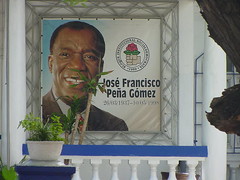
DR Photos: Peña Gómez; Guevara y Caamaño

Yet another DR photo. Though I'm almost cold-free, I didn't feel up to much today, so I missed New York's Gay Pride March, and haven't been able to produce any longish entries here.

Instead, I'm posting another photo from the trip, taken in the Gazcue neighborhood of Santo Domingo, west of the Colonial Zone. Most (all?) of the major Dominican political parties have headquarters there; the last time we were down there and walked through Gazcue, we happened upon the HQs of the ruling PLD party (its head, Dr. Leonel Fernández Reyna, is the current President of DR and previously served from 1996-2000), and the PRD, or Dominican Revolutionary Party, which was headed for years by the intellectual Juan Bosch (who was deposed in a coup in the early 1960s, which led to US occupation and the 12-year rule in the late 1960s and early 1970s of the arch-racist Joaquin Balaguer, who later led the Reformista Party in his subsequent decade long rule from 1984-1994).
Peña Gómez
One of the major leaders in recent PRD history was José Francisco Peña Gómez (1937-1998, pictured at right) a Dominican of Haitian ancestry and the beloved former mayor of Santo Domingo, who three times ran for and lost the Presidency, though he nearly won in 1996, despite vicious anti-Haitian and racist attacks orchestrated by Balaguer (who even wrote a book demonizing Black people). (I should note that Peña Gómez, after whom Santo Domingo's international airport is now named, also was alleged by various sources, such as Philadelphia's City Paper, Peña Gómezto have bankrolled his run for the presidency by courting drug traffickers). Balaguer managed to foil Peña Gómez's electoral success by forming a coalition with Fernández Reyna, who then defeated Peña Gómez and the PRD (its HQs I photoed last winter, at left) in the runoff, presiding over four years of economic success and financial scandal ($100 million simply disappeared from the government coffers).

Of course, this scandal hardly compares to the raft of scandals which characterized the most recent government, led by PRD-member Hippólito Mejia, including a bank failure that was underwritten by $2.2 billion in Dominican Treasury funds, seriously crippling an already weak economy...but that's a story for another day.

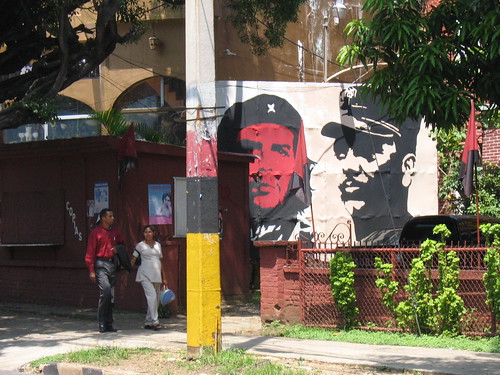
The photo below, taken in Gazcue, shows a billboard of two important figures for the Dominican left, and I believe sits on the grounds of HQ of the Fuerza de la Revolución (FR), a far-left party that united the Communists and several other key radical and independent political groups and organizations. Pictured are Che Guevara (on the left), the enduring icon of a certain era of Latin American transnational Socialism and a hero of the Cuban Revolution, and Francisco Caamaño Deñó (on the right) a colonel in the Dominican Army who was a key representative of the anti-Trujillo and later anti-US invasionary forces and briefly held the presidency in 1965.

Caamaño was a leading figure among the April 1965 revolutionists who overthrew the military-backed Triumvirate that had deposed the democratically elected leftist (PRD) leader Juan Bosch. Caamaño's associates, who came to be known as Constitutionalistas and who drew considerable popular supported, wanted ultimately to reinstall the deposed Bosch to the presidency and to reinstitute the Constitution of 1963, while the Triumvirate aimed eventually to place Dr. Joaquin Balaguer, a wily politician and confidant of the assassinated dictator Rafael L. Trujillo Molina (perhaps best known for his ordering the slaughter of 30,000+ Haitians and dark-skinned Dominicans in 1937; his brutal dictatorship and fascist leanings; his persecution of unionists and Roman Catholic clergy; and his role in helping to destabilize leftist governments across Latin America) in the presidency.

Caamaño ran the country from what was known as the Constitutional Sector, headquartered in a building on el Conde (the main thoroughfare of the Colonial Zone), and, not long after being sworn to the office, renounced it in favor of the former president of the Chamber of Deputies, José Rafael Molina Ureña. Shortly after the Constitutionalistas' removal of the Triumvirate from office and their successful attempt at blocking the military forces from crossing the Ozama River and entering the Colonial Zone area of Santo Domingo, the United States sent an contingent of marines and for the second time occupied the Dominican Republic. Despite international protests, the US manipulated the Organization of American States into backing its action, got several other Latin American nations (including Brazil, which was then under a dictatorship) to send forces, and helped to establish a parallel government that, unsurprisingly, facilitated the election of Balaguer; though Caamaño was sent to London as an envoy in 1966, by the following year he was in exile in Cuba, which had opposed the Trujillo dictatorship and openly protested the American occupation.

According to the Dominican authorities, Caamaño died leading a guerilla group in 1973. According to Ernesto Sagas's and Orlando Inoa's The Dominican People: A Documentary History, Caamaño, an enduring hero of Dominican independence and one of its great leftist visionaries, was slain along with his small, unsuccessful expeditionary force by the much larger and more powerful military forces, then under Balaguer's command, to which he'd once belonged.

Che Billboard

Saturday, June 25, 2005

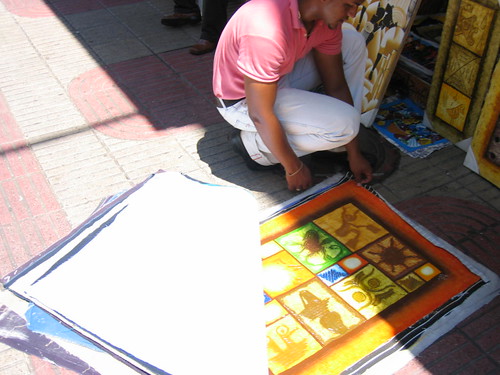
DR Photo: The World from above the Earth

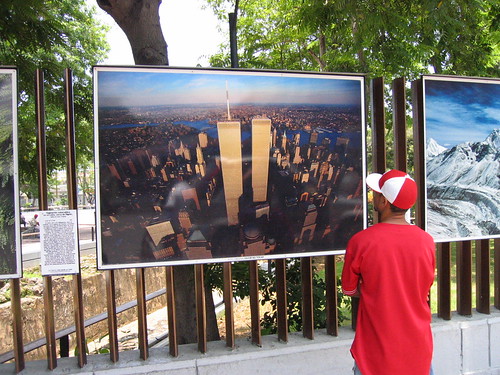
I'm still battling a cold, so here's another DR photo taken on Calle las Mercedes outside the Parque Independencia in Santo Domingo. It shows an exhibit of giant color photographs of scenes across the globe taken from high above the earth. The plate window-sized images ringed the gates of the park, which houses the tombs of the DR's 1844 independence leaders. Unfortunately I didn't manage to write down the name(s) of the photographer(s).

The particular image the young man is viewing holds special resonance for me, not only because of the terrible tragedy that happened there, but also because I lived for 7 years right across the river from where the Twin Towers once stood, and we used to be able see them from our home. Only a year before 9/11, I did a reading with Asha Bandele in a Barnes & Noble beneath the base of one that played for months on one of New York City's local cable channel; I vividly remember ascending the steep banks of escalators to reach the vast, wind-swept plaza....

Photo Exhibit

Friday, June 24, 2005

Downing Street Memo + Basquiat_in_Brooklyn's Event @ Nuyorican

By now most readers of J's Theater are probably familiar with the Downing Street Memo, which was actually minutes taken during a meeting, between top British officials and those in the White House in July 2002, concerning the then-looming Iraq War. The original memo, which was leaked during Tony Blair's parliamentary campaign, became memos when about six or seven more were subsequently released a few weeks ago. After the appearance of the initial one, blogs like Downing Street Memo, After Downing Street and Big Brass Alliance, and afterwards many of the other, better known liberal bloggers like AmericaBlog, Daily Kos, Atrios, Juan Cole, Doug Ireland, and numerous others, pushed the media for greater coverage of what are extremely significant documents, and the government for answers on when exactly the W administration actually decided to go to war against Saddam Hussein (the memos appear to make clear that it was well before W claimed, corroborating previous allegations by former Treasury Secretary Paul O'Neill and former top national security advisor Richard Clarke) and whether it not it actively lied and dissimulated, with the active connivance of the British government, by exaggerating, misstating or hiding evidence to convince the American people and Congress of the need for war.

The original leaked memo notes that the W administration was "fix[ing]" the "intelligence and facts" "around the policy," which seems like a clear enough indictment to me, though some W supporters and even liberal commentators have claimed alternative connotations. So be it, but actively lying to Congress, which alone has the Constitutional power to declare war, let alone all the other things that occurred to get our troops over there toppling Saddam, sounds like an impeachable offense. Given that Republicans control both houses of Congress, however, it's unlike we'll be seeing a trial anytime soon. (Would ill Supreme Court Chief Justice William Rehnquist, who got his start harassing Black voters in Arizona, be as jolly and dapper as he was when sitting in judgment of Bill Clinton?) The release of the original memo may have had some effect in Tony Blairs loss of 100 seats in the British House of Commons (were the Conservative Party more than a bad right-wing joke, and the Liberal Party not a pallid version of the old Labour Party, Blair might actually have been knocked off his perch), and yet most of the mainstream US press refused to cover it for almost five weeks. Some top editors of major newspapers, like the Los Angeles Times's formerly "liberal" Michael Kinsley, even pooh-poohed what is obviously a very serious issue altogether.

The easily cowed and timorous Democrats, however, have not been completely silent since the electoral debacle last November; Congressman John Conyers (D-MI) has led a charge by Democratic House members to demand accountability from the W administration. On Conyers' site, you can sign the letter he prepared, which is the same one more than 80 other members of Congress sent W on May 5, 2005. It asks the White House some hard questions about the Memo and its implications, and the more citizen signatories it gets, the better. I should add that the Blueblooded Weathervane himself, John Kerry, finally has prepared his own letter (he claimed several weeks ago that as soon as he returned to Congress he was going to broach this issue, but it took the senior Senator from Massachusetts, Teddy Kennedy, to deliver remarks on the floor of the Senate first), which was leaked to Raw Story today. A number of key Democratic senators, including Barbara Boxer, John Corzine (soon to be Governor of New Jersey), Frank Lautenberg, Dick Durbin, and Tim Johnson have signed on to it.

If you can, sign John Conyers' letter, and think about this: if Democrats were to regain the House and Senate in 2006, Conyers, as the ranking member would become head of the House Judiciary Committee and Henry Waxman (D-CA) would head the Government Reform Committee, while hard-hitter Pat Leahy would head the Senate Judiciary Committee. Impeachment would not be out of the question.... Voting machine shenanigans notwithstanding, do what you can to make this happen!

***
On a completely different note, fellow afroblogizen and cogitator Frank Leon Roberts hosts a 2005 Gay Pride event featuring James Earl Hardy, Staceyanne Chin, Alphonso Morgan, and Hanifah Walidah tomorrow at the Nuyorican Poet's Cafe.

Frank's Event
***
Another photo from DR:

artist
An artist flipping through his paintings on el Conde, the main street in Santo Domingo's historic Zona Colonial.

Thursday, June 23, 2005

Thursday Quote: Kant

"Enlightenment is man's release from his self-imposed immaturity. Immaturity is man's inability to make use of his understanding without direction from another. Self-imposed is this immaturity when its cause lies not in lack of reason but in lack of resolution and courage...."
-Immanuel Kant, "What is Enlightenment" (1784)

Wednesday, June 22, 2005

Obadike + Villareal + Bass (This Week!)

This is a week of openings for exhibits and performances by several multitalented people I know pretty well. I've been under the weather so I may miss the openings, but when I'm feeling better I intend to view the exhibits.

First up, fellow CCer Dr. Mendi Lewis Obadike, who brilliant posts on SWEAT, will be showing some of her work in the Rhizome Artbase exhibit, beginning tomorrow at the New Museum of Contemporary Art, 210 11th Avenue 2nd Floor NYC 10001. The opening was tonight at 6:30 pm.

RHIZOME ArtBase 101
June 23 - September 10, 2005

RHIZOME ARTBASE 101 surveys salient themes in Internet-based art-making, a practice that has flourished in the last ten years. The exhibition presents forty selections from Rhizome.org's online archive of new media art, the ArtBase, which was launched in 1999 and currently holds some 1,500 works by artists from around the world. Featured works are grouped by ten unifying themes and include seminal pieces by early practitioners as well as projects by some of the most pioneering emerging talents working in the field today. Encompassing software, games, moving image and websites installed on computers or elaborated in installations, Rhizome ArtBase 101 presents the Internet as a strapping medium that rivals other art forms in its ability to buttress varied critical and formal explorations.

You can view the digital work, "Keeping up Appearances," here.

***
VillarealA very good friend of a very good friend, writer and artist Rebecca Villareal, is having her first Chicago exhibit at the Jumping Bean Cafe in Pilsen.

Her photos (like "New Window" at left) are visible here.

Today Alison Neumer positively blurbed the exhibit in the Chicago Tribune:

Philadelphia-born artist Rebecca Villarreal captures quiet daily moments in Chicago's Pilsen neighborhood in her first photography exhibit, "Intimate on 18th Street," a collection of 22 black and white images that opened Friday in the neighborhood's Cafe Jumping Bean.

Villarreal, who also is a published poet, photographed a nearby barber shop and the men who wield scissors there, a ballet class for young girls taught out of a neighbor's spare room, and a sewing machine store packed with old models.

"I'd like to see more people embrace the small joys of life," Villarreal said, pointing to the subtle details and emotions in her photos that eventually emerge for the patient viewer. "New Ballerina" is a straight-on portrait of a small girl in a ballet skirt and shoes whose face is bright with pleasure and concentration.

Last year Villarreal, 36, moved to Pilsen from Washington, D.C., where she had lived starting in college. She was inspired by her new surroundings, she said.

"It's like a muse falling down on you," she said. "It needs to be shared, and that's why I make art."

"Intimate on 18th Street" runs through July 21 at the cafe, 1439 W. 18th St.
***
Finally, this Saturday, fellow CCer and sower of beautiful spirits Holly Bass presents her one-time, one-woman performance, "Diary of a Baby Diva," which the press release describes like this: "A giddy concoction of comedy, monologues, lipsynching and musical dance sequences--the Village Voice called it 'mesmerizing'--it bends genres and genders. It'll take place at this year's Downtown Urban Theater Festival, during Gay Pride weekend.

Diary of a Baby Diva
for one night only at the
Cherry Lane Theatre Studio
Written and Performed by Holly Bass
Directed by Barbara Colaciello-Williams

Cherry Lane Theatre Studio
7:30PM, Saturday, June 25, 2005
38 Commerce Street, New York City

Tickets are $20 in advance or $25 at the door.

To order call 212-352-3101 or go to theatermania.com (then go to "Downtown Urban Theater Festival 2005 (DUTF)" and click on "The Dakota & Diary of a Baby Diva."