Tuesday, June 21, 2005

Trip Reading (Senna; Kluge) + Pic

For once I acted like I had good sense and didn't take 10 books to read on a four-day trip to the Dominican Republic. I only brought along two: acclaimed author Danzy Senna's new novel, Symptomatic, which I read and finished in a little over a day, and Alexander Kluge's The Devil's Blind Spot: Tales from the New Century, which at 100 stories is a distilled version of the German original that includes, I believe I read somewhere, at over 500. (His New Notebooks 1-17: "The Uncanniness of Time", from the 1970s, has about as many, and some are recycled, such as one of my personal favorites, "From the Age of the Enlightenment." ) I did not buy any books this trip, mainly because I didn't visit even one bookstore, though at the airport's giftshop, which includes a small book section, I saw poetry and fiction anthologies that were very interesting. The last time I was there, I purchased a thorough, readable history of the country, Historia Dominicana (no less), written in Spanish by Dominican historian Jaime de Jesús Dominguez and published by ABC Editorial, a publishing company based in Santo Domingo--and, I should add, it does not stint on, but probingly examines the country's extensive African heritage, from the cover imagery to the text itself (I'll post more on the DR soon).

The Dominican author whose I am usually on the lookout for is the narrativist and critic
José Alcántara Almanzar, in part because I was once mistaken for him at the Macondo bookstore in New York City, and because his short fiction and critical texts are excellent. But I didn't do much searching this time through. Me disfrutaba....

SymptomaticSenna's book, as I've noted above, I read in almost one sitting. I found her first, award-winning novel Caucasia rich in characterizations, well plotted and thought out, almost perfectedly keyed in tone and voice, brimming with telling details: an excellent debut. Though the themes of the mixed race person's--in particular the "mulatto"--struggle to situate herself in the social structure and racial passing have been amply treated in American and African-American literature, Senna conversed with her literary predecessors while transcending them with her deeply engaging, contemporary story. My main quibble was the periodic slackness of the prose, but I didn't think it detracted from the book's overall high quality. Tisa B. pointed out to me that Caucasia was a response of sorts to an earlier work, The Deep North, by Senna's mother, the marvelous fiction writer, poet and translator Fanny Howe, and after reading that enchanting and provocative little novel, I completely agreed, and have wondered whether anyone has written about these two works in conjunction. (Does anyone know?)

Symptomatic has neither the grand aspirations nor the depth of characterizations, structural complexity or wealth of recognition that the earlier book had; it essentially treats a similar theme, that of the emotionally, socially and psychologically dislocated mixed race person in America, but uses the genre of the noir thriller, which makes it hard (impossible!) to put down, but ultimately renders it less successful than the earlier work. My main quibbles were with the moments of implausibility and obviousness (there is one very early on that made me say out loud, "Oh, no, please, this is too over the top"), as well as passages of discursive shorthand that exist in so much contemporary writing; Senna has estimable talent, as both her first novel and this one, despite its faults, make clear, and so I wanted her not ever to take the easy path, in terms of descriptions, details, characterizations, anything. (Anytime an author describes someone as "blond" these days, I cringe--and I do so even more when an American writer of color resorts to what is basically now a null term.) Senna's skills are extensive, however, so she manages to endow the novel with elements that a work by a less talented author wouldn't achieve, such as a deftly interwoven symbolism throughout (involving names, mirrors, etc.), many moments of irony and humor, including an identity switch that calls out to be transferred to film, and those telling details that make Senna an author I admire and read carefully. I'm still trying to decide whether or not I'll teach this novel this fall, but it was definitely worthwhile travel reading, especially, given its theme, to the DR.

Kluge NovelI'll write more about Kluge soon, but will say here that there is no writer like him in contemporary American literature, nor, for that matter, in almost any literature I know of (though there very well may be others writing elsewhere who are doing similarly unusual things). A noted lawyer, philosopher and social critic, and one of the most important filmmakers and leaders of the New German Cinema, with films such as Yesterday Girl (based on his famous story "Anita G."), The Female Patriot, Occasional Work of a Female Slave, and Artists Under the Bigtop: Perplexed, he has also published short fiction, or rather texts that hover between several different genres in which fiction, history and philosophy are central since the early 1960s, when he issued his first collection, Lebensläufe (Case Histories), which was translated initially by Leila Vennewitz as Attendance List for a Funeral, and then later under the more approximate English title. One of his most notable stylistic traits is his dizzying concision; in the early work, this function at the level of the sentence, which is to say in descriptive passages of pinpoint precision and detail, as well as aphorisms, but in the later stories (Kluge is around 73), the brevity rises to the level of the texts themselves--as overall length, concision of structure, characterization, you name it. Many of the stories in The Devil's Blind Spot (and he actually does write about the Devil, or some version of him, in many of the pieces) are no longer than two-three printed pages, or are broken up, as in the earlier work, into sections which also are as brief as prose poems, though they're written in declarative prose and fragments, and rarely in lyric language. I have about two sections to go, but I can say, anyone who can range from stories about medieval witchcraft to the unrequited souls of African slaves in Brazil to Adorno's girlfriend to the Islamicists' attacks on the American embassy at Islamabad to the thought processes of cilia (yes!) and make nearly all these texts work gets superprops from me.

I also realize as I'm concluding this book that a genius of Kluge's type is sorely needed in our contemporary American sociopolitical discourse, but his is such an acquired taste that it's unlikely he'll be read by more than a handfull of people. But more on him and the stories soon.

C. purchased a new, small camera, so we were snapping photos throughout the trip, and here is one of my favorites, a young brotha changing money in a gallery-money exchange-warehouse-hangout spot right off the main street, el Conde, and the park in front of the Cathedral Basílica of Santo Domingo, the oldest Catholic church in the oldest continously European-settled city in the Americas. To say his arms and hands are dancing as he's enjoying himself (money can do that to you!) wouldn't be an exaggeration.

Cambiando dinero
Photo © John Keene, 2005.

Monday, June 20, 2005

Back + Helen Oyeyemi + Sidgwick Review

I'm just back from an incredible trip with my partner C., elated and pretty exhausted, and I'll post a bit about some aspects of it eventually, but here are two little blurbs to two interesting pieces I came across today.

The first is a link to Felicia Lee's profile of Nigerian-British novelist Helen Oyeyemi in today's New York Times. Titled "Conjuring an Imaginary Friend in the Search for an Authentic Self," it touches upon Oyeyemi's new and highly praised first novel, The Icarus Girl, and its relation to her personal life story, the racism of British "multicultural" education, and the author's other projects, including a novel-in-progress that sounds fascinating. Lee, to whose articles I've previously linked, cannot help herself in terms of the hype surrounding Oyeyemi's youth, but this is hardly surprising, as it's been one of the media's and publishing industry's guiding memes for some time.

She does, however, manage to convince you that The Icarus Girl is one of the books to read this year (I'm definitely going to get it ASAP), and that the author, Oyeyemi, is a grounded, charming and prolific writer to follow.

In a recent (June 6, 2005) issue of The Nation, the philosopher Martha Nussbaum writes about an author for whom there is no contemporary hype, the Victorian Utilitarian, Henry Sidgwick (1838-1900), whose name, I would imagine, is recognized by very few people these days, and is certainly less well known than either of his two major predecessors, Jeremy Bentham (1748-1832) or John Stuart Mill (1806-1873). In her spirited and persuasive yet fairly brief review, entitled "The Epistemology of the Closet" (playing obviously off Eve Sedgwick's landmark literary and cultural study) of Bart Schulz's just-published, mammoth biography of Sidgwick, Nussbaum suggests that Schulz has succeeded in portraying the tremendous complexity of an essential philosopher whose life work was to figure out how human beings could be happy and simultaneously pursue fairness. Among his intellectual descendents are some of the greatest thinkers of recent years, including Bernard Williams, John Rawls, and Amartya Sen. One of my favorite sections is when she quotes a section of Sidgwick's private notations to show his struggle, captured in an offhanded poetic voice and style that remind me of Whitman, Wittgenstein and others, with the normative ethos of his time:

1. These are my friends--beautiful, plain-featured, tender-hearted, hard-headed.
2. Pure, spiritual, sympathetic, debauched, worldly, violent in conflict.
3. Their virtue and vice are mine and not mine: they were made my friends before they were made virtuous and vicious.
4. Because I know them, the Universe knows them and you shall know them: they exist and will exist, because I love them.
5. This one is great and forgets me: I weep, but I care not, because I love him.
6. This one is afar off, and his life lies a ruin: I weep but I care not because I love him.
7. We meet, and their eyes sparkle and then are calm.
8. Their eyes are calm and they smile: their hands are quick and their fingers tremble.
9. The light of heaven enwraps them: their faces and their forms become harmonious to me with the harmony of the Universe.
10. The air of heaven is spread around them; their houses and books, their pictures and carpets make music to me as all things make music to God....
13. Some are women to me, and to some I am a woman.
14. Each day anew we are born, we meet and love, we embrace and are united for ever: with passion that wakes no longing, with fruition that brings no satiety.

I doubt I'll have much time to read this Sidgwick biography soon, even one that sounds so appealing, but when I break through my backlog, I'll keep this one in mind.

Wednesday, June 15, 2005

Poem: Michael Harper

I'm off for several days to celebrate my birthday, and I may not be able to post until I get back--though I may try to upload a few photos--so until then, a Michael Harper poem in keeping with my last couple posts:

Four Worthies: Souls of Black Folk

To Know, in heart, in groin;
to Move, trestle, bog, boat, mask;
to Love, woman, child, land, trees;
to Aspire, where blood, sperm, bone join.

Copyright © Michael S. Harper, from Images of Kin.

Tuesday, June 14, 2005

130 Years of Sumner High School (St. Louis)

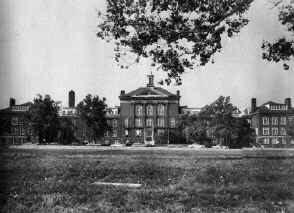
As a counter to the post on the anti-lynching resolution, I thought I'd mention a more positive historical story, that of Sumner High School in St. Louis, Missouri. This year, Sumner turns 130 years old, making it the oldest public high school for Black students west of the Mississippi River.

Sumner was founded in 1875 as the "High School for Colored Students" during the Reconstruction era (which Rutherford Hayes would end a year later in his successful ploy for the Presidency), and was named after the then just-deceased Massachusetts abolitionist Senator Charles Sumner, whose personal dedication to the freedom and equality of African-Americans was exemplary. In 1848, he helped to found the Free Soil Party, some of whose adherents later went on to establish the anti-slavery Republican Party. In 1849 he legally challenged the segregation of schools in Boston. In 1856, he was caned to unconsciousness on the floor of the Senate by Southern pro-slavery Congressman Preston Brooks after insulting Brook's uncle in an attack on the slavery partisans in Kansas; because of his injuries, Sumner could not attend to his Senate duties for three years. During the early days of the Civil War, he was one of the first to push for the enlistment of Black soldiers, and strongly supported Union General John C. Frémont, later Senator from California, who unilaterally freed the slaves in Missouri in 1861 without federal authorization. Later he pushed through the Civil Rights bill of 1866 and the Reconstruction Acts of 1867, all of which had a dramatic effect on the participation, at least for a brief moment, of African Americans in American public and civil life. Sumner also led the impeachment proceedings against Southerner Andrew Johnson, and during Ulysses S. Grant's first term fell out with the Union War hero over what Sumner perceived to be his insufficient attention to the cause of Black liberty. Sumner died of a heart attack in 1874.

In sum, then, an appropriate person after whom to name the first public school for Black students. I should also note that ex-slave John Barry Meachum established the first St. Louis school for Black children in 1827, yet was forced to close it shortly thereafter. In 1847 Missouri outright banned the education of Blacks on its soil, fearing that intellectually armed they might revolt, so Meachum ingeniously started a school on a riverboat shortly thereafter. Also, William Greenleaf Eliot, the founder of Washington University in St. Louis and grandfather of the poet T. S. Eliot, co-founded a school to educated free and escaped Blacks at the height of the Civil War, in 1863; two days after it was opened it mysteriously burned down, though it continued at different sites for several years. Finally, Hiram Rhoades Revels, who became the first Black member of the United States Senate in 1870, from the state of Mississippi no less, also established schools for Black children. Revels, who had earlier been a principal of a school for Black children in Baltimore, started his St. Louis school around the start of the Civil War, and it also was located on a boat. I should also add that last fall I actually met Revels's grand-daughter, now an octogenarian; she lives in Chicago and is one of the premier collectors of African-American art in that city.)

I didn't attend Sumner (my own high school alma mater turns 50 years old this fall), but my parents, one of my grandfathers and both of my grandmothers did, one of my godmothers and one of my godfathers, many of my aunts, uncles and cousins did, as did the majority of Black teenagers through the period of integration of St. Louis's schools, which began in the late 1950s and continued well into my own high school years, in the 1980s. St. Louis's public (and private, for that matter) schools were racially segregated, as were most of its facilities and institutions; as the (once) chief city in a former slave state, it applied Jim Crow laws with a vengeance. (Actually, Blacks still were expected to get their food through the back doors of some restaurants as late as the mid-1960s, though "colored" drinking fountains and required back-of-the-bus seating were no longer officially in effect. )

Originally Sumner was located at 11th and Spruce Streets downtown, but after parents protested that the students were required to walk past the gallows and morgue, officials moved the school in the 1880s, and then in 1910, after parents again petitioned the school district, Sumner moved to its final site, 4248 Cottage Avenue, in the historic Ville neighborhood, with the building designed by famous educational architect William B. Ittner.

Sumner remained St. Louis City's only Black public high school until 1927, when Vashon High School was founded. (Vashon was named for George Boyer Vashon (1824-1878), an abolitionist and jurist who was the first Black person to graduate from Oberlin College and later became the first African-American lawyer in New York State in 1847 and the first Black person to run for statewide office in New York in 1855; and his John B. Vashon (1859-1924), a noted Black schoolteacher, lawyer and linguist who taught in the St. Louis Public schools for 34 years.) St. Louis's lone suburban Black high school for many years, (Frederick) Douglass High School, was established in 1892 in Webster Groves (home also to writer Jonathan Franzen), just up a hill from where I grew up.

Among Sumner's most famous alumni are Arthur Ashe, Chuck Berry, Grace Bumbry, Hon. William Clay, Billy Davis, Jr. (of the Fifth Dimension--group members Ron Townson and Lamonte McLemore were also from St. Louis), Dick Gregory (who graduated around the time of my mother and whose brother was her classmate), Robert Guillaume, Elston Howard (Yankee great), Robert McFerrin (the opera singer and father of Bobby "Don't Worry, Be Happy"), and Tina Turner (who was there when my uncle James was in school). (I think I heard that Congresswoman Maxine Waters also attended Sumner, but I'm not sure.)

In addition to a reunion in February and a black-tie fundraiser this upcoming Saturday, a core group of Sumner alumni have envisioned a mentoring program to reach its current faculty and students, whose socioeconomic profiles and educational backgrounds differ considerably from students during the school's mid-20th century heyday, when Sumner drew from all sectors of St. Louis's Black community. The alumni's involvement can help to ensure that despite the changed conditions, Sumner remains a vital institution and continues to play a vital role in the African-American communities of St. Louis and the nation. I hope the effort takes flight, not only at Sumner but at other similar institutions across the country, and to Sumner High School, I wish it 130+ more years of remarkable service!

Monday, June 13, 2005

Senate Apologizes (Finally) for US Lynching

Almost 40 years after the last officially recorded lynching of an African-American person occurred--and I say "officially recorded," since many lynchings were never recorded, and periodic lynchings and brutal racially motivated murders have continued to occur across the United States up to the present day--and despite the House of Representatives thrice passing resolutions and the urgings of 7 US Presidents, it wasn't until today that the United States Senate finally approved a non-binding resolution that issued a formal apology for the 4,742 recorded lynchings that occurred between the 1880s and the 1960s. Descendants of lynch victims, as well as a nonegenarian survivor, James Cameron, came to the Capitol to share their family histories of lynching, and accepted the resolution.
Crawford
According to the New York Times, this resolution was the first time in US history that the Senate had ever apologized to African Americans for anything. That is, in 229 years (if you go back to 1776) or 219 (if you pick 1789), despite all that has befallen Black people in the US, the Senate never once before apologized for a damned thing. Better late than never, I suppose--except that instead of a roll call vote, the Senate, taking the cowardly route, used a voice vote, which means that there is no printed record of how the actual Senators actually voted. And the resolution had only 80 co-sponsors, the chief ones being moderate Democrat Mary Landrieu of Louisiana, and the repellent Republican George Allen of Virginia (he of the Confederate flag and nooses in his office!), though there are 100 Senators. So who were the 20 who didn't feel the need to support this non-binding, grossly overdue, utterly symbolic resolution? I have some ideas...and who took the truly slimy route and voted against it? Unfortunately we may never know.

Tonight on the News Hour with Jim Lehrer, correspondent Gwen Ifill spoke with one of the leaders of the apology movement, Doria Dee Johnson, the great-granddaughter of Anthony Crawford (pictured above, F.S. Hays From NAACP files at Library of Congress) of Abbeville, South Carolina, a community leader (president of the Black Masons, founder of a farmer's union and a Black school, member of a federal jury, voter) who was lynched in 1916 after claiming that a white store owner was paying him five cents less (.85) than white farmers. As Johnson, the founder of Anthony Crawford Remembered, struggled through an obvious surge of sorrow to relate the story to Ifill, over 200 whites in Abbeville, after beating, stabbing and shooting Crawford, hanged his body from a tree, then ordered all 13 of his children to abandon their homes and property on penalty of death. Over 100 of his descendants were present at the presentation of the resolution today. Ifill asked Johnson "what difference does [this apology] make?" Johnson had some excellent responses, one of them being that if you didn't do this, "You have blood on your hands."

A necessary symbolic step, like Clinton's apology for slavery, but the rivers and creeks and gulleys, like the mountains and plains from Maine to Florida, Maryland to California, remain incarnadine with the blood of countless Black Americans....

***
Update: According to Americablog, here are the bloody-handed crew who refused to cosponsor--even after the fact--the symbolic lynching resolution. All but one are Republicans; big surprise! Let's also not forget that these are the people who just put Janet Rogers Brown, a horribly damaged Black woman who equates liberalism (which ended the legal segregation into which she was born!) with "slavery" and called the New Deal America's "socialist revolution" on the DC appellate court. Their contempt for Black people and Americans in general (no, make that humanity in general) knows no bounds....

Lamar Alexander (R-TN)
Robert Bennett (R-UT)
Thad Cochran (R-MS)
Kent Conrad (D-ND)
John Cornyn (R-TX)
Michael Crapo (R-ID)
Michael Enzi (R-WY)
Chuck Grassley (R-IA)
Judd Gregg (R-NH)
Orrin Hatch (R-UT)
Kay Bailey Hutchinson (R-TX)
John Kyl (R-AZ)
Trent Lott (R-MS) -- Big surprise here!
Lisa Murkowski (R-AK)
Richard Shelby (R-AL)
Gordon Smith (R-OR)
John Sununu (R-NH)
Craig Thomas (R-WY)
George Voinovich (R-OH)
+ Senate Majority Leader Bill Frist (R-TN: he refused a roll call vote!)

Sunday, June 12, 2005

Puerto Rican Day Parade + Hip-Hop Theater Festival + 2 New Fest Films

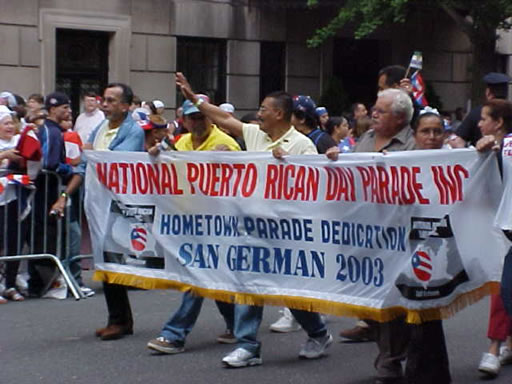
In 1958 the first Puerto Rican Day Parade in New York occurred, just over half-a-center after Puerto Rico became a U.S. colony as a result of the Spanish-American War; in 1995, this celebration of Puerto Rican heritage and pride became the National Puerto Rican Day Parade. Today marked the 10th anniversary of the national celebratory march, which took place along Fifth Avenue from 44th to 86th Streets and ran from 11 am-6 pm (officially). The parade once again drew one of the largest and most festive crowds of any of New York's summer festivals, with marchers and musical performers from all of New York's boroughs, delegations from the island and islets of Puerto Rico, as well as celebrants from across the City, tri-state area, U.S. and world.
Tego
Very obvious this year was the audible dominance of reggaeton/reggetón music and its stars (Ivy Queen, Daddy Yankee, Zion y Lennox, Julio Voltio, Baby Rasta, Adassa, Wisin, etc., and the Afrorican lodestar himself, Tego Calderón) over the more traditional Puerto Rican musical forms, salsa and bomba y plena; even the TV commentators (repeatedly) made note of it. They also noted the increased presence of younger participants, both in the parade itself and in the stands, though they offered no suppositions or explanations for why. I won't either. But it does bode well for the future of this event, which despite some recent problems (including attacks on female attendees several years ago), one of the centerpieces of New York's heritage celebrations. En el espíritu del desfile de hoy, let me add: ¡Viva el Borinken, viva la gente y el orgullo boricua!

***
Benji Reid
Hearing reggetón today jogged my memory about another event that began yesterday and runs until this upcoming Sunday: The fifth annual Hip-Hop Theater Festival. Taking place in multiple cities this year (San Francisco for 10 days in May, Washington in July, and Chicago in September), the weeklong series of plays and performances hit New York with a "best-of" previous festivals event and a late-night party at Sutra, on the Lower East Side. Other events include a hiphopera, some interesting-looking solo sets, and two world premieres, including Briton Benji Reid's "13 Mics" (pictured at right, courtesy of Hip-Hop Theater Festival) and German Niels "Storm" Robitzky's "Solo for Two." I'll be away so I'll have to miss most of it, but if any readers check it out, do post a reply or direct me to your comments on it.

***

This weekend I did see two films at New Fest, Kyle Schickner's feature Strange Fruit, and Nicole Conn's documentary little man, which was co-produced by a friend of my partner C.

Strange Fruit was definitely worth catching, despite being very uneven, with an outlandish ending. What I found refreshing were the attempted depiction of one Black gay man's return to his former home in the Deep South (Louisiana's bayou country), the desire to tweak the viewers' plot expectations, and some of the portrayals, particularly the thoroughly handsome Kent Faulcon as William Boyals, the Black, gay, New York-based attorney who heads back to his native town to investigate the lynching on his friend, Kelvin Ayers, and David Raibon as Duane Ayers, Kelvin's straight, paroled brother (both pictured below). What wasn't refreshing was the recourse to stereotypes and clichés, the gaping plot holes and implausibilities, and the moments of (very) bad acting. For whatever reason, the actors depicting the white police officers were especially off-key, as was the young actor who overemoted as Boyals' ex. The bayou setting itself verged a bit too much on a boiled down In the Heat of the Night. (A close friend's date, a brotha who's a native of southern Georgia, said that he found the setting totally unbelievable.) I personally thought that with a few shifts in the plot to tie up some of the unbelievable elements, better direction to tone down the acting (and nail the Louisiana accents), and the elimination of the schmaltzy non-diegetic music, the film would have been much stronger. Still, it's rare to see the characters and scenarios Strange Fruit depicts on screen (down to the floating, rope-pulled walkway needed to reach the gay bar), so even with its serious faults, I'd recommend it.
Faulcon and Raibon
Little man follows the vicissitudes of filmmaker Conn (Clair of the Moon, Cynara) and her partner, political activist Gwen Baba, after they contract with a surrogate mother who turns out to have health problems that result in a severely damaged infant. The documentary skillfully and movingly follows Conn, Baba, their daughter, and the baby boy, Nicholas, as he battles for life over a period of several years. More than once he hovers on the threshold of death, as his body's neuroelectrical system cannot regulate itself and his digestive system in particular falters; his struggles and their effects on Conn and Baba provoke each of them to question their initial aims in the surrogacy, interrogate their personal and shared values, and to ask what constitutes a "decent life" for a child experiencing such intense and continuous suffering. I won't give the ending away, but it is an excellent movie, and one ancillary point it broached for me was the issue of access to quality health care, which millions of Americans lack completely, yet which is so essential to Nicholas's survival. The film unfortunately doesn't press the question, but if these two extraordinary women did not have the resources to fund their son's repeated trips to the hospital, his surgeries, his physical therapy, his necessary medical equipment, and so on, what might the outcome have been? All in all, little man is a superb documentary which I hope, like Strange Fruit, makes it to more theaters and TV (Sundance, Logo, etc.) soon.

Saturday, June 11, 2005

Saturday Quote: Manthia Diawara

"For people of African descent, blackness is...a way of being human in the West or in areas under Western domination. It is a compelling performance against the logic of slavery and colonialism by people whose destinies have been inextricably linked to the advancement of the West, and who have therefore to learn the expressive techniques of modernity: writing, music, Christianity, and industrialization in order to become uncolonizable. They have to recuperate the category black from the pathological space reserved for it in the discourse of whiteness, and reinvest it with attributes valorized in modern humanism."
--Manthia Diawara, from "Englishness and Blackness: Cricket as Discourse on Postcolonialism"

Friday, June 10, 2005

Freewayblogger.com

Subversion, a particular form of resistance, can take many forms. Freewayblogger.com's is pretty ingenious and worthwhile, recognizing our national dependence upon cars and roadways, especially highways, and using them as a means to promote dissenting, dissonant, truthful speech.

The site contains several pages of great images, links to similar sites, a cursory examination of the legality of the signage, a blog, an archive, and pointers on other suggested activity, all of which fall under the rubric, which we can never take for granted, especially not in contemporary America, of promoting and exercising our Constitutional right to "free" speech.

Thursday, June 09, 2005

Javier Marías's Your Face Tomorrow

One book I'm especially looking forward to reading this summer is the first volume of Spanish writer Javier Marías's trilogy, Your Face Tomorrow: Fever and Spear (Tu rostro mañana: 1 Fiebre y lanza), which New Directions published earlier this month. Over the last decade the profoundly prolific Marías (1951-) has become one of the most widely translated, read and discussed contemporary Spanish authors, because of his succession of deceptively transparent but delightfully enigmatic, quasi-autobiographical, highly discursive novels, which include All Souls, A Heart So White, Tomorrow in the Battle Think of Me, When I Was Mortal, The Man of Feeling, and the truly Sebaldian Dark Back of Time.
Marias
My favorites are All Souls, a fictional account of Marías's sabbatical at Oxford, which manages to movingly evoke (and invoke) an outsider's experiences in that strange, hermetic world and possess a far greater depth than its pages at first reveal, and the disarmingly memoiristic Dark Back of Time, which at first seems to be an analytical exploration of the earlier Oxford book before it dissolves or expands into a far more complex and elusive text about fiction, narration and authorship. The only book of Marías's that I've read--or more like stumbled through--in Spanish is Vidas escritas, a colorful--and fairly easy to read--series of capsuled ruminations on writers such as Dostoyevsky, Kafka, and Faulkner, so I can't speak to the quality of the translations, from all the reviews I've seen, his regular English translator, Margaret Jull Costa, is superb.

Your Face Tomorrow: Fever and Spear on first glance seems to be a departure; it's billed as a kind of spy or detective novel, whose protagonist, Jaime (or Jacques or Jack) Deza, recently separated from his wife, finds himself being recruited for the British secret service. But almost immediately many of Marías's touchstones pop up: the recruiter is none other than a retired Oxford don; the narrator's voice unfolds in ponderous, yet charged serpentine curls; and history (or History), ever present in the previous novels, plays a determined role here. I haven't gotten that far, so I can't say much about how this first book in the trilogy functions on its own, but the reviews suggest that it does hold up quite well, guiding you right into book number two (Dance and Dream), which I also look forward to reading. Marías supposedly is writing the third volume right now.

Being a truly contemporary author, he has a fabulous Website (which is almost completely in Spanish, except for one page with hyperlinks to essays on his writing, interviews and reviews), chock-full of information on his work and life, and best of all, a very chatty blog!

Here are the opening sentences of Your Face Tomorrow: Fever and Spear, which gives a sense of Marías's style and thematic concerns, and the rich vein of possibilities they both hold and discharge:

One should never tell anyone anything or give information or pass on stories or make people remember beings who have never existed or trodden the earth or traversed the world, or who, having done so, are now almost safe in uncertain, one-eyed oblivion.

Wednesday, June 08, 2005

Remix Hotel 2005 NYC + Haiti Update

Remix HotelAlways so much going on in the naked city! This past weekend, Remix magazine's Remix Hotel held its 2005 three-day total immersion conference for DJs, professional and amateur musicians, and others interested in hands-on access to the latest in electronic music technology and equipment. The gathering included presentations and demos, workshops and master classes, panel discussions, live performances, and parties.

According to the heads up I got from Shocklee Entertainment, Remix Hotel 2005 NYC drew over a thousand attendees, including Chuck D, Prince Paul, Brand Nubian, Pete Rock, Tony Tone, Rich Medina, Needlz, Jeru the Damaja, Jae Millz, Cipha Sounds, Propellerhead, Lil' Cease, and Latasha Natasha Diggs. There are some photos of the event on the Remix Hotel 2005 pages, with more to come.

The next Remix Hotel is scheduled for August 5-7, 2005, in Los Angeles, and another one was originally scheduled for some time this year in Chicago, so if you have any interest, check out the site and register in advance.

***
HaitiHave you written/called/faxed/blasted your Congressperson concerning the worsening situation in Haiti yet?

Back in March I posted about the ongoing problems there ("Sake pase nan Ayiti?"), so I won't rehash them, but keep in mind that although the mainstream media have aimed their focus on the W administration's nation-building (and destroying) activities in Afghanistan and Iraq, they have almost completely averted their gaze from the crisis the United States and France exacerbated in the oldest independent Black nation in our hemisphere.

Before the coup that exiled Haiti's democratically elected president, Jean-Bertrand Aristide, we were told that he and his Lavalas Famn Party were the main obstacles to a functioning democracy; the intransigent opposition simply would not and could not work with him, and the creeping thuggery, which included murders, abductions, death threats, and so on, was laid at Aristide's doorstep. Yet since Aristide's departure, things have not improved. They have gotten worse. Despite the blandishments of the US's puppet, Gerard LaTortue, political and criminal killings continue unabated, the rebels have not fully disarmed, the UN troops, mostly from Brazil, have maintained only a tenuous peace in parts of the capital, and the majority of Haiti's more than 7 million people continue to suffer, politically and economically.

If this were not bad enough, Haiti's neighbor on Ayiti-Kiskeya, the Dominican Republic, is again expelling Haitian refugees from its territory of late (a state action that occurs periodically, especially when, as now, the DR is suffering its own severe economic downturn). And, according to a Reuters report today, the W administration just suggested that Haiti's illegitimate government buy more weapons to arm its police force, rather than working harder to reserve the political hurdles that have paralyzed the country's government and economy. This is another foreign mess this administration has stoked, and rather than let it continue to pass undiscussed by our own government, please contact your Congressperson and ask her or him to put it on the legislative docket. Millions of peoples' lives hang in the balance.

Tuesday, June 07, 2005

Book Returns + Fassbinder's Birthday + Bancroft RIP

If you've ever had a book published in sizable numbers (say above 2,500-5,000 copies) by someone other than yourself or a vanity press, which is to say from one of the small independent presses to one of the conglomerates, and if your book made its way into one of the bookstore chains and it wasn't a bestseller--which would characterize the vast majority of books printed and published since Gutenberg--then you probably have dealt with "returns." For the author, returns usually mean a negative number on the royalty statement; after the press has earned back its monetary advance (which might be anywhere from $1,000 to $1 million or more, depending upon the book and author), if there is one (and there usually is one, however modest, for works of fiction and non-fiction of all kinds), the author often will get royalties, even small ones.

However, according to the strange economics of the book business, booksellers can return unsold books to the publisher. Authors get no royalties on these returned books, which publishers often will then sell at heavily discountered prices to "remainder" houses, if they don't pulp them outright. Remaindered books, like used and resold books, provide authors with no royalties, so if the books don't sell and are returned, and if the publishers don't keep the returned books in a warehouse to sell at full price down the road, an increasingly unlikely prospect given the huge volume of books published each year, the author's chance of earning any royalties diminishes to zero. The return system as it stands disincentivizes the chain book stores from keeping books for the extended periods they once did; they simply bring in the new books, ship out the old, and the consumer has to either order the book when she walks in or go the online ordering route.

Overall, the system is a mess, and is getting worse. The consolidation of publishers, bookstores and distributors--which has led to a rise in book prices; a narrowing of content, including a dumbing down of books in general; and the disappearance of independent first-sale bookstores in many cities--along with the overall national decline in reading, draws a grim portrait of the future of book publishing as we've known it. Other options, including just-in-time electronic publishing and books-on-demand, appear to offer some promise, but until they mature, publishing will continue careening towards its demise.

That's my potted discussion of the topic. Here's another, by the Wall Street Journal's Jeffrey Trachtenberg, in the current edition of the Pittsburgh Post-Gazette: "Quest for best seller means lots of returned books." It's not just a grim portrait, but a grave one, but necessary reading for anyone interested in the current business of books.

***
Ali
Doug Ireland's recently blog pointed out something I'd missed completely: the just passed birthday of the late German playwright, filmmaker-auteur and force of nature, Rainer Werner Fassbinder (1945-1982). It's hard to capture nowadays the esteem and excitement with which many cinephiles held Fassbinder's movies in the late 1970s and early 1980s, when he became one of the leading representatives of a new wave of European, and in particular German, cinema. As late as the early 1990s Fassbinder, whose films represent a particular vein of post-modernism, was also being taught in many film and semiotic studies programs. His idiosyncratic and ironic revival of Sirkian melodrama is especially significant, and is visible in the work of US filmmaker Todd Haines.

Some of Fassbinder's early and mid-period films, like Why Does Herr R. Run Amok? (1970) and Whity (1971), while still fascinating, don't hold up so well in retrospect, but other early films, like his existential drama Katzelmacher (1969), the race-age-class-tinged tragedy Ali: Fear Eats the Soul (1974, shown above), and the stunningly overwrought The Bitter Tears of Petra von Kant (1972), as well as his late masterpieces that deal with the Nazi period and its aftermath--The Marriage of Maria Braun (1979), Lilli Marlene (1980), Lola (1981), and Veronika Voss (1982), and the magisterial TV version of Alfred Döblin's Berlin Alexanderplatz(1980)--remain significant moments in cinematic art. Unlike most of today's mainstream movies, Fassbinder's films often deal with publicly and privately conflicted (and constrained) characters, usually political, economic, and social (sexual) outsiders and outlaws. They rarely offer the now-expected neat and usually sentimental resolutions (cf. Crash). Frequently the outcome of the plot is tragedy, with elements of dark humor mixed in, so that the movies complicate two common spectator responses, identification and recognition. The low production values of some of the films, their cultural transgressiveness, campy outrageousness and satire, and their warped quotations of prior works have always repelled some viewers, but at their best, as in Maria Braun, which was an international success, Fassbinder's achievement is obvious and lasting.

My introduction to Fassbinder was Querelle (1983), the final film he directed, before he committed suicide, though he had he given himself a little more time, a massive heart attack brought on by years of drug and alcohol abuse and a frenzied pace that would have slain most mortals (he made over 50 films in 20 years) probably was around the corner. Querelle is his highly stylized (and failed) adaptation of Jean Genet's lyrical and perverse inverted-Billy Budd novel. I was still in high school when it briefly appeared in US theaters, and snuck out to the sole moviehouse in my city that showed foreign films to catch it. Although I hadn't read the Genet source novel, I knew he was a homosexual and that the film itself dealt with homosexuality, sailors and murder, a magnetic combination. (I didn't yet know that Fassbinder also was gay and had cast several of his lovers, including the Arab actor El Hedi ben Salem, who later killed himself in prison, and the Afro-German Günther Kaufmann, who frequently played an American soldier, in many of his films). I can't even say I remember anything of that first viewing beyond being awed by the fantastically phallic architecture of Fassbinder's imagined French port of Brest and the incomprehensible storyline, but I saw it several years later on VHS, and became hooked on his work.

The Criterion Collection has issued beautiful versions of Maria Braun, Lola and Veronika Voss, which I recommend, and just a few weeks ago I bought a Criterion supplementary disk featuring an interview with Fassbinder, as well as with his surviving collaborators. Also, in 2000 as a form of homage, French enfant terrible François Ozon (Eight Women, Under the Sand, Criminal Lovers) made a worthwhile film of Fassbinder's stage play Water Drops On Burning Rocks.

***

Finally, a very brief note of tribute to Bronx native Anne Bancroft (1931-2005), a superb film and stage actor who also produced and directed films. Although her most memorable performance was as the drunken seductress Mrs. Robinson in The Graduate (1967) ("Do you want me to seduce you?"), she set a high standard in a number of other roles over the years, including in her Academy Award-winning turn as Annie Sullivan in The Miracle Worker (1962), as the conflicted ballerina in The Turning Point (1977), as the knowing Mother Superior in Agnes of God (1985), and as Harvey Fierstein's loving but meshugah mother in Torch Song Trilogy (1988).

One film role of hers I always enjoyed that I haven't (yet) seen mentioned in many of the tributes is 84 Charing Cross Road(1987), in which she plays (and slightly overplays, as she sometimes did) American book lover Helen Hanff, who initiates a romance via letters with a character played Anthony Hopkins. It's a charming film, if not a great one, and Bancroft makes it worth watching. (It even got me to visit some the used bookstores on Charing Cross Road, as C. will attest.)

Monday, June 06, 2005

New (York Gay and Lesbian Film) Fest(ival)

It's that time of year: from June 2-12, 2005, for the 17th time, the New Fest-New York Gay and Lesbian Film Festival will be showing new LGBT-themed films.
Kiki and Herb
Among the offerings are Daniel Peddle's documentary on gender-dissonant women of color, The Aggressives; Quentin Lee's Ethan Mao, a coming-of-age story featuring a young Asian-American protagonist; David Buckley's rarely screened pre-AIDS-era drama A Saturday Night at the Baths; Kyle Schickner's exploration of two sgl African-American friends in Louisiana, Strange Fruit; Mr Leather, Jason Garrett's study of the Mr. LA Leather contest and contestants; Kiki and Herb on the Rocks, starring the renowned downtown musicmakers (or manglers, from what I recall; pictured above); and Tom Murray's documentary on the travails of religious lesbians and gays, Fish Can't Fly.

All of the screenings will take place at:
  • Loews Cineplex Entertainment 34th Street Theater, 312 W 34th St at 8th Ave or;
  • Loews Cineplex Entertainment State Theater, 1540 Broadway at 45th St
All Filmmakers Forum panels will take place at:
  • The New Yorker Hotel - Gramercy Park Conference Room, 481 8th Ave at 34th St (across from Loews 34th St)
On the final night of screenings, the New Fest usually presents a range of awards; among last year's winners were Rodney Evans's Brother to Brother, which has since appeared at a number of festivals and had a short cinematic run, and Tadeo Garcia's On the Down Low. I used to go to the New Festival screenings faithfully when Wellington Love (my fellow Gemini) was running things, but I haven't done so in recent years. Some of these films may get me over to Midtown this week and next.

Sunday, June 05, 2005

Crash (a/k/a Crap)

So last night, after listening to the fulsome praise of a few friends and acquaintances, and viewing a variety of critical bouquets by film critics, I went with my partner C. to see Oscar winner Paul Haggis's new movie, Crash, the new ensemble piece set in contemporary Los Angeles. Not far into the film, I think we both concluded: it's awful!

Or, to put it another way, this car wreck of a movie is pure sentimental, overwrought ridiculous Hollywood liberal (or conservative, depending upon where in the film you are) garbage being pawned off as a meaningful and artistic portrayal of racial and ethnic interaction at the dawn of the 21st century. People in the City of Angels (and perhaps if we extrapolate further, in "War on Terror" riven America?) are so lacking in intimate interactions that they need crashes of various sorts, including racial outbursts, to provide the means for "touching" each other, for connecting, being honest, keeping it real. Or, as Cheadle's character narrates: "Violent contact—in word or on wheels—is the only way left to reach out and touch somebody." Uh, okay, and if you buy this nonsense, I've got a few insurances policies on land in Atlantis I'd like to sell you as well. As Shakespeare might have put it in one of his own fulsome moments of epizeuxis, Crash is crap, crap, crap, crap, crap!

I kept thinking as I watched it that this contrived claptrap may reflect how some upper-middle-class, privileged White people like Haggis and producer Sandra Bullock--and maybe even some deluded Black folks--view the world, but it was such an implausible, hole-ridden, poorly constructed fantasy world so far from anything I or anyone I know knows that I couldn't buy into it for more than a moment. Now, I'm all for outrageousness, fantasy, and so forth. But the point of this film is supposed to be its clever realism and authenticity. Yet it was mostly so false it gave new definition to the word "fiction." As critic Armond White noted in his harsh New York Press review (which unfortunately confuses Jennifer Esposito and favorite-Latino-paired-with-Negro-male lead Eva Mendes), the Black folks in this film are "caricatures," the white folks are "tragic," and almost none of it reflects the reality of contemporary Los Angeles or America. Only one lone characterization rung true: that of the Latino locksmith, played by Miguel Peña, whose personal story would have made a very interesting film all by itself.

But back to Crap: I mean, where to begin?
  • If you've just been pulled from a burning car wreck, do you think you'd still have your three-inch pumps on? Your clothes only barely torn, your face only lightly bruised? And if you did survive a burning car wreck and were able to walk away and talk about it, don't you think your very first action--I mean, it could be just me here--would be to call your loved one or loved ones or some close family member as soon as possible, or have someone else do it for you? Even if you've had a bad argument--you've just survived a burning car wreck, for God's sake!!!
  • Only in a Hollywood movie could a white rookie cop--yes, even a blond-haired, blue-eyed do gooder like Ryan Phillippe--persuade two other officers (veteran? rookie? etc.), with their guns trained on a Black carjacking suspect, who'd led them on a highspeed chase and who subsequently decided to curse them out, to let said suspect walk away with a citation. Oh yeah, right. Maybe Haggis has missed the frequent video captures of Negroes being beaten up after police pursuits, whether they're guilty or not (hey Paul, why not check out Cops while you're at it, they rough up white folks too), but then again, we're talking about the product of America's liberal "dream factory," so....
  • And only in a Hollywood movie would a Black man jump out of a car screaming at and walking towards police and not be shot, let alone blown away. Seriously. Try and if it works for you, well, I don't know, send me a sign via a Ouija board or something. Or some other kind of sign. No, on second thought, don't try it. We lose enough Black men every day--no need to lose even one more.
  • And only in a Hollywood movie would a Black man--or anyone--who's been carjacked, after surviving a totally implausible confrontation with liberally armed policepeople and a liberal do-gooder cop ride around with his carjacker (of whatever race, mind you!!!) and as he's dropping him off (dropping him off!!!), utter such drivel as "You embarrass me." (You embarrass me!!!) Okay, maybe Black Christ on his return would do this or something, but anyone else even halfway sane....
  • Why does Hollywood always feel the need to redeem white racists? Don't people like Haggis realize that many such people are unredeemable? The whole Matt Dillon-is-an-avowed-racist-but-saves-the-hightoned-Black woman-who-glances-up -thankfully-into-his-eyes scenario made me want to vomit. Weren't all those adaptation of Kyle Onstott's novels, let alone Monster's Ball, etc. enough? Come on!
  • Also, from what planet were Haggis's strange upper-middle-class Black people teleported? I've known more a few members of the Black haute bourgeoisie, and they sure in the hell don't act anything like the characters portrayed by Thandie Newton and Terrence Dashon Howard. Now, there are hanky heads running around out there, like Clarence Thomas and Ward Connerly (neither of whom grew up as "equestrians" or among the Black upper classes), but then would these folks really have Howard's outburst, particularly with police guns trained...oh well, see above. And would an entitled, upper-middle-class Black woman, of all people, have allowed a white cop to molest her as Newton's character did, and not be on the phone right away with a phalanx of lawyers? Seriously? (I won't even go into Newton's bursting-into-tears histrionics on the TV set....)
  • And, after your wife called to say she'd survived a burning car wreck (yep, I'm back to that) and you'd just survived a carjacking, would you possibly just drive around like a fool and then participate in a bonfire? I ask again, what planet was this strange upper-middle-class Negro teleported from???
  • You're in an interracial or interethnic relationship. So you regularly a) show some semblance of respect for your beloved's background or b) pop off insulting, ignorant remarks that show you don't have a goddamned clue about the other person's ethnicity? According to Haggis, if you're Black, it's definitely b. And of course despite the fact that you're an intelligent Black detective who's about to be appointed to an important post, you're actually too stupid, being a Black caricature, to tell the difference between different Latino ethnicities, so you're fucking person who's half Puerto Rican (I can remember what the other nationality Jennifer Esposito claimed to be), but you tell your mother on the phone that you're fucking a "white woman" and you then you assume this "white" woman you've been fucking is actually "Mexican." Which means you get to toss out a hateful slur against Mexicans. Yep, sure. I know, "race play," etc. Happens all the time. All. The. Time....
  • Does anyone on earth believe that Sandra Bullock's character would actually tell her Latina housekeeper-qua-Mammy-cita, who of course is there to provide her with that necessary comfort, that Mammy-cita is her only and best "friend"? After she's yelled at the woman and is ranting about people of color in general? But of course, because you know, she has an epiphany after her ass slides down the stairs; it knocks some sense into her White upper-middle-class head. Her egotism and paranoia, as Armond White says, were believable. But the rest wasn't at all. Her best friend of ten years can't come comfort her because she's getting a massage--but she also doesn't call the police or someone else. And Bullock only has this one friend, you know, unfortunately. But fortunately, of course there's always some person of color to help such people out, preferably a subserviant one brown-skinned one. Why does Hollywood keep pushing this particular fantasy? Seriously?
  • Shaun Toub, who plays the Iranian(-American) father, totally loses his accent at one point. It just vanishes. Oops. And in fact the whole Iranian-mistaken-as-Arab-and-gets-store-vandalized storyline just felt, oh, I don't know, a bit much. Yes, I know after 9/11 (and before) Iranians and other non-Arab people (no matter what their religion, Muslim, Christian, Zoroastrian, perhaps even Jewish) from the Middle East, as well as South Asians (Sikhs especially) were mistaken for Arabs and attacked, but there's a large, well integrated Iranian-American community in Los Angeles that has been there since before the fall of the Shah, yet these particular Iranians seemed completely cut off, untethered, and of course, Toub's response to the vandalization of his store was to go after the Latino, which, you know, just makes so much sense outside of a filmic genealogy that, as White points out, derives from Falling Down and House of Sand and Fog...
  • If you're dragged beneath a van as the "Chinaman" was, and then roughly dragged out from under the van, and then dumped outside a hospital, is it humanly possible--school me, folks--for you lying in bed after this extremely traumatic experience, and to be chatting with your wife (girlfriend, who knows, the Asian American folks in the film were barely dealt with except in broad stereotypic strokes) and directing her to look in a locker and cash a check, because of course you're involved in transporting illegal aliens, and the person paying you to do so would write you a check (which of course would be so easy for the INS to trace...).

Why does Don Cheadle's mother have to be a heroin addict? What purpose does that serve? Did "racial preferences" really destroy Dillon's father's business, because from what I can see, across America, white people still own and run most of everything, including small businesses, so whose racist, conservative fantasy is this "history" reinforcing? What purpose was Keith David's grinning minstrel supposed to serve, and couldn't there have been even one Black male character who wasn't a weak head-bowing, embodiment of shame? Would Ryan Phillippe's character, who just happens to be listening to country music (you know, authentic "White" music or something), really pick up some random Black hitchhiker and then turn defensive and fearful on a dime, leading to yet another unnecessary tragedy in the film, which of course just works perfectly for its crappy, interwoven plot structure? Why the need to descend into sentimentality with the "I love you's" when the filmmaker demonstrated that he could portray something approaching true emotional resonance clearly enough in the Latino locksmith's storyline? What exactly was the point of Ludacris's character, really? Irony is one thing, but Haggis's point, that this pro-Black-rhetoric-spouting pseudo-philosopher buffoon would eventually experience his own epiphany of sorts was just beyond believable. Who on earth believed the scene where Ludracis lets the Chinese (I suppose) immigrants out onto the streets of Chinatown? And why does he have to utter yet another gratuitous racial remark at the end of the scene (nigga just cain't help hisself...)?

Other than the Peña character, about the only other true moment I witnessed was when the white lawyer chatting with Don Cheadle's character spouted off hateful remarks about Black men. I've actually experienced such a moment, more than once. That wasn't fiction, I felt, so much as Haggis and Hollywood just getting their hateration off their chests. What's wrong with the nigger male? Can't they (you) get their (your) acts together? We aren't to blame, you know--well, some of us, but not all of us. In fact, had Haggis delved a bit more deeply he might have come up with a far more engaging film about racial--and human--interactions that actually mirrored the painful realities so many of us live every day. A film of greater subtlety, that actually interrogated the sources of so many of our society's problems, that probed the complexity of a liberal or conservative worldview (from the viewpoint of anyone, but particularly those at the top and bottom), that truthfully looked at race, ethnicity, gender, sexuality, class, religion, and above all the regimes of power, to use Foucault's term, that aren't so easily localized but reinforced by an overall white supremacist power structure--that is, a film that actually went beyond trying to make upper-middle-class, White liberal people feel comfortable, once again, and Black people feel, well, like the impotent minstrels we're viewed as, might have been worth however many millions this shit cost to make.

I think J. G. Ballard and David Cronenberg should sue for having this dreck potentially confuse viewers into thinking there's more than one decent contemporary film with Crash as its title.

Saturday, June 04, 2005

Jean-Michel Basquiat Show @ Brooklyn Museum

Untitled (Skull), 1981With only a few days left before the Jean-Michel Basquiat exhibit at the Brooklyn Museum closed, I raced over there on Friday afternoon and caught it. Many of the blogs I admire, like Bernie's Bejata.com, have already posted positive reviews about the show and most of the newspaper and online visual arts journal reviews I've read have been strong to rhapsodic, so instead of a full-scale I thought I'd post a few random notes and some images culled from the Net as well photos I snapped at the Brooklyn Museum, though it doesn't allow photos in special exhibits like the Basquiat one.

Overall I found "Basquiat" to be a comprehensive, authoritative, and intellectually coherent exhibit (even more so in terms of the works' conversation with and relation to each other than the pop-scholarly texts that accompanied them--Basquiat as the "the last major painter in an idiom that had begun decades earlier in Europe with the imitation of African art by modern artists such as Picasso and Matisse"--puh-leeze!) that would give anyone who wanted to learn more about Basquiat's work and life at the very least a better sense of his aesthetic and career trajectory that popular accounts and the enjoyable Julian Schnabel film lacked. What was also clear throughout the exhibit, though less so in Schnabel's film or Phoebe Hoban's biography was Basquiat's deep and abiding interest in and commitment to his Blackness (despite the desire to claim, as the museum did, that he "transcended it"--but that's the dead and defunct metaphysics of a mainstream society that's always trying to escape, elude and "transcend" Blackness, thank you very much), which he explored in multiple ways in and through the work; in the works on display, there are layers of racial, ethnic, cultural, ideological and political exploration and expression, often intricately and subtly worked like fine lace, that very few accounts of the artist-as-tragic-naïf-and-hipster have come close to capturing.

What I also realized was that Basquiat's work thrills and heartens me as much today as it did when I first heard of him and saw the pictures at the age of 20; he was already far up the ladder of legend then. In the same vein, his tragic death still saddens me today. Judging from the packed galleries and the comments I overheard, many people feel the same way. Though it ends tomorrow, June 5, I recommend catching it if you haven't already done so.

Basquiat (1960-1988), as is well known, became the most famous Black artist of his generation in the American and international art worlds, and remains an iconic figure in contemporary American and African-American art. Born in Brooklyn to a Puerto Rican mother and Haitian-American father, he literally embodied the African diaspora and the African-American experience, both of which played central roles in his personal iconography and symbology. (I rarely hear anyone state outright that in addition to obviously being Black and African American, he also was a Latino.) An artist from childhood, he began his public career in his late teens as a poet and graffitist (known as SAMO ©), and soon became active in the downtown music and art scene, fronting a band called Gray, rapping with figures such as Fab Five Freddy, hanging at the Mudd Club, and starring in Downtown 81; in 1980 he was included in his first group show, and by the age of 21, he had distinguished himself as one of the brightest talents among the cognoscenti. In 1982, he had six solo exhXibits, and was in the Whitney Biennial; that year and later in 1983, he created some of his most memorable works, which combine a range of influences and media in a rich, dense, expressive style that paralleled what his peers were doing, but which was very much his own. (How much non-Western pictorial traditions factor into his work is something I wished the museum had explored more, though perhaps art historians have done so.)

His fame and recognition steadily rose through the mid 1980s, as he pushed the formal possibilities of his work (Bernie notes that he painted on a helmet early on; later he created various kinds of constructions and experimented with a range of media) and began concentrating on several recurrent themes and emblems which give the work thematic coherence and power. At the same time, the cannibalization of his talent by the mainstream (white) artworld was well underway. Basquiat, no stranger to recreational drugs, also began using heroin, and became very ill because he lacked a spleen as a result of a childhood accident; but despite his addiction he managed to produce a number of masterpieces during this period. As his fame rose, he befriended Pop Art doyen Andy Warhol, and in 1986 he began collaborating with Warhol. Warhol died in 1987, and Basquiat lived only 18 months more, tragically dying of a heroin overdose at age 27.

Some notes (not comprehensive or even telling, just what I jotted as I walked and looked):

Brilliance: Brilliance of this brotha's mind, which was probing and querying and comparing and working and reworking to the very end; brilliance of color, especially reds, blues, greens, yellows, and bichrome (especially black or red oil crayon, pencil or ink on white paper, and black and white paintings in which the sharpness of the effect is indelible); brilliance of visual and architectural composition in the works themselves, which manage to create movement, narrative and coherence simultaneously with the energy and chaotic density; brilliance of improvisation, evident in Basquiat's special gift for juxtaposing media, images, texts; brilliance of wit, for JMB's knowledge, humor, and spirit, and his intermittent motherwit at playing the artworld's game (which ultimately destroyed him) are sometimes apparent in the strategies he chose in the works to secure attention for them.
X
Thanatos: There is death-haunted imagery from very early on is; I read a strong teleological undercurrent, with death as one of its foci, in the persistent skulls, skeletons, and crucified figures. Art is a testament to (his) survival in the face of Death's onward march. Basquiat seems to have foreseen his far too early demise, and to have viewed it as a kind of unstoppable process. He was constantly afraid of being exploited and repeatedly codes this fear (at times paranoia) in his works. Of course he was exploited (young! Negro! artist! [savage!] [savant!] [manchild!] buy! buy! buy!) and as he appears to have foreseen, his death sent interest in (and the prices of) his work (and his fame) skyrocketing.

Anatomy: Basquiat is fascinated by anatomy, but he goes beyond mere copying of anatomical drawings and texts (as the white art critics are so fond of pointing out about this self-taught artist and autodidact), because even with the textworks, he's anatomizing the battles--social, economic, political, culture--of [his] suffering [heroes (who include Basquiat himself, famous athletic and musical personalities like Sugar Ray Leonard and Charlie Parker)], and by extension, of Black people. Black bodies here are drawn and painted and celebrated beyond and into and as recognition. Basquiat vivisects and inspects so much--race and ethnicity, as well as racism, gender, class, nation, language, and more--directly in(to) his art.

Ennoblement and suffering: Basquiat often twins the two after 1981, when his true fame began. It goes beyond martyrdom. Heroes have little choice. Accompanying the skulls, anatomical figures, vivisected faces (sometimes in x-ray view), and cartoon-like featureless images are halos, crowns and crowns of thorns, with the two being less clear than the critical texts in the museum imply; the figures are beknighted (by Basquiat) and benighted (by society). IT's SAMO's/JMB's hand, however, that ultimately canonizes them.
Dust Bins
Anger, irony and fierce humor: Basquiat actually is quoted on his profound "anger," which is clear even in some of the coolest, most neutral-appearing early word texts/poems, and on his sense of humor, which he deflected. Was he not supposed to be angry? But a ferocious humor--one could even call it "Black humor," mixed with lacerating irony, underlines so much of the work. Reading it devoid of irony is, I think, to miss quite a lot of what's going on in it.

Struggle as gesture/composition/line/color: the gestural fury, gouged surfaces and figurative heterogeneity of the early and middle-period works reflects not only Basquiat's graffiti background, his personal knowledge of a range of musical referents (jazz, hiphop, r&b, etc.) and prior visual art sources like Twombly, Dubuffet and the Abstract Expressionists, but also the often frenetic struggle of living and surviving, especially as a Black person, in an urban environment like New York (Ford to NY, 1975: "Go to Hell!") in the 1970s and 1980s. Both he and those early brushstrokes are ever on the move. It also embodies his own personal life struggles, against alienation, illness, racism, exploitation, sexuality, addiction. This is truly art-work. The art-work on display grows somewhat calmer and sparer after 1985--"Now's the Time," for example, huge, beautiful black-and-white disc honoring Charlie Parker (one of my favorite works), or the griot series--before the return of a dizzying, anxious density, though rendered through photocopies and screens, in a late work like Exu.
Untitled 1981Drawing painting: Basquiat often breaks down the boundaries between the two--drawings like the Daros Suite possess a painterly density and architecture, and a number of the paintings show drawing's immediacy, its mark textures, it simplicity of line and color.

Texts/Works: Basquiat began as a poet, and I was thinking of his use of language not only in terms of his graffiti and early 1980s neo-Expressionist peers, but also in terms of the early spoken word and hiphop poetry movements of that era, as well as of preceding eras. His visual is often oral/aural. The lyricism, both in text and image, continues through till the end (cf. the Eroica series), and though the visual grammar shifts, the consistency in textual strategies makes it possible to (re-)orient yourself if you use your eyes, ears, and his other works as your compass(es).

Music/Works: Music is a constant from start to finish, the cut, the break, the bar, "harmonious affinity" even when disharmonious, the melodic line that races away as in Parker and Gillespie's "Klacktoveedstene," which JMB cites/sights/sites; whether drawing upon the lyrics of songs he heard or wrote, citing and quoting jazz standards, or finishing his career with a series of works titled after Beethoven's famous symphony, JMB pages and canvases sing, sound, tune, bop, funk, baila. They are rarely static, even if it is only color and composition, as in To Repel Ghosts, that keeps the(ir) beat.

Spirit/Conversation: JMB is in constant conversations--the earliest works read like responses to questions posed by the dopest interlocutor you could ever imagine, and later on the conversations expand across a range of boundaries. I'm thinking of his dialogues with Leonardo, various bluesmen, gallery owners, Edouard Manet and his Olympia, the Middle Passage, folks standing outside a bodega, ghost taggers, the dead and the living and the dying, himself. Repelling ghosts, maybe, his own; but appealing to (the) spirits, with the third eye and multiples, as in Exu, looking and talking and looking some more, are features of his work.

Symbolic economy: So many iconic systems are tranformed by this man's amazing mind and hands into something recombinant and new, something else, a dense, hybrid symbolic economy and web of signification he can draw on again and again, so profoundly personal and yet so compelling in its public presentation. The Daros Suite pictures like the later, flow-chart like works require, as Adrian Piper suggests, extended viewing: "Don't think," Wittgenstein says, "look." JMB's language game requires that you do both--hard.

Hybridity: Again recombinance--but are the descendants of Africans in the Diaspora but hybrid? Mestizaje, métissage, mixture, re-mix(ed): Basquiat's always remixing and recoding, enacting his own manner of detournement, whether in pencil or in his age of mechanical reproducibility, with the photocopies and silkscreens--the hybrid is one of the grounds of his art.

Mythopoeisis: He was already entering himself the realm of myth in his own lifetime, as the mainstream artworld was creating its myths about him (he sprung from a box! he taught himself everything he knew from artbooks! he would have been just another tagger had he not been "discovered"!) The mythmaking becomes increasingly realized and depicted in the work, from 1981 on. One example: in Leonardo's Greatest Hits, John Henry's=Jean-Michel's laying his mad (railroad) tracks in the lower left corner, now that the journey's already underway...

Dis/locations: Brooklyn, New York, the street, the gallery/galleries, the (post-)Factory and Warholia, Hollywood, pop culture, Afrobohemia, the Diaspora, Borinquen/Ayiti, bebop, numerous topoi, tropes, chronotopes, themes, references, systems: Is there ever a fixed locus or key, or as in myth isn't the continuum the thing, and why would we expect fixity from this constant boundary crosser, this visible scion and personification of Exu?

The (sexual) cut: everywhere, all the time, passing through and in it--cut and recut. Cf. Eroica II (the "b" words--sexual, Black references, dope slang, etc.)

Some of my favorite pieces: Untitled (pick a bunch), Per Capita, Irony of Negro Policemen, Boy & Dog in Johnnypump, Six Crimee, St. Joe Louis Surrounded by Snakes, Jesse, Price of Gasoline in the Third World, Leonardo da Vinci's Greatest Hits, Hollywood Africans, Untitled (Black Tar & Feathers), Now's the Time, the triptych Chas. the First, the sestych (!) Brothers Sausage, escaping slave in The Nile, Tuxedo, Untitled (Caucasian/Negro), Gold Griot, Riddle Me This (Batman with Tizol!), Daros Suite, Jim Crow, and the Eroicas.
X
Finale (Thanatos II):
Eroica I
(from the canvas
itself "For Blues"
--"Fixing to Die
Blu--" then it
runs off under
the frame)

As Bernie says, one of the disturbing aspects of the exhibit was how it ends, with the terminus being the packed and buzzing Basquiat merchandise mart (pictured above). ReggieH noted that this is common at museums, but it only reinforced one of the most cynical readings of the artworld's championship of Basquiat, his commercial value, and seemed to underline the notion that the best way to depart from this engagement with genius was not to carry away what you might have stored in mind and spirit, but what might fit in and fill out a Brookyn Museum-stamped plastic bag.

Plush safe he think....

***
One cool note: after talking up Ronaldo W. with Tisa B. the night before, I ran into his (former) student Khary, who told me Ronaldo would be at the museum eventually. I never did see him, but the almost-rendezvous was good enough.


Friday, June 03, 2005

Friday Quote: M.I.A.

MIA"I think it [hip-hop] did save my life. It made me look outside of where I was. When I was living in the estate, I used to think the reason other kids thought I was shit was because I was not like them, and that I'd have to go out and aspire to be like them. Either I could spend my life trying to fit in with them and make them like me or find something else that was my own. At the time, hip-hop was just taking off and it was through the underground and I was hearing it.
The only person I was getting it through was this guy who lived on one side of my flat; my radio had been burgled by people who were beating me up on the other side! So there was a 14-year-old boy on this side and a 19-year-old boy on the other side and I was like 11 or 12, I could barely speak English. People started giving us stuff for our flat-- we'd just got it-- and so we had a video and a telly and I always slept with the radio on. I was listening to Paula Abdul, that's all I was listening to-- mainstream radio. And I'd be like, "Man, this is what the kids at school are listening to--Madonna and Bananarama and stuff."
--M.I.A. (DJ and musicmaker Maya Arulpragasam, in an interview with Pitchfork Media)

Thursday, June 02, 2005

(Impromptu) New York City UFT Protest & March

Today the NY Times, in an article entitled "Student Scores Climb Strongly Across City" by David M. Herszenhorn, trumpets a rise in New York City reading and math tests, which is certain to give current Republican mayor Mike UFT ProtestBloomberg a boost in his upcoming reelection bid, since improving the City's public education has been one of his major platform points. The article actually even attributes the sharp rise among fifth graders' scores to Bloomberg's threat to force fifth graders to repeat the grade (i.e., tough love). Some of his opponents, like Democrats Manhattan Borough President and mayoral candidate C. Virginia Fields and City Councilwoman Eva Moskowitz, as well as educational specialists, have unsurprisingly and rightly asked that before anyone declares success, there needs to be more study and contextualization of the results. According the Times, there are questions about whether the tests were easier this year, and also about the excessive emphasis on preparation i testing in these subjects to the detriment of others. But what do New York City teachers think?

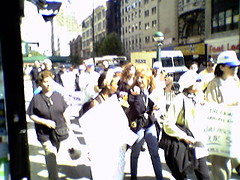
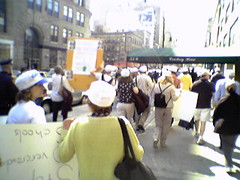
I'm not sure--I know a few, and intend to ask them--but I did participate briefly in a United Federation of Teachers protest march westward on 14th Street and then up 6th Avenue. The union, a local of the New York State United Teachers, is seeking a new and fair contract from the Schools Commissioner Joel Klein and the mayor, and have taken out subway ads and TV commercials to bolster their cause. They've gone without a contract for over two years. Although I haven't taught in a New York City public school since 1996, my heart lies with the teachers, who do a yeoman's job, often working long hours, dealing with an inflexible bureaucracy and unsympathetic administrators, and usually with minimal support and respect (cf. Ms. Soucouyant's blog and Mrs. Treasure's Feeding the Devil, for example). My participation was impromptu; I was coming out of 24/7 Gym after renewing for the summer when I noticed the vanguard of the marchers, placards and banners in hand, their chants filling the air like incense. A cordon of policepersons on foot and bikes bordered them on the roadway side of the pavement. I stood for a moment considering whether I wanted to go straight to the PATH or join them, and decided to walk with them in solidarity. Workers--and teachers of the world--unite! (I'm a faculty member at a private institution that doesn't have a teachers' union.) I walked part of the way up 6th Avenue with them, then turned around and doubled back to my underground shuttle to New Jersey.
UFT Protest
When I got home, I checked the online papers; no mention of the march whatsoever. I saw nothing on the local news either. And even on the New York State teachers Website and on the United Federation of Teachers Website, there's no information about the march. But I did witness and photograph (two blurry snapshots, with my cellphone, above and below) and join the marchers, so I know they weren't a phantasm. Even if the possibility of a new and decent contract for them remains one.