Wednesday, May 31, 2006

FIFA World Cup Preview

Well, not really a preview of the games, teams and matchups in the FIFA World Cup 2006, which begins next week, but some shots of the players (hotties) going through their final stages of preparation for the world's most watched sports event.

The opening matches?

On June 9, in Munich, the host country and one of the favorites to win, Germany, faces Costa Rica, while in Gelsenkirchen, Poland faces Ecuador.

Adriano
Brazilian beauty and star Adriano holding a World Cup replica at Tom Jobim Airport, in Rio (Reuter/Domingos)
Placemarker
Ecuador's Valencia stretches during warmups in Austria (Reuters/Granja)
Namouchi
Tunisian midfielder Namouchi at a friendly match against Belarus, in Tunisia, on Monday (AFP/Belaid)
Saborosa
Portugal's Sabrosa signs autographs in Evora, Portugal (Reuters/Ribeiro)
Cufre
Argentina's Cufre at a press conference in southern Italy (AP/Pecoraro)
Lennon
England's Aaron Lennon, prancing on the pitch in Manchester (AFP)
Placemarker
The US's Eddie Johnson fights with Latvia's Oskars Klava for the ball (Reuters/Snyder)
Malouda et son equipe
Malouda of France celebrating with his teammates in a friendly game against Mexico (Reuters/Tessier)
Henry
French star and Arsenal fixture Thierry Henry looking dapper before the game against Mexico (Reuters/Tessier)
Onyewu
American Oguchi Onyewu (r) moving the ball past Venezuela's Rojas, in a match in Cleveland (AFP/Maxwell)
Seol
South Korea's Seol (at right) celebrate with his team mates after he scored a goal against Bosnia-Herzegovina during a friendly match at the Seoul World Cup stadium (Reuters/Kim)
Odonkor
German team member Odonkor's face shot, in Sardinia (AFP/Gilliar)
Arellano
Mexico's Arellano at a training session in France (Reuters/Pratta)
Massad
Saudi Arabia's football player Massad warms up in Austria (AFP/Cizek)
Santos
Japan's Brazilian-born player Santos, at a press conference in Saitama, Japan (AP/Kyodo News)
Beasley and team
United States national soccer player DaMarcus Beasley runs with his teammates during training in North Carolina (AFP/Davis)
Wallace
Costa Rica's Harold Wallace plays basketball in the pool following a sunrise workout with the national team at the Conchal beach resort near Brasalito, Costa Rica (AP/Gilbert)
Tenorio
Costa Rica's national soccer team players Paulo Wanchope (L) and Mauricio Solis stretch during a early training session in Conchal beach resort, Costa Rica (Reuters/Ulate)
Walcott
England's young Theo Walcott (3rd l) participating in a fitness test with his teammates (Reuter/Keogh)
Cha
Korean player Cha during a match with Bosnia-Herzegovina (AFP/Jung)
Appiah
Ghana's captain Stephen Appiah during the African Nations Cup match against Zimbabwe in Egypt (AFP)
Cisse
France's Djibril Cisse after a friendly match against Denmark in Lens, France (AP/Ena)

Memorial Day Doings

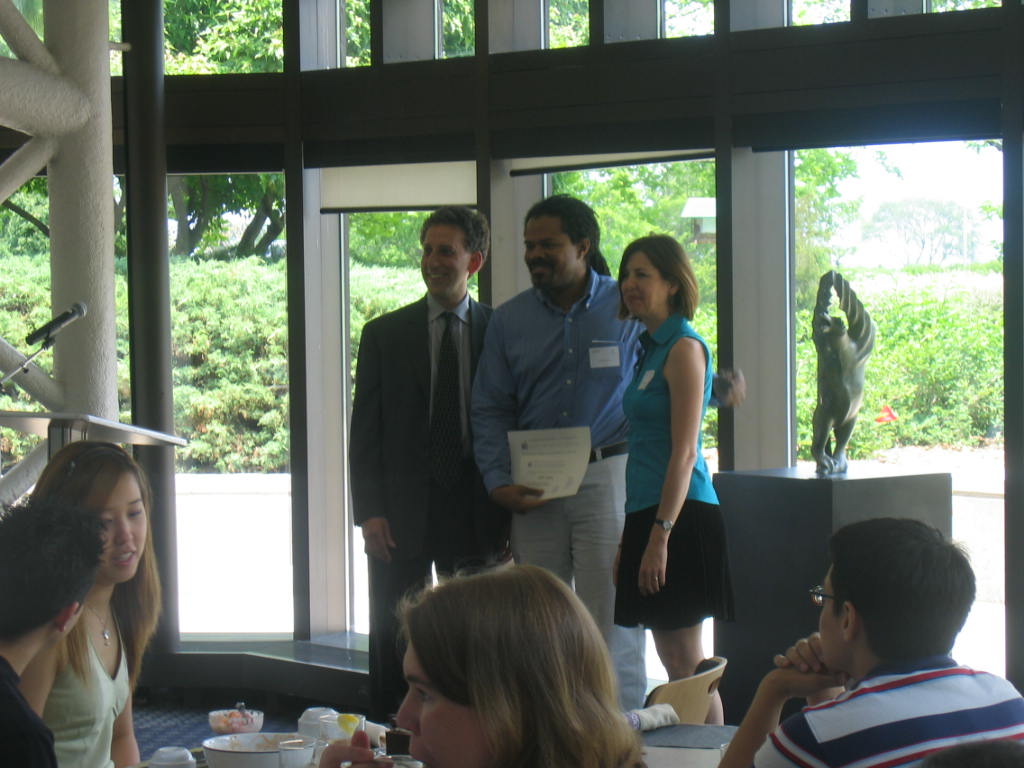
I hope all the regular and periodic readers of Jstheater had an enjoyable holiday weekend. C. and I were in the infernally hot Chicago area yesterday to attend a small luncheon ceremony at the university, which bestowed on me the E. Leroy Hall Award for Excellence in Teaching. I've posted only a little about my teaching career and experiences on this blog over the last year, and usually I've only done so to praise the wonderful students I've worked with (and both the graduates and undergraduates were amazing again this year), but I do find teaching one of the most rewarding experiences in my life, and I can truthfully say that there are few things more exciting and moving that witnessing my students' intellectual development and growth. Many teachers say that they learn as much from their students as they give, and I eagerly attest to this. I've used the concept of the conversation before, in relation to writing fiction, translations, and other forms and modes of creativity, but I think it's most salient and necessary in the classroom; without dynami,c multivalent conversations, particularly in the humanities and arts, I tend to feel that no real intellectual--and thus educational--exchanges can even (begin to) occur. I've yet to teach a class in which I didn't learn something new, including about myself, and my aim is that my students can leave my classes feeling the same way. My thanks go to my colleagues, and above all, to my students!

The ceremony was brief and lovely, and below is a photo that C. took of the Dean of the College of Arts and Science (at left), my department chair (at right), and me, as I accepted the award.

Monday, May 29, 2006

Memorial Day

Sunday, May 28, 2006

Poem Excerpt: Alice Oswald

OswaldA few weeks ago, after David and I'd left Reggie's reading with the Baltimore poets, we ran into James O., a fellow writer and Canadian native, who asked me if I'd ever read the British poet-gardener Alice Oswald's long poem Dart (Faber, 2002). James told me in the most enthusiastic terms that I had to read this work, and described Oswald (at right, photo © Kate Mount, from British Arts Council) as the [TS] "Eliot" (!) of the 21st century, or something along those lines. I later said to David that not even Eliot would want to be the Eliot of the 21st century, if that were possible, but the aim of James's comparison was clear enough.

DartI haven't yet found a copy of Dart in the bookstores, and also have yet to purchase it online, but I did come across a packet of information on Oswald, who's variously described as one of the leading younger British poets, a nature "mystic," an heir(ess) to nature poet Ted Hughes, and a versifier who sees "Virgil" and "Homer" in her work. Oh, and fiction writer and critic Jeannette Winterson wrote a rapturous short review of this book. Truthfully, none of these factlets beyond Winterson's critique particularly makes Oswald that appealing or draws me to her poetry, but after James talked her up so fulsomely, I am going to seek out this belauded volume as well as her strongly praised first book, which has one of the most British titles I could imagine, The Thing in the Gap-Stone Stile (Oxford, 1996).

Given the title of the book, I thought it might be about people "darting" around London or some other metropolis, a poem about the speed, multiplicity and simultaneity of contemporary life, and so forth, but it's a modern pastoral of sorts, or at least at points, about the world around and embodied in a British river from whose name the place names "Dartmouth" and "Dartmoor" derive. One of the bits about her that I found online was her interim report from her funded project to begin the writing of the millennial Dart River community poem that became Dart. She says about the project

Last year [1998], I applied for money to write a poem about the River Dart. My idea was to orchestrate it like a kind of jazz, with various river-workers and river-dwellers composing their own parts. The result was to be a river's story, from source to mouth, written by the whole Dart community.

After working at this for a couple of months, I began to think it was people's living, unselfconscious voices, not their poems, that were most awake to the river. At any rate, some people were overflowing with poetry and some people had a beautiful, technical way of talking about the river; but the two didn't often coincide.


It includes the following snippet, which has its moments, especially the mellifluous (or, given that it's a river, mellifluent) 10th stanza.... (There is more on the site, and I think I will give the entire 48 pages a go.)

From Dart:

Who's this moving alive over the moor?

An old man seeking and finding a difficulty.

Has he remembered his compass his spare socks
does he fully intend going in over his knees off the military track from Okehampton?

keeping his course through the swamp spaces
and pulling the distance around his shoulders

the source of the Dart - Cranmere Pool on Dartmoor,
seven miles from the nearest road

and if it rains, if it thunders suddenly
where will he shelter looking round
and all thtlt lies to hand is his own bones?

tussocks, minute flies,
wind, wings, roots. ..

He consults his map. A huge rain-coloured wilderness.
This must be the stones, the sudden movement,
the sound of frogs singing in the new year.
Who's this issuing from the earth?

The Dart, lying low in darkness calls out Who is it?
trying to summon itself by speaking...

the walker replies

An old man, fifty years a mountaineer, until my heart gave out, so now I've taken to the moors.
I've done all the walks, the Two Moors Way, the Tors, this long winding line the Dart

this secret buried in reeds at the beginning of sound I
won't let go of man, under
his soakaway ears and his eye ledges working
into the drift of his thinking, wanting his heart

I keep you folded in my mack pocket and I've marked in red where the peat passes are and the
good sheep tracks


Copyright © Alice Oswald, 2002.

Saturday, May 27, 2006

Bob Wing and Brian Burwell on Bonds Haters and Bonds

Bob Wing on Bonds Haters
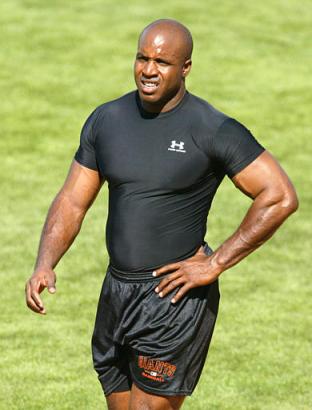
Bonds(I'd been meaning to post this five days ago, shortly after I received the link, but now that Barry Bonds has hit his 715th home run, passing Babe Ruth's total of 714 for second place, I think it's especially apt.)

Here's another take (thanks Bernie!), from the Black Commentator website's guest writer Bob Wing, on some sports commentators' and fans' ongoing hatefest against Barry Bonds. I agree with him on many points (and since he didn't try to type his as quickly as possible as I did mine, they're not as crabbed and more comprehensible). I really am waiting for Bonds to hit his 715th home run so that we who follow baseball can pass this particular junction.

Brian Burwell, an African-American sportswriter for the St. Louis Post-Dispatch, is having none of this. He views Bonds's plight quite differently and disdainfully, dismissing comparisons between Aaron's experience with racism as he broke Ruth's record with the media criticism of Bonds. His point of comparison is O.J. "The Juice" Simpson; as he believed was the case with OJ, race only became a salient issue once he found himself in trouble. Or as Burwell says:

He's a brother who has basically lived untouched by most of the normal strictures of blackness. Born to wealth, accustomed to privilege, impervious to racism's harmful limitations all his life, Bonds is now what I call a brother of convenience.

He is conveniently casting himself in the role of the persecuted black man being undone by some unseemly plot by The Man, when the truth is, he's nothing but a cheating jerk caught redhanded.

But is all of this true? Wasn't Bonds a target of media criticism, some of it tinged with racism, before the steroid scandal erupted? Hasn't he been singled out for years for "personality" problems (he's "difficult," he's not "friendly to the media," he's "angry," etc.) in ways many of his non-Black peers were not? Also, isn't it possible to criticize Bonds's occasional arrogance, self-absorption and moments of self-pity while also not forgetting the role of racism and racist discourse in American professional sports and the sports media?

Back to the other home run leaders. I wish Ken Griffey Jr., who's never been linked to steroids or any other performance-enhancing drugs, hadn't suffered through several injury-filled seasons, or he might be closer to Ruth by now. As it is, of the active batters with over 400 home runs, Griffey Jr. is the closest after Bonds, at 542, putting him 12th on the list; next on the list of active players are Frank Thomas at 457, Gary Sheffield at 453, Carl Yastrzemski at...okay, just joking (he finally did retire!), Bonds HottieJeff Bagwell at 449, Jim Thome at 447, Manny Ramirez at 444, A-Rod at 440, and Mike "Butch" Piazza at 403. Griffey is entering the tail-end of his career, and has struggled to stay healthy, so he should at least break 600 if he can hang on.

Of this others in this cohort, A-Rod has the talent and enough years left, if he doesn't get injured, to catch Bonds-Ruth, and perhaps Vladimir Guerrero (316 after 11 years) and Albert Pujols(223 after 6 years) will also at least break the 550 mark if they keep hitting at their current pace and play for about 20 years. But there's no one on the near horizon who looks set to catch up with Bonds. The anti-Bonds fanatics perhaps should start accepting this fact, though the main effect may be to provoke them go after Bonds even more.

One of the most recent casualties of the anti-Bonds crusade is Albert Pujols, the star first baseman for the St. Louis Cardinals. Pujols, who is leading the league in multiple categories right now, and who's on pace to tie or even break Bonds's single-season home run record, had the independence of mind (gall?) to praise Bonds's talent, act friendly towards him with the Cardinals were playing the Giants, and even tape a segment for an ESPN show.

And as surely as Prince Albert, or El Hombre as he's also been dubbed, was born in Santo Domingo, at least one St. Louis sportswriter and some fans began their criticism. Actually, what most got St. Louis Post-Dispatch sportswriter Bernie Miklasz's nose in a twist was Pujols's legitimate question, "Are steroids going to make you better? Who knows?" Steroids probably did make some already talented players--including Mark McGwire, Rafael Palmeiro, Jason Giambi--better hitters, but there are many who haven't really been helped, either for a season or over the long haul at all. Miklasz has a right to his opinion, as Pujols has to whom he associates with, but I wish sportwriters like him would also take a little space at least criticize the very system and those running it that looked the other way about steroid usage for a decade or more.

All Star Game
If you are a baseball fan and haven't yet voted for this year's All Stars, you can do so here, up to 25 times. Just remember to uncheck the two boxes that tell Major League Baseball that you want to be bombarded with spam their and others' offers, or, as I can attest from past years, you certainly will be.

Friday, May 26, 2006

Far Right Attacks in Germany Precede World Cup 2006

Map of GermanyUwe-Karsten Heye, a spokesman in the government of former German Social Democratic Party (SPD) chancellor Gerhard Schröder, set off a political tempest on Wednesday when he warned people of color visiting the country for the 2006 World Cup, which begins on June 9, not to venture into rural areas of eastern Brandenburg State (the pale blue state on the right in the map at left), which surrounds the federal capital, Berlin, because they might be attacked by Neo-Nazis and other members of the German far right. He told Deutschlandradio Kultur, "There are small and mid-sized towns in Brandenburg and elsewhere where I would advise anyone with a different skin color not to go," and added quite dramatically, "they may not leave with their lives."

Wolfgang Schäuble, the Interior Minister of Germany's current government, headed by the right-leaning Christian Democratic Party (CDU) and chancellor Angela Merkel, however, claimed that Germany would not "tolerate any form of extremism, xenophobia or anti-Semitism." His counterpart in Brandenburg State, Jörg Schönbohm, asserted that visitors of all colors would feel "safe" and called for Heye to resign from his position a German anti-racist group, Gesicht zeigen (Show Your Face), while the head of the tourism committee for the German parliament denied the Germany "was far from a country" where visitors should fear attacks from far rightists. The premier (governor) of Brandenberg, Matthias Platzeck, a fellow SDU member, decried what he called Heye's "absurd slur of a whole region that is no way justifiable." Berlin's openly gay, Socialist mayor, Klaus Wowereit, also claimed that visitors would be fine.

Yet there have been a rush of racist attacks that have set politicians and Germany's citizens on edge. Last month, an Ethiopian-born German man was beaten so badly he remains in a coma; the attack occurred in Potsdam, the capital of Brandenburg state. A few weeks ago, regional assemblyman Giyasettin Sayan (below right, Deutsche Welle) who represents Berlin's Lichtenberg district on the reconstituted-Communist Left (Links) Party line, was brutally attacked near his home by two men who called him a "dirty foreigner," and suffered head injuries severe enough that he had to be hospitalized. SayanJust today, a spate of racially-motivated attacks occurred in eastern Germany: 6 people were attacked in Berlin, including a Turk, a Lebanese man, an Indian, and a Guinean. The police were able to arrest all or most of the attackers. In Weimar, the country's capital from the end of World War I to Hitler's chancellorship, three Mozambicans and a Cuban man were injured when attackers burst into a private party and assaulted them. The police did arrest 8 suspects. In the eastern German city of Wismar, an Indian man was beaten at a flea market. Yet things were localized solely in eastern Germany. In the western town of Würzburg, nine people were detained after shouting Nazi slogans at a birthday party; any promotion or depiction of pro-Nazi iconography or rhetoric is officially illegal in Germany.

Germany's Afrika-Rat (African Council) has published a list of "no-go" places in Brandenburg and other parts of the east for Black people and other people of color. Berlin political scientist Yonas Endrias, a member of the Africa-Rat, ratified Heye's warning by noting that there were places in Brandenburg that he and other Black Germans wouldn't dare take their families, because while he averred that there was racism in western Germany, in the east Black people were more likely to be attacked. The World Cup committee is set to publish an online guide to warn potential visitors about notorious racist hotspots. Between 2004 and 2005, far-right crime in Germany rose by 28%, to more than 15,000 incidents, and of these, 958 were linked directly to Neo Nazis, a 24% increase.

Some figures in the German government, as well as in the German media and intellectual classes, believe that Heye's warning and the focus on the racial attacks are overblown. They also have suggested that Germany's extreme right-wing National Democratic Party (NDP) is hoping to gain attention and support both inside and the country from the focus on a rise in far right activism and attacks. It also has planned to stage rallies at some of the World Cup matches, including the one between Angola and Iran, which it has said it will support because of Iranian president Mahmoud Ahmadinejad's comments against Israel.

The usual explanations for the far right activity in east Germany hinge on the harsh economic disparities that have existed since unification between this still-poor, job-challenged formerly Communist sector and the far wealthier western states that once constituted the Federal Republic of Germany; alongside the east's economic problems, those appraising the Neo-Nazi (and Nazi residue) problem cite the Easterners' issues with economic competition based on immigration, the lack of a liberal and plural democratic tradition (after 40 years of Communism), and the inadequacy of (or indifference by) the unified liberal government and liberalism as an ideology to address the racial and ethnic transformation of the country. Yet I would argue that these issues are as salient in western Germany and other parts of Europe as in Germany's eastern states. In addition, East Germany's particular educational approach to understanding the Nazi past also has received blame. In the BBC article, the Simon Dubnow Institute for Jewish History and Culture at the University of Leipzig's Dr. Frank Neseman attributes the presence of Neo-Nazism in Eastern Germany to the "authoritarian education systems under the communists...this kind of education was always based on ideas of hatred - anti-capitalism and against class enemies, Zionism, the US, West Germany," as if the long history of xenophobia, anti-Semitism, and racism and racialist thinking in Germany and Austria (and Europe more broadly), particularly on the political right, were also somehow not central. In addition to anti-Semitic appeals going back centuries, anti-Black and anti-foreign sentiment particularly took hold among the Austrian right at the end of the 19th century, and among the Germany right in the 1920s. One of the first governmental policies enacted after the Nazi takeover was the mass sterilization of mixed-raced, especially part-African, children. In Western Germany, numerous former Nazi officials were permitted to serve in the post-War government, which created a smooth transition when the German economic miracle occurred, but did not lead to the sort of ideological break, at least beneath the surface, that did in fact occur in East Germany.

Post-unification economic problems in eastern Germany caused by the reordering of the economy and globalization certainly have fostered resentment against the west, foreigners and people of color, but neo-Nazi groups and far right parties also exist in western Germany (as today's news makes clear), as well as in neighboring countries with a strong economic performance, such as Austria and Belgium. Schäuble's and Schönbohm's denials and laissez-faire approach only contribute to the problem rather than helping to resolve it.

Speaking of Belgium, the recent racist murder of an Malian-born woman and her child (Oulemata Niangadou, 24, and Luna Drowart, 2, were slain; a Turkish woman, Songul Koca, was wounded in the attack) in Antwerp has caused national shockwaves, after Blacks and other people of color had been attacked recently in Brussels. Today, at a "White March" (?), thousands marched through Antwerp's streets to protest the murder and the extremist Vlaams Belang (Flemish Interest) party, to which the murderer was linked. Meanwhile, a surge in racist attacks has plagued Russia, and, after the flareups last fall in France, the leading figure in that country's "moderate" right, Nicolas Sarkozy, has proposed a sweeping, harsh anti-immigrant bill, now passed by the French lower house, that would find much favor among the GOP in the U.S. House of Representatives.

Thursday, May 25, 2006

Translations: Eugenio Montale + Oprah's Legends Ball

Translating Montale's mottetti
MontaleMy Italian is rudimentary, but a few years ago, I fell in love with these two poems by Eugenio Montale (1896-1981, at right, Nobel Academy), which first appeared in his collection Le Occasioni (The Occasions), which were written over an eleven-year period and published in 1939. The mottetti (motets) and other poems from this book have been translated in English more than once, especially after Montale received the Nobel Prize in 1975.
One of the things I most love about these tiny poems is how Montale utilizes the aural possibilities, the music of the Italian language to embody the themes, imagery and action of the poems. In the first, we get echoes of the "fiore che ripete," the forget-me-not ("non scordati de mi"), all throughout the poem, along with its swaying at the edge of the fissure, or crevasse--that literal phonic space tossed "tra me e te," between "you and me" that calls out to us, the readers, as it calls out to both Montale and his beloved. It is an actual physical space, but also a metaphysical, an emotional and psychoological one. In the second stanza, we get music akin to the sound of gears churning (the "ch" of "cigolio" and "ci" [note again the echo] the "sf" of "sferra") and again, at the very end, another echo, of long "a"s, but this time borne away by funicular that has brought us to the far side. In the second poem, Montale captures the swooping flight of the swallows, birds whose name in English still retains this up-and-down movement, but it is sharper in Italian, where the vowels literally leap up and down ("balestrucci"), while the long "a"s of half the words in the first three lines are like the air itself, carrying us forward. The poem concludes with the "oo" sound regnant, conveying simultaneously openness and closure; English's cognates allow me to capture some of this, though only some. Dana Gioia, the NEA head, has published an entire book of translations of Montale's mottetti, though to my mind the best English translator of this great poet is Jonathan Galassi, who's also editor-in-chief at Farrar Straus & Giroux.


Il fiore che ripete
dall'orlo del burrato
non scordarti di me,
non ha tinte più liete né più chiare
dello spazio gettato tra me e te.

Un cigolìo si sferra, ci discosta,
l'azzurro pervicace non ricompare.
Nell'afa quasi visibile mi riporta all'opposta
tappa, già buia, la funicolare.

The flower that repeats
from the edge of the fissure
forget-me-not
has no hues fairer or brighter than
the space cast here between you and me.

A metal gear grinds, separating us:
the stubborn azure does not hold.
In a cloud almost visible, I am borne back to the other
stage, where already darkness settles in, by the funicular.

Il saliscendi bianco e nero dei
balestrucci dal palo
del telegrafo al mare
non conforta i tuoi crucci su lo scalo
né ti riporta dove più non sei.

Già profuma il sambuco fitto su
lo sterrato; il piovasco si dilegua.
Se il chiarore è una tregua,
la tua cara minaccia la consuma.

Copyright © Eugenio Montale, 1939, 2006.

The rising and falling black and white
of the swallows from the telegraph pole
to the sea
hardly comforts you, perched at the edge
of the water,
nor returns you to where you no longer are.

Already the elder thickly perfumes
above the dig; the small storm dissipates.
If this brightening up is a truce,
your sweet threat consumes it.

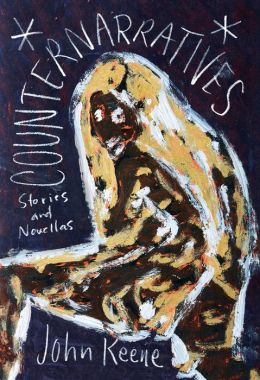
Translations © John Keene, 2006


Oprah's Legends Ball
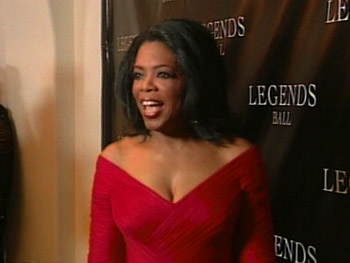
Oprah at the Legends BallReading Anthony Montgomery's Monaga blog today reminded me that C. and I'd watched Oprah Winfrey's Legends Ball on Monday night, and also made me remember how much I'd enjoyed it. In fact I almost missed because I hadn't been paying much attention to the hype and rarely catch her TV show. What I most enjoyed was seeing a number of the major African-American female cultural figures and pioneers of the last 50 years--Coretta Scott King, Leontyne Price, Dorothy Height, Cicely Tyson, Ruby Dee, Patti Labelle, Gladys Knight, Della Reese, Tina Turner, Diana Ross, Nancy Wilson, Dionne Warwick, Elizabeth Catlett, Chaka Khan, Diahann Carroll, Roberta Flack, Naomi Sims, and many of their younger successors (whom Oprah called the "young'uns")--together, being celebrated, championed, extolled for what they individually and collectively have made possible, not only for African-American women, but for Black people, women and everyone else. Seeing these women assembled together at the luncheon and then at the Sunday gospel brunch-picnic, which Patti Labelle set off live (I said that if she hadn't passed the mic back to Bebe Winans the entire lawn would have started levitating) naturally, were the real highlights.

While I do question the materialism that was on display (those drop-diamond earring sets were really over the top!), I was actually sort of amazed and delighted to witness Winfrey, one of the most powerful and galvanizing figures in our culture, taking over an hour of prime time to celebrate other Black women and call attention to their achievements. (Of course in the process Oprah yet again demonstrated how important and powerful she truly is, while also celebrating, well, herself.) I wish there'd been more time for her to explore the honorees' accomplishments, even though I already knew about all of them, and less time spent on the glitz, but then it's the glitz (and all the other celebrities who attended the actual ball and the luncheon) that drew a broad(er) range of viewers and advertisers. I also wondered where some other notable figures who were listed as attending were (Toni Morrison, Katherine Dunham, Aretha Franklin, Nikki Giovanni, Lena Horne, Alice Walker), though I assume either health or other reasons (scheduling, etc.) were behind their not being on camera. There are certainly many other major Black female figures, from women in business to science and the arts, to political figures, who also could have been included and honored, but it was Oprah's show, and were she to honor all the legendary figures and many unheralded ones, it would take months--perhaps that's what we need, Oprah's Legends Summer. I also wondered whether there was a male figure who might do the same for African-American men, and about a comprehensive way of honoring and celebrating people outside the mainstream of our entertainment culture who've achieved remarkable things, particularly on behalf of others, across class, gender and other lines.

Clay Cane's colorful take on the show is here.

Wednesday, May 24, 2006

Pamuk on the Freedom to Write + On (Appiah's) Cosmopolitanisms?

Orham Pamuk on the Freedom to Write
PamukOn April 25 of this year, Orham Pamuk, perhaps Turkey's leading fiction writer and a repeated target of governmental oppression, most recently when he was brought up on charges for having spoken openly of the Armenian genocide, delivered the inaugural PEN Arthur Miller Freedom to Write Lecture. The New York Review of Books printed it in the May 25, 2006 issue, and it's worth reading, so I link to it here.

A quote:

I always have difficulty expressing my political judgments in a clear, emphatic, and strong way—I feel pretentious, as if I'm saying things that are not quite true. This is because I know I cannot reduce my thoughts about life to the music of a single voice and a single point of view—I am, after all, a novelist, the kind of novelist who makes it his business to identify with all of his characters, especially the bad ones. Living as I do in a world where, in a very short time, someone who has been a victim of tyranny and oppression can suddenly become one of the oppressors, I know also that holding strong beliefs about the nature of things and people is itself a difficult enterprise. I do also believe that most of us entertain these contradictory thoughts simultaneously, in a spirit of good will and with the best of intentions. The pleasure of writing novels comes from exploring this peculiarly modern condition whereby people are forever contradicting their own minds. It is because our modern minds are so slippery that freedom of expression becomes so important: we need it to understand ourselves, our shady, contradictory, inner thoughts, and the pride and shame that I mentioned earlier.

On (Appiah's?) Cosmopolitanism: Responses to Keguro
In the comments section yesterday, Keguro posted one of his very concise and very provocative responses, so I thought I'd offer some responses. I can't and won't presume to speak for Kwame Anthony Appiah, or even recapitulate his rich and variegated arguments in a nuanced or extensive way, but I loved the issues Keguro posed, so here are my responses.

K: Appiah bothers me a lot. I am skeptical that shared cultural products necessarily have any connection to shared ethical values: that one sees cellphones in Ghana says little about the potential for one's ethical orientation.

J: What exactly bothers you about Appiah? Or Appiah's theorizations of cosmopolitanism. I'm curious to know what bothers. The New York Times Magazine/RSA e-journal article is problematic to me in part because I think Appiah is extrapolating from his particularized, glamorous experiences and views, presenting them (somewhat differently than he does in his philosophical work, which requires more careful theorization and abstraction) as the primary optics (and evidence) for viewing and understanding what's really a more complex phenomenon. The seeming equation of circulating consumerisms and ethics is problematic, but his larger point even in this piece has to do with authenticities and the individual's relation to his various allegiances, his location of self and selves, doesn't it? With cosmopolitanism(s) when very different kinds of contexts and experiences in and between worlds could constitute the basis for an argument on behalf of cosmopolitanism(s). That's why I think the larger defense of kinds and practices of cosmopolitanisms, which Appiah states at several points aren't fixed but fluid--he suggests that they're "challenges" rather than anything realized even by him so far--is interesting, and at times persuasive. So I wonder if the assumption that shared cultural products relates easily or directly to shared ethical values isn't a misreading of his arguments in both books; doesn't he suggest just the opposite, that the assumption of shared ethical values based on consumerist products or even a shared ideology is problematic for establishing one's ethical compass and values?

K: How does one become cosmopolitan? And what keeps one cosmopolitan?

J: These are great questions. My personal take would be that you could point to various routes, or to use Bourdieu's term, various habituses, by which you develop cosmopolitan identities and identifications (and disidentifications), acquire cosmopolitan affinities, and so on, and your particular experiences in the world, your allegiances, the norms and contexts of your experiences, etc., would all affect your sense of, performance of, practices of cosmopolitanism(s). If I were to distill to an extreme degree Appiah's complex arguments, a general shared experience of humanity--this abstracted, shared sense of being part of the human community beyond one's immediate group identifications and not relating solely to the kinds of commercial circulations he cites in the article--pulls (some of?) us towards cosmopolitanism. This lies at the heart of his philosophical exploration of the concept, but also leads to his critiques of universalisms--which some people (wrongly?) read cosmopolitanisms as--both of the local and, well, global kind.

K: Is globalization central to the formation of cosmopolitan identities (as Bruce Robbins and Pheng Cheah might suggest)?

J: I suppose Appiah would say that it's central, or rather , though it has had a profound effect on the formation of contemporary cosmopolitanisms and cosmopolitan identifications because of its role in the process of circulating ideologies, norms, goods, practices and so on. But in the second book, as briefly mentioned in the article, Appiah locates one origin of cosmopolitanism in the beliefs and practices of the Cynics, though I guess you could argue that the Greeks were proto-globalists, at least in terms of how far their technological achievements were able to take them. (I think you could also read the Phoenicians, the Egyptians, the Chinese, and others' circulatory histories as proto-globalizations.) I haven't read Sloterdijk in many years, but doesn't he come to different conclusions based on his reading of the Cynics?

K: Is cosmopolitanism necessarily opposed to national identities (as Gilroy might suggest and Laura Chrisman disagrees)? Is cosmopolitanism nothing more than moral obfuscation, cultural consumption and literacy taken as an ethical orientation (where, I think, Tim Brennan's early work ends)? (Okay, yes, I have many issues with the term and how academics use it.)

J: From what I gather, Appiah is suggesting that cosmopolitanism isn't necessarily opposed to national identities, but that they might be in tension with certain forms of cosmopolitanism. (This is the case for other kinds of identities as well.) I'm not that familiar with Brennan's work, so I plead ignorance, but I would imagine that Appiah interrogates the place and function of the moral pretty thoroughly, and doesn't link cosmopolitanism so easily or readily to cultural consumption and literacy, but to a more complex and as I said negotiated ethical orientation to one's lifeworld.

K: I wonder what happens to the quotidian in and within "cosmopolitanism."

J: This is a great question. I wonder what exactly the "quotidian" might be--since I'm thinking the "quotidian" could be many things (I know you're familiar with Michel de Certeau's work on this topic, among others), from its basic sense of the everyday, to a particular psychological, philosophical and/or sociological state or location, to an ideologically conditioned, ontological site of subjectivities, practices, etc...and if one were mapping one's own cosmopolitanisms, wouldn't the quotidian factor in(to) its many layers and aspects and be transformed by one's performance of them?

K: But now I'm simply testing out ideas contained in something I've been working on for a while--and will continue to do so for some time.

J: Please do post more on this (here and/or on your blog), and of course do critique my responses as fully as you can.

Random photo

Movie set, West 4th Street and 6th Avenue

Tuesday, May 23, 2006

Appiah on Cosmopolitanism + Reggie Harris on BookExpo

Appiah on Cosmopolitanism
AppiahI've been meaning to write something about the brilliant philosopher Kwame Anthony Appiah's (left, Princeton.edu) various books and articles in the popular press on the theme of cosmpolitanism, especially since the topic is particularly relevant as we're witnessing an upsurge in nativism and misplaced nationalism around the issue of immigration, in light of growing religious fanaticism and intolerance of all kinds, and because globalization has for some time been pressing important and necessary questions of identity and identification upon us, but really, to do them justice, even the ones that basically repeat what he's already written, would require a good week's worth of reading and research and, I have to say, I haven't yet found the time or energy. Yes, that's a pathetic excuse, particularly for someone who finds the topic fascinating and considers himself to be at heart a cosmopolitan, in the little "c" sense).

But last summer I did slog through read large portions of Appiah's study The Ethics of Identity (Princeton, 2004), a demanding and excellent philosophical treatise on the themes of identity, ethics and cosmopolitanism, with essays into the topics of nationalism, pluralism and citizenship, morality and rationalism, norms and normativity, racial, ethnic and other kinds of stereotyping, autonomy and solidarity, his concept of "life scripts" (which he broached years ago at a panel, leading to immediate misunderstandings on the part of many in the audience), and a host of other themes relating to the book's main focus. It helps if you are going to pick up this book to have read some John Stuart Mill, since Appiah basically applies a thoroughgoing reading of Mill to ground his central thesis and critiques.

But, if you didn't get to Ethics of Identity, you can always try Appiah's subsequent study, Cosmopolitanism: Ethics in a World of Strangers (W.W. Norton, 2006) which, from several cursory glances at the bookstore and library, strikes me as a boiled-down, more accessible, historicized version of the prior study, with an even greater focus on Appiah's central theme of "rooted cosmopolitanism," which I take to mean an approach to the world that is ethically oriented towards our shared human fate, and open to negotiating the understandable sense of connection to our particularized experiences (his royal Ghanaian ancestry, which we hear quite a bit about in his work, for example) with a broader commitment to others beyond our immediate familial, national and other group-based identifications and filiations (racial, ethnic, religious, national, gender, etc.). As in the earlier book, I imagine Appiah's philosophical interest in ethics and its history comes to the fore, as does his skepticism about any easy or simple moral or ethical precepts (whether religious, classical, Kantian or other) for determining how to act in the world.

One of the leading contemporary philosophical ethicists, Thomas Nagel (of NYU), penned a knowledgeable and laudatory reading of both of Appiah's works in the February 2, 2006 issue of The New Republic. (Like many so many public commentators, he feels he must offer an especial critique of "black identity," as "incoherent," while failing to explicitly question its binaristic antithesis, "white identity," which is normative in this society and thus manages to elude deeper analysis, except by those specifically interrogating it). Nevertheless, I want to quote his concluding paragraphs, which give a sense of his reading and Appiah's book:

What is universal, though immensely important, merely provides a protective framework for the flourishing of individuality. And we can come to agree on certain basic protections in practice without starting from a common theoretical foundation. (Here Appiah invokes Cass R. Sunstein's constitutional theory of "incompletely theorized agreements.") The key to co-existence and mutual benefit from the variety of forms of life is familiarity, and not just reason. We have to get used to one another, and then over time our habits will evolve. Sheer exposure can accomplish a great deal. This, Appiah points out, is how attitudes toward homosexuality have been transformed in our own society. And it may eventually have its effect on the "woman question" that he thinks plays a large part in fueling Islamic hostility to the West.

It is a humane and optimistic vision, eloquently expressed. Disarmingly, Appiah describes his view at one point as "wishy-washy cosmopolitanism," and if these books have a fault, it is that of under-rating the depth of the conflicts that make the spread of liberalism so difficult. Appiah's golden rule of cosmopolitanism is a famous quotation from the comic playwright Terence, a former North African slave who lived and wrote in Rome: "I am human: nothing human is alien to me." Though he acknowledges that pessimists "can cite a dismal litany to the contrary," Appiah believes that the accumulation of changes in individual consciousness brought on by communication and mobility is already propelling us along this upward path. He rejects by implication the "clash of civilizations" as the global drama to which we are all condemned. I hope the future will prove him right, though the experience of our time makes me wonder. Episodes such as the recent widespread and violent reaction to a few cartoon depictions of Mohammed prompt the grim reflection that it took centuries of bloodshed for the West to move from the wars of religion to its present roughly liberal consensus. We may have to wait a long time.


An excerpt from Appiah's second book appeared on January 1, 2006 in the New York Times Magazine; I remember finding the opening sentences so annoying that I really didn't want to continue reading it. ("I’m seated, with my mother, on a palace veranda, cooled by a breeze from the royal garden. Before us, on a dais, is an empty throne, its arms and legs embossed with polished brass, the back and seat covered in black-and-gold silk." You know even more references to the royal house of the Asante are on their way....) It's now a Times-Select article, so it's inaccesible unless you're willing to cough up their monthly fee (or make a one-time archive payment). But wait; the article is accessible, since it's been reprinted verbatim in the RSA e-journal: yes, it's the very same "The Case for Contamination." After getting past the opening, I have to admit that Appiah makes some telling points that draw upon the insights of the earlier book on ethics and identity, and he's nearly convinced me to do more than just browse Cosmopolitanism when I find the time.

Reggie H. on BookExpo
Do you wish you could have/had gone to this year's BookExpo in our lovely capital, Washington, to see American publishers and self-publishers hawking their textual wares? Or maybe you just wanted to see New Jersey's (my) ex-governor, Jim McGreevey, brandishing the not very revealing excerpt from his forthcoming memoir (thanks Rod!), that is, the one that describes how he visited rest stops (in New Jersey? did he by chance hit the Walt Whitman Service Area?) for anonymous sex (while he was married and living on the DL in the closet?). Reggie doesn't waste his time on McGreevey, but in his thoroughly enjoyable report he does manage to touch upon the samo-samo "Best American Novel of the Last 25 Years" panel (including his thoughts on the antediluvian better known as Cynthia Ozick), as well as the one that addressed the Canonical Crew vs. Street Lit divide, Queen Latifah's appearance, and a few other delectable impressions that bring the event to life.

Monday, May 22, 2006

Dunham Tribute + News from Bloggers

Legendary dancer Katherine Dunham passes
DunhamAs readers of Jstheater have come to fathom, I think it's important to write brief tributes to those who've enriched our lives and experiences, both while they're alive and after they're gone. One person who fits this description in multiple ways is the late Katherine Dunham, who passed away yesterday in New York City after a full and marvelous life at the age of 96. Dunham was a pioneering figure in African-American and African-Diasporic arts and cultural production, and one of the most important choreographers of the 20th century. A native of the Chicago suburb of Glen Ellyn, she attended the University of Chicago (she was one of the first African-American undergraduates), where she studied social anthropology, training that would crucially shape her dance performances for the rest of her life. After traveling on a Rosenwald Fellowship to study the dances of the Caribbean, Dunham served as a director of Chicago's Federal Theater Project before founding her own troupe in 1938. In her work and performances from this period, she began to explore the connections between African-American and Caribbean dances and their African roots, tracing out various retentions and creating new, synthetic, Diasporic forms that also incorporated movements, techniques and rhythms from the South Pacific and other non-European cultures. These innovations would deeply influence both performers and scholars of dance and Diasporic cultural practices. She opened her Katherine Dunham School of Arts and Research in 1945, which extended her training to several generations of dancers, and began touring the globe with her revues, garnering both national and world-wide acclaim. During this period her she cemented strong connections to dance troupes in Haiti, Brazil, western Africa, and Europe. She would go on to choreograph dances for operas and musicals in New York and elsewhere, help to create new dance troupes, and serve as a visiting professor and later ultural affairs consultant and director of the Performing Arts Training Center and the Dynamic Museum at Southern Illinois University in Edwardsville.

It was in conjunction with her work in southern Illinois that Dunham became more than just a iconic figure to me. The SIUE Dynamic Museum and the Performing Arts Training Center were located in East Saint Louis, Illinois, the sister city across the Mississippi from my hometown, and during her most active years there, from the late 1960s through the early 1990s, as East St. Louis suffered a severe economic decline, transforming it at one point into one of the poorest cities in the United States and one of the most dangerous, Dunham's Dynamic Museum and the SIUE Katherine Dunham Center, later renamed the Katherine Dunham Centers for Arts and Humanities, became one of the few sites providing critical, comprehensive educational and artistic opportunities for the socially and economically displaced young people of East St. Louis. Growing up, I would hear about Dunham's enduring and truly dynamic commitment to this community--because she received as much as she gave--and found it then, as I still do, a model that every artist who can, if and when possible, should emulate. I also should mention her 47-day hunger strike, at the age of 82 in 1993, which sought to call attention to the United States' problematic relationship with Haiti; it undoubtedly played a role in President Clinton's subsequent restoration of Jean-Bertrand Aristide's democratically elected government.

Dunham in Rara TongaDunham received numerous honors for her work, including a Presidential Medal of Arts, the Kennedy Center Honors, the French Legion of Honor, Southern Cross of Brazil, Haiti's Grand Cross, Chevalier in the Haitian Legion of Honor and its Commander and Grand Officer titles, an NAACP Lifetime Achievement Award, Lincoln Academy Laureate, the Urban Leagues’ Lifetime Achievement Award, the American Dance Festival's Samuel H. Scripps Award, and an induction into the St. Louis Walk of Fame in the University City Loop. Dance troupes across the spectrum, from the Martha Graham Dancers to Alvin Ailey hailed her contributions to the art of dance. In recent years, like so many pioneering black figures, she had fallen on hard financial times, but according to the St. Louis Post-Dispatch, her economic situation had recently improved. She did not live to participate in the birthday tribute, scheduled for next month at the Missouri History Museum, which will bring together dancers from Alvin Ailey American Dance Theater, Ballet Hispánico and Afriky Lolo, but her spirit will be dancing along with them.
Blog Round Up
I just noticed the news on Rod 2.0's site that the anthology Freedom in the Village: 25 Years of Black Gay Men's Writing (Carroll & Graf, 2005), which author E. Lynn Harris edited (and which contains an excerpt of a novel I've been working on) was awarded a 2006 Lambda Literary Award. Congratulations to E. Lynn, Carroll & Graf, Don Weise, and everyone in the anthology. I went to the Lambda Literary Foundation website, but there was no update on the awards ceremony, which took place last Wednesday, or the winners, so I'll go with Rod's report (he also credits Bernie and Keith, who also points out that Thomas Glave received the prize in nonfiction for his superb new collection of essays, Words to Our Now. Congratulations, Thomas!).

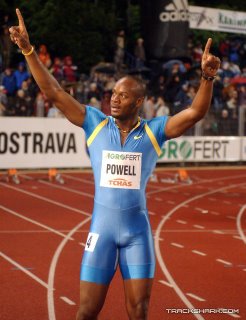
Also on Bernie's site, you can find a great writeup of the International Association of Athletics Federation's (IAAF) revision of American sprinter Justin Gatlin's (right) winning time at the Qatar Grand Prix. It seems his world record time should have been rounded up, from 9.766 to 9.77, thus tying Jamaican Asafa Powell's (left) previous record. I can wait till they race against each other later this year!
Gatlin

Random photo

The skeleton of another new building (condos? corporate? mixed use?), near the Marin Blvd. light rail station, downtown Jersey City

Sunday, May 21, 2006

Nagin Wins in NO + Sorrentino RIP + Bonds Ties Ruth

Ray Nagin reelected
NaginAs has been widely reported, incumbent New Orleans mayor Ray Nagin was reelected last night, by a margin of 52.3% to 47.7%, over Louisiana's Lieutenant Governor and political heir Mitch Landrieu. Nagin had been trailing Landrieu in several polls leading up to the ballot, and there were many questions, particularly after a series of comments he made earlier this year, about whether he would or even could receive enough support from white voters to replace the lost votes of New Orleans's large and displaced black population, more than 180,000 of whom still have not returned to the city.

With the win, Nagin will be poised to continue the difficult work of rebuilding the city, particularly the still devastated Lower Ninth Ward, whose neighborhoods suffered some of the worst damage during Hurricane Katrina. I sincerely hope he's up to the tasks and makes the most of this second opportunity. A former Republican and business executive, Nagin moved leftward after the tragedy of the hurricane and its aftermath, and he'll need to draw on all of his charm and connections, from across the political spectrum, to get the reconstruction monies promised to the city and state; I cannot think of anyone who doesn't want to see New Orleans once again vibrant and a cultural capital rather than the ghostly theme park that it's become.

Gilbert Sorrentino RIP
SorrentinoScanning the obits as I'm wont to do, I came across a small death notice today mentioning that author, artist and editor Gilbert Sorrentino had passed away this past Thursday. For nearly 40 years, Sorrentino was one of the leading figures in American experimental prose. The Brooklyn native and military veteran began publishing avant-garde literary journals and magazines shortly after graduating from college in the 1950s and early 1960s. He then served as an editor at Barney Rosset's Grove Press, where he worked on Alex Haley's The Autobiography of Malcolm X. In 1966, he published his own debut novel, The Sky Changes, which was the first of almost 20 books of poetry, fiction, nonfiction and dramatic literature, including Mulligan Stew (his most commercially successful novel, and a masterpiece), Imaginative Qualities of Actual Things, Splendide-Hôtel, Aberration of Starlight (one of his best and my favorite), Blue Pastoral, The Orangery (poems), and Lunar Follies.

After leaving Grove in 1970, Sorrentino taught at Stanford for more than two decades, and received considerable acclaim for his innovations, which included interpolating the discourse of criticism into his novelistic idioms and a carnivalesque manipulation of genres and forms. An atypical usage of autobiographical materials and emphasis on working-class characters marked many of his novels, as did his profound, humanistic sense of humor. In addition to a Guggenheim Fellowship, he received the Lannan Foundation's Literary Award in 1992 and its Lifetime Achievement Award last year.

Many of Sorrentino's novels are available as reissues from Dalkey Archive Press.
Jacket Magazine's April 2006 Sorrentino feature, with critical essays and tributes, is here.
Alex Lawrence's interview with Sorrentino is available here.
Michael Silverblatt's 2004 conversation with Sorrentino, as well as a clip of Sorrentino reading, is available on the Lannan Foundation's site, here.

Barry Bonds Ties Ruth
So it finally happened: San Francisco Giant outfielder and alleged steroid user Barry Bonds hit his 714th home run, tying MLB icon Babe Ruth's lifetime total, in a game against the Oakland As in Oakland's stadium. Major League Baseball has hypocritically decided that it won't honor Bonds, who's now second only to Hall of Fame near-deity Hank Aaron in lifetime home runs (755), and whose career and achievements lie under the cloud generated by the Balco steroids scandal. The sports media labeled him a malcontent years ago and many of its members have pretty much dismissed every accomplishment of his over the last few years, though his record-breaking 73-home run season even silenced them for a minute. This year opposing fans are again throwing debris at Bonds when he's taking the field in opposing teams' parks, and some opposing players have publicly derided or scorned him, though there's no conclusive proof he knowingly used steroids (though the signs point that way), and he certainly wasn't the only steroid user (star Baltimore Oriole player Rafael Palmeiro tested positive last season, after having testified before a Congressional committee that he'd never used drugs!).

To me the larger issue to me is major league baseball's lackadaisical attitude, for blatantly economic reasons, for years concerning the (rampant?) use and abuse of steroids. One of the players MLB promoted heavily years ago, former Cardinal Mark McGwire, admitted to using androstenedione, a steroid that was later banned, and other supplements, and New York Yankee outfielder Jason Giambi has openly admitted that he took steroids to bulk up and boost his home run tallies. Other players like home run driller Sammy Sosa, have been singled out as well, and the late former player Ken Caminiti not only was abusing steroids, but illicit drugs as well. Baseball kept silent for years, even as rumors and proof surfaced about steroid use, but it was content to look the other way while the homers kept flying out of its ersatz-vintage parks and fans kept packing in, buying league-approved merchandise, and allowing its (chemically assisted-)larger than life stars to become their heroes and shape their dreams. Now that the issue of steroid use and abuse is part of the public discourse and meddlesome politicians have decided to get involved, Bonds is being treated as a scapegoat. In a sense, weren't they following the logic and economics of their profession? Also contributing to the enmity towards him is his bad history with the media and, I think, the basic fact that he's a black man. Would the media's beloved "Big Mac" McGwire, had his body held up and were he approaching Ruth's total, have encountered the same opprobrium? I doubt it. (Aaron, a personable enough player, received racist death threats leading up to and on the very day he broke Ruth's record.) Will he provoke the same brouhaha as he nears Aaron's record? I wonder.

Saturday, May 20, 2006

Five MLB Rookies + The Other Big Papi

Five MLB Rookies
Here are five Major League baseball rookies I've been keeping my eye on during the first two months of this season:
Liriano
Minnesota Twins pitcher Francisco Liriano (2-0, 2.96 ERA, 37 Ks in 27.1 innings) (AP/Morry Gash)
Barfield
San Diego second baseman Josh Barfield (.279 BA, 3 HRs, 10 RBIs, 22 runs, 7 stolen bases) (AP/Jeff Robertson)
Fielder
Milwaukee Brewer Prince Fielder (son of great home run hitter Cecil Fielder), .308 BA, 8 HRs, 24 RBIs, 26 runs, and 3 stolen bases (AP/Morry Gash)

Pittsburgh Pirates catcher Ronny Paulino (.278 BA, 1 HR, 11 RBIs, his pitching staff has a 3.30 ERA when he catches)
Johjima
Seattle Mariners catcher Kenji Johjima (.289 BA, 5 HRs, 23 RBIs, 20 runs) (AP/Jim Bryant)

Albert Pujols
And then there's Albert Pujols, last year's Most Valuable Player and the star of my favorite team, the Central Division-leading Saint Louis Cardinals. First baseman Pujols, whose amazing first five years are comparable to some of baseball's all-time greats, is having an extraordinary season so far: batting around .320, he's hit 20 home runs, driven in 53 batters and scored 43 runs, all of which lead the majors. Though it's still very early in the season, of he's keeps up anywhere near this pace, there'll be no question about a MVP repeat.
Pujols
Pujols checking his bat (AP/Tom Gannam)
Pujols
Pujols singling against Kansas City(AP/Dick Whipple)
Pujols
Pujols looking pensive on his day off (AP/Tom Gannam)
Pujols
Pujols hitting a solo homer against Arizona (AP/Bill Boyce)
Pujols
Pujols receiving high fives from his teammates after his 18th home run, against the Colorado Rockies (AP/Tom Gannam)

Hamels Show at Princeton + Swanky in Brooklyn

Jennifer and Eric Hamel's Exhibit
Yesterday I took the train down to Princeton to the opening of an art show by a writer and artist whose friendship I've cherished for nearly two decades, Eric Hamel.

He was exhibiting his beautiful watercolor, ink and oil paintings and drawings at the University Medical Center at Princeton University (253 Witherspoon St., Princeton) alongside bright and lively oils by his sister, Jennifer Hamel. The paintings are on display until July 19 (Daily 8 a.m.-7 p.m.; (609) 497-4069). Eric 's works on display here are mostly landscapes, and they range between black-and-white ink washes and multicolored abstractions, but all, in their calligraphic expressivity, subtlety and precision, reflect the poetic sensibility he brings to his literary work.

Below are some photos from the exhibit.

Eric doing some last-minute adjustments to a painting

One of Jennifer Hamel's landscapes

Some of Eric's works on exhibit

One of Jennifer Hamel's symbolist paintings

Eric Hamel

Swanky at the Base in Brooklyn
Friday night C. and I headed over to Brooklyn to catch a party that friends of his are promoting: Swanky, at the Base (229 Empire). MASSIVE Productions and RASfm Productions were behind the evening. Featuring some of the best and most infectiously danceable reggae, soca, dancehall, and hiphop beats (with an almost zero homophobic quotient, thankfully!) I've heard in years, Swanky's doors opened at 10 pm, by 3 am the club was starting to fill with partygoers. The featured artists--Benjai, Juicy, Baba Shanta, Trinity, and surprise guests--may have hit the stage after we left. For those interested in future Swanky events, you can contact them directly at info@rasfm.com or log onto RASfm.com. Some photos from the event are below:


One of the DJs jamming

The bar area and the VIP area in the background

Some of the revelers (friend and promoter Donavan S. is in the background)

Some of the partygoers listening to the music

C., friend Tonya C., one of the Swanky greeters, and I

Thursday, May 18, 2006

Translations: Mateo Morrison

Mateo Morrison
Mateo MorrisonOne of the books I picked up during my recent trip to the International Book Fair in Santo Domingo was a fascinating slender, double, or flip, volume, which featured Dominican author Mateo Morrison's book of poems Dorothy Dandridge on one side, and on the other a collection of writings about him, edited by Adrián Javier, entitled Del Verso a la Fragua: Mateo Morrison en Persona y Obra (Santo Domingo: Publicacions de la Universidad Autónoma de Santo Domingo, 2006).

Morrison (1947-, pictured above at left with Angela Oisteanu, Director of Public Relations for the Romanian Cultural Institute and Coördinator of the International Gathering of Poets of the Latin World Ars Amandi, Listín Diario) is a major figure in Dominican letters and longtime literary activist. He founded the literary group "La Antorcha" (The Torch), and the noted Taller César Vallejo (Cesar Vallejo Workshop), and for many years was editor of the literary supplement Aquí (Here), which appeared in the La Notícia newspaper. Morrison currently is director of the Arts and Cultural Programs Department at the Autonomous University of Santo Domingo. In addition to several volumes of poems, including the highly regarded collections Aniversario del dolor (1973, Anniversary of Pain) and Visiones del transeúnte (1985, The Transient's Visions), several critical texts, and a novel, Un silencio que camina (2006, A Traveling Silence).

Here are my draft translations of five of Morrison's poems from Dorothy Dandridge. All of the poems in the brief volume are brief, none longer than 10 lines, and their dreamlike flow and concision presents a challenge. Though Morrison's earlier poetry gained acclaim for its formal openness and lyricism, the compression of the Spanish, which I think may mirror the constraints of Dandridge's life itself and its silences, both seemed to push me towards more English words, so to render the idea fully, and yet to restrain myself in order to evoke the poems' terse and charged expressivity.


Cinco poemas de Mateo Morrison
del libro de poesía Dorothy Dandridge

Dorothy escuchaba los ecos del have dream
Mientras los blacks panters
Apuñalaban el cielo
En las calles de Harlem

***

Aquí la esperan aves
Que saludan la noche
Rostros desconocidos
Profundizan el vacío

***

Bella con sus aretes enormes
Blusa negra y una flor en las manos
Ojos inquisidores, una leve sonrisa
Dorothy representaba sobre su piel
los dioses tutelares
De toda la africanía

***

Recorro sonámbulo los caminos
Donde debió pasar
Hago siluetas en las arenas
En que quizás depositó sus pies

***

Toco las huellas
Que dejó en múltiples aceras
Me inclino en las iglesias
y le dejo oraciones

Copyright © Mateo Morrison, 2006

Dorothy was listening to the echoes
Of "I Have a Dream"
While the Black Panthers stabbed the sky
In the streets of Harlem

***

Here birds await her
Those that greet the night
Unfamiliar faces
Peer deep into the emptiness

***

Beautiful with her enormous earrings
Black blouse and a flower in her hands
Eyes inquisitive, a tender smile
Dorothy represented on her skin
The tutelary deities
Of all Africana

***

I pass like a sleepwalker through the very streets
That she must have passed through
I create silhouettes in the sands
In which, perhaps, she placed her feet

***

I touch the footprints
That she left on multiple sidewalks
I bend down in churches
And offer her my devotions

Draft translations by John Keene, 2006

Wednesday, May 17, 2006

I(international) D(ay) A(against) HO(mophobia)

IDAHOIDAHO: International Day Against Homophobia
Today is International Day against Homophobia (IDAHO) which Black French academic and activist Louis-Georges Tin established a year ago. I linked to Direland's post and interview about Tin a few days ago, and there's lots of information on the day and international action on the IDAHO site.

Rod 2.0, on it as always, covers several different bloggers who posted on the topic, and on some instances of intolerance and homophobia around the globe.

Some quotes to close out the day:

Paul Newman: “I'm a supporter of gay rights. And not a closet supporter either. From the time I was a kid, I have never been able to understand attacks upon the gay community. There are so many qualities that make up a human being... by the time I get through with all the things that I really admire about people, what they do with their private parts is probably so low on the list that it is irrelevant."

Kanye West: "Not just hip-hop, but America just discriminates. And I wanna just, to come on TV and just tell my rappers, just tell my friends, `Yo, stop it.'"

José Luis Rodríguez Zapatero (PM of Spain): "We are not the first but I am sure we will not be the last. After us will come many other countries, driven, ladies and gentleman, by two unstopable forces: freedom and equality."

Alanis Morissette: "Anytime I can support the gay community in whichever way I can, I want to really show up big."

Ernest J. Gaines: "Why is it that, as a culture, we are more comfortable seeing two men holding guns than holding hands?"

Simone de Beauvoir: "The fact that we are all human beings is infinitely more important than all the peculiarities that distinguish humans from one another."

James Baldwin: "Everybody's journey is individual. If you fall in love with a boy, you fall in love with a boy. The fact that many Americans consider it a disease says more about them than it does about homosexuality."

Fran Lebowitz: "If you removed all of the homos and homo influence from what is generally regarded as American culture, you would be pretty much left with Let's Make a Deal. Fran Lebowitz

Michel Foucault
: "We must be relentlessly gay."

Random photo

A commercial being filmed, Patchin Place, Greenwich Village

Tuesday, May 16, 2006

Kunitz & Spark Appreciations

Stanley Kunitz RIP
KunitzLast week former award-winning poet, editor, journalist and teacher Stanley Kunitz died of pneumonia, at the age of 100, in Manhattan. A longtime resident of New York and summer denizen of Provincetown, he had been writing and publishing his unadorned, carefully crafted poetry for nearly three quarters of a century, and had received numerous prizes over the years, including the Pulitzer Prize in 1959 and the National Book Award in 1995, at the age of 90, the year he was appointed Poet Laureate of the United States. He is a writer of whom it can be said, as was the case for Elizabeth Bishop, that quality more than compensated for lack of quantity. Kunitz also gained renown as an editor, particularly during his supervision of the Yale Younger Poet's Prize series from 1969 through 1977, and as a teacher, at Columbia, Bennington, New School, Rutgers, Yale, Princeton, and many other institutions, including the invaluable Poets House in New York and the esteemed Provincetown Fine Arts Work Center, both of which he helped found. Among his former students are some of the major contemporary poets in America, including Louise Glück and Carolyn Kizer.

For a long time, I paid little attention to Kunitz's work; I'd read a few of his poems in high school and college, but they made little impression. They lacked the sort of flash and verbal exuberance, or formal novelty, that I'd grown attracted to, and I assumed that he was a relic of another era like some of his contemporaries, who were then still alive. My thoughts about his work changed, however, when I was teaching 7th and 8th grade students in during the 1995-1996 school year. Another poet I was working with brought in one of Kunitz's most famous poems, "The Portrait," which I'd never seen before. I scanned the poem and was struck silent: the restraint and simplicity of the language belied the powerful emotions contained in it, and I thought to myself, this poet has gotten through to something very profound, something not only painful and barely expressible inside himself but to me too; I was 29 then and struggling to deal with my feelings about my own father. I even felt tears welling up, which I didn't want the students to see, but they perceived something was up, and asked to hear the poem, so I read it to them, my voice quavering. They were less shaken up by it than I was, but appraised it as "very good," and as part of their exercise proceeded to write their own poems that dealt with painful situations they'd encountered with their parents. Ah, the genius of children! Here is the poem:

The Portrait

My mother never forgave my father
for killing himself,
especially at such an awkward time
and in a public park,
that spring
when I was waiting to be born.
She locked his name
in her deepest cabinet
and would not let him out,
though I could hear him thumping.
When I came down from the attic
with the pastel portrait in my hand
of a long-lipped stranger
with a brave moustache
and deep brown level eyes,
she ripped it into shreds
without a single word
and slapped me hard.
In my sixty-fourth year
I can feel my cheek
still burning.

Copyright © Stanley Kunitz

And I can still hear Louise Glück tearing up as she read poems to Kunitz at a tribute reading at NYU almost ten years ago; at his best, he has this capacity to capture with his plainspoke and precise language aspects of life that are so elemental, and universal.

An Op-Art piece on Kunitz by Lauren Redniss (from the Provincetown Times) Kunitz Op-Ed Art

The New York Times's obituary for Kunitz, by Christopher Lehmann-Haupt, is excellent.

Muriel Spark RIP
SparkA little over a month ago, one of the truly original and prolific English-language fiction writers of the 20th century passed away: Muriel Spark. A native of Scotland and longtime resident of Italy, Spark is probably best known for her 1961 novel, The Prime of Miss Jean Brodie, about an unethical schoolteacher whose ideas, detached from practicality, morality and history, lead her students--her "girrrls"--to tragic outcomes. The novel became a successful play and then a 1969 a film, which included Maggie Smith's riveting, Academy Award-winning performance. But she wrote over 20 others, as well as short stories, poems, literary studies, biographies, and journalism. Her novels the bizarre but compelling debut The Comforters (1957), which she published at the age of 39, after a divorce and a nervous breakdown caused by a diet pill addition; in the text itself, a young woman suffers auditory hallucinations, which include hearing someone typing the very novel she's in; her tart, taut sendup of Watergate, set in a convent, The Abbess of Crewe (1974); her exploration of fakery and a real, unsolved murder involving a noted British aristocrat, the delectable Aiding and Abetting (2000); and final novel, which idiosyncratically took apart the creative writing program experience, The Finishing School (2004).

Spark's novels show a mastery of irony, a sometimes startling ability to command authority through the most apparently simple syntax and statement, and an overriding preoccupation with evil. What provokes it, she seemed to be asking again and again, how much does it depend on context, and don't all humans have a capacity for it? Despite her adult conversion to Roman Catholicism, she seemed to pose questions of ethics unlinked to simple or easy Christian nostrums. Take for example Miss Brodie's persistent unorthodoxy, which we might champion over the stifling traditionalism and conventions of the girl's school in which she found herself; and yet her fascination with power, which resulted in a magnetic, exultant power over her young charges, approximated a kind of evil as she played unintentionally dangerous, and in the case of one girl, ultimately deadly games with their lives. Another aspect of this interest in the darker side of human existence was Spark's repeated exploration of masks and the multiple identities they foster and make possible. But she also examined the lies and deceptions the required to be maintained, and how they could and can ultimately and utterly alter what we consider to be (the) real. In Aiding and Abetting, the reader begins to see that no one is who she says she is, though we by the end of the novel, we can't really be sure; who is Lucky, or the person who claims to be Lucky? Can we even believe Spark herself? She playing with the "truthiness" of fiction, among other things, long before it was noteworthy.

The Guardian's Unlimited's obituary, by Jenny Turner, gives Spark her due.

Random Photo

Lower Manhattan, from Hoboken station platform

Monday, May 15, 2006

Natl Guard Troops on the Border + Blacks & Immigration + Brazil Riots

US National Guard Troops on the border?
National GuardTonight we are getting an opportunity to hear about W's newest horrible policy, which involves deploying about 150,000 National Guard troops (or 6,000 troops replaced every few weeks" according to W tonight) on the Mexico border to supplement the US Border Patrol's agents. This appears to be part of Plamegate leaker Karl Rove's proposed to placate the right-wing Republican base and dangle yet another phantasm before the increasingly less gullible American people in order to win the 2006 midterm elections and hold onto Republican control of Congress. W is making this proposal even though his 2006 budget only funded 210--yes, that's right, ONLY TWO HUNDRED TEN!--new Border Patrol agents, and despite the fact that the US National Guard, like the Army and Marines, are currently under extreme staffing pressure because of the ongoing War in Iraq. We saw last fall during the aftermath of Hurricane Katrina what sorts of problems arose when necessary National Guard troops were unavailable.

W has had FIVE years since September 11, 2001, his endless touchstone, to secure the borders through increased border patrol staffing, better technology, and better cooperation with Mexico, but he was more concerned with his vanity war against Saddam Hussein and providing tax cuts for the rich and cheap labor for US corporations to do anything serious. Now that his approval rating has plummeted to 29%-30% and the GOP base is revolting, he's proposing to militarize the border, while still floating his awful guest-worker program, which would lead to legalized exploitation of a large mass of people, even cheaper labor for businesses, and no set guarantee of citizenship after the explotation. Also, does anyone believe that if the rest of the world realizes there'll be open slots every year for foreign workers everyone who wants to come won't try? If we already have 10 to 12 million undocumented immigrants in the country now, we'll have 20-30 million by the time the Congress decides to repeal the program. Meanwhile, enforcement against hiring of undocumented workers has plunged from 2,000+ investigations in 1999 to about 213 last year, while fines and prosecutions have fallen from the several hundred to only 3 last year.

Meanwhile, some on the far right are talking about more extreme measures...yet another mess created by the Worst President Ever.

My question is, how many people yet again will be suckered by this blatant political ploy?

Stephen Steinberg on Blacks and Immigration
I came across this essay, by author Stephen Steinberg, entitled "Immigration, African Americans and Race Discourse," in New Politics. Steinberg analyzes and historicizes the relationship between African Americans and non-Black immigrants, showing in the process how immigration has tended to harm the interests of Black workers, particularly those at the bottom of the economic ladder and at historical junctures, such as the post Reconstruction era and in the mid-1960s, when the possibilities for Black labor looked brighter. One fascinating point he notes is how during the 20th century world wars, when immigration to the US came to a halt, the options for Black workers improved substantially even in spite of racism.

Steinberg also discusses how neo-liberalism underpins the arguments of some pro-immigration enthusiasts, particularly social scientists, and repeatedly returns to how they've actively and extensively overlooked the the fundamental role of racism. (He doesn't mention white supremacy or skin privilege as contributing factors to political, social and economic capital, but the idea underlines his arguments.) He has a number of suggestions for how to rethinking the issue, among them that the issue of America's earlier unfinished agendas needs to be addressed, that a sane immigration policy that protects immigrants and American citizens should be implemented, that targeted affirmative action be reinstituted to counter the effect of closed social networks, and that immigrants and African-Americans develop and strengthen coalitions to protect each others' interests. The article makes many other great points, and I highly recommend it.

Riots in Brazil kill 80
Prison HostageThe First Capital Command crime syndicate, or PCC, decided on Thursday to show the Brazil's local and federal authorities who was really in control in São Paulo city and state, the country's economic engine. Reacting to an attempt by the police to transfer eight of the PCC's leaders to a high security prison, the gang launched more than a hundred attacks against the police, both at work and at home, then on Sunday targeted commuters, before staging multiple simultaneous riots at more than 70 prisons both inside and outside São Paulo that have so far left 80 people dead and many more injured. Brazil's president, Luiz Inacio Lula Da Silva, has ordered more than 4,000 federal troops to quell the violence, but terrified bus drivers in São Paulo city and its environs refused to go to work, stranding millions of residents. Riots continue in prisons across the country, like the one pictured above, in the wealthy southern state of Paraná (AP Photo/Dirceu Portugal-AGENCIA ESTADO), and police have foiled attacks in other parts of the country. Still, federal authorities also fear that the violence could spread to the teeming, slum-ringed city of Rio de Janeiro; state and municipal authorities in both São Paulo and Rio de Janeiro states have struggled over the last three decades with rising crime born, in part, out of the vast economic inequities and resources disparities that plague both densely populated regions.

Random photo

Greenwich Village street scene: trop belle pour tout?

Sunday, May 14, 2006

Baltimore Poet Pix + Audio on Poets + IDAHO/Tin + Rod's Posts + Happy Mothers Day

Baltimore reads NYC
Below are some photos from yesterday afternoon's reading by Charm City poets, Chris Toll, Barbara DeCesare and Reggie Harris, who dropped into to read and perform their poems at the Bowery Poetry Club yesterday. One of the highlights was hearing Reggie's new work (or work I'd never heard before), especially a moving pantoum that included the image of one lover stroking another's back "like a guitar," a poem that I imagined snaked down the page like the faintly rhymed images that constituted it, and the pieces from his ongoing boxing series. Also in the house were Reggie's partner, Mark C., who came up with Reggie from Baltimore, and fellow bloggers-writers Bernie and Steven.

Chris Toll starting off the afternoon

The often hilarious Barbara DeCesare

Reggie Harris, with his Cave Canem bag at right

Reggie reading one of his boxing poems

Audiologo on Young and Trethewey
Also on the poetry tip: A few days ago I added poet and scholar Audiologo to the blogroll at right, and today, flipping through her blog, I saw she'd posted on two poets I know very well and really admire, Kevin Young and Natasha Trethewey. Both Kevin and Natasha teach at Emory and both are fellow former Dark Room Writers Collective members. If you like poetry at all, I highly suggest out both of these poets' works; Kevin has four superb collections of poetry out and recently put out an anthology of jazz poetry with Everyman Library (and it includes one of my poems too), and Natasha's brilliant new book, Native Guard, uncovers yet another hidden aspect of American history. Audiologo links to Kevin's books and Natasha's appearance just the other day on PBS, so click away!

Direland on International Day against Homophobia
TinDoug Ireland has a great post on the second annual International Day against Homophobia (IDAHO) this Wednesday, May 17, and its founder, French scholar and activist Louis-Georges Tin (photo at left, Direland). In addition to penning an informative précis of Tin's life, including mention of his founding the Representative Council of Black Associations (Conseil Représentatif des Associations Noires) in France after the riots last fall, and appending a short interview with him, Ireland again calls US national LGBT organizations on the carpet for their failure to participate in a worldwide effort on a pressing topic. Homophobia, heterosexism and anti-gay violence take many forms across the globe, from state-sponsored killings of LGBTs in Iran and Saudi Arabia to indifference over anti-gay violence in Jamaica to the push for a federal amendment banning gay marriage in the United States, where less than a half a decade ago, sex between consenting adults of the same sex (or in some states, of the opposite sex) was criminalized.

For those who read French, there are French interviews with Louis-George Tin at:
Homoedu: Portrait d'un intellectuel militant
Le Mague Journal: Interview de Tin
And at Les mots sont importants, an essay by Tin, "Êtes-vous communautaristes?" (Are you communitarians?).

Also, if you are opposed to a US-led war against Iran and to theocratic oppression in that country, you can add your name to a growing petition hosted by the Campaign for Peace and Democracy (CPD's) here, and check out the CPD's other activities at www.cpdweb.org.

Rod 2.0 on Line of Beauty, Morehouse Case and Anglin's Standing Down
I'd meant to post a version of this yesterday but ran out of time: Rod 2.0 as always has a cornucopia of news, tidbits, hot shots and much more. Three items in particular caught my eye.

The first was his mention of the resentencing, a reduction, based on a judge's whimsy, for former Morehouse student Aaron Price, who brutally attacked fellow student Gregory Love because he thought Love was making (homo)sexual overtures towards him in the showers. The judge supposedly was initially angered at the initial trial by Price's attorney's use of a gay panic defense, which led to the original 10-year sentence. Because of the change, Price could get out of jail very soon, if the parole board does the wrong thing.

AnglinThe second was his post on Charles Anglin (left, photo Rod 2.0), the Liberal Democrat city councilor from London's Lambeth borough who lost his seat when his profile on a gay website was discovered. Rod covers blogger-scholar Larry Lyon's compelling response and some of the commentary it generated. Echoing many of the comments on Larry's blog, I personally have no problem with politicians seeking companionship, in whatever venue they see fit, so long as it's legal, is not expected to result in a legislative favor, and is with a consenting adult or adults. They're human too, and in my opinion it's better if they're open about who they are and what they're into and seeking than repressing it. If Anglin, an out, pro-gay politician, wants to meet men for wrestling and sex and admits it, why on earth would this be an impediment to him doing his job, and doing it well? Better Gaydar.com than the Watergate Hotel, no?

Last was his mention of British actor Don Gilet's appearance in the BBC2's version of Alan Hollinghurst's resplendant 2004 Man Booker Prize-winning novel The Line of Beauty. What a book! As verbally dexterous a text as this would prove daunting to all but the most skilled of filmmakers, I imagine, so I hope whoever's taken it on has superhuman directing gifts and a poet's eye. Then again, on sheer plot points alone, if the acting is at all competent, it could still be riveting.

And to all Jstheater readers who fit the bill: HAPPY MOTHER'S DAY!

Saturday, May 13, 2006

Guardian on Nollywood + Best American Fiction + Gatlin's record + Fox host's racist call

Nollywood
NollywoodWhich country has the third largest film production system after the US (Hollywood) and India (Bollywood)? Britain, you say? No. France? No. Brazil? Japan? Australia? No, no, no. China? Canada? Korea? South Africa? Well, I wouldn't have guessed it, but it's Nigeria. Actually, months ago, Mendi O. of SWEAT mentioned Nollywood (the photo at left is from HuMobisten.nl) in a comment, and I'd made a mental note, but in the shuffle.... Yesterday, however, I recalled Mendi's note when I came across a piece by Jeevan Vasagar from the March 23, 2006 issue of the Guardian Unlimited titled "Welcome to Nollywood" that details how extensive the film production and distribution system there really is. Vasagar writes:

Nigeria is home to one of the world's youngest film industries, but it's booming. In just 13 years it has gone from nothing to estimated earnings of US$200m (£114m) a year - making it the world's third biggest film industry after that of America and India. The films are made on the cheap, but they are big box office.

Except that there is no box office, of course. In Nollywood, as it has inevitably been dubbed, movies are shot on video and copied straight on to tapes or DVDs and then sold on from thousands of street stalls and hole-in-the-wall shops, not just in Nigeria but across the continent, as well to the African diaspora via markets in the west.

"They sell a lot of our films in Peckham and in Dalston market [in London]," says Paul Obazele, the veteran producer on American Dream, who has already turned out four movies this year, and plans a US cinema opening for this latest effort. "But Peckham is becoming too small for us. We have decided to take on the world."

There's a lot of fascinating stuff in the article, from the tight economics and resourcefulness of the industry to the role of syncretism (traditional cultural beliefs and motifs, along with Christianity) in shaping the most popular film genre of "voodoo-horror." It also got me to wondering about how extensive possible future partnerships or investments of the kind Vasagar mentions, involving African-American actors and others in the US film industry, like Wesley Snipes, might become (are Tyler Perry and T. D. Jakes, both of whom Audiologo pointed to in a recent comment, scoping out opportunities over there yet?), and whether if sufficiently financed Nollywood might eventually function as a major parallel system for the production of (quality?) films for the African Diaspora. Or will the focus remain on the domestic, Nigerian expatriate and trans-African market, even though there is a potentially vaster global market outside Africa, in Europe, the Americas, Asia, and the Pacific that is only inadequately being addressed, much as Hollywood (and Bollywood) has figured out. One thing that brings this to mind is my recollection that when Brazil's new Black-oriented, São Paulo-based TV station was looking for programming, they immediately approached BET and TV One, the two US stations. Nigeria and Brazil have a special historic relationship, and I wonder if Nollywood might not someday become another source of creative production--and if the exchange with Brazil and other countries, in addition to the US, might not go in the opposite direction as well.

Best novel of the last 25 years?
I'm always skeptical of newspapers' or magazines' "best" lists, especially when the criteria are unclear, the methodology is mostly subjective and the judges or arbiters are unnamed, and yet I usually end up accepting the premises of such lists and performing my own on-the-spot comparative evaluations, especially if they're on a topic or subjects I have even a passing familiarity with. Recently the New York Times decided to ask a group of 100 culturati to rank the "best American work of fiction" of the last 25 years, and the top choice was Toni Morrison's 1987 masterpiece Beloved. I have to say that I totally agree; this remarkable novel, like the best of Morrison's works, satisfies its immense ambitions on every level. The runners up were by the usual suspects...and, as usual, contained almost no works of fiction by any other women, people of color, out LGBTs: Don DeLillo's Underworld, a tour-de-force of language; Cormac McCarthy's gory, dazzling Blood Meridian; the repellant John Updike's Rabbit novels (Rabbit at Rest is a finely written and moving capstone work, I must admit); Philip Roth's American Pastoral, which I have to say is the strongest of his semi-autobiographical wordfests of the last decade; Etc. Marilynne Robinson's brilliant Housekeeping (which the Times states it did not review!) was in the next tier of books. Tony Scott has an explanatory (exculpatory?) essay that accompanies the picks. I wonder how many of the selecters listed the brilliant works during this period by Alice Munro, John Edgar Wideman, David Bradley, Samuel Delany, Annie Proulx, Jhumpa Lahiri, Peter Ho Davies, Colson Whitehead, Michael Cunningham, Grace Paley, Gayl Jones, Louise Erdrich, Jane Smiley, Dale Peck, Carole Maso, Percival Everett, Chang-Rae Lee, and others?

Gatlin jets to new world record
Gatlin breaks record
Olympic 100 meter champion Justin Gatlin (left, photo AP Photo/Abdul Basit) set a new world record yesterday in the men's 100 m when he ran a 9.76 at the Qatar Grand Prix in Doha. The previous best was Jamaican Asafa Powell's 9.77 last summer in Athens, Greece. Gatlin and Powell will face each other at Gateshead in Britain on June 11. I would love to see this race live.

Fox host urges non-Hispanics to have more babies
Does anyone remember when the racist crank Ben Wattenberg, coiner of the phrase "birth death," was whining about the declining birthrate among (white) people in industrialized countries years ago, and urging white people to have more (white) babies? Several of the mass-market magazines and newspapers gave his argument a good amount of play, with images of little blue-eyed babies on the cover. The sort of alarmist, white supremacist-informed fear that he was articulating, however, was an integral part of this country's self-conception, and has continued to play a key role in the US's self-regard and development, informing most issues the society has faced, from immigration and citizenship to education and crime to sexual liberation and women's control of their bodies. Like a full and rancid aquifer it's still frequently tapped. John Gibson, the mummified host of Fox News's The Big Story, drew upon it again when he urged viewers (whom, I presume, he imagined to be non-Latino) on Wednesday to "make more babies" because, he warned his presumed white addressees, in "twenty-five years...the majority of the population is Hispanic." Given the Census Bureau's predictions and since mass deportations (or more horrible means) seem unlikely, his answer is to have more (white) babies. He went on to urge: "Procreation not recreation," about as succinct an echo of Pope Benedict (or Hitler) as one could imagine. Like Jean-Marie LePen and others on the European far right, Gibson also appears to have serious worries about the declining birthrate among whites in Europe, which he claims is in danger of turning into "Eurabia." Etc. Media Matters has the rank goods.... I'd add that we should probably always keep in mind the awful history of American eugenics and the period sterilization policies that've been launched against poor and working-class women of color...Norplant? Hysterectomies? Nothing is too far-fetched with this crowd.

Random photo

Young Haitian man, Calle Sanchez, Santo Domingo

Friday, May 12, 2006

BPC Readings Tomorrow + New New Directions Anthologies

Readings tomorrow at Bowery Poetry Club
There are some great readings tomorrow at the Bowery Poetry Club. At 2 pm, my very good friend Reggie Harris, author of Ten Tongues (and whose blog Noctuary is now on the roll at right) will be reading with two other poets from Baltimore, Barbara DeCesare and Chris Toll. From 4-6 pm, Eliot Weinberger (see below) and Susan Howe (one of my favorite poets!) will be reading their work. From 6-7, poet Leonard Gontarek will be signing copies of his book, Deja Vu Diner, and my NYU contemporary Daniel Nester, author of God Save the Queen, will be signing his book History of My World Tonight. At 10 pm, the BPC is hosting a Hip Hop Commedia.

From their calendar:
The Bowery Poetry Club
308 Bowery, New York, NY 10012
212.614.0505
***
2:00pm
Baltimore Poets $6
4:00pm - 6:00pm
Segue Reading Series: Eliot Weinberger and Susan Howe $6
6:00pm - 7:00pm
Leonard Gontarek Reading & Signing Deja Vu Diner, Autumn House Press, 2006.
Daniel Nester Reading & Signing History Of My World Tonight, BlazeVOX, 2006.
7:00pm - 7:45pm
Crystal Bacon, Brandel France de Bravo, Jennifer Martelli, and Barbara O'Dair $6
8:00pm - 9:30pm
Greetings Zine
10:00pm - 11:30pm
Hip Hop Commedia $10/5

Terrestrial IntelligenceNew anthologies from New Directions
Eliot Weinberger, who'll be reading tomorrow, is the editor of a hot new anthology, World Beat: International Poetry Now from New Directions (2006), that features the work of over 20 internationally renowned poets who've been published by New Directions Publishing Corporation over the last 25 years. Most of the poets in the volume have made their name in part through formal experimentation and political progressiveness, and they include the late Nobel Laureate Mexican Octavio Paz, Bajan wordsmith and scholar (and my former prof) Kamau Brathwaite, Chinese poets Gu Cheng and exile Bei Dao, Japan's Kazuko Shiraishi, Israeli Aharon Shabtai, the young Albanian writer Luljeta Lleshanaku, Denmark's Inger Christensen. There are a handful of outstanding American poets, including the late Robert Creeley, Anne Carson, Nathaniel Mackey, Michael Palmer, Rosmarie Waldrop, and Susan Howe. Also in the volume is Iraqi exile and US resident Dunya Mikhail, who with Palmer is a finalist for Canada's 2006 Griffin Poetry Prize.

Terrestrial IntelligenceNew Directions has published a companion fiction volume, Terrestrial Intelligence: International Fiction Now from New Directions (2006), edited by ND's Editor in Chief Barbara Epler. Like the poetry volume, this one features selections from novels and books of short stories the press has published over the last 25 years, and includes authors such as the deceased and periodically sublime German-British author W. G. Sebald; Russia's comic "enfant terrible" Victor Pelevin; Germans Uwe Timm and noted filmmaker and theorist Alexander Kluge; Scot Dame Muriel Spark, the author of The Prime of Miss Jean Brodie and other suberbly styled novels, who passed away just a few weeks ago in Italy; Swiss ironist Fleur Jaeggy; Guatemalan Rodrigo Rey Rosa, who was translated by famed Beat Era expatriate Paul Bowles; Haiti's René Philoctète; Spanish maximalist Javier Marías, a likely candidate for the Nobel in a few years; Israeli experimentalist Yoel Hoffman; and Chilean native Roberto Bolaño, whose remarkable last novel 2066 will appear later this year. In this volume, there's only one American writer, whom I can say I know very, very well: John Keene.

Both collections would be perfect for general enjoyment and classroom use, so consider purchasing them if you're so inclined.

Random photo
66th St. Station
66th St. Station, Lincoln Center, on a Saturday afternoon

Thursday, May 11, 2006

More Bush/NSA spying + Dean against Gays (Again) + France's Universities Dying?

NSA database program revealed
A while ago, Bernie linked to a site that detailed the partial list of cthe rimes, disasters, scandals, and crises that have occurred under George W. Bush, who, as the self-described "the decider," appears to have decided to outdo even the worst of his predecessors (Warren Harding, Franklin Pierce, Millard Fillmore, James Polk, his father) in his quest for the title of "Worst US President Ever." Today, we learned he's been working overtime on this effort: Leslie Cauley of USA Today reported that under Bush, the National Security Agency has been secretly culling the phone records of tens of millions of ordinary Americans without judicial warrant, but with the cooperation of telcom companies AT&T, Verizon and BellSouth. Denver-based Qwest, however, refused to participate. According to Cauley,

For the customers of these companies, it means that the government has detailed records of calls they made - across town or across the country - to family members, co-workers, business contacts and others.

The three telecommunications companies are working under contract with the NSA, which launched the program in 2001 shortly after the Sept. 11 terrorist attacks, the sources said. The program is aimed at identifying and tracking suspected terrorists, they said.

Vermont Democratic Senator Patrick Leahy questioned whether millions of ordinary Americans were supposed to be members of Al Qaeda, and continued to inquire about the program's legality on tonight's New Hour with Jim Lehrer, while leading GOPers in the Senate and House had mixed responses, some defending Bush on the meretricious grounds of the nebulous "war on terror," while others expressed concern about yet another possibly illegal and un-Constitutional administration program. 72 members of the House (71 Democrats and 1 independent) so far have filed papers towards a bill to end the database program

Obviously worried about the political fallout of having yet another domestic spying program revealed, Bush tossed out his usual buzzwords ("September 11" etc.) at a noon press conference, assuring listeners that the program was legal and necessary. One immediately casualty may be his designated new CIA chief, General Michael Hayden, who is allegedly an architect of this program. But we are surely only getting an infinitesimal sliver of the truth, and I have to wonder at this point how Bush could possibly believe--if he does--that he has any credibility left except among the diehard and dwindling few that still applaud his tenure. Meanwhile, with prior administrations and local governnments having already paved the way for the increasing incorporation of a surveillance society and the negation of the 4th Amendment's protections, and under the guise of the limitless and extratemporal "war on terror," we are confronted with another example of the administration's assault on the US's Constitutional system, on the government's separation of powers, and on our civil liberties, among other things. Like the manufacturing of the war in Iraq; the Guantánamo detentions; the secret and not-so-secret torture programs; the global renditions and ghost prisons in Europe; the 750 signing statements disregarding Congressional prerogatives or laws; and the previously disclosed domestic warantless wiretapping program, Bush and his administration have shown that they will pursue and arrogate to themselves as much power as they can, secretly or openly, with de facto tyranny being the result. If they have bankrupted the Treasury and left the nation's laws, military and infrastructure in a shambles in the process, so much the better. As it stands, they know and fear no limits.

Dean slags off on gay people again
Dizzy DeanAs Bush and the Republicans keep digging an abyss for themselves and the country, some members of the Democratic Party unfortunately do their best to compound the effort, align themselves with bad Republican positions and drive away longstanding and potential supporters. Howard Dean (at right, photo from Southern Voice), the excitable chairperson of the Democratic National Committee, had already created a stir last year by eliminating the gay outreach desk and then again just weeks ago by firing Paul Hitchcock, the DNC's gay outreach adviser. Wednesday night, on the unstable Pat Robertson's far right-wing 700 Club, he misstated the Democratic Party's 2004 electoral platform, erroneously claiming that the party espoused the belief that marriage was solely "between a man and a woman." The National Gay and Lesbian Task Force not only criticized Dean's remarks in the strongest terms, but also returned a DNC donation.

Given that the dizzy doc is the putative head of the party, there simply is no excuse for his mistake. Dean has been courting Southerners and conservative Democrats since he won the chairpersonship, but the 21st century Democratic Party simply is not--never--going to appeal to the far loony wing of Christianists even come Armageddon (they'll be swept up, they believe, in the "rapture"), and there are numerous dire issues Americans are demanding that politicians address, yet with this unnecessary and idiotic stunt, he's shown that once again, he's already bought into a bad and virulent Republican meme. Perhaps if Democrats spoke and acted with conviction, rather than pandering and falling over themselves to kiss the ass of nutcases, as Dean has done, they might draw even more voters to the polls on their behalf, whether they agreed with gay marriage or not. As things stand, Dean has given some gay voters a reason at the least to assume that the two parties, despite their obviously differing approaches to LGBT issues, are actually not so far apart.

France's university system is kaput
A few years ago, an older friend of mine lived for a short period in France with her husband, a computer scientist, when he taught for a semester at the University of Grenoble. (I believe it was Grenoble and not Nantes.) She told me that she enjoyed the experience tremendously, as did her husband, whose innovative genius, track record of entrepreneurship and long corporate experience all led to the CS department there to invite him as a visitor. At most American research universities and even many public and private colleges, this sort of invitation wouldn't be uncommon, but it was, if I recall correctly, a big deal in France. In today's New York Times, there's an article on the problems with France's university system, which is completely state-controlled, underfunded and badly structured in a two-tier system that ill serves the vast majority of its students, who attend free of charge or for very little, and makes many American public universities and colleges, which also face funding crises, look as flush as Harvard or Princeton. The article specifically examines the dilapidated campus of the University of Paris-Nanterre (where Michel Foucault was appointed to the chair in philosophy in 1967, just before he assumed a similar post at the experimental university at Vincennes). These days, according to the Times, Nanterre is a physical and administrative mess; a crowded commuter school that's falling apart, it offers degrees that are basically worthless. Most of the state's educational budget goes to a handful of elite schools, or grande écoles, like the l'École Normale Supérieure (ENS) or l'Institut des études politiques de Paris (Sciences Po), while the rest of the system is starved. This scenario is worse, from what I can tell, than two of France's wealthiest and large neighbors, the UK and Germany. In Britain, a funding crisis spurred increased fundraising and private investment in the public system, while the bottleneck in intellectual opportunities led to the construction of a host of newer universities and programs over the last 30 years. In Germany, the state universities have also been in malaise, but for the most part, I think, the Germany system is not subject to the funding or institutional hierarchy that exists in France. I have often criticized the American higher education system, which over the last three decades has increasingly unaffordable for many Americans as tuition and fees have outpaced inflation and incomes, even at public institutions, but France's system, if it is at all akin to what the Times lays out, seems like a pretty awful alternative.

Courtyard at College de FranceOn the other hand, there is the small and extraordinary Collège de France, where Foucault (and other exalted intellectual figures, including Pierre Bourdieu, Yves Bonnefoy, Fernand Braudel, Georges Dumézil, Pierre Boulez, Claude Lévi-Strauss, and Jean-Pierre Vernant) also taught (unsurprisingly, almost no women or people of color have ever been appointed to a chair there). I've always thought that an institution of this (though without the misogyny, racism and ethnocentrism), that drew some of the top scholars in the US and world to a central, fully funded center that was, unlike the august, intellectually immured Institute of Advanced Study in Princeton, fully open to the public, would be a great addition in the US system. But public funding for it is unforeseeable even in the distant future.

Random photo

A Hudson Street flower vendor, on a late night in April

Wednesday, May 10, 2006

Farrago

PerryTyler Perry's House of Payne
I saw ads for this show on Monday, then this evening heard Wendy Williams on her WBLS show dismissing it and breaking on Tyler Perry (at right, courtesy EURWeb) when she responded to a caller's inquiry about the purported romance between Perry and Tyra Banks (Wendy implied that Perry's real interests lay in the person of the show's star, Allen Payne ("How you doin'?")). So I was curious to catch it, despite my longstanding feelings about the buffoonery Perry packages so adeptly and lucratively for public consumption. As I was chatting on the phone with my friend David this evening, C. pointed to the TV screen to say that the show was coming on, at 11 pm, on UPN after WWOR-TV's infamously over-the-top news program. Though I missed the first few minutes of the show, when I finally did begin watching it I realized that I was witnessing something so bad, so awful, that it actually merited the description "dreadful," as in, "filling one with dread at the possibility of seeing it again." Dreadful premise, dreadful production, dreadful performances. In fact, it's so dreadful I thought it might be an elaborate joke, until I realized that, no, it was for real. It makes both The Jeffersons and Good Times look not only like high art, but progressive. The premise involves Payne's character moving back home with his parents, his two children in tow, because his wife has become...a crack addict who burned the house down! (Maybe I misheard this bit, but then maybe I'm misremembering a similar scenario for Perry's character in Diary of a Mad Black Woman.) The actor playing Payne's father was in full minstrel mode, and would have made Amos or Andy jealous; the woman playing Payne's mother, when not missing her timing, actually had to turn sideways to exit the soundstage. Payne himself seems to be performing as if he'd never learned even the basics of acting, including convincing facial expressions and gestures and was in a drama. Tonight's episode involved the father/grandfather fearing that his grandson, who he caught with a very tiny tutu hanging (not draped, and he wasn't wearing it) around his neck, was a "tambourine player." Which is to say, gay. (Is "tambourine player" an alternate name for gay people somewhere on this planet? Is "Riverdance" a gay reference? Really?) So the show went through all the predictable, homophobic responses. It suggested that if a young boy didn't want to be a fireman or learn karate, he could still be beaten up to be "toughened up," which would, naturally, de-gay him. (I guess there wasn't time or narrative space to deploy the Bible's de-gaying powers in this episode.) Payne's character, the boy's father, showed no character by going along with this, and initially was unable to deal with the fact that his son was sitting alone in the kitchen drinking out of a carton of milk (in an African-American household?) with the tutu hanging from his neck. Wouldn't this provoke some basic questions even in the most inane sitcom world? The source of the family's gay panic, the clumsy tutu-as-symbol, ultimately turned out to be rather simple and utterly sentimental, however; the boy missed his (crackhead) mother, and was sporting the tutu, which would not have fit on a Barbie, let alone a human being, like a necklace (?) because he and she used to dance around while she wore it (how?) when times were good (naturally), and of course it still bore her scent. Yep. In Tyler Perry-land. I know Perry is a hot commodity right now, but someone with UPN must have a semblance of aesthetic and critical judgment left, right? According to EURWeb, 10 episodes of this syndicated dreck are set to air. UPN, please stop while you're ahead.

The PATH Train Disparity
This entry will really be of interest only to those of us who (have to) take the PATH trains between New York and New Jersey. Every day that I've been back in New Jersey and have ridden the PATH into and out of Manhattan, I've said to myself, you have to write something on the blog about how the Port Authority of New York and New Jersey continues to run more Hoboken-bound trains than Journal Square-bound (Jersey City) trains, even though Jersey City, the second-largest city in the state, is now almost as populous as Newark, the largest city, and the more-frequent Hoboken-bound trains are seldom full at any hour of the day or night (except when on a holiday schedule that combines their route with the Journal Square trains'), while the Journal Square trains are alwayspacked at morning and evening rush hours, and sometimes approaching full in the early afternoon and late evening. For years I dealt with this, inquired of and complained to conductors and thought, they are eventually going to figure out that this disparity is idiotic and will finally run more Journal Square trains. But it seems in over 10 years, they haven't gotten a clue. I've always heard the rationale that the Hoboken trains are more frequent because of the New Jersey transit rail lines that converge at the Hoboken station, but then where are all the train riders? Does the Secaucus exchange get most of them? Do they simply go straight into and out of New York's Penn Station and skip the PATH ride? There is the alternate explanation of racism; the fact is, the majority of people taking the Journal Square trains (like the Newark trains) are people of color, while the majority of Hoboken line commuters are white, but this seems too blatant and obvious. And with steroid-style development that's overtaken Jersey City, there's again a large and growing white population in Jersey City, though many of the new residents are much more affluent than their predecessors from 50 and 100 years ago. Will the train schedule disparities change once this new Jersey City population reaches critical mass, or will there still be more Hoboken trains?

MooneyNew Yorker's Rowing Experiment Capsizes
It was a fascinating idea, for undeniably great public and private causes. But unfortunately 41-year-old Victor Mooney wasn't able to get beyond the coast waters of Senegal in his attempt to row across the Atlantic Ocean to raise money for HIV/AIDS research and prevention. Fortunately for him the Senegalese Navy came to his rescue. If he does try this again, and I hope he does for the reasons he outlined, I pray that he'll find more seaworthy boat and some national, NGO or corporate sponsorship, and an official rescue agreement with several navies and coast guards. The Reuters article ended rather disturbingly with the following paragraph:

"I know the sea and how it gets. That man is going to have trouble in that boat -- he doesn't even seem to know how to row," said a local boatman who saw him take his first strokes.

Given what he was undertaking, I trust his rowing skills and prowess weren't really and won't in the future be an issue....

Brazil's Pirahã Tribe Upends Chomskyan Thesis
Or so says this article in Der Spiegel, which tells of a Brazilian tribe, the Pirahã, who, unlike every other group of speakers on earth, never use the very sort of compound sentence I'm unfurling here. This fact appears to contradict the recursion theory of human linguistic development, of which MIT linguist, philosopher and activist Noam Chomsky, one of my intellectual avatars, is an pioneer. But then the person who's made this claim is one of the few non-Pirahãs to understand and speak the language, so two Chomskyans are going to check things out very soon. They will get there, they will figure out what's really up.

Blog Round Up
Bernie has an excellent post on the appalling but not surprising Cocodorm story
Andrés beautifully memorializes HIV/AIDS activist Juan Mendez
Keguro posts on Googlebombing to aid the detained Egyptian blogger Alaa Abdel Fatah
Frank features fabulous photos for days on the Awards Ball 2006
Larry K. gives a thumb down to the Broadway version of The Color Purple
Nubian posts a video that speaks for itself
EJ has an Old School Wednesday lineup to carry you into the weekend

Random Photo

At the World Trade Center temporary PATH station, which from the day it opened has been a work of art

Farrago - I have always loved this word, though I'm using it here in its more positive connotations as a motley assembly, rather than a confused one.

Tuesday, May 09, 2006

Photos: 9th International Book Fair, Santo Domingo


At the Café Bohemio, "Propuesta E+Z=P" (Poetics and poetry of Argentinian Ernesto Sábato and Dominican Zacarías Espinal), featuring Puro Tejada and José Almonte Batista

Students walking in front of the Argentina pavilion

Wall of quotes (Jorge Luis Borges is at the top)

An artist working on large sheet of paper in the Argentinian pavilion

Public popular art commemorating the US invasion 41 years ago

Person effects of Pedro Henríquez Ureña, one of DR's and Latin America's major literary figures

People awaiting a talk (I think I waited for about a half-hour)

In the José Peña Gómez pavilion (he was one of the key figures on the Dominican left until his death several years ago)

People chatting between readings in the Dominican authors' pavilion

An outdoor print workshop

Students taking notes on Marcio Veloz Maggiolo's bibliography

A tableau of Veloz Maggiolo with other archeologists, discovering Taino paintings in Dominican caves

Paintings by Veloz Maggiolo, in the Veloz Maggiolo Pavilion

Lounging around the Verdi statue

The baseball pavilion, with its long line.

Monday, May 08, 2006

9th International Book Fair/IX Feria Internacional del Libro, Santo Domingo

Last week I did something I've never done before, which was to attend an international book fair outside the US. I went to the IX Feria Internacional del Libro 2006, in Santo Domingo, Dominican Republic. This government-sponsored literary and arts festival, which was much larger and more vibrant than I'd expected (it's the largest in the Caribbean, and one of the larger ones in Latin America), ran from April 24 through May 7, and took place mostly throughout the grounds and museums of Santo Domingo's designated arts and cultural area, the Plaza de la Cultura Juan Pablo Duarte, in the leafy Gazcue neighborhood. The fair's theme was "Leer Ilumina" (Reading Illuminates), and from my spot observations, the nearly two-week event drew thousands of authors, booksellers, and literary enthusiasts from across the city, nation, and world. Most of the attendees and literary figures I came across were from Hispanophone countries; the strong attendance of Dominicans themselves, especially young adults and children, was particularly encouraging. As far as I could discern, the presence of Anglophone publishers and writers was minimal, however, outside of a few joint English-Spanish Dominican-American and Puerto Rican books, and I didn't see any official US representation (which perhaps was a good thing given that there were several exhibits both at the fair and in the city (at the Parque Independencia) commemorating the country's liberation four decades ago from the US invasion and occupation that began in 1965). There were booths and pavillions from France, Italy, Japan, Haiti, Germany, and other nations.

Veloz MaggioloEvery year, the fair designates a País Invitado (Invited Country), or Country of Honor, and this year's honoree was Argentina, which has one of the most distinguished literary traditions in 20th century Spanish-language and world literature. Argentina mounted a pavilion which I didn't find especially impressive (in it there was an English-language (?) travelogue film, with Spanish subtitles, that was packing people in but which I found sort of cheesy and dull). Much more interesting I thought was the tiny historical exhibit the Dominican National Library featured on Argentina's major authors that I spent a good while viewing. Other highlights of the festival included an exhibit of paintings by poets, including some beautiful small canvases by one of the DR's most famous authors, Marcio Veloz Maggiolo (above, right, from Gutierrez's Escritores Dominicanos); a pavillion dedicated to the fair's dedicatee, the prolific Maggiolo himself, which included many more examples of his plastic gifts, many copies of his books, and photos of him with writers I adore, like Jose Saramago and João Guimarães Rosa; several historical rooms in different museums devoted to aspects of Dominican and Latin American history; the modestly stocked but engaging Museum of Contemporary Art; and the almost endless array of Spanish-language publishers and booksellers, which were divided up into various categories. Another exciting aspect of attending was that the minimal English-language presence meant that I had to function almost completely in Spanish (or occasionally French). I managed okay, though there were moments when my lack of Spanish vocabulary and longstanding mild deafness, which was first identified in first grade (when I opened the letter from the auditory testers to my parents, saw that they'd noted I had a possible hearing problem, and promptly threw it down the grate at the curb) combined to such an extent that I caught about half of what was being said. Throughout I felt like a guest at a very special party whose secrets were being steadily revealed to me, so long as I paid attention and made more than a cursory effort.

Whenever I travel outside the US, I always look for books by authors I know and have never heard of, and this trip I came across several revelations. One was the Dominican author Pedro Peix (1952-), whose highly lauded, inventively experimental stories and prose pieces were collected and published by the fair's organizers, via their publishing unit Ferilibro (Dirección del Feria International del Libro) in a huge and attractive volume, El amor es el placer de la maldad: Relatos 1976-2006 (Love Is Evil's Pleasure: Stories 1976-2006), which Jimmy Hungría compiled. I recalled Peix's name (but hadn't read his story) from Marguerite Fernández Olmos's and Lizabeth Paravisini-Gebert's Caribbean short-story anthology, Remaking a Lost Harmony. Another Dominican author whose work I'd seen before but wasn't too familiar with was poet Mateo Morrison (1947-), who is a native of San Pedro de Macorís, the town from which a number of the country's most famous baseball players (Sammy Sosa, Alfonso Soriano, Robinson Cañó, George Bell, Joaquín Andújar, etc.) come from, and which has had a history of immigration from the English-speaking Caribbean as well as of African-Americans during the Boyer regime in the 1820s.

AndújarOther authors whose books I picked up include La Vasta Lejanía (The Vast Distance) by Cuban poet Agustín Labrada (1964-)--and there were so many fascinating books of Cuban poetry I had trouble picking. The cultural and arts organ Cielonaranja's press offered up some of the most visually appealing books, bound in what looked like heavy brown card stock, with linotype-style printed title cards and inside pages, and I ended up getting a reprints of works by Antonio Lockward Artiles (1943-) and late fiction avatar Aída Cartagena Portalatín (1918-1994). My visit to their booth involved a dreadlocks demonstration to a group of young schoolgirls! I had also long been curious about the Congo-derived drumming traditions which are based in the town of Villa Mella, which is north of Santo Domingo city proper, and I found a book, ¡Kalunga Eh! Los Congos de Villa Mella, by Dominican anthropologist Carlos Hernández Soto. One press that had lots of books I was interested in was Isla Negra, based in Puerto Rico. Juan Dicent (?-) read from his collection of contemporary pop-flavored stories, Summertime (Shampoo, 2005), at the fair's Café Bohemia on Tuesday, and I figured I'd get the book and read the whole thing. Two volumes I bought were by the acclaimed Dominican short-story writer and scholar, José Alcántara Almánzar (1946-), and a fairly young Dominican author who lives part-time in the US, Reynolds Emmanuel Andújar (1977-, pictured at left, courtesy Cielonaranja). I was especially looking for Puerto Rican author Ángel Lozada's second novel, No quiero quedarme sola y vacía (I Don't Want to Be Left Alone and Empty, 2006), published by Isla Negra, which my friend Anthony Montgomery hipped me to before I headed down and which was to make its debut (se estrenaría) at the fair, but I had to leave before Ángel was scheduled to read and the different guys repping the press that I spoke with couldn't even find it in the catalogue! (I wasn't able to find his first novel in any of the New York Spanish-language bookstores, so I ordered it online.)

Other highlights of the trip included having a great time with Anthony and getting an inside view (literally) of Santo Domingo's Colonial Zone houses and apartments (as if we had stepped straight into a Pedro Peix story setting); having brunch with David Lee of the Sports Bar; finally meeting Alan Washington of Tropical Desires; walking the streets of the city, especially down Calle Cesar Nicolas Penson, past the heavily fortified American Embassy; talking and dining with Bernard T. of Philly; witnessing the mad campaigning for the upcoming elections (though I could do without the eardrum-blasting speakers; catching the tail-end of the still-unfinished Hard Rock Café's fashion show on the Conde; spotting Scotch of Casa New Yorker at the airport and later getting a chance to laugh with him and Byron; and hanging out with the many other Americans (Vincent, Joshua, and many others) and Dominicans (José, el maestro de la moda, y los otros).

I'll post photos in my next entry.

Sunday, May 07, 2006

Young's and Zazeela's Dream House

One of my brilliant former students, Tai Little, suggested almost a month ago that I check out composer LaMonte Young's and visual artist Marian Zazeela's Dream House: Seven + Eight Years of Sound and Light, one of several versions of a pioneering famous sound and light environmental art installation, which opened for its thirteenth season at the Mela Foundation down in Tribeca last year. Since Tai suggested I knew it would be worth seeing, though it took me weeks to finally get downtown to check it out. After being introduced to the space by a friendly woman (was it Zazeela? I didn't think to ask before she disappeared) I was the only person in the rooms.

I recommend Dream House, especially if you have some time to spare, aren't too bothered by loud, repetitive music, don't need lots of visual flash and are in a contemplative mood, and want to experience one of New York's famous participatory sensory aesthetic artworks. As the site says:

Both artists are presenting works utilizing concepts of structural symmetry. Zazeela's mobile forms are arrayed in symmetrical patterns with lights placed in precisely symmetrical positions creating symmetrical colored shadows; the wall-mounted light sculpture and the neon are both symmetrical forms. Young's sound environment is composed of frequencies tuned to the harmonic series between 288 and 224, utilizing numbers with factors of only 9, or those primes or octave transpositions of smaller primes that fall within this range. The interval 288/256 reduces to a 9/8 interval as does the interval 252/224. Thirty-two frequencies satisfy the above definition, of which seventeen fall within the range of the upper, and fourteen fall within the range of the lower of these two symmetrical 9/8 intervals. Young has arranged these thirty-one frequencies in a unique constellation, symmetrical above and below the thirty-second frequency, the center harmonic 254 (the prime 127 x 2).

The technical aspects of the piece will probably appeal more to a composer or mathematician, while the experience of repetitive music and light over extended durations may draw out the psychologist and philosopher in a viewer. I also recommend taking someone with you to check it out, since I believe this will alter the dynamics of the waveforms; whenever I stood in one spot, the rhythmic pulsing turned into buzzing. I tried walking slowly, then running, then hopping around, punctuating my different paces with long pauses--at least as long as I could take the feedback-like buzzing--but I did wonder what it would be like to experience with others present. The photos below are from the exhibit, though I have to say they hardly capture my realtime ocular experience, since the camera's optics filter out the multilayered imagescape that the human eye is able to perceive. If I go back, maybe I'll try my first podcast...

The entry hallway

Inside one of Zazeela's environments, Imagic Light, Magenta Day (the mobiles are almost invisible)

Another view of Imagic Light, Magenta Day

Zazeela's neon Dream House Variation I

Zazeela's Ruine Window 1992 from her series, Still Light
.
Self-portrait in the Imagic Light room

Saturday, May 06, 2006

David Blaine at Lincoln Center

He's a little bit of a 21st century Houdini and a little bit Kafka's "Hunger Artist" come to life, and over the years I've been as magnetized by David Blaine's public spectacles (including his suspension above London, his live burial, and his immurement in ice) as the hundreds of people I saw milling about Lincoln Center Plaza. He entered the watery sphere this past Monday and is aiming to hold out until this upcoming Monday, despite the numerous dangers that his aqueous sojourn poses. If he makes it till Monday, he supposedly is going to cap thigns off with a Houdiniesque escape. Some people are more willing to tempt fate than others, I guess.

One thing I do enjoy about Blaine's performances above all is how they're usually free, at least part of the time, and bring all kinds of people out to see them, just as similar stunts would have drawn similar crowds 100 or 200 years ago. The crowd I saw was a typical cross-section of New York: all ages, colors, classes, assembling to participate in a communal experience in an iconic, semi-public space, which have become rarer in the city with each passing decade. Since I first heard about Blaine's current project, I've had one basic, very prosaic question, which I heard a young woman vocalize as I was snapping the pictures. How does he go to the bathroom?

Here are some photos:

The distortion caused by the sphere's curvature, the light and the water made Blaine literally look larger than life.

People were watching from the balcony of the New York State Theater, where a ballet was also taking place today.

From a westerly perspective.

Blaine's bubble with the Metropolitan Opera House in the background.

Blaine greeting fans.

A close-up.

Reaching out to touch a fan.

The woman in the red hat was grinning widely seconds after I snapped this photo.

Some of the many who were out to see what was up.

Update: Blaine survived his week underwater, but he was unable to hold his breath long enough to break the record. He unlocked the double wrist locks as the clock counted down, but blacked out with more than a minute to go. Nevertheless, it was a great bit of showmanship of the kind that this culture often seems to have lost sight of.

Friday, May 05, 2006

Quote: Ricardo Piglia (on Viswanathan)

This past week I was (re)reading Argentinian writer Ricardo Piglia's 1992 novel, Ciudad Ausente (The Absent City), and came across this passage at the end of his afterward. I immediately thought of the plagiarism scandal surrounding Kaavya Viswanathan's novel, now-recalled How Opal Mehta Got Kissed, Got Wild, and Got In (Little Brown, 2006). His idealist, anticapitalist view clashes squarely against the reality of global capitalism itself, and in particular the fact that a 17-year-old received half a million dollars, plus a movie deal, for a project that appears to have been slapped together by a marketing company, but at the same time, it poses many interesting questions, including: is language common property, and can anyone--any corporation, in particular--ever fully own it?

***


"I hold the same relationship with literary property as I do with property in society: I am against it. I think there is a game with property in translation. That is, it puts into question something that common literary sense takes for granted, which is the fact that issues of property in literature are extremely complex, just as they are in society. Language is a common property; in language there is no such thing as private property. We writers try to place marks to see if we can detain its flow. There is no private property in language; language is a circulation with a common flow. Literature disrupts that flow, and perhaps that is what literature is."
--Ricardo Piglia, from the afterword to The Absent City (Introduction and translation by Sergio Waisman; Durham: Duke University Press, 2000), pp. 146-147.

Monday, May 01, 2006

May Day

Happy May Day!

May Day Poster

For workers' rights we must unite • la lucha continua • sempre la luta da vida e da trabalho • Мы имеем мы заработали • wir müssen für unsere Freiheite kämpfen • 労働者は結合する • 우리는 우리가 있는 모두는 투쟁으로 이겼다 • toujours il nous faut marcher pour nos droits