Friday, September 30, 2005

(Bad) Photo: Linh Dinh

Last Sunday, a colleague and I went to see the writer Linh Dinh read with Bill Allegrezza at Myopic Books' poetry series, which Chuck Stebelton hosts in Chicago. I'd never heard Linh Dinh read before, but have been a fan of his work since Tisa Bryant sent me Renee Gladman's beautifully bound Leroy chapbook of his playful and highly original poems, entitled A Small Triumph over Lassitude.
Dinh
He didn't disappoint; he read prose and verse from old and new works, a great deal of it formally straddling several genres, including the epigram and the aphorism; his one line stories were especially sharp. Many felt like snippets from pointed, yet generic narratives, though he has a way of making his fictions, however brief, quite vivid, mainly through specificity of detail, imagery, and his careful use of rhetoric. I thought of Tan Lin's thrilling readings last spring at the university, and how both writers, without explicitly mentioning that they're Asian-American in much of their work, nest moments of indeterminacy in their texts, creating zones and spaces of disruption and noise that throw off any easy, normative reception or understanding of them. Or maybe that's just how I hear and read them.

Linh Dinh finished with a raw, disjointed brand-new poem, accompanied by an audiotape (of what initially sounded like a train, but then turned into someone or people breathing heavily, as if she or he were panting, or making love, or just heaving), in sotto voce until, by its end, he was reading at full voice. He says it will soon be on Penn Poets, so if and when it appears, I'll link to it. I found the low-tech multimedia addition to the reading exciting, and wished that Bill Allegrezza, whose best poems were pungently lyrical, had added something extra to his performance as well.

I forgot to bring my camera, so I turned to my cameraphone, whose lens, I think, is now so blurry it really isn't of much use. But try to imagine that the person beneath the light, past the gleaming crown of hair, is managing, in an unassuming way, to set your mind on fire. That's Linh Dinh.

(A shout out to Hai (sp.?), who brought Linh, now heading to Britain for 9 months to teach at the University of East Anglia, to Madison, Wisconsin, to read with William Waltz in the Felix: A Series of New Writing -- Beyond Boundaries series earlier in the week.)

Thursday, September 29, 2005

Bill Bennett's Racism (Enough of the GOP!)

ScumbagReally, there's no other way to preface this post, except to say: I am utterly fed up with Republicans. Utterly. Fed. Up. I'm fed up with their lies, incompetence, their corruption, their small-mindedness, their warmongering-chickenhawkery, their greed, their destructiveness, their hypocrisy, and above all, their "isms": racism, classism, sexism/genderism, misogyny, heterosexism. I'm fed up with their social pathologies which are wreaking havoc on this country and the world.

No, I'm not saying the Democrats--or the Greens, or the Democratic Socialists, or Libertarians, or Socialist Workers, etc.--or any other party is the answer, but I am saying, I'm fed with Republican rule of the United States. I'm fed up with George W. Bush, with his Cabinet, with the Republican Congress, whose leadership is now in a process of devolution, with the Republican-leaning courts in this country, with this party whose overall aims and acts make a mockery of the small-r republican system of government laid out in our federal and state constitutions. The most recent trigger for my tide of disgust was the comments by the bloated, hypocritical, lying slag Bill Bennett, who stated on his radio program (Bill Bennett's Morning in America airs on approximately 115 radio stations with an estimated weekly audience of 1.25 million listeners)--because far too many of these creeps have public broadcast platforms--that:

...I do know that it's true that if you wanted to reduce crime, you could -- if that were your sole purpose, you could abort every black baby in this country, and your crime rate would go down.

This self-appointed "morality" czar, who racked up millions of dollars of gambling debts a few years ago, made this statement on the air, and I thank MediaMatters.org for capturing it and the transcript, no matter how repellant it is.

Now, there are many people out there who don't like it when I and others point out how racist this society is. This society has many problems, and racism is only one of them, though it is a central and controlling one. I have most often encountered resistance to talking about racism from White people; BUT, there are many BLACK people--and other people of color--who really don't like it when people--Black, White, Latino, what have you--point out how racist this society is. They particularly don't like it when uppity Black people like Kanye West--who should be singing and rapping and counting his dollars all the way to the bank--and Julianne Malveaux and Tavis Smiley and others, who should be happy to be among the middle and upper classes and support the racially inflected class social structure as it's constituted, get on TV and the radio and call the racists and the racism out. They like to claim that we have advanced from the days of separate drinking fountains and entrances to restaurants (which still existed in my lifetime), from White police chiefs turning firehoses on masses of Black people and their supporters, from redlining and police brutality and racial profiling and...oops, well, from de jure Jim Crow (even though Tyson Foods is being sued in Alabama for allowing a racially hostile workplace in which White employees put up "Whites Only" signs--just within the last few years!).
Scag
We hear that WHOA, these people are being politically correct, they're censoring, they're too sensitive, they're beating a dead horse, blah blah blah, because racism is really not a problem. Yes, a white convict has a better chance of getting a callback or being hired than a Black person with no criminal record (cf. Pager, AJS, 2003). Yes, Blacks pay higher rates for their mortgages (Chicago Sun-Times, 9/4/05), and still encounter difficulties renting apartments (as I did in 2001 in Chicago, Illinois) and buying homes in certain areas. Yes, Blacks and Latinos are disproportionately convicted and jailed for drug violations, and disproportionately stopped for traffic violations, and receive substandard medical care even when they are equally insured and paying the same fees as their white counterparts (as my mother recently encountered while in the hospital getting a knee transplant). Yes, yes, yes. But we're told that we shouldn't talk about racism, because hey, maybe that'll make it go away. They're racist in Spain and France and Japan and everywhere else, but not here. The Germans slaughtered millions of Jews and Gypsies and homosexuals and mixed-race people and Slavs, not Americans. They mistreat Indians in South America, but here they now get to have casinos and are doing dandy, so dandy that a scag like Jack Abramoff can swindle them out of money and call them "monkeys" and other insulting names to create a slushfund for, guess who? The GOP. And then every minute of every day, someone commits a racist act, systemic racism and White supremacy occur, bearing out what the truthtellers have to--and MUST--say.

Now, you can try to excuse or "frame" Bill Bennett's hatefulness (or Barbara Bush's or Pat Buchanan's or Trent Lott's or Ann Coulter's or David Horowitz's or pick your racist scumbag Right Winger of choice), as Michael Crowley does on Joshua Michael Marshall's Talking Points Memo, when he notes the "kooky" caller who provoked the exchange, but I'm sorry, you just don't spout off about ABORTING EVERY BLACK BABY IN AMERICA as a means of REDUCING CRIME if you're not a hardcore racist scumbag. You just don't. If you're a Klansman or a Neo-Nazi or something else, this makes sense. I mean, I have known and been around White people my entire life; I was delivered into this world by a White doctor 40 years ago, and I would imagine that he, like the vast majority of White people running around this country--LIKE THE VAST MAJORITY OF PEOPLE IN THIS COUNTRY--do not subscribe to such an overtly racist, hateful view, and would not be uttering crap like this no matter WHO provoked their thoughts, however "kooky" they are. Whether they'd been steeping in Freakonomics, which in any case does NOT RACIALIZE its argument.
Sleazepig
Yet Bill Bennett uttered it, on the radio--and yes, he qualified it, but then look at his final statement. He couldn't help himself. The truth is, here are so many people in the larger Republican constellation who cannot help themselves, who harbor such views, who are a danger to our humanity and well-being--as human beings. They do not like--they loathe and fear--Black people, or poor people, or women, or homosexuals, bisexuals and transgender people, or Arabs, or Latinos, or Asians, or Native Americans, or Jews, or Buddhists, or Hindus, or Muslims, or people who are differently abled, or who do not speak English--hell, they do not like themselves! Even when they FALL UNDER ONE OF THESE VARIOUS FORMS OF IDENTITY AND IDENTIFICATION, the dislike and hate doesn't end. When they feel free to voice such feelings, they do so, even at the risk of attacking themselves. As I said, they are pathological, and I personally do not feel they should be accorded any more power in this society. Not even after extensive psychological therapy. I have a cousin who used to like to vent all his anger at the racism of White liberals; and he often made some excellent points. But even he got a wakeup call after George W. Bush was elected a SECOND TIME. Kanye West wasn't talking jack or whistling "Dixie."

In my opinion, no apology from Bill Bennett will be acceptable. I don't want to hear it. I've heard enough. Enough apologies, enough of these "slips," enough. I don't want to hear it. I don't trust anything you have to say, I haven't for years, I don't trust the corrupt scum around you, and I will urge everyone I know to boycott anything that you touch, anything that you grace, anything that you despoil, you lying, bloated sanctimonious ragball of rotted offal. Enough of you, and all the other scumbags in the self-reinforcing ideological network that is causing death and destruction across the globe, under the banner of what was once our first gay president, Abraham Lincoln's, former Republican Party. So save your words, Bill Bennett.

Or better yet, abort yourself, Bill Bennett. Immediately.

***
Update: Bennett continues to defend his comments with lies and misstatements (he claims he was basing them on Swift's A Modest Proposal--uh, nowhere in the transcript does he cite Swift, and he clearly says "I know...it's true," which is hardly hypothetical), as do his supporters, yet the White House took the tepid step of calling them "inappropriate." Well, whoopdeedo! Then Bennett actually claimed that his wife did more for Black people than the entire Black Caucus! Is he that deluded? Why not be a man and admit that your ideas are in line with Charles Murray's and the Pioneer Fund, that you harbor a racial animus that would make Putzi Hanfstangl and Joseph Goebbels blush, that, as you said, you think it's true that aborting an entire race's foetuses would cause crime to drop. And then consider the case of the utter criminality and destruction of World Wars I and II, Nazi Germany and Stalinist Russia, etc., and ask yourself, who's committed the most and worst crimes--including against humanity--thus far (I'm leaving the genocide against the Native Americans, slavery and colonialism out of the mix to give you a leg to stand on)? Maybe the late Susan Sontag can provide you with an answer, Dr. Bennett.

Tuesday, September 27, 2005

ALA's Banned Book Week

Banned BooksYesterday I touted Oprah Winfrey's return to championing books by living authors (of fiction and some types of non-fiction), so it's especially appropriate that I post that yesterday also marked the start of the American Library Association's (ALA) Banned Book Week (BBW). Established in 1982, BBW, in its founders' words, "celebrates the freedom to choose or the freedom to express one’s opinion even if that opinion might be considered unorthodox or unpopular and stresses the importance of ensuring the availability of those unorthodox or unpopular viewpoints to all who wish to read them. After all, intellectual freedom can exist only where these two essential conditions are met."

The weeklong effort aims to promote greater public consciousness about the challenges lodged, which can lead to bans, by parents, library patrons and administrators against the presence of certain books remaining in curricula and on bookshelves, and to foster civic discussions and action to prevent censorship, which in any case is already underway among the mainstream media, and has been internalized by many Americans. The fear many people, especially politicians and TV personalities, have of overtly and publicly criticizing President Katrina is one example.

Two authors who've been featured on the Oprah Winfrey Book Club, Toni Morrison and Maya Angelou, have written books that have repeatedly made the Top 100 most challenged or banned books books list over the 1990-2000 period. Angelou, in fact, is the 8th most challenged author during the 1990-2004 period.

The ALA site notes that between 1990 and 2000, of the 6,364 challenges reported to or recorded by the Office for Intellectual Freedom (see The 100 Most Frequently Challenged Books):

  • 1,607 were challenges to “sexually explicit” material (up 161 since 1999);
  • 1,427 to material considered to use “offensive language”; (up 165 since 1999)
  • 1,256 to material considered “unsuited to age group”; (up 89 since 1999)
  • 842 to material with an “occult theme or promoting the occult or Satanism,”; (up 69 since 1999)
  • 737 to material considered to be “violent”; (up 107 since 1999)
  • 515 to material with a homosexual theme or “promoting homosexuality"; (up 18 since 1999)and
  • 419 to material “promoting a religious viewpoint.” (up 22 since 1999)

It goes on to say that "other reasons for challenges included 'nudity' (317 challenges, up 20 since 1999), 'racism' (267 challenges, up 22 since 1999), 'sex education' (224 challenges, up 7 since 1999), and 'anti-family' (202 challenges, up 9 since 1999)." Works were often challenged, as the list below shows, on multiple grounds. The majority (71%) of the challenges were against texts in schools or school libraries, while 24% were against texts in public libraries (which represented a drop of 2% in this category). Parents brought 60% of the charges, patrons brought 15%, adminstrators brought 9%.

In 2004, the ALA received reports of 547 challenges, and believes that for every reported challenge, 4 or 5 go unreported. Top 10 most challenged books for 2004, in descending order of challenges, are:
  1. The Chocolate War for sexual content, offensive language, religious viewpoint, being unsuited to age group and violence
  2. Fallen Angels by Walter Dean Myers, for racism, offensive language and violence
  3. Arming America: The Origins of a National Gun Culture by Michael A. Bellesiles, for inaccuracy and political viewpoint
  4. Captain Underpants series by Dav Pilkey, for offensive language and modeling bad behavior
  5. The Perks of Being a Wallflower by Stephen Chbosky, for homosexuality, sexual content and offensive language
  6. What My Mother Doesn't Know by Sonya Sones, for sexual content and offensive language
  7. In the Night Kitchen by Maurice Sendak, for nudity and offensive language
  8. King & King by Linda de Haan and Stern Nijland, for homosexuality
  9. I Know Why the Caged Bird Sings by Maya Angelou, for racism, homosexuality, sexual content, offensive language and unsuited to age group
  10. Of Mice and Men by John Steinbeck, for racism, offensive language and violence
The ALA's website notes, "Three of the 10 books on the 'Ten Most Challenged Books of 2004' were cited for homosexual themes - which is the highest number in a decade. Sexual content and offensive language remain the most frequent reasons for seeking removal of books from schools and public libraries." The site also points out that within the last week, poet and fiction Rudolfo Anaya's award-winning novel Bless Me, Ultima, was banned from the Norwood, Colorado schools for offensive language. Having read Anaya's novel (and met him, years ago, when I invited him, Elizabeth Alexander and Li-Young Lee to participate in a panel at the University of Virginia), I can say without hesitation that most students--from kindergarten through high school--probably hear far worse language at home, in the school hallways, on TV, in public, than they'll encounter in Bless Me, Ultima.

Yet this fact doesn't halt the censors, who, like their predecessors at the cusp of the literary age, and like people from oral cultures across the globe, still attribute tremendous power to the written word. If it's in a book, it's particularly dangerous. The Nazis were particularly fixated on this point; among their first public acts were book burnings. It took them four years (1937) to mount a "Degenerate Art" exhibit, and nearly till the beginning of the war to expunge "objectionable" music (Jazz, music by Jewish composers, avant-garde or ideological resistant music) from the repertories of all the German and Austrian orchestras.

So what can you do? In addition to reading and pushing to have the banned books available at your local library, you can go to the ALA's Action Guide Page, which lists an extensive array of activities you can undertake to counter censorship and promote freedom of access to books and freedom of expression. Read and take action!

Monday, September 26, 2005

Oprah's Book Club

More than once I've joked about Oprah Winfrey possessing some special mental ray or signal that, when she beams it out from during the taping of her show on her Harpo Studio soundstage, brainwashes millions of people, particularly suburban, middle-and-upper-middle class women, who are immediately reduced to ecstatic Oprahettes. Of course the truth is that Winfrey is a brilliant businessperson and savvy performer who has steadily refined her methods for connecting with her audience, which she has expanded over the years to transform herself into one of the highest-earning and most influential TV entertainers of all time, as well as one of the richest Black people on earth. Several years ago, she also became one of the most powerful and influential people in publishing through her Oprah's Book Club, which from 1996 through 2002 regularly selected works of fiction and non-fiction, nearly all of them decently written, most but not all by women, many by women of color, which hundreds of thousands--and in some cases millions--of readers would then buy and, in the best-case scenario, read and discuss, at planned gatherings, on online forums linked to The Oprah Winfrey Show, telepathically with Winfrey. (Just kidding.) Winfrey would invite the authors on her show and chat them up, usually going beyond the usual superficial exchanges to solicit their opinions about their works, to ask questions that she, as a genuine lover of literature, had been pondering, and to allow audience members to have their say. Occasionally she'd host specially events, like a dinner for Nobel laureate Toni Morrison that also included together several female readers specially drawn from her audience. (I remember discussing that event in one of my graduate writing classes.)

The effect of her selections in almost every case was far higher book sales than would otherwise have occurred; in nearly every case as well, the authors experienced a financial windfall, with some becoming millionaires as the books flew off the shelves. It was a marvelous little system, which had its critics, but for six years, it had no peers, though publishers and other programs tried to emulate it. Winfrey ceased featuring living authors on her book club in 2002, however, shortly after being publicly insulted by Jonathan Franzen, the author of the award-winning book The Corrections (and a series of other works of fiction and non-fiction). Franzen voiced what some critics had been stating anonymously or in a far les public way--that the Book Club trafficked in insufficiently literary, often therepeutic work (a ridiculous charge given that among Winfrey's selections were outstanding literary works by Morrison, Ursula Hegi, Edwidge Danticat, Rohinton Mistry, Bernhard Schlink, André Dubus III, and many others; and as for the charge of therapy, he could take that up with Aristotle, Freud and others) that mainly appealed to women (this was only slightly closer to the truth, but so what? What was wrong with a woman choosing books she enjoyed that might appeal to other women? Had anyone with such a public profile done this before, and weren't male authors and readers also benefiting in the process, by having more people actively reading and seeking out books in general?). In fact, Winfrey had chosen Franzen's book and invited him onto her show, but while she disinvited him from appearing, she didn't jettison the book, helping it to sell hundreds of thousands of copies, and the controversy didn't hurt either...Franzen or his book sales, that is. Many other potential Book Club authors, as well as the publishing industry, experienced pangs of shock, horror and sorrow at the knowledge that the golden goose's neck had been wrung.

Instead in 2003, after a hiatus, Winfrey turned to "classic"--i.e., canonical--mainly European and American literature for a while. The picks ranged from Tolstoy's Anna Karenina to Alan Paton's Cry the Beloved Country, with a little (or big) Gabriel García Márquez (still living) thrown in, culminating in this summer's audacious selection of three of William Faulkner's greatest novels, Light in August, As I Lay Dying, and my favorite, The Sound and Fury (the sublime Absalom, Absalom, arguably Faulkner's masterwork, really would have been too much). It is difficult to get anyone to read any of these three extraordinary novels, especially the third, under the best of circumstances, even though they are easily among the greatest works of American literary prose fiction, but Winfrey's imprimatur persuaded hundreds of thousands of people to buy them, and then, through the online forums, which included literary critics and specialists, actually got quite a few of the books' purchasers to read and discuss them. But slogging, even with extra guidance, through Faulkner is not the same as zipping through Wally Lamb (by a long shot), and Oprah's Book Club readership, at least in terms of sheer numbers, fell off. (Nevertheless those readers who stuck with the sage of Mississippi won't soon forget the crazy Compsons, Dilsey, the Bundrens or any other of those larger-than-life characters anytime soon.)

Then, last week, the good news came: Edward Wyatt wrote in his September 23, 2005 New York Times article that Oprah will resume featuring living authors in her book club. She will not, however, limit it only to fiction and literary non-fiction. Instead, she will now be picking memoirs, histories, biographies, whatever strikes her fancy. (Poetry, literary criticism, cookbooks, etc., don't appear to be among the options.) As she says in the article,

"I wanted to open the door and broaden the field," Ms. Winfrey said in an interview. "That allows me the opportunity to do what I like to do most, which is sit and talk to authors about their work. It's kind of hard to do that when they're dead."

She has already chosen the first book in the new Book Club series, a 2003 memoir of drug addiction and recovery (not so literary...therapy....), entitled "A Million Little Pieces" by James Frey. No comment. It'll be fascinating to see what she chooses next and what the works of fiction will be. And how will people in publishing, from the industry executives and editors, to agents and writers, respond? According to Wyatt's article, book executives are already cheering. But some writers, unfortunately, are already making condescending, no stupid, comments: Meg Wolitzer--"'To have somebody with a really loud mouth and a lot of power saying to people, "You need to read this," is important.'" Please, Meg Wolitzer, can you keep your "loud mouth" closed, or at least try not to disdain someone whose efforts will help you in the long run? Doing so, I assure you, will be very "important." Above all, I say let's give the new Book Club a chance. Despite the obvious popularity of J. K. Rowling's Harry Potter series, decreasing numbers of people in the United States read even one book, especially a literary text, in a given year, so Winfrey's advocacy can't hurt.

Sunday, September 25, 2005

Photos: Millennium Park II

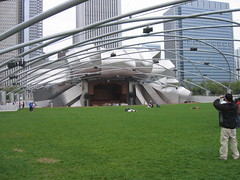
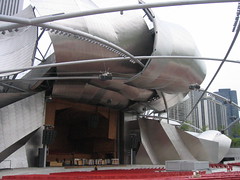
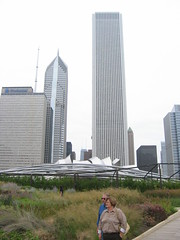
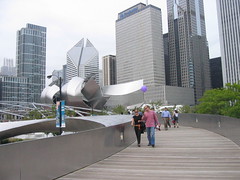
More photos from the trip to Millennium Park:

The Pritzker Pavilion
The Pritzker Pavilion from the back edge of the Great Lawn

The Pritzker Pavilion, a bit closer
The nearly empty stage of the Pritzker Pavilion, from a closer vantage

The Aon Tower from the Lurie Garden
In the Lurie Garden, with the exploding crown of the Pritzker Pavilion barely visible, and the Loop's Aon Tower looming in the background.

A bend in the BP Bridge
A bend in Gehry's BP Bridge, the snakescale-like aluminum cladding sloping downwards to the autumn plantings

On the BP Bridge
On the BP Bridge

A fellow photographer on the bridge

The BP Bridge's sinuous curves, over the highway
The bridge's scythe-like ascent over Columbus Drive

Allee of trees near Daley Bicentennial Plaza
Venting allee near Daley Bicentennial Plaza

Saturday, September 24, 2005

Photos: Millennium Park

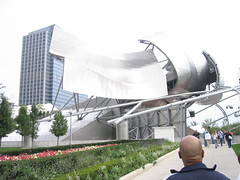
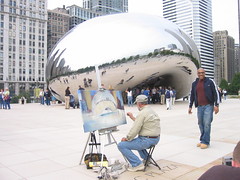
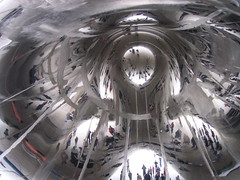
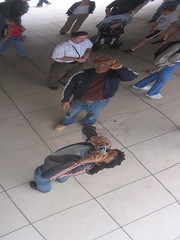
C. and I visited the park I'd been calling Mayor Daley's (the son's) "boondoggle." And as my friend from Boston attested, it represents a marvelous reutilization of public space, with several distinguishing art and architectural treasures--the Crown Fountain with Jaume Plensa's LED towers and gracefully graded wading pond; the Anish Kapoor Cloud Arch, or sublime little "Bean," which immediately provoked awe and reduced me to a giddy child; the Frank Gehry-designed Pritzker Pavilion and bandshell, with its immense stainless steel shards forming a thrilling backdrop not only to the music played in it, I'm sure, but to today's ambient sounds; the monumental steel trellis in front of it, floating like a webbed canopy or shell above the Great Lawn; the multilevel Lurie Garden, a space of fragrant and quiet contemplation within sightlines of the city's major financial buildings; and the stunning, serpentine BP bridge, also designed by Gehry, which snakes across Columbus Drive to the Daley Bicentennial Plaza, which the first mayor Daley established a little over half a century ago. (We didn't visit the Wrigley Plaza and its classical peristyle.)

Without question, Millennium Park ranks among the major attractions in Chicago; I'm glad we visited it and I'll definitely head back. I want to see it when winter hits; how will its stewards cover all of that exquisite wood in the bandshell? Are there winter plants, other than the various evergreens, in the Lurie Garden? Are those LED towers winterproofed to withstand the below-zero windchills that arrive in January? Will the helmeted Segway-riding security men, "post-modern centaurs" as my brilliant former student Tai L. aptly labeled one of them (who was telling a homeless man that "we" weren't "animals"--hello?), be tooling about to patrol and police, to keep the park the pristine landmark that it has quickly become? Will workers be scurrying about to polish all the plaques, signs and other insignia (the "Chase" Promenade, the "Boeing" walkway, etc.) that distinguish Millennium Park as one of the most extensively corporately tagged public spaces I've ever set foot in as well? In this regard, it is definitely a product of its time. I was almost expecting the trees to have labels on them. (I'm not wishing this into being....) None of this obviates the Park's utopian aspects (like those of Central Park, or Forest Park, or Chicago's other parks), its embodiment of longstanding humanistic, and in particular, Anglo-American humanistic ideals, which are evident in its spaces--especially in the partially open, partially obscured garden, the open yet carapaced Great Lawn, the monumental towers showing the faces of city denizens, and the bridge, with its traffic-crossing yet muffling path--even if its reality (no place for those without homes or means), our contemporary societal reality, is quite different.

Here are some photos:

Gehry's Pritzker Pavilion
C. heading towards the Pritzker Pavilion

Loudspeaker trellis and ramp to the Great Lawn
The steel trellis above the ramp leading to the Great Lawn

C at Anish Kapoor's Cloud Arch (
C. and an artist in front of Kapoor's Cloud Arch, the "Bean"

Interior dome of the Bean

Our reflection in the Bean
Our reflections in the Bean's exterior

And I'll post more photos tomorrow....

***

Today, over 150,000 people rallied and marched in Washington in what was the largest anti-war protest since the start of the Iraq War. Activists also convened in Los Angeles, San Francisco, London, Rome and other cities to protest the disastrous mess that the Iraq War has become, and to demand the withdrawal of American and other foreign troops. Over 147,000 American troops are stationed in Iraq; 1,911 have been killed and over 14,000 wounded, while some estimates suggest that over 100,000 Iraqi non-combatants have been killed since the war began. I stand with the protesters who call upon the president to withdraw troops; the war was wrong from the beginning, it was based on lies and false premises, it and its aftermath have been incompetently managed, its financial and human costs are excessive, its peripheral effects (from the extensive use of torture to "extraordinary rendition" to the abrogation of our civil rights), and what it has brought into the world, a terrorist training camp the size of California, and a weak Islamic state with strong ties to Iran, cannot be explained away by constant, simplistic and propagandistic links to the 9/11 tragedy or Saddam's brutal reign, which both W's father, George H. W. Bush, and the right-wing's icon, Ronald Reagan, actively aided and abetted, for eight years. Since the Pentagon has refused from the beginning to fight the war adequately or with an eye to anything beyond Republican Party politics, it's long past time to bring the troops home.

***

Although Hurricane Rita turned out to be less destructive than originally predicted, it has still caused extensive damage, so please consider any help you can offer to those regions and people, including some of the people who originally survived Hurricane Katrina and its aftermath, who've been affected by it.

***

A question: what happened to Yve-Alain Bois? It appears that his colleague and close friend, Benjamin Buchloh, has replaced him at Harvard. Is this just a temporary or permanent change?

Friday, September 23, 2005

Poem: Xavier Villaurrutia

VillurrutiaHere's a poem by one of my favorite poets, the late Mexican, gay playwright and poet Xavier Villaurrutia (1903-1950), whose work I tried to teach myself to translate from Spanish before I could really read the language because his lyrical gifts seemed so powerful from the little I was able to divine.

With Salvador Novo, Villaurrutia cofounded the literary journal Ulíses (1927-1928), which was the leading organ of the Contemporáneos group, and then was associated with their eponymous journal Contemporáneos from 1928-1931. These poets wrote against the nationalist tide of their historical moment, instead creating a lyric that strove for emotional authenticity and an immersion in the metaphysical layers beneath reality, both of which are evident especially in his mature work.

In 1931, Villaurrutia established the first avant-garde theater company in Mexico. As a playwright, he strove to revitalize Mexican drama by employing experimental techniques and subject matter, and by retraining Mexican actors in order to perform in them and similar works. His most famous play is Invitation to Death (1943). Later in life he translated a wide array of contemporary foreign literature, served as a co-director or director for a series of films, taught at the National University of Mexico, edited Octavio Barreda's literary journal The Prodigal Son, and directed the Bellas Artes theater program.

Villaurrutia's books of poems, almost of which pivot on the exploration of desire and, especially in the later works, on mortality, include Reflejos (1926); the earliest of the famous Nocturnos (1933), a series of poems written in and to the night; Nostalgia for Death (1938); and Tenth Death (1941). Early on he described his work as "Juego difícil, de ironía e inteligencia" [A difficult game, made up of irony and intelligence]. Two of his best known and beautiful poems are the overtly homoerotic "Nocturno Amor" (Nocturnal Love) and "Nocturno de los Ángeles" (Nocturne of the Angels).

Here is a powerful, representative one I found on the Web:

LOVE IS AN ANGUISH, A QUESTION

Love is an anguish, a question,
a luminous doubt suspended;
it is a desire to know the whole of you
and a fear of finally knowing it.
To love is to reconstruct, when you are away,
your steps, your silences, your words,
and to pretend to follow your thoughts
when unmoving at last by me side, you fall silent.

Love is a secret rage,
an icy and diabolic pride.

To love is not to sleep when in my bed
you dream between my circling arms,
and to hate the dream in which, beneath your brow,
you abandon yourself, perhaps in other arms.

To love is to listen at your breast,
until my greedy ear is glutted,
to the noise of your blood and the tide
of your measured breath.

To love is to absorb you young sap
and join our mouths in one river-bed
until the breeze of your breath
impregnates my entrails forever.

Love is a mute, green envy,
a subtle and shining greed.

To love is to provoke the sweet moment
in which your skin seekd my awakened skin,
to gratify the nocturnal appetite
and to die once more the same death—
provisional, heart-rending, dark.

Love is a thirst, like that of a wound
that burns without being consumed or healing,
and the hunger of a tormented mouth
that begs for more and more and is not sated.

Love is an unaccustomed luxury
and a voracious gluttony, always empty.

But to love is also to close our eyes,
to let sleep invade our bodies
like a river of darkness and oblivion,
and to sail without a course, drifting;
because love, in the end, is indolence

Copyright © Xavier Villaurrutia, 1940. Translated by Rachel Benson.

Thursday, September 22, 2005

Thursday Quote: Yve-Alain Bois

"Well, I don't share the tragic notion of negation of an Arthur Danto when confronted with a row of Warhol's Brillo boxes. There are two kinds of negation. The modernist mode of negation was: you don't know how to justify what you are doing, so you eliminate what you cannot justify. This led to many different strategies. The readymade was one of them but it also includes all strategies of non-compositionality which are a standard of modernism—the grid, the index, the field image (like Jasper Johns's Flag), chance, the monochrome. All these hyper-modernist strategies have to do with justification, motivation, the eradication of arbitrariness, etc., and this is what we call modernism. Now the eradication of arbitrariness always implies negation and therefore it implies “death”. If you finally eradicate everything that is arbitrary, then you have killed everything. Fortunately, you can never do it."
--art historian and critic Yve-Alain Bois from Andrew E. McNamara and Rex Butler, "All About Yve: An Interview with Yve-Alain Bois," Eyeline, Autumn (27):16-21, 1995.

Wednesday, September 21, 2005

Bush the Ironist + Sharon Olds Speaks Out + Rod on 50 Cent

A few weeks back the thought came to me, why hasn't some snarky Republican made the argument that despite all appearances to the contrary, our incurious and incompetent figurehead-in-chief is actually the greatest ironist who ever set foot in the White House?*
Mission Accomplished
But what if someone did make the argument that the inanities we've witnessed involving the Resident-in-Chief from BEFORE day one, starting let's say with his ridculous performance in the debates in the 2000, to Bush v. Gore, to his announced aim to bring respectability "back" to the White House and the "working across the aisles," to his prancing aboard the aircraft carrier in that sock-stuffed flightsuit to declare "Mission Accomplished," to his OK Corral-ish vow to get Osama bin Laden "dead or alive," or his urging the Sunni revolutionists and the Zarqawi crowd Iraq to "come and get 'em," or his frenzied flight back to Washington from his ranch to sign a bill to overrided spousal rights and help "save" the brain-dead Terri Schiavo, just a few weeks ago, his declaration that "Brownie" had done "a heck of a job," like his numerous actions over the last five years, from sitting for seven minutes frozen before a classroom full of schoolchildren after he learned that the World Trade Center had been attacked by airplanes, or his Potemkin rallies before the 2004 election and Social Security "town meetings," or his failure to return, on his own initiative, whether by instinct or some other internal guide, to Washington as soon as he learned of Hurricane Katrina's severe impact, were not testimony to a dim and lacking mind and defunct personality, but of a person possessed of a capacity for irony in several of its older senses (I don't mean Socratic irony, though maybe they could try that as well) so profound that it might startle the majority of his critics to realize it?

By which I mean, a talent--a genius, in his case--for behavior (dramatic irony) and utterances (verbal irony) signifying the exact opposite of what they connotatively convey, as "simulated ignorance" (eironia)? There is almost too much in his record to recommend Bush as a debased--the most debased--example of the eiron, the traditional dissembler (liar) in Ancient Greek drama, though in his case, one would have to drop the integral elements of wit and humor; when Bush had Condoleezza Rice testify before the 9/11 Commission, with a straight face, no less, that the August Presidential Daily Briefing headlined "Osama bin Laden Determined to Strike in United States" was "historical," the joke was lost on the families of those who were killed, as well as on the committee, the Congress (at least half of it), and millions of Americans and others around the globe.

His performance in the 2000 and 2004 debates, including that moment in the first Kerry debate where he seemed to be responding poorly to transmitted answers from a hidden earpiece? Irony!

His his inability to name even one failing during his dreadful first term, his constant avowals of the inevitablity of readily weaponizable WMDs in Iraq, his repeated assertions of Saddam-Al Qaeda links, his claims about the positive economic effects of his tax cutting plans, tort "reform," the bankruptcy bill, and Medicare drug law? Irony!

His selection of a the head of his VP search committee to be his VP, Donald Rumsfeld, Paul Wolfowitz, Karl Rove, Douglas Feith, Gale Norton, Margaret Spellings, Ed Gillespie, Ken Mehlman, Michael Powell, Ken Tomlinson, James Gurley, Joe Allbaugh, Michael Brown, Jeffjames Gannonguckert, etc.? Irony!

The fact that the US has lost a net number of jobs over the last five years, the US poverty level has increased overall by more than 20%, the country has faced consecutive years of record annual budget deficits, and environmental degradation is increasing to such an extent that some scientists are now arguing we may not be able to reverse the negative effects? Irony!

The over 1,900 US and coalition soldiers who've died and the more than 20,000 who've been maimed or injured in Iraq, the many thousands (100,000+) Iraqi citizens who've died, the ongoing turmoil that has resulted in a religiously and ethnically divided, weak Islamicist dominated government, closely linked to Iran, taking power in Baghdad? IRONY!!!

The blood-red W Bush defenders could argue that in fact, it's all ironic, all one vast joke that should be understood as such, and we should be thanking W Bush, really, though there's three more years to go (no one act plays with this one, unfortunately); it's all been a big joke, a long, horrific grand mal seizure of levity--comedy and tragedy being intimately linked, in the classical sense, so there have to be some tough bits, no, many very, very, very tough bits, thrown in, the post-Hurricane Katrina horrorshow being only the most recent example.

But then none of W Bush's supporters would make such an argument because they realize how insanely inane it would sound. No one is that stupid....

--
* I am not sure who'd be in the running against him, since an ironic personality has not been one of the common traits of those seeking the White House (and being an outright liar or dissembler, like Richard Nixon, is something else altogether). So who would his competition be? Warren Harding? Ronald Reagan? Millard Filmore? His ineffectual father?

***
Olds
Poet Sharon Olds breaks Laura W. "Kanye-Hatin'" Bush a new one off in her letter, published in the current issue of The Nation, announcing that she won't be participating in the First Lady's Book National Book Festival in Washington, which is set to take place on September 24, the national day of protests against W Bush's Iraq War. Olds's fearlessness is well known; she has written some of the most emotionally and sexually candid and raw poetry published over the last 30 years--this is a woman who titled one of her collections The Wellspring, partially in reference to the...wellspring of human sperm in the testicles! As befits a National Book Critics' Circle Award winner, though, Olds doesn't rant, but in a movingly cogent, poetic fashion, breaks it down for Mrs. "Disgusting." Olds details her active role‡ and interests in and abiding appreciation for creating and sustaining a community of readers and writers, which leads her to explain why she cannot "break bread" with the First Lady, who is the public face of an administration that has

"unleashed this war and that wills its continuation, even to the extent of permitting 'extraordinary rendition': flying people to other countries where they will be tortured for us."

Please read the letter, and if you can, send Sharon Olds a note of appreeciation. I say Bravo to you, Sharon Olds, and, once again, THANK YOU!
--
‡I must add that I was one of those "young poets" whom she and others sent out to teach at New York City public schools, which was a life-defining experience for me.)

***
50 Cent
I'd missed 50 Cent's literary debut (or was there an earlier volume?), but Rod 2.0 is there in "What Up S.L.U.T. to apprise of us of some of the more salacious tidbits among the bullet-riddled rapper's youthful experiences in homoerotic appreciation. It seems 50 Cent wasn't loathe to remark on noteworthy male packages, so to speak, and even earned the name of "Fucking Slut" from his well-hung hardcore drill sergeant in youth boot camp! And Rod 2.0 says there's more to come! (Does 50 talk about when he first started plucking his eyebrows? Does he give us the name of his first boo? Does he reveal that the first bullet--really a shank wound!--was the result of a lover's quarrel?) Somebody's gotta be on it, so thanks, Rod!

In a prior entry, he reads Terri McMillan's interview in the current Essence, and concludes that the former Mrs. Jonathan Plummer "is not a survivor; she's creating a huge public dialogue to mine material for yet another book, the same formula used to write a bestseller and movie about her boy toy. There's a fine-line between anger and hostility. Terry McMillan crossed it long ago." What more could anyone add? And when's that book, More Sugar than a Canefield (or its Caribbean edition, Why Yu Fe Galang So, Bwatty?) going to hit the stands?

Tuesday, September 20, 2005

First Day of Classes

Dybek's BookToday was the first day of classes, which went well, though I never get enough sleep the night before and so am always exhausted by day's end. The new classes make me think of former students, to whom I extend fond greetings and for those who graduated earlier this summer, my heartiest congratulations. I really do miss you! There are probably fifty writers I enjoy reading more than Stuart Dybek--well, maybe forty--but I never tire of his reading or using for my intro fiction class his story "Pet Milk," which is quintessential Dybek, especially in its retrospective trajectory and lyrical ending, and which, in its first few paragraphs, provides any number of examples of how a very good contemporary American short story works. The polysemous verb "snow" in the first sentence, like the language embodying the gurgling of the condensed milk a little later in the opening paragraph, are such perfect examples of masterful writing I they should be included in most standard fiction-writing guides. In the ones I've looked through, they aren't....

Cloud GateAn old friend was in town from Boston, so we had dinner at an excellent Italian restaurant called Topo Gigio, in Old Town. If you're in Chicago near the Loop and are looking for a delicious and reasonable place to eat, this is definitely a place to hit. It's on Wells, just south of North Avenue, and parking is available around the block. As I drove her back to her hotel, we passed Millennium Park, the mayor's baby. I glanced over and didn't see the supposedly amazing Lurie Garden, the iconic Anish Kapoor "Cloud Gate," also known as the "Bean" (pictured above), or Frank Gehry's Pritzker Bandshell, though I did see one of the giant "face screens," which was pulsing red in the dusk; perhaps when C. is here we can drop by there. My friend said that not only does the park utilize space superbly, but the Bandshell is as beautiful as I imagined. Also, she noted that there were more than a few people in caps busily collecting leaves, sweeping, or jetting around on Segways, to maintain order: Chicago tax dollars at work!

Monday, September 19, 2005

Photos: Full Moon Chicago

Here are a few cellphone photos from my weekend gallivant.


Bus stop on Clark at Belmont

Bright lights, big city...full moon (at top)

Garçon Stupide (the things some people will do in movie theaters)

Young man in front of me, looking out the grimy bus window, as we headed north

Sunday, September 18, 2005

Garçon Stupide

Garcon StupideLast night I decided to cool my Netfliction and head out to see a movie, which is a more economical proposition in Chicago than in most parts of the New York area (though New York always gets new films before the Third City).

Having already seen The Constant Gardener, which I recommend--though if current events are stressing you out you may want to brace yourself for lots of topicality, as well as several National Geographic exotica moments--I debated whether to see Garçon Stupide (Stupid Boy) Swiss director Lionel Baier's first feature-length film, or El crimen ferpecto (Ferpect Crime), Álex de Iglesia's well praised dark comedy. The former film's gay storyline, frank sexual content, and experimental formal conceits were tipping the scale. Then on my way to the cinema, I ran into two female friends who had just seen the film and at first were split, but they both ended up saying that it was worth seeing, so my decision was firm.

Garçon Stupide is, I realize after thinking about it a bit more, a very provocative, fresh and worthwhile film. Initially I wasn't so sure. It does tends towards moralism in its overall message, is unnecessarily art(s)y at times, and isn't fully plausible in terms of the trajectory of its narrative and plot, but its complexity, in terms of the filmmaking and the narrative itself, elevates it among the films that I've seen of late. Up to its final moments, it presents a well-drawn drama without melodrama, and avoids sentimentality in depicting a story that almost no American filmmaker I can think of, and few American producers, would put on the screen.

Garçon Stupide centers on the story of a 20-year-old, undereducated, confused chocolate factory worker named Loïc, who lives in the provincial, French-speaking Swiss city of Bulle, not far from the larger metropolis of Lausanne, where he lodges on weekends with his female friend, Marie, who's a student working in a natural history museum. Though we see that Marie harbors romantic feelings towards Loïc, he spends much of his free time trolling for sex with men he meets on the Internet and street, survives on aspirin and Maalox, and snaps photos with his mobile phone camera. A child trapped in a man's body, with a man's libido, he lives for the sensory pleasures of casual sex, it appears, and little else. While Marie accepts Loïc's (homo)sexuality, she doesn't really want to know the details, which the self-absorbed Loïc insists on rubbing in her face. Eventually, Loïc meets an older man online, named Lionel, who's played by the film's director. We never see Lionel's face. He apparently carries a movie camera with him at all times and we hear his voice in the filmed exchanges with the young man. Unlike most of the men Loïc meets, he doesn't want the 20-year-old for sex, but is interested in conversation and non-sexual intimacy, which he describes to Loïc in philosophical terms. He even praises Loïc's photographic talent, which Marie also encourages, though the young man doubt's Lionel's motives and his female friend's advice. In fact, while Loïc is obviously drawn to Marie because of platonic aspect of their relationship, Lionel's lack of sexual interest unnerves him, since who seems to relate to every other gay man he meets in purely carnal terms, even going so far as to state that he doesn't like small talk, but just wants to get to the action. Loïc, after try to force Lionel's hand, eventually breaks off relations with him.
Alves
Meanwhile, Marie has found another male friend who takes a seemingly romantic interest in her, which upsets the confused Loïc; although he has told Lionel that he's unreservedly gay and not bi, he assumes the macho jealous role, menaces Marie's male friend, and then insults her so badly that she gets fed up. Having tired of his puerility and of serving as a quasi-parent to (rather than having an more equal relationship with) him, she throws him out, severing relations between them. His childish response is to ignore her and Lionel's calls, with tragic results. Now on his own, he has to decide what he wants to do with his life, beyond his dead-end job, the nonstop fucking, and his growing obsession with a handsome, Afro-Portuguese soccer player named Rui Pedro Alves (pictured at right, Ugo Robard on the left, Alves on the right), whom he basically stalks for a while. After a final meeting with Lionel, during which he announces that he is no longer gay, he decides to drop in on Marie, but finds that she has committed suicide (with a deft touch, Baier sets up early on in the film which means by which she does so), so Loïc steals her car, goes driving up into the Alps and...in a dreamlike sequence, meets Rui Alves and his infant son Noah, spending time with them in the dazzling snow. On his way back, he has crashes Marie's car and has to live again briefly with his non-responsive parents as he convalesces, which leads to an epiphany: he must, as Rilke says, "change his life." He does, and in a final scene, realizes that real love might be possible.

Pierre Chatagny turns in an excellent performance as the alienated, searching, debauched young Loïc. He makes palpable the young man's churning combination of confidence (in his sexual prowess and dominance, attractiveness, and narcissistic esprit de vivre), ignorance (he has never heard of Hitler (!), and has to look up "Impressionism" after spotting it on the spine of a book in the apartment of one of his tricks, he has never seen frenum piercings and thinks they are totally novel, etc.), and naïeveté, or in other words, his rich and complex subjectivity. In this role Chatagny embodies a nexus of cool self-possession and roiling self-confusion so strong that it borders on social pathology, and Marie's character eventually calls him on it. Natacha Koutchoumov turns in an equally fine performance as Marie, whose obvious love for Loïc battles with her frustration at his inability to respect or love her back, or get his life in order. Often she is able to convey the tension through facial expressions and posture alone, and expressions in the scene in which she is reading one of her course books as he amusedly watches a sausage-making show, utterly oblivious to her presence, show more than a minute of dialogue. The Lionel conceit, however, which melds cinema verité documentary with the fictionalized realist space of the rest of the film, doesn't really work, in my opinion. (The mixing of verisimilitudinous realism, through the use of the documentary device and non-actors like the real football player Alves, is quite fascinating.) Lionel, as Baier portrays him, is not an interesting character, and feels almost vampirous. As interesting as Baier's innovative gesture is in principle, by the end of the film I felt the unseen Lionel character could have been utilized much more carefully and artistically, especially in making Loïc's epiphany and life change plausible. As it is, when he disappears, I didn't really miss him, yet because the self-referentiality of the Baier-Lionel character had unsettled the film's fictive space, calling undue attention to the other moments of artifice in the movie and blunting the power of the dream-like sequences that come later on. (On the other hand, Lionel's physical absence, in theoretical terms, foregrounds a certain type of gay male gaze and its directional vector; the older man is socially and sexually invisible yet intellectually present, while the younger, attractive sexual dynamo, a kind of cipher, is the focus.)

As I noted above, Baier includes several scenes of explicit male-male sex, as well as post-sex action, from Loïc doffing a used condom and cleansing his foreskin to the man he has sex with wiping his ass. This worked well in terms of the film's documentary feel, but then Baier wants to have it both--or multiple ways--by overtly invoking visual symbols during the sex scenes as if to underline a moralistic view of Loïc's actions. He does so by employing split screens during the sex--as well as at other times--with one screen showing the fucking (which includes an orgy) while the other one shows stuffed animals in the natural history museum or the machines at Loïc's factory. The film at times aims for comedy, and some of these parallels are comical, though I wasn't sure whether Baier intended them to be so; at any rate, the director is hammering into our heads the fact that the young man's sexual experiences, which are depicted as ntense and pleasure-filled, are empty, mechanical, dead. Again, I liked attempt at an innovative gesture, but I think it's too much. Moreover, it sets up a Platonic schema--and here I am thinking of the Plato of the Symposium--that can only be read as moral. We do not see Marie's satisfying sexual encounter, only its tender aftermath, which Loïc creepily threatens, literally, at knifepoint, and Lionel, who does not want Loïc physically, but emotionally and psychologically, remains disembodied, except as a voice of reason. That is, true love exists beyond the realm of the flesh, spiritually, especially the expressedly genital.

Baier underscores this split, I think, in the Alpine scenes involving Loïc and Alves: we do see the soccer player (even briefly in the nude), but the beginning of their true moment of connection occurs on the blindlingly white slopes, with the bodies dematerializing into the blankness, symbolic of a space almost beyond the earthly realm, and when they do fully connect at an emotional level, with the truth-telling Black man serving as Loïc's means of catharsis, it is platonic as well--there is nothing sexual between them--and Alves's snowblindness renders his body ineffective. They can only communicate spiritually. Their exchange, in which Loïc finally must show some tenderness and care for another person, jumpstarts the younger man's process of profound realization. After his recuperation, he has decided what he will do with his life and enunciates his personal manifesto--he will no longer be a "garçon stupide"--and will tell his own story. No more mindless screwing, no more emptiness, no more playing at being a photographer, no more trying to escape his true identity, which is beyond categories, or so he declares. Only then does he meet the man, a bleached blond twink, for whom we're led to believe he can feel true love. The final scene, on a brightly lit ferris wheel, with lush music by Rachmaninoff, hovers between dream and reality, and concludes on a romantic, almost schmalzily sentimental note. Loïc is looking upwards, downwards, literally reaching towards the beloved, but the physical connection, which we get so graphically earlier on, doesn't occur.
Koutchoumov
While I found the romantic ending endearing, I also felt it was predictable and it left me unsatisfied. I wanted to believe that Loïc's change was organic, but I didn't buy it. I also found the Platonic schema troubling, and an unfair indictment of casual sex and promiscuity. What if Baier had not problematized Loïc's sex life in this moralistic way, or counterbalanced it with Marie's (pictured at left) as he does? In a review of the film, Jeannette Catsoulis of the New York Times described Loïc's life as "dangerous"; but why? What was dangerous--the sex or the facts that he was emotionally volatile, stuck in a deadening job and living in a dysfunctional relationship? I would venture that Catsoulis, following Baier's lead, felt that the problem lay in the sex. (In fact, Baier shows us that he practiced safe sex.) In a way, the gay sex seemed to be there not only to make the film's point, but for shock value. I'm thinking primarily of the orgy scene, following Loïc's outburst at Lionel and his visit to a dance club; it was if the multiple partnering was a final, Dionysian burst before he turned to the more Apollonian aspects of his personality. But what if Baier explored the utopian aspects of the sex? The fact that although Loïc cannot afford McDonalds (this forms a little joke in the film), his looks and body are a source of power, a commodity of ready exchange value, functioning as a counterweight his lack of education and his alienated labor in the factory? The elements for a deeper view are there already. I also wondered about the trajectory towards the romantic ending and self-acceptance, a kind of bourgeois respectability that Baier questions through Marie's failed relationship and the deadened life of Loïc's parents. What if Baier had found more convincing means, without the film's central female character sacrificing herself (her body) and the lone non-White person sacrificing (even temporarily) his own (his eyes), to bring truth to Loïc? Or, after his friend's suicide and the mystical encounter with Rui Alves, which was a fascinating element in the film, he had not changed, or, had changed less dramatically, and hewed more to the ironic realism the documentary aspect of the film seemed to be asserting? In fact, I find I'm especially intrigued by the melding of the fictional and realistic storylines and wondering what else Baier might have done with them, especially his own character, "Lionel."

Overall, as I noted, the film is very interesting and worth seeing. It provokes quite a bit of thought, or at least did so for me. It made me wonder yet again about the differences between American and European cinematic portrayals of LGBT life. I'm not saying that European filmmakers don't fall prey to clichés or stereotypes at times, but in addition to the male frontal nudity, they often are willing to present much more complex portraits than one gets in most mainstream American gay films. I can think of at least ten European gay films--from France, Spain, Italy, the UK, Germany, and now Switzerland--that explore gender, class, racial and ethnic, and political/ideological complexities with far greater depth than most American LGBT films, which seem fixated on a fairly narrow, youthful, middle-class to upper-middle-class, usually White and male perspective, or, if class enters the picture, it revolves around hustling or prison scenarios. Perhaps the very fact of my mentioning "mainstream" is the determinative factor in what American filmmakers put on screen, even American LGBT filmmakers.

All of which leads me to add that I wish I could see more commercial, feature films--not just tiny little films or shorts or documentaries that play at the New Fest or Mix and then are hard to get ahold of--that address LGBT life, especially the lives of LGBT people of color, women, older people, fat people, people with disabilities, sexual minorities, etc.--with similar candor, innovation and risk. I know the screenwriters and directors are out there--out here. Please, if you can, can you get some (more) of these films on screen?

Saturday, September 17, 2005

Drawing: Samuel R. Delany

Here's the drawing of one of the writers I most admire, the exemplary Samuel R. Delany. I initially thought that this drawing of him was from the Afro-Futurist/SF conference that was really a festschrift for him, but according to the notes on the back of the piece, it turns out that I drew it when he was delivering the university's annual Leon Forrest lecture, which preceded the mini-conference by a day. (Last year's speaker was another writer I tremendously admire and have also drawn, Toni Morrison. I even presented the drawing to her in person around the time she published Jazz, when she gave a lecture at MIT.)

Some notes from his talk, "The Politics of the Paraliterary" (he presented a selection, I believe, from The Black Discourse, a cross-genre/gender work); he was making a very sophisticated argument about the nexus of race and racism, and homosexuality and homophobia/heterosexism. The quotes below should be read not as his settled views, but as fragments from a larger, highly provocative argument:

  • The one-drop rule sought to fix the racial vector in one way--black tainted white but not the reverse
  • The untrammeled pursuit of pleasure [is thought to be] the opposite of social responsibility
  • [According to social norms, and his uncle] pleasure must be doled out rigorously, with a contract.
  • Desire is never outside all social constraints.
  • Race is a construct that has no opposite.
  • Race is mediated by heredity, not geography; you can't have heredity without sex.
  • Race is the thing in the body that is inherited.
  • The thing that is inherited is the thing that can be polluting.
  • The sign of pollution is often homosexuality.
  • [For racists] To lift or end racism is to allow pollution to run wild.
  • To lift the stigma of homosexuality is to opt out of the pollution issue altogether.
  • [According to their argument, then] Race exists to pollute procreation.
  • [And accordingly] Homosexuality brings it to a halt altogether....


Friday, September 16, 2005

Friday Roundup

St. LouisThe St. Louis Cardinals became the first team in Major League Baseball to clinch a division title yesterday, which puts them in the playoffs for the fifth time in six years. Last year they went all the way to the World Series, but couldn't hit their way out of wet and torn paper bag, pitched ineffectively, and lost badly to the eventual champions, the Boston Red Sox, allowing that team to end its almost-century long streak of World Series failures. (The Cardinals helped to ignite the Red Sox's train of futility as recently as 1967.)

The team's constitution is a bit different this year. In 2004, the Cardinals won their division and the pennant primarily because of their bats. This season, having traded the quick bat of Edgar Renteria and lost the bat and arm of third baseman Scott Rolen, and for significant stretches the hitting of Larry Walker and Reggie Sanders, the Redbirds have had to make do with a less productive Jim Edmonds, two new role players, shortstop David Eckstein (who was a key player on the Anaheim Angels' World Series-winning team) and second-baseman Mark Grudzielanek, superstar Albert Pujols, and a decent bench. What has been dramatically different is the startinng pitching. Chris Carpenter, who won 15 games last season before suffering a biceps injury that kept him out of the postseason, has won 21 games and is hurling towards his first Cy Young Award. The Cards kept third, fourth and fifth starters Matt Morris (who is 14-8 and faltering), Jeff Suppan (who is 15-10, pretty much matching his record of last season), and Jason Marquis (who at 12-14 has fallen apart), but they replaced Woody Williams with former Oakland ace Mark Mulder, who has won 15 games, thrown two shutouts, and after a rough patch, been one of the best lefthanders in the league.
Pujols
The combination of quality starting pitching--the Cardinals staff has the most quality starts of any team in the league--combined with good middle and long relief, and one of the league's better closers, Jason Isringhausen, has meant that even when the Cardinals' bats were silent, they could stay in games. It also should ensure better odds against their National League rivals and, if they win the league pennant, whomever they face (the Yankees? Cleveland? the Los Angeles Angels of Anaheim? the Oakland As? the Red Sox again?) in the World Series.

***
Terminator
Arnold Schwarzenegger, the action movie star and increasingly unpopular governor of California, has announced that he'll run for reelection next year. Winning a flawed and outrageous recall election against moribund Democrat Gray Davis in 2003, Schwarzenegger maintained strong public support for about year, but over the six months the movie-star's luster has dimmed and his credibility has waned. He's revealed himself to be a loudmouthed, ethically challenged bully in the pocket of big business interests, with an imperial style that clashes with his state's republican system of government. He's also shown more than once that he's less moderate than the bedazzled media initially styled him. In addition to promising a veto the California legislature's landmark passage of a gay rights bill, Schwarzenegger has repeatedly publicly attacked the Democratic legislators, taken anti-union stands (including against the nurses' union, which now hounds him all across the state), and is pushing a fall referendum that polls show a majority of Californians don't and probably won't support.

Just last summer the Gropenator (or Der Gropenführer, or the Hon. Guvernator) was being touted as a future presidential candidate. Despite his admission of extensive steroid use, despite the raft of allegations of sexual misconduct (not the adultery, but the nonconsensual groping), despite the fact that under Article 2 of the US Constitution he'd be ineligible anyway, Republicans and even some Democrats were slobbering over the possibilities. Now he'll have to show he still has some ammo in his arsenal, as he faces a potential political defeat in just a few months, and the loss of his office next year, to State Treasurer Phil Angelides, State Controller Phil Westley, or someone else.

***
Bushie's Shirt
I passed on the latest bit of aestheticized politics from W and Co., the presidency-saving appeal from the drowned and devastated city of New Orleans, but C. watched it and noted that the eerily blue-lit St. Louis Cathedral reminded him of Disney Land, though a creepy version, especially since it was color-coordinated with W's misbuttoned shirt. Well, Maureen Dowd was on the same page and skewers this bit of Potemkin Village palavering in her column "Disney on Parade." It is vintage Dowd, scalpel honed to a surgeon's perfection, as she cuts through the noxious Rovian excrescence that millions of TV viewers were subjected to last night, while also carving up the ongoing failures of W's attempts to be the "reverse" of his father's presidency. She writes:

The Oedipal loop-de-loop of W. and Poppy grows ever loopier.

With Karl Rove's help, Junior designed his presidency as a reverse of his father's. W. would succeed by studying Dad's failures and doing the opposite. But in a bizarre twist of filial fate, the son has stumbled so badly in areas where he tried to one-up Dad that he has ended up giving Dad a leg up in the history books.

As Mark Twain said: "When I was a boy of 14, my father was so ignorant I could hardly stand to have the old man around. But when I got to be 21, I was astonished at how much the old man had learned in seven years."

Of course, it's taken Junior only five years to learn how smart his old man was.

His father made the "mistake" of not conquering and occupying Iraq because he had the silly idea that Iraqis would resent it. His father made the "mistake" of raising taxes, not cutting them, and overly obsessing about the federal deficit. And his father made the "mistake" of hewing to the center, making his base mad and losing his bid for re-election.


The rest is even better.

***
SchumerI've been listening, when I can, to Supreme Court Chief Justice nominee John Roberts Jr.'s confirmation hearings, and he's succeeded, it appears, in his verbal and intellectual rope-a-dope on the members of the Senate Judiciary committee. Parrying even the most determined queries of Democrats like ranking member Pat Leahy (Vermont), Chuck Schumer (New York, pictured at left, Stephen Crowley/New York Times), Teddy Kennedy (Massachusetts), Dick Durbin (Illinois), Dianne Feinstein (California), Russ Feingold (Wisconsin), and presidential wannnabe (again) Joe Biden (Delaware), as well as Republican committee chair Arlen Specter (Pennsylvania), Roberts has managed to demonstrate an acute grasp of American jurisprudence while remaining enigmatic and gnomic about his beliefs or how they would affect his rulings on the court. As Biden, Schumer and others noted, the hearings verged on "Kabuki theater," though some of the Republicans' performances were out of the theater of the absurd. I'm thinking in particular of Jeff Sessions of Alabama, who often babbled on like a fascinated infant and South Carolina's Lindsey Graham, who almost seemed to be flirting with Roberts at times.

The most outrageous Republican, though, has been Tom Coburn, who bizarrely broke down at one point and decried the "incivility" of American politics, even though he himself has repeatedly trashed the opposition, once called for the killing of doctors who performed abortions, hysterically denounced "lesbianism," which he claimed was rampant in , committed Medicare fraud and sterilized a young woman against her consent and will (yes, voters actually elected this complete nutcase to a statewide, federal office!). A photographer even captured a crossword puzzle among Coburn's papers. Perhaps this isn't so uncommon, especially given the repetitive nature of some of the questioning, but still, even if you utterly supported Roberts, in light of the importance of the post he is probably going to occupy, couldn't you hold on the mental recreation for even a week?

Democrats face a quandary. Do they vote against Roberts, based on the little information they have and his ideological shiftiness, and send a message to W, which he'll surely ignore? Or do they vote to confirm Roberts, hoping he won't be a nightmare (instead pulling a Souter on the GOP) and, once again, lie down like felled logs waiting to be turned into plywood? Some, like Hillary Clinton, will do whatever is politically expedient, while others, like Kennedy, Durbin and Schumer, will vote against the man both on principle and based on the extreme tenor of his available writings. Others, like Joe Lieberman, will probably do whatever George W. Bush wants. I can't see any Republicans, including the true moderates like Susan Collins or Olympia Snowe, or Lincoln Chafee, who faces a right-wing primary opponent and an eventual Democratic opponent in one of the most liberal states in the country, voting against Roberts. But who knows? If W's numbers keep tanking, maybe they'll be emboldened.

And what of Roberts? Bill of FFactory arts blog wrote in an comment to me that he's come to believe that Roberts is a "minimalist," an opinion which legal scholar Cass Sunstein, in a New York Review of Books article, agrees with. I bet he's right. Roberts probably is a "minimalist" rather than an "originalist," a "literalist," or a raving lunatic like Clarence Thomas (or even worse, Janice Rogers Brown or Robert Bork). He certainly has created a new art of minimalism in answering Judiciary Committee questions with empty élan. Alan Dershowitz suggests in his Huffington Post entry "What I Have Learned from Listening to Judge Roberts" that Roberts will probably tear down the church-state wall, defer to presidential executive power, give Congress a bit more leeway, and not overturn Roe vs. Wade. Dershowitz also thinks Roberts would not use the equal protection argument in another Bush v. Gore decision, though he'd likely pick a Republican over a Democrat, especially if the Republican could muster the more convincing legal argument. As I said in a prior post, I just don't know. The hearings have been instructive on many levels, though, in terms of the law, the confirmation process and the relationship between the various branches, and the intellectual bankruptcy of most of the judiciary committee's Republicans.

***
Speaking of Cass Sunstein, he has a lively review of Supreme Court Associate Justice Stephen Breyer's new book about the Constitution and the Supreme Court, "Philosopher-Justice," in the current online issue of the New Republic. (I first started reading this publication back when George H.W. Bush was still president. At that time, Michael Kinsley, who was recently fired resigned from the Los Angeles Times, was creditably editing it, before Andrew Sullivan and Michael Kelly plunged it into the quasi-neo-liberal, neo-con morass from which it's never fully emerged.) Breyer is one of the SCOTUS judges I find most fascinating, because while he is often portrayed as a liberal, his record shows that of the sitting justices (and the one that just went to Hell, William Rehnquist), he has been the most deferential to Congress's intentions and legislations, and takes an obviously incremental approach in most of his written decisions and dissents.

Sunstein argues that Breyer's approach, as detailed in this book, now represents the chief intellectual counterpoint on the Supreme Court to Scalia's view of the law, and should spark extensive discussion and commentary. Breyer's argument, to summarize, is that the Founders strongly believed in the idea of "active liberty" (participatory liberty) as opposed to merely negative liberty (the freedom to be left alone). Isaiah Berlin broke a slightly similar formulation down as positive freedom and negative freedom. To Breyer, many of the rulings of liberal justices in the past, like Earl Warren and William Brennan, sought to uphold those aspects of the ideas embedded in the Constitution which would promote active liberty over negative liberty; thus, the desire to permit free speech against government attempts to limit it; the promotion of affirmative action as a means of remediating past discrimination, so as to have a citizenry who not only experienced equality, but then could act upon it democratically; and the enumeration of other rights not literally expressed in the Constitution's text that empowered democratic participation and liberty. To Breyer, rather than literalist readings of the text, what is called for is active judgment and deliberation, as well as incremental approach to interpretation (which is lawmaking, given SCOTUS's power), rather than sweeping rulings that fail to take into account the limits of jurists' understanding or knowledge.

Sunstein has more to say as well, and much more persuasively than I. He criticizes the text it for being more of a sketch of ideas, however, rather than a full-blown treatise, for not citing some of its predecessors, and for not taking into account some of the implications of its arguments. Still, he praises it soundly, and lawyers and legal scholars probably will find much to gain in it, as Sunstein suggests. I'll wait till someone distills it somewhat, but what I gathered of Sunstein's article I found enlightening.

***
Haskins
Today's New York Times features a minimalist article by Andy Newman, "Serving Gays Who Serve God," on the Unity Fellowship Church in Brooklyn. As the article points out, Unity Fellowship is the main congregation serving LGBT/sgl people of color in the New York metro area, and is a branch of the Unity Fellowship of Christ Churches that the Rev. Carl Bean founded in Los Angeles back in 1990. Two things about the article drew me in. First, I know the 50-year-old minister, Jeff Haskins (pictured at right, Michelle V. Agins/New York Times), now the Reverend Jeffery A. Haskins, from years ago, when he was an actor and performer, and a running buddy of one of my close friends. (Two degrees....) It is good to see he's still around and to know he's working hard to nurture the lives and hearts of others. The other thing I liked was the Web images, which are really evocative. I'm linking to them because while the article will soon enter the Times' fee-based archive, the images should be available in perpetuo virtuo (or as long as the servers permit).

***

I thought it was going to be worth listening to but...if you want to hear the verbal slag-and-slop fest between the arch, neo-conning ex-Troskyite Christopher Hitchens and the dictator-admiring expulsed Labourite minister George Galloway that recently took place at New York's Baruch College, you can hear it here, on Houston-KPFTx's Website. (The Quicktime links seem to work best on the Mac; the mp3s download to iTunes but don't play consecutively.)

As I said, I was expecting wit, even laced with acid, but the muck these two threw about wasn't really worth it. Bill as a debate, it was more of a descent: who could go lower. Hitchens seemed to be reveling in his waxing ontrariness--kissing the ass of powerful Republicans is one way to keep food on the table--even going so far as to insult the crowd a few times, while Galloway went out of his way to take positions that no sane liberal or progressive, but someone living in a ultraleftist Bellevue (or Cloudcuckooland, take your pick), might find palatable.

It would be great to see some smart and well-known political, academic and unaffiliated critical figures engage in a real debate on pertinent issues like the Iraq War, the global and domestic economy, the oil industry and commodity pricing, racial, gender and class inequality, health care, the environment, political partisanship and the role of ideology in policy, the future of gay rights, homosexuality and Christianity (or even just the Catholic Church), referendum-based legislation vs. republican legistating, the Constitution in the 21st century, AIDS and public health, propaganda and public lying, our civil responsibilities, what exactly does "liberty" mean, the role and function of the arts, the relationship between popular culture and the social order, and on and on. On national TV, on a regular basis, at a regular time. It is undoubtedly too much to ask, and yet we must ask--no demand--a more informed public discourse and public discussions than we're getting right now.

***
Grosz
Serendipity. Tonight while unpacking my just-arrived books, I decided to flip through Biting the Error: Writers Explore Narrative, a collection of essays on new narrative edited by Mary Burger, Robert Glück, Camille Roy, and Gail Scott. I wanted to see if there were any pieces I might use in one of introductory fiction sourcebooks. I immediately went to Renee Gladman's short piece, "The Person in the World," which had previously appeared in The St. Mark's Newsletter last year. After skimming it I read the footnotes, something I often do with books whose main texts I can't continue in--I always find marvelous nuggets in the footnotes and endnotes, indices, and forematter and aftermatter, and so on; Tyrone Williams even published a great book of poems, titled cc., of which some were based on footnotes!--and noticed that she not only mentions, but champions ("I found this quote in the notes of an astounding book that I recommend to all readers of this essay...") a book I was trying to recall but for the life of me couldn't. It's philosopher Elizabeth Grosz's Architecture from the Outside: Essays on Virtual and Real Space (MIT Press, 2001), which I think I first saw on the MIT Press Website, then later in the St. Mark's Bookstore, but didn't buy ($$). I'm interested to read this book in light of other works I've mentioned before. After Googling Grosz's texts, I see that among her many works there's a interesting looking book on sexuality, bodies and space that the university's library has (it doesn't have Architecture from the Outside, though!), and which will soon be checked out under my name.... Thank you, Renee!

Thursday, September 15, 2005

Drawing: Greg Tate

Attending the Afro-Futurism/festschrift for Samuel R. Delany organized by Alex Weheliye and others at the university last year, I took copious notes which I only recently found and have been perusing, and, as I often do when too engrossed to write things down or feel the compulsion, did some quick drawings. I thought I'd drawn Alondra Nelson and Kodwo Eshun, but the only two images I found--and which I scanned in today--were of Greg Tate and Samuel Delany (I'll post my drawing of him tomorrow).

I know Greg passingly, having met him back in the day when I was in the
Dark Room, and he was first starting to work on his science fiction novel (or maybe it was before then, and he was regularly dazzling readers with his weekly critiques in the Village Voice) and then again when he staged his thrilling adaptation of Amiri Baraka's Dutchman. For a week or so the scenes from his version of that play were on autoloop in my consciousness. I found myself looking askance at any potential Lulas on the T.

He gave a talk on the hiphop/tagger/graffiti artist Rammelzee and linked this to Delany's work, noting how Delany "foregrounds the marginal, the countercultural as central, through his literary and cultural practice" (his works, his lectures, his life). In the Q&A, Greg spoke a little about the James Snead, the ideas of the break and the cut, the fugitive, being at the origins of hiphop, the fluidity of performance in all the forms, and the articulation of multidimensionality. He also mentioned the notion of "race memory," in relation both to the hiphop/graffiti aesthetic and to Delany's art.

Anyways, here's my "interesting little sketch," to use Louis Delsarte's term for them, for the flyboy in the buttermilk:

Greg Tate
Actually, it could be a self-portrait....

***

If anyone from Blogger is checking out this page, here's a suggestion. Please recalibrate the "Add Image" button in Mozilla Firefox for the Mac platform so that it's more flexible and precise. I'm glad it's now working in Firefox and that it allows you to post directly from the desktop, but it adds the javascript command "onblur," causing the image always to float to the top, and adds other specs that control the image in ways I often don't want to (and other posters might not either).

I always end up going in and erasing everything except the a href and img src tags, the hyperlinks (to Blogger's page, where the image is stored), and the border and alt commands. As it is, border always sets to <"0">, while there's no way to insert any words or phrases for the alt command. It sets no default hspace or vspace parameters either.

***

I also have resumed allowing anonymous posts, though now you'll have to enter a letter code, which ought to prevent the spamming autobots that have accounts on Blogger to evade blocked anonymous posts. Are the system administrators addressing that problem yet?

Wednesday, September 14, 2005

Transits + Translations

ChicagoThe new quarter begins next week, so I've headed back to to the midwest, a transition that's become familiar but never routine or easy, though the intra-term commuting is less disorienting now than it was a few years ago. The mental resettlement is the hardest part; it is an issue, in part, of translation. I have the voyager but not the nomad in my blood, the rooted ambassador but not the rootless journeyman. (Back to dis/locations....)

As is probably evident, I've begun to decelerate my blogging, though I have focused quite a bit on Hurricane Katrina and its horrific aftermath, since the latter represents, in crystalized form, so much of what is and has been wrong with our government and society, particularly over the last five years. I hope to maintain my discipline of posting at least a piece, even if only a poem (by someone else) or a quote of some sort everyday. So far I've broken the regime only during our summer trips; I said I was going to blog via remote, but I didn't get much past checking email once or twice.

Recently in packing up for the return west, I found some drawings (from an Afro-Futurist conference last spring at the university) I plan to scan in, and have been dabbling in some other things that should, with a little tweaking, be postable. I never cease to be amazed by people who, without a committee or assistance, can post long, deep and cogent entries on a daily basis (do they do anything else beyong blog, bathe, eat, go to the bathroom, and sleep?). I used to be able to write long journal entries on a daily basis, but they were hardly cogent or coherent (and since they were and are for private purposes, what need was there for them to be?).

I've wanted this to be a space for many--if not the full array--of my interests, particularly in the arts, but setting things down daily has proved more burdensome than I originally envisioned, especially after I sailed through my backlog. There are entries I've never gotten around to finishing, on Black aesthetics, Wittgenstein, Elizabeth Alexander's "When," and so on, and since they're involved, they'll have to wait for a bit/a lot longer. My own writing, creative and academic, as well as the argosy of student work I'll be seeing--since I teach a section of the introductory fiction writing class (Hi former students!) and that graduate class I outlined several entries ago--will mean even less time for entries here. But let's see what happens.

PS: To the Field Study Group A participants, I haven't forgotten you....

***
A shout out to Professor and fellow CC poet Greg Pardlo, who was just awarded an NEA translation grant to continue his work on the poetry of the young Danish poet Niels Lyngsoe. Greg published a collection of Lyngsoe's poems, titled Pencil of Rays and Spiked Mace (BookThug) last year.
***
And speaking of translations, polymath Ella Turenne has sent word of an upcoming conference at Columbia University, to be held on International Translation Day. It's entitled "Translating."

The Center for Comparative Literature and Society
at Columbia University
presents a conference celebrating International Translation Day

"Our goal is to think about translation as an active skill in this multilingual and globalized world. Translation today is not merely a convenience that forgets the original, but a performance that celebrates the original, makes it accessible to a larger audience even as it requires language learning among our students."

"Translating"
September 29-30, 2005

September 29
6-8 pm
Heyman Center Common Room
East Campus Entrance

Keynote Dialogue
Lawrence Venuti "Translation, Simulacra, Resistance" (Temple University)
Response: Mary Louise Pratt (New York University)

September 30, 2005
Buell Hall
East Gallery, 1st Floor
9:00 am -12:00 pm

Translation: A Conversation
Moderator: Reinhold Martin (Columbia University)
Speakers:
David Damrosch (Columbia University)
Karen Van Dyck (Columbia University)
Emily Apter (New York University)
Gayatri Chakravorty Spivak (Columbia University)
Martin Puchner (Columbia University)
Andreas Huyssen (Columbia University)

1:00 – 3:00 pm
Problems in Translation: The Rest of the Word I
Moderator: David Freedberg (Columbia University)
Speakers:
Kofi Anyidoho "Translating The Oral Performance" (University of Ghana)
George Saliba “Seeking Earlier Cultures: Translations into Arabic in Early Islamic Times”(Columbia University)
Valerie Henitiuk “Things That Can Be Treacherous: Worlding the Pillow Book” (University of Alberta)
Paolo Valesio “Notes from a Translation Workshop”(Columbia University)

3:30 – 6:30 pm
Problems in Translation: The Rest of the Word II
Moderator – Jean Franco (Columbia University)
Speakers:
Halyna Hryn “Translating the Soviet Experience: Ukrainian Case Studies”(Harvard University)
Lydia Liu “What is Printed English”(University of Michigan)
Bruno Bosteels “Just Translating”(Cornell University)
Arindam Chakrabarti “Acyuta! Park my chariot between the two armies: How to Do Things with Sanskrit and English Words” (University of Hawaii)

Co-sponsored by La Maison Française

Tuesday, September 13, 2005

Hung Debuts

Tonight is the pre-launch party for author and critic Scott Poulson-Bryant's Hung. It's very exciting to see his book hitting the bookshelves, and from what I know of his critical acumen and the writeups I've seen, it's a scrumptiously profound read. (The title alone wins him multiple points.) I've known Scott for close to two decades now (it's a little astonishing to write that--I am getting old) and have enjoyed his critical work for years. even remember when he was a fierce young wordsmith at the Village Voice. If he sees this entry, he'll know that I'm still waiting for that earlier-promised work, TWAMTWW, but Hung I know will be more than satisfying!

Monday, September 12, 2005

Harlem Fundraiser for Hurricane Katrina Survivors

From Elizabeth Alexander, who'll be appearing with an incredible lineup!

Hurricane Relief Concert

AARON DAVIS HALL and SEKOU SUNDIATA
present

DOWN FOR THE CAUSE
A Harlem Relief Response to Hurricane Katrina

AARON DAVIS HALL
Sunday, September 18, 2005 – 3:00 PM

Tickets: $20, $40, $60, $80, $100
$250, $500, $1000
General Admission
Proceeds go to Gulf area hurricane relief efforts.

Featuring

BURNT SUGAR
CRAIG HARRIS GROUP
with special guests CARLA COOK and GRAHAM HAYNES
QUEEN ESTHER and her band
SEKOU SUNDIATA and his band
with special guests WILL CALHOUN and RONALD K. BROWN
SING SING PERCUSSION ENSEMBLE
RHA GODDESS
ELIZABETH ALEXANDER
DANIEL BERNARD ROUMAIN
BILLY BANG
REVERAND OSAGYEFO UHURU SEKOU and More…

Tickets can be purchased in advance by calling 212-650-7100, or at the door.

A list of recipient organizations will be available at concert.

If you can't attend but would like to donate, please make checks payable to:
Aaron Davis Hall / Down with the Cause

and mail to
Aaron Davis Hall, W. 135th St. & Convent Ave., New York, NY 10031.

Sunday, September 11, 2005

Arthur Danto on the Art of 9/11

Lohn's ArtworkPhilosopher and art critic Arthur Danto has for a long time been one of my favorite writers on contemporary art. His essays in The Nation, which I used to read avidly, functioned as a secondary, powerful introduction to the fields of aesthetics and art criticism for me. On the front page of Artnet.com's current magazine, he has a short, cogent piece, "9/11 Art as a Gloss on Wittgenstein," which serves as an introduction to an exhibit he's curated at New York City's apexart gallery, called "The Art of 9/11" (Jeffrey Lohn's "Untitled," 2001, from the exhibit is shown above at right).

Danto begins his brief essay with a statement of profound recognition:

I learned two truths from the attacks of 9/11, both of which I would be glad never to have come to know. One was that everyone is capable of heroism, and, correlatively, that the moral aftereffect of tragedy is a mutual commiseration among survivors. For months after the event, there was a spontaneous bond between New Yorkers that expressed itself in a rare warmth and consideration. The other truth was that even the most ordinary people respond to tragedy with art. Among many unforgettable experiences of the early aftermath of the event was the unprompted appearance of little shrines in fronts of doors, on windowsills, and in public spaces everywhere.

The shrines, as well non-artforms with aesthetic power, which I saw when I returned to the City the day after September 11, 2001, immediately struck me as truly appropriate, moving, comprehensible, and communicative responses--they were not just aesthetic artifacts, but deeply psychological and social artifacts--that a person could devise, under the circumstances. Danto continues:

I could not imagine that anyone not practically engaged in coping and helping was able to do anything except sit transfixed in front of the television screen, watching the towers burn, and of the crowds at street level running from danger and, later, trudging through smoke and detritus in search of someone they knew. I thought the last thing on anyone’s mind was art. But by day’s end the city was transformed into a ritual precinct, dense with improvised sites of mourning. I thought at the time that artists, had they tried to do something in response to 9/11, could not have done better than the anonymous shrine-makers who found ways of expressing the common mood and feeling of those days, in ways that everyone instantly understood.

For him, this common understanding is Wittgensteinian; whether the person created her artwork out of an original impulse or by emulating someone else's, which presupposes understanding or at least a recognition of the prior model, the basis for all the works drew upon a common understanding of the appropriate range of social responses to such an extreme tragedy. (That is, they draw upon rules from a commonly understood language game.) Wittgenstein, and Danto building upon his idea, called the responses an "act of piety." This introduces a religious, or at least spiritual aspect, which might be in keeping with some of the discussions of 9/11's perpetrators as embodiments of a profound "evil." (Danto even uses this term. I find this Manichean-tending argument in general a bit simplistic and, as a result, rather dangerous in the long run, but that's for another discussion.) As Danto says,

In his Notes on Culture, Ludwig Wittgenstein writes, "Recall that after Schubert’s death, his brother cut some of Schubert’s scores into small pieces, and gave each piece, consisting of a few bars, to his favorite pupils. And this act, as a sign of piety, is just as understandable as the different one of keeping the scores untouched, accessible to no one. And if Schubert’s brother had burned the scores, that too would be understandable as an act of piety."
For Danto (pictured below, at the opening of the exhibit, on September 7, 2005, photo courtesy of Artnet.com), this exhibit, consisting of artworks by artists who have a relationship to and with him, like his wife, Barbara Westman, or his friend, Cindy Sherman, is more than a mere showing of art; as a form of memorial to 9/11, it must be. It--and the works in it individually and collectively--is, he believes, an act of piety, that will "serve as an aspect of the question of what art is after all for, and how it, just as Hegel had said, serves, together with religion and philosophy, as a moment in what he called Absolute Spirit." While I beg off the Hegelianism--and truthfully, how many of the people who created those shrines not only did not have the slightest clue about Hegel's thought, but would agree with its premises, particularly in terms of his historicized theories of art?--I would agree that the impromptu works Danto cites, and the sort of art that will probably be in this exhibit aim to go beyond formalism, purposiveness, or aestheticism (here meaning art for art's sake).

The day-after memorials were tangible embodiments of the almost incalculable fear and sorrow of what had just occurred, and embodiments of the finitude, the incompleteness, the ephemerality, the materiality, the mortality, the indeterminacy, the ethics and humanness, of human experience. They were also irreducible social and ethical artifacts--the tragedies of 9/11, the makers' experiences of them, and the viewers' experiences of those tragedies, all were constituted by the works and the experiences of the artists in society--as opposed to some vacuum, or based on ideal templates or metaphysically based models--themselves. The same is true to a certain extent of the artworks, I would imagine, in Danto's exhibit, though as the products of established artists, they are mediated by many other elements, including the art world and art commodity system itself, to which most of the instant shrines neither belonged, nor aspired.
Danto
One day you could be going to work in a tower in Lower Manhattan, with a view of New York Harbor or the entire island itself and northern or western boroughs or Long Island or New Jersey, and the next day, as the result of events unfolding beyond your ken of knowledge or experience, your entire world might have come to an end, or at least be utterly upended, as it was and remains for so many people. Those shrines communicated this, embodied this fact that what binds us together are the social dimensions of our experience, because art is a profoundly social medium. This is a tenet expounded not only by the likes of Kant, Schiller, Schopenhauer, Dewey, Marcuse, and other philosophers of art, including Danto, but by an anthropologist like Ellen Dissayanake, who might argue (as Wittgenstein did, in a roundabout way) that the "understanding" that Wittgenstein and Danto talk about derives from the social connections we share and negotiate on a continuous basis--it is an understanding perhaps not so much of what art is, but what art is for, and what it can do. Even in response to events that seem to exceed our ability to grasp them, at least intially, like 9/11.

Danto will give a curator's talk on September 21, 2005, at 6:30 pm, at apexart.

***

I ask that we not only remember the tragic events of 9/11 and those who perished or were severely injured on that day, but also the governmental nonresponsiveness, indifference and incompetence that allowed it to occur. I also ask that we work together, to the best of our ability as human beings who stilll have hope for our future and this world, to end the possibility of such an event ever happening again, on US soil or anywhere else.

Saturday, September 10, 2005

How to help the Hurricane Katrina-devastated HBCUs

As I wrote in a post several days ago, I have been very concerned about the fate of two very important institutions located in New Orleans, Dillard University (established in 1869) and Xavier University of Louisiana (est. 1915). I've heard anecdotally that both were at least partially submerged by the post-Hurricane Katrina flood waters. From a colleague at my university, I learned that another historically Black college (HBCU) Tougaloo College (est. 1869), in Mississippi's capital city, Jackson, suffered a small amount of damage as well (please see below).

These three HBCUs have played a key role in educating African-Americans over the last century and a quarter. Dillard is the alma mater of Brown University's president, Dr. Ruth J. Simmons, the first Black person and female to lead an Ivy League institution, and for a while at the end of the 1990s, Dillard had as its president one of the dynamic figures in African-American education, Dr. Michael Lomax of Atlanta, Georgia. Xavier is the only Roman Catholic HBCU in the Western hemisphere and has one of the highest levels per capita of producing Black physicians and scientists of any college or university in the United States. Tougaloo, which was a headquarters for civil rights activism and the push for African-American political and social equality in the 1960s, graduates over 3/4ths of Mississippi's African-American doctors and lawyers.

All three institutions have considerably more limited financial resources than Hurricane Katrina-affected non-HBCUs in the region, such as Tulane University, and will need as much help as they can get, in terms of monetary donations, books and supplies, and new enrollment, to survive. The United Negro College Fund is collecting money on their behalf, so I urge you to contribute something to help all three institutions out.

Dillard:
According to Wikipedia's site, "Three buildings at the university were reported destroyed by a fire. [1]. A bus fire also destroyed belongings of 37 students in the process of being evacuated."
•This is Dillard's temporary, official Website.
•Dillard has set up this site for Hurricane Katrina information, though nothing has been posted yet.
•There are photos of Dillard University evacuees at this Centenary College site.
Chronicle of Higher Education article on Dillard's president's fundraising efforts to save the institution

Xavier:
Xavier's emergency Website
•Xavier University in Cincinnati has a Website with information on Xavier University in Louisiana

Tougaloo:
•On Tougaloo's Website, the college's president reports that the electricity has been restored and the cleanup has gone well, "you would not know the storm had ever touched our campus."

A general article on the institutions' devastation from the Chronicle of Higher Education:

BLACK COLLEGES IN NEW ORLEANS RAVAGED BY HURRICANE KATRINA
New Orleans is a predominantly black city. And upwards of 80 percent of the city's black population is poor, with no automobiles, no relatives outside the city, and no money to buy transportation required to retreat from the devastation in the aftermath of Hurricane Katrina. Therefore, Hurricane Katrina has been disproportionately catastrophic for blacks.
As is the case with most natural disasters in urban areas, the sharp divide between blacks and whites becomes painfully clear.

So too is the terrible impact on African-American college students in New Orleans. Today and for the foreseeable future, there is no higher education in New Orleans, even on high ground, because there is no electricity in the city. Louisiana officials say that 135,000 college students in the state now have no school to attend.

According to JBHE's count, there are at least 20,000 black students enrolled in college in New Orleans who have been displaced and will not be attending classes this semester.

Colleges around the country, in many cases, have tried to find room for displaced students from New Orleans. But in most cases they are skimming off the academically talented white students from Tulane and other predominantly white institutions whose families are prepared to pay or have paid full tuition. Most African-American college students in New Orleans go to community colleges. Tens of thousands of them will have no place to go.

So far, JBHE has no data on the total number of displaced black students who have been admitted to other colleges. Hampton University, the historically black institution in Virginia, reports that about 25 black students who were enrolled at colleges in New Orleans are planning to transfer and enroll at Hampton.

Most of the students who lived on campus at historically black Dillard University were evacuated to predominantly white Centenary College in Shreveport before the hurricane struck. Both colleges are affiliated with the United Methodist Church. The Dillard campus was subsequently flooded with up to eight feet of water. Dillard president Marvalene Hughes has set up office in Atlanta. President Hughes is concerned that Dillard will permanently lose many students who enroll at other institutions this semester.

About three quarters of the 1,600 students at Xavier University, the historically black Catholic university in New Orleans, left campus before Hurricane Katrina hit the city. About 400 students remained on campus. They were housed in two high-rise dormitories. By this past Thursday they had run out of food and water. National Guard troops reached the dormitories by amphibious vehicles and transported the students to a nearby elevated highway. The students were then taken to Southern University in Baton Rouge. University officials said it would be at least late January before the university reopens.

The United Negro College Fund has set up a relief effort for Xavier and Dillard universities and also for Tougaloo College in Mississippi, which was also hit hard by the hurricane. Donations can be made online at: www.uncf.org.

Friday, September 09, 2005

Fiction vs. Reality

FICTION
Susanna Clarke
"'Perhaps it is the age. It is not an age for magic or scholarship, is it sir? Tradesmen prosper, sailors, politicians, but not magicians. Our time is past.'"

***

"Mr. Robinson was a polished sort of person. He was so clean and healthy and pleased about everything he positively shone -- which is only to be expected in a fairy or an angel, but is somewhat disconcerting in an attorney."

***

"The war destroyed every present comfort and cast a deep gloom over the future. Soldiers, merchants, politicians and farmers all cursed the hour that they were born, but magicians (a contrary breed of men if ever there was one) were entirely delighted by the course events were taking."

--Susanna Clarke (photo at right, by Sigrid Estrada), from Jonathan Strange & Mr. Norrell: A Novel (2004)

***

REALITY
Bush 43

ON THE EVACUEES/SURVIVORS
"My advice is to prepare yourself now. Hoard weapons, grow gills and learn to communicate with serpents."--Right-wing nutcase, NRO Online columnist and chickenhawk Jonah Goldberg, to the people suffering in the Louisiana Superdome

"We questioned why we couldn't cross the bridge anyway, especially as there was little traffic on the 6-lane highway. They responded that the West Bank was not going to become New Orleans and there would be no Superdomes in their City."--Two French paramedics who were stranded in New Orleans

"If we had opened the bridge [to the evacuees and tourists], our city would have looked like New Orleans does now: looted, burned and pillaged."--Gretna Police Chief Arthur Lawson to API

"What I’m hearing which is sort of scary is they all want to stay in Texas. Everyone is so overwhelmed by the hospitality. And so many of the people in the arena here, you know, were underprivileged anyway, so this--this (she chuckles slightly) is working very well for them."--Barbara P. Bush, former First Lady of the United States and mother of W

"That Americans would somehow in a color-affected way decide who to help and who not to help - I just don't believe it."--Secretary of State, former National Security Advisor and Shoe-Shopper-par-excellence Dr. Condoleezza Rice

"Now tell me the truth, boys, is this kind of fun?"--House Majority Whip, gerrymanderer and anti-judicial activist Tom "Bug-Killer" DeLay, to three young evacuees in the Houston Astrodome


ON THE HURRICANE KATRINA CATASTROPHE
"I don't think anybody anticipated the breach in the levees."--George W. Bush, 43rd PResident of the United States (pictured above)

"What didn't go right?"--ibidiot to Congresswoman and House Minority Leader Nancy Pelosi (D-California)

ON FEMA DIRECTOR MIKE "BROWNIE" BROWN
"Brownie, you're doing a heck of a job."--ibidiot

"Mike [Brown] used to handle a lot of details. Every now and again I'd ask him to write me a speech. He was very loyal. He was always on time. He always had on a suit and a starched white shirt."--Bill Dashner, former City Manager, speaking of fantasist, serial incompetent and FEMA chief (still), Mike "Brownie" Brown

ON VP DICK CHENEY
"Go f*ck yourself."--Vice President Dick Cheney to Senator Patrick Leahy (D-Vermont), on the floor of the US Senate

"Go f*ck yourself!"--A Mississippian to Vice President Dick Cheney, in the Hurricane Katrina-ravaged city of Gulfport, Mississippi

ON NEW ORLEANS MAYOR C. RAY NAGIN
"Mayor Nay-ger..." --drug addict and radio blowhard Rush Limbaugh Limblatherer

ON NEW ORLEANS
"Those who want to see this city rebuilt want to see it done in a completely different way: demographically, geographically and politically....I'm not just speaking for myself here. The way we've been living is not going to happen again, or we're out."--James Reiss, "descendent of an old-line Uptown [New Orleans] family" and Chairman, New Orleans Regional Transit Authority

"We finally cleaned up public housing in New Orleans. We couldn't do it, but God did." --Rep. Bob Baker (R-Louisiana)

Thursday, September 08, 2005

This week's New Yorker

Every year when my subscription renewal to The New Yorker comes up, I engage in a short debate with myself as to whether to send them a check or just be done with the damned bourgeois, self-satisfied, always verging on being too tired for its own good, monocultural thing. After all, every library I get within 200 feet of subscribes to it, the articles now frequently seem to tread well-worn ground and are far less intellectually ranging than they were during the Gottlieb years (I will never forget Sacks's riveting discussion of Tourette's syndrome, which led me and my coworkers to act out some of the passages, or the remarkable account of Richard Evans Schultes' strange botanical genius that made me rue I hadn't taken a course with him, though I don't even think I ever once heard his name mentioned once during my college years), the poems are often dreadful (no more poems about pets/flowers/suburban kitchens/pets and flowers in suburban kitchens/dead parents as apparitions in suburban kitchens, etc. please) imageand rarely by a person of color or an out homosexual (without either of whom New York would be, well, a giant Schenectady), the stories often read like truncated novel chapters (though I did think Bolaño's "Gomez Palacios" was amazing, and Alice Munro and Haruki Murakami are never less than brilliant), Malcolm Gladwell and Alex Ross and David Denby and John Updike make me want to scream and Seymour Hersh and Susan Orlean don't publish enough in there, and they once held poems of mine for weeks (months) and the poetry editor even claimed to my agent that she was taking them with her on vacation, and I believed that one, but of course I never heard anything back, I didn't even get one of those small, rectangular, polite rejection slips that Tina Brown's legions used to send out (though I always liked the respectfully curt and cruel ones from George Plimpton's The Paris Review the best), and the billionaire-rich Newhouses don't need my money anyhow....and then I think, maybe there'll be a disorienting little piece by Hilton Als (like the brilliant one he wrote about André Leon Talley that deserved a magazine award or at least to be wheatpasted or framed in places where people who thought that conformity had totally taken over could glance up at it and be reassured), or they'll publish a Kevin Young or Carl Phillips poem, or a story by some person I've never heard of that makes me say "I've got to read more by this person," or I'll learn about the arcane history of some system or region or type of cultural proces, and then I'll tell myself that it's not that costly, especially if I get lucky and receive one of those professional discounts (for the lone piece I wrote in Out ten years ago and had to beg and cajole to get paid for)....

This week is a trove. In addition to a Talk of the Town section devoted completely to the Hurricane Katrina and President Katrina tragedies and a Q&A on the topic with Nicholas Lemann, Brahmin Frances Fitzgerald pins an interesting article on Brown University's president, Ruth Simmons, and her establishment of a committee to study that university's founders' roles in the slave trade. Jeffrey Toobin explores Supreme Court Associate Justice Anthony Kennedy's passion for foreign/international law (a fact that sends the Christianist right wingers into paroxysms of derangement). David Grann looks at the career of the ageless Ricky Henderson, whom I think may still be hitting jaw-dropping lead-off home runs around a field just a few miles from where I'm typing this. There's an Ann Beattie story I haven't read, but I plan to; she is one writer my graduate fiction students tend to loathe, though maybe it's just the particular stories by her I've tended to assign; and three poems by someone named Martha Serpas, but I have not looked at the contributor's page to see who she is, nor devoted more than a cursory glance to any of them (and none leapt out at me). There are also pieces by Malcolm Gladwell (!), as well as by David Denby (!!), and John Updike (!!!). Denby's resume of Susan Sontag's film criticism and practice is critical without being nasty (though he gets in some barbs), but I confess that now that Susan Sontag has died, I am interested in reading anything about her life and art; and Updike, who often makes me wretch, pens a snappish but praiseworthy review of a new novel, "The March," by one of my favorite writers, E.L. Doctorow, which makes me want to read Doctorow's new novel even more. No Ross blabbing on about classical music and tossing in his usual barbs against Schoenberg, for a change, and no Joan Acocella, whom I'll never forgive for her trashing of Bill T. Jones, based on faulty aestheticist premises (though get her to discuss Kant and Pater and Wilde together and I'll give you a dollar). At least I think it was Acocella.

***
Quote of the day/month/year/millennium from the "liberal" media: "They are so poor, and they are so black..." -- Wolf Blitzer, CNN's The Situation Room with Wolf Blitzer, Thursday, September 1, 2005

Wednesday, September 07, 2005

(Dis)locations (in contemporary African Diasporic fiction)

One of the results of the hurricane and its aftermath has been mass-scale dislocation, displacement, diaspora. More people than the total residents of numerous counties in the United States have dispersed northwards, westwards, eastwards--away from what had been their home, temporary or permament. One of the questions I asked a few posts ago was, what will happen not only a week from now, but six months, or a year, or several years from now, to all of the survivors? Other questions arise: who among them will return to New Orleans, southern Louisiana, and the Mississippi and Alabama gulf coast area? When? What will determine whether or not they come back? What of their homes--what images, memories, sounds, smells, textures, interior spaces and impressions, dreams and nightmares, scars--do they carry with them? Do they carry with them psychogeographic map they can put into words and images? What spaces and places are theirs now, will be theirs? How do they think of home, of place, of location now? What traces of them have survived the storm, what history, what cultural and social artifacts, what imprints and footprints?

Basquiat_in_Brooklyn's recent post about the upcoming term at NYU provoked a temporary pang of nostalgia for those afternoons and evenings in Main Building, 19 University Place, the aeries of Bobst, the computer room at Third Avenue North, the African Studies department, Washington Square Park and the West and East Villages, and so on--but mainly underlined for me that I'd been asking these questions, not about the Gulf Coast tragedy but about certain literary texts, back last spring. I had the opportunity to devise a new graduate English course in the area of African-American literary studies, so I decided I'd teach a course, under the general rubric of Topics in Contemporary Literature, and I'd call it "Dis/locations in Contemporary African Diasporic Fiction."

Actually, it was initially "Contemporary African Diasporic Literature," but after juggling a number of novels, books of poetry, plays, and cross-genre works, I decided I'd restrict the primary texts to novels and short story collectioons, for the sake of consistency, and try to mix in works I've taught before with ones I haven't. I also wanted works from across the Diaspora, but in such cases unless students can read in other languages, you have to go with translated works in English, which is one reason I work on translations. I had an idea of some of the texts I wanted to read with my students, but the list quickly swelled to about 40, which wouldn't be practical under any circumstances.

My final list has come down to:

Calixte Beyala, Your Name Shall Be Tanga
Octavia Butler, Kindred
Maryse Condé, The Last of the African Kings or I, Tituba, Black Witch of Salem
Samuel R. Delany, Atlantis: Model 1924
Junot Díaz, Drown
Renee Gladman, The Activist
Marilene Felinto, The Women of Tijucopapo
Wilson Harris, Carnival
Earl Lovelace, Salt: A Novel
Nalo Hopkinson, The Salt Roads
Zakes Mda, The Heart of Redness
Caryl Phillips, Crossing the River
Patricia Powell, The Pagoda
Edgardo Rodríguez Juliá, The Renunciation
Fran Ross, Oreo
Colson Whitehead, The Intuitionist

Further winnowing things down, I believe I will invite the grad students to look at the texts by Beyala, Delany, Lovelace, and Phillips on their own, but I may change this. In the past I've taught Condé's I, Tituba (one of my favorite texts of all time), Delany's Atlantis (ditto--I have read this book perhaps 15 times, and every time I read it I find something new), Díaz's Drown, Felinto's The Women of Tijucopapo, Phillips's Crossing the River, and Rodríguez Juliá's The Renunciation in my undergraduate history and myth in African Diasporic literature class (along with works by Ishmael Reed, Toni Morrison, Edwidge Danticat, John A. Williams, Thomas Glave, and others), and I've also used stories from Drown in every undergraduate fiction course I've taught over the last few years. I enlisted Whitehead's The Intuitionist for my graduate fiction workshop last year, and the students loved it (how could they not, it's an extraordinary book), and Ross's Oreo a few years ago when I taught a group of very keen advanced undergraduates in Providence. They found the book funny and charming, which it is. I've never taught Renee's novel, nor any works by Beyala, Hopkinson, Lovelace, Mda, or, astonishingly for me given the strong affinities on many levels, Wilson Harris (whose works are hard to get ahold of). It almost feels blasphemous to type that, but it's true. But now's the time. If I teach this class again, I hope to substitute works by Zadie Smith, Tisa Bryant, Manuel Olivella Zapata, Mayra Santos, Luis Rafael Sánchez, Ben Okri, Werewere Liking, Danzy Senna, Jeffrey Renard Allen, Loida Maritza Pérez, V. Y. Mudimbe, Ngugi, Pauline Melville, Esmeralda Santiago, and others.

In terms of critical and theoretical texts, I have been thinking of a wide array of texts, by critics such as Adorno, Alexander, Anderson, Anzaldua, Bachelard, Baraka, Bell, Benjamin, Bhabha, Bloch, Brathwaite, Boyce-Davies, Butler, Carby, Césaire, Delany, Deleuze and Guattari, Edwards, Eshun, Fanon, Gayle, Gilroy, Giscombe, Glissant, Hall, Harris, Heidegger, (C.L.R.) James, JanMohamed, Kant, Lacan, Lorde, Lyotard, Marcuse, Massey, McClintock, Morrison, Moten, Muñoz, Narayan, Neal, Nietzsche, Okpewho, Parmar, Scarry, Schechner, Spivak, Stone, Trinh, Weheliye, Wittgenstein, and Wynter, to name a few. Their various theoretical interventions, I think, will provide analytical lenses through which to view and frame the course's chief theme of dis/locations.

More specifically, I'm interested in locations and dislocations, as inflected by race, ethnicity, class, sexuality and gender, ideology, economics, politics. Out of the general theme, I hope to examine such issues--in an order related to the order in which we'll be reading the specific texts, beginning with Rodríguez Juliá and ending with Gladman--as interiority and various kinds of imaginaries; exteriority and object(ive) social, political and ideological relations; essentialisms and more fluid forms of identity and identity relations, including various kinds of socially constructed identitarian spaces, cosmopolitanisms, and the ethics of types of identities; power relations and macro/microregimes (of power); centeredness and decenteredness, margins, fragmentation; presence, presentness and absence; authenticity as site of experience; liminal, border and extreme positionalities; questions and notions of home, homelands, home spaces; exile; displacement; nomadism; hybridity and hybrid spaces; the body (with and without organs), embodiment and embeddedness, and non-Cartesian bodies, language, linguistic, symbolic and discursive systems and structures; cultural and social positions and positionalities; geographical/geophysical, topographical, psychogeographical, psychological, and abstracted spaces and locations; African philosophical views of space/location/positionality, and their relation to metaphysical and mythological realms; African-American aesthetic theories of location, monunital cognition, non-objectivity, and Muntu principles; other kinds of ontologies and ontological spaces, including phantom/ phantasmal spaces; modern/Modern and postmodern/post-Modern (including late Capitalist and post-Industrial) locations; post-colonial and subaltern locations; enunciated and unenunciated spaces; diaspora as a location, diasporic spaces, including diasporas in and as process and practice; sign systems as socially embedded locations; chronotopes; smooth/ striated spaces, and nomad/sedentary spaces; deterritorialization and reterritorialization; imagined communities, filiations and non-filiated relationships as loci; imaginary wish-landscapes and utopian spaces, including the idea of the not-yet-born; sites of performance and performativity; Lacanian topologies; Heideggerian Being/being and existential positionality; virtual/cybernetic space(s), and the post-subjective and post-human. And there are others....

In an undergraduate class, I would of course choose perhaps a handful of these to focus on, but I'm looking forward to delving into as many of them as possible, in relation to the primary creative texts, to see what sorts of conversations develop, and how much I learn as we explore these works. I also want to screen John Akomfrah's The Last Angel of History, and Julie Dash's Illusions or Daughters of the Dust. The quarter system is just too brief, though....

Reading or rereading and thinking about many of these works have proved one of the joys of this summer, and reawakened in me a feeling quite different from nostalgia, closer to sheer excitement and aliveness, sometimes exceeding my ability to put it in (simple) words. I will try to say a bit more about some of the themes of this course down the road, and welcome any suggestions for additional topics and themes that you think might be applicable....

***

As for reading for pleasure, there are so many books on the list I may have to wait until I actually finish one of the ones I'm currently working on.

"And then there is using everything"--Gertrude Stein (on the façade of Brown University's department of literary arts building)

Tuesday, September 06, 2005

Bouillabaise

Gay MarriageTonight, the California State Assembly, following the California Senate's lead last week, became the first state legislature in the United States to pass a bill permitting same-sex marriage. The bill passed by a 41-35 tally, with no Republican support. It now goes to California Governor Arnold Schwarzenegger, who Direland reports will probably veto it. Considered to be one of the leading pro-gay Republicans, Schwarzenegger has previously stated that unlike most Republicans he would rather have the courts decide the legality of the issue. (Is that because Democrats control both houses of the legislature?) The Golden State's highest court is doing just that as it looks at Proposition 22, which mandated that marriage can only be between a man and a woman. I don't know enough about California's state constitution to say whether legislated statutes trump a referendum-imposed law, if the Supreme Court were to uphold it, but this is an historic legislative act, no matter how you feel about marriage as an institution or gay marriage in particular, and if Schwarzenegger signs it, will reframe the political struggle around this issue for years to come.

Not only is California the most populous state in the country (it has more people than Canada, Australia or Spain, with an economy larger than France's), but it has frequently been a cultural and social trendsetter (along with Massachusetts, the only other state that approves same-sex marriage). If Schwarzenegger signs the gay marriage bill into law, I could very well see New York State or another one of the New England states (Rhode Island? Maine?) soon following in California's steps. New York's highest court, the Court of Appeals, is currently reviewing the legality of same-sex marriage right now, I believe.

The Washington Post and New York Times offer their takes on the vote.

***

GGB 25Bahia is one of Brazil's oldest and largest states, and traditionally has been one of its most conservative. Its captivating capital city, Salvador, not only served as the first headquarters of Portugal's New World empire from 1549-1763 and as one its major slave ports for several centuries, but also was where the oldest, continuous human and LGBT rights organization in Brazil was born. This summer marked the 25th anniversary of the Grupo Gay da Bahia (GGB). Scholar, activist and visionary Dr. Luiz R. B. Mott (in photo at right, courtesy of Marccelus Bragg) established GGB in 1980, and the organization has grown to become one of the leading engines of societal awareness, opennesss and change not only in Bahia but across the conservative, poor northeastern region and across Brazil in general. Mott's partner, Marcelo Cerqueira (in photo at left), now heads GGB, and he has played a key role in GGB's ongoing activism, in its pride celebrations, and in developing LGBT organizations in smaller cities and towns throughout Bahia. (I conducted an interview with him that appeared here months ago.) Here's to wishing GGB a Happy 25th Anniversary and many more years of leadership and success!

***
BlakeIf religion, according to Marx and Engels, is the opiate of the masses, then professional sports are one of several reliable narcotics. They do make me trip at times, and I've been on a little high as I've watched tennis player and most-beautiful-man-on-the-tour James Blake, who was facing an array of personal disasters last year (a broken vertebra; the death of his father from stomach cancer; a case of facially-paralyzing zoster), play his way into the quarterfinals of US Open Tennis Championships for a matchup against future Hall of Famer Andre Agassi. Blake defeated the 2nd seed, Capri-pants sporting Spanish phenom Rafael Nadal, and then knocked off another talented young Spaniard, Tommy Robredo, to become only the third Black male player to get this far. The other two were 1968 champion and sports icon Arthur Ashe, and Rodney Harmon, in 1982. Now Blake must defeat Agassi, the sentimental choice, to reach the semis, and if he goes all the way, he could face defending champion and current powerhouse Roger Federer of Switzerland.

The Williams sisters weren't in top form during this tournament, and especially not when they faced each other this past weekend. Aloof and cygnine Venus won their matchup, but less through brilliant player than through her sister's Serena collapse. Having won her third Wimbledon just a month ago, Venus seemed set to get all the way and win her third US Open title, but found herself dispatched from Flushing Meadows tonight after falling apart against Belgian Kim Clijsters, who won 4-6, 7-5, 6-2. Clijsters goes on to face the current darling of the women's tour, Russian Maria Sharapova. With Venus out, I'm hoping that Amélie Mauresmo, the young, out French lesbian, can win her first major. She'll have to get past Lindsay Davenport and maybe Sharapova (I am too lazy to check the seeds!), though.

Pujols BattingThe St. Louis Cardinals are still in first place in their division, with a record of 88-51, which is the best record in baseball right now. Though they've lost a major piston in their winning machine, third baseman Scott Rolen, to a season-ending shoulder injury, the Redbirds have continued to win.

They have one of the best pitching staffs in the majors, paced by the league's only 20-game winner so far, Chris Carpenter, who's leading or near the top of several statistical categories, and who's the presumptive favorite for the Cy Young Award. On the offensive side, the Cardinals have counted on the steady production of MVP candidate Albert Pujols, who continues to dazzle, with a .336 average, 36 home runs, 112 runs and 103 runs batted in. Their weak points include a sub-filled lineup (though rookies Abraham Núñez, John Rodriguez, and Yadier Molina have all played above expectations), the declining skills of future Hall of Famer Larry Walker, and inconsistency since the All Star Game from starting pitchers Matt Morris and Jason Marquis (who has an astounding .342 batting average). The Cardinals still have the talent, and I hope determination, to redeem their dismal play in last year's World Series, when the champion Red Sox walloped them badly. Can they do it? I hope so.

***
St. Louis CathedralFinally, returning to the New Orleans (whose St. Louis Cathedral is pictured at left) theme, this is a poem I wrote years ago that mentions the city. It's based on a family story, and mentions the first Black U.S. Senator, Hiram R. Revels (1822-1901) of Mississippi, who took his seat during the Reconstruction period (1870-1871). Before becoming a politician, he was a minister and social activist, taught school in various places, including St. Louis, and raised one of the Civil War's Black regiments there in 1863. (I met his granddaughter earlier this year in Chicago; she's an elderly woman now, and a major collector of Black art.)


LETTER TO MY SISTER (St. Charles, Mo., 1885)


Today falls in a curtain of rain my determination can barely part.
My Heart, the Missouri once again pounds towards the great Muddy,
the county is shifting again beneath our feet. I just gave ma pétite Anna
a licorice stick to quiet her, its sweetness bleeds black across her lips.

Oh, the pains come and go, aggravated by weather such as we’re having
now, no snow yet but these days that still into a blur of ice. My good husband knows
his Indian remedies, though, keeping busy around here even on the coldest days,
taking odd jobs, such as repairing clocks or paving walks, with the better of the Lutheran families.

Things had been well. Then yesterday while passing the general store
halfway to town, I was dreaming of Maman and wandered in through the front door.
I paid for some flour and rising powder, having awoken with the taste
of her pound cake on my tongue. Madame B. clucked, said nothing, counted

my coins, passed back my sack. No change. As I thanked her, it made me think
things may be improving for our people, until I noticed her hands, my own, blanched
pale as wheat flour, the gallery of crueler, blanker stares. Un-noosing my shawl I flew—
my face cold as a white lady's—hoisting my petticoat so they could not see the tears.

My Heart, I hope you are prospering in New Orleans. How are your girls, your Creole husband?
Please send word to your poor soeur more often. My boys are robust as steamboat stokers,
your older niece is courting a coachman from the city. We keep the farm and homestead running
such as we can, for our Good Lord sustains us, despite the neighbors and our Democratic governor.

Often I think about how years ago your friend, that wordsmith who became our first Negro
Senator, set up his academy in a boat on the Mississippi, just a stone’s throw off the levee
over in Saint Louis. With God’s grace he taught those few children to recite their prayers, arithmetic,
geography, even the capitals of foreign states, how to spell and craft Father Abraham's English.

For true I used to wonder why he risked it all, despite the threats of bullets, fires, no money,
and then the answer rose as clear in me as dawn: he tried, as we labor on, My Heart, so that some day
every one of our children, like the currents of the greatest rivers, can keep rolling as they set this all down.

Copyright © John Keene, 1995, 2005.

Monday, September 05, 2005

Animated Poem: Matrix

Breaking from the thrust of recent posts, I'm posting another animated piece from a few years back. It's called "Matrix." I was aiming to create a short, looping piece in which two words could tell an erotic story. I think they can. What do you think?

****

Sunday, September 04, 2005

Rehnquist and the Worst-Case Scenario


I actually thought earlier today that the country couldn't have gotten any news worse than what we've gotten since Hurricane Katrina touched down and left death and destruction in its wake. The scenes of human suffering and dying beamed from New Orleans and river delta region, and from Mississippi's Gulf coast, and the "inadequate"--no, Mr. President, INCOMPETENT--governmental responses have shocked, horrified and enraged people not only across the United States but the entire world. What's also been shocking is seeing our disengaged, disingenuous and endlessly dissimulating President and his cabinet go through the motions (though they're now engaged in a grand PR--as in PROPAGANDA--campaign to rectify the public's disgusted opinion of them); grossly incompetent leaders of the key first-response federal agencies; an incommunicative cross-governmental bureaucratic system; a big city police force that disintegrated before the cameras; and one of the nation's most important historical and cultural respositories, and economic engines, nearly washed away under fetid floodwaters. Sadly, the devastation and the incompetence continue as I type this entry. But Hurricane Katrina did not occur in a bad news vacuum: before it wreaked havoc, other bad news included the ongoing war and constitutional crisis in Iraq, the rise in gas prises and the US national poverty rate, George W. Bush's nomination of John Roberts to the Supreme Court, several dreadful recent bills passed by Congress, the splintering of the major labor union coalition, and numerous other crises in Washington and across the globe.

And the bad news keeps coming, with repercussions that may extend as far into the future as the devastation of New Orleans. The extreme right-wing Chief Justice of the Supreme Court, William H. Rehnquist, died today of thyroid cancer at the age of 80, leaving the Chief Justice seat open on the bench and possibly opening up the possibility of three seats for the "King of Vacations"--to use Hugo Chávez's term for our President, who couldn't be bothered to fly back to Washington to address the Hurricane Katrina situation or to address the glaring pre-9/11 Presidential Daily Briefing that stated that Osama bin Laden was "determined to attack in the United States" but did rush back from Crawford in order to sign legislation that would meddle with Terri Schiavo's husband's spousal rights--to work with.

Rehnquist has gained notoriety during his years on the Supreme Court, which he joined after being nominated by Richard Nixon in 1971, for his conservative views, which have often favored state powers against individual rights, and states' rights against federal control. He also strongly opposed desegregation and abortion rights, and supported school prayer and capital punishment. His extreme beliefs, with have had a racist cast, were apparent years before, however, when as a law clerk for Supreme Court Associate Justice Robert Jackson he wrote a brief in favor of racial segregation, and later, while a Republican activist in Phoenix, Arizona actively worked to discourage Blacks and Latinos from voting. During his years on the Burger Court, Rehnquist was often in dissent (his judicial and ideological inverses being the famous liberal judges William J. Brennan and Thurgood Marshall). But in the 1980s, with Ronald Reagan's presidency, Rehnquist no longer found himself a right-wing lone wolf. First Reagan appointed the "Federalist" Sandra Day O'Connor in 1981, and then, after elevating Rehnquist to the Chief Justice post to replace Warren Burger in 1986, nominated the "strict constructionist" Antonin Scalia in replace him. President George H. W. Bush appointed Anthony Kennedy, an economic conservative in 1990, and year later, in 1991, seated the ultraconservative Clarence Thomas, giving Rehnquist a five-person conservative, pro-states' right, anti-Congress juggernaut, at least for much of the 1990s.

With Rehnquist's death, George W. Bush has a number of options for remaking the court. Almost all will involve selected right-wingers to replace both Rehnquist and O'Connor; now that he's not up for reelection and has only his far-right base and the Straussian neoconservatives to count on, why would he nominate a moderate? For the good of the country? That's even funnier than the central joke of The Aristocrats!

I think the worst-case scenario would be this:


He would elevate Clarence Thomas, one of most conservative current members of the court--with some libertarian views--to the Chief Justice position. By nominating Thomas, Bush would please his Christian conservative base and conservative Black clergypeople and activists, and also make history as the president who appointed the first Black Chief Justice. Thomas, who barely made it onto the court in a 52-48 vote in 1991, would probably be voted up by a similar margin. In truly cynical fashion, Bush's and Thomas's supporters could argue that opposing him was racist, and in light of the alleged rightward drift of the Republican Party and many of the appellate courts, could even argue that he was in a "mainstream" of sorts.

With the attention on Thomas, John Roberts, whom Bush has nominated to replace Sandra Day O'Connor, would waltz in without much Democratic Senate opposition. Roberts has a minimal paper trail as a jurist, but his writings as a law clerk and as a member of Ronald Reagan's legal staff show him to be on the ideological Far Right. In addition, he served as a legal coach during the contentious post-election struggles in Florida in 2000.
Thomas
By elevating Thomas, Bush would open up a third slot on the court, to which he could appoint his close friend, Alberto Gonzales, the current Attorney General. Were Gonzales confirmed, which seems likely given the Republican majority in the Senate and the likelihood that some conservative Democrats, as well as Latino moderate Ken Salazar (D-Colorado) and African-American progressive Barack Obama (D-Illinois), who have both repeatedly voted for candidates of color across the ideological spectrum, would provide a majority vote cushion. Bush would again make history by appointing the first Latino to the Supreme Court. While Gonzales's rulings during his brief tenure as an associate judge on the Texas Supreme Court varied between moderation and conservatism, his political approach has been conservative, with deference to the executive branch, and it seems likely that he would write reliably from that position more so than any other. The most damning recent indictments against him are his drafting of memoranda, while White House Counsel, supporting the use of torture methods for the "War on Terror," and his main organizational focus as Attorney General on pornography involving consenting adults.

Even if Bush didn't elevate Thomas and nominate Gonzales, he could elevate Scalia, and nominate a similarly ultraconservative judge, with "originalist" views, as a replacement. (I actually fear Thomas as Chief Justice more than Scalia.) If the third nominee were a woman, even a woman as far out there as Janice Rogers Brown (a two-fer, Black and extremist), Bush would again be able to gain some positive press for himself from the compliant, easily misled media, and possibly achieve a boost in the polls. Any additional "capital" in this man's hands, as events over the last five years have proved time and again, is like plutonium.

Taking a longer-term view, the youthful quartet of Thomas, Scalia, Roberts, and Gonzales, if they could secure periodic votes from Associate Justice Kennedy, would be able to issue conservative to ultraconservative rulings on fairly frequent basis. It's unlikely that Kennedy, who has drifted increasingly to the left in several recent rulings, would concur in overturning Roe v. Wade, Lawrence v. Texas, or several other cases that have increasingly vexed the Right Wing, but his opposition to affirmative action and his role in Bush v. Gore are well known. Were 85-year-old John Paul Stevens to retire either before Democrats gain control of the Senate (at the earliest in 2006) or before a Democratic president took office (in 2008) or both, Bush could make another nomination to ensure an ironclad right-wing majority for decades to come....

Update: W has decided upon John Roberts to replace William Rehnquist as Chief Justice, bypassing both Scalia and Thomas. Jeffrey Rosen was on Brian Lehrer's WNYC show this morning (Monday, September 5th) arguing that Roberts will be to the left of Rehnquist on some issues, while also claiming that Roberts adheres to the principle of stare decisis. I'm not a legal scholar, but I'm also not at all convinced by Rosen's defense. I fear Roberts, with his lifetime appointment and immense power, will be even more conservative than anyone envisions. Doug Ireland, in his usual mordant way, breaks down the dangers of a Roberts-led court in his post today, "Bush's Roberts-for-Chief Ploy." (Though he calls it a "black day for America," I never go along with the usual "black=negative" metaphor.) To quote:

One of the most attention-getting will be the case involving the Bush Administration's legal assault on Oregon's right-to-die-with dignity law, which John Ashcroft began the effort to nullify and which Alberto Gonzales is also committed to erasing. The new Chief Justice is a devout Roman Catholic, and his church was in the forefront of the Terri Schiavo case. The ultra-right Christer lobby, the Family Research Council, has already given its stamp of approval to Roberts, telling the Washington Post this morning, "We have a measure of confidence that he would be better on our issues than Sandra Day O'Connor." What FRC means by "our issues" are things like diminishing abortion rights and the criminalization of homosexuality (O'Connor voted against the former and for striking down the latter).

Check his post out....

Saturday, September 03, 2005

Kanye West speaks out + More relief info

WestA number of bloggers (Rod 2.0, Scott Poulson-Bryant, etc.) covered handsome, dapper rap impresario Kanye West's recent statements on his MTV special "All Eyes on Kanye West" against homophobia. Specifically, he talked about how "gay" had become an antonym for hiphop, and said that while hiphop had once been about "speaking your mind and about breaking down barriers...everyone in hip-hop discriminates against gay people." He continued: "Not just hip-hop, but America just discriminates. And I wanna just, to come on TV and just tell my rappers, just tell my friends, 'Yo, stop it.'"

I applaud West for making these comments, and feel that even if they were primarily meant to help market his new CD, which is set to pop off at Number 1 on the Billboardcharts, and to buttress his heterosexuality, countering the idea embedded in his song "Mama's Boy" that he was a mama's boy and possibly gay, the gesture, which is all too rare in contemporary hiphop, was still an important and necessary one. In his overt anti-homophobic stance, he joins fellow Chicagoan Common, who, after issuing one of the more virulently anti-gay CDs I can remember, later changed his tune.

But I think West wasn't being cynical; while his whining about a lack of attention and praise has rankled me in the past, I do think he's a talented and skilled musician, and even the comments above include a broader commentary about discrimination, which he demonstrated on last night's NBC Concert for Hurricane Katrina Relief, when he broke away from scripted comments and channeled the rage that millions of Americans--especially Black Americans--feel about the horrors we've been viewing on TV. But in fact, he went further: he managed to connect the War in Iraq to the bureaucratic and logistical disaster that worsened the situation on the Gulf Coast, and to indict his own materialism (and by implication, Secretary of State Condoleezza's scandalous recreation and shopping spree in New York after the cataclysm in Louisiana, Mississippi and her home state of Alabama had already occurred.)

The network was unable to censor his live comments, which directly indicted the President of the United States, on the East Coast, but did censor them on the later West Coast feed.
Meyers and West
Courtesy of Crooks & Liars: Quicktime Link Windows Media Link

The transcript (courtesy of Crooks & Liars):
"I hate the way they portray us in the media.

"If you see a black family it says they are looting if you see a white family it says they are looking for food.

"And you know that it’s been 5 days because most of the people are black and even for me to complain … I would be a hypocrite because I would turn away from the TV because it’s too hard to watch. I’ve even been shopping before giving a donation and so right now I’m calling my business manager what is the biggest amount I can give.

"And just to imagine if I was down there, those are my people down there. So anybody out there who wants to help with the set up, the way that America is set up to help … The poor, the black people, the less well off as slow as possible. I mean, Red Cross is doing everything they can.

"We already realize a lot of the people that could help are at war now fighting another way and they’ve given them permission to go down and shoot us."
(Mike Meyers tries to get back on prompter, reads from script and then camera cuts back to Kanye. He pauses before Kanye West continues.
"George Bush doesn’t care about black people."
The cameras then abruptly switched to actor Chris Tucker.

God Bless Kanye West for his courage and for using this brief platform to speak truth, impromptu and unyielding, directly to power!

***

From Jamie Schweser, courtesy of the incomparable Tisa B.:

The NAACP has been trying to send buses into the Gulf states to help with
evacuation efforts. Their buses were reportedly turned back for lack of
proper permits. They've opened an emergency command center in Biloxi, MS,
and have other resources available. They are also partnered with MoveOn.org
(see below).

http://www.naacp.org

Donate money to displaced black college students via the United Negro
College Fund. The academic year won't be starting for many students from
affected areas.

http://www.uncf.org/

Here is a one-page list of non-profits to which you can donate money to help
with emergency evacuation, children and families, and rebuilding efforts:

http://www.networkforgood.org/topics/animal_environ/hurricanes/?source=AOL&c
mpgn=NTWK


The Sparkplug Foundation has a great list of funding and volunteering
options with organizations that doing grassroots relief work that focuses
on people of color and poor people, especially groups that are run by, or
accountable to people of color and economically devastated communities:

http://www.sparkplugfoundation.org/katrinarelief.html

Tides Foundation has a Rapid Response Disaster Relief Fund that specializes
in relief projects that serve those most in need and most forgotten or
disenfranchised from traditional relief organizations:

http://www.tidesfoundation.org/RR_0905.cfm

The League of Pissed Off Voters has a New Orleans Fund, of which 100% of
the money donated goes to their work of building a team of media,
organizing and advocacy-savvy Nawleans refugees who are ready to write
op-eds, fight, advocate, support their displaced neighbors during this
crisis, and work for New Orleans to be restored in a way that includes the
input of ordinary people!

https://secure.democracyinaction.org/dia/shop/indyvoter/custom.jsp?
donate_page_KEY=80


New Orleans Network : In about 24-36 hours, the website that myself (Jamie),
Shana Sassoon and a whole team of volunteer techies are working on, and
will be functional as a way for people to connect with and support the New
Orleans refugees in their area, It will also be a way for New Orleans
refugees to find each other in their exile communities and organize to take
back their city and make sure that it is rebuilt in ways that serve ALL New
Orleans residents. There will be exile community bulletin boards,
discussion boards, resource listings, advocacy how-to sheets, events
calendars, etc.

http://www.NewOrleansNetwork.org

Finally, as the Neighborhood Story Project, (Jamie's friends) Abram and
Rachel will spend the next 4 months working with refugee high school
students to document the stories of people living in the Astrodome. They
are in the process of reprinting the original Neighborhood Story Project
Books at a printshop in Houston. The original books, each written by a
highschool student about their neighborhood in New Orleans, were the
best-selling books in New Orleans over the summer, behind Harry Potter 6.
All remaining copies were destroyed in the flooding.

Anyone who wants to help get their local independent bookstore to take a
box of these incredible books to sell as a way to raise money for relief
and recovery, and as a way to get out the amazing stories of the people and
neighborhoods of New Orleans, please contact me at jamieschweser@yahoo.com
Abram and Rachel will need to raise thousands of dollars to reprint the
books and get them shipped out to bookstores. Information about how to
help will come soon, when they can get some sort of bank accounts and 501c3
organization in Houston after the holiday weekend.

Thanks for all that you are all doing, and for all of the kind words and
well wishes.

It feels great to know that so many people are willing to do so much to
help our friends, family, brothers and sisters who have been so terribly
affected by this disaster of nature and all of the catastrophes of racism
and classism that have made it worse.

Jamie Schweser

Friday, September 02, 2005

More Hurricane Katrina Relief Information

One thought that has come immediately to mind are that we need a non-governmental, Black-run and operated global relief agency that could step in to provide various kinds of assistance--from money, clothing, to technical expertise, coordination of relief and placement, etc.--to Black people, both in the US and elsewhere, in the event of natural disasters such as the one that occurred earlier this week along the Louisiana, Mississippi and Alabama gulf coasts, or other kinds of mass-scale crises. Perhaps such an organization exists, and if so, pardon my ignorance; if not, it's an idea whose relevance the horrific scenes out of New Orleans, Slidell, Gulfport, Biloxi and other cities and towns have underscored.

This organization would not preempt any governmental efforts, or other relief agencies, like the Red Cross or Red Crescent, or other kinds of NGOs, like those associated with the UN or independent entities such as Doctors Without Borders/Médécins sans frontières. But it would be able to offer something and provide an immediate response that, as we saw, was utterly lacking this past week. The organization would have to be financially transparent, have transparent disbursement and distribution procedures and, as much as possible, apolitical; it might have on its board some of the very rich Black people that Cane mentions as well as high-level non-governmental officials from across the globe, like actors Danny Glover, Don Cheadle and Sophie Okenedo, public health experts Joycelyn Elders, David Satcher and David Malebranche, scientists and mathematicians Benjamin Carson, William Massey, and Jonathan David Farley, scholars Anthony Appiah, Angela Davis, Johnetta Cole, and Gordon Rohlehr, religious leaders Archbishop Desmond Tutu and Reverend Calvin Forbes, business executives Kenneth Chenault, Pamela Thomas Graham and Stanley O'Neal, authors and artists Nancy Morejón and René Depestre, musical entertainers like P. Diddy, Jay-Z, Aretha Franklin, and Me'Shell Ndege'Ocello, former government officials with vast expertise, including Nelson Mandela, Clifford Alexander, Colin Powell, Alexis Herman, and many others; and there would also be a rotating group of non-famous representatives from across the African Diaspora.

I think it's a realizable goal. What do you think? How much would they need to accomplish even modest goals? How much could this organization accomplish? How long would it take? Certainly they might have been more effective than the ineptitude the entire world has witnessed through today.

***
More Relief and Donation Options (I can't vouch for any, but I'm providing them nevertheless):

Newscaster and entertainer Tom Joyner has set up a special relief fund:

BlackAmericaWeb.com Relief Fund
PO Box 803209
Dallas, TX 75240
OR you can make an online donation by going to www.blackamericaweb.com/relief
This fund has been set up by nationally syndicated radio personality Tom Joyner

NAACP Disaster Relief Efforts

The NAACP is setting up command centers in Louisiana, Mississippi, and Alabama as part of its disaster relief efforts. NAACP units across the nation have begun collecting resources that will be placed on trucks and sent directly into the disaster areas. Also, the NAACP has established a disaster relief fund to accept monetary donations to aid in the relief effort.

Checks can be sent to the NAACP payable to

NAACP Hurricane Katrina Relief Fund
4805 Mt. Hope Drive
Baltimore, MD 21215

Donations can also be made online at www.naacp.org/disaster/contribute.php
FYI, the NAACP, founded in 1909, is America's oldest civil rights organization

Team Rescue One
www.teamrescueone.com
Set up by native New Orleans rapper Master P and his wife Sonya Miller

Rainbow Relief Fund

Please be part of the LGBT community's response to the loss and devastation caused by Hurricane Katrina. Hurricane Katrina has blazed a trail of destruction throughout Louisiana, Mississippi, and Alabama. Thousands of homes have been destoyed and several hundred lives have been lost. Many of the survivors are homeless and in need of food, safe drinking water, and medical care. It is estimated that tens of thousands will need temorary housing for months to come. RWF has established a fund for donations to help the survivors of Katrina. We are responding with food aid -- donations through RWF will go to our partner America's Second Harvest (ASH), the nation's food bank network. ASH is one of the most effective charities in the world. ASH expects that at least ten food banks and hundreds of related agencies were hit by Hurricane Katrina. Your donations will be used to provide meals and groceries, transport food to survivors, and secure additional warehouse space to assist food banks in resuming and maintaining operations. 100% of the funds you donate to the RWF Hurricane Katrina Relief Fund will go toward helping the survivors recover.

Donate at: http://www.rainbowfund.org/donate, and specify "Katrina" or send a check, payable to Rainbow World Fund, PO Box 14480, San Francisco, CA 94114.

Please help spread the word and forward this email to your friends and families.

Mississippi Action For Community Education

Dear Friends:

Art Without Walls/Caring For Creators of Change in cosponsorship with the Mississippi Action For Community Education,Inc
are working together to assist the victims of hurricane Katrina in Louisiana, Mississippi, and Alabama.

Mace is a non-profit , multi-purpose community development corporation established in 1967 by civil rights activist and community organizers. The organization was created to build and strengthen local human capacities and indigenous community development efforts in the 20-county Mississippi Delta region.

Throughout the years, programs implemented by MACE have encompassed leadership development programs for adults, youth, and public officials; GED/adult literacy training; job training and career development programs; the Mississippi Delta Blues and Heritage Festival; arts education programs; housing and real estate development; and technical assistance to unincorporated rural communities. MACE also brought national attention to the need of investment capital to fuel development by creation of the Delta Foundation, a capital investment entity, and pioneered the concepts of community development in rural areas.

MACE has agreed to act as a conduit for the distribution of money, food and clothing. Contributions of money can be sent to:

Mississippi Action For Community Education
Mr. Wendall Paris
119 South Theobald Street
Greenville, Mississippi 38701
Telephone: 662-335-3523
e-mail: mace03@bellsouth.net website: www.delatamace.org

For updates please tune in to Dr. Carlos Russell radio Show, "Thinking It Through", 1190, 12am-5 pm

Please be patient as we work to develop "distribution sites" where food and clothing and medical supplies can be dropped off.
I will update you and send a list as soon as possible. Moreover, we are trying to locate the recent graduates from Cuban Medical School a group of doctors who returned less than two weeks ago to the USA.


Thank you for your support,
Mae Jackson

General Sites (from Biogems Environmental Defense):
Charity Navigator
Network for Good

Non-Perishable Shipping Sites

You can ship non-perishable items to these following locations, which are confirmed to be delivering them to the hurricane and flooding victims:

Center for LIFE Outreach Center
121 Saint Landry Street
Lafayette, LA 70506
atten.: Minister Pamela Robinson
337-504-5374

Mohammad Mosque 65
2600 Plank Road
Baton Rouge, LA 70805
atten.: Minister Andrew Muhammad
225-923-1400
225-357-3079

Lewis Temple CME Church
272 Medgar Evers Street
Grambling, LA 71245
atten.: Rev. Dr. Ricky Helton
318-247-3793

St. Luke Community United Methodist Church
c/o Hurricane Katrina Victims
5710 East R.L. Thornton Freeway
Dallas, TX 75223
atten.: Pastor Tom Waitschies
214-821-2970

S.H.A.P.E. Community Center
3815 Live Oak
Houston, Texas 77004
atten.: Deloyd Parker
713-521-0641

****
Also, poet/musician Latasha Natasha Diggs sends this word:

Join KEVIN POWELL and Special Guests

as they present a BENEFIT for New Orleans

THURSDAY, SEPTEMBER 8, 2005
at CANAL ROOM
285 West Broadway (at Canal Street)
downtown Manhattan in New York City
7:00 pm - 11:00 pm

* 21 and over with ID
Please RSVP to cher_harrison@yahoo.com

They are not accepting cash donations, but are asking for a range of things, including aspirin, adult and children's clothes and shoes, bedding materials, batteries, and so on.

** If you are placing donated items in a bag PLEASE
LABEL (for example,
Children's shoes or Adult shoes, or Children's clothes
or Adult clothes).

We will NOT be taking monetary donations. See
information below on where you
can send financial contributions.

CANAL ROOM ownership is generously donating the space but there will be a CASH BAR ALL NIGHT.

***
Alternative Websites with accurate and balanced information about the Hurricane Katrina catastrophe

www.diversityinc.com
www.alternet.org
www.blackelectorate.com
www.npr.org
www.daveyd.com
www.slate.com
www.bet.com
www.allhiphop.com
www.democracynow.org
www.blackamericaweb.com

Thursday, September 01, 2005

"We need help down here!" + Hughes Poem

Though it's the first day of September and classes will begin in just a few weeks, my mind is far away from school; I cannot stop thinking of the unfolding tragedy in southern Louisiana, coastal Mississippi, and the other areas that suffered the brunt of Hurricane Katrina. The scenes from the New Orleans' Superdome, the Convention Center, its submerged and semi-submerged neighborhoods, and from the various cities and towns in Mississippi (where my grandfather was born) along the Gulf of Mexico and miles inland have filled me with sorrow, anger, frustration.

"We need help down here." Numerous survivors--refugees--of this catastrophe have repeatedly uttered this plea directly into the TV cameras. They need help down there. They need it NOW. Where is it? Why is it so slow in coming? Why weren't the numerous potential repercussions of this catastrophe taken into account and acted upon in advance? What is going to happen to all of these survivors later today, tomorrow, next week, four weeks, four months, a year down the road? Where will all they go? How will they manage? Will we as a nation forget about them once the next crisis arises? What about New Orleans and the Gulf Coast? Will we forget about them? What about the other issues we face as a society, the longstanding ones--race, class, gender, sexuality, economic inequality, and so on--that Hurricane Katrina's aftermath have brought into such stark relief--and more current ones, like the vacuum in political leadership that we've faced for the last five years. I keep returning to the images I've been watching repeatedly over the last few days: one point a large Convention Center crowd, wet, hungry, gathered outside and led by a fiery brotha with dreadlocks, chanted "We need help" in unison. I heard them, and have responded as I could, but did the people who really could assist them immediately hear their cries? Did and do they care? "It's about people," a woman said, her face reddened, her small infant limp in her arms. It's about people--our people. They need help. That's where my head is today.


Here's one of my favorite poems, by one of my favorite writers, Langston Hughes. It's applicable, I think, to the situation many of the people in New Orleans and surrounding areas find themselves right now:

DEMOCRACY

Democracy will not come
Today, this year
Nor ever
Through compromise and fear.

I have as much right
As the other fellow has
To stand
On my two feet
And own the land.

I tire so of hearing people say,
Let things take their course.
Tomorrow is another day.

I do not need my freedom when I'm dead.
I cannot live on tomorrow's bread.

Freedom
Is a strong seed
Planted
In a great need.

I live here, too.
I want freedom.
Just as you.
Copyright © Langston Hughes. All rights reserved.