Walt Whitman (b. March 31, 1819-1892)
In honor of the birthday of the Good G(r)ay Poet, three poems from his groundbreaking collection Leaves of Grass (1860 edition), a volume I try to reread at least once every few years, not only because of the sheer novelty and beauty of the poems, but because of their profound capaciousness, reflection, humanity, liberty, simplicity, and love.
"When I heard at the Close of the Day"
WHEN I heard at the close of the day how my name had been receiv’d with plaudits in the capitol, still it was not a happy night for me that follow’d;
And else, when I carous’d, or when my plans were accomplish’d, still I was not happy;
But the day when I rose at dawn from the bed of perfect health, refresh’d, singing, inhaling the ripe breath of autumn,
When I saw the full moon in the west grow pale and disappear in the morning light,
When I wander’d alone over the beach, and undressing, bathed, laughing with the cool waters, and saw the sun rise,
And when I thought how my dear friend, my lover, was on his way coming, O then I was happy;
O then each breath tasted sweeter—and all that day my food nourish’d me more—and the beautiful day pass’d well,
And the next came with equal joy—and with the next, at evening, came my friend;
And that night, while all was still, I heard the waters roll slowly continually up the shores,
I heard the hissing rustle of the liquid and sands, as directed to me, whispering, to congratulate me,
For the one I love most lay sleeping by me under the same cover in the cool night,
In the stillness, in the autumn moonbeams, his face was inclined toward me,
And his arm lay lightly around my breast—and that night I was happy.
‡ ‡ ‡
"O Me! O Life!"
O ME! O life!... of the questions of these recurring;
Of the endless trains of the faithless—of cities fill’d with the foolish;
Of myself forever reproaching myself, (for who more foolish than I, and who more faithless?)
Of eyes that vainly crave the light—of the objects mean—of the struggle ever renew’d;
Of the poor results of all—of the plodding and sordid crowds I see around me;
Of the empty and useless years of the rest—with the rest me intertwined;
The question, O me! so sad, recurring—What good amid these, O me, O life?
Answer.
That you are here—that life exists, and identity;
That the powerful play goes on, and you will contribute a verse.
‡ ‡ ‡
"Who is now Reading This?"
WHO is now reading this?
May-be one is now reading this who knows some wrong-doing of my past life,
Or may-be a stranger is reading this who has secretly loved me,
Or may-be one who meets all my grand assumptions and egotisms with derision,
Or may-be one who is puzzled at me.
As if I were not puzzled at myself!
Or as if I never deride myself! (O conscience-struck! O self-convicted!)
Or as if I do not secretly love strangers! (O tenderly, a long time, and never avow it;)
Or as if I did not see, perfectly well, interior in myself, the stuff of wrong-doing,
Or as if it could cease transpiring from me until it must cease.
***
And in memory of poet about whom and whose work I have long had rather complicated feelings: Robert Creeley (1926-2005). He died on Wednesday in Texas. What follows is one of my favorites of his poems, an apt (and ironic) epitaph:
HEROES
In all those stories the hero
is beyond himself into the next
thing, be it those labors
of Hercules, or Aeneas going into death.
I thought the instant of the one humanness
in Virgil's plan of it
was that it was of course human enough to die,
yet to come back, as he said, hoc opus, hic labor est.
That was Cumaean Sibyl speaking.
This is Robert Creeley, and Virgil
is dead now two thousand years, yet Hercules
and the Aeneid, yet all that industrious wis-
dom lives in the way the mountains
and the desert are waiting
for the heroes, and death also
can still propose the old labors
Copyright © 1959, Robert Creeley.
Thursday, March 31, 2005


Wednesday, March 30, 2005
The Art of Obits + Harold Cruse, RIP
I have long been fascinated by obituaries; I usually don't conclude a reading of either a print or online newspaper without having glanced at the obituary page or section. And I do mean obituaries, rather than death notices, which are usually very brief and say almost nothing beyond listing information on the funeral, surviving relatives, and so on. Although this is a macabre enthusiasm, I love to read about the lives people have led, especially lives very different from my own, whatever the quotient of joy or tragedy, and I find that the best obituaries are really bonsaized biographies or potted histories that reveal not only something about the people they're memorializing, but about the world they lived in.
I even considered at one time of pursuing obituary-writing as a side-profession, though I had no idea of how you went about it; I wasn't sure if one applied specifically to a given news bureau's obituary division or section, or whether all the reporters or writers on staff tried their hands (pens, keys) at it, or when some famous outside person is asked to pen something appropriate and summary. I subsequently read a few online and published articles on how different newspapers prepare obituaries, and I did scan Porter Shreve's novel on this topic as well, so now I have a better sense of the process, but questions remain.
One is, when do ertain major papers or news bureaus (like the AP, Reuters or AFP), at the behest of the editor of the obituary or another bureau, decide toprepare the obituaries of the famous (but not always moribund) people? Is it after the first burst of fame or notoriety? Or at the sign of a major health crisis? And is it true that in some cases the editors will request that these famous people indicate whom the staff might contact for updates, information, and so on? This strikes me as even more creepy (though also flattering)--will the obit prep become prophetic? Take the case of Susan Sontag, for example: the Times may have begun writing her obituary well before her first serious bout with cancer in 1973 or 1974; but certainly after it they had some draft text in place to epitaphize her. (And even then, it became clear the "newspaper of record" didn't know exactly how to write her epitaph or what was appropriate and what excessive, as it edited down one of the most mesmerizing descriptions of a creative person I've ever read to much more inert prose in a later edition, and left out the fact that her longtime lover was--her lover!) Here, in fact, is Margalit Fox's amazing passage that someone edited down:
Related to this is the language and forms that obituary writers (and the editors who scrutinize) employ. I've studied them closely for tips on narrative concision, and have always said I would assign a fictional obituary as an exercise in one of my creative writing classes, but haven't done so--yet. It's obvious what the plot and climax are, and outside of fiction works, truth must be central (verifiable truth, no less)--so characterization, tone, voice, structure and narrative weight, pacing, and the process of narration become key. There are certain linguistic formulas or phrases that crop up in smaller papers, such as "baptized into the Hope of Christ's Resurrection" or "received the Sacrament of the Holy Mother Church" (both used for Roman Catholics), as well as structural formulas. In fact, the obituaries in smaller papers are utterly formulaic; my local paper, the Jersey Journal, usually has a page or two of obituaries that follow the formula "Services for X, age, [where, when, etc.]--X died [where], X was born [where], X worked [job, where, how long], X has the following survivors [names, order=spouse, children, parents, siblings, grandchildren, great grandchildren, friends]." If there's a divergence from this pattern, I immediately take note. I used to read the black-owned newspapers in St. Louis (one of which is owned by a distant relative) when I was growing up, and I found their obituaries to be fairly formulaic too, but always full of extraordinary details; they often were like little history lessons, on the early post-slavery era, the Great Migration, and so on. But even larger papers like the Chicago Tribune or Boston Globe follow formulas of this sort for all except designated prominent people. At times these obits read like microfictions or short-shorts, though of course they're about real people who've died. They are, in effect, gravemarkers--so we return to the macabre--yet they're also, at a certain level mnemonics. I can recall details in some obituaries that I may never forget, and it is these shorthands, like details in works of fiction, that keep the deceased alive.
And what about the people who've died? What would they think about some of these write ups? Some, of course, would be furious, while others, like Sontag, I think, might have been quite charmed at the NY Times's exuberant, elliptical initial piece, though I can only imagine she'd have been annoyed by ex-NY Times Book Review editor-in-chief Charles McGrath's subsequent, inexact, inept attempt at a memento mori.
***
Speaking of the deceased, Harold Cruse, the African-American studies pioneer and intellectual pathblazer who wrote The Crisis of the Negro Intellectual, a trenchant, often brilliant and infuriating critique of black intellectual life and agency, and Plural but Equal: A Critical Study of Blacks and Minorities and America's Plural Society, as well as other important works, just passed. I first read this book while an undergraduate, and found it both appealing in its scorching analysis of black intellectuals' dependence upon European models and their pro-integrationist stance, particularly at a critical moment during the Civil Rights era, and also deeply troubling in its problematization of what seemed to me to be every option other than a separatist nationalist approach, which I knew even then would have little place for my cosmopolitan affinities and liberal ideological leanings. I also found his racial essentialism troubling too. I did, however, take to heart his emphasis on the creation of self-defining black cultural identities (vis-à-vis America in general), on striving for autonomy (in all forms), and on economic and social solidarity, and his concept of the "triple front" (political, cultural, and economic) as a means of measuring the success of black political and revolutionary movements. Some of his criticisms, such as of cultural appropriation, have lost some, but not all, of their salience. Ironically, though he co-created the Black Arts Repertory Theater/School in Harlem with Amiri Baraka to foster black creativity and agency, Cruse ended up in a majoritarian institution, the University of Michigan; his own career trajectory has become the standard for many--and one might say most--black American intellectuals, and it remains a point of contention, especially given the indifference and disdain, on every level, with which such institutions treat the issues and concerns of black people. Cruse created a crucial and necessary space for contemplating and enacting resistance.
I even considered at one time of pursuing obituary-writing as a side-profession, though I had no idea of how you went about it; I wasn't sure if one applied specifically to a given news bureau's obituary division or section, or whether all the reporters or writers on staff tried their hands (pens, keys) at it, or when some famous outside person is asked to pen something appropriate and summary. I subsequently read a few online and published articles on how different newspapers prepare obituaries, and I did scan Porter Shreve's novel on this topic as well, so now I have a better sense of the process, but questions remain.
One is, when do ertain major papers or news bureaus (like the AP, Reuters or AFP), at the behest of the editor of the obituary or another bureau, decide toprepare the obituaries of the famous (but not always moribund) people? Is it after the first burst of fame or notoriety? Or at the sign of a major health crisis? And is it true that in some cases the editors will request that these famous people indicate whom the staff might contact for updates, information, and so on? This strikes me as even more creepy (though also flattering)--will the obit prep become prophetic? Take the case of Susan Sontag, for example: the Times may have begun writing her obituary well before her first serious bout with cancer in 1973 or 1974; but certainly after it they had some draft text in place to epitaphize her. (And even then, it became clear the "newspaper of record" didn't know exactly how to write her epitaph or what was appropriate and what excessive, as it edited down one of the most mesmerizing descriptions of a creative person I've ever read to much more inert prose in a later edition, and left out the fact that her longtime lover was--her lover!) Here, in fact, is Margalit Fox's amazing passage that someone edited down:
Over four decades, public response to Ms. Sontag remained irreconcilably divided. She was described, variously, as explosive, anticlimactic, original, trendy, iconoclastic, captivating, hollow, rhapsodic, naïve, sophisticated, approachable, abrasive, aloof, attention-seeking, charming, condescending, populist, puritanical, sybaritic, sincere, posturing, ascetic, voluptuary, right-wing, left-wing, mannered, formidable, brilliant, profound, superficial, ardent, bloodless, dogmatic, challenging, ambivalent, accessible, lofty, erudite, lucid, inscrutable, solipsistic, intellectual, visceral, reasoned, pretentious, portentous, maddening, lyrical, abstract, narrative, acerbic, opportunistic, chilly, effusive, careerist, sober, gimmicky, relevant, passé, facile, illogical, ambivalent, polemical, didactic, tenacious, slippery, celebratory, banal, untenable, doctrinaire, ecstatic, melancholic, humorous, humorless, deadpan, rhapsodic, aloof, glib, cantankerous and clever. No one ever called her dull.Also, what do obituary writers decide to focus on, or omit (beyond the required date and place of birth, occupation, surviving relatives, etc.), and why? Are there things they're required to leave out, along the lines of "not speaking ill of the dead?" What do the emphasized facts (or in some cases, lies) and those silences mean? Who are they geared towards, and how (much) do these contribute, especially in the cases of obituaries of notable public figures (or even unknowns) in major publications or the leading newswire services, to shaping popular, public perceptions of the deceased persons? In the case of Johnnie Cochran's LA Times obit, the author focused a great deal on Cochran's pre-O.J. civil rights legal practice in Los Angeles, which was the city of his upbringing, and mentioned the fact that he was the first black law clerk in the city attorney's office, a significant historical achievement, yet did not broach the Bruce trial. It also gave far more information about his personal life, though it drew somewhat of a veil over large portions of it. The NY Times cited far less about this earlier work and naturally focused extensively on his New York highlights. There was no mention of his being the first black law clerk or one of the first black assistant city attorneys, though it probably would have noted this about the person holding a similar distinction in New York. Or maybe not.
Related to this is the language and forms that obituary writers (and the editors who scrutinize) employ. I've studied them closely for tips on narrative concision, and have always said I would assign a fictional obituary as an exercise in one of my creative writing classes, but haven't done so--yet. It's obvious what the plot and climax are, and outside of fiction works, truth must be central (verifiable truth, no less)--so characterization, tone, voice, structure and narrative weight, pacing, and the process of narration become key. There are certain linguistic formulas or phrases that crop up in smaller papers, such as "baptized into the Hope of Christ's Resurrection" or "received the Sacrament of the Holy Mother Church" (both used for Roman Catholics), as well as structural formulas. In fact, the obituaries in smaller papers are utterly formulaic; my local paper, the Jersey Journal, usually has a page or two of obituaries that follow the formula "Services for X, age, [where, when, etc.]--X died [where], X was born [where], X worked [job, where, how long], X has the following survivors [names, order=spouse, children, parents, siblings, grandchildren, great grandchildren, friends]." If there's a divergence from this pattern, I immediately take note. I used to read the black-owned newspapers in St. Louis (one of which is owned by a distant relative) when I was growing up, and I found their obituaries to be fairly formulaic too, but always full of extraordinary details; they often were like little history lessons, on the early post-slavery era, the Great Migration, and so on. But even larger papers like the Chicago Tribune or Boston Globe follow formulas of this sort for all except designated prominent people. At times these obits read like microfictions or short-shorts, though of course they're about real people who've died. They are, in effect, gravemarkers--so we return to the macabre--yet they're also, at a certain level mnemonics. I can recall details in some obituaries that I may never forget, and it is these shorthands, like details in works of fiction, that keep the deceased alive.
And what about the people who've died? What would they think about some of these write ups? Some, of course, would be furious, while others, like Sontag, I think, might have been quite charmed at the NY Times's exuberant, elliptical initial piece, though I can only imagine she'd have been annoyed by ex-NY Times Book Review editor-in-chief Charles McGrath's subsequent, inexact, inept attempt at a memento mori.
***
Speaking of the deceased, Harold Cruse, the African-American studies pioneer and intellectual pathblazer who wrote The Crisis of the Negro Intellectual, a trenchant, often brilliant and infuriating critique of black intellectual life and agency, and Plural but Equal: A Critical Study of Blacks and Minorities and America's Plural Society, as well as other important works, just passed. I first read this book while an undergraduate, and found it both appealing in its scorching analysis of black intellectuals' dependence upon European models and their pro-integrationist stance, particularly at a critical moment during the Civil Rights era, and also deeply troubling in its problematization of what seemed to me to be every option other than a separatist nationalist approach, which I knew even then would have little place for my cosmopolitan affinities and liberal ideological leanings. I also found his racial essentialism troubling too. I did, however, take to heart his emphasis on the creation of self-defining black cultural identities (vis-à-vis America in general), on striving for autonomy (in all forms), and on economic and social solidarity, and his concept of the "triple front" (political, cultural, and economic) as a means of measuring the success of black political and revolutionary movements. Some of his criticisms, such as of cultural appropriation, have lost some, but not all, of their salience. Ironically, though he co-created the Black Arts Repertory Theater/School in Harlem with Amiri Baraka to foster black creativity and agency, Cruse ended up in a majoritarian institution, the University of Michigan; his own career trajectory has become the standard for many--and one might say most--black American intellectuals, and it remains a point of contention, especially given the indifference and disdain, on every level, with which such institutions treat the issues and concerns of black people. Cruse created a crucial and necessary space for contemplating and enacting resistance.
Tuesday, March 29, 2005
Happy Birthday, Salvador + Johnnie Cochran, RIP
It was to be a brief post, but...: This week marks the 456th birthday of one of my favorite cities, São Salvador da Bahia dos Todos os Santos (The Holy Savior of All Saint's Bay). Salvador, also known as Bahia, was the first capital of Brazil (from 1549 to 1763), making it the religious, political and social brain and heart of the early Portuguese colony, a fact reflected in its architectural patrimony, which includes more than 300 churches, including Brazil's first cathedral, which is still standing. Salvador was also the chief Brazilian port through which enslaved Africans passed for three centuries, which indelibly stamped and shaped the city, the surrounding state of Bahia, and most of the northeastern region. Although Rio de Janeiro, Recife-Olinda, and Belém do Pará were also major Brazilian slave transit points, more than 1.3 million Africans passed through Salvador alone, or more than all the slaves brought to the United States during our own unofficial and official periods of African slavery and servitude (1619-1865).
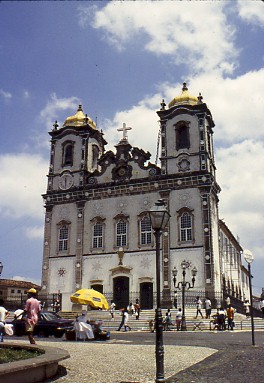
Salvador's world famous musical and dance traditions (samba, afoxé, forró, etc.), cuisine (particularly the spicy, dendê-based dishes), martial arts (capoeira), and spiritual-religious traditions (most notably Candomblé), to name a few, result from this heritage, and a contemporary visitor to Salvador can find all of them thriving throughout the Bahian capital. But these are not just historical artifacts or traces; a tourist in Bahia will also notice quickly what Brazil's census has quantified: the city and state have the largest percentage of self-identified black or mixed people in the country, and the Afro-Brazilian cultural traditions are thoroughly woven into the fabric of Bahian life, from the Baianas, in their headwraps and white and multicolored petticoats, to its park (O Parque Dique de Tororó) with giant statues of the Candomblé Orixás to the black-saint filled Igreja da Nossa Senhora do Rosario dos Homens Pretos do Pelourinho (the Church of Our Lady of the Rosary of Black Men of the Pelourinho) to its Carnaval celebration, one of the three most important ones in Brazil (along with Rio's and Recife's). The cultural and spiritual vibes, the links to an African past (Yoruba, Congolese, etc.) that still lives in the present, I can attest, are palpable, and I know several black Americans whose lives were changed forever after stays there.
Today, Salvador is the third most populous city in Brazil (after São Paulo and Rio), and has cemented its position as one of Brazil's major cultural capitals. It remains the birthplace or home of numerous internationally reknowned musicians and musical groups, such as Brazil's minister of culture, Gilberto Gil, his former bandmate Caetano Veloso and Veloso's sister, Maria Bethânia; the blocos afros Olodum, Ilê Aiyê, Muzenza, and Ara Ketu; the group Timbalada, led by Carlinhos Brown, Margareth Menezes, and so many others. C. and I saw Olodum live in 2000, right in the outdoor square, the Terreiro de Jesús. Many of Salvador's and Bahia's native musicians frequently perform in and around the city, and Veloso supposedly appears from time to time right on the Barra, Ondina and Pituba beaches.
Salvador draws so many tourists that the Brazilian and Bahian governments decided, in the 1990s, to invest money in rehabilitating and restoring large sections of historic core, especially the Pelourinho ("[little] pillory" in Portuguese), returning much of the original beauty to the area without Disneyfying or destroying it. It was also the longtime home of one of Brazil's most famous and prolific writers, Jorge Amado (a native of the southern Bahian city of Itabuna, and author of the masterpieces Gabriela, Clove and Cinnamon and Dona Flor, and Her Two Husbands), and the Fundação Casa Jorge de Amado is located right in the center of the Pelourinho. One sight not to be missed is the barococo, ultragilt interior of the São Francisco church, with its sexualized caryatids and carvings, and in its adjoining convent, the scary room of saints (I was transfixed), the upstairs room with its bleeding Jesus (ropes of velvet--it has to be seen), or the ossuary crypt in the basement.
Other areas in the city, such as Lower City (Cidade Baixa, the commercial district where the city's port, its Mercado Modelo, and the famous Bunda ("Booty") sculpture are all located), and the Barra (where we stayed), Dois de Julio, Campo Grande, Liberdade, Saúde, Pituba, Ondina, Rio Vermelho, and Itapoã neighborhoods all offer a lot to see and explore as well. In addition, Salvador is the best starting off point for boat tours of the nearby bay islands (giant Itaparica, and the islets of dos Frades and da Maré); the cross-bay Valença party town of Morro de São Paulo; the interior, former sugar-growing regions of the Recôncavo, or the northern beaches along the Linha Verde (Green Line), some of which have become increasingly commercialized (like the Costa do Sauípe).
Salvador also is home to the oldest gay group in Brazil, Grupo Gay da Bahia, which has transformed the conservative city into a cynosure of pro-gay legislation and activism.
Neither Brazil nor the Bahian state government have been able to remedy the endemic problem of (local) poverty. While the city doesn't experience anywhere near the levels of violent crime of Rio or São Paulo, the class and racial divisions, which show themselves in economic, social and political divisions and disparities, are evident. I have read that the employment situation over the last few years has slightly improved (though perhaps nowhere near as well as many had hoped when the Worker's Party candidate Lula da Silva assumed the presidency), and in terms of the street children, several local and international groups actively raise money on their behalf (the colored fitas do bomfim that many visitors to Salvador bring back are part of this effort).
I'm not sure when I'm going to be able to get back to Salvador, but I hope it's soon. Until then, I'm wishing the city and its people a Feliz Aniversario! Salvador wears its more than four centuries of history and tradition remarkably well!
***
I also want to acknowledge the passing of Johnnie L. Cochran, Jr. (1937-2005), who died after a two-year battle with brain cancer. Though he'll forever be associated with his successful defense of O.J. Simpson in that infamous 1995 criminal trial, he also won many other important cases, particularly in the area of civil rights. He won numerous judgments against the Los Angeles city government and LAPD, beginning in the 1970s, usually for non-celebrity clients. Later, he won a judgment on behalf of torture victim Abner Louima in his lawsuit against the NYPD, and he eventually avenged the 1972 prosecution of Black Panther Elmer "Geronimo" Pratt by gaining a reversal in 1997. He also got Sean "P.Diddy" Combs acquitted of gun possession charges. One other really interesting aspect of his career is that, as a deputy city attorney for Los Angeles in the early 1960s (he had been the first black law clerk in that office), he prosecuted Lenny Bruce on criminal obscenity charges, which were later overturned on First Amendment grounds. A remarkable lawyer, person, and race man (in WEB DuBois's and Hazel Carby's senses of the term), by any measure, and one of the major defenders not only of the already powerful, but, throughout his career, of those at the bottom of society as well.
Salvador's world famous musical and dance traditions (samba, afoxé, forró, etc.), cuisine (particularly the spicy, dendê-based dishes), martial arts (capoeira), and spiritual-religious traditions (most notably Candomblé), to name a few, result from this heritage, and a contemporary visitor to Salvador can find all of them thriving throughout the Bahian capital. But these are not just historical artifacts or traces; a tourist in Bahia will also notice quickly what Brazil's census has quantified: the city and state have the largest percentage of self-identified black or mixed people in the country, and the Afro-Brazilian cultural traditions are thoroughly woven into the fabric of Bahian life, from the Baianas, in their headwraps and white and multicolored petticoats, to its park (O Parque Dique de Tororó) with giant statues of the Candomblé Orixás to the black-saint filled Igreja da Nossa Senhora do Rosario dos Homens Pretos do Pelourinho (the Church of Our Lady of the Rosary of Black Men of the Pelourinho) to its Carnaval celebration, one of the three most important ones in Brazil (along with Rio's and Recife's). The cultural and spiritual vibes, the links to an African past (Yoruba, Congolese, etc.) that still lives in the present, I can attest, are palpable, and I know several black Americans whose lives were changed forever after stays there.
Today, Salvador is the third most populous city in Brazil (after São Paulo and Rio), and has cemented its position as one of Brazil's major cultural capitals. It remains the birthplace or home of numerous internationally reknowned musicians and musical groups, such as Brazil's minister of culture, Gilberto Gil, his former bandmate Caetano Veloso and Veloso's sister, Maria Bethânia; the blocos afros Olodum, Ilê Aiyê, Muzenza, and Ara Ketu; the group Timbalada, led by Carlinhos Brown, Margareth Menezes, and so many others. C. and I saw Olodum live in 2000, right in the outdoor square, the Terreiro de Jesús. Many of Salvador's and Bahia's native musicians frequently perform in and around the city, and Veloso supposedly appears from time to time right on the Barra, Ondina and Pituba beaches.
Salvador draws so many tourists that the Brazilian and Bahian governments decided, in the 1990s, to invest money in rehabilitating and restoring large sections of historic core, especially the Pelourinho ("[little] pillory" in Portuguese), returning much of the original beauty to the area without Disneyfying or destroying it. It was also the longtime home of one of Brazil's most famous and prolific writers, Jorge Amado (a native of the southern Bahian city of Itabuna, and author of the masterpieces Gabriela, Clove and Cinnamon and Dona Flor, and Her Two Husbands), and the Fundação Casa Jorge de Amado is located right in the center of the Pelourinho. One sight not to be missed is the barococo, ultragilt interior of the São Francisco church, with its sexualized caryatids and carvings, and in its adjoining convent, the scary room of saints (I was transfixed), the upstairs room with its bleeding Jesus (ropes of velvet--it has to be seen), or the ossuary crypt in the basement.
Other areas in the city, such as Lower City (Cidade Baixa, the commercial district where the city's port, its Mercado Modelo, and the famous Bunda ("Booty") sculpture are all located), and the Barra (where we stayed), Dois de Julio, Campo Grande, Liberdade, Saúde, Pituba, Ondina, Rio Vermelho, and Itapoã neighborhoods all offer a lot to see and explore as well. In addition, Salvador is the best starting off point for boat tours of the nearby bay islands (giant Itaparica, and the islets of dos Frades and da Maré); the cross-bay Valença party town of Morro de São Paulo; the interior, former sugar-growing regions of the Recôncavo, or the northern beaches along the Linha Verde (Green Line), some of which have become increasingly commercialized (like the Costa do Sauípe).
Salvador also is home to the oldest gay group in Brazil, Grupo Gay da Bahia, which has transformed the conservative city into a cynosure of pro-gay legislation and activism.
Neither Brazil nor the Bahian state government have been able to remedy the endemic problem of (local) poverty. While the city doesn't experience anywhere near the levels of violent crime of Rio or São Paulo, the class and racial divisions, which show themselves in economic, social and political divisions and disparities, are evident. I have read that the employment situation over the last few years has slightly improved (though perhaps nowhere near as well as many had hoped when the Worker's Party candidate Lula da Silva assumed the presidency), and in terms of the street children, several local and international groups actively raise money on their behalf (the colored fitas do bomfim that many visitors to Salvador bring back are part of this effort).
I'm not sure when I'm going to be able to get back to Salvador, but I hope it's soon. Until then, I'm wishing the city and its people a Feliz Aniversario! Salvador wears its more than four centuries of history and tradition remarkably well!
***
I also want to acknowledge the passing of Johnnie L. Cochran, Jr. (1937-2005), who died after a two-year battle with brain cancer. Though he'll forever be associated with his successful defense of O.J. Simpson in that infamous 1995 criminal trial, he also won many other important cases, particularly in the area of civil rights. He won numerous judgments against the Los Angeles city government and LAPD, beginning in the 1970s, usually for non-celebrity clients. Later, he won a judgment on behalf of torture victim Abner Louima in his lawsuit against the NYPD, and he eventually avenged the 1972 prosecution of Black Panther Elmer "Geronimo" Pratt by gaining a reversal in 1997. He also got Sean "P.Diddy" Combs acquitted of gun possession charges. One other really interesting aspect of his career is that, as a deputy city attorney for Los Angeles in the early 1960s (he had been the first black law clerk in that office), he prosecuted Lenny Bruce on criminal obscenity charges, which were later overturned on First Amendment grounds. A remarkable lawyer, person, and race man (in WEB DuBois's and Hazel Carby's senses of the term), by any measure, and one of the major defenders not only of the already powerful, but, throughout his career, of those at the bottom of society as well.
Monday, March 28, 2005
Paulo José Miranda's Hijinks (Lead to My Web Mention!)
Until a few days ago, Paulo José Miranda, a Portuguese author (poet, playwright, and novelist, and winner of the 1999 José Saramago Prize [?]), didn't register on my radar. To tell the truth, I know quase nada about contemporary Portuguese literature beyond the big names: José Saramago, the Nobel Laureate novelist; Antonio Lobo Antunes, the acclaimed fiction writer and frequent Nobel candidate who'd served in and written about the Angolan War of liberation and whom my only Portuguese teacher, an Azorean woman, peremptorily dismissed as a hack ("the great writers don't need to have a war to write about"); Fernando Namora, the country doctor whose simple prose remains among the most difficult I've ever tried to translate; and a few others, like the gay poet Joaquim Manuel Magalhães, or writers I struggled through in my lessons, like the surrealist Agustina Bessa Luis, the poet Sophia de Mello Breyner, and the deceased earlier writers Vergílio Ferreira, Jorge de Sena and José Cardoso Pires. (Pessoa, Castelo Branco and Camões aren't of recent vintage.) Most of the literature in Portuguese that I know a little about comes from Brazil; I've said I'm going to familiarize myself with contemporary African Lusophone literature, which a colleague extolled, but I haven't gotten beyond a few authors (Luandino Vieira, etc.).
In fact, I'd never even heard of Miranda until I read Jan Herman's arts and politics blog on Arts Journal. (Greg Sandow's infrequently updated music blog is the other one I always scan on that site.) Herman was calling attention to a bombastic flash site set up by Miranda and several friends, called "America Is," which Herman described as "very weird, well-designed, right-wing propaganda." On first glance, it appears to be so. The site asks you to click on a box that will give you Miranda's "ontological proof of America in 99 points." You only get 17 (the rest you have to pay for! ha ha), which read as if one of the "sleepwalkers" (cf. Musil, Broch or Mabuse) had snapped them off, between claps and Bible glances, at this past summer's Republican National Convention. For example, No. 4: "America keeps growing. America keeps welcoming the world." Or No. 18, which begins, "Iraq is not invaded. Iraq is being updated...." Or No. 19: "The product Coca Cola is more widely known than the Eiffel Tower, the tower of Pisa or the Vatican. America makes things the world understands. America makes things for its people." Or most simplistically, No. 41, "America is it."
Now, my first response was, I think these Portuguese folks are having a bit of fun at our expense. And why not? Hell, 51% (or so we've been conned into believing, or accepting, or both) of the voting electorate put W back in office just last fall. His main order of business has been to destroy (under the Orwellian description "reform") Social Security, the best US government program created in the 20th century, and one of the few remaining corners of a nation-wide safety net. He's got his Republibots to ram through an awful "tort-reform" (cf. above) bill (a gift to insurance companies and megacorporations), and an even worse "bankruptcy" reform bill (a gift to the credit card companies), and he's further weakened laws that prevent environmental degradation. As a sop to his anti-gay base, he wasted precious minutes of his State of the Union Address to again call for the hateful anti-gay FMA. The self-admitted doper (finally!), who supposedly found "Christ" at the age of 40, burns news paths of anti-Christian behavior by pushing for making his tax cuts permanent while calling for draconian cuts to a range of programs geared to help the poor and working-classes. He elevated an inept, incompetent, serial dissembler, and a bad one at that, to be Secretary of State. He made the legalistic enabler of torture our Attorney General. He nominated anti-UN ranter John Bolton to be...Secretary to the UN. He has nominated neoconservative liar and adulterer Paul Wolfowitz...to head the World Bank. He named John Negroponte, who still has blood on his hands from his years in Central America, to be...first Ambassador to Iraq and then head of the National Intelligence Office. And let's not even get started on Iraq, or the rest of the Middle East, which remains in turmoil though he's taking (and being given) credit for unleashing "freedom" (cf. ibid, Orwell, etc.). Then there's the steadily increasing theocratic cast of his party, which has even got some GOPers up in arms--he actually flew back from his ranch to grandstand on the Terri Schiavo tragedy, even though he and the rest of his racket claim to stand up for the "sanctity of marriage" and he signed a law in Texas allowing the ending of life support, and a black baby just last...oh, why even go on? I'm sure the Taliban are feeling pretty envious right about now....
At any rate, I didn't need to consider even ONE of the W Unltd. administration's actions to realize what Miranda and company are up to. Why? Because although I can be obtuse at times (pronouncing "gimlet" like "gym-lit" and forgetting the Pythagorean Theorem), I do get paid to read critically, and I could see through this bit of jollity--irony-steeped jollity at that--as if I were peering through the Grand Canyon. So I wrote Senhor Herman a little e-mail, and...he published it in his blog, mentioning me by name. As you see, I give him his props, because I was raised that way and I really like his blog, especially when he quotes his white friend, Bill Osborne, who loves to go off about "honky myopia" (no, he's actually making sharp critiques, not being a self-hating racist). But I was very surprised that he didn't see through Miranda's funning. I mean, Europe does have authentic right-wing fanatics and nutjobs. Lots of them. They actually are running Italy, were (are?) running Austria, and are quite strong in Germany, the Netherlands, France (remember Chirac's LePen scare, and he's a corrupt rightist himself), Spain, etc. Portugal, by the way, was ruled by a right-wing dictator for much of the 20th century. Europe also has lots of left-leaning folks who are also quite racist and anti-Semitic. And lots of casual racism (cf. Spanish soccer fans).
But Miranda e seus amigos (or os amigos dele, as some Brazilians might say), I think, is sticking a poniard (that's what did in Marlowe, right?) into America's eye. In the case of João Felino, a lots of them (cf. my post on Ellen Gallagher!). Look at the "More America" links he lists on the blog: Anal Philosopher, Andrew Sullivan.... Let's see how long it takes for others to figure this out. Or maybe not. [WARNING: Clicking on Nuno Miguel Alves's or Rui Parada's links caused my Mozilla browser to freeze!] I really want to read one of his novels.
In fact, I'd never even heard of Miranda until I read Jan Herman's arts and politics blog on Arts Journal. (Greg Sandow's infrequently updated music blog is the other one I always scan on that site.) Herman was calling attention to a bombastic flash site set up by Miranda and several friends, called "America Is," which Herman described as "very weird, well-designed, right-wing propaganda." On first glance, it appears to be so. The site asks you to click on a box that will give you Miranda's "ontological proof of America in 99 points." You only get 17 (the rest you have to pay for! ha ha), which read as if one of the "sleepwalkers" (cf. Musil, Broch or Mabuse) had snapped them off, between claps and Bible glances, at this past summer's Republican National Convention. For example, No. 4: "America keeps growing. America keeps welcoming the world." Or No. 18, which begins, "Iraq is not invaded. Iraq is being updated...." Or No. 19: "The product Coca Cola is more widely known than the Eiffel Tower, the tower of Pisa or the Vatican. America makes things the world understands. America makes things for its people." Or most simplistically, No. 41, "America is it."
Now, my first response was, I think these Portuguese folks are having a bit of fun at our expense. And why not? Hell, 51% (or so we've been conned into believing, or accepting, or both) of the voting electorate put W back in office just last fall. His main order of business has been to destroy (under the Orwellian description "reform") Social Security, the best US government program created in the 20th century, and one of the few remaining corners of a nation-wide safety net. He's got his Republibots to ram through an awful "tort-reform" (cf. above) bill (a gift to insurance companies and megacorporations), and an even worse "bankruptcy" reform bill (a gift to the credit card companies), and he's further weakened laws that prevent environmental degradation. As a sop to his anti-gay base, he wasted precious minutes of his State of the Union Address to again call for the hateful anti-gay FMA. The self-admitted doper (finally!), who supposedly found "Christ" at the age of 40, burns news paths of anti-Christian behavior by pushing for making his tax cuts permanent while calling for draconian cuts to a range of programs geared to help the poor and working-classes. He elevated an inept, incompetent, serial dissembler, and a bad one at that, to be Secretary of State. He made the legalistic enabler of torture our Attorney General. He nominated anti-UN ranter John Bolton to be...Secretary to the UN. He has nominated neoconservative liar and adulterer Paul Wolfowitz...to head the World Bank. He named John Negroponte, who still has blood on his hands from his years in Central America, to be...first Ambassador to Iraq and then head of the National Intelligence Office. And let's not even get started on Iraq, or the rest of the Middle East, which remains in turmoil though he's taking (and being given) credit for unleashing "freedom" (cf. ibid, Orwell, etc.). Then there's the steadily increasing theocratic cast of his party, which has even got some GOPers up in arms--he actually flew back from his ranch to grandstand on the Terri Schiavo tragedy, even though he and the rest of his racket claim to stand up for the "sanctity of marriage" and he signed a law in Texas allowing the ending of life support, and a black baby just last...oh, why even go on? I'm sure the Taliban are feeling pretty envious right about now....
At any rate, I didn't need to consider even ONE of the W Unltd. administration's actions to realize what Miranda and company are up to. Why? Because although I can be obtuse at times (pronouncing "gimlet" like "gym-lit" and forgetting the Pythagorean Theorem), I do get paid to read critically, and I could see through this bit of jollity--irony-steeped jollity at that--as if I were peering through the Grand Canyon. So I wrote Senhor Herman a little e-mail, and...he published it in his blog, mentioning me by name. As you see, I give him his props, because I was raised that way and I really like his blog, especially when he quotes his white friend, Bill Osborne, who loves to go off about "honky myopia" (no, he's actually making sharp critiques, not being a self-hating racist). But I was very surprised that he didn't see through Miranda's funning. I mean, Europe does have authentic right-wing fanatics and nutjobs. Lots of them. They actually are running Italy, were (are?) running Austria, and are quite strong in Germany, the Netherlands, France (remember Chirac's LePen scare, and he's a corrupt rightist himself), Spain, etc. Portugal, by the way, was ruled by a right-wing dictator for much of the 20th century. Europe also has lots of left-leaning folks who are also quite racist and anti-Semitic. And lots of casual racism (cf. Spanish soccer fans).
But Miranda e seus amigos (or os amigos dele, as some Brazilians might say), I think, is sticking a poniard (that's what did in Marlowe, right?) into America's eye. In the case of João Felino, a lots of them (cf. my post on Ellen Gallagher!). Look at the "More America" links he lists on the blog: Anal Philosopher, Andrew Sullivan.... Let's see how long it takes for others to figure this out. Or maybe not. [WARNING: Clicking on Nuno Miguel Alves's or Rui Parada's links caused my Mozilla browser to freeze!] I really want to read one of his novels.
Sunday, March 27, 2005
Swerve #13 + Max Gordon on Oprah Presents: Their Eyes..."
Tonight I ventured over to Brooklyn to attend a launch party for the literary journal Swerve's issue #13, which features original hand-painted covers by a friend and collaborator on a book project, artist Christopher Stackhouse. Images of some of them are available on Swerve's Website; unfortunately for art-lovers (but fortunately for Swerve), the issue has completely sold out, but they are always accepting new subscriptions (and the poetry they publish is quite good; this issue includes poems by m. (Mike) loncar, author of 66 galaxie).

Christopher's covers truly are works of art, and I don't use that term lightly, or just to roll logs on his behalf; these tight pieces, which form the first, outer panel of the z-folded periodical, span a range of styles, some of them redolent of Japanese rice-paper paintings, while others recall in miniature form such painters as William T. Williams, Sam Gilliam, Richard Diebenkorn, Agnes Martin, Andy Warhol, Jean-Michel Basquiat, and Gerhard Richter; yet they are evidently Christopher's own creations and follow from other larger works on canvas and paper that he's done. They're neither echoes nor knock-offs. Viewing the covers up close reveals many details like the speed, intricacy and delicacy of the brushwork; the screen-like layering on many of them; the richness of the covers, and the tinier touches, such as the splatters, grisailling and subtle geometric patterns. They're like visual versions of piano studies, of considerable melodic and harmonic range and color--études diverses. I hope Christopher decides to issue prints of many of them, and to produce larger works (he's said that many of these are studies) in this vein. He'll have a winner of a show.
***
Tisa B. called my attention to Max Gordon's trenchant analysis of Oprah Winfrey's ABC version of Zora Neale Hurston's Their Eyes Were Watching God. I missed it (no TiVo, didn't videotape or DVR), because I went to see Lydia Diamond's fine stage adaptation of Toni Morrison's The Bluest Eye at Chicago's Steppenwolf Theater. Hallie Gordon was the director. (I was weary of how a staged version of Morrison's first novel might turn out, but the outstanding acting, the inventive sets and lighting, the condensation of the narrative, and parceling out of Morrison's third person narration, both the exposition and the more lyrical, interior sections, to the various characters, sometimes in varying chorus-like groups, all succeeded).
As for Their Eyes, I did enjoy Oprah's somewhat misguided take on Beloved, an unfilmable book because of its narrative density and complexity, its lyrical interiority (which Jazz, I think, exceeds) and in general I am all for adaptations of black literature--God knows, we need to draw upon sources that might provide something else besides the rampant, unironic schmaltz, minstrelsy and ersatz depictions of our lives that fill movie and TV screens on a daily basis. But I still had misgivings, based on advance commentary that I was reading and hearing.
At any rate, if you saw the TV movie and want one writer's astute and acerbic take, read Gordon's commentary. I especially took to heart the passages on the differences between witnessing and watching, particularly in light of the truly f*cked up society (and world) we're living in now. Zora was a witness; Gordon, as I read his review, is saying that instead of her powerful, challenging and beautiful art and testimony, we got something quite different, lacking, mangled, therapeutic: something geared primarily for us to watch (and soon forget).
Here are fifteen novels by black authors I'd like to see adapted--adroitly, of course--into films: Calixthe Béyala's Loukoum: The Little Prince of Belleville; Dionne Brand's In Another Place, Not Here; Octavia Butler's Kindred; Cyrus Colter's The Catacombs; Tsitsi Dangarembga's Nervous Conditions; Louis Edwards's Ten Seconds; E. Lynn Harris's Invisible Life; Paule Marshall's The Chosen Place, The Timeless People; Gayl Jones's Corregidora; Andrea Lee's Sarah Phillips; Zakes Mda's The Heart of Redness; Ishmael Reed's Reckless Eyeballing; Edgardo Rodríguez Juliá's The Renunciation; Sherley Ann Williams's Dessa Rose; and Shay Youngblood's Black Girl in Paris.
+++
Easter = Redemption.
Christopher's covers truly are works of art, and I don't use that term lightly, or just to roll logs on his behalf; these tight pieces, which form the first, outer panel of the z-folded periodical, span a range of styles, some of them redolent of Japanese rice-paper paintings, while others recall in miniature form such painters as William T. Williams, Sam Gilliam, Richard Diebenkorn, Agnes Martin, Andy Warhol, Jean-Michel Basquiat, and Gerhard Richter; yet they are evidently Christopher's own creations and follow from other larger works on canvas and paper that he's done. They're neither echoes nor knock-offs. Viewing the covers up close reveals many details like the speed, intricacy and delicacy of the brushwork; the screen-like layering on many of them; the richness of the covers, and the tinier touches, such as the splatters, grisailling and subtle geometric patterns. They're like visual versions of piano studies, of considerable melodic and harmonic range and color--études diverses. I hope Christopher decides to issue prints of many of them, and to produce larger works (he's said that many of these are studies) in this vein. He'll have a winner of a show.
***
Tisa B. called my attention to Max Gordon's trenchant analysis of Oprah Winfrey's ABC version of Zora Neale Hurston's Their Eyes Were Watching God. I missed it (no TiVo, didn't videotape or DVR), because I went to see Lydia Diamond's fine stage adaptation of Toni Morrison's The Bluest Eye at Chicago's Steppenwolf Theater. Hallie Gordon was the director. (I was weary of how a staged version of Morrison's first novel might turn out, but the outstanding acting, the inventive sets and lighting, the condensation of the narrative, and parceling out of Morrison's third person narration, both the exposition and the more lyrical, interior sections, to the various characters, sometimes in varying chorus-like groups, all succeeded).
As for Their Eyes, I did enjoy Oprah's somewhat misguided take on Beloved, an unfilmable book because of its narrative density and complexity, its lyrical interiority (which Jazz, I think, exceeds) and in general I am all for adaptations of black literature--God knows, we need to draw upon sources that might provide something else besides the rampant, unironic schmaltz, minstrelsy and ersatz depictions of our lives that fill movie and TV screens on a daily basis. But I still had misgivings, based on advance commentary that I was reading and hearing.
At any rate, if you saw the TV movie and want one writer's astute and acerbic take, read Gordon's commentary. I especially took to heart the passages on the differences between witnessing and watching, particularly in light of the truly f*cked up society (and world) we're living in now. Zora was a witness; Gordon, as I read his review, is saying that instead of her powerful, challenging and beautiful art and testimony, we got something quite different, lacking, mangled, therapeutic: something geared primarily for us to watch (and soon forget).
Here are fifteen novels by black authors I'd like to see adapted--adroitly, of course--into films: Calixthe Béyala's Loukoum: The Little Prince of Belleville; Dionne Brand's In Another Place, Not Here; Octavia Butler's Kindred; Cyrus Colter's The Catacombs; Tsitsi Dangarembga's Nervous Conditions; Louis Edwards's Ten Seconds; E. Lynn Harris's Invisible Life; Paule Marshall's The Chosen Place, The Timeless People; Gayl Jones's Corregidora; Andrea Lee's Sarah Phillips; Zakes Mda's The Heart of Redness; Ishmael Reed's Reckless Eyeballing; Edgardo Rodríguez Juliá's The Renunciation; Sherley Ann Williams's Dessa Rose; and Shay Youngblood's Black Girl in Paris.
+++
Easter = Redemption.
Saturday, March 26, 2005
Saturday Quote: Tom Miller + Another Hate Crime
"I've done a lot of work where I paint on furniture and other objects. The pieces that I use are what I grew up with--furniture like what my grandmother would have in her dining room--that type of thing. And these pieces, in many cases, are things that have been discarded. Not valuable antiques but working-class people's furniture mostly from the '30s and '40s with a few pieces from the '50s. I paint a 'skin' on the furniture and the pieces become very active--wiggling and moving. It's like Friday night in Baltimore City. Everybody's out, everybody's moving. I try to capture the same energy level that I admire in black people, like when Michael Jordan jumps--how can another human being do that?"
--artist Tom Miller, "Interview with Greg Henry, Tom Miller and Al Carter," from Next Generation: Southern Black Aesthetic (Winston Salem: South Eastern Center for Contemporary Art, 1990), p. 152.
***
A day ago Planetblack sent along links about another attack on a gay man of color in New York, this time activist Nelson Torres:
Bruthas,
Yet another violent attack against a gay man of color. Nelson Torres, an employee of Hispanic AIDS Forum, was attacked outside of his Bronx home this past Saturday. For more info, go to:
Press release
Photos
I don't know any more about this, but as I learn and hear more I'll post more.
--artist Tom Miller, "Interview with Greg Henry, Tom Miller and Al Carter," from Next Generation: Southern Black Aesthetic (Winston Salem: South Eastern Center for Contemporary Art, 1990), p. 152.
***
A day ago Planetblack sent along links about another attack on a gay man of color in New York, this time activist Nelson Torres:
Bruthas,
Yet another violent attack against a gay man of color. Nelson Torres, an employee of Hispanic AIDS Forum, was attacked outside of his Bronx home this past Saturday. For more info, go to:
Press release
Photos
I don't know any more about this, but as I learn and hear more I'll post more.
Friday, March 25, 2005
Bebel Gilberto + Pierre Boulez
Can these two figures--Bebel Gilberto and Pierre Boulez--really inhabit the same sound world? For me they do.
 Bebel Gilberto's scrumptious Tanto Tempo was one of the top CDs of 2001 and provided track after track (in original and remixed versions, by Suba, Kruder & Dorfmeister and countless others) for lounges and lounge lizards all over the world. (It actually became one of Brazil's best-selling CDs ever, matching her famous father João Gilberto's efforts.)
Last year she released her long-awaited followup, the eponymous Bebel Gilberto, which actually improves upon her debut issue. Gilberto tries out and succeeds with a wider range of musical source material and collaborators while keeping this new CD as mellow and melodic. She sings tunes these often ethereal sounding tunes in Portuguese, English and a mix of the two. As with the first CD, her music rooted in my ear while also seeming ripe for DJs' and mixers' re-visions.
My favorite tracks so far are "Aganjú," a Candomblé-flavored song written by Bahian impresario and musician Carlinhos Brown (most recently of Tribalistas fame), featuring a danceable melody and rhythm--and it actually conjures the Yoruba orisha it invokes; "Simplesmente," which is as simple and lovely a meditative song as its title suggests; "Winter," a slow and seductive charmer that is at least a season away from the chilly weather outdoors; and "All Around," another English-lyric song, written with Japanese musician Masa Shimizu, which Gilberto has said is her personal favorite; it even features a complete string orchestra accompaniment. Its refrain, the almost-banal but beautiful "Never forget that when / I think of you / You're not alone" keeps running through my head. Gilberto's music manages to enchant and relax at the same time, and here it falls more on casting its spells.
I missed Gilberto during her summer and fall tour of the US, so I hope to hear her perform some of these songs live eventually, but I also want to hear what remixers--and she attracts some of the best out there--stir up in the meanwhile.
***
Tomorrow marks the 80th birthday of the one of the 20th century's former infants terribles, the extraordinary French composer and conductor Pierre Boulez (1925-). After taking a degree in mathematics he later studied with the inimitable Frenchman Olivier Messiaen, and René Leibowitz, the doyen of the Darmstadt School. Boulez originally became famous for his extreme, authoritarian pronouncements about music, such as that opera houses should be blown up, or, having dismissed most of the music of his predecessors in favor of the serial technique pioneered by Schoenberg, his subsequent triumphant declaration that Schoenberg was "dead!" Ah youth! In fact, Boulez was dismissive of almost all his peers as well, including such notable American composers as John Cage and Morton Feldman (some of whose chance techniques he soon incorporated into his works), arguing for a strict, scientific approach that emphasized atonality and organized every aspect of a composition (he did study math!). Boulez was known to be especially cutting and frosty in person, and Feldman in particular rants quite a bit about him, though he was hardly alone. Having killed off his father, Schoenberg, he then went out at wrote a piece in 1954, "Le marteau sans maître," whose debt to Schoenberg's "Pierrot Lunaire" is so obvious it's painful--but it feels, at the same time, almost sui generis in sound, like music beamed down from Jupiter. It wasn't only the Austrian father he slew; having symbolically shot down French daddy Claude Debussy (so little variation! all that static harmony! that Hispanophilia!), Boulez then incorporated the poetry of Stephane Mallarmé into one of his major works, "Pli selon pli" (as Debussy had done in his greatest composition, the orchestral masterpiece "Prélude de l'aprés-midi d'un faune")....

But, with time for some comes maturity (also known as the combination of perspective and a little wisdom), and so it was with Boulez. He began conducting in the 1960s, and gradually became one of the most noteworthy interpreters not only of early 20th century avant-garde music (especially Berg, Schoenberg, Webern, Stravinsky, Debussy, Bartók, Messiaen, Ligeti, and Carter), but also of some of the Romantic composers he so harshly decried, such as Mahler (some of his versions are among the best), Wagner, Bruckner, Dvorak, and...yes, Beethoven! The destroyer of institutions later led both the London Philharmonic (1971-1974) and, gods be stilled, the New York Philharmonic (1971-1977), conducted at the Bayreuth (!) and Paris Operas, and in the late 1970s founded both the l'Institut de Recherche et Coordination Acoustique/Musique (IRCAM), one of the leading institutions of electronic music in the world, and the Ensemble InterContemporain, an outstanding contemporary music performance group. Boulez has been a guest conductor for many years with several other major establishment orchestras, including the Chicago Symphony Orchestra and before that with Cleveland's great symphony, and is supposedly now much more generous, not only to fellow composers, but to musicians and concert attendees. (I hope to see him conduct Berg's "Chamber Concerto" in Chicago later this spring.)
As for his own music, he began to relax some of his strictures by the late 1950s, and has rewritten or reworked a number of his pieces. Others he has withdrawn. Some of the compositions since the mid-1960s not only have tone coloristic qualities that echo Romanticism and much of the 20th century's sonic experiments, but moments approximating an emotional presence and warmth. A number of the later pieces are fragments, which seems quite fitting for a composer who called for total serialization and organization, while sniffing at others who were writing in standard key signatures and using traditional forms. (If you throw out all the foundations, well, you've got to come up with new ones!)
Of course there are many who still loathe him, or at least the idea of him. Grudges die hard, and the man has long held considerable power and is the embodiment of the contemporary, moribund classical music establishment, which is enough of a crime for many people. Josh Ronsen came up with a novel way of expressing his Boulez-disgust, while the leading American composer John Adams and the young British composer Thomas Adès both offer up deliciously waspish thoughts (scroll down to the bottom) about Boulez's historical significance. Pre-mid 60s Boulez is often harsh, rigid and suffused, I think, with an anger born of arrogance and superiority, an attempt to surpass, and in a certain sense, erase all else that has come before, while the later works often appear to battle through their failures to live up to his grand designs. His struggles are audible throughout them, with their often ghostly instrumental pairings and multiples, their insistent harmonic bleets, shimmers and moans, and the sometimes thrilling racing or glacial tempi. As formal artifacts that convey intellectual beauty or conceptual possibility more than emotion, they strike me as better musical analogs of Mallarmé, for example, particularly the Mallarmé of the "livre pur" than anything Debussy composed.
I personally like a number of his later compositions, including "...explosant-fixe..." and the related works "Anthèmes" and "Anthèmes 2," and "Mémoriale"; "Messagesquisses"; "Dialogue de l'Ombre Double"; "Répons" (I've gone back and forth with this one); and "Dérive I" and "II." The early piano sonatas and "Notations" (for piano--I like the orchestral version) I can stomach on an exceptional day, like "Marteau." As a conductor, I think he's one of the best with the Second Viennese School, the French composers, and Bartók, Mahler, and Stravinsky. In truth I'm rather glad to have Boulez around (still), especially since I've never had to deal with him in person. The music, often beautiful and often strange, stands on its own.
Bebel Gilberto's scrumptious Tanto Tempo was one of the top CDs of 2001 and provided track after track (in original and remixed versions, by Suba, Kruder & Dorfmeister and countless others) for lounges and lounge lizards all over the world. (It actually became one of Brazil's best-selling CDs ever, matching her famous father João Gilberto's efforts.)Last year she released her long-awaited followup, the eponymous Bebel Gilberto, which actually improves upon her debut issue. Gilberto tries out and succeeds with a wider range of musical source material and collaborators while keeping this new CD as mellow and melodic. She sings tunes these often ethereal sounding tunes in Portuguese, English and a mix of the two. As with the first CD, her music rooted in my ear while also seeming ripe for DJs' and mixers' re-visions.
My favorite tracks so far are "Aganjú," a Candomblé-flavored song written by Bahian impresario and musician Carlinhos Brown (most recently of Tribalistas fame), featuring a danceable melody and rhythm--and it actually conjures the Yoruba orisha it invokes; "Simplesmente," which is as simple and lovely a meditative song as its title suggests; "Winter," a slow and seductive charmer that is at least a season away from the chilly weather outdoors; and "All Around," another English-lyric song, written with Japanese musician Masa Shimizu, which Gilberto has said is her personal favorite; it even features a complete string orchestra accompaniment. Its refrain, the almost-banal but beautiful "Never forget that when / I think of you / You're not alone" keeps running through my head. Gilberto's music manages to enchant and relax at the same time, and here it falls more on casting its spells.
I missed Gilberto during her summer and fall tour of the US, so I hope to hear her perform some of these songs live eventually, but I also want to hear what remixers--and she attracts some of the best out there--stir up in the meanwhile.
***
Tomorrow marks the 80th birthday of the one of the 20th century's former infants terribles, the extraordinary French composer and conductor Pierre Boulez (1925-). After taking a degree in mathematics he later studied with the inimitable Frenchman Olivier Messiaen, and René Leibowitz, the doyen of the Darmstadt School. Boulez originally became famous for his extreme, authoritarian pronouncements about music, such as that opera houses should be blown up, or, having dismissed most of the music of his predecessors in favor of the serial technique pioneered by Schoenberg, his subsequent triumphant declaration that Schoenberg was "dead!" Ah youth! In fact, Boulez was dismissive of almost all his peers as well, including such notable American composers as John Cage and Morton Feldman (some of whose chance techniques he soon incorporated into his works), arguing for a strict, scientific approach that emphasized atonality and organized every aspect of a composition (he did study math!). Boulez was known to be especially cutting and frosty in person, and Feldman in particular rants quite a bit about him, though he was hardly alone. Having killed off his father, Schoenberg, he then went out at wrote a piece in 1954, "Le marteau sans maître," whose debt to Schoenberg's "Pierrot Lunaire" is so obvious it's painful--but it feels, at the same time, almost sui generis in sound, like music beamed down from Jupiter. It wasn't only the Austrian father he slew; having symbolically shot down French daddy Claude Debussy (so little variation! all that static harmony! that Hispanophilia!), Boulez then incorporated the poetry of Stephane Mallarmé into one of his major works, "Pli selon pli" (as Debussy had done in his greatest composition, the orchestral masterpiece "Prélude de l'aprés-midi d'un faune")....
But, with time for some comes maturity (also known as the combination of perspective and a little wisdom), and so it was with Boulez. He began conducting in the 1960s, and gradually became one of the most noteworthy interpreters not only of early 20th century avant-garde music (especially Berg, Schoenberg, Webern, Stravinsky, Debussy, Bartók, Messiaen, Ligeti, and Carter), but also of some of the Romantic composers he so harshly decried, such as Mahler (some of his versions are among the best), Wagner, Bruckner, Dvorak, and...yes, Beethoven! The destroyer of institutions later led both the London Philharmonic (1971-1974) and, gods be stilled, the New York Philharmonic (1971-1977), conducted at the Bayreuth (!) and Paris Operas, and in the late 1970s founded both the l'Institut de Recherche et Coordination Acoustique/Musique (IRCAM), one of the leading institutions of electronic music in the world, and the Ensemble InterContemporain, an outstanding contemporary music performance group. Boulez has been a guest conductor for many years with several other major establishment orchestras, including the Chicago Symphony Orchestra and before that with Cleveland's great symphony, and is supposedly now much more generous, not only to fellow composers, but to musicians and concert attendees. (I hope to see him conduct Berg's "Chamber Concerto" in Chicago later this spring.)
As for his own music, he began to relax some of his strictures by the late 1950s, and has rewritten or reworked a number of his pieces. Others he has withdrawn. Some of the compositions since the mid-1960s not only have tone coloristic qualities that echo Romanticism and much of the 20th century's sonic experiments, but moments approximating an emotional presence and warmth. A number of the later pieces are fragments, which seems quite fitting for a composer who called for total serialization and organization, while sniffing at others who were writing in standard key signatures and using traditional forms. (If you throw out all the foundations, well, you've got to come up with new ones!)
Of course there are many who still loathe him, or at least the idea of him. Grudges die hard, and the man has long held considerable power and is the embodiment of the contemporary, moribund classical music establishment, which is enough of a crime for many people. Josh Ronsen came up with a novel way of expressing his Boulez-disgust, while the leading American composer John Adams and the young British composer Thomas Adès both offer up deliciously waspish thoughts (scroll down to the bottom) about Boulez's historical significance. Pre-mid 60s Boulez is often harsh, rigid and suffused, I think, with an anger born of arrogance and superiority, an attempt to surpass, and in a certain sense, erase all else that has come before, while the later works often appear to battle through their failures to live up to his grand designs. His struggles are audible throughout them, with their often ghostly instrumental pairings and multiples, their insistent harmonic bleets, shimmers and moans, and the sometimes thrilling racing or glacial tempi. As formal artifacts that convey intellectual beauty or conceptual possibility more than emotion, they strike me as better musical analogs of Mallarmé, for example, particularly the Mallarmé of the "livre pur" than anything Debussy composed.
I personally like a number of his later compositions, including "...explosant-fixe..." and the related works "Anthèmes" and "Anthèmes 2," and "Mémoriale"; "Messagesquisses"; "Dialogue de l'Ombre Double"; "Répons" (I've gone back and forth with this one); and "Dérive I" and "II." The early piano sonatas and "Notations" (for piano--I like the orchestral version) I can stomach on an exceptional day, like "Marteau." As a conductor, I think he's one of the best with the Second Viennese School, the French composers, and Bartók, Mahler, and Stravinsky. In truth I'm rather glad to have Boulez around (still), especially since I've never had to deal with him in person. The music, often beautiful and often strange, stands on its own.
Thursday, March 24, 2005
Editions Balland Le Rayon series: Mort
During an overseas trip a few years ago, I picked up several books, by Erik Remès, Nicolas Pages, Djallil Djellad, and Michel Zumkir, which were all published by French publisher Éditions Balland, under their le Rayon (the Ray) gay fiction line.  The editor of the series was a writer I in my ignorance had never heard of, though he was already zooming down the path of becoming one of the most notorious and exciting figures in contemporary French publishing: Guillaume Dustan. I grabbed these books because I'd asked one of the people working in the bookstore, Les Mots à la Bouche, who the most interesting younger French gay writers were, and he pointed me towards a table stacked with Rayon's colorful, eye-catching volumes. I also grabbed Rachid O.'s Chocolat Chaud, published by Gallimard.
The editor of the series was a writer I in my ignorance had never heard of, though he was already zooming down the path of becoming one of the most notorious and exciting figures in contemporary French publishing: Guillaume Dustan. I grabbed these books because I'd asked one of the people working in the bookstore, Les Mots à la Bouche, who the most interesting younger French gay writers were, and he pointed me towards a table stacked with Rayon's colorful, eye-catching volumes. I also grabbed Rachid O.'s Chocolat Chaud, published by Gallimard. Whenever I've been fortunate enough to travel I've looked for new work by (younger) black or LGBT or black LGBT authors, since it's usually the last to be translated. Though none of the authors were from sub-Saharan Africa or the Caribbean or Latin America--which is to say, black Francophone people as I'd mentally constructed them--Djellad and O. were among the few Maghrebi (from north Africa) presences in this new gay wave.
My original goal was to read and translate all of these works--but of course translation is tough work! I did make some headway with O., Pages, Djellad, and Zumkir, and eventually contacted Balland via e-mail to inquire about publishing the translations of the Swiss artist and writer Pages's novel Je mange un oeuf (I Eat an Egg for Breakfast) in an American literary journal. In my translation I'd gotten furthest with it.
Who responded? Not a foreign rights representative, as with Gallimard, but the editor-in-infamy himself, Guillaume Dustan! I had sort of expected a snappish exchange with the author of the laceratingly ironic and anti-sentimental autofiction Dans ma chambre (translated into English and published by Serpents Tail), Je sors ce soir, Plus fort que moi, and Nicolas Pages, but he was both professional and pleasant, and stated that I needed to have whatever journal that agreed to publish the work contact Balland to square things away. Doing the translations, he made clear, were okay. I gathered that he actually could speak and write English well (as is the case with nearly every non-U.S. author I've translated), but didn't want to and wouldn't, so our correspondence was in my faltering and too formal written French.
Okay, so I had this e-mail exchange with Dustan, whoop-de-doo. Well, in the interim, I've tried repeatedly to place the selections from Pages's novel...but no one will touch them. (Pages has since written two others, spent time in the US working with Nan Goldin, and been immortalized, as I noted above, by Dustan, in the eponymous volume that won the Prix de Flore in 1999.) I thought this might be because the translations weren't that good, but I did have several readers and speakers of French review them and they thought they were on target and lively enough. (I refuse to believe that people in the literary world have caught the virus of Francophobia, and rather think the work is just not sophisticated enough.)
The Pages novel is a breezy, highly repetitious diary of his activities, from waking (je me reveille) to sleeping (je me dors, je me couche), with a heavy emphasis on cruising guys, having sex, smoking pot, hitting clubs, obsessing over his health, and eating raclettes (a Swiss delicacy). The prose style pulses, like strobe lights (or the techno music that hovers beneath its surface), à la post-modern Pater. Pages jaunts all over the place--across his native country of a thousand years of peace, to London, Paris, Mykonos, etc.--and subtly details an ethics of living and art-making that parallels, in many ways, gay men's all over the world, but more closely Dustan's. In fact, Dustan appears to have incorporated elements, down to the prose style itself, of Pages's novel into his novel Nicolas Pages, which differs, however, in its greater formal complexity, thematic depth, and overall chattiness and bitchiness.
Where Pages's novel steadily opens onto the (his) self, Dustan's encompasses the (his) world.
So I couldn't publish the Pages pieces, though I've subsequently applied for grants (about which I'm extremely doubtful about my chances of getting any funds) to continue translations of Djellad and O., because it struck me that, for a variety of reasons, especially right now, providing Americans and other English speakers access to original texts by (LGBT) Muslims living in a hostile Western (a/k/a French) society might be helpful in fostering greater knowledge and understanding--and perhaps even one means to a dialogue. But when I went to contact Dustan again, I learned that he was no longer the editor of the Rayon series, and woe betide, it no longer existed. Balland was still offering the books for sale, but the line was gone. In fact, they'd effectively wiped it from their Website.
Then, last fall, on the online Nouvel Observateur, I read that Balland itself had to file for bankruptcy. (This despite its great success in publishing Eve Ensler's The Vagina Monologues, among other works.) Many of the books have found publishers, but Rayon was significant for blazing a path in publishing a wide range of younger, out, sometimes controversial, and usually very talented French authors, as well as notable foreign authors.
I do intend to keep translating these works, I guess as private projects, though perhaps I will find a publisher for some of them. Pages' novel has since been republished--this is now the third time--by J'ai lu. It's definitely got something going for it. Or take Patrick Thévenin's word: "I remember the first time I read this book, I said to myself that this book only spoke about me. When, in fact, this book spoke only about Nicolas Pages himself, or another. But the important thing was that it spoke so well about me. And I thought that books that spoke so well about me, or about anyone else, were far too rare."
At any rate, maybe I'll even get to Dustan's works too. He, by the way, has published about 4 or 5 new works since our e-mail exchange, including his most recent nonfiction work, Premier essai: chronique du temps présent [First essay: Chronicle of the Present Times] (Broché, 2005), and Dernier roman [Last Novel] (Flammarion, 2004).
Wednesday, March 23, 2005
Frida Kahlo, the Love Affair All Over Again
When I was in my early 20s, I came across Hayden Herrera's biography of Mexican artist Frida Kahlo (1907-1954), and immediately became obsessed with Kahlo. Obsessed to the point of drawing badly derivative pieces of myself splayed out nude on a white background, with umbilical cords or wires or ropes or cualquier sabe solamente el Díos extending from my body--from stigmata? I can't recall--out into the foreground (or negative space, what have you). In one drawing I do recall, the cords/wires/ropes were tethered to books, and I actually created little books (cut the covers and pages, sewed them together, penned in tiny texts, etc.) which I planned to attach to the (unrealized) oil paintings that, like Kahlo's, were going to be my modest but ultimately epoch-shattering contributions to the visual arts.  Last summer while cleaning up my main desk drawer I even came across one of the booklets. Its cover was cobalt blue (in homage to none other than Yves Klein, who will merit a mention here at some point down the pike, and Miles Davis), its miniscule pages filled with doggerel. Others I'd planned to fill with the great epic poem I was going to write, which would bear the combined essences, while being utterly original, of Aimé Césaire, St.-John Perse and none other than Pablo Neruda, whose lines like redwoods have rooted in my consciousness forever: " Ah vastedad de pinos, rumor de olas quebrándose...."
But back to Kahlo--I shook off my thrall eventually, but not after pig-earing and breaking the spine of that Herrera volume and hunting down anything I could find about her in every bookstore and library within a 5-mile radius of Boston. At the time, my friend Kevin K. and I imagined, maybe even vowed that we would live lives like those of the artists we admired (Kahlo! Basquiat! Klein! Warhol! García Márquez! Genet! etc.), and for me, Kahlo's rebelliousness, her bisexuality (or polysexuality), her endless physical and emotional suffering, her Catholic and mixed heritages, her leftist political allegiances, and her passionate and undying love (for a difficult but amazing man) were things I totally identified with. She nearly died for love--more than once! She hosted and slept with Trosky and Noguchi! She seduced Breton's wife (or maybe that was just a rumor) and countless other women! She had her loyal acolytes come to her house in Coayacán, where she liberated their minds and aesthetics, while sometimes running around in the nude. She was an artist who was fêted in other countries (the United States, France!) yet didn't have an exhibit of her work in her home country until she could no longer get out of bed--and so, being the diva she was, she had her bed brought by ambulance to the gallery! I also loved those images, which she ginned up in her head but which drew upon a wealth of traditions, stunning even the Surrealists. For me her artwork was the main thing, and those images remain indelible.
But as I said, the thrall broke, and I found new artists to worship--Anselm Kiefer and Joseph Beuys, Wilfredo Lam, Dana C. Chandler Jr., Meret Oppenheim, David Hammons, nearly all the Russian Constructivists, and almost anyone who happened to be exhibiting at MIT's List Visual Arts Center, which for me became one of the cutting edge places to see (new) art, especially from beyond the U.S.'s shores, and then babble about it with people like Kevin and the (more sophisticated, it seemed) Dark Room writers, some of whom were watching Tarkovsky films at the Harvard Film archives and hobnobbing with the likes of Richard Leacock.
The thrall broke, and soon it seemed everyone was latching onto Frida Kahlo. Including Madonna. Supposedly a movie was in the works...a Hollywood movie, no less!...which of course is basically a death knell...and then it appeared in 2002, starring Salma Hayek, which led me to stifle a scream, because at the very least, she is Mexican (but was it just me, or were all the tan and dark-skinned Mexicans who populate Mexico's capital city and its suburbs somehow overlooked [erased?] during the filming of that biopic?), and she produced it. The movie was colorful and entertaining and included some charming mimicry by Hayek and Alfred Molina, but it and the industry that had developed around her led me to cross Frida Kahlo off my list, at least for the foreseeable future.
But tonight, like a good bourgeois spectator, I was watching TV, and after surfing between "America's Next Top Model," which I'd managed to avoid so far, and "Survivor: Palau," which I'd also managed to ignore until Ryan C. urged me to check out Ibrehem ("the lips," etc.), I decided I'd stay glued to the couch and watch the PBS special on Kahlo, "The Life and Times of Frida Kahlo," which I'd also read about in Anita Gates's preview in the increasing irrelevant New York Times. And lo and behold...Kahlo cast her spell over me all over again. By the end of the hour and a half I didn't want the narrative to end. I wanted more images, anecdotes--more Frida! I restrained myself from pointing out to my partner C. that one of my former professors, the Mexican writer Carlos Fuentes, was one of the talking heads, or from giving a potted history of who Carlos Monsiváis or Elena Poniatowska was, even from rushing upstairs and fishing out my copy of Herrera's biography--I was satisfied simply to sit and listen, watch, start my mental tape and enjoy being in Kahlo's company again. I understood why I'd fallen in awe before, and why people will continue to do so; she was and remains an extraordinary figure, an utter original.
"VIVA LA VIDA"--Frida Kahlo
Last summer while cleaning up my main desk drawer I even came across one of the booklets. Its cover was cobalt blue (in homage to none other than Yves Klein, who will merit a mention here at some point down the pike, and Miles Davis), its miniscule pages filled with doggerel. Others I'd planned to fill with the great epic poem I was going to write, which would bear the combined essences, while being utterly original, of Aimé Césaire, St.-John Perse and none other than Pablo Neruda, whose lines like redwoods have rooted in my consciousness forever: " Ah vastedad de pinos, rumor de olas quebrándose...."But back to Kahlo--I shook off my thrall eventually, but not after pig-earing and breaking the spine of that Herrera volume and hunting down anything I could find about her in every bookstore and library within a 5-mile radius of Boston. At the time, my friend Kevin K. and I imagined, maybe even vowed that we would live lives like those of the artists we admired (Kahlo! Basquiat! Klein! Warhol! García Márquez! Genet! etc.), and for me, Kahlo's rebelliousness, her bisexuality (or polysexuality), her endless physical and emotional suffering, her Catholic and mixed heritages, her leftist political allegiances, and her passionate and undying love (for a difficult but amazing man) were things I totally identified with. She nearly died for love--more than once! She hosted and slept with Trosky and Noguchi! She seduced Breton's wife (or maybe that was just a rumor) and countless other women! She had her loyal acolytes come to her house in Coayacán, where she liberated their minds and aesthetics, while sometimes running around in the nude. She was an artist who was fêted in other countries (the United States, France!) yet didn't have an exhibit of her work in her home country until she could no longer get out of bed--and so, being the diva she was, she had her bed brought by ambulance to the gallery! I also loved those images, which she ginned up in her head but which drew upon a wealth of traditions, stunning even the Surrealists. For me her artwork was the main thing, and those images remain indelible.
But as I said, the thrall broke, and I found new artists to worship--Anselm Kiefer and Joseph Beuys, Wilfredo Lam, Dana C. Chandler Jr., Meret Oppenheim, David Hammons, nearly all the Russian Constructivists, and almost anyone who happened to be exhibiting at MIT's List Visual Arts Center, which for me became one of the cutting edge places to see (new) art, especially from beyond the U.S.'s shores, and then babble about it with people like Kevin and the (more sophisticated, it seemed) Dark Room writers, some of whom were watching Tarkovsky films at the Harvard Film archives and hobnobbing with the likes of Richard Leacock.
The thrall broke, and soon it seemed everyone was latching onto Frida Kahlo. Including Madonna. Supposedly a movie was in the works...a Hollywood movie, no less!...which of course is basically a death knell...and then it appeared in 2002, starring Salma Hayek, which led me to stifle a scream, because at the very least, she is Mexican (but was it just me, or were all the tan and dark-skinned Mexicans who populate Mexico's capital city and its suburbs somehow overlooked [erased?] during the filming of that biopic?), and she produced it. The movie was colorful and entertaining and included some charming mimicry by Hayek and Alfred Molina, but it and the industry that had developed around her led me to cross Frida Kahlo off my list, at least for the foreseeable future.
But tonight, like a good bourgeois spectator, I was watching TV, and after surfing between "America's Next Top Model," which I'd managed to avoid so far, and "Survivor: Palau," which I'd also managed to ignore until Ryan C. urged me to check out Ibrehem ("the lips," etc.), I decided I'd stay glued to the couch and watch the PBS special on Kahlo, "The Life and Times of Frida Kahlo," which I'd also read about in Anita Gates's preview in the increasing irrelevant New York Times. And lo and behold...Kahlo cast her spell over me all over again. By the end of the hour and a half I didn't want the narrative to end. I wanted more images, anecdotes--more Frida! I restrained myself from pointing out to my partner C. that one of my former professors, the Mexican writer Carlos Fuentes, was one of the talking heads, or from giving a potted history of who Carlos Monsiváis or Elena Poniatowska was, even from rushing upstairs and fishing out my copy of Herrera's biography--I was satisfied simply to sit and listen, watch, start my mental tape and enjoy being in Kahlo's company again. I understood why I'd fallen in awe before, and why people will continue to do so; she was and remains an extraordinary figure, an utter original.
"VIVA LA VIDA"--Frida Kahlo
Tuesday, March 22, 2005
Thom Mayne + Bobby Short
Yesterday Los Angeles-based architect Thom Mayne won the 2005 Pritzker Architecture Prize, the "Nobel" of the architecture world, for his "'talent, vision, and commitment to furthering the art of architecture,' and for an outstanding body of work and future promise." He's the first American winner in more than a decade, and has been described by critics as a "maverick," which I take to mean that he truly has done his own thing. His buildings (the Caltrans Headquarters in Los Angeles being the most notable of the recent ones), especially the major ones of them certainly singular works of this ancient collaborative art, bear this out. Some critics have snarked at his work, though in photo and jpeg form, at least, their originality and boldness, as well as their emphasis on particular details, such as a metal screens and monumental signage, charm me. Mayne runs a very hot architectural shop called Morphosis, which means "being in the process of change," and has many more high-level commissions on the way, including a new building for the Cooper Union on Cooper Square and a planned Olympic Village for Queens). But one of the most significant aspects of his career, I think, is his co-founding of the Southern California Institute of Architecture (SCI-Arc), an architectural school that he hoped would "radical[ly]" rejuvenate architectural education by bringing a new complexity of vision and incorporating then-current theoretical discussions--in addition to the necessary studies in drafting, history and aesthetics--into the classroom. SCI-Arc still exists, and though Mayne no longer teaches there, this kind of visionary educational work is but one of his important legacies.
***
Yesterday, I heard that pianist Bobby Short died at age 80 from leukemia. I'd always wanted to see him perform at the Café Carlyle, but never got around to it, mainly out of laziness and a fear of disappointment (though that has hardly kept me from realizing any number of other longstanding wishes over the years). Or maybe it was some other fear--of enjoying his performance too much? Some things about him--his prissiness, his ties to the New York aristocracy, and especially Gloria Vanderbilt, his seeming Tom-ishness and equanimity about racial issues, what I thought to be his narrow repertoire--annoyed me. And yet I was also fascinated by him, from childhood on. I wondered what his life was really like--what lurked behind that always gay façade? Later I learned that he often paid homage to the tradition of African-American musical composition, and was less of a jester than the media made him out to be. I learned that he didn't grow up in luxury, but was the 9th of 10 children from Danville, Illinois, and had started working while still a child, gaining fame for his pianistic prowess by his early teens. I learned that while he'd played for the likes of Richard Nixon and Ronald Reagan, he'd also jammed with Louis Armstrong and Mabel Mercer. I also grew to like his interpretations of certain songs, including Cole Porter's "You're the Top," even though I couldn't bear to hear him singing it when I was 21. All that finickiness, his phrasings, his timbre...now I actually enjoy it. I don't own even one Bobby Short CD, but I probably would buy one, maybe even the supposedly incredible one pairing him and Mercer, just to be able to listen to him from time to time. Better late than never.
***
Yesterday, I heard that pianist Bobby Short died at age 80 from leukemia. I'd always wanted to see him perform at the Café Carlyle, but never got around to it, mainly out of laziness and a fear of disappointment (though that has hardly kept me from realizing any number of other longstanding wishes over the years). Or maybe it was some other fear--of enjoying his performance too much? Some things about him--his prissiness, his ties to the New York aristocracy, and especially Gloria Vanderbilt, his seeming Tom-ishness and equanimity about racial issues, what I thought to be his narrow repertoire--annoyed me. And yet I was also fascinated by him, from childhood on. I wondered what his life was really like--what lurked behind that always gay façade? Later I learned that he often paid homage to the tradition of African-American musical composition, and was less of a jester than the media made him out to be. I learned that he didn't grow up in luxury, but was the 9th of 10 children from Danville, Illinois, and had started working while still a child, gaining fame for his pianistic prowess by his early teens. I learned that while he'd played for the likes of Richard Nixon and Ronald Reagan, he'd also jammed with Louis Armstrong and Mabel Mercer. I also grew to like his interpretations of certain songs, including Cole Porter's "You're the Top," even though I couldn't bear to hear him singing it when I was 21. All that finickiness, his phrasings, his timbre...now I actually enjoy it. I don't own even one Bobby Short CD, but I probably would buy one, maybe even the supposedly incredible one pairing him and Mercer, just to be able to listen to him from time to time. Better late than never.
Monday, March 21, 2005
Sometimes in April
Yesterday I posted Raquel Cepeda's AP question-and-answer transcipt with actor Idris Elba to call attention to his work as an actor in general, and to his current role in the Raoul Peck film "Sometimes in April," which I saw tonight. If you have access to HBO East or West, I strongly urge you to see it, but I will say that it's far more graphic and saddening than "Hotel Rwanda," which was a tragic and moving film. Telling the story of two Hutu brothers (Elba is soldier Augustin Muganza, who married a Tutsi woman and had three children, while Oris Erhuero is Honoré Muganza, a radio DJ who helped to fan the flames of ethnic rage) who found themselves on opposite sides of the 1994 genocide, "Sometimes in April" explores the roots of the tragedy in Rwanda's colonial history and the inaction of the West as nearly 1 million people were murdered. Its incisive pacing and cross-cutting narrative structure, its chronotopic authenticity and verisimilitude (it's the first movied on the 1994 massacres filmed on the sites in Rwanda where they took place) wrench you out of emotional complacency.
As I watched, sometimes having to turn away from the screen because of the brutal events portrayed (though the film mostly avoided gore), I kept asking myself, how on earth do we as human beings allow these kinds of tragedies to occur? Why? Why do we value human lives so little that so many of us would either participate in the oppression and slaughter of those around us, because of some perceived or real difference (in race, ethnicity, sexual orientation religion, language, social class, and so on), or, as horrible, why do so many of us sit by silently and not speak out?
I cried more than once while watching this film, and I thank director Raoul Peck, the outstanding cast of actors (especially Elba, Erhuero, Debra Winger, and others, including the hundreds of Rwandan extras), and HBO Films for making this movie possible.
***
If you haven't seen Raoul Peck's 2001 feature film Lumumba, I highly recommend it. Though it's primarily a historical biopic on the late Congelese liberation hero and leader, it opens up a window onto the history of early post-colonial Africa, and the Cold War's (and in particular the US's) role in the failed politics that have plagued so many African nations since the 1960s. I also highly recommend Peck's excellent documentary, Lumumba, la mort du prophéte (Lumumba: Death of a Prophet), which appeared in 1992 and won the Procirep Prize, Festival du Réel and Best Documentary at the Montreal Film Festival.
As I watched, sometimes having to turn away from the screen because of the brutal events portrayed (though the film mostly avoided gore), I kept asking myself, how on earth do we as human beings allow these kinds of tragedies to occur? Why? Why do we value human lives so little that so many of us would either participate in the oppression and slaughter of those around us, because of some perceived or real difference (in race, ethnicity, sexual orientation religion, language, social class, and so on), or, as horrible, why do so many of us sit by silently and not speak out?
I cried more than once while watching this film, and I thank director Raoul Peck, the outstanding cast of actors (especially Elba, Erhuero, Debra Winger, and others, including the hundreds of Rwandan extras), and HBO Films for making this movie possible.
***
If you haven't seen Raoul Peck's 2001 feature film Lumumba, I highly recommend it. Though it's primarily a historical biopic on the late Congelese liberation hero and leader, it opens up a window onto the history of early post-colonial Africa, and the Cold War's (and in particular the US's) role in the failed politics that have plagued so many African nations since the 1960s. I also highly recommend Peck's excellent documentary, Lumumba, la mort du prophéte (Lumumba: Death of a Prophet), which appeared in 1992 and won the Procirep Prize, Festival du Réel and Best Documentary at the Montreal Film Festival.
Sunday, March 20, 2005
AP Q&A with actor Idris Elba
One of my favorite actors, the gorgeous Briton Idris Elba, will be starring in director Raoul Peck's (Lumumba) new film, on the Rwanda genocide, "Sometimes in April," which premieres tonight on HBO at 8 pm. Recently, the AP's Raquel Cepeda conducted an interview with Elba that I'm reprinting here, according to the Fair Use doctrine.
Originally posted by the AP on Tuesday, Mar. 15, 2005
AP Q&A with actor Idris Elba
by Raquel Cepeda, Associated Press
NEW YORK - Fans of "The Wire" lost a family member when Idris Elba's drug dealing, real-estate-loving character Russell "Stringer" Bell got whacked last December. Now the Afro-European actor is back on HBO, playing Hutu soldier Augustin Muganza in director Raoul Peck's new film "Sometimes in April," which premieres Saturday at 8 p.m. EST.
The epic unfolds concurrently in April 2004 and April 1994. The latter marks the onslaught of the Rwandan ethnic genocide that would claim an estimated 800,000 lives in just 100 days. Based on true stories and filmed where the actual events occurred, "Sometimes in April" shows Muganza as a survivor trying to reconcile the atrocities that tore his family and country apart.
 The 32-year-old Brit spoke with The Associated Press in his native Cockney accent about Don Cheadle, his mid-life music crisis and the state of black cinema:
AP: How emotional was it for you to get into character to play Augustin Muganza?
Elba: I knew this was going to be a difficult film, but I didn't realize that by the end of the film I'd be so attached to it that it became a solid part of my memory, and changed my viewpoint on a lot of things. The people (that survived the genocide) lived through it and here am I as an actor - it nearly turned my world over and strengthened me at the same time.
AP: Carole Karemera, your wife in the movie, is she one of the survivors?
Elba: Yes, there were times when she was definitely moved more so than we were because this was her home. But she is a survivor and there is a lot of pride that comes with that. There were other actors that had to take five minutes to collect their thoughts. We shot this movie in exactly a lot of locations where it actually happened, and for a lot of the survivors it was like re-living the whole thing again.
AP: With the acclaim for Don Cheadle and "Hotel Rwanda," did you feel an added pressure to carry your film?
Elba: No, it was encouraging, in fact. ... I was so pleased that Don Cheadle was going to take on a role like this and his film is such a big Hollywood blockbuster, I was glad that they were going for it and I am proud that it has done so well.
AP: Is there still tension between the Tutsis and the Hutus in present day Rwanda
Elba: In Rwanda now there is race of Rwandese people - whether Hutu, Tutsi or Twa - who are trying to make a better and successful place. They have issues with poverty and they're dealing with that. They have a business structure they are trying to build up. Rwanda is a success story. If you compare the Rwanda from ten years ago until now, it's an amazing success story.
AP: Films like "Sometimes in April" are so few and far in between in black cinema today. Americans, on the other hand, are cranking out one "Barbershop" after another.
Elba: All these films have their place in the market and are necessary for the commerce of black film. I don't think that commercial films hurt us. I do believe that the educated audience that is out there are starving and need films that are going to broaden their minds. Not everyone wants to laugh and giggle at a film on a Friday night, and those that do are sufficiently taken care of. Films that are more educational are more difficult to fund. Like Raoul made two films that challenged politics and challenged the way we think about it, and gave us a broader view of what happened in certain parts of Africa. I'm not mad at these films that get made (like) the "Fridays" and it keeps our black dollar relevant, you know what I mean?
AP: Would you ever consider starring in one of those films?
Elba: I don't limit myself at all. Musicians, painters, directors or writers that kind of snub that commercial world are often fearful because they can't do it.
AP: Talk about the film you're currently shooting, "The Gospel."
Elba: It's about a black church in Georgia. I play a young pastor who was brought up by a man who brought up his son and me. His son is a very successful R&B singer and my character stays in the church. When the pastor dies, my character wants to turn it into a more electronic, T.D. Jakes type of church. But the son from the R&B world wants to keep the church more traditional, so there's sort of a dilemma with what kind of faith you should follow.
AP: Like your fictional brother in "The Gospel," music is your passion in real life. I've been to some really amazing parties where you've DJed on the wheels of steel.
Elba: I'm going through a mid-music-life crisis right now (laughs). I was born and raised in London, by African parents. I was brought up with the sound system of England, and I did pirate radio for a long time. When I first came to America, I needed to use my records to make money to survive while I was auditioning. I got into the hip-hop world really heavily. After my work on "The Wire," I got exposed to that world even more so. In Europe, drum-n-bass and house, and U.K. hip-hop and all of that stuff, and garage is all big. So my future sets are going to be much more mixed, but finding an audience for that is hard to do. I do a lot of mixtapes where I blend in stuff. I'll put rock vocals with some reggae, I'll mix some drum-n-bass with some hip-hop.
AP: Have the floodgates of opportunity opened for you due to your work in "Sometimes in April?"
Elba: It's really from "The Wire," that's really where people discovered what I do. It hasn't exactly turned into checks yet, but the interest is definitely there. I'm not in a rush to become a "movie star" because as a black actor, we often tend to rush things or believe our hype a bit too early, and therefore our careers are shortened in the long run.
AP: Playing Stringer Bell also turned you into a sex symbol.
Elba: (Laughs.) Well, "Sometimes in April" knocked that out the box. There is no sex appeal in that movie nowhere! I think there's a shot of my feet, and I must not have had a pedicure for that month or so. That whole sex symbol thing came from Stringer being such a charismatic gangster, and Americans are in love with charismatic gangsters.
Originally posted by the AP on Tuesday, Mar. 15, 2005
AP Q&A with actor Idris Elba
by Raquel Cepeda, Associated Press
NEW YORK - Fans of "The Wire" lost a family member when Idris Elba's drug dealing, real-estate-loving character Russell "Stringer" Bell got whacked last December. Now the Afro-European actor is back on HBO, playing Hutu soldier Augustin Muganza in director Raoul Peck's new film "Sometimes in April," which premieres Saturday at 8 p.m. EST.
The epic unfolds concurrently in April 2004 and April 1994. The latter marks the onslaught of the Rwandan ethnic genocide that would claim an estimated 800,000 lives in just 100 days. Based on true stories and filmed where the actual events occurred, "Sometimes in April" shows Muganza as a survivor trying to reconcile the atrocities that tore his family and country apart.
The 32-year-old Brit spoke with The Associated Press in his native Cockney accent about Don Cheadle, his mid-life music crisis and the state of black cinema:AP: How emotional was it for you to get into character to play Augustin Muganza?
Elba: I knew this was going to be a difficult film, but I didn't realize that by the end of the film I'd be so attached to it that it became a solid part of my memory, and changed my viewpoint on a lot of things. The people (that survived the genocide) lived through it and here am I as an actor - it nearly turned my world over and strengthened me at the same time.
AP: Carole Karemera, your wife in the movie, is she one of the survivors?
Elba: Yes, there were times when she was definitely moved more so than we were because this was her home. But she is a survivor and there is a lot of pride that comes with that. There were other actors that had to take five minutes to collect their thoughts. We shot this movie in exactly a lot of locations where it actually happened, and for a lot of the survivors it was like re-living the whole thing again.
AP: With the acclaim for Don Cheadle and "Hotel Rwanda," did you feel an added pressure to carry your film?
Elba: No, it was encouraging, in fact. ... I was so pleased that Don Cheadle was going to take on a role like this and his film is such a big Hollywood blockbuster, I was glad that they were going for it and I am proud that it has done so well.
AP: Is there still tension between the Tutsis and the Hutus in present day Rwanda
Elba: In Rwanda now there is race of Rwandese people - whether Hutu, Tutsi or Twa - who are trying to make a better and successful place. They have issues with poverty and they're dealing with that. They have a business structure they are trying to build up. Rwanda is a success story. If you compare the Rwanda from ten years ago until now, it's an amazing success story.
AP: Films like "Sometimes in April" are so few and far in between in black cinema today. Americans, on the other hand, are cranking out one "Barbershop" after another.
Elba: All these films have their place in the market and are necessary for the commerce of black film. I don't think that commercial films hurt us. I do believe that the educated audience that is out there are starving and need films that are going to broaden their minds. Not everyone wants to laugh and giggle at a film on a Friday night, and those that do are sufficiently taken care of. Films that are more educational are more difficult to fund. Like Raoul made two films that challenged politics and challenged the way we think about it, and gave us a broader view of what happened in certain parts of Africa. I'm not mad at these films that get made (like) the "Fridays" and it keeps our black dollar relevant, you know what I mean?
AP: Would you ever consider starring in one of those films?
Elba: I don't limit myself at all. Musicians, painters, directors or writers that kind of snub that commercial world are often fearful because they can't do it.
AP: Talk about the film you're currently shooting, "The Gospel."
Elba: It's about a black church in Georgia. I play a young pastor who was brought up by a man who brought up his son and me. His son is a very successful R&B singer and my character stays in the church. When the pastor dies, my character wants to turn it into a more electronic, T.D. Jakes type of church. But the son from the R&B world wants to keep the church more traditional, so there's sort of a dilemma with what kind of faith you should follow.
AP: Like your fictional brother in "The Gospel," music is your passion in real life. I've been to some really amazing parties where you've DJed on the wheels of steel.
Elba: I'm going through a mid-music-life crisis right now (laughs). I was born and raised in London, by African parents. I was brought up with the sound system of England, and I did pirate radio for a long time. When I first came to America, I needed to use my records to make money to survive while I was auditioning. I got into the hip-hop world really heavily. After my work on "The Wire," I got exposed to that world even more so. In Europe, drum-n-bass and house, and U.K. hip-hop and all of that stuff, and garage is all big. So my future sets are going to be much more mixed, but finding an audience for
that is hard to do. I do a lot of mixtapes where I blend in stuff. I'll put rock vocals with some reggae, I'll mix some drum-n-bass with some hip-hop.AP: Have the floodgates of opportunity opened for you due to your work in "Sometimes in April?"
Elba: It's really from "The Wire," that's really where people discovered what I do. It hasn't exactly turned into checks yet, but the interest is definitely there. I'm not in a rush to become a "movie star" because as a black actor, we often tend to rush things or believe our hype a bit too early, and therefore our careers are shortened in the long run.
AP: Playing Stringer Bell also turned you into a sex symbol.
Elba: (Laughs.) Well, "Sometimes in April" knocked that out the box. There is no sex appeal in that movie nowhere! I think there's a shot of my feet, and I must not have had a pedicure for that month or so. That whole sex symbol thing came from Stringer being such a charismatic gangster, and Americans are in love with charismatic gangsters.
Saturday, March 19, 2005
Saturday Quotes: Ludwig Wittgenstein + 3.19.2003
"Don't think, but look!"
"Ethics and aesthetics are one."
"Uttering a word is like striking a note on the keyboard of the imagination."
"For heaven's sake, don't be afraid of talking nonsense. But you must pay attention to your nonsense."
"The aspects of things that are most important for us are hidden because of their simplicity and familiarity. (One is unable to notice something - because it is always before one's eyes.) The real foundations of his enquiry do not strike a man at all. Unless that fact has at some time struck him. - And this means: we fail to be struck by what, once seen, is most striking and most powerful."
"If people did not sometimes do silly things, nothing intelligent would ever get done."
--all quotes by Ludwig Wittgenstein (1889-1951)
***
March 19, 2003 / March 19, 2005
Q: Was it worth it? (The costs so far--over 1,500 US and coalition soldiers killed; over 13,000 wounded; over 100,000 Iraqi civilians killed or wounded; hundreds of billions of dollars spent, many unaccounted for; Osama bin Laden still on the loose; a pro-Iranian Islamic government now in control of Iraq; the US's international standing now worse than before, our longstanding alliances severely damaged; and on and on.)
W. Definitely not, especially given the what we've learned about the original premises (the nonexistent WMDs, the phantom Hussein-Al Qaeda links, etc.).
"Ethics and aesthetics are one."
"Uttering a word is like striking a note on the keyboard of the imagination."
"For heaven's sake, don't be afraid of talking nonsense. But you must pay attention to your nonsense."
"The aspects of things that are most important for us are hidden because of their simplicity and familiarity. (One is unable to notice something - because it is always before one's eyes.) The real foundations of his enquiry do not strike a man at all. Unless that fact has at some time struck him. - And this means: we fail to be struck by what, once seen, is most striking and most powerful."
"If people did not sometimes do silly things, nothing intelligent would ever get done."
--all quotes by Ludwig Wittgenstein (1889-1951)
***
March 19, 2003 / March 19, 2005
Q: Was it worth it? (The costs so far--over 1,500 US and coalition soldiers killed; over 13,000 wounded; over 100,000 Iraqi civilians killed or wounded; hundreds of billions of dollars spent, many unaccounted for; Osama bin Laden still on the loose; a pro-Iranian Islamic government now in control of Iraq; the US's international standing now worse than before, our longstanding alliances severely damaged; and on and on.)
W. Definitely not, especially given the what we've learned about the original premises (the nonexistent WMDs, the phantom Hussein-Al Qaeda links, etc.).
Friday, March 18, 2005
Ellen Gallagher + More Lives Cut Short
I've known Ellen Gallagher since way back when. Or more accurately, I first met Ellen when she was just out of art school and living in Boston, back in the late 1980s. I had just joined the Dark Room Collective and Ellen was often at the Inman Street readings, exhibiting her artwork, drawing, hanging out, and generally being a lovely, gentle, and warm spirit. I didn't know her well, but we did chat from time to time. What else I recall: her smile mixing amiability and canniness, her quiet manner, and her determination to create art, which was what the Dark Room was in part about. She's kept on creating art, very fine art, in fact, for which she's now become quite famous.

Last fall the prestigious Gagosian Gallery in Manhattan held a solo show of Ellen's work, and just a few months ago, an exhibit of her recent work, "DeLuxe," opened at the Whitney Museum of American Art, in Manhattan. The specially created photogravures in "DeLuxe" rework imagery taken from black magazines, focusing on hair: she has painted over wigs in ads she's collected, from the late 1930s through the 1970s, geared to black women, with variously colored plasticene bouffants and bobs, while covering, framing, masking and otherwise transforming the figures' faces. She has grouped some of these images into larger grids that, like her earlier work, don't immediately disclose their complexity, careful draftspersonship, or profundity.
"Deluxe," from what I can tell, is chatting over the fence in terms of familial resemblance with Adrian Piper, in its deployment of grids, its mingling of media, its movement between conceptual abstraction and ontological critique, its utilization of process, its historical consciousness. It defies, unlike the work of some other contemporary artists, easy ideological analysis. Like some of Nayland Blake's works, it avoids a reductive reversal of (racial or sexual) stereotypes. Like both Piper and Blake, Gallagher is playing on a sometimes fraught black cultural aesthetic and prosthetic--here hair, and in specific, the wig and black female imaginary, and more specifically self-representation, as viewed both intraracially and extraracially. The images, as shown in Edward Lewine's January New York Times review, were arresting (I intend to look at them more carefully this upcoming week, when I hit the exhibit), but on first glance, I immediately thought of palimpsests; the underlying faces and heads were not exactly or completely erased or effaced, but rather transformed, revised and revisioned, with a futuristic edge. "DeLuxe" is conversant with Gallagher's prior work, and like it continues to mark out new spaces for (black) art of the late 20th and early 21st centuries.
Check out Ellen's show if you can. It runs till May 15, 2005.
***
Today, on Bejata.com, guest contributor Mark Tuggle details another life cut short, that of 52-year-old black sgl Bronx-resident Marvin Page, who was horifically murdered in his apartment, right across the street from a police precinct. The police apparently have no leads, and as Tuggle points out, the local media are resorting to their usual dismissive rhetoric, which in essence says, "Black, gay men's behavior is the problem" and "Black and gay people have little to zero value."
On Keith Boykin's Website, he notes the death of Washington, DC LGBT activist Wanda Alston, who was found slain in her home. Last fall, Mayor Anthony Williams had appointed her to head the capital's Lesbian, Gay, Bisexual and Transgender Affairs office, and Keith also notes that she had previously served as the mayor's special assistant to the District's gay community, as a DC delegate to the 2004 Democratic National Convention, and as a former board member of the National Organization for Women (NOW). A friend from DC, who knew her, is as shocked by the killing as Keith is. Though I didn't know either Marvin Page or Wanda Alston, my heart goes out to both their families and friends, to all who knew them. With each bit of news like this, amidst all the other grave problems our society and world are facing, I feel ever more steeled to pose and answer the question, "What can we do to turn things around?"
A smaller and more immediate gesture: write these names down and say them aloud, repeat them, at some point in the future, to ensure they're not forgotten, as an act of memory, and resistance, and love.
Last fall the prestigious Gagosian Gallery in Manhattan held a solo show of Ellen's work, and just a few months ago, an exhibit of her recent work, "DeLuxe," opened at the Whitney Museum of American Art, in Manhattan. The specially created photogravures in "DeLuxe" rework imagery taken from black magazines, focusing on hair: she has painted over wigs in ads she's collected, from the late 1930s through the 1970s, geared to black women, with variously colored plasticene bouffants and bobs, while covering, framing, masking and otherwise transforming the figures' faces. She has grouped some of these images into larger grids that, like her earlier work, don't immediately disclose their complexity, careful draftspersonship, or profundity.
"Deluxe," from what I can tell, is chatting over the fence in terms of familial resemblance with Adrian Piper, in its deployment of grids, its mingling of media, its movement between conceptual abstraction and ontological critique, its utilization of process, its historical consciousness. It defies, unlike the work of some other contemporary artists, easy ideological analysis. Like some of Nayland Blake's works, it avoids a reductive reversal of (racial or sexual) stereotypes.
Like both Piper and Blake, Gallagher is playing on a sometimes fraught black cultural aesthetic and prosthetic--here hair, and in specific, the wig and black female imaginary, and more specifically self-representation, as viewed both intraracially and extraracially. The images, as shown in Edward Lewine's January New York Times review, were arresting (I intend to look at them more carefully this upcoming week, when I hit the exhibit), but on first glance, I immediately thought of palimpsests; the underlying faces and heads were not exactly or completely erased or effaced, but rather transformed, revised and revisioned, with a futuristic edge. "DeLuxe" is conversant with Gallagher's prior work, and like it continues to mark out new spaces for (black) art of the late 20th and early 21st centuries.Check out Ellen's show if you can. It runs till May 15, 2005.
***
Today, on Bejata.com, guest contributor Mark Tuggle details another life cut short, that of 52-year-old black sgl Bronx-resident Marvin Page, who was horifically murdered in his apartment, right across the street from a police precinct. The police apparently have no leads, and as Tuggle points out, the local media are resorting to their usual dismissive rhetoric, which in essence says, "Black, gay men's behavior is the problem" and "Black and gay people have little to zero value."
On Keith Boykin's Website, he notes the death of Washington, DC LGBT activist Wanda Alston, who was found slain in her home. Last fall, Mayor Anthony Williams had appointed her to head the capital's Lesbian, Gay, Bisexual and Transgender Affairs office, and Keith also notes that she had previously served as the mayor's special assistant to the District's gay community, as a DC delegate to the 2004 Democratic National Convention, and as a former board member of the National Organization for Women (NOW). A friend from DC, who knew her, is as shocked by the killing as Keith is. Though I didn't know either Marvin Page or Wanda Alston, my heart goes out to both their families and friends, to all who knew them. With each bit of news like this, amidst all the other grave problems our society and world are facing, I feel ever more steeled to pose and answer the question, "What can we do to turn things around?"
A smaller and more immediate gesture: write these names down and say them aloud, repeat them, at some point in the future, to ensure they're not forgotten, as an act of memory, and resistance, and love.
Thursday, March 17, 2005
Naxos.com: Still and Ohzawa
Though I've been loathe to post anything that would take a reader of this web log directly to any commercial sites, I'm going to do so today to call attention to two and worthwhile recent music releases. Naxos.com is one of the largest and most active publishers of budget CDs and DVDs, with an astounding catalogue of Euro-American classical, contemporary and jazz recordings. Despite the low cost (well below CDs at most record stores), the quality of the recordings is often second to none. They repeatedly manage to get second or third-tier US and European orchestras to turn in recorded peformances of a lifetime, such that you might actually find a better recording of even some works in the traditional repertoire on a Naxos disk than by one of the major orchestras (I'm not kidding!).
The recordings range from re-releases and remasters to original recordings of rarely heard work, so much of it very good. For example, Ned Rorem (1923-), one of this country's leading and most belauded composers, best known for his songs (my favorite recording is Susan Graham's version of them, accompanied by pianist Malcolm Martineau and the Ensemble Oriol), wrote three symphonies in the 1950s, each of them distinctive and worth hearing, but they're rarely performed by American orchestras, and shockingly, Naxos's 1993 recordings were the first ever for numbers 1 and 2. But Rorem's not alone; Naxos has done a herculean job in putting on disk quite a bit of neglected classical fare, both American and not, including work by Ives, Carpenter, MacDowell and others. What's especially great about the site is that if you register, you can hear 25% of any recording (like iTunes), and for about $20 a year, you can stream the Windows Media files directly to your computer and listen to almost everything they've got. If you like to (or have to) pinch pennies like I do, this is a great way to go--and it's also a great entré into classical music in general, especially if you want to branch out beyond the German-Austrian Bach-Handel-Haydn-Mozart-Beethoven-Schubert-Schumann-Brahms circuit you're likely to hear if you go to any major metropolitan symphony orchestra, especially the larger ones (cf. New York Philharmonic, Chicago Symphony Orchestra, etc.).

Which brings me to William Grant Still (1895-1978) and Hisato Ohzawa (1907-1953). Still is often considered the dean of African-American classical composers, and one of the greatest; his orchestral and choral work is highly regarded, and both smaller and some of the larger American symphony orchestras do occasionally perform his highly tonal, lilting, vernacular-infused, neo-romantic pieces, though not enough in my opinion. (The underperformance of almost all the major African-American classical, neo-classical, art, and jazz composers, from Still and R. Nathaniel Dett to living ones like Braxton, Newton, Davis, Hale Smith, Anderson, etc., might be the subject of another post.). The Detroit Symphony Orchestra, in fact, has recorded both his first and second symphonies, the first of which secured his reputation and fame.
Among Naxos.com's most recent offerings, under its "American Classics Series" is a recording (8.559174) of Still's "In Memoriam: The Colored Soldiers Who Died for Democracy," his symphonic poem "Africa," and his "Symphony No. 1, Afro-American," performed by the Fort Smith Orchestra, with John Jeter conducting. Although I don't have the scores in front of me, I will dare to assert that the orchestra and conductor beautifully render the Symphony, which I have on several different recordings; and both the "In Memoriam" and "Africa," which he'd withdrawn from performance and kept unpublished, each possessing his distinctive blues-and-jazz threaded lyrical idiom, were revelations as well.
 A composer I had never heard of, but whom I listened to on Naxos.com and whose CD I intend to purchase, is Hisato Ohzawa. The Naxos CD contains the premiere recordings of his sparkling "Piano Concerto No. 3, Kamikaze" and his "Symphony No. 3: Symphony of the Founding of Japan," both written after he returned from years of study in the United States (in Boston, with Converse, Ruggles and for a short time with Schoenberg) and France (in Paris, of course, obligatorily, as for so many composers, with Boulanger, and briefly with Dukas). Dmitry Yablonsky adroitly conducts the Russian Philharmonic Orchestra, with Ekaterina Saranceva on piano, to bring the dazzle of this forgotten artist's music to life. I personally liked the concerto a little more, especially the jazzy, fugitive second movement, which succeeds in combining Japanese pentatonic scales and the blues. But both the concerto (whose opening themes is redolent of a repeating melodic motif in the first movement of Rorem's "Third Symphony") and symphony are enjoyable, and their availability, both for sampling and for purchase, underline why Naxos is such a great site (and music company).
I urge all readers of this blog to audition both the Still and Ohzawa recordings; on the Naxos site there are many more treasures to be found.
*****
To those of you with a little Irish ancestry like me or none at all, a Happy St. Patrick's Day!
The recordings range from re-releases and remasters to original recordings of rarely heard work, so much of it very good. For example, Ned Rorem (1923-), one of this country's leading and most belauded composers, best known for his songs (my favorite recording is Susan Graham's version of them, accompanied by pianist Malcolm Martineau and the Ensemble Oriol), wrote three symphonies in the 1950s, each of them distinctive and worth hearing, but they're rarely performed by American orchestras, and shockingly, Naxos's 1993 recordings were the first ever for numbers 1 and 2. But Rorem's not alone; Naxos has done a herculean job in putting on disk quite a bit of neglected classical fare, both American and not, including work by Ives, Carpenter, MacDowell and others. What's especially great about the site is that if you register, you can hear 25% of any recording (like iTunes), and for about $20 a year, you can stream the Windows Media files directly to your computer and listen to almost everything they've got. If you like to (or have to) pinch pennies like I do, this is a great way to go--and it's also a great entré into classical music in general, especially if you want to branch out beyond the German-Austrian Bach-Handel-Haydn-Mozart-Beethoven-Schubert-Schumann-Brahms circuit you're likely to hear if you go to any major metropolitan symphony orchestra, especially the larger ones (cf. New York Philharmonic, Chicago Symphony Orchestra, etc.).
Which brings me to William Grant Still (1895-1978) and Hisato Ohzawa (1907-1953). Still is often considered the dean of African-American classical composers, and one of the greatest; his orchestral and choral work is highly regarded, and both smaller and some of the larger American symphony orchestras do occasionally perform his highly tonal, lilting, vernacular-infused, neo-romantic pieces, though not enough in my opinion. (The underperformance of almost all the major African-American classical, neo-classical, art, and jazz composers, from Still and R. Nathaniel Dett to living ones like Braxton, Newton, Davis, Hale Smith, Anderson, etc., might be the subject of another post.). The Detroit Symphony Orchestra, in fact, has recorded both his first and second symphonies, the first of which secured his reputation and fame.
Among Naxos.com's most recent offerings, under its "American Classics Series" is a recording (8.559174) of Still's "In Memoriam: The Colored Soldiers Who Died for Democracy," his symphonic poem "Africa," and his "Symphony No. 1, Afro-American," performed by the Fort Smith Orchestra, with John Jeter conducting. Although I don't have the scores in front of me, I will dare to assert that the orchestra and conductor beautifully render the Symphony, which I have on several different recordings; and both the "In Memoriam" and "Africa," which he'd withdrawn from performance and kept unpublished, each possessing his distinctive blues-and-jazz threaded lyrical idiom, were revelations as well.
A composer I had never heard of, but whom I listened to on Naxos.com and whose CD I intend to purchase, is Hisato Ohzawa. The Naxos CD contains the premiere recordings of his sparkling "Piano Concerto No. 3, Kamikaze" and his "Symphony No. 3: Symphony of the Founding of Japan," both written after he returned from years of study in the United States (in Boston, with Converse, Ruggles and for a short time with Schoenberg) and France (in Paris, of course, obligatorily, as for so many composers, with Boulanger, and briefly with Dukas). Dmitry Yablonsky adroitly conducts the Russian Philharmonic Orchestra, with Ekaterina Saranceva on piano, to bring the dazzle of this forgotten artist's music to life. I personally liked the concerto a little more, especially the jazzy, fugitive second movement, which succeeds in combining Japanese pentatonic scales and the blues. But both the concerto (whose opening themes is redolent of a repeating melodic motif in the first movement of Rorem's "Third Symphony") and symphony are enjoyable, and their availability, both for sampling and for purchase, underline why Naxos is such a great site (and music company).I urge all readers of this blog to audition both the Still and Ohzawa recordings; on the Naxos site there are many more treasures to be found.
*****
To those of you with a little Irish ancestry like me or none at all, a Happy St. Patrick's Day!
Wednesday, March 16, 2005
MLB 2005: A Gibson Poem
The 2005 Major League Baseball season begins later this month under clouds of suspicion, recriminations and uncertainty. Because of the ongoing Balco trial, recent allegations by former longball hitter José Canseco, and revelations over the past few years about players such as the late Ken Caminiti, the public now knows considerably more about the prevalence of steroid use among major leaguers. Some of baseball's biggest past and current stars--Barry Bonds, Jason Giambi, Mark McGwire, Ivan Rodríguez, Juan González--find themselves tagged as steroid users or "cheaters," their accomplishments supposedly tainted, though questions about more players have arisen. How widespread was and is steroid use? Whose achievements were aided by or are being boosted by chemical enhancements, some of which were not always illegal? How should we view players who were, in many cases, merely attempting to advance and ensure their careers, benefiting not only themselves but also Major League Baseball itself, which refused to take the steroid issue seriously until it had to?  How many millions did it gain by looking away?
Fans thrilled to St. Louis Cardinal Mark McGwire's 1998 home run race against Chicago Cub Sammy Sosa, which the Popeye-looking Redbird first baseman won 70-66, breaking former Yankee and Cardinal Roger Maris's unfairly asterisked 1961 mark of 61 home runs. Barry Bonds's 2001 shattering of McGwire's record with 73 home runs also brought cheers and praise, even to a player most of the media, and many fans, detest. But didn't some of us--more than a few us--suspect those 70 or 73 (or even Sosa's 66) might not have been possible without some "help"? And even if we suspected it, did we really have a problem with it? Did we say anything, voice our doubts or concerns? Didn't we want to see Maris's and then McGwire's records broken? Now Bonds approaches Hank Aaron's all-time home run record of 714 total, and I, like many, have to ask, what will the value of his new record be if he passes Aaron? Is it even possible to judge it against the accomplishments of a pre-steroid era (PSE) batter like Aaron, who also played at a time of far more overt racial hostility?
I offer up this preamble to say that although I root for the batters (roided up or not), I have always been more of a pitching enthusiast. While many baseball fans' eyes automatically beam on the box scores' HR and AVG columns, I always look at the pitching lines; a Randy Johnson no-hitter or Pedro Martínez shutout or Dwight Gooden 15-strikeout performance or Greg Maddux 90-pitch game, with no walks, are all more amazing to me than a multi-homer game (that is, unless Albert Pujols is hitting them). My favorite PSE pitcher of all is Bob Gibson, the Hall of Fame St. Louis Cardinal who played from 1959-1975, amassed 251 wins, a 2.91 lifetime ERA and two Cy Young awards. His greatest year was 1968, when he went 22-9, with an ERA of 1.12, posted the best single-season earned run average in the live ball era, and registered an astonishing thirteen shutouts. For the third time in five years, he led his team to the World Series (which they unfortunately lost to Detroit). He was one of a constellation of stars on the great Cardinals teams of the 1960s. Among the others were Stan Musial (who retired just before I was born), Hall of Famer Lou Brock (inventor of the Brockabrella), Mike Shannon, Curt Flood (whose courage helped to enrich subsequent generations of players), Orlando Cepeda, future Hall of Famer Steve Carlton, Maris, awful announcer Tim McCarver, and manager Red Schoendienst. I even got to see Gibson pitch when I was very small, in the twilight of his career, though I don't really remember much beyond being taken to Busch Stadium, noticing the Clydesdales circling the field, and eating popcorn. I do remember, however, the stories about his ferociousness on the mound, his stint as a Harlem Globetrotter, his keen mind, his racial pride. Opposing players feared Gibson, and they respected him.
For years I tried to write a poem about Gibson, but couldn't. Too much emotion surged up every time I started writing or typing. Then about a year ago, I was able to do it. Maybe it was maturity, clarity, a better sense (from reading and teaching) of how to frame my admiration. So here it is:
1.18 (GIBSON, 1968)
Is there a mountain
as high as the mound
when he graces it?
Batters pace the circle,
step in the box, then watch
as each pitch disappears
as it nears them, praying
he's not aiming to clean
the plate, claim their noses
or breastbones as souvenirs. What
kinda mojo he putting
on them fastballs?
Years ago, the balls
were whatever he scavenged
on Omaha's streets,
his ferocity already evident
in his sandlot victories over sweet-spot
hitters and the mean realities
of daily life as a Negro.
Whatever you do, don't let the fear show.
Whatever you do, let the enemy know
you ain't playing. Every fourth game,
he faces down the opposing battery,
stare cool and deadly as a fighter pilot's,
arm cocked and spinning, drawing
beads of worry even on the cool brows of Mays,
Aaron, Robinson, Clemente, McCovey.
He froze the Yankee lineup in the '64 Series.
Leg mended, he singlehandedly took the '67 trophy from Boston.
Now, against Detroit, all of St. Louis awaits
his October magic display, wondering how many
talented Tigers he'll dispatch to the bench
puzzling how they ever made it to the majors.
Whatever he throws, he won't let the fear show.
Win or lose, his teammates and opponents know
his stakes are the highest they've ever played for.
--John Keene (c) 2005
In just a few weeks, we'll all be able to say play ball!
How many millions did it gain by looking away?Fans thrilled to St. Louis Cardinal Mark McGwire's 1998 home run race against Chicago Cub Sammy Sosa, which the Popeye-looking Redbird first baseman won 70-66, breaking former Yankee and Cardinal Roger Maris's unfairly asterisked 1961 mark of 61 home runs. Barry Bonds's 2001 shattering of McGwire's record with 73 home runs also brought cheers and praise, even to a player most of the media, and many fans, detest. But didn't some of us--more than a few us--suspect those 70 or 73 (or even Sosa's 66) might not have been possible without some "help"? And even if we suspected it, did we really have a problem with it? Did we say anything, voice our doubts or concerns? Didn't we want to see Maris's and then McGwire's records broken? Now Bonds approaches Hank Aaron's all-time home run record of 714 total, and I, like many, have to ask, what will the value of his new record be if he passes Aaron? Is it even possible to judge it against the accomplishments of a pre-steroid era (PSE) batter like Aaron, who also played at a time of far more overt racial hostility?
I offer up this preamble to say that although I root for the batters (roided up or not), I have always been more of a pitching enthusiast. While many baseball fans' eyes automatically beam on the box scores' HR and AVG columns, I always look at the pitching lines; a Randy Johnson no-hitter or Pedro Martínez shutout or Dwight Gooden 15-strikeout performance or Greg Maddux 90-pitch game, with no walks, are all more amazing to me than a multi-homer game (that is, unless Albert Pujols is hitting them). My favorite PSE pitcher of all is Bob Gibson, the Hall of Fame St. Louis Cardinal who played from 1959-1975, amassed 251 wins, a 2.91 lifetime ERA and two Cy Young awards. His greatest year was 1968, when he went 22-9, with an ERA of 1.12, posted the best single-season earned run average in the live ball era, and registered an astonishing thirteen shutouts. For the third time in five years, he led his team to the World Series (which they unfortunately lost to Detroit). He was one of a constellation of stars on the great Cardinals teams of the 1960s. Among the others were Stan Musial (who retired just before I was born), Hall of Famer Lou Brock (inventor of the Brockabrella), Mike Shannon, Curt Flood (whose courage helped to enrich subsequent generations of players), Orlando Cepeda, future Hall of Famer Steve Carlton, Maris, awful announcer Tim McCarver, and manager Red Schoendienst. I even got to see Gibson pitch when I was very small, in the twilight of his career, though I don't really remember much beyond being taken to Busch Stadium, noticing the Clydesdales circling the field, and eating popcorn. I do remember, however, the stories about his ferociousness on the mound, his stint as a Harlem Globetrotter, his keen mind, his racial pride. Opposing players feared Gibson, and they respected him.
For years I tried to write a poem about Gibson, but couldn't. Too much emotion surged up every time I started writing or typing. Then about a year ago, I was able to do it. Maybe it was maturity, clarity, a better sense (from reading and teaching) of how to frame my admiration. So here it is:
1.18 (GIBSON, 1968)
Is there a mountain
as high as the mound
when he graces it?
Batters pace the circle,
step in the box, then watch
as each pitch disappears
as it nears them, praying
he's not aiming to clean
the plate, claim their noses
or breastbones as souvenirs. What
kinda mojo he putting
on them fastballs?
Years ago, the balls
were whatever he scavenged
on Omaha's streets,
his ferocity already evident
in his sandlot victories over sweet-spot
hitters and the mean realities
of daily life as a Negro.
Whatever you do, don't let the fear show.
Whatever you do, let the enemy know
you ain't playing. Every fourth game,
he faces down the opposing battery,
stare cool and deadly as a fighter pilot's,
arm cocked and spinning, drawing
beads of worry even on the cool brows of Mays,
Aaron, Robinson, Clemente, McCovey.
He froze the Yankee lineup in the '64 Series.
Leg mended, he singlehandedly took the '67 trophy from Boston.
Now, against Detroit, all of St. Louis awaits
his October magic display, wondering how many
talented Tigers he'll dispatch to the bench
puzzling how they ever made it to the majors.
Whatever he throws, he won't let the fear show.
Win or lose, his teammates and opponents know
his stakes are the highest they've ever played for.
--John Keene (c) 2005
In just a few weeks, we'll all be able to say play ball!
Subscribe to:
Posts (Atom)